Posts Tagged ‘China’
September 11, 2011
China’s lunar probe Chang’e 2 completed its mission orbiting the moon three months ago and has now reached Lagrange (liberation) Point L2.
It has now reached a point in space where neither the moon nor the earth’s gravity will affect the probe. This point is called L2. It’s the farthest a Chinese spacecraft has ever been.
Chang’e 2’s primary mission was to orbit the moon at only 100 kilometers from the surface, taking high resolution photos. After completing this, scientists decided that there was enough fuel to continue with the second part of the mission. But sending the probe from the moon was unprecedented. Similar missions has previously left directly from Earth, so keeping the satellite on course was a technological challenge.
Zhou Jianliang, Deputy Chief Designer, Measure & Control System of Chang’e 2, said, “The satellite faced various disruptions on its journey, which could have led it off course. We had planned four readjustments to keep it on track. But we only need(ed) to do it once since the first adjustment proved so accurate.”
China’s ambitious three-stage moon mission is steadily advancing. The next phase will be the launch of Chang’e-3 in 2013. The probe’s mission is to land on the moon together with a moon rover. In the third phase, the rover should land on the moon and return to Earth with lunar soil and stones for scientists to study. The Chang’e program was named after the legendary Chinese goddess who flew to the moon. With the progress in technology and experience from the Chang’e mission, sending a Chinese astronaut to the moon is now clearly feasible.
On Lagrange Points:
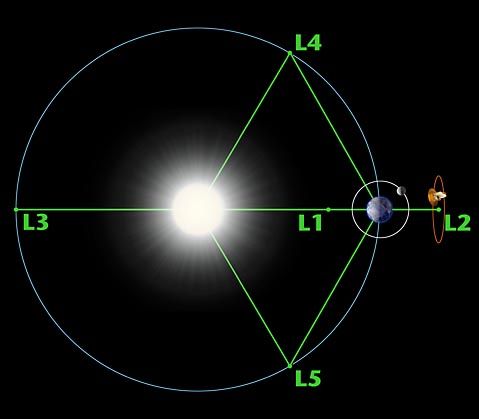
The Italian-French mathematician Joseph-Louis Lagrange discovered five special points in the vicinity of two orbiting masses where a third, smaller mass can orbit at a fixed distance from the larger masses. More precisely, the Lagrange Points mark positions where the gravitational pull of the two large masses precisely equals the centripetal force required to rotate with them. Those with a mathematical flair can follow this link to a derivation of Lagrange’s result (168K PDF file, 8 pages).
Of the five Lagrange points, three are unstable and two are stable. The unstable Lagrange points – labeled L1, L2 and L3 – lie along the line connecting the two large masses. The stable Lagrange points – labeled L4 and L5 – form the apex of two equilateral triangles that have the large masses at their vertices.

Lagrange Points of the Earth-Sun system (not drawn to scale!): NASA
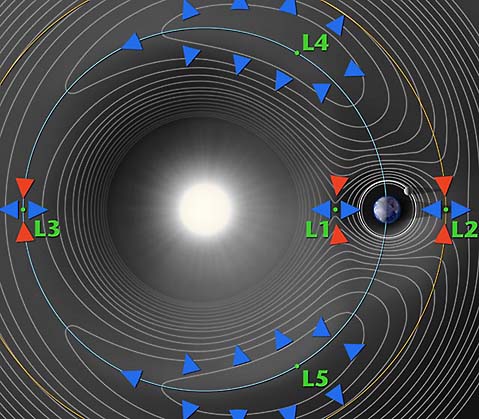
The easiest way to see how Lagrange made his discovery is to adopt a frame of reference that rotates with the system. The forces exerted on a body at rest in this frame can be derived from an effective potential in much the same way that wind speeds can be inferred from a weather map. The forces are strongest when the contours of the effective potential are closest together and weakest when the contours are far apart. In the contour plot below we see that L4 and L5 correspond to hilltops and L1, L2 and L3 correspond to saddles (i.e. points where the potential is curving up in one direction and down in the other).

A contour plot of the effective potential (not drawn to scale!): NASA
Tags:Chang'e 2, China, Exploration of the Moon, Joseph-Louis Lagrange, Lagrangian point, Lunar exploration, Moon
Posted in China, Lunar science, Science, Space | Comments Off on Chang’e 2 is now “liberated” from earth and lunar gravity
August 10, 2011

Image via Wikipedia
The Chinese economy is not immune to whatever craziness is going on around the world. They hold such a large amount of US treasury bonds that the gridlock and political irresponsibility in Washington is leading to some fundamental policy changes regarding their reserve holdings. The People’s Bank of China owns about $1.1 trillion of US Treasury bonds out of the $1.5-trillion treasury bonds or so of foreign treasuries that it holds amid China’s total reserves of about $3.2 trillion.
It is not therefore surprising then that China is among those most concerned by Standard & Poor’s recent downgrade of the United States’ AAA credit rating. It was sufficiently concerned to publicly chastise the US for its irresponsibility!
“The U.S. government has to come to terms with the painful fact that the good old days when it could just borrow its way out of messes of its own making are finally gone,” reported the Xinhua news agency.
Meanwhile
BEIJING, Aug. 10 (Xinhua) — China Wednesday reported faster than expected growth in exports, imports and trade surplus in July, but analysts said the picture would become worse in the coming months amid a faltering global economy.
The trade surplus rose sharply to a record high of 31.48 billion U.S. dollars in July from June’s 22.27 billion U.S. dollars and the 28.7 million U.S. dollars in the same period a year ago, the General Administration of Customs (GAC) said on its website.
July exports rose 20.4 percent year-on-year to reach 175.128 billion U.S. dollars, a record monthly high compared with 17.9 percent in June. Imports quickened from June’s 19.3 percent to 22.9 percent to 143.64 billion U.S. dollars.
The robust readings suggests both China’s competitiveness in exports and domestic demand are in relatively good shape, Bank of America-Merrill Lynch economist Lu Ting said in an email to clients.
Exports to the EU and Japan rose to 22.3 percent and 27.2 percent year-on-year in July from 11.4 percent and 20 percent in June.
And exports to the United States expanded 9.5 percent, down slightly from 9.8 percent in June, but down significantly from 13.3 percent in the second quarter and 21.4 percent in the first quarter, which indicated weakness in the U.S. economy has been weighing on its imports from China, according to Lu. ….
On Wednesday morning, yuan hit a record high of 6.4167 against the U.S. dollar.
US politicians in the Administration and those grand-standing in Congress will need to get their act in order if they are to avoid the day when the Chinese are no longer around to buy their debt. As it is, China is now engaged in diversifying its foreign reserves away from US dollars to other currencies and even other asset classes and is under severe internal pressure to accelerate this diversification.
Tags:China, Chinese reserves, United States, United States dollar, US credit rating downgrade, US debt, US Treasuries
Posted in China, Economy, International Trade | Comments Off on Chinese trade surplus at a record high as US downgrade threatens their holdings
May 12, 2011
Swedish Radio has just announced that the agreement between Saab and Hawtai has been suspended and negotiations continue!!!
I have little confidence in Victor Muller and his jet-setting around the world – at Saab’s expense – ostensibly to save Saab, seems more and more like the acts of a charlatan. I have observed earlier that his high-profile chasing of Russian and Chinese money will probably lead nowhere except to prolong the agony for Saab.
Svenska Dagbladet writes:
Saab’s new commercial venture with Chinese Hawtai is at risk of collapse. Saab’s President Victor Muller has already started planning to go to China for new negotiations with previously upset Chinese automakers. But Chinese car companies feel themselves cheated by Muller.
After Hawtai’s delegation visited Saab factory in Trollhättan at the end of last week they were aghast at how bad the situation was. They then demanded tough renegotiations with Victor Muller. If Hawtai and Saab cannot agree before the deadline for the contract expires tomorrow the deal may be over.
According to SvD’s industry sources, the agreement between Dutch Spyker, which owns Saab, and Hawtai is only a framework agreement. The agreement that was presented with great fanfare on 3rd May is full of ecape clauses that Hawtai can use if the parties fail to agree. Now Saab’s President Victor Muller is preparing to travel to Beijing. He will try to repair bridges with Chinese companies he has previously been in conflict with. Two relevant companies are the Great Wall Motor company and the government car giant BAIC. … Neither Great Wall nor BAIC have any affection for Muller. “BAIC can consider buying Saab, but they do not like Muller, they know that he has deceived them”, says a key figure in the affair. … BAIC believed they had the rights to the Saab 9-3 when Saab announced that they intended to produce in China with Hawtai. Until mid-April BAIC negotiated for the Saab dealership in China. And till April 30th Great Wall negotiated with Saab. Great Wall is a large and successful private Chinese automaker. But the negotiations ended because Great Wall needed at least one more week to do a due diligence and to have a board meeting, which Muller felt that the bleeding Saab did not have time for. Three days later, on May 3, he presented the Hawtai agreement. Great Wall reacted very negatively and it was not alone. Even private automaker Youngman Automobile Group of Hangzhou reacted sharply. “We were extremely disappointed and upset”, said one of Youngman’s management team . “ We have a written contract with Spyker that they could not negotiate with any other Chinese company before we were done. We took it for granted that they would follow the rules”.
Spyker had had negotiations ongoing with at least three other Chinese companies, Great Wall, Hawtai and another company. Youngman says they began negotiations for Saab in January. They also signed a letter of intent on cooperation. Youngman Automobile is the only company that has already submitted an application for Saab and an investment permit to the Chinese National Reform and Development Commission, NDRC.
Victor Muller clearly cannot be trusted and his ethics are highly suspect.
Tags:China, Hawtai, SAAB, Spyker Cars, Victor Muller
Posted in Automobiles, Behaviour, Ethics, Sweden, Technology | 4 Comments »
March 28, 2011
Xinhua News:

March 25, 2011 MA600 aircraft in Luoyang City of central China's Henan Province. (Xinhua/Li Qiaoqiao)
One of China’s new generation of short-haul passenger aircraft, the MA600, was put into use Saturday at a civil aviation training base in southwest China’s Sichuan Province.
The “Modern Ark” 600 was delivered in December last year to the Civil Aviation Flight University of China (CAFUC) by its manufacturer, the Xi’an Aircraft International Corporation (XAIC), which is based in northwestern China’s Shaanxi Province.
CAFUC ordered two MA600 aircraft at the China International Aviation and Aerospace Exhibition, which was held in the city of Zhuhai in Guangdong Province in November 2010.
The MA600 is an upgraded version of the company’s MA60 passenger aircraft and can carry 50 to 60 passengers. The aircraft has been updated with a more comfortable cabin and other design improvements.
“The MA600 also features better performance in regards to safety and fuel efficiency,” said Wang Kaiyin, an official with the CAFUC. The turboprop aircraft has a range of 2,450 km.
Tags:Aircraft, China, short haul aircraft, Xian MA 600
Posted in Aviation, China | 2 Comments »
March 7, 2011
On 15th March 1959, the Dalai Lama fled from Tibet, on foot from Lhasa, and reached India on 31st March. It was also last year on March 14th when Tibet saw the most wide-spread protests and demonstrations in over 20 years. Demonstrations also took place in 2008 and travel bans -especially of foreigners – to and in Tibet are a regular occurrence.

image: dismalworld.com
Now the Chinese Government is watching the developments in North Africa with a great deal of sympathy for the regimes which are being toppled. Foreign journalists, the internet, mobile networks and social media are being monitored very closely and any gathering is being quickly broken up throughout the country. Now the Chinese government has once again forbidden the visit of any foreigners to Tibet.
Chinese travel agents organizing trips to Tibet said Monday they have been ordered not to receive foreign visitors around the March 14 anniversary of a bloody anti-government riot in 2008.
Beijing Youth Travel Service saleswoman Li Jianyue said the order was conveyed verbally, as is often the case with official directives that the government does not wish to defend or explain. …. Tourists from outside the country were banned entirely for more than a year following the 2008 riots in Lhasa that left at least 22 people dead and set off a wave of protests across Tibetan areas of western China.
China responded with a massive military crackdown in which Tibetan rights groups say nearly 140 Tibetans were killed. China blamed followers of Tibet’s exiled Buddhist leader the Dalai Lama for fomenting the disturbances, a charge the Buddhist leader denies.
Chinese officials announced plans to take a hard line with foreign journalists on Sunday, as Beijing braces against calls for Middle East-style popular protests.
Li Honghai, vice director of Beijing’s Foreign Affairs Office, said reporters must apply for government permission before gathering news within city centres, making explicit guidelines police began imposing more than a week ago.
Security crews have been closely watching journalists near sites in Beijing, Shanghai and other Chinese cities, where anonymous Internet postings have been calling for residents to gather in peaceful protest.
Onlookers, media and heavy security gathered at proposed protest sites on Sunday, although no demonstrations have appeared since the posting began appearing online three weeks ago.
Tags:14th March protests, China, Dalai Lama, jasmine revolutions, Tibet, travel restrictions Tibet
Posted in China, Politics | Comments Off on Will Tibet see a “Facebook” demonstration in March?
February 18, 2011

Wen Jiabao: Image via Wikipedia
The Chinese Government is taking steps to keep control of the development, production and export of rare earth materials under state corporations. Until production from alternate sources in Vietnam, Afghanistan, India, Sweden and other countries are ramped up, production and export of rare earth materials is likely to be used as an instrument of Chinese foreign policy. This leaves Japan particularly vulnerable and is likely to speed up the Japanes investment in the production of these materials in other countries.
Asahi reports:
CHONGQING, China–In a move likely to strain already scarce supplies of rare earth materials worldwide, China will introduce new controls on production and export of the elements crucial for electronics and environmental technologies.
According to the state-run Xinhua News Agency, Chinese Premier Wen Jiabao instructed a State Council standing committee meeting Wednesday to designate rare earth materials as an important strategic resource, and implement measures to strengthen government control over the materials.
With many players fighting over the largely unregulated market, from state corporations to small firms, Beijing, worried about smuggling and rampant environmental destruction, has decided to step in. Beijing plans to grant authority to develop and manage rare earths to state corporations to allow better oversight and control.
The state will also decide export volumes each year after assessing domestic demand and price trends in global markets. Watchers have said the measures are primarily designed to allow Beijing to use its control over the materials as a strategic diplomatic tool.
China has already taken steps to further its control over rare earths production this year, by designating Jiangxi province a nationally administered mining district for rare earths. Under the arrangement, natural deposits will be monitored by Beijing, and exploration and mining will be conducted under close control by the government.
Related: China and the use of rare earth elements trade as a tool for diplomacy
Tags:China, exports, International trade, Jiangxi, production, rare earth elements
Posted in China, International Trade, Materials | Comments Off on Beijing turns the screw on rare earth materials
February 15, 2011
Free-loading civil servants are present everywhere and are the rotten apples among the many millions who are actually civil and who do actually serve but this case from China stands out. Though it is somewhat unclear as to whether he is a heroic whistle-blower or just a free-loader.
“Chinas most capable civil servant”

Jiang Jinxiang - "Chinas most capable civil servant"
WhatsonXiamen.com reports:

A civil servant from Longyan, Fujian Province, who collected a monthly salary for nearly nine years without lifting a finger, intends to go back to work Monday.
Jiang Jinxiang, a former director at the Urban Construction Commission in the Standing Committee of Longyan People’s Congress, was suspended on May 16, 2002 and never returned to work.
Internet users exposed him after they learned he still received a monthly salary of 2,700 yuan ($410) from the local government even though he stayed home. Jiang, 55, who was suspended for trying to expose quality control problems at a city project during a local People’s Congress session in 2002. He told the Global Times Sunday that he stopped going to work in 2002 because his colleagues did not talk to him, which made him unhappy.
“I couldn’t accept the government’s treatment. I felt it was unfair because what I exposed was true,” Jiang said. Jiang saw a government notice in the Minxi Daily on Saturday that ordered him to show up for work within 15 days. Zheng Lixin, head of the Longyan Construction Bureau, which oversees Jiang’s section, said that they kept sending him payments on humanitarian grounds since his family was poor, according to the Xinhua News Agency.
Tags:China, Civil service, Jiang Jinxiang, Longyan
Posted in Behaviour, China | Comments Off on Nice work if you can get it! The rewards of whistle-blowing?
February 14, 2011
From Xinhua News:

Li Liansheng: photo China Daily
BEIJING, Feb. 10 (Xinhua) — The recent revocation of a national scientific award due to academic fraud was the first of its kind in China, National Office for Science and Technology Awards told Xinhua Thursday.
China’s Ministry of Science and Technology, on Feb. 1, issued a statement revoking the State Scientific and Technological Progress Award (SSTPA) given to Li Liansheng, former professor of Xi’an Jiaotong University.
According to the statement, the investigation found Li had plagiarized others’ works and fabricated data in his winning project, and his prize will be canceled and money awarded retrieved.
Zhao Baojing, senior officer with the National Office for S&T Award, told Xinhua that it was the first time China had withdrawn a national scientific honor.
Li Liansheng, former professor and doctoral tutor of Xi’an Jiaotong University, received the second-place prize of the SSTPA in 2005 for his research on key technologies for designing and manufacturing scroll compressors.
In 2008, he was accused of plagiarism and providing false data in the winning project by six professors of Xi’an Jiaotong University. An investigation was later carried out.
Xi’an Jiaotong University suspended Li from working at the university and rescinded his employment contract in March, 2010.
AsiaOne.com writes:
News that the ministry is stripping him of his award for scientific and technological progress comes three years after six colleagues first claimed that the energy and power studies expert had plagiarized the work of others.
Wan Gang, the minister of science and technology, had earlier vowed that there would be a “zero tolerance” policy toward research frauds and academic plagiarism amid growing criticism about the country’s academic integrity.
“We will dig up the past of those researchers who fake their works and punish them,” he told China Daily in November 2010.
The country has more than 2.3 million workers in the science and technology field and the number of research papers published on the subject has topped the world.
The intense competition to get work published has led some researchers to exaggerate their achievements, said critics.
“In China, we care whether a paper is published in a magazine more than we care about the paper’s quality and academic influence,” Rao Yi, dean of the School of Life Sciences at Peking University, was quoted as saying in a report in China Youth Daily.
Universities and colleges are ranked according to the number of academic papers their staff can get published and the number of references they get in influential journals
Related:
https://ktwop.wordpress.com/2010/10/13/chinese-science-ministry-vindicates-academic-fraud-journalists/
Tags:Academic Dishonesty, China, Li Liansheng, Plagiarism, Scientific misconduct, Xi'an Jiaotong University
Posted in China, Ethics, Fraud | Comments Off on China retracts a national scientific award for plagiarism
January 31, 2011
Xinhua reports that Carrefour and Walmart have damaged their own reputations by trying to cheat Chinese consumers by overpricing. With the New Year to be celebrated on 3rd February, they are being seen as trying to exploit the traditional Chinese generosity during the festival holiday:

Carrefour and Walmart swindle Chinese consumers
Over the crowds of holiday shoppers in China’s big stores this Spring Festival lingers an atmosphere of suspicion. With charges of price deception hanging over the big chains of Carrefour and Wal-Mart and local authorities moving to levy fines, many Chinese — normally averse to be pinching pennies during the Lunar New Year — are checking their receipts at the tills.
The New Year, which falls on Feb. 3 this year, is normally a time of largesse and excess — all the more reason why many shoppers feel so betrayed. Customers can be seen recording label prices in notebooks or calculating their final bill on their mobile phones as they walk the aisles. At outlets of Carrefour and Wal-Mart in cities such as Beijing, Shanghai and Chengdu, the check out queues have grown as customers doublecheck prices at the tills.
“I would never have imagined global firms would do this intentionally and I have to be cautious,” said a woman surnamed Wang, after shopping at a foreign-owned supermarket in Chengdu, southwest China’s Sichuan Province.
From KamCity:
Carrefour and Walmart have issued public statements of apology to their customers in China, after local regulators found that several of their outlets were overcharging customers. The National Development and Reform Commission had found several instances of overpricing at 11 Carrefour and three Walmart outlets, on products including tea, underwear, and household products.
Carrefour said it “sincerely apologises” for the errors, and offered to refund customers five times the difference between the price charged and that on the label. Meanwhile, Walmart also expressed its “sincere apology” to those affected, adding that it has “launched self-examinations” and “will strengthen its price monitoring.”
The NDRC ordered local authorities to fine the individual outlets and confiscate their “illegal income”, with fines amounting to five times the amount confiscated, or up to 500,000 yuan if the amount cannot be calculated.
In the Chinese government’s battle against inflation, the Western retailers are building up a reputation for being a significant part of the problem.
Tags:Carrefour, China, Chinese New Year, Overpricing swindle, Retail cheating, Wal-Mart
Posted in Behaviour, Business, China, Ethics | Comments Off on Carrefour and Walmart branded as cheats in China
January 26, 2011
The Telegraph reports:
Asian and Middle-East investors have thronged to buy the first issue of AAA-rated bonds by the eurozone’s new bail-out fund, marking a key moment in the evolution of Europe’s monetary union.
The auction of €5bn (£4.3bn) of five-year bonds to fund the first stage of the Irish loan package was nine times subscribed, reflecting appetite for bonds ranked with core German or French debt but offering higher returns. The yield was 2.89pc, compared with 2.31pc for Bunds.
The outcome was not in doubt after Japan said it would buy 20pc of this month’s total issue by the European Financial Stability Facility (EFSF), and China emerged as a white knight for EMU debt. Asian investors bought 38pc of the issue.
“It is the biggest order book ever. We will check before notifying the Guinness Book of Records but nobody can remember anything like that in the world,” said Klaus Regling, head of the EFSF. Ralf Umlauf from Helaba said the auction was “a step in the direction of a eurobond”.
The demand came from over 500 investors and totalled over $ 60 billion (about €45 billion).
Tags:China, Eurobond, European Financial Stability Facility, European Union, Japan, Middle-East, record demand
Posted in Economics, Economy, European Union | Comments Off on Euro bail-out bond: Asia to the rescue with record demand


 The k2p blog