Posts Tagged ‘climate change’

Simple harmonic model – without carbon dioxide – fits reality better than the IPCC climate models

August 16, 2013

A new post at the Norwegian GeoForskning (Geological Research) site by Jan-Erik Solheim and Ole Humlum is quite significant I think. Solheim is Professor (emeritus) at  Institutt for teoretisk astrofysikk, University of Oslo while Humlum is professor of Physical Geography at the University of Oslo and an adjunct Professor at UNIS (University Centre in Svalbard). The post shows that a simple harmonic model (movements of the sun, moon and planets together with linear trends) provides a better fit to the global temperature data since 1850 and likely a better predictor than the assembly of 44 climate models used by the IPCC. They find no signal since the 1950’s which could correspond to any significant impact of carbon dioxide concentration and find no need to include such an influence. If such an effect is present its influence is miniscule.

Models need to be parsimonius to exclude parameters and mechanisms whose effects cannot be discerned. Otherwise they cannot be anchored in reality. A problem with many of the so-called climate models is that they include hypothetical effects which cannot be discerned in the available data, then apply forcing feedbacks to such hypothetical effects and then conclude that the results are valid!

If we’d had a warming due to CO2, this should appear as a deviation from the simple harmonic model since 1950. There are no signs of any additional heating due to CO2 as IPCC claims in their reports. Also CO2 effects of climate models for the IPCC based are exaggerated. The net effect of CO2 is thus so modest that it can not be seen in this data.

A simple, empirical, harmonic climate model

by Jan-Erik Solheim and Ole Humlum

(The paper is in Norwegian and this English version is from the HockeySchtick)
(more…)

Apocalypse delayed – Himalayan researchers reverse earlier predictions of water shortages

August 6, 2013

I sense that some of the alarmism and the apocalyptic futures always associated with global warming hysteria are beginning to moderate.

Earlier predictions of water shortages due to the shrinkage of Himalayan glaciers are being reversed by new research which now predicts increased water flow in two Himalayan watersheds.

W. W. Immerzeel, F. Pellicciotti & M. F. P. Bierkens, Rising river flows throughout the twenty-first century in two Himalayan glacierized watersheds, Published online 04 August 2013, Nature Geoscience  (2013) doi:10.1038/ngeo1896

EnergyWire comments:

One of the big unknowns of climate change predictions — and one that has led to considerable contention — lies in knowing the future of water runoff from the Himalayas. The snow- and ice-rich region supplies water for billions of people in Asia and is sometimes referred to as the Earth’s “Third Pole.”

For years, scientists struggled to understand how precipitation will change in these mountains (ClimateWire, Oct. 24, 2011). They have also had difficulty determining how much glacier melt from the mountains contributes to water supply. 

A study out yesterday in Nature Geoscience by Walter Immerzeel, a physical geographer at Utrecht University, suggests that, in at least two major Himalayan watersheds, river flows and runoff should rise until 2100.

“We show that the peak in meltwater is later than we previously thought, which in combination with a projected increase in precipitation results in an increase in water availability until the end of the century,” he said.

The two watersheds Immerzeel reports on in the paper are those of the Baltoro and Langtang glaciers, which feed the Indus and Ganges rivers, respectively. In the Baltoro watershed, this is largely due to more glacier runoff from melt. In the Langtang, increased precipitation drives the extra runoff.

Immerzeel and his co-authors used the output of the latest global climate models from the Coupled Model Intercomparison Project (CMIP5) to look at temperature and precipitation projections. They combined that data with a hydrologic model of glacier responses to climate change.

They found that in both watersheds, runoff from glaciers should increase until the 2040s or 2060s, later than previous estimates, depending on which climate scenarios are applied.

….. In the paper, Immerzeel points out that his new finding contradicts previous work he has published, suggesting that runoff in the Indus and Ganges basin would decrease. At least for now, this is good news for people and farmers who rely on that water, he said.

“Strong increases in water demand are projected in the Indus as the food production needs to grow to feed the quickly rising population,” Immerzeel said. “An increased water availability from the mountains may help to sustain this growing demand.”

Abstract: Greater Himalayan glaciers are retreating and losing mass at rates comparable to glaciers in other regions of the world. Assessments of future changes and their associated hydrological impacts are scarce, oversimplify glacier dynamics or include a limited number of climate models. Here, we use results from the latest ensemble of climate models in combination with a high-resolution glacio-hydrological model to assess the hydrological impact of climate change on two climatically contrasting watersheds in the Greater Himalaya, the Baltoro and Langtang watersheds that drain into the Indus and Ganges rivers, respectively. We show that the largest uncertainty in future runoff is a result of variations in projected precipitation between climate models. In both watersheds, strong, but highly variable, increases in future runoff are projected and, despite the different characteristics of the watersheds, their responses are surprisingly similar. In both cases, glaciers will recede but net glacier melt runoff is on a rising limb at least until 2050. In combination with a positive change in precipitation, water availability during this century is not likely to decline. We conclude that river basins that depend on monsoon rains and glacier melt will continue to sustain the increasing water demands expected in these areas.

Satellite data clearly shows global cooling from 1984 – 2006

August 4, 2013

Brightness temperatures derived from the Meteosat data show a planetary trend of global cooling of upto  2K/decade since 1984.

One wonders why this data has not been publicised earlier.

In general, the Atlantic Ocean, Africa and Europe show a negative temperature trend, varying between zero and -2 K/decade.

Andries Rosema, Steven Foppes and Joost van der Woerd, Meteosat Derived Planetary Temperature Trend 1982-2006Energy & Environment, Volume 24, Number 3 – 4 / June 2013, 381-396, doi:10.1260/0958-305X.24.3-4.381

The paper is behind a paywall at the Journal but a pdf version is available (via climategate.nl): Rosema et al Meteosat data 1984-2006

From the author’s conclusions:

The amazing finding of the present study is that we do not observe global warming in the period 1982-2006, but significant cooling. …

The satellite data are from a reliable origin supported by the European meteorological community. Their accurate calibration has received due attention and efforts from Eumetsat. Our processing of these data has been simple and straight forward, involving only noon and midnight image composition, averaging and a filter to eliminate cloud effects. We have created similar planetary temperature change images for the unfiltered, 10, 20 and 30 day filtered data, clearly showing convergence towards the longer filters, indicating that cloud influences were effectively removed. 

Moreover, we do observe significant temperature increase at some locations which are due to human interventions, and which are quantitatively in line with the theoretically expected effects of these interventions. Therefore we believe the observed planetary temperature decrease for most of the hemisphere to be real.

The cloud filtered temperature change patterns, in figure 2c, indicate that the largest decrease occurs in the more cloudy regions of the hemisphere: the tropics and the temperate zones, while in the desert belt the temperature decrease is much smaller. This suggests that cloudiness changes could be the mechanism behind the observed global cooling since 1982: an increase in cloudiness would decrease global radiation and increase rainfall and evapotranspiration. Both effects tend to decrease the surface temperature.

While their conclusions about cloud cover as the determining mechanism are plausible – but as yet unproven – their general observations are quite significant:

In general, the Atlantic Ocean, Africa and Europe show a negative temperature trend, varying between zero and -2 K/decade. Remarkable, is a large area in southern Africa, mainly Zimbabwe and Mozambique, where the temperature decrease is even larger and in the range of -2 to -3 K. Also note the temperature decrease of Lake Chad and Lake Nasser, probably due to an increase in their surface areas. There are also some spots that show a substantial temperature increase, in particular in SE Iraq (figure 3a) and NW Tanzania (figure 3b).

They see a general reduction of temperature everywhere except in two small areas of Iraq and Tanzania:

  1. SE Iraq- An exceptional location which shows a strong temperature increase of some 5K in the period of 20 year. This increase took mainly place in the period 1993-1995 and reflects the draining of the marshes at the confluence of the Ephrata and Tigris under the regime of Sadam Hussein.
  2. NW Tanzania, south of Lake Victoria. There is a temperature increase of 1.3 K in 20 year. This location is in a strongly developing mining area. Decrease in vegetation cover and reduced  evapotranspiration may have caused this temperature increase.

ABSTRACT
24 year of Meteosat hourly thermal infrared data have been used to study planetary surface temperature change. Thermal infrared radiation in the 10.5-12.5mm spectral window is not affected by CO2 and only slightly by atmospheric water vapor. Satellite thermal infrared data have been converted to brightness temperatures as prescribed by Eumetsat. Hourly brightness temperature images were then composed to corresponding noon and midnight temperature data fields. The resulting data fields were cloud filtered using 10, 20 and 30 day maximum temperature substitution. Filtered data were subsequently averaged for two 10 yearly periods: 1986-1995 and 1996-2005. Finally the change in brightness temperature was determined by subtraction. In addition nine locations were selected and data series were extracted and studied for the period 1982-2006. Our observations point to a decrease in planetary temperature over almost the entire hemisphere, most likely due to an increase of cloudiness. Two small areas are found where a considerable temperature increase has occurred. They are explained in terms of major human interventions in the hydrological balance at the earth surface.

Idiot Science! Human conflict caused by cooler climate and/or by hotter climate

August 2, 2013

Silly science can sometimes just be idiot “science” and no science at all.

One says warmer temperatures cause human conflict, another that colder climate does so.

The idiocy lies first in assuming that climate is the determining factor for the political, economic, social and behavioural stresses that cause conflict among humans and second in the classic idiocy that correlation is equal to causation.

1. Solomon M. Hsiang, Marshall Burke and Edward Miguel, Quantifying the Influence of Climate on Human ConflictPublished Online August 1 2013, Science DOI: 10.1126/science.1235367

Abstract: A rapidly growing body of research examines whether human conflict can be affected by climatic changes. Drawing from archaeology, criminology, economics, geography, history, political science, and psychology, we assemble and analyze the 60 most rigorous quantitative studies and document, for the first time, a remarkable convergence of results. We find strong causal evidence linking climatic events to human conflict across a range of spatial and temporal scales and across all major regions of the world. The magnitude of climate’s influence is substantial: for each 1 standard deviation (1σ) change in climate toward warmer temperatures or more extreme rainfall, median estimates indicate that the frequency of interpersonal violence rises 4% and the frequency of intergroup conflict rises 14%. Because locations throughout the inhabited world are expected to warm 2 to 4σ by 2050, amplified rates of human conflict could represent a large and critical impact of anthropogenic climate change.

2. Ulf Büntgena, Tomáš Kyncld, Christian Ginzlera, David S. Jackse, Jan Esperf, Willy Tegelg, Karl-Uwe Heussnerh, and Josef Kyncld, Filling the Eastern European gap in millennium-long temperature reconstructions. Published online January 14, 2013, Proceedings of the National Academy of Sciences. doi:10.1073/pnas.1211485110.

Abstract: Tree ring–based temperature reconstructions form the scientific backbone of the current global change debate. Although some European records extend into medieval times, high-resolution, long-term, regional-scale paleoclimatic evidence is missing for the eastern part of the continent. Here we compile 545 samples of living trees and historical timbers from the greater Tatra region to reconstruct interannual to centennial-long variations in Eastern European May–June temperature back to 1040 AD. Recent anthropogenic warming exceeds the range of past natural climate variability. Increased plague outbreaks and political conflicts, as well as decreased settlement activities, coincided with temperature depressions. The Black Death in the mid-14th century, the Thirty Years War in the early 17th century, and the French Invasion of Russia in the early 19th century all occurred during the coldest episodes of the last millennium. A comparison with summer temperature reconstructions from Scandinavia, the Alps, and the Pyrenees emphasizes the seasonal and spatial specificity of our results, questioning those large-scale reconstructions that simply average individual sites.

The lunar nodal cycle and its effects on climate

July 27, 2013

A paper has just been published in the International Journal of Climatology showing that the lunar nodal cycle influences “the low-frequency summer rainfall variability over the plains to the east of subtropical Andes, in South America, through long-term sea surface temperature (SST) variations induced by the nodal amplitude of diurnal tides over southwestern South Atlantic (SWSA).”

Eduardo Andres Agosta, The 18.6-year nodal tidal cycle and the bi-decadal precipitation oscillation over the plains to the east of subtropical Andes, South America, International J of Climatology, DOI: 10.1002/joc.3787

Abstract: This work shows statistical evidence for lunar nodal cycle influence on the low-frequency summer rainfall variability over the plains to the east of subtropical Andes, in South America, through long-term sea surface temperature (SST) variations induced by the nodal amplitude of diurnal tides over southwestern South Atlantic (SWSA). In years of strong (weak) diurnal tides, tide-induced diapycnal mixing makes SST cooler (warmer) together with low (high) air pressures in the surroundings of the Malvinas/Falklands Islands in the SWSA, possibly through mean tropospheric baroclinicity variations. As the low-level tropospheric circulation anomalies directly affect the interannual summer rainfall variability, such an influence can be extended to the bi-decadal variability present in the summer rainfall owing to the nodal modulation effect observed in the tropospheric circulation. The identification of the nodal periodicity in the summer rainfall variability is statistically robust.

The lunar nodal cycle is not something that is very well known but it is another celestial cycle which is clearly not to be ignored. Naturally the IPCC takes no notice of solar cycles, planetary cycles or lunar cycles and all these are lumped into what could be considered “natural variability”.

(Sourced from Wikipedia)

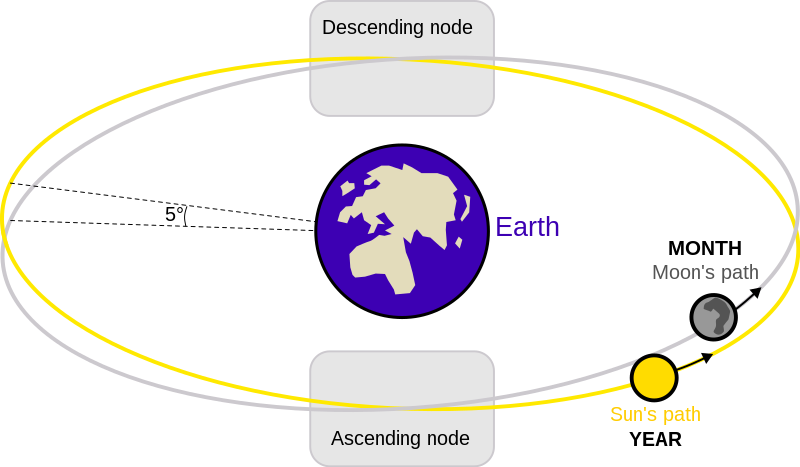
The lunar orbit is inclined by about 5 degrees on the ecliptic. The moon  therefore can lie up to about 5 degrees north or south of the ecliptic. The ecliptic is the plane of the apparent path of the Sun on the celestial sphere, and is coplanar with both the orbit of the Earth around the Sun and the apparent orbit of the Sun around the Earth.

File:Lunar eclipse diagram-en.svg

Lunar eclipse orbital diagram: wikipedia

The lunar nodes precess around the ecliptic, completing a revolution (called a draconitic or nodical period, the period of nutation) in 6793.5 days or 18.5996 years.

The effects of the 18.6 year lunar nodal cycle on climate on tides and geological sediments and on weather and climate have long been of interest (though not apparently for the IPCC).

Nanocycles Method is the English translation of the title of a book published in Russian by Professor of Geology S Afanasiev of Moscow University in 1991,ISBN 5–7045–0109–0.

From “Nanocycles Method” by S Afanasiev, 1991

The lunar node cycle, which is presently 18.6 years, affects the rainfall on a 9.3 year cycle and this shows up as varying thickness layers of deposits, or varves, in geological formations. 

However the moon’s orbit is gradually getting larger over time and so its period is slowing down. The rate of movement of the nodes is also decelerating and Prof Afanasiev has determined the accurate nodal cycle period for the whole of the last 600 million years.

The cycle of the lunar node is important in affecting the weather because it plays a part in determining tides in the atmosphere, oceans and solid body of the earth. The atmospheric tides affect rainfall which in turn affects river flows and hence the deposition of geological varves, or annual deposits in geological layers. ….. 

At the present time, with a nodal cycle of 9.3 years, successive nodal cycles begin 0.3 years later in the seasons each cycle. Therefore after 3 or 4 cycles the nodal cycle start return to the same time of year again. The average period of the cycle when the nodal cycle comes at the same time of year is 9.3/0.3 or 31 years. Specific occurrences of nearly the same season, within 0.1 year, will occur after 28, 65 and 93 years and so on. 

…. Because the lunar nodal cycle period has changed from 9.147 years to 9.298 years in the last 1.0 million years, the secondary cycle has varied from 62.12 years to 31.21 years. If this cycle can be measured in a deposit to an accuracy of 1 year then it allows the dating of the deposit to an accuracy of +/-0.03 million years.

A small selection of papers dealing with the effects of the 18.6 year lunar nodal cycle is given below:

Fun and games at the US Senate hearing on Global Warming

July 21, 2013

A US Senate hearing has just been held under the Chairmanship of Senator Barbara Boxer “to focus on Climate Change and the serious threat it poses to our nation”.

(As an aside – I wonder if the proponents of global warming are so nervous and uncertain about their own creed that they need to use “Climate Change” as a euphemism. If they mean “global warming” why don’t they just say “global warming”? Or could they be just preparing their own fall-back positions in case “global warming” turns out to be “global cooling”?).

But if the good Senator’s hope was that the case for global warming (aka Climate Change) was going to be established beyond all reasonable doubt then it seems the hearings have spectacularly backfired.

From WUWT:

Quite a performance yesterday. Steve Milloy is calling it the “Zapruder film” implying it was the day the AGW agenda got shot down. While that might not be a good choice of words, you have to admit they did a fantastic job of shooting down some of the ridiculous claims made by panelists prior to them. While this may not be a Zapruder moment, I’d say that it represented a major turning point.

…..

Video link and links to PDF of testimonies follow.

Here is the video link, in full HD:

http://www.senate.gov/isvp/?type=live&comm=epw&filename=epw071813

Dr. Spencer writes about his experience here and flips the title back at them:

http://www.drroyspencer.com/2013/07/senate-epw-hearing-climate-change-its-happened-before/

The PDF’s of each person’s testimony can be accessed by click on their names below:
Panel 1

Dr. Heidi Cullen
Chief Climatologist
Climate Central
Mr. Frank Nutter
President
Reinsurance Association of America
Mr. KC Golden
Policy Director
Climate Solutions
Ms. Diana Furchtgott-Roth
Senior Fellow
Manhattan Institute for Policy Research
Dr. Robert P. Murphy
Senior Economist
Institute for Energy Research

Panel 2

Dr. Jennifer Francis
Research Professor
Institute of Marine and Coastal Sciences, Rutgers University
Dr. Scott Doney
Director, Ocean and Climate Change Institute
Woods Hole Oceanographic Institution
Dr. Margaret Leinin
Executive Director, Harbor Branch Oceanographic Institute
Florida Atlantic University
Dr. Roger Pielke, Jr.
Professor, Center for Science and Technology Policy Research
University of Colorado
Dr. Roy Spencer
Principal Research Scientist IV
University of Alabama, Huntsville

Disaster looms! Sea level may rise 5 cm by 2100

July 5, 2013

Sea levels in the past have been 10 m higher than today and 150 m lower than today.

Alarmism will have us believe that +5 cm ±15 cm in sea level that may actually happen by 2100 will threaten the very existence of humanity!

A new paper from Nils-Axel Mörner.

SEA LEVEL CHANGES PAST RECORDS AND FUTURE EXPECTATIONS

by Nils-Axel Mörner

ABSTRACT The history and development of our understanding of sea level changes is reviewed. Sea level research is multi-facetted and calls for integrated studies of a large number of parameters. Well established records indicate a post-LIA (1850–1950) sea level rise of 11 cm. During the same period of time, the Earth’s rate of rotation experienced a slowing down (deceleration) equivalent to a sea level rise of about 10 cm. Sea level changes during the last 40-50 years are subjected to major controversies. The methodology applied and the views claimed by the IPCC are challenged. For the last 40-50 years strong observational facts indicate virtually stable sea level conditions. The Earth’s rate of rotation records a mean acceleration from 1972 to 2012, contradicting all claims of a rapid global sea level rise, and instead suggests stable, to slightly falling, sea levels. Best estimates for future sea level changes up to the year 2100 are in the range of +5 cm ±15 cm.

ENERGY & ENVIRONMENT, VOLUME 24 No. 3 & 4 2013

“Climate alarmism was a child born of good times”

June 30, 2013

Pointman has an interesting essay here:

….  Climate alarmism was, and could only have been, a child born of good times. In the midst of an extraordinarily long fifteen year economic boom when most people had jobs, money, houses and not many real concerns, it was something that a number of people actually needed to invent. The politicians needed a danger they could save us from and as it happened, a few scientists raised some genuine concerns over the slight temperature uptick that occurred in the closing decades of the previous century. The political activists of the well left of centre group, still reeling from the double whammy of the death of the liberal dream in the eighties and the collapse of Soviet communism in the nineties, needed it even more desperately. …. 

A few compliant third-rate scientists were catapulted blinking mole-like out of obscurity and up into that media firmament of stardom. Basking in their new-found adulation, they became masters of the climate universe. The media hung on every word they uttered, the politicians engaged them as climate advisers, big business paid them handsomely for the cachet of their time as consultants, little men suddenly became important little men and gradually, the details of the science not only became unquestioned but also unquestionable. …

A good read.


Global warming “hockey stick” is turning into a baseball bat

June 29, 2013

(A fun comment at CA is particularly apposite!

Posted Jun 28, 2013 at 5:18 PM 

@Steve McIntyre

From Fig. 4 above:

it’s quite obvious that in 2009 and again in 2011, you shamelessly plagiarised Briffa 2013

Easily the worst sin in the academic book, run a close second only by disrupting the space-time continuum in order to perform the plagiarism)

======================================================

Steve McIntyre’s objections to the Yamal tree (“the most important tree in the world”) in the global warming hockey stick are being vindicated as the new version of the data series resembles a baseball bat much more than a hockey stick.

Full story at Climate Audit and at WUWT

yamal_chronology_compare-to-b13

Global warming theory lacks a falsifiable hypothesis and climate policy lacks Conditions of Success

June 21, 2013

In Science – to be considered a science – it is the formulation of the falsifiable hypothesis that is critical and ought to determine the subsequent collection or generation of data.

A fundamental requirement before setting out a new policy or embarking on any new course of action should be to define the Conditions of Success (CoS) prior to starting. This is usually so in industry and business – usually explicit but sometimes implicit – especially where investment is to be made or resources are to be used in implementing the new course of action:

  1. What are the objectives to be achieved, and
  2. how will we be able to measure if we are on track.

1. A Falsifiable Hypothesis:

The “global warming” hypothesis is that humans are impacting global climate and specifically that man-made carbon dioxide emissions are causing – through direct and indirect effects – the global climate to warm. But this formulation is virtually impossible either to prove or to falsify. With the many hundreds – if not thousands – of parameters which impact the chaotic system which makes up our climate, it is almost impossible to either collect or generate data which can isolate the effects of just this one parameter.

The prevailing “belief” that this hypothesis is correct is based on being able to say that observed warming is not inconsistent with climate models which include the warming due to anthropogenic emissions of carbon dioxide and that no better models exist. (The hiatus in temperature over the last 20 years is dismissed as being a “temporary” hiatus or due to some unknown effect – such as deep ocean take-up of heat – which is not included in the models). If no observation is permitted to falsify the hypothesis then this is merely a belief and a religion and not science.

However, the same global warming theory can easily be converted into a falsifiable hypothesis if it is formulated thus: “Increasing anthropogenic emissions of carbon dioxide have a significant warming effect on global climate”. This can then be subject to being proved false. The recent hiatus in global temperature then immediately leads to the conclusion that either

  1. the hypothesis is false, or
  2. the hypothesis must be modified to be
  3. “Increasing anthropogenic emissions of carbon dioxide may have a significant warming effect on global climate over long periods in excess of at least 50 years”

And then there is no longer any need for panic.

If the study of climate is ever to become science, the hypotheses will need to be revisited.

2. Conditions of Success

I am always somewhat perplexed that the global warming scare has led to the implementation of policies which – in not a single case – address the Conditions of Success. In no case of “decarbonisation” or carbon taxes or carbon credits or support for renewable energies is there any consideration of the measurements to be made to determine if the actions are having the desired effect.

It has been a blind rush into the support of solar and wind energy with no assessment of the increased electricity prices, the reduction of growth and the subsequent loss of jobs. In no country has there been a definition of the measurable results to be achieved along the way (except for measuring how much money was spent). Just the increase of the capacity of wind and solar power production has been taken to be a success though electricity prices have gone up sharply and no reduction of carbon dioxide concentration has been achieved. All the actions taken over the last 3 decades against the use of fossil fuels have had no impact whatsoever in reducing the rate of increase of carbon dioxide concentration in the atmosphere.

In the US the unexpected advent of shale gas has led to a reduction of carbon dioxide emissions though the global emissions are higher than ever before. And yet the global temperature has been at a standstill for almost 2 decades!

Of course for politicians carbon taxes and the like have become merely a source of revenue where the scare of “global warming” is used as a label merely to prevent resentment against a new tax. These taxes are invariably decoupled from any effects on the changes to carbon dioxide concentration and on global temperature to be achieved.

All these “climate” policies which have produced no reduction of carbon-dioxide concentration or even a reduction in the growth rate and where global temperatures have also failed to increase now seem needlessly self-destructive.

“Climate change policies” will never be credible or of any value until the Conditions of Success for such policies are defined in advance of such policies being implemented.