Posts Tagged ‘climate change’
January 1, 2013
A failure of something utterly unnecessary ought to be a success. But the damage caused by the pursuit of meaningless goals for unsound reasons has been immense.
The Kyoto protocol was adopted in 1997 and came into effect in 2005. “The controversial and ineffective Kyoto Protocol’s first stage comes to an end today, leaving the world with 58 per cent more greenhouse gases than in 1990, as opposed to the five per cent reduction its signatories sought”.
It has been a solution addressing the wrong problem.
Kyoto Protocol aimed for 5% cut in carbon emissions — instead, we got a 58% increase
But in spite of this increase global temperatures have flattened out and may even have decreased slightly.
Global warming stopped 16 years ago
And all that has been achieved is that electricity prices have increased to pay for the massive subsidies for chasing a mirage. The financial crisis was not caused by the Kyoto Protocol but the crisis has certainly been prolonged and the recovery has been delayed by unnecessarily high electrical prices.
Tags:climate change, global warming, Greenhouse gas, Kyoto, KyotoProtocol
Posted in Alarmism, Environment, Renewable Energy | Comments Off on Kyoto protocol fails in all ways: Goals not achieved and for something utterly unnecessary
December 19, 2012
The International Energy Agency has just released its annual Medium-Term Coal Market Report (MCMR) and reports that “coal’s share of the global energy mix continues to rise, and by 2017 coal will come close to surpassing oil as the world’s top energy source”.
Yet global temperatures have not risen for 16 years and continue to decline. And the demonisation of the use of coal has increased electricity prices quite unnecessarily. The end of the world will not happen either on 21st December 2012 or by the use of fossil fuels.
In a press release the IEA says:
“Thanks to abundant supplies and insatiable demand for power from emerging markets, coal met nearly half of the rise in global energy demand during the first decade of the 21st Century,” said IEA Executive Director Maria van der Hoeven. “This report sees that trend continuing. In fact, the world will burn around 1.2 billion more tonnes of coal per year by 2017 compared to today – equivalent to the current coal consumption of Russia and the United States combined. Coal’s share of the global energy mix continues to grow each year, and if no changes are made to current policies, coal will catch oil within a decade.”
China and India lead the growth in coal consumption over the next five years. The report says China will surpass the rest of the world in coal demand during the outlook period, while India will become the largest seaborne coal importer and second-largest consumer, surpassing the United States.
The report notes that in the absence of a high carbon price, only fierce competition from low-priced gas can effectively reduce coal demand. “The US experience suggests that a more efficient gas market, marked by flexible pricing and fueled by indigenous unconventional resources that are produced sustainably, can reduce coal use, CO2 emissions and consumers’ electricity bills, without harming energy security,” said Ms. van der Hoeven. “Europe, China and other regions should take note.”
While coal consumption and carbon dioxide have been rising, global temperatures have not been paying any attention – much to the dismay of alarmist models.
(more…)
Tags:climate change, IEA, IEA Coal Market Report, International Energy Agency
Posted in Alarmism, Climate, Coal, Energy | Comments Off on Coal consumption growing inexorably — but global temperatures are still declining
December 15, 2012
The draft IPCC AR5 report has been leaked and is available on the net.
IPCC AR5 draft leaked, contains game-changing admission of enhanced solar forcing – as well as a lack of warming to match model projections, and reversal on ‘extreme weather’
Of course this is only the draft report and AR5 is not due to be final till the end of 2013. The political summaries are not yet finalised and there is still plenty of time for data to be cherry-picked to support the conclusions to be drawn. But what is clear is that climate models are a load of old codswallop!
Observations just do not support the alarmist global warming models. The impact of solar forcings are beginning to be acknowledged. The role of carbon dioxide emissions is nothing but conjecture.
One picture tells the tale.
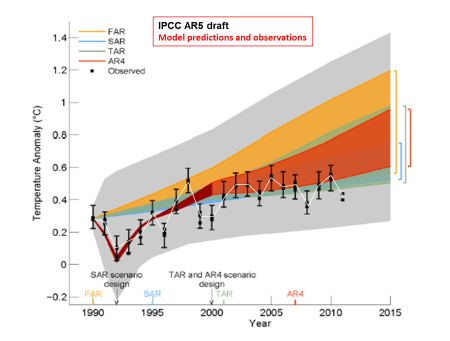
Model predictions versus observations
Here is the caption for this figure from the AR5 draft:
Estimated changes in the observed globally and annually averaged surface temperature (in °C) since 1990 compared with the range of projections from the previous IPCC assessments. Values are aligned to match the average observed value at 1990. Observed global annual temperature change, relative to 1961–1990, is shown as black squares (NASA (updated from Hansen et al., 2010; data available athttp://data.giss.nasa.gov/gistemp/); NOAA (updated from Smith et al., 2008; data available at http://www.ncdc.noaa.gov/cmb-faq/anomalies.html#grid); and the UK Hadley Centre (Morice et al., 2012; data available at http://www.metoffice.gov.uk/hadobs/hadcrut4/) reanalyses). Whiskers indicate the 90% uncertainty range of the Morice et al. (2012) dataset from measurement and sampling, bias and coverage (see Appendix for methods). The coloured shading shows the projected range of global annual mean near surface temperature change from 1990 to 2015 for models used in FAR (Scenario D and business-as-usual), SAR (IS92c/1.5 and IS92e/4.5), TAR (full range of TAR Figure 9.13(b) based on the GFDL_R15_a and DOE PCM parameter settings), and AR4 (A1B and A1T). The 90% uncertainty estimate due to observational uncertainty and internal variability based on the HadCRUT4 temperature data for 1951-1980 is depicted by the grey shading. Moreover, the publication years of the assessment reports and the scenario design are shown.
Tags:AR5, climate change, global warming models, IPCC, IPCC Fifth Assessment Report
Posted in Alarmism, Climate, UN | 1 Comment »
December 3, 2012
COP18 in Doha enters its second week and politicians are now arriving in droves. A small fortune has already been spent during the first week. But this is a gathering of an alarmist movement built on unprovable fears. Inevitably the greedy “groupies” gather (some 17,000 of them). A convention of the cowardly in the “theatre of the absurd”.
As The Economist puts it
NEVER let it be said that climate-change negotiators lack a sense of the absurd. Thousands of politicians, tree-huggers and journalists descended on Doha this week, adding their mite of hot air to the country that already has the world’s highest level of carbon emissions per head. The feeling of unreality is apt. ……. The jamboree in Doha is the 18th UN climate-change summit, but the third since a landmark one at Copenhagen in 2009.
We shall see – and are seeing — new alarmist articles and press releases every day till the end of this week. But the fundamental problem is not so much the politics of alarmism connected with this one non-issue of climate change, but the fact that the once laudable environmental movement now resorts to the politics of fear. Courage is singularly lacking.
Courage is the subordination of fear to purpose. Today however with the politics of alarmism, fears dominate purpose. Inevitably these are fears which can never be disproved because they are forecasts of what lies a long way in the future. And the politics of fear generates its own greedy “groupies”
Once upon a time, the environmentalists were a courageous lot and were surely instrumental in the cleaning up of many areas from the effects of real pollution … But the simple virtues of keeping things clean and preventing disease and improving the standard of living for humans has given way to the more pompous and pretentious goals of preventing global warming (an unbridled arrogance), of maintaining bio-diversity (and why is this important?) and of preserving “scarce resources due to the “limits to growth”…
… Inevitably the politics of alarmism are accompanied by the opportunists whose greed leads to all the scams surrounding environmental subsidies for renewable power or for carbon trading.
Tags:Alarmism, climate change, Courage, Doha, environment, Environmental cowardice, KyotoProtocol, United Nations, United Nations Framework Convention on Climate Change
Posted in Alarmism, Climate, UN | Comments Off on COP18 in Doha: A convention of the cowardly in the “theatre of the absurd”
November 25, 2012
There can be few things more wasteful than this. And all for a hypothesis which cannot be proven and is increasingly looking like “hot air”.
The annual climate jamboree is about to start for 17,000 participants!!!!!
This from the BBC
- Doha climate talks: Will ‘hot air’ derail the process?
- More than 17,000 participants are expected in the Qatari capital Doha for the 18th Conference of the Parties (COP18) of the United Nations Framework Convention on Climate Change.
- Qatar, rich in oil and particularly gas, has some of the highest per-capita carbon emissions in the world.
- One of the concerns is over “hot air” – several EU countries were given huge allowances of carbon permits that they want to carry over into a new commitment period. But the scale of the surplus, some 13 billion tonnes of carbon dioxide, could render future promises to cut carbon effectively meaningless. (Note that cutting Carbon itself is pretty meaningless)
Tags:climate change, COP1 18, Doha, Kyoto Protocol, Qatar
Posted in Alarmism, Climate, UN | Comments Off on COP18 in Doha and “hot air”
November 19, 2012
Just in time for the COP 18 meetings in Doha, the Potsdam Institute has produced – for the World Bank – the most apalling mish-mash of baseless fear-mongering I have seen for a long time (one could say that being from Potsdam it is only to be expected). Much about increasing emissions but nothing about the broken link between carbon dioxide and temperature. This is Alarmism at its worst.
Why a 4°C warmer world must be avoided (Summary pdf)
Tags:Alarmism, climate change, COP18, Doha, global warming, Potsdam, World Bank
Posted in Alarmism, Climate | Comments Off on Potsdam Institute for the World Bank showcases alarmism at it its very worst
November 17, 2012
Hot on the heels of the report that the IPCC has not been invited to the COP18 meeting in Doha later this month comes this report that the US is trying to funnel large parts of what is to be discussed at Doha into other forums and effectively bypass and undermine the UNFCCC
Could it be the US and China and India and other non-European countries who are disillusioned with the IPCC, are responsible for the snub?
EurAktiv reports:
The US is considering a funnel of substantive elements of the Doha Climate Summit away from the UN framework and into the Major Economies Forum (MEF), a platform of the world’s largest CO2 emitters, EurActiv has learned.
Since 1992, the United Nations Framework Convention on Climate Change (UNFCCC) has provided an umbrella for talks to curb global greenhouse gas emissions, and on 26 November, will host the COP18 Climate Summit in Qatar.
But it has been confirmed to EurActiv that Washington is increasingly looking to shift policy action to the MEF whose members account for some 85% of global emissions, and which the US views as a more comfortable venue for agreeing climate goals.
If the idea gains traction, it could demote the UNFCCC to a forum for discussing the monitoring, reporting and verification of emissions reductions projects, sources say. …
…… The MEF is a successor to the Major Economies Meetings set up by President Bush, and criticised by several governments for undermining the UN process.
Its participants include: Australia, Brazil, Canada, China, the European Union, France, Germany, India, Indonesia, Italy, Japan, Korea, Mexico, Russia, South Africa, the United Kingdom, and the United States.
Tags:climate change, COP18, MEF, UNFCCC, United States
Posted in Alarmism, Climate, Politics, UN, US | 1 Comment »
November 17, 2012
UPDATE: This email from IPCC at Revkin’s site seems to confirm that they are not officially invited but will be present anyway (at whose cost?) to provide a “background briefing for media”! Just in case the media cannot get their stories right “when they come to write about AR5“!!
Pachauri and the IPCC have apparently not been invited to the United Nations Climate Change Conference (COP18/CMP8) which is to be held in Doha from November 26th to December 7th. Pachauri has been talking to the press in Doha and seems very aggrieved. His press interview seems like he is almost begging for an invitation. He’s already in Doha so maybe he could just gatecrash the event!!
It could just be a secretarial oversight or it could be an intentional snub by the UN for a discredited organisation or it could be the UN expressing its displeasure for the manner in which the IPCC preens itself and usurps the UN’s own perceived role. Or it could be that some of the key countries attending plan to question or reject the IPCC’s findings and just don’t want them around.
My guess is that some way will be found for Pachauri to save some face.
The Gulf Times (Bonnie James) reports:
The Intergovernmental Panel on Climate Change (IPCC) will not be attending the upcoming United Nations Climate Change Conference (COP18/CMP8) in Doha, chairman Dr Rajendra K Pachauri has said.
“For the first time in the 18 years of COP, the IPCC will not be attending, because we have not been invited,” he told Gulf Times in Doha. ……
……. Dr Pachauri first hinted about his ‘anticipated absence’ at COP18, while speaking at the opening session of the International Conference on Food Security in Dry Lands (FSDL) on Wednesday at Qatar University.
Later, he told Gulf Times he did not know why the IPCC has not been invited to COP18, something that has happened never before.
“I don’t know what it is. The executive secretary of the climate change secretariat has to decide. I have attended every COP and the chairman of the IPCC addresses the COP in the opening session,” he explained.
Tags:climate change, COP18, Intergovernmental Panel on Climate Change, IPCC, Rajendra K. Pachauri, United Nations
Posted in Alarmism, Climate, UN | 2 Comments »
October 11, 2012
Reality Check.
The death of coal utilisation or the exhaustion of coal reserves is not even a glimmer on the world’s energy horizon — thank goodness.
Add to this the fact that carbon dioxide concentrations in the atmosphere (and man made CO2 emissions are a minor contribution to this concentration) simply have no significant effect on climate. Trying to control climate by reducing man-made carbon dioxide emissions must rank as one of the world’s most useless and wasteful efforts in the last 30 years.
Terence Corcoran writes in the Financial Post:
….. The idea that coal is dying seems to be mostly wishful thinking on the part of green activists, as well as some politicians and regulators in the United States and parts of Canada. Ontario aims to end dirty coal-fired power generation, at great cost to consumers who are now paying high prices for the putative clean alternatives, wind and solar. The United States, via regulation from the Environmental Protection Agency, has established rules that are said to present the coal-power industry with a “dead end.”
(more…)
Tags:climate change, Coal, coal use carbon dioxide emissions, Energy, Fossil fuel
Posted in Alarmism, Climate, Coal, Energy | Comments Off on The demise of coal has been greatly exaggerated