Posts Tagged ‘demographics’

By 2100 a world population decline and a shortage of a “productive population” will be the problem

November 3, 2012

There are still alarmists and Malthusians who believe that the world will face catastrophe due to overpopulation. They believe that the carrying capacity of the earth has been exceeded, that there will be food shortages, energy shortages and resource shortages in every field; that – in short – the population will not be able to sustain itself let alone to maintain growth.

But like so many alarmist theories (be it global warming or peak oil or peak gas or GM crops) the overpopulation meme builds on beliefs and ignores evidence. The environmentalists are increasingly taking faith-based and anti-science positions. Alarmism invokes political correctness and “consensus beliefs” rather than evidence to silence criticism . Even hard-core environmentalists are beginning to question this myopic adhesion to ideology (Environment360).

Just taking the overpopulation myth as an example, the data and projections in the United Nations, Department of Economic and Social Affairs, Population Division (2011): World Population Prospects: The 2010 Revision. New York (Updated: 15 April 2011) are pretty unambiguous and revealing. Within 100 years world population will be declining. The majority of children being born today in the developed world will live to be over 100 years old. There will begin to be a shortage of  the required “productive population” relative to the “supported populations of the young and the retired” – a problem already evident in Japan and other developed countries. In Sweden (and some other European countries) for example, this proportion is being maintained only by means of immigration and the slight consequent increase in average fertility rates. The “productive population” in Germany would be below the required level were it not for the “guest workers”. The 11 million or so “illegal immigrants” who are nearly all part of the “productive population” in the US  are a vital part of maintaining this balance.

The challenge in 2100 will be to maintain the balance between those “producing” to those “supported” in a declining and aging population. Perhaps immigration or population migrations or  productivity increases by the use of robots and an increase in the age one joins the “supported” population will be parts of the solution. I have no doubt that solutions will be found, but the “overpopulation problem” would have left the stage.

(more…)

7 billion people from October 31st by UN decree – but it is an opportunity not a problem

August 30, 2011

Sometime soon the world’s population will exceed 7 billion. No one knows exactly when. According to the UN Population Reference Bureau, this will happen on 31st October in India or in China. The world’s 6 billionth living person was “suppposedly” born just 11 years ago in Bosnia, and world population is expected to reach 9 billion by 2050.

Monsters&Critics

The billion mark was reached only after 1800. As many as a billion have been added in the eleven years of the 21st century alone, and predictions on future population growth are now treated with the same caution and scepticism as long-range weather forecasts. David Bloom of the Harvard School of Public Health says that the multitude of unpredictable factors means that taking a global view is problematic. ‘Among them are infectious diseases, war, scientific progress, political change and our capacity for global cooperation,’ he says.

The general expectation is, however, that population growth will tail off, with UN predictions for 2050 ranging from 8.0 to 10.5 billion.

Interactive UN map is here

source: UN (via Time)

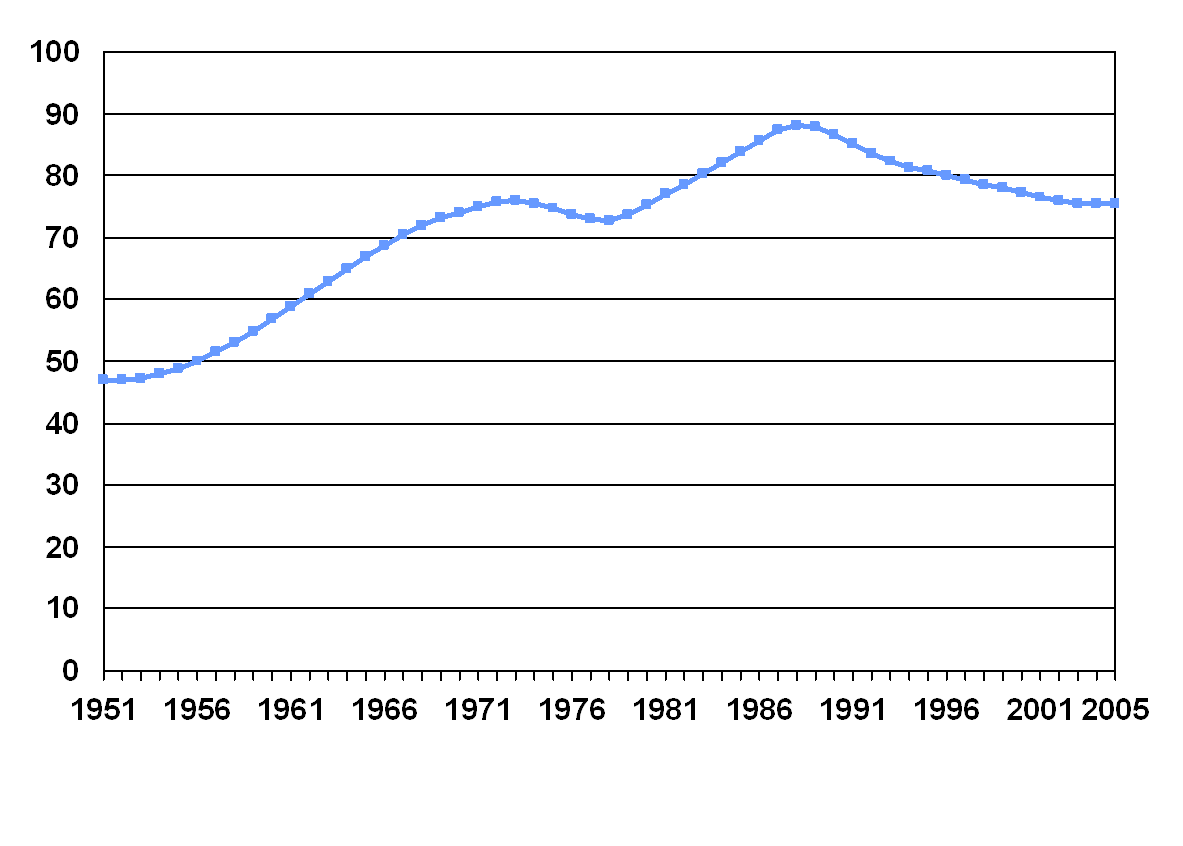
The annual rate of increase seems to have peaked around 1988 and is decreasing slowly. The UN medium scenario seems to be close to the actual development.

Annual increase of world population: Source United Nations, World Population Prospects: The 2004 Revision, 2005.

But I am no Malthusian and have a strong belief that the catastrophe theories are fundamentally misguided. Peak gas will never happen. Peak oil is a long way away and will be mitigated by new ways of creating oil substitutes as oil price increases. All the dismal forecasts of food production not being able to cope with population have not transpired. In my own lifetime I have only seen human ingenuity increase. Every doomsday scenario has had to give way before human ingenuity responding to human needs. I also believe that our children and our grandchildren will be considerably “smarter” than we are and will have (or will develop) technologies and tools that we cannot even dream of. I am not very convinced or impressed by those who would ban things today “for the sake of our children and our grandchildren”.

Even by the wildest stretch of his imagination my grandfather – who died around 1918 – would not have been able to imagine the technologies available today. Even my father – an engineer – who died in 1988 would not have been able to forecast the technologies we have at our command today.

With the definition below I would have no problem to be labelled a cornucopian.

cornucopian is a futurist who believes that continued progress and provision of material items for mankind can be met by similarly continued advances in technology, and the abundance of matter and energy in space would appear to give humanity almost unlimited room for growth.

What population problem? More brains and hands could well cater for the extra mouths to feed