Posts Tagged ‘Energy’
October 11, 2012
Reality Check.
The death of coal utilisation or the exhaustion of coal reserves is not even a glimmer on the world’s energy horizon — thank goodness.
Add to this the fact that carbon dioxide concentrations in the atmosphere (and man made CO2 emissions are a minor contribution to this concentration) simply have no significant effect on climate. Trying to control climate by reducing man-made carbon dioxide emissions must rank as one of the world’s most useless and wasteful efforts in the last 30 years.
Terence Corcoran writes in the Financial Post:
….. The idea that coal is dying seems to be mostly wishful thinking on the part of green activists, as well as some politicians and regulators in the United States and parts of Canada. Ontario aims to end dirty coal-fired power generation, at great cost to consumers who are now paying high prices for the putative clean alternatives, wind and solar. The United States, via regulation from the Environmental Protection Agency, has established rules that are said to present the coal-power industry with a “dead end.”
(more…)
Tags:climate change, Coal, coal use carbon dioxide emissions, Energy, Fossil fuel
Posted in Alarmism, Climate, Coal, Energy | Comments Off on The demise of coal has been greatly exaggerated
September 30, 2012
As the financial crisis continues, countries – one after another – are finding that the cost of pandering to environmental correctness is unacceptable. Renewable energy is proving to be unsustainable.
- Poland: The government moves to overhaul its system of support for green energy by effectively cutting funding for onshore wind.
- Greece: Greece has slashed the guaranteed feed-in prices it pays to some solar operators and is no longer approving permits for their installation.
- Switzerland: Switzerland plans for using more gas until 2050 and “energy needs can be completely covered by renewable energy”.
- Spain: Government has introduced a new tax on electricity production revenues to try and curb Spain’s current energy sector deficit caused mainly by the government’s renewable subsidy program.
- UK: UK cuts feed-in tariffs for Solar panels.
- Germany: Germany to press on with energy changes to the renewable subsidy system and with the easing of environmental over-regulation to rein-in renewable energy costs.
- Australia: Victoria cuts solar subsidies as the amount paid to new solar customers for power sold to the grid will be reduced from 25 cents to eight cents per kilowatt-hour.
- US: Tax breaks for wind energy to be curbed. Hopes that wind power could be competitive without any subsidy have been dashed by the plunge in North American natural gas prices.
Subsidies for what are essentially inferior products for electricity generation are ineffective. Subsidies for what are misguided objectives are just not sustainable.
Tags:Energy, Feed-in tariff, Renewable energy, Subsidy
Posted in Alarmism, Energy, Renewable Energy | Comments Off on Hard times forces a measure of realism into the mirage that is renewable energy
July 9, 2012
Recovery of gas and oil from shale is more than just a game changer – it is a mind-changer. The recoverability of oil and gas from shale postpones “peak oil” and “peak gas” indefinitely. For 3 decades we have suffered from the rampant pessimism of the alarmists and the coercive politics of fear. A change of mind-set from pessimistic environmentalism and backward-looking conservationism is called for. A shift of attitude from the joyless “glass half-empty and we are doomed” to the entrepreneurial “glass half-full but can be filled” is over-due.
Resource depletion with usage is a trivial truth – though matter at the elemental level is never destroyed by human use. However utilisation of resources does alter the composition and concentration of materials remaining available. But every alarmist and doom-sayer who has ever lived and has forecast impending catastrophe has been proven spectacularly wrong. Human ingenuity has faced every challenge and trumped the doom-sayers – every time.
The pictures say it all:
The scope of the US oil shale resource
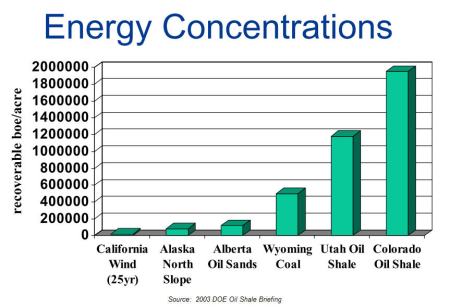
The scope of the US oil shale resource
Related: “Peak Oil” hypothesis is following “Peak Gas” into oblivion

Moving peaks
Tags:"Peak" gas, Business, Energy, oil shale, Peak oil, Resource depletion
Posted in Alarmism, Conservation, Development, Energy, Environment, Gas, Oil, Politics | Comments Off on As with peak gas, peak oil and rampant pessimism need to be postponed
July 6, 2012
I don’t believe in subsidies.
In over 30 years in power generation I have yet to see a convincing case of public subsidies in the market place actually helping to commercialise new technologies. I have seen cases where Government support at the research stage has helped to bring new areas into focus and which has eventually led to commercially driven investments which have deployed the technology. But temporarily distorting the market place by means of public subsidy is unsustainable and does not – in itself – help to make a new technology commercially viable. In fact an artificially distorted market in favour of a new technology only helps to cuccoon and insulate it such that there is no incentive left to make it competitive. Subsidies shift the focus from technology development to subsidy maximisation and when subsidies begin to be removed all creativity is wasted on prolonging subsidies.
The case of subsiding the market place for the deployment of renewable energy is a case in point. Developing technology for wind and solar power is desirable but distorting the market place to deploy wind and solar is just plain stupid and unsustainable.
1. Der Spiegel
Solar subsidies cost German consumers billions of dollars a year and are widely regarded as inefficient. Even environmentalists are concerned that Berlin’s focus on solar comes at the detriment of other renewables. But the solar industry has a powerful lobby, and politicians have proven powerless to resist.
…… A new study by Georg Erdmann, professor of energy systems at Berlin’s Technical University, reveals just how far Germany’s current center-right governing coalition — made up of Chancellor Angela Merkel’s CDU and the business-friendly Free Democrats (FDP) — has strayed from its own self-imposed goals. Erdmann has calculated the effects that the latest changes to the EEG will have between now and 2030. He believes that subsidies for renewable energy, including an expansion of the power grid, will saddle energy consumers with costs well over €300 billion ($377 billion). ….
2. BBC News
Fight on for wind power subsidies
Wind power firms warn they may take the government to court if they get caught in a political row over subsidies. After conducting technical studies, the energy department proposed a subsidy cut of 10% for power from onshore wind. But the chancellor is under pressure from back-benchers to scrap subsidies, and is said to favour a 25% cut.
The industry body, Renewable UK, says it may take legal action if the government makes a decision that overrides its own technical evidence. …
3. GWPF / IVN
California’s Green Suicide
New economic impact study on California’s Global Warming Solutions Act finds that the average California family will end up paying an additional $2,500 annually by 2020. In addition, the state is expected to lose an additional 262,000 jobs, 5.6 percent of the gross state product, and a whopping $7.4 billion through decreased annual state and local tax revenues as a result.
The California Manufacturers and Technology Association released a new report last week that suggests costs associated with AB 32 may be a lot higher than previously estimated. AB 32, otherwise known as the California Global Warming Solutions Act of 2006, was signed into law by Governor Arnold Schwarzenegger- propelling California to the forefront in the fight against global warming. Successful passage of the law effectively turned the state into one of the most stringent regulators of green house gas emissions in the nation and globally. Some would argue that the move all but eliminated California’s competitive edge in today’s market. ……
Tags:Energy, Renewable energy, Solar power, subsidies, technology commercialisation, wind power
Posted in Business, Energy, Politics, Renewable Energy, Technology | 1 Comment »
May 12, 2012
It has been just over two years since I started this blog – my first – and I now feel sufficiently comfortable to move away from the general and to try and focus just on the topics that interest me most. I have changed the sub-heading to reflect this.
My opinions on aspects of energy and power generation and climate and environment will now take centre stage on this blog. I shall have to try to address my interests in technology and materials and behaviour and management and anthropology and politics elsewhere. It has been the advent of accessible electric power which has been the single most liberating force for the human condition – ever. For the foreseeable future humanity will continue to use – and need to use – electric power. And virtually all our sources for electric power – except perhaps some nuclear fuels – derive from the Sun.
Sol Invictus.
The blog image is of sunrise on a very cold day in February last year.
Tags:climate, Electric Power, Energy, environment
Posted in Climate, Energy, Environment | Comments Off on A slight shift of focus
April 8, 2012
Common sense and simple economics are beginning to reassert themselves as the the fundamental weaknesses in the fashionable – but subsidised – expansion of solar and wind power plants are revealed. The expensive, intermittent and unpredictable generation that derives from solar and wind power plants can – at best – be used to augment an existing system. They are actually useful as an auxiliary heat and power source as small decentralised units. But in a large power grid they are more of a nuisance than an asset and can only increase the cost to the consumer.
China has now published a policy document changing direction towards nuclear and hydro power and an accelerated development of shale gas use. Solar and wind power are downgraded.
Electric Light & Power
China will accelerate the use of new-energy sources such as nuclear energy and put an end to blind expansion in industries such as solar energy and wind power in 2012, Chinese Premier Wen Jiabao says in a government report published on March 5.
(more…)
Tags:China, Energy, Energy development, Hydro Power, Nuclear power, Shale gas, Solar power, wind power
Posted in China, Energy, Nuclear Power, Renewable Energy | Comments Off on China downgrades solar and wind power – pushes for nuclear, hydro and shale gas
February 20, 2012
Oil production from oil shales in North Dakota is increasing rapidly and the much-heralded “peak” of oil production may have to be postponed. Alarmists will not be pleased.
“Peak Oil” and “Peak Gas” are the points in time where the production of oil and gas respectively reach a peak and then decline to zero. The concept is based on the normal production cycle of an individual well extrapolated to all the oil and gas existing. The fundamental flaw in these hypotheses when trying to apply them to “finite” and exhaustible resources of any product is of course that:
- new sources of the product are discovered
- new extraction technologies enhance what can be recovered from existing sources,
- new technologies make non-viable sources viable
- new technologies allow the synthesis or alternative production of the product (price driven)
- consumption is modified by pricing
Moving peaks
In recent times the development of fracking technology and the discovery of huge deposits of gas-bearing shales together with the discovery of new deep-sea sources of natural gas have pushed the “peak” for gas production beyond the visible horizon and into the distant future (a few hundred years). When – rather than if – methane hydrates become available for gas production, the “peak” will shift further into the future.
In the case of oil there are already many feasible alternatives which are technically feasible but where commercial production by these methods can only be triggered by the sustainable price being higher than the production cost. For example bio-diesel costs are commercial with oil prices above about $70 per barrel but there is a hidden cost in decreased or disrupted food production. Coal liquefaction would need oil prices above $120 per barrel while oil extraction from oil shales and oil sands become commercial at about $90 and $100 respectively. Deep sea wells (new exploration) are increasingly commercial as the price increases.
The alternatives are now coming into play:
(more…)
Tags:"Peak" gas, Energy, oil shale, Peak oil, Shale gas
Posted in Alarmism, Energy, Gas, Oil, Oil price | Comments Off on “Peak Oil” hypothesis is following “Peak Gas” into oblivion
January 18, 2012
The advent of shale gas has moved the peak of “peak-gas” into the future by some 250 years. This together with the fact that gas-fired power plant have the shortest construction times and the lowest investment costs of any form of power generation provides the possibility to hold down electricity generation costs. The increase in generation costs in recent times has been the natural consequence of the subsidy regimes for wind and solar power plants and the opportunistic rush to renewable power. Huge fortunes have been made by “green” developers as the subsidies have been milked – but consumers have only seen rising electricity prices.
Bloomberg reports:
A shale-driven glut of natural gas has cut electricity prices for the U.S. power industry by 50 percent and reduced investment in costlier sources of energy. With abundant new supplies of gas making it the cheapest option for new power generation, the largest U.S. wind-energy producer, NextEra Energy Inc. (NEE), has shelved plans for new U.S. wind projects next year and Exelon Corp. (EXC) called off plans to expand two nuclear plants. Michigan utility CMS Energy Corp. (CMS) canceled a $2 billion coal plant after deciding it wasn’t financially viable in a time of “low natural-gas prices linked to expanded shale-gas supplies,” according to a company statement.
(more…)
Tags:Electricity generation, Energy, gas glut, Gas price, gas turbine boom, Natural gas, Shale gas, Utilities
Posted in Energy, Engineering, Gas | 2 Comments »
November 15, 2011
There are some simple and rather obvious matters that the “green” lobbies prefer to ignore.
- In spite of twenty years of subsidies wind power is still not commercially viable without subsidy. Solar thermal power plants enjoy feed in tariffs some 3 times higher than the cost of conventional fossil power generation. Wherever renewables have been used to any extent, electricity prices for the consumer have increased.
- Intermittent sources of power (which cease when the wind does not blow, or blows too hard or when the sun does not shine at night or when clouds appear) are – by definition – unreliable. They do not add to the reliable, base-load, generating capacity that any electricity grid requires and must be backed up. In Scotland for example – as Professor Colin McInnes points out – wind power capacity now exceeds nuclear capacity but only produces about one-third of the energy.
- Electricity is energy in motion and cannot be stored as electricity. For any electrical grid, at any instant, generation must, perforce, equal demand – and pumped storage schemes are merely devices to try and ensure such balance. Since the outages of wind and solar power are unpredictable (though it is generally predictable that solar power will not be available at night), and cannot be relied on to meet load demand fluctuations, “balancing power” (usually from gas turbines) must be arranged for whenever wind or solar capacity is added.
- In addition to the direct subsidies, whenever wind or solar power is available at times when there is low load, the subsidised regime forces the turning-down of other capacity – to the detriment of that capacity – and adds to the total cost of the grid.
Now – finally – some of the real numbers are beginning to be acknowledged but not, of course, by the green lobbies. KPMG has produced a new report
“Thinking about the Affordable” and
Power Engineering International reports that:
Tags:Business, Energy, grid balancing, KPMG, rnewable power, Scotland, wind power
Posted in Business, Energy, Environment, Renewable Energy | 3 Comments »
August 26, 2011
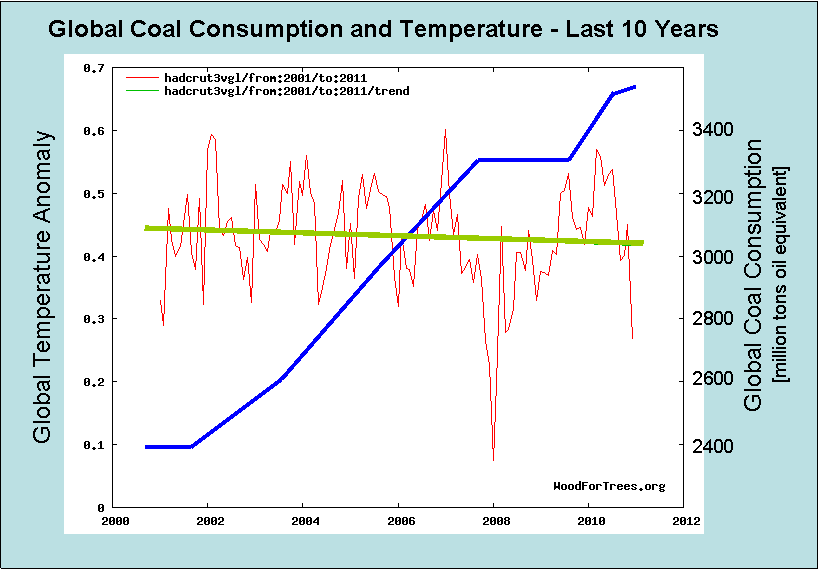
There is a clear disconnect between global coal consumption (and therefore carbon dioxide emissions) and global temperatures.
Of course we must take into account that these are only real data over the last 10 years and are not generated by computer models and have not been validated by the IPCC!!
Quote of the week at WUWT 22nd May 2011
“People underestimate the power of models. Observational evidence is not very useful,” adding, “Our approach is not entirely empirical.” John Mitchell, principal research scientist at the UK Met Office
P Gosselin at NoTricksZone has the “heretical” story:
Global Coal Consumption Jumps Almost 50% – Yet Global Temps Drop!
A recently released BP report here shows that global coal consumption has risen over the last 10 years by almost 50%. So wouldn’t you think that all those millions of tons of emitted CO2 (food for plants) as a result would drive the global temperatures up? Have temperatures risen along with all that extra coal burning?
No they haven’t. In fact they’ve dropped slightly over the same period. So go figure!
In the above chart the blue line shows global coal consumption, data taken here, Review of World Energy. According to the report, India and China alone are responsible for 90% of the world’s coal consumption increase, while renewable energy in the 2 countries plays nary a role. According to BP figures, global CO2 emissions rose 5.8% in the year 2010. ……..
Read source report
Tags:carbon dioxide emissions, climate, Coal, coal consumption, coal consumption disconnected from global temperature, Energy, Fossil fuel, global temperature, IPCC, John Mitchell
Posted in Alarmism, Climate, Energy | Comments Off on Coal consumption increases almost 50% in 10 years and has no impact on global temperature



 The k2p blog