Posts Tagged ‘Energy’

Wind power has less potential than claimed and the role of gas is underestimated

August 14, 2011

That the intermittent nature of solar and wind power inherently limits how such capacity can be installed and despatched seems pretty obvious but has always been underestimated by the renewable energy lobby. As subsidies are reduced in the face of government cutbacks and as the still very high costs of renewable power work their way into electricity tariffs some of the “green sheen” surrounding solar and wind power is becoming decidedly tarnished.

A new  study of the UK energy system has been published by the Oxford Institute for Energy Studies 

The Impact of Import Dependency and Wind Generation on UK Gas Demand and Security of Supply to 2025

By Howard Rogers

Summary: This paper by Howard Rogers challenges the assumption of UK government policy papers and projections that, as a result of substantial increases in renewable and other low carbon generation capacity, the role of gas in the will decline rapidly over the next decade and beyond. The study suggests that gas will retain a central and undiminished role in the UK power generation sector. Although its role in the power generation sector may change, gas is likely to be particularly important in respect of ensuring security of supply in the context of increasing intermittent wind generation. As a result, additional gas storage will be needed and, given current market conditions, immediate attention needs to be devoted to creating incentives to ensure this will be provided.

The Telegraph writes:

UK Windpower targets are ‘unfeasible’

Howard Rogers, senior research fellow at the Oxford Institute for Energy Studies, said in a study that Britain’s power network is not built for wind power accounting for more than a third of capacity on the system.

He said that any more than 28 gigawatts of wind would mean it is likely that turbine owners would regularly have to be paid to keep capacity off the system. Earlier this year, six wind farms were paid £900,000 to stop generating for one night, because the system became overloaded.

The study challenges the ambitious estimates in a study commissioned by the Government which estimates that 58 gigawatts of wind is likely to be built in a “medium activity” scenario by 2030, out of a total system of 80 gigawatts of capacity. …. Mr Rogers said this does not fully consider the ability of the grid to cope with the intermittency of wind, which often does not blow at all or can be too strong, causing overload.

“It would appear that the more ambitious targets for wind generation in the UK have been formulated without a full appreciation of the costs and complexities caused by the intermittency of very substantial levels of wind generation,” the report says. “The analysis concludes that the maximum feasible level of wind generating capacity is 28 gigawatts.

At higher levels than this, the country faces the prospect of short notice intervention to reduce turbine output with the added complication that forecasts of wind speed beyond six hours into the future are inherently uncertain.”

The Oxford Institute for Energy Studies is allied to three Oxford University colleges but also receives funding from “members” and sponsors, such as gas producers BP and BG Group and companies with huge investments in wind power, including Centrica and Dong Energy. Its gas research is also sponsored by National Grid.

Professor Jonathan Stern writes in the preface to the study: “It is no part of the remit of the Oxford Institute for Energy Studies gas research programme to promote natural gas, either in the UK or more generally. We are gas researchers not advocates or lobbyists. However, our research increasingly suggests that the likely future role of gas in energy balances has and continues to be underestimated.”
Related:

Wind stops wind power….. 

Bio-gas is out, shale gas is in and there is no “peak” gas in sight!

Renewable Energy follies: Subsidies discourage maintenance

July 6, 2011

A key problem with subsidising “renewable energy” is that the economics become so distorted that developers/owners focus first on maximising the extraction of subsidies and not on the long-term operation of the plant or the production of power. As soon as payback is achieved the focus is on generating revenues while minimising  expenditure on operation and maintenance (O & M). Inevitably such plants are abandoned as soon as the O & M costs approach the level of revenues. Whereas conventional power plants (coal, gas, hydro and nuclear) have a design life of 30 – 40 years and often carry out maintenance to extend this lifetime, subsidised “renewable energy” plants have a lifetime of less than 10 years and often even less.

For example grants for construction and high tariffs were used for many years to encourage sugar producers in India and Brazil and other countries to build power plants burning bagasse (the waste matter left after crushing sugar-cane to extract juice). But the consequence was that sugar producers could generate more revenue by producing power rather than sugar – especially when the sugar price was low. Sugar producers built power plants which were larger than they needed themselves and based solely on the level of grant that could be extracted. Access to the grid was guaranteed. But again many of these plants were abandoned as soon as the O & M costs became too onerous. Effectively the developers had recovered all the investment (which was mainly grant money anyway) and more from the allowed 16 – 20% rate of return (which in practice was more like about 30-50% ) of the supposed investment. As plants were “cashed out” and abandoned, the grid just had to absorb the disturbances – which were not negligible.

The subsidies in Europe for wind and solar power are encouraging the same behaviour. In Germany the almost profligate subsidy regime has encouraged the implementation of less than serious power projects by less than serious developers. The game has been the extraction of subsidies not of generating power. In Germany wind turbine and photo-voltaic solar cell plants popped up everywhere. Farmers and shop-keepers and schools all have became power generators. Grid stability has been weakened to cope with the plethora of small plants cutting in and out of the grid. The obscenely high feed-in tariffs in Spain have encouraged solar plants to burn more gas than permitted and pass off the power generated as being “renewable power” at the high tariff. But as the subsidy regime weakens and tariffs reduce and grants are scaled down, the likelihood of these plants being abandoned is increasing. Certainly there is no incentive to spend any money on maintenance.

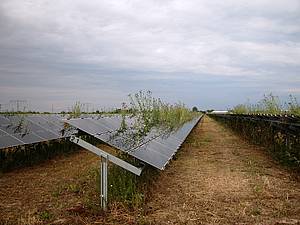
P. Gosselin at NoTricksZone has this about a pv solar plant (2.7 MW) after less than 2 years:

Weed-Covered, Neglected Solar Park: 20 Acres, $11 Million, Only One And Half Years Old! 

solar plant weeds

Over the next few years we shall see many more solar and wind power plants in Europe where money will not be spent on maintenance unless it is absolutely necessary for the generation of short-term (subsidised and inflated) revenues. Long-term maintenance will just not happen. And when the O & M costs become too onerous the plants will simply be abandoned. No doubt bankruptcies will be arranged when the plants are cashed-out such that there is no recourse to the developers/owners for any remaining liabilities.

Subsidies just don’t work for their intended purpose in power generation – but they are short-term gold mines for some developers.

Power generation from shale gas is here to stay

May 31, 2011

The capital cost of building different types of power plants is a reality that cannot be wished away:

November 2010 Capital costs for power plants

Gas fired combined cycle plant use the least capital of all power generation plants. With shale gas set to become even cheaper than natural gas and with gas fired plants having capacity factors well above 90% compared to the 25% of wind power or the 30% of solar plants, it is a no-brainer to conclude that wherever shale gas is available it is going to be used for power generation.

Where it is not available coal fired plants and nuclear plants will continue to be used.

Intermittent renewable power plants are going to need subsidies for a long time to come to get anywhere near the cost of electricity from gas. At best they could be useful to augment production of electricity but being intermittent cannot really contribute to reliable capacity.

Bio-gas is out, shale gas is in and there is no “peak” gas in sight!

May 6, 2011

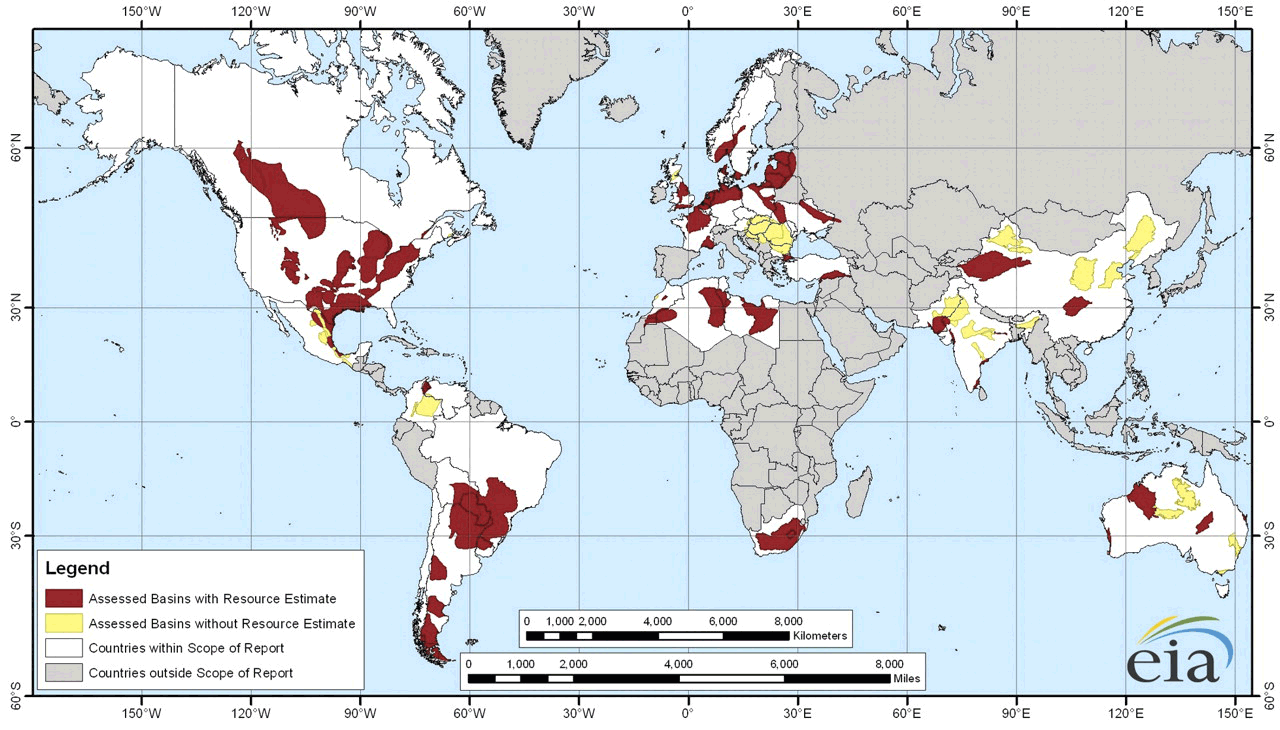
Shale gas is abundant and now beginning to undercut the price of other sources of natural gas. It is already cheaper than LNG transported around the world which requires both terminals for liquefaction and receiving stations for evaporation. Gas-fired power plants are relatively cheap and quick to build. In simple-cycle operation gas turbine based power plant provide the economic method of choice for emergency power and peak power. In combined cycle operation they provide the highest efficiency of all types of fossil fired electricity generation (around 60%). The ratio of gas price to coal price determines whether this can be cheaper than coal fired power generation.

Shale gas is abundant: map via Wikipedia

Total oil, gas and coal resources in the Earth’s crust are estimated at more than 570,000 exajoules. The world will use about 450 exajoules (billion billion joules) of fossil fuel energy this year.

Exajoule

The exajoule (EJ) is equal to 1018 joules. The 2011 Tōhoku earthquake and tsunami in Japan had 1.41 EJ of energy according to its 9.0 on the Richter magnitude scale. Energy in the United States used per year is roughly 94 EJ.

Matt Ridley:

Quantity is not really the point; price is. Most fossil fuels are impossibly hard to extract at a reasonable price. More than half the reserves consist of methane clathrates hydrated gas found mostly on the seabed near the margins of the continents in vast quantities. Nobody knows how to turn them into fuel except at huge cost, although the Japanese are on the case. So the question is not whether we run out of fossil fuels but whether we run out of cheap fossil fuels.

With oil, the answer may be “yes”. A huge amount of oil is still untapped, but most of it is under deep water or in oil sands and is costly to extract. But with gas, the answer is “no”. Most free methane is found in impermeable rocks such as shale, not in permeable “traps” whence it is easiest to extract. Shale gas was thought to be as inaccessible as clathrates, and when it began to be exploited in the 1990s it looked as if it would still come in at the top of the price range. Now technological improvements have brought the price down so far that it undercuts conventional gas. 

The “shale-gas shock” will have far-reaching consequences. It will make gas prices lower and less volatile relative to oil than ever before.

This will cause gas to take market share from coal, nuclear and renewables in electricity generation, and from oil in transport. London buses should follow Washington and Delhi in switching to gas both to save money and to produce less smog.

Shale gas is good news for America and China (which probably has even more of it than America), consumers (cheap fuel means higher standards of living) and farmers (fertiliser is made from gas). It is bad news for Russia and Iran (which hoped to corner the gas market in coming decades), for coal (until now the cheapest fuel for electricity) and for the nuclear and wind industries. The last two had expected to be rescued from dependence on subsidies by rising fossil fuel prices. They may now not be.

The losers are formidable enemies, so there is a movement, whose fans range from Gazprom to Greenpeace, to strangle the shale-gas industry at birth, by claiming that drilling for it contaminates water with carcinogenic and even radioactive chemicals. This turns out to be true only in the sense that coffee is carcinogenic, bananas radioactive and dihydrogen monoxide (water) a chemical.

The use of gas for power generation is perfectly sustainable into the foreseeable future. As the hysteria and alarmism around carbon dioxide causing global warming is debunked and begins to fade away the fashionable and unsustainable focus on bio-gas will also die away. The price of electricity production from gas will be the benchmark for judging whether wind and solar power make any sense. Without artificially imposed penalties on carbon or carbon taxes on fossil fuel, bio-gas can never be more than a marginal fuel of little significance. For bio-gas to have any significance catchment areas become so large that food production is adversely affected. The cost of production is relatively high. Without a carbon dioxide scare and the resulting subsidies, wind and solar power are still not able to compete against any form of fossil fuel power generation or hydro power or nuclear power.

But the success of technologies for the extraction of shale gas ensures availability of significant quantities for a long time to come. These quantities are so large that there is no “peak” in sight and all the alarmist “peak” gas scenarios are rendered meaningless.

Moving peaks: Peak gas will never come

Related: Europe told of potential shale gas bonanza

New report: “wind cannot be relied upon to provide any significant level of generation at any defined time in the future”

April 6, 2011

It is a bit like belabouring the obvious for the upmpteenth time but it has the stamp of authority of  a Consulting firm supported by the John Muir Trust and it is reported in the main stream media. Perhaps – one can dream – some realism will return to the rose-tinted views prevailing about renewable energy.

Intermittent sources of energy cannot – by wishful thinking and pious platitudes alone – become continuous suppliers of electricity until the storage of electricity becomes real. And since electricity is itself energy in a state of flux, it is not amenable to any simple storage as a flux.

The BBC reports:

Wind farms are much less efficient than claimed, producing below 10% of capacity for more than a third of the time, according to a new report. The analysis also suggested output was low during the times of highest demand.

The report, supported by conservation charity the John Muir Trust, concluded turbines “cannot be relied upon” to produce significant levels of power generation.

… The research, carried out by Stuart Young Consulting, analysed electricity generated from UK wind farms between November 2008 to December 2010. Statements made by the wind industry and government agencies commonly assert that wind turbines will generate on average 30% of their rated capacity over a year, it said. But the research found wind generation was below 20% of capacity more than half the time and below 10% of capacity over one third of the time.

It also challenged industry claims that periods of widespread low wind were “infrequent”. The average frequency and duration of a “low wind event” was once every 6.38 days for 4.93 hours, it suggested. The report noted: “Very low wind events are not confined to periods of high pressure in winter. “They can occur at any time of the year.” During each of the four highest peak demands of 2010, wind output reached just 4.72%, 5.51%, 2.59% and 2.51% of capacity, according to the analysis.

It concluded wind behaves in a “quite different manner” from that suggested by average output figures or wind speed records.

The report said: “It is clear from this analysis that wind cannot be relied upon to provide any significant level of generation at any defined time in the future. There is an urgent need to re-evaluate the implications of reliance on wind for any significant proportion of our energy requirement.”


Using cerium oxide to mimic absorption of solar energy by plants

December 24, 2010

A new paper in Science:

Science 24 December 2010: Vol. 330 no. 6012 pp. 1797-1801 DOI: 10.1126/science.1197834

High-Flux Solar-Driven Thermochemical Dissociation of CO2 and H2O Using Nonstoichiometric Ceria by William C. Chueh, Christoph Falter, Mandy Abbott, Danien Scipio, Philipp Furler, Sossina M. Haile, and Aldo Steinfeld

In the prototype, sunlight heats a ceria cylinder which breaks down water or carbon dioxide

In the prototype, sunlight heats a ceria cylinder which breaks down water or carbon dioxide

Abstract:

Because solar energy is available in large excess relative to current rates of energy consumption, effective conversion of this renewable yet intermittent resource into a transportable and dispatchable chemical fuel may ensure the goal of a sustainable energy future. However, low conversion efficiencies, particularly with CO2 reduction, as well as utilization of precious materials have limited the practical generation of solar fuels. By using a solar cavity-receiver reactor, we combined the oxygen uptake and release capacity of cerium oxide and facile catalysis at elevated temperatures to thermochemically dissociate CO2 and H2O, yielding CO and H2, respectively. Stable and rapid generation of fuel was demonstrated over 500 cycles. Solar-to-fuel efficiencies of 0.7 to 0.8% were achieved and shown to be largely limited by the system scale and design rather than by chemistry.

The BBC says:

A prototype solar device has been unveiled which mimics plant life, turning the Sun’s energy into fuel. The machine uses the Sun’s rays and a metal oxide called ceria to break down carbon dioxide or water into fuels which can be stored and transported.

Conventional photovoltaic panels must use the electricity they generate in situ, and cannot deliver power at night. Details are published in the journal Science. The prototype, which was devised by researchers in the US and Switzerland, uses a quartz window and cavity to concentrate sunlight into a cylinder lined with cerium oxide, also known as ceria.

Ceria has a natural propensity to exhale oxygen as it heats up and inhale it as it cools down.

If as in the prototype, carbon dioxide and/or water are pumped into the vessel, the ceria will rapidly strip the oxygen from them as it cools, creating hydrogen and/or carbon monoxide. Hydrogen produced could be used to fuel hydrogen fuel cells in cars, for example, while a combination of hydrogen and carbon monoxide can be used to create “syngas” for fuel. It is this harnessing of ceria’s properties in the solar reactor which represents the major breakthrough, say the inventors of the device. They also say the metal is readily available, being the most abundant of the “rare-earth” metals. Methane can be produced using the same machine, they say.

The prototype is grossly inefficient, the fuel created harnessing only between 0.7% and 0.8% of the solar energy taken into the vessel. Most of the energy is lost through heat loss through the reactor’s wall or through the re-radiation of sunlight back through the device’s aperture.

But the researchers are confident that efficiency rates of up to 19% can be achieved through better insulation and smaller apertures. Such efficiency rates, they say, could make for a viable commercial device.

“The chemistry of the material is really well suited to this process,” says Professor Sossina Haile of the California Institute of Technology (Caltech). “This is the first demonstration of doing the full shebang, running it under (light) photons in a reactor.”

It has been suggested that the device mimics plants, which also use carbon dioxide, water and sunlight to create energy as part of the process of photosynthesis. But Professor Haile thinks the analogy is over-simplistic. “Yes, the reactor takes in sunlight, we take in carbon dioxide and water and we produce a chemical compound, so in the most generic sense there are these similarities, but I think that’s pretty much where the analogy ends.”

While cerium is quite abundant in the earth’s crust it is one of the “rare earths” and current production is dominated by China.  Cerium oxide, which is used to finish semiconductors and obtained from the rare earth element cerium, rose in price from $ 4.70 per kg on April 20 to 36 U.S. dollars a kilo on Tuesday, October 19. An increase of 665 percent.

Bleak future for wind power generators in Sweden

November 22, 2010

Swedish P1 Radio had a broadcast this morning where wind turbine owners in southern Sweden were interviewed. Wind turbines in Southern Sweden operate at an average capacity of about 25% but when the wind blows in in Sweden it usually blows in Denmark as well. As Denmark builds more subsidised but intermittent wind turbines they become more dependant upon the import of hydro and nuclear power from Sweden and Norway.

It could be a dark future for wind power, at least for wind power owners in southern Sweden. As wind turbines multiply, the surplus power when the wind blows reduce prices and wind turbine revenues are reduced drastically.

The Marketing Director for Lunds Energi said that they had no plans for building any more wind turbines to add to the 6 small wind turbines they already had.  There was no chance, he said, of the Danes importing wind power from Sweden when the wind was blowing for then they had their own power. And when the wind was not blowing and prices were better there was no power to sell!

Vindkraftverk i Vänern. Foto: Fredrik Sandberg/Scanpix

Wind power plant in Lake Vännern. Foto: Fredrik Sandberg/Scanpix

Kjell Jansson, the Managing Director of Svensk Energi was also interviewed and pointed out that electricity could not be stored except as hot water. Therefore using surplus wind energy to store in heating systems was at best a partial solution but did not help the fact that industry and people needed electricity as electricity – and not just as hot water. Even the planned Danish solution of using surplus power to “charge up” heating systems for district heating as hot water or for “charging up” electric cars relied on having electricity – from nuclear and hydro power from Sweden and Norway – available to be imported for the Danish electricity system.

Therefore, he continued, when the wind did not blow in Denmark  – and then usually did not blow over the whole of Scandinavia – the high electricity price was an advantage for the hydro and nuclear generators. In any case this would require much more investment in transmission systems and in hydro power generation.

But I can see a situation where Denmark will pay swingeing prices for imported electricity when the wind is not blowing and a cold wave is sweeping across Europe. And if it is a really severe cold wave then there may be no electricity available for import.

Coal still king as green power IPO struggles

November 4, 2010

Black vs. green. Wikimedia commons

“Green” is no longer as fashionable and trendy as it used to be. The slime of Climategate has had its impact as has the arrogance of the alarmists. But if the hard-headed world of business investments is anything to go by it seems “black” is begining to trump “green”. An earlier post described the huge success that Coal India’s IPO had. This needs to be contrasted with the tepid response to the the IPO for ENEL Green Power which also listed today.

http://www.reuters.com/article/idUSTRE6A31RH20101104

Waning investor interest in clean energy contrasted sharply with enthusiasm for coal on Thursday as shares in Enel Green Power fell on their debut while Coal India’s soared.

Enel Green Power (EGP), which generates clean energy from hydro and geothermal to wind and solar and is Europe’s biggest listing since 2008, dropped over 4 percent on its debut despite a cut price offered to lure investors.

Shares of Coal India, a similar sized share sale at around $3.5 billion, gained 40 percent in Mumbai on the same day.

“The struggle for renewables reflects the fact that they are quite capital-intensive, in a world that is capital-constrained, and face regulatory uncertainty,” Robert Clover, alternative energy equity analyst at HSBC said.

India, which has the world’s fifth biggest coal reserves after the United States, Russia, China and Australia, is riding an economic boom that is thirsty for fuel.

“Fundamentally, Coal India is a structural play on India’s rising energy demand,” said Binay Chandgothia, chief investment officer at Principal Global Investors in Hong Kong.

TOP EUROPEAN LISTING

Europe has seen a resurgence in public offerings as equity markets trade around 6-month highs, and many European companies have managed to get their initial public offerings toward the upper end of their price guidance.

But EGP’s parent company Enel, an Italian power giant that also controls Spain’s Endesa, struggled to woo professional investors for the sale of up to a third of its renewable unit against a backdrop of underperforming green energy stocks

It was forced to cut the price to 1.6 euros a share from a price range of 1.8-2.1 euros, and early guidance of 1.8-2.4 euros, raising only 2.5 billion euros ($3.5 billion) compared with the 3 billion euros it had wanted to help reduce debt.

Institutional investors had raised concerns over EGP’s lower growth rate versus peers, its lack of a track record and uncertainty on green energy incentives, despite its wider geographical footprint and technology mix.

The Italian power giant, which also controls Spanish utility Endesa, eventually managed to get the deal away thanks to interest from retail investors, but it will raise less than its 3 billion euro ($4.2 billion) target, key to cut debt.

Even after the price cut, shares fell over four percent both in Milan and Madrid on the first day of trading.

“”In any jumbo IPO you want it to trade up so that you can say the market has a good feeling about it, but I don’t think a lot of people expected this to trade well given how much went to retail,” said a source close to the deal.

By contrast, an attractive IPO valuation for India’s dominant coal miner spurred demand from investors who applied for more than 15 times the number of shares on offer in the country’s largest-ever IPO. Enel Green Power IPO was just 1.1 times covered.

The Coal India listing comes at a time of record foreign fund inflows into Indian stocks and in one of the best years for IPO fundraisings for the country.

Sweden: Opposition to wind power grows

October 30, 2010

Freely translated from Ny Teknik:

Opposition to wind power is now so extensive that it can be compared with nuclear public opinion as it was more than 30 years ago. Now opponents are kicking-off a campaign with the slogan “Wind power – no thanks.”


Wind Power - No Thanks


With 20 000 registered members and a symbol reminiscent of the 80’s symbol “Nuclear power – no thanks’, the Association for Swedish Landscape Protection is growing steadily as is the opposition to wind power.
“You can definitely compare today’s opinion with the movement against nuclear power, “said Karin Hammarlund, a researcher in landscape analysis at SLU, to the newspaper “Miljörapporten”
But there is one important difference between the protests against nuclear power and the resistance to wind power, says Karen Hammarlund.
“What is causing concern is not wind power technology in itself but how it affects the landscape and social structures”.
According to Elisabeth von Brömsen, chairman of  Swedish Countryside Protection, the resistance movement has this year gained about a thousand new members, both private individuals and associations.

It is beginning to get through, I think, that with the existing nuclear and hydro power available in Sweden, the role for intermittent wind power is marginal and primarily as an exercise in the following of  “fashion”. It has little to contribute to either generation capacity or transmission security. And it is expensive.

But the nuclear renaissance is continuing steadily anyway and history will probably show the “wind story” to be little more than a diversion from common sense for a decade or two.

A ramble through electricity consumption and aspirations.

September 29, 2010

From the IEA 2010 World Energy Statistics, the country with the lowest electricity consumption is Haiti at 23 kWh /capita. The country with the highest consumption is Iceland with 49,818 kWh/capita. In between come Ethiopia at 42 kWh/capita, Kenya at 156, India at 566, Iraq at 1267, China at 2453, France at 7,703, the US at 13,647, Canada at 17,053 and Norway at 24,868 kWh/capita. For the world as a whole the average consumption is 2,782 kWh/capita.

The average is 18 times less than the maximum and the minimum is 120 times less than the average. And of course the average in every country itself represents an enormous spread between individuals.

To put this into the perspective of living standards and the quality of life, the electricity consumption of household goods is typically as follows:

  • One 60 W light –bulb for 8 hrs per day consumes 175 kWh/annum,
  • Typical 19” colour TV (70 W) for c. 5 hrs per day 125 kWh/annum
  • Table fan (20 W) for c. 12 hours per day 88 kWh/annum
  • Desktop computer (100 W) for 8 hours per day 290 kWh/annum
  • Refrigerator (80 W), continuously, 700 kWh/annum
  • Freezer 150 W continuously, 1300 kWh/annum

To have access to one 60 W light bulb when you have none is an enormous improvement in the quality of one’s life. To have access to a fridge so that shopping and cooking every day while also holding down a full-time job is no longer necessary is the difference between freedom and slavery for many women in the developing world. It is a sobering thought that if every Haitian used just one 60 W light bulb for 8 hours every day, the electricity consumption in Haiti (and therefore electricity generation) would increase seven-fold!

(more…)