Posts Tagged ‘EU’

I’m quite optimistic about a Trump Presidency

January 23, 2025

Let’s be clear about one thing. In my opinion Kamala Harris was just a DEI hire. She was fundamentally incompetent but selected and appointed to demonstrate diversity, equity and inclusion as VP. Apart from her remarkable ability to generate meaningless word salad about anything (and everything), she had no redeeming characteristics which would have allowed her to be of value as President – either for the US or for the world. Even as a token woman she would have been a disaster. (I listened to her talk about the LA fires yesterday and it was an embarrassment).

So my reaction to the results of the US Presidential election was first of immense relief that the world would avoid four miserable, wishy washy years of Biden being followed by an even worse four years of Harris. I am not sufficiently opposed to, or disturbed by, Donald Trump as a person or his behaviour to object to him as President. I think he is pompous and crude and vulgar but he has felt the pulse of the working people of the country much more than any one among the Democrats. He is also the appropriate, abrasive personality needed at this time to clean-up after years of mess. A Ronald Reagan would have been far too laid back and would not have suited the needs of the times. The effete Democrats and their intellectual pretensions bring to mind a degenerate Berlin of the late 20s or even the degenerate and dissolute Western Roman Empire before it fell. I am constantly amazed at how closed and petty the minds of “learned liberals” are. I now associate arrogance and nasty intolerance with the Liberal label. Trump, for all his petty faults, does know how to make a deal and he has a gut feeling for the right political direction for the country. He understands, I think, that it is making real things which others want, which is what lies at the core of a country’s prosperity. I think he has an intuitive understanding of what a deal really is. He knows in his bones – even if he does not articulate it very well – that a deal in a conflict situation always involves the minimisation of the total pain. It is only deals made in times of peace and growth where the art of the deal is looking for a maximisation of the total joy. Win/win does not apply to conflict situations. So, I was quite pleased at the election results.

The US – and the world which follows the lead of the US – desperately needs much more than just a course correction. It needs a sharp change of direction away from the elitism of the self proclaimed intelligentsia and the insidious woke virus which has been corrupting and eating away at the body politic. I was not, and am not, even mildly sympathetic to the promotion of sanctimonious wokery, the glorification of freaks, the canonisation of pretend victimhood and the stifling of entrepreneurship. So, I was first enormously relieved to see Harris lose, but I am an optimist at bottom and was also quite pleased to see Trump win.

Unlike many, I am quite hopeful that under a Trump Presidency, there is a much greater probability for resolutions of conflict in the world, for a stimulation of global economic growth, and above all for eradicating the wokery disease now endemic in the US and which has spread across the globe. More bilateralism and less internationalism is badly needed. At least 5 of the UN’s 15 specialist agencies ought to be scrapped. (The EU also needs much dismantling but Trump can only affect this indirectly). A Trump Presidency is needed I believe not only for a change of course in the US, but also for the change that needs to follow in the rest of the world. Europe and Canada and parts of S America and Asia also desperately need to correct course. Mucking out the  stables of “social academia” globally is not going to be easy or quick. Under the vacillations of Obama and the utter incompetence of Biden, the Mid East conflagration had become inevitable. Under EU arrogance and Biden’s support of NATO and EU expansion, the Russia / Ukraine conflagration became inevitable. (That Biden was senile and not responsible for what was done in his name for the last 2-3 years is moot).

The cease-fire in Gaza may not last very long but it is a start. It is pretty impressive that it got put in place before he had even assumed office. Biden and his now-pardoned-guilty team got nowhere since the Hamas atrocities of October 7th. The first rule of negotiation I was taught when seeking funding for contract research, and later when I worked in sales, was that the first bid or offer you make should be outrageously positioned to shift the playing field towards you. It is also the first rule when going into an arbitration. Make your claim as extreme as possible. Every arbitrator – of necessity – seeks the middle ground. Now even before he assumed office, Trump started his outrageous positioning. Ultra-woke Trudeau came running and then resigned. Greenland is already on the table even if indignant Danish voices are being heard. Denmark has not done very much for Greenlanders over the years and is no longer the principal in the discussion. It is the Greenlanders who now suddenly find that their citizenship is carrying a growing value tag. Greenlanders are calculating what their windfall could be worth, whether as a part of Denmark or of the US or of both! And so also with the Panama Canal. One outrageous statement by Trump has changed the playing field and even the game being played. In fact some of Trump’s protagonists thought they were playing basketball are now scrambling as they find that Trump has started by playing soccer. I see that on his first day as President the Indian government assured the US that some 18,000 Indians illegally in the US would be taken back by India. Trump has already put BRICS on notice that putting forward alternative currencies to displace the US Dollar would be frowned upon. The BRICS countries are now back-tracking on some of their rhetoric. What were effective threats from foreign countries for Biden are seen as provocations to be avoided with Trump. And so it goes. Trump 2.0 is quite a different beast to Trump 1.0.

The size and inefficiencies of governments around the world have kept on increasing for the last 70 years (not least due to the examples set by international agencies). In a little way, Argentina recently started demonstrating that many government civil servants are really not necessary at all. Trump and his DOGE ar likely to take it very much further. I only hope that some of the good housekeeping gets exported to the profligate and bloated bureaucracy that is the EU. Trump’s Department of Government Efficiency “has vowed to cut bureaucratic red tape by 50 percent, reduce federal spending by US$1 trillion over the next four years, and re-engineer the function of government by providing real-time budget tracking to the US public”. We shall see.

And of course common sense needs to return to immigration and the misuse of applications for “asylum”. The self-righteous sanctimony of the liberal left has to be stopped and the high priests of the religion of multiculturalism need to be defrocked – in public.

Mercator: 

…. Much to the chagrin of his critics, Trump’s mass deportation plan is remarkably popular — not just among his supporters, but American voters generally, and Hispanics in particular. And Trump already appears to be living up to his pledges — with the controversial CBP One app shut down, a suite of Biden executive orders rescinded, a border emergency declared, and the Laken Riley Act about to be signed into law. …..

Nevertheless, if the contrast between Trump’s first and second presidential portraits is any indication, Trump 2.0 emerges energised, defiant, sharper to the strategies of his adversaries, and determined to complete the mission he was sent to accomplish in Washington.

I am looking to see the Ukraine/ Russia conflict be resolved, not to anybody’s liking, and not perhaps in 100 days, but with the lowest total pain, in around 12 – 18 months. I have no doubt that a workable solution is going to include ceding Ukrainian territory to Russia and some form of restraints on NATO expansion. I look to a focus on growth and an abandonment of virtue signalling – especially by industry. Companies need to get back to providing the best product and abandon advertising how woke they are. I have no objection to an America First policy by Trump’s government. That is actually the duty of any national government in any country. Their primary obligation is to take care of their own citizens first.

Maybe my optimism will be unfounded.

But I think not. The legacy of both Bushes and of Obama look fairly lacklustre in hindsight. Obama’s foreign policy was a disaster and he was particularly bad in many domestic areas. (I was very taken with Obama to begin with, but it didn’t last. He was a nice guy, like Jimmy Carter, but ….). It could be that Trump’s Presidency may turn out to be the next most successful after Reagan.

The EU cannot change geography , but they can change their rules

June 11, 2016

The geographical reality of the UK being part of the continent of Europe will not change with Brexit. Europe will not disappear even if the EU does.

The European Union is a somewhat artificial, and now also very sick, association. The EU as it is today “is a misassembled, headless monster, owing less to Charlemagne than to Frankenstein.” Economically the EU has become the sick man of the global economy. It is a club which needs to revise its reason for being. It has to move away from grandiose dreams of creating a new Holy European Empire and its rules need urgently to change. The European Parliament is a useless appendage and needs to be abolished. It is the most wasteful and non-democratic parliament ever. The European Court of Human Rights has done more than most institutions to demonstrate that the EU (not human rights) is an ass. The European Commission is a self-righteous, self-serving, profligate bureaucracy which dwarfs Roman bureaucracy. It may have been intended to be a disseminator of best practices, but has become instead the propogator of scams designed to milk EU subsidies. The Euro is a failed experiment.

With less than two weeks to go for the UK referendum, it is worth remembering that the vote itself is just the start of a long 2-3 year process. It can be stopped by the UK parliament at any time (though at the cost of a government and a few politicians). A NO vote would galvanise similar sentiments in Holland and Denmark and even some of the newer members. I am convinced that it is the shock necessary for the EU to confront its existential problem and tone down its political aims and focus on its trdaing and economic aims. The free movement of genuine labour has to be tempered to exclude the free movement of the scavengers. The European Commission has to be decimated and drawn back from its intrusion into what are local, national matters.

My desired scenario is that a NO vote in the referendum will give the EU the biggest shock it has had since its inception. Minds will then be sufficiently concentrated to really think about reforms and to be more than the cosmetic sops so far offered to David Cameron. The rush to reform (led by Germany, France and Italy) will be real and announced well before any ratification vote (probably in about 6 -12 months) in the UK parliament. And then the UK parliament can overrule the BREXIT referendum and have that ratified by a General Election.

Just wishful thinking on my part. But I see a glorious future possible for Europe. But not for the Europe of the European Union.

Frank Jacobs wrote in his piece “Where is Europe” in the NYT:

…… This “Europe” is a misassembled, headless monster, owing less to Charlemagne than to Frankenstein. It stalks the bureaucratic labyrinth of Brussels, beying for tribute from the peoples of Europe. But this modern minotaur is also a petty, powerless bureaucrat, issuing directives on the correct curvature of cucumbers, but unable to save the euro from collapsing. …

…… most of Europe’s borders are self-evident. They are the waters that border it on three sides: the Arctic Sea to the north, the Atlantic Ocean to the west and the Mediterranean and Black Seas to the south. Ah, but then the ultimate problem becomes painfully clear: Where to draw Europe’s eastern border? And does it even have one?

Let’s return to our earlier definition: A continent is a large, contiguous land mass. And not half of one. Many geographers see what we call the European continent as a mere peninsula of a gigantic continent of Eurasia, spanning halfway across the world, from the Strait of Gibraltar to the Bering Strait. There is no good reason to divide that continent in two. No good geographic reason. …..

Europe as she should be

Europe as she should be

Europe is not a continental mass in itself. It is just the western end of the Eurasian continental plate. The Eurovision song (?) contest may – in its inanity – include Israel and Turkey and Azerbaijan and Australia but whatever definition of Europe finally evolves it should not include Turkey and cannot include Ukraine or Belarus. That the definition must encompass Switzerland and Iceland – and the UK – is self-evident.


Norwegian court mollycoddles Breivik, the monster

April 20, 2016

The European convention on human rights defies common sense. It is yet another experiment of Europe which has gone wrong.

Breivik has won part of his case against the Norwegian State and has been awarded 330000 kronor in damages. A district court found that his “rights” under Article 3 have been breached. But the court found that rticle 8 had not been breached.

Swedish RadioAccording to the judgment, The terrorist has been exposed to so degrading a treatment in prison that it involves a violation of article 3 of the European Convention on Human Rights, which prohibits torture and degrading treatment as punishment.
The ruling was that Breivik has been isolated for so long, for over four and a half years. According to the district court Breivik’s mental health condition had not taken sufficient account of when his restrictions in prison were decided.
The extensive strip searches and nightly checks Breivik is subjected to can not be adequately justified from a safety perspective in law. ….. Oslo District Court however acquits the Norwegian government from allegations of breach of the European Convention, article 8, dealing among other things, with the right to correspondence with people in the outside world.

Breivik’s 77 victims are spinning in their graves and the European Convention on Human Rights is proving to be a donkey.


A Holy European Empire is – for now – untenable

November 29, 2015

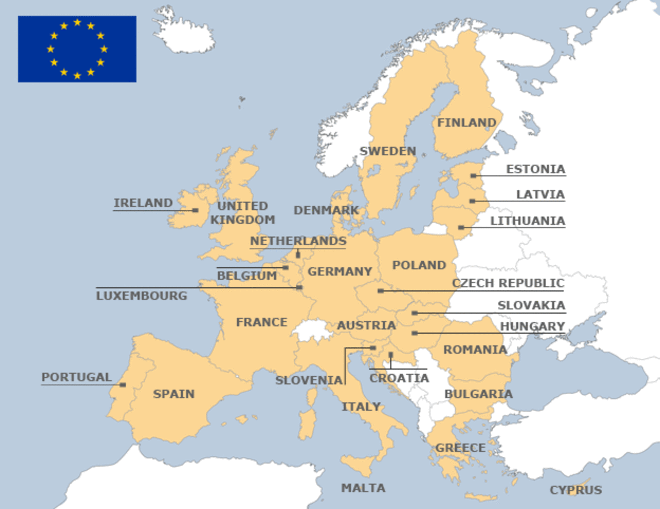
The EU has been facing an unprecedented assault on its borders with the refugee crisis. So much so that internal dissent about the free movement across the EU has never been higher. The Schengen agreement has been suspended and member states are reintroducing border controls. Political disparity across the member states ranges from far-left governments (Greece, Portugal….) to nationalistic governments which include far-right elements (Poland, Hungary…). Economic disparities across the member states are also extremely wide with the poverty (relative) of Greece and Romania at one end and the wealth of Scandinavia and Northern Europe at the other. Some members pay only lip service to fiscal responsibility and balanced budgets (inevitably these are left-of centre governments and includes France) while others keep within the nominally required deficit limit of 3% of GDP. Civic values are not homogeneous across the EU and individual behaviour follows national mores. In Greece, to pay tax is almost a “sin” and tax avoidance is a national game. In Sweden, it is almost considered a sin for a handyman to be paid in cash for fixing a creaking door and waiters are expected to declare and offer up their tips for taxation.

EU 28 members Oct 2013

EU 28 members Oct 2013

At the core of the EU idea has been a vision of a Holy European Empire which is far, far more than a free trade zone. It was a vision of a modern Utopia, a homogeneous Empire, a single state, administered from Brussels and stretching far into Asia, all the way till Kazakhstan. People would be citizens of Europe first. The nations would fuse their sovereignty into that of the Empire. Values and living standards and employment opportunity and prosperity would be uniform. There would be a single currency and a uniformity of education, health and welfare services across this new Empire. It would be a Holy Empire in that the values it espoused would be the envy of, and the standard aspired to by, the rest of the world.

There’s nothing wrong in having such a vision, but instead of trying to do this over a few centuries or a millennium, the EU has tried to do this over decades. Worse, EU leaders have not bothered to carry people with them but have allowed the administrators to lead the way. Country after country has been admitted to membership even though the disparities of values and prosperity and politics and behaviour were huge. In the last 30 years it has been an aggressively expansionist EU. The tail has been wagging the dog. Enforced monetary union has been used as tool to try and enforce a fiscal uniformity instead of being as a result of fiscal harmony. Free movement of labour has been encouraged before establishing harmony of unemployment and welfare benefits. There has been a significant number of people moving (always towards the more prosperous nations) – not for the sake of employment – but for the sake of the welfare services available. Brussels has became a place where the worst practices within member states become enshrined as the norm, rather than being from where best practices are disseminated.

The expansion has gone too far, too fast. And now the cracks can no longer just be papered over. The geographical boundaries have been expanded and the borders have become indefensible. So much so that “the fall of Rome” is being looked at as an analogy.

Business InsiderDutch Prime Minister Mark Rutte suggested that western European states might need to bring in a “mini-Schengen” to deal with the bloc’s migrant crisis, ….. He turned that into a more startling analogy, according to a report from the Financial Times. Here’s the kicker:

“As we all know from the Roman empire, big empires go down if the borders are not well-protected,” said Mr Rutte in an interview with a group of international newspapers. “So we really have an imperative that it is handled.”

Niall Ferguson is professor of history at Harvard University and writes in the Boston Globe:

Paris and the fall of Rome

…. Here is how Edward Gibbon described the Goths’ sack of Rome in August 410 AD:

“In the hour of savage license, when every passion was inflamed, and every restraint was removed . . . a cruel slaughter was made of the Romans; and . . . the streets of the city were filled with dead bodies . . . Whenever the Barbarians were provoked by opposition, they extended the promiscuous massacre to the feeble, the innocent, and the helpless . . .”

Now, does that not describe the scenes we witnessed in Paris on Friday night?

True, Gibbon’s “History of the Decline and Fall of the Roman Empire’’ represented Rome’s demise as a slow burn over a millennium. But a new generation of historians, such as Bryan Ward-Perkins and Peter Heather, has raised the possibility that the process of Roman decline was in fact sudden — and bloody —rather than smooth: a “violent seizure . . . by barbarian invaders” that destroyed a complex civilization within the span of a single generation.

…. Let us be clear about what is happening. Like the Roman Empire in the early fifth century, Europe has allowed its defenses to crumble. As its wealth has grown, so its military prowess has shrunk, along with its self-belief. It has grown decadent in its shopping malls and sports stadiums. At the same time, it has opened its gates to outsiders who have coveted its wealth without renouncing their ancestral faith. Uncannily similar processes are destroying the European Union today, though few of us want to recognize them for what they are. …….

It is conventional to say that the overwhelming majority of Muslims in Europe are not violent, and that is doubtless true. But it is also true that the majority of Muslims in Europe hold views that are not easily reconciled with the principles of our modern liberal democracies, including those novel notions we have about equality between the sexes and tolerance not merely of religious diversity but of nearly all sexual proclivities. And it is thus remarkably easy for a violent minority to acquire their weapons and prepare their assaults on civilization within these avowedly peace-loving communities. ……

…… I do know that 21st-century Europe has only itself to blame for the mess it is now in. ……. “Romans before the fall,” wrote Ward-Perkins in his “Fall of Rome,” “were as certain as we are today that their world would continue for ever substantially unchanged. They were wrong. We would be wise not to repeat their complacency.”

The EU has to put its grand visions of a Holy European Empire on the shelf for now. It has to focus on the building up of the fundamentals of economic prosperity and fiscal rigour and trade among its members, and forget – for now – its ambitions to force economic uniformity on its members. It has to stop interfering and trying to be a social engineer. Values cannot be imposed, they have to develop naturally. When all member states have achieved, each in its own time, a uniformity of values, fiscal structure and economic prosperity, a single currency will be the natural outcome. And if a Holy European Empire is ever to develop it can only do so when it becomes the obvious choice for the peoples of its member states.


While the EU debates whether they are immigrants or refugees – a toddler dies

September 2, 2015

Reuters - 3 year old toddler among 12 syrian refugees drowned 2nd september 2015

A Turkish police officer stands next to the body of the young boy. Photograph: Reuters

EU values in action.

It is an existential question. Is the EU its proclaimed values or its actual behaviour?

Immigrants, after all, are, by definition, “bad”. Refugees from countries democratised by the EU (among others) don’t exist. To seek sanctuary in the EU, asylum seekers should be able to prove that they face execution from wherever they fled.

 A Turkish police officer carries a young boy who drowned in a failed attempt to sail to the Greek island of Kos. Photograph: Reuters

A Turkish police officer carries a young boy who drowned in a failed attempt to sail to the Greek island of Kos. Photograph: Reuters

Cameron is the unlikely winner of the Greek referendum

July 6, 2015

There will be millions of words written about the Greek “No” to the conditions set by its international creditors and what it means. But what strikes me is that the only real winner is David Cameron.

For Greece and the EU it is a lose-lose situation. If the creditors soften their conditions, the Euro and the EU loses. If the creditors stand firm and Greece leaves the Euro, the sanctity of the Euro and membership of the Eurozone is gone forever. My view remains that the best for Greece and the EU is for a return to the drachma, an EU which shrinks its ambitions and a dissolution of the Euro.

If the creditors now soften their conditions and a Grexit from the Eurozone is avoided, it will demonstrate that the IMF, ECB and EU conditions will never be the final word again for any member country. Each will always have the option in any negotiation of calling a “referendum” to reject the terms. Any negotiation by a member country with the EU can use a referendum to finally reject an EU position. Any country can then reserve the right to put any EU Directive to a referendum and EU Directives will become merely guidelines to be accepted or rejected by member countries at will.

If, on the other hand, a Grexit does occur and the fatally flawed Euro experiment begins to come to an end, it will be emphatic evidence also that the entire concept of a new Holy European Empire is something only in the minds of a very few in Bonn and Paris and Brussels, but is not shared – at this time – by the general population (represented by the general Greek public). It is a concept either too far ahead of its time or possibly which will never be real. At any rate, for this time, it would demonstrate that it is fundamentally flawed.

And what strikes me is that this helps David Cameron both within the EU in his quest for renegotiation and even for treaty change. It even helps him domestically. He has had an issue of credibility in that he has called for an In/Out referendum where he will surely have to call for an “In” vote. His problem lies in being able to show that he has won enough during negotiations to justify an “In” recommendation. But now, with the Greek precedent, he can even demand the most drastic changes in Europe without being thrown out of any room. He is likely to get changes which were unthinkable yesterday. He can even go to a referendum ostensibly demanding an “Out” as a negotiating ploy, get an “Out” vote and then return to the negotiating table. He can call a second or even a third referendum (and if a bankrupt Greece can carry out a referendum within a week then surely the UK can manage something similar).

Referenda are now just a step in the EU negotiating process.

Greek deal will be done: Bread rather than Guernica

June 22, 2015

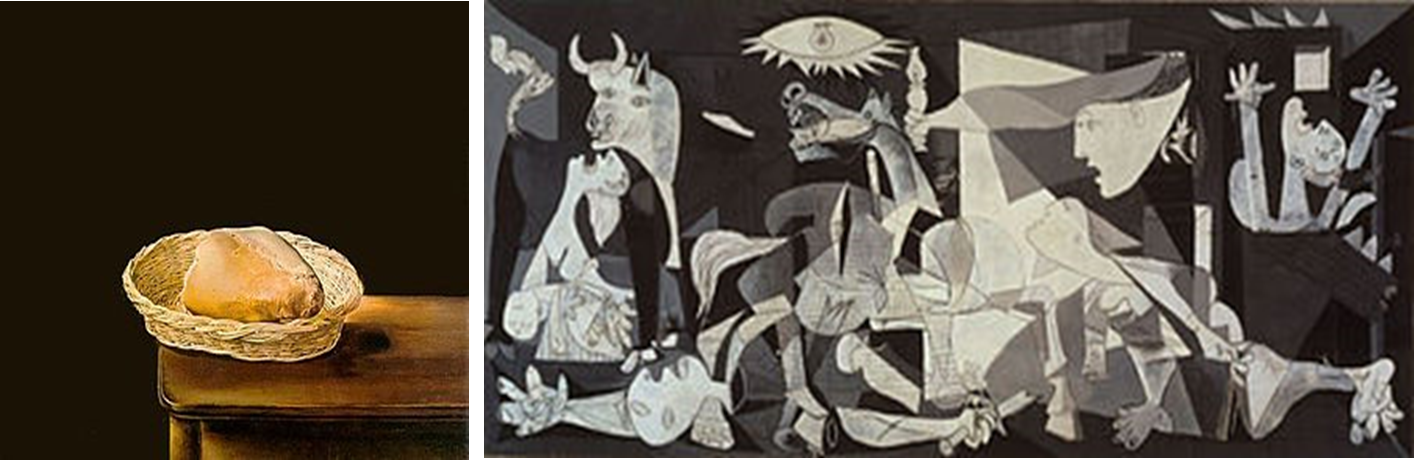
I was listening to Swedish, UK and German radio this morning and one could be forgiven for being utterly depressed. But surprisingly, the blackness went over the top. It was too much. The picture being painted by all the pundits and commentators seemed a little surreal. The picture left in my mind is of  Salvador Dali’s “Basket of Bread” rather than Picasso’s “Guernica”.

bread rather than destruction

bread rather than destruction

So instead, I am feeling remarkably upbeat. Maybe I am just an optimist and would rather see bread than destruction. But I am sufficiently “moved” that I shall make a forecast for the next few weeks.

Tsipras will make statements which seem like that he will do something about curtailing pensions. These will be worded sufficiently loosely such that the Eurozone Finance Ministers can accept the assurances and still have their posteriors covered. Tsipras will have sufficient face-saving text so that he can argue domestically that pensions will not actually be cut when the turnaround occurs and that the turnaround is just around the next corner (or maybe the one after that).

The ECB will make further emergency arrangements so that the current run on Greek banks will not be unmanageable. (By some accounts Greek banks have seen some €20 billion withdrawn).

The payment due to the IMF will be paid.

A short-term (6 month?) deal will be done and the whole problem of a non-homogeneous and splintered Eurozone will be patched up for the short term

Which is good for the short term but which, in the long term and if the Eurozone does not become homogeneous, will give a very big bang when it implodes.

There is a little more brinkmanship to go through until the Greek payment actually falls due at then end of the month.  But I expect a real jump in European markets – and followed by the Asian markets – when Greece makes the payment due and a “deal” is announced. Probably by the end of June.

Maybe it is time to pick up some equity bargains.

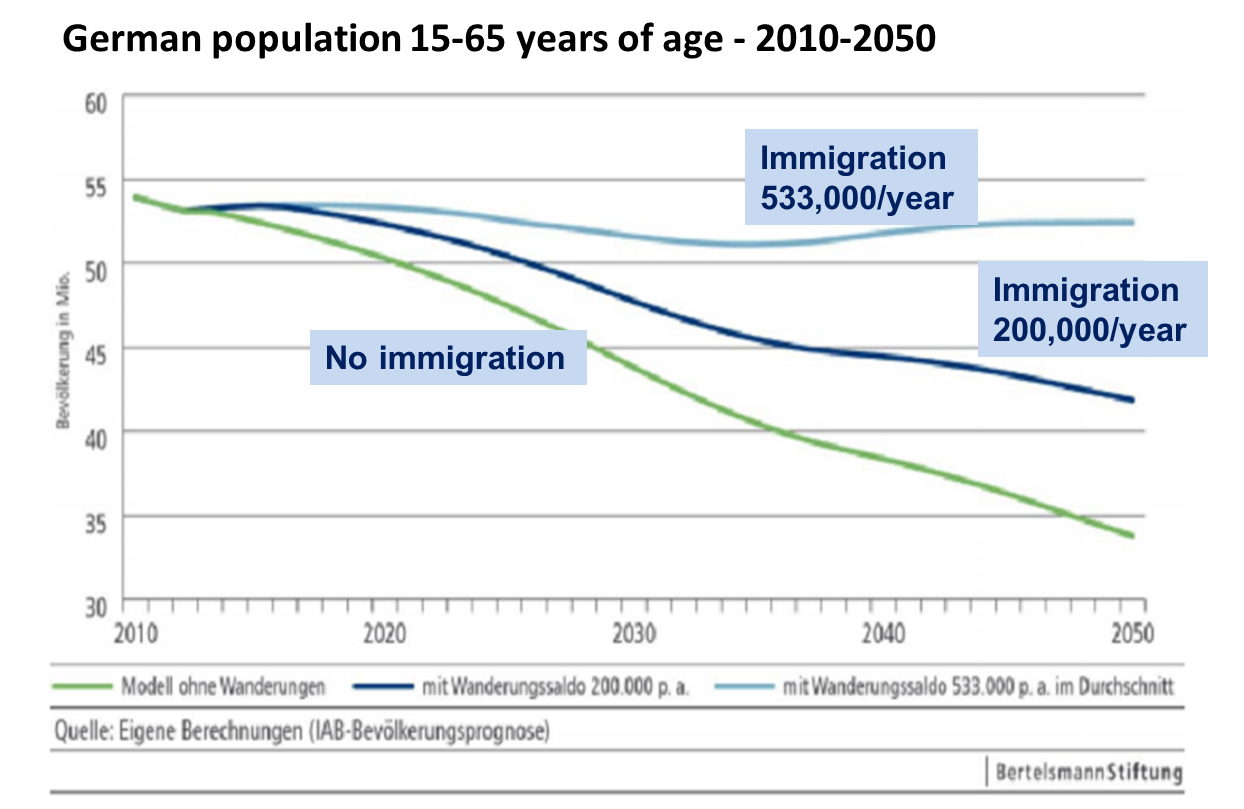
Germany needs 500,000+ immigrants every year till 2050

March 27, 2015

A new study has just been published by the Bertelsmann Stiftung:

Zuwanderungsbedarf aus Drittstaaten in Deutschland bis 2050

Press Release: Without immigrants, the potential labor force would sink from approximately 45 million today to less than 29 million by 2050 – a decline of 36 percent. This gap cannot be closed without immigration. Even if women were to be employed at the same rate as men, and the retirement age was increased to 70 in 2035, the number of potential workers in the country would rise by only about 4.4 million.

In 2013, a total of 429,000 more people came to Germany than left the country. Last year, the net total was 470,000, the Federal Statistical Office reports. According to the study, net immigration at this level would be sufficient for at least the next 10 years to keep the country’s potential labor force at a constant level. From that time onward, however, the need for immigrants will grow, because the baby-boomer generation will be entering retirement. One out of two of today’s skilled workers with professional training will have left the working world by 2030. …

….. the current high levels of immigration from EU countries (2013: around 300,000) will soon decline significantly, as demographic change is shrinking populations across the European Union, and because incentives to emigrate in crisis-stricken countries will decline with economic recovery. The experts forecast an annual average of just 70,000 immigrants or fewer from EU counties by 2050. For this reason, efforts to attract skilled workers from non-EU countries should be intensified. …

German working population  development

German working population development – Bertelsmann Stiftung

This is not a picture that is unique to Germany in Europe. Moreover just keeping the working population constant does not allow for the additional numbers who are ageing and whose “pensions” whether from the Sate of from private sources must be supported by a corresponding growth in the resource funds.

All politicians are well aware of the demographic inevitabilities in Europe. But they have not yet managed to convince all their constituencies that “old Europe” has to renew and reinvent itself. A “new Europe” cannot hark back to the days of the Crusades. Few, if any, politicians in today’s Europe and on the right of the divide, have had the courage to point out that immigration from outside the EU is necessary and that these immigrants must be speedily integrated. Few of the politicians on the left of the divide have either had the courage to point out that a multiethnic society still requires a single over-riding culture (set of values) which may then have as many subordinate cultures as desired. Few have had the courage to point out that “multiculturalism” does not allow a single society to be sustained. If these politicians truly want to take care of their children’s children they will have to come to terms with the reality of the cold hand of demographics. The only alternative to immigration – but hardly viable – is a Europe-wide “baby production” policy which would have to discourage abortions and maximise incentives for having children. Fertility clinics and multiple births could always be heavily subsidised.

But I can’t help feeling that EU immigration policy cannot be just based on “asylum seekers”. Any such policy must be built on demographic realities and must be based on needed skills (and on the provision of training in the needed skills) and not just on “asylum seekers” and the random set of skills that that represents.

EU 2009 Ageing Report:

…. low birth rates, rising life expectancy and continuing inflow of migrants can be expected to result in an almost unchanged, but much older, total EU population by 2060, meaning that the EU would move from having four working-age people (aged 15-64) for every person aged over 65 to a ratio of only two to one. The largest decrease is expected to occur during the period 2015-35 when the baby-boom cohorts will be entering retirement. …….

The fiscal impact of ageing is therefore projected to be substantial in almost all Member States, becoming apparent already over the course of the next decade. Overall, on the basis of current policies, age-related public expenditure is projected to increase on average by about 4¾ percentage points of GDP by 2060 in the EU and by more than 5 percentage points in the euro area – especially through pension, healthcare and long-term care spending.

Muddled EU and an indecisive US help Russia emerge from the Cold War doldrums

March 9, 2014

The Soviet Union was dissolved 23 years ago. The experiment of exporting and imposing the Russian vision of socialism on 14 other countries had collapsed in spectacular fashion. It was a resounding victory for Ronald Reagan, Rambo, Capitalism, Democracy and “Western” values – in that order. The 15 post Soviet countries were then Armenia, Azerbaijan, Belarus, Estonia, Georgia, Kazakhstan, Kyrgyzstan, Latvia, Lithuania, Moldova, Russia, Tajikistan, Turkmenistan, Ukraine and Uzbekistan. Countries within their influence but not part of the Soviet Union broke free and looked to find a new place in the growing and expansionist European Union. Czechoslavakia split. Yugoslavia fractured into many pieces. And Europe picked up the pieces. On the back of their economic problems and the dissolution of their Empire, Russia had no diplomatic clout left to speak of. They did inherit the Soviet seat on the Security Council along with its veto and that kept them at the big table if rather ineffective.

But all that is beginning to change. There is a long way to go but with its wealth of resources the Russian economy is beginning to recover. There is a resurgence of Russian diplomacy. Russian diplomats are beginning to have opinions on all matters of substance. They are aided and abeted by a muddled and meddlesome EU together with an indecisive and risk-averse President in the US.

In foreign as with economic policy the EU is a place of very many voices. Some members are looking to create a successor to the Holy Roman Empire with a Holy European Empire. Others are looking to create the United States of Europe. Some want in for the benefits but want out of the costs. But rather than being a place for the dissemination of best practices it has become a hodge-podge where the lowest common denominator applies. They claim to share the same “values” of equality and freedom but none of them like dirty gypsies from Romania. The European Parliament and the European commission add layers of fairly useless politicians and bureaucrats. If only there had been a rule that every sinecure created at the European level would have been accompanied by a reduction at a country level! Radicalised youth in the EU now provide cannon fodder for many conflicts around the world. On all possible sides. The UK and France provide psychopathic young muslims to conflicts in the Middle East and North Africa. French and German and Swedish skinheads travel to the Ukraine to support the neo-nazi Right Sector.

With so many countries in the EU it is not too surprising that they get confused. A referendum in the Crimea is illegal but a referendum in Scotland is OK. They have been fooled into supporting miltant islamists in Syria and have handed the opposition into the control of Al Qaida. They have tried to meddle in the Ukraine and only succeeded in building up the neo-nazi Right Sector and in provoking Russia to enter the Crimea ostensibly to support the Russian origin population. One Swedish politician today suggested implementing a fast track entry for the Ukraine into the EU “as a signal to the Russians”. Little people trying to be politicians on the world stage. With 28 member states and 8 more in the wings, with a full range of political opinions in each country, it is hardly surprising that what emerges as policy, from the attempt to be balanced, borders on idiocy. Meanwhile the US is tired of its expensive adventures in Iraq and Afghanistan which have achieved very little. President Obama is looking to disengage wherever he can. To take on new risk is anathema. In Syria, Obama kept re-drawing red lines, and kept retreating behind them. That proxy war is being won by the Assad regime supported by Russia. The US and the EU no longer know who they support – or should support –  in Syria.

Syria and the Ukraine are just examples. A confused EU together with an indecisive US are providing the Russians with opportunities to test their diplomatic skills and to test the resolve of the EU and the US.

And judging by the results so far, neither the US nor the EU has a sticking point. There is not a leader in sight.

EU Corruption Report: Brussels bureaucrats kill chapter on corruption in EU Institutions

February 3, 2014

The EU corruption report is out today and is getting a lot of media attention. It has no big surprises and estimates the cost of corruption directly in the member states to be about 120 billion € which is about the same size as the EU budget and is about 1% of the total EU GDP at about 12 trillion €.

But – in a major victory for the faceless bureaucrats of Brussels – the report does not consider corruption within EU Institutions as it was supposed to. My perception is that the corruption level within the EU Institutions is as bad as in the worst member state. In Brussels where the bureaucrats are drawn from member countries, the practices they employ are imported from what they are used to in their home countries. And Brussels – in my little experience and in my opinion – is perfectly suited to levelling-down and to the spreading of the worst practices available.

EU Observer: The European Commission has decided not to include a chapter on EU institutions in a report on corruption in member states …. The original plan, announced in 2011, was to assess corruption across the member states and within the EU institutions. EU home affairs commissioner Cecilia Malmstrom is set to release the first bi-annual report on Monday (3 February), around six months later than originally planned.

Malmstrom’s spokesperson Michael Cercone told this website in an email that the commission had considered assessing the anti-corruption efforts of the EU’s own institutions but “realised that this is something we will have to come back to in a future EU anti-corruption report – to be sure that the evaluation would be satisfactory and objective.”

And when this part of the report does come out – if it is ever completed – it will ensure that the analysis is set so far in the past that no current bureaucrats/politicians will be implicated.

But the size of the corruption suggests that while petty corruption is much lower than in some developing countries, the extent of large sophisticated contract scams is not insignificant. It takes a few thousands of petty corruption events to come up to the level of a single large contract scam. The Report points out that:

The individual country analyses revealed a wide variety of corruption-related problems, as well as of corruption control mechanisms, some of which have proved effective and others have failed to produce results. Nevertheless, some common features can be noted either across the EU or within clusters of Member States. The country analyses show that public procurement is particularly prone to corruption in the Member States, …..

Of course the EU countries exhibit a wide variety of behaviour and some member states view the payment of “fees” or the exchange of “favours” to get an advantage as a normal activity. As the report states “However, the long-standing absence of comprehensive anti-corruption strategies in some Member States which are facing systemic corruption problems turned out to be an issue of concern, ..”.  There is a political dimension as well Provoked by the crisis, social protests have targeted not only economic and social policies, but also the integrity and accountability of political elites. High-profile scandals associated with corruption, misuse of public funds or unethical behaviour by politicians have contributed to public discontent and mistrust of the political system. Integrity in politics is a serious issue for many Member States….”.

Oh well! Business will continue as usual in Brussels.