Posts Tagged ‘Existence’

Is the Principle of Least Resistance the Zeroth Law of Being?

June 22, 2025

The underlying compulsion

Is thrift, parsimony, a sort of minimalism, part of the fabric of the universe?

Occam’s razor (known also as the principle of parsimony) is the principle that when presented with alternative explanations for the same phenomenon, the explanation that requires the fewest assumptions should be selected. While Occam’s razor is about how to think and describe phenomena, I am suggesting that parsimony of action, the path of least resistance is deeply embedded in causality and in all of existence.

Why is there something rather than nothing? Why does the universe exist? The answer is all around us. Because it is easier to be than not to be. Because at some level, in some dimension, in some domain of action and for some determining parameter, there is a greater resistance or opposition to not being than to being. Why does an apple fall from a tree? Because there is, in the prevailing circumstances, more resistance to it not falling than in falling. At one level this seems – and is – trivial. It is self-evident. It is what our common-sense tells us. It is what our reason tells us. And it is true.

It also tells us something else. If we are to investigate the root causes of any event, any happening, we must investigate the path by which it happened and what was the resistance or cost that was minimised. I am, in fact, suggesting that causality requires that the path of sequential actions is – in some domain and in some dimension – a thrifty path.

A plant grows in my garden. It buds in the spring and by winter it is dead. It has no progeny to appear next year. Why, in this vast universe, did it appear only to vanish, without having any noticeable impact on any other creature, god, or atheist? Some might say it was chance, others that it was the silent hand of a larger purpose. But I suspect the answer is simpler but more fundamental. The plant grew because it was “easier”, by some definition for the universe, that it grow than that it not grow. If it had any other option, then that must have been, by some measure, more expensive, more difficult.

In our search for final explanations – why the stars shine, why matter clumps, why life breathes – we often overlook a red thread running through them all. Wherever we look, things tend to happen by the easiest possible route available to them. Rivers meander following easier paths and they always flow downhill, not uphill. Heat flows from warm to cold because flowing the other way needs effort and work (refrigerator). When complexity happens it must be that in some measure, in some domain, staying simple faces more resistance than becoming complex. How else would physics become chemistry and form atoms and molecules? Why else would chemistry become biochemistry with long complex molecules? Something must have been easier for biology and life to be created than to not come into being. The bottom line is that if it was easier for us not to be, then we would not be here. Even quantum particles, we are told, “explore” every possible path but interfere in such a way that the most probable path is the one of least “action”. This underlying parsimony – this preference for least resistance – might well deserve to be raised to a status older than any law of thermodynamics or relativity. It might be our first clue as to how “being” itself unfurls. But is this parsimony really a universal doctrine or just a mirage of our imperfect perception? And if so, how far does it reach?

We can only elucidate with examples. And, of course, our examples are limited to just that slice of the universe that we can imperfectly perceive with all our limitations. Water finds the lowest point (where lowest means closest to the dominant gravitational object in the vicinity). Light bends when it moves from air into glass or water, following the path that takes the least time. Time itself flows because it is easier that it does than it does not. A cat, given the choice between a patch of bare floor and a soft cushion, unfailingly selects the softer path. It may seem far-fetched, but it could be that the behaviour of the cat and the ray of light are not just related, they are constrained to be what they are. Both are obeying the same hidden directive to do what costs the least effort, to follow a path of actions presenting the least resistance; where the minimisation of effort could be time, or energy, or discomfort, or hunger, or something else.

In physics, this underlying compulsion has been proposed from time to time. The Principle of Least Action, in physics, states that a system’s trajectory between two points in spacetime is the one that minimizes a quantity called the “action”. Action, in this context, is a quantity that combines energy, momentum, distance, and time. Essentially, the universe tends towards the path of least resistance and least change. Newton hinted at it; Lagrange and Hamilton built it into the bones of mechanics. Feynman has a lecture on it. The principle suggests that nature tends to favor paths that are somehow “efficient” or require minimal effort, given the constraints of the system. A falling apple, a planet orbiting the Sun, a thrown stone: each follows the path which, when summed over time, minimizes an abstract quantity called “action”. In a sense, nature does not just roll downhill; it picks its way to roll “most economically”, even if the actual route curves and loops under competing forces. Why should such a principle apply? Perhaps the universe has no effort to waste – however it may define “effort” – and perhaps it is required to be thrifty.

The path to life can be no exception

Generally the path of least resistance fits with our sense of what is reasonable (heat flow, fluid flow, electric current, …) but one glaring example is counter-intuitive. The chain from simple atoms to molecules to complex molecules to living cells to consciousness seems to be one of increasing complexity and increasing difficulty of being. One might think that while water and light behave so obligingly, living things defy the common-sensical notion that simple is cheap and complex is expensive. Does a rainforest  – with its exuberant tangle of vines, insects, poisons, and parasites  – look like a low-cost arrangement? Isn’t life an extremely expensive way just to define and find a path to death and decay?

Living systems, after all, locally do reduce entropy, they do build up order. A cell constructs a complicated molecule, seemingly climbing uphill against the universal tendency for things to spread out and decay. But it does so at the expense of free energy in its environment. The total “cost”, when you add up the cell plus its surroundings, still moves towards a cheaper arrangement overall and is manifested as a more uniform distribution of energy, more heat deposited at its lowest temperature possible. Life is the achieving of local order paid for by a cost reckoned as global dissipation. Fine, but one might still question as to why atoms should clump into molecules and molecules into a cell. Could it ever be “cheaper” than leaving them separate and loose? Shouldn’t complex order be a more costly state than simple disorder? In a purely static sense, yes. But real molecules collide, bounce, and react. Some combinations, under certain conditions, lock together because once formed they are stable, meaning it costs “more” to break them apart than to keep them together. Add some external driver – say a source of energy, or a catalyst mineral surface, or a ray of sunlight – and what might have stayed separate instead finds an easier path to forming chains, membranes, and eventually a primitive cell. Over time, any accessible path that is easier than another will inevitably be traversed.

Chemistry drifts into biochemistry not by defying ease, but by riding the easiest local, available pathway. It is compulsion rather than choice. Action is triggered by the availability of the pathway and that is always local. Evolution then – by trial and error – makes the rough first arrangement into a working organism. Not a perfectly efficient or excellent organism in some cosmic sense, but always that which is good enough and the easiest achievable in that existential niche, at that time. One must not expect “least resistance” to provide a  perfection which is not being sought. A panda’s thumb is famously clumsy – but given the panda’s available ancestral parts, it was easier to improvise a thumb out of a wrist bone than to grow an entirely new digit. Nature cuts corners when it is cheaper than starting over.

Perhaps the reason why the spark of life and the twitch of consciousness evade explanation is that we have not yet found – if at all we are cognitively capable of finding – the effort that is being minimised and in which domain it exists. We don’t know what currency the universe uses and how this effort is measured. Perhaps this is a clue as to how we should do science or philosophy at the very edges of knowledge. Look for what the surroundings would see as parsimony, look for the path that was followed and what was minimised. Look for the questions to which the subject being investigated is the answer. To understand what life is, or time or space, or any of the great mysteries we need to look for the questions which they are the answers to.

Quantum Strangeness: The Many Paths at Once

Even where physics seems most counter-intuitive, the pattern peeks through. In quantum mechanics, Richard Feynman’s path integral picture shows a particle “trying out” every possible trajectory. In the end, the most likely path is not a single shortest route but the one where constructive interference reinforces paths close to the classical least-action line. It also seems to me – and I am no quantum physicist – that a particle may similarly tunnel through a barrier, apparently ignoring the classical impossibility. Yet this too follows from the same probability wave. The path of “least resistance” here is not some forbidden motion but an amplitude that does not drop entirely to zero. What is classically impossible becomes possible at a cost which is a low but finite probability. Quantum theory does not invalidate or deny the principle. It generalizes it to allow for multiple pathways, weighting each by its cost in whatever language of probability amplitudes that the universe deals with.

It is tempting to try and stretch the principle to explain everything, including why there is something rather than nothing. Some cosmologists claim the universe arose from “quantum nothingness”, with positive energy in matter perfectly balanced by negative energy in gravity. On paper, the sum is zero and therefore, so it is claimed, no law was broken by conjuring a universe from an empty hat. But this is cheating. The arithmetic works only within an existing framework. After all quantum fields, spacetime, and conservation laws are all “something”. To define negative gravitational energy, you need a gravitational field and a geometry on which to write your equations. Subtracting something from itself leaves a defined absence, not true nothingness.

In considering true nothingness – the ultimate, absolute void (uav) – we must begin by asserting that removing something from itself cannot create this void. Subtracting a thing from itself creates an absence of that thing alone. Subtracting everything from itself may work but our finite minds can never encompass everything. In any case the least resistance principle means that from a void the mathematical trick of creating something here and a negative something there and claiming that zero has not been violated is false (as some have suggested with positive energy and negative gravity energy). That is very close to chicanery. To create something from nothing demands a path of least resistance be available compared to continuing as nothing. To conjure something from nothing needs not only a path to the something, but also a path to the not-something. Thrift must apply to the summation of these paths otherwise the net initial zero would prevail and continue.

The absolute void, the utter absence of anything, no space, no time, no law, is incomprehensible. From here we cannot observe any path, let alone one of lower resistance, to existence. Perhaps the principle of least resistance reaches even into the absolute zero of the non-being of everything. But that is beyond human cognition to grasp.

Bottom up not top down

Does nature always find the easiest, global path? Perhaps no, if excellence is being sought. But yes, if good enough is good enough. And thrift demands that nature go no further than good enough. Perfect fits come about by elimination of the bad fits not by a search for excellence. Local constraints can trap a system in a “good enough” state. Diamonds are a textbook example. They are not the lowest-energy form of carbon at the Earth’s surface, graphite is. Graphite has a higher entropy than diamond. But turning diamond into graphite needs an improbable, expensive chain of atomic rearrangements. So diamonds persist for eons because staying diamond is the path of least immediate, local resistance. But diamonds will have found a pathway to graphite before the death of the universe. The universe – and humans – act locally. What is global follows as a consequence of the aggregation, the integral, of the local good enough paths.

Similarly, evolution does not look for, and does not find, the perfect creature but only the one that survives well enough. A bird might have a crooked beak or inefficient wings, but if the cost of evolving a perfect version is too high or requires impossible mutations, the imperfect design holds. A local stability and a local expense to disturb that stability removes a more distant economy from sight.

Thus, the principle is best to be stated humbly. Nature slides to the lowest, stable, accessible valley in the landscape it can actually access, not necessarily the deepest valley available.

A Zeroth Law or just a cognitive mirage

What I have tried to articulate here is an intuition. I intuit that nature, when presented with alternatives is required to be thrifty, to not waste what it cannot spare. This applies for whatever the universe takes to be the appropriate currency – whether energy, time, entropy, or information. In every domain where humans have been able to peek behind the curtain, the same shadow of a bias shimmers. The possible happens, the costliest is avoided, and the impossible stays impossible because the resistance is infinite. In fact the shadow even looks back at us if we pretend to observe from outside and try and lift the curtain of why the universe is. It must apply to every creation story. Because it was cheaper to create the universe than to continue with nothingness.

It may not qualify as a law. It is not a single equation but a principle of principles. It does not guarantee simplicity or beauty or excellence. Nature is perfectly happy with messy compromises provided they are good enough and the process the cheapest available. It cannot take us meaningfully to where human cognition cannot go, but within the realm of what we perceive as being, it might well be the ground from which more specific laws sprout. Newtons Laws of motion, Einstein’s relativity, Maxwell’s equations and even the Schrödinger equation, I postulate, are all expressions of the universe being parsimonious.

We can, at least, try to define it: Any natural process in our universe proceeds along an accessible path that, given its constraints, offers the least resistance compared to other possible paths that are accessible.

Is it a law governing existence? Maybe. Just as the little plant in my garden sprouted because the circumstances made it the easiest, quietest, cheapest path for the peculiar combination of seeds, soil, sunlight, and moisture that came together by chance. And in that small answer, perhaps, lies a hint for all the rest. That chance was without apparent cause. But, that particular chance occurred because it was easier for the universe – not for me or the plant – that it did so than that it did not. But it it is one of those things human cognition can never know.

Home truths 1: Science & Philosophy

July 26, 2024

I find it ridiculous that the general assumption is that we know all about gravity. The reality is that we have no idea about why it exists or how the force of gravitation works. We can calculate the effects of gravity essentially still using Newton’s laws together with Einstein’s tweaks. But we have not the faintest idea about how one mass attracts another or why it should. How does the sun communicate with the planets and tell them what force applies  – if it does. A fundamental particle called the graviton is the proposed solution but we have never found one and it lives in the land of the Jumblies. We do not even have any idea what mass is. Physics even has massless particles (the gluon, the photon and the imaginary graviton) but only the God of Physics knows what massless, matter-less stuff such particles may contain. The reality is that science is strictly limited. It is limited by its fundamental assumptions and its boundary conditions. It cannot address matters outside of these conditions.

We put down motion at a distance to forces such as gravitational or electromagnetic. But we really have no idea how these forces are mediated. Probably by Mysterious Quantum Wave Functions which collapse conveniently when needed. But who knows why they exist? And let us be clear. Particles do not exist in two places at the same time. Never. And any physics which says so lives in the land of the Jumblies.

I am just trying to clear my mind by writing down my (current) home truths. I have chosen to arrange my “core beliefs” in three categories as 3 separate posts.

  1. Science & Philosophy
  2. Behaviour
  3. Society & Politics

I start with Science and Philosophy. The list below could have been much longer but I stopped when I started getting bored.


Home truths 1: Science & Philosophy

  1. We have no clue as to the question which existence is the answer to.
  2. We only have circular definitions for truth but what does exist (we assume) is true.
  3. The human mind is finite. There are things that are known, things that are knowable but unknown and there are things that cannot be known (the unknowable).
  4. Infinity, by definition, is a label – in language – for that which cannot be comprehended.
  5. Boundless, endless, timeless and infinite, just like before the beginning and after the end, are labels for the incomprehensible, no matter what the pretense.
  6. The human capability for language is genetic and unmatched by any other species on earth.
  7. The capability for language is discovered but all languages are invented.
  8. Once the concept of oneness – identity / one(1) – is defined, all other numbers of every kind are fixed. Once one (1) exists every other number of every kind automatically follows. Note that zero comes after 1 and derives from 1 – 1.
  9. One and all the numbers derived therefrom are concepts and do not exist explicitly in nature.
  10. All numbers are unreal and abstract.
  11. The process of counting and all of what is now called number theory are also derived from, and fixed by, the concept of one.
  12. Mathematics describes abstract relationships and abstract patterns connecting abstract concepts and does this using a number of invented languages. It is not a science.
  13. The practice of mathematics is art rather than science.
  14. Language is what gives humans the ability to describe the unreal, the past, the future and to lie.
  15. All languages are silent about the truth value of what is being described by language.
  16. Nonsense language is the perfectly correct use of language but where the content is nonsense.
  17. To create nonsense language or nonsense mathematics (in the manner of Edward Lear or Srinivasa Ramanujam) needs very great skill and great proficiency in the language.
  18. Mathematical equations are just propositions, as any sentence in any language, and are silent about the truth value of the content.
  19. Writing a mathematical equation provides no proof of that equation.
  20. Time is unidirectional and a brute fact of our universe. Negative time is not possible in our universe.
  21. The flow of time and existence emerge together.
  22. Mathematical equations for theories having negative time are merely nonsense mathematics (correct by the rules of mathematics but having nonsense as content).
  23. Physics and other scientific theories which do not explicitly exclude the possibility of negative time are incomplete or false.
  24. Scientific theories which are silent or are unable to exclude the possibility of negative time do not imply any support for the possibility of negative time.
  25. No logic system (or science) can ever prove the fundamental assumptions it is itself based upon.
  26. Science assumes that existence, the flow of time, causality, life and consciousness are all self-evident. Therefore science cannot address, let alone explain, any of them.
  27. Anything truly random (without cause) is inexplicable. Random is part of what we cannot know (or else it is Divine).
  28. Every scientific discipline assumes that cause precedes effect but ignores the unavoidable first cause problem.
  29. The Cosmic Big Bang theory cannot explain why there had to be a Big Bang.
  30. Matter forever or matter from nothing are equally inexplicable and unsatisfactory.
  31. Mass “is the amount of matter in matter” which means we have no clue as to what mass is.
  32. We do not know why there are as many “fundamental” particles as there are (or seem to be).
  33. We do not know why the fine structure constant is exactly the number that it is (or why the speed of light is what it is).
  34. Something from nothing cannot be explained by any Science nor by any theology or belief in a God.
  35. Time without beginning cannot be explained by any Science nor by any theology or belief in a God.
  36. A global zero made up of an arbitrary  local “+ dark energy” and balanced by a local “- gravitation energy” proves nothing.
  37. The concept of nothingness is beyond the finite human mind. (Zero derives from 1 and is not a description of nothingness).
  38. Why the universe (including its dimensions, matter, energy and all other properties) is compelled to exist is unknown. (This is an alternative formulation of home truth 1.1)
  39. There is no known explanation for the spark of life.
  40. Consciousness is a mystery without explanation.
  41. Though we can calculate its effects, nobody has the faintest inkling of how gravity is mediated or how it works.
  42. Nobody has a clue as to how large the universe (and not just the observable universe) is (or how big the Big Bang was).

When the tree falls in the forest, the sound is only due to language

May 1, 2022

The classic, cliched question goes:

“If a tree falls in a forest and no one is around to hear it, does it make a sound?”

The non-philosophical part of question is easily answered.

  • If a tree falls within an extant medium, and
  • there is consequent vibration within that medium, and
  • there is an organ which can detect such vibrations, and
  • the organ generates impulses, and
  • it sends these impulses to a brain, and
  • that brain interprets the impulses as something the brain itself labels as sound, then
  • there will be sound.

If the tree fell in a vacuum there would be no vibration of anything. No medium, no sound. No ear, no sound. No brain. no sound. In fact, if we did not have ears connected to our brains our language would be unable to come up with words for ears, hearing or sound. If we had no word for sound then there might well be vibrations when the tree fell, but there would be no sound. The non-philosophical answer then becomes that if we had no word in language for sound then there would be no sound. When a dog or a bat detects vibrations at frequencies that our ears cannot detect then such signals never reach our brains to ever be classified in our language as sound. What an animal might interpret in its brain when its ears detect signals is whatever that animal interprets it or labels it to be.  Only if we define the word sound to loosely mean what any brain may interpret on receiving signals from any ear-like organ, could we say that the animal discerns sound.

The philosophical part of the question, however, which considers perception, observation and existence is much more interesting. There are many things we cannot directly experience with our limited senses. But we can infer and/or deduce that they exist by their interactions with other things giving changes which we can observe directly. We extend our senses by creating wonderful instruments which then produce changes observable directly by our traditional senses. We “see” in the ultraviolet or the infra-red only because our cameras convert these UV or IR signals into images that do fall within our visible range.

But what of all that we cannot observe, directly or indirectly, by our limited senses and our finite brains? Is it so that if something cannot be observed, cannot be perceived, cannot be inferred to exist by any interaction it has with anything else in this universe, then it does not exist? Or is it merely that we are ignorant of its existence? Philosophy is, of course, about asking unanswerable questions. Once a question can be answered it leaves the field of philosophy.

Take bongism for example. We cannot observe it, perceive it, infer it or deduce it. It has no known interactions with anything else in this universe. But it is the imbalance in bongism which caused all existence in the first place. It is the answer to the question “Why do things exist at all?”.

Does bongism exist?

It must do, since I have a word for it.


God or no-God? That is the wrong question

August 24, 2021

I find debates where one unprovable belief battles against other unprovable beliefs to be tiresome. Human cognition does not allow an absence of belief. A claimed non-belief is, of course, just another belief. I find statements of the kind “I do not know, but I know it isn’t that” to be self-contradictory and shallow. I find invocation of the scientific method, or of Divine Beings, without reference to boundary conditions and the limits of knowability, to be incomplete and invalid as arguments. This essay is just my attempt to marshal my own thoughts as to why I find it so.

(revised 26th August 2021)

The primal need to know

Human cognition demands that the world around us is ordered and rational and that it is capable of being understood. This is the fundamental and overriding assumption that pervades all thought and human endeavour. Science begins with this assumption of order in all parts of the universe and throughout all time. In addition, science assumes that causality, and the arrow of time, apply. The human brain is finite, and its attendant senses are limited. We do extend our sensory range with instruments but even these must convert their detected signals to be what humans can perceive directly by their senses and interpret with their brains. Even when looking at the same thing, what the eyes of a dog see as interpreted by a canine brain, is different to what a human eye sees as interpreted by a human brain. Whatever, and all, that humans observe are just their perceptions and are always subjective.

Human comprehension is “cabined, cribbed, confined, bound in” by the capabilities of the brain/sense combination. That some things are unknowable to the finite human mind is inevitable. Reason tells us that knowledge is whatever a brain can comprehend to be knowledge. Epistemology is a whole branch of philosophy dedicated to understanding the nature of knowledge. And yet we can do little better than concluding from all our analyses that knowledge is what knowledge is. Whatever lies beyond human comprehension is the realm of the unknowable. Observation is limited to what exists and is observable by the human brain/sense combination. Human reason and comprehension, though finite, can contemplate the unknowable, but without any hope of comprehension. Human language (including mathematics) can encompass both the real and the unreal. Language can describe things that do not exist. But when language addresses the unknowable it only deals in labels. The brain using that language cannot wrap itself around the unknowable which it labels. What we do not know, we seek and sometimes find. What we cannot know we can never find, and yet we seek. I cannot help but conclude that it is the seeking, not the acquisition, of knowledge, which is a primal characteristic (perhaps a purpose) of the human species.

But the ego of human cognition is such that it does not allow the inexplicable to remain dangling and unaddressed. That all mysteries must have, and require, explanation is a distinguishing characteristic of the human species. Human cognition abhors a mystery without an explanation. Anything mysterious or incomprehensible is always, eventually, explained away by an appropriate invocation of unknown, unknowable, imagined states or powers. It applies as much to science (metaphysics) as to philosophy or to theology. The explanations are often just labels for speculations which harness the unknown and the supernatural. Reason tells us that everything has a cause, but the First Cause problem defeats us. Our language allows us to formulate self-contradictory impossibilities. Before the beginning, we say and after the end. When our reason and our logic make recourse to infinite regress, it is often dismissed because it is incomprehensible. When we reach the unknowable, we invent new labels for abstract concepts such as divine or supernatural or infinity or forever. Never mind that they are unknowable. An infinite space or a forever existence are inherently incomprehensible and magical. We pretend that inventing a label brings us closer to understanding.

God Theories and the invention of Gods

In human discourse, the invention of God Theories and of Gods came about as we sought answers and explanations for inexplicable relationships observed in the surrounding physical world. The invocation of Sun-gods and wind-gods and weather-gods seems both obvious and inevitable in the early history of man. The invented explanations – again inevitably – required the existence of supernatural states and the exercise of powers beyond human capability. It was entirely logical and reasonable, then, that postulating the existence of supernatural or superhuman powers or states was entirely justified by the greater need to bring a perceived order to the observed world. To have a perceived order in the physical world was primal. The emotional human need for spirituality was also partly satisfied by the inclusion of the supernatural. With this world view, which allowed incomprehensible states and supernatural powers, these Great Explanations invoking the unknowable were quite reasonable, even if they were all merely labels for what could not be comprehended. Mysteries were replaced by labels which implied, but never actually bestowed, understanding. As human knowledge and sophistication increased, the need for the supernatural also adjusted to the new mysteries uncovered. It was not necessary for these supernatural states or powers to be invested in imaginary Beings, but some mediator was necessary for the exercise of supernatural powers. What the human mind considers reasonable is dynamic and shifts as learning occurs and knowledge increases. Given the existence of unknown, extra-natural forces, it was entirely reasonable, then, to imagine a living entity, a Being, as the mediator. Doing so certainly did improve the narrative. The first Sun God had the power to make the Sun rise every day. This explanation did not necessarily have to be invested in a Being, but it was convenient. It was merely for the ease of the narrative that these Beings took on forms and shapes and behaviours that were close enough to human forms and behaviours to be recognised and identified with. And so were born the Theories of Gods, the Gods, and the various pantheons of gods.

It is my contention that

  1. Human comprehension is finite and limited, and
  2. demands that order be perceived in the world.
  3. Incomprehensibilities and mysteries need to be explained to maintain the perceived order of the world, and
  4. invoking supernatural states and powers allows unanswerable questions and infinite regressions to be closed.
  5. Supernatural states and powers need a mediator, and therefore
  6. Beings invested with such states and powers have been invented as the mediators.

Inexplicabilities and mysterious events were most conveniently explained as the work of unknowable, supernatural or superhuman things. That these imagined things, labelled gods, were then imbued with the quality of being and of having forms and shapes and behaviour and families was, and is, mere embellishment. The fundamental reason for inventing any god was to be able to answer or explain the inexplicable. Every God ever invented was, at its core, a Theory of Explanation.

Religion, of course, is something else (see Notes).

The Great Mysteries

Where once we resorted to supernatural Beings, cosmology and metaphysics now resort to equally fanciful Theories. We have not had a new God invented for over a thousand years. We have had many Theories propounded though. The theories of today are consistent with the knowledge of today. They are as astute (or as ridiculous) as the God Theories of old.  The number of theories in cosmology about the origins of the universe are as numerous today as the multitude of ancient creator gods. The common feature is that these Theories, then as now, speculate about the incomprehensible and the unknowable. I observe that atheism today is very often all about debunking these God Beings, these deities in the image of man. They often focus on the attributes of the invented Beings. But this is superficial, and atheism rarely addresses the great mysteries which led to the invention of the God Theories in the first place.

What is considered inexplicable has changed over the years though many of the inexplicabilities have only changed cosmetically and in formulation. None of the great, deep mysteries about life the universe and everything have changed much or been resolved. The ultimate questions about the physical world regarding matter and energy and motion have not vanished either; they have just become much more sophisticated. We now say we know why the earth rotates around the Sun though we still have no clue as to how gravity is mediated. We know exactly how the effects of gravity can be calculated and we can traverse the distant reaches of space. But we have no clue as to why the perceived force follows an inverse square law and not the inverse cube law or something else. We can calculate the effect of electro-magnetic fields and can generate light and electricity and heat and motion almost at will. But we still have no clue as to how the earth communicates to a raindrop that it must move towards the surface of the earth. When we throw a ball in the air, we still have no idea of how the earth tells the ball it is time to change direction and fall. Einstein’s spacetime would say that the earth’s gravity distorts the fabric of the spacetime in which the ball exists such that it has no choice but to move down the spacetime slope towards the earth. But “down” is defined by gravity. To “move down” merely invokes another form of some kind of super-gravity, for there is no reason for any motion up or down a slope unless there is an overriding force. (When in doubt we can always just invent a new fundamental particle imbued with supernatural powers as the mediator. Let us call it a graviton). Nevertheless, we believe we now know why the earth orbits the Sun and have consigned the Sun-gods to the realm of the redundant. But the stark reality is that we still do not know how gravity is mediated.  It is noteworthy that the word gravitation could be replaced by the words magical attraction in any scientific text without any loss of meaning. (See notes). Admitting to magic, however, is not politically correct or acceptable. Instead, we now invoke the Theories of Relativity and Quantum Mechanics with spooky actions shrouded in mystery, except that we no longer label these metaphysical Theories as Gods.

Quantum mechanics dreams of a single all-encompassing quantum wave function, as just one particular instance of an incomprehensible infinity of possible wave functions. This Ultimate Wave Function which happens, by chance, to collapse to give all the other wave functions which in turn give us and the universe which we inhabit. One Ultimate Wave Function to rule them all. The quantum vacuum is not quite completely empty since it has the laws of quantum mechanics embedded within it. It is another Theory of Explanation which might as well be called the God of Quantum Mechanics. Though I am not clear if the God of Random Interaction is the Son or the Father. With the God of Gravity they make up a Trinity.

All the Great Mysteries – Existence, Causality, Time, the arrow of time, Life, Identity, Consciousness, Spirituality, Ethics, and Morality – have been great mysteries for at least 10,000 years and are still great mysteries. I do not include Mathematics in my list of Great Mysteries. I take the view that Mathematics is an invented language describing relationships in our observed world. Like all languages, it can also describe things that do not exist or are ridiculous. The beauty of relationships observed in the real world are not due to Mathematics, but due to the mystery of Existence and as described by Mathematics. Beauty lies in the thing not in the language describing the thing.

Mathematics started in prehistory with counting and the study of shapes

The metaphysics of existence remain mystical and mysterious and beyond human cognition, as much today as in prehistoric times. Nevertheless, it is the cognitive capability of having the concept of a unique identity which enables the concept of one……. Numbers are not physically observable. The concept of one does not, by itself, lead automatically to a number system. That needs in addition a logic system and invention (a creation of something new which presupposes a certain cognitive capacity). It is by definition, and not by logic or reason or inevitability, that two is defined as one more than the identity represented by one, and three is defined as one more than two, and so on. Note that without the concept of identity and the uniqueness of things setting a constraint, a three does not have to be separated from a two by the same separation as from two to one. The inherent logic is not itself invented but emerges from the concept of identity and uniqueness. That 1 + 1 = 2 is a definition not a discovery. It assumes that addition is possible. It is also significant that nothingness is a much wider (and more mysterious and mystical) concept than the number zero. Zero derives, not from nothingness, but from the assumption of subtraction and then of being defined as one less than one. That in turn generalises to zero being any thing less than itself. Negative numbers emerge by extending that definition. The properties of zero are conferred by convention and by definition. Numbers and number systems are thus a matter of “invention by definition”, but constrained by the inherent logic which emerges from the concept of identity.

We have discovered and can enumerate more Laws of Nature now than we ever could. But why these particular laws exist and none other, remains a Great Mystery. The existence of the natural laws, of matter, of energy and even of space itself remain as answers to unknown questions. We do not know what compels them to be what they are. The spark of life remains elusive. If nothing else the apparent purpose of all living things to survive, grow and replicate has appeared from Chance knows where. A purposeful chance is to delve into the unknowable. 

They all boil down, in my view, to two fundamental Great Mysteries. I find that they can be grouped either under Existence or under Life. Causality, Time, and Identity all emerge from the Great Mystery of Existence. It seems logical to me that Consciousness, Spirituality, Ethics, and Morality are mysteries which follow from the Great Mystery of Life. I used to subordinate the Life Mystery to the Mystery of Existence, but I think the injection of an apparent purpose elevates Life to be as great a mystery as Existence.

The fundamental questions

What leads to life the universe and everything?

God or no-God? is, in my view, a rather shallow question. There is no great mystery in the invention of gods. Every God ever invented was, at its core, a Theory of Explanation. And even if we get to find the God of the Theory of Everything, we would still have to reach for the unknowable to comprehend Existence and make sense of Life.

The fundamental Great Mysteries have always been, and still are:

  1. Why existence? and
  2. Why life?

Note 1.

Gods need to be distinguished from religions.

My take on religions is that they came later, after beliefs in gods had caught the human fancy. They came together with, or because of, an increasing need for human societies to organise themselves. They provided a way for the exercising of political power by utilising the human need for spirituality and exploiting the established beliefs in gods. All organised religions, whether they admit to it or not, are attempts to influence the behaviour of others and are all, unavoidably, cases of exploiting belief for the exercise of political power. I find the lip-service paid to the separation of state and religion rather meaningless since all organised religions – as all states and political parties – are involved in the business of influencing the behaviour of others.

Note 2.

Take, for example, this text from the Wikipedia article on Gravity where I have replaced the words “gravity” and “gravitation” with “magical attraction”.

Gravitation Magical Attraction, is a natural phenomenon by which all things with mass or energy—including planets, stars, galaxies, and even light —are attracted to (or gravitate toward) one another. On Earth, gravity magical attraction gives weight to physical objects, and the Moon’s gravity magical attraction causes the tides of the oceans. The gravitational magical attraction of the original gaseous matter present in the Universe caused it to begin coalescing and forming stars and caused the stars to group together into galaxies, so gravity magical attraction is responsible for many of the large-scale structures in the Universe. Gravity Magical Attraction has an infinite range, although its effects become weaker as objects get further away.

Gravity Magical Attraction is most accurately described by the general theory of relativity (proposed by Albert Einstein in 1915), which describes Gravity Magical Attraction not as a force, but as a consequence of masses moving along geodesic lines in a curved spacetime caused by the uneven distribution of mass. The most extreme example of this curvature of spacetime is a black hole, from which nothing—not even light—can escape once past the black hole’s event horizon. However, for most applications, Gravity Magical Attraction is well approximated by Newton’s law of universal gravitation Magical Attraction, which describes Gravity Magical Attraction as a force causing any two bodies to be attracted toward each other, with magnitude proportional to the product of their masses and inversely proportional to the square of the distance between them


“To die will be an awfully big adventure” – or will it?

June 8, 2021

“To die will be an awfully big adventure.”  –  J.M. Barrie, Peter Pan

I have never been quite sure if the quote from Barrie’s Peter Pan is terribly profound or utterly banal.

Not because Peter Pan is not a brilliant and captivating reflection on losing innocence and on timelessness and that Neverland – in one way or another – is not something that has been imagined, in some form, at some time, in everybody’s mind. But because I am not sure if death can actually be considered a state at all. Certainly it is not a state that can be observed by the subject. Equally, before birth is not a state that is observable by the subject in question.

The philosophical difficulty I have is in trying to equate negations; to equate different kinds of zeros. Can the not being before birth be equated to the not being after death. In fact, can not being be considered a state at all? The state of the world in 1900 will be some thing other than the state of the world in 2100. Neither of these two states of being will include me. However, in the second case an identity that once was me would be present in records or in memory. That suggests that my not being after my death is somewhat different to my not being before I was born. But they both need an observer – who is not me.

Why does the universe go from a (presumed) simple ground state to a much more complex condition? Not to be – it seems – must always be simpler (in energy and complexity) than to be. Non-existence must be more parsimonious in the scheme of things than existence. Is it time which is the great disruptor? Why existence rather than non-existence remains the greatest mystery of all. “I think therefore I am” may be an indicator of consciousness but it is silent about being. We get tangled between language and philosophy, between philosophy and metaphysics. Nothing or no thing causes problems of language and of metaphysics. A thing must first be defined for a state of no thing to be discerned. Not any thing is quite different – in language – to no thing. It is much wider and encompasses all things. But even not any thing is restricted by human cognition to just those things that can be imagined. What is beyond human comprehension cannot even be addressed. A thing presupposes existence. The state – if it is a state – of not being is equally dependent upon first having in place the concept of being. Shakespeare’s Hamlet was questioning living rather than not living, and the meaning of life. But his “To be or not to be? That is the question ..” is probably more profound than Shakespeare ever intended and is the most fundamental question of philosophy and metaphysics. Why existence at all? What could be the question that existence is the answer to?

The living are irrelevant to a person not yet born. They are equally irrelevant to the dead. But note the inherent contradictions in the use of language. A person not yet born, or a person who is dead, is not a person at all – a non-person. We cannot, logically, speak about relevance to a person who is a non-person. As we age, it is not the state of being dead that causes much concern. The state of others as a consequence may be of concern. The process of dying and the accompanying pain and indignities give concern to many. But being dead is both linguistic and metaphysical nonsense. Being dead translates logically to the self-contradictory being a not-being. Just as an after-life translates to a logically nonsensical life after the end of life. Just as before the beginning is not logically sustainable. A person being dead causes ripples and even large waves in the surrounding world and among other people, but is never of any concern to persons who do not exist.

To be born is indeed an adventure.

I am not sure that to die is any kind of anything.


Thinking oneself into existence

April 16, 2019

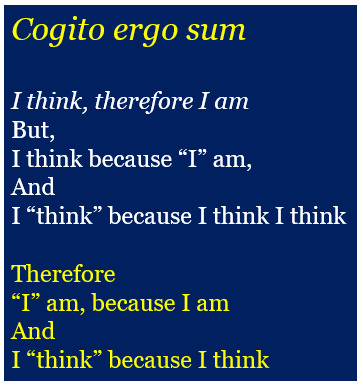
Cogito, ergo sum is a philosophical proposition by René Descartes usually translated into English as “I think, therefore I am”.

In no philosophy is thinking a prerequisite for existence. Of course, Descartes’ formulation is just tautology since it presupposes the “I” and the “think” and the “am”. Thinking is taken here as proof of existence, but is nothing more than an assertion of existence.

But what could prove existence?

That question in itself requires what constitutes “proof” to be defined and requires criteria specifying “existence”. An that leads only to circular arguments.

  • Existence refers to the ontological property of being.
  • “To be” does not require the capability of being observed or an observer with a consciousness.
  • “To exist” does not require proof of existence.
  • However “proof” of existence requires an observer and therefore no “proof” can be anything other than subjective to the observer.
  • Existence is not caused by an observers perception of proof.

I always end up with the case of the tree falling in the forest, creating a pressure wave and whether or not there is a brain to detect the pressure wave and perceive sound. A perception of existence is not the same as existence. The perception may be true or false. The perception requires an observer and a consciousness.

The real conundrum is the existence, not of a bunch of atoms which look like me but, of the “I” of me.

  • The “I” exists as long as – and only when – I think I think.
  • The existence of other things is not dependent upon my perception of proof of existence.

But I still cannot quite come to grips with what “thinking” is.