Posts Tagged ‘Geopolitics’

Both Venezuela and Greenland are part of the Great US-China Game

January 20, 2026

I have been amazed at the stupidity of the European response to Trump’s rhetoric about Greenland. They seem to have no clue as to the game that is being played. While Trump is negotiating they are reacting to tactics and red herrings and have no idea what the end goal is and even which game is being played. It is not that Trump is conferring idiocy upon the clueless European leaders – they have been self-harming themselves!

For the US (Trump) the motive in both regions is not personal pique or detest for Maduro. It is not either about resources for just their own sake.  This is part of the Great Game between the US and China for the coming 100 years. It is about strategic leverage against China’s growing global footprint. That is the thread tying them together. In another century it was the Great Britain and Russia. The US and China are taking the Great Game to new regions. The serious geo-political analysts see it. I am afraid that the European leaders get bogged down and utterly distracted by Trump’s injection of red herrings which they just cannot discern.


Venezuela – Yes oil but not only oil

Venezuela’s primary strategic value is its natural resources, above all oil. It has the world’s largest proven oil reserves. The recent U.S. intervention and pressure campaign explicitly cites oil access and disruption of adversarial influence as motives.

  1. China has deep financial and commercial ties with Venezuela, long providing loans and buying Venezuelan energy and commodities.
  2. Venezuelan rare earths and critical minerals are potential future assets — but currently underdeveloped, lacking infrastructure and clear exploitation plans.

The U.S. objectives are no secret and have been discussed so openly that I wonder why reporters of the lower kind and one-note politicians so easily forget.

  1. Deny China Easy Access to Resources
    Even if Venezuela isn’t a top rare-earth producer today, Washington sees value in preventing Beijing from locking up any potential resources or influence that could reduce U.S. leverage. This jibes with official U.S. rhetoric about countering “non-hemispheric competitors.”
  2. Break China’s Growing Footprint in the Region
    Latin America isn’t neutral territory anymore. China is a major trading partner across many states, and U.S. strategy now frames this as a geostrategic threat – something that could give Beijing leverage deep in the Western Hemisphere.
  3. Strategic Oil Supply and Energy Security
    Oil still matters as base strategic power: controlling Venezuelan oil limits Beijing’s access to energy markets, which could constrain China’s industrial or military trajectory in a crisis.
  4. Supply Chain & Rare Earth Sentiment
    Some U.S. policy thinkers argue the future of tech and defence depends on diversifying supply chains away from China – and Venezuela’s minerals could play into that if infrastructure and political stability were achieved.

My assessment is that the U.S. wants to disrupt Chinese access. This fits with how Washington/Rubio/Trump are now framing their moves. This is a long-term geo-political play about material resources and influence. A not insignificant part is the rare earths  potential in Venezuela even if they are not yet a fully realized asset.

Greenland: Raw Materials and Strategic Geography

Greenland doesn’t fit exactly the same profile as Venezuela, but it does fit the same pattern. It is about access to strategic resources and a denial of geo-political access to China. Greenland hosts some of the richest deposits of rare earth elements outside China. U.S. strategic planners see this as a way — someday — to dilute China’s dominance in critical raw materials that power everything from electric vehicles to missiles. Besides minerals, Greenland is a gateway to the Arctic — territory increasingly contested by Russia and China. U.S. military interest there reflects broader strategic positioning. Rather than wait for China (or Russia) to embed itself economically or militarily, the U.S. has pushed aggressive diplomacy, investment deals, and even territorial rhetoric, explicitly meant to keep rival influence out.

Extracting rare earths in Greenland is currently expensive, technically difficult, and far from market scale. Greenland’s harsh climate and lack of infrastructure make mining a long-term project. But from a strategic viewpoint, that doesn’t matter much — the U.S. wants to lock in preferential access and preclude China from doing so first.


The Great Game: supply chain security 

Both cases tie into a bigger story about critical minerals, supply chains, and great-power competition:

  1. China still controls a vast share of refining and processing for rare earths and other minerals, not just mining.

  2. The U.S. has made securing alternative sources, both domestic and allied, a declared priority, often written and described in the language of national security.

  3. Latin America and the Arctic are the competitive regions for the next century where access to resources and influence matters as much as traditional military positioning.

  4. Within the next century new off-Earth regions of supply chain competition and security will be opening up with the moon (China present and US playing catch-up) and Mars (US first) already included within strategic planning

This not about gestures and virtue signalling and personal pique. It is plain and simple geopolitics.

Who is going to have control of critical raw materials and whose military or economic reach will have dominance in key regions?

That is the game being played not whether the Peace Prize can be legally shared or not!!


Afterword

U.S. actions in Venezuela and Greenland are partly about denying China access to strategic resources and partly about securing their own access:

  • Venezuela: important for oil access and preventing Chinese economic dominance in the hemisphere; rare earths are a secondary but growing part of that calculus.

  • Greenland: a long-range bet on critical materials, strategic geography, and preemptive advantage over China and Russia.

This is part of the Great Game between the US and China for the coming 100 years. It is about strategic leverage against China’s growing global footprint. That is the thread tying Venezuela and Greenland together.


Strategic Importance of Greenland | SOF News


Crimea is a fait accompli – as White House is so relieved that Putin deigned to call

March 29, 2014

The news this morning is that Vladimir Putin called Barack Obama to discuss Ukraine. But the tone from the White House is that this was a great diplomatic victory for Obama since it was Putin who initiated the call. So far it has always been Obama calling Putin to draw red lines in the air.

(Reuters)Russian President Vladimir Putin called U.S. President Barack Obama on Friday to discuss a U.S. diplomatic proposal for Ukraine, the White House said, adding that Obama told him that Russia must pull back its troops and not move deeper into Ukraine. It was believed to have been the first direct conversation between Obama and Putin since the United States and its European allies began imposing sanctions on Putin’s inner circle and threatened to penalize key sectors of Russia’s economy. …… The White House noted specifically that it was Putin who called Obama, who is ending a four-country trip in Saudi Arabia and had just returned to his Riyadh hotel after talks with King Abdullah.

And so another crisis is solved – until the next one. But the Kremlin account is somewhat different to the White House account

NYT: “President Obama underscored to President Putin that the United States continues to support a diplomatic path in close consultation with the government of Ukraine and in support of the Ukrainian people with the aim of de-escalation of the crisis,” the White House said in a statement. “President Obama made clear that this remains possible only if Russia pulls back its troops and does not take any steps to further violate Ukraine’s territorial integrity and sovereignty.”

In its statement posted on its official website, the Kremlin said Mr. Putin “drew Barack Obama’s attention to continued rampage of extremists who are committing acts of intimidation towards peaceful residents, government authorities and law enforcement agencies in various regions and in Kiev with impunity. …. In light of this,” it added, “the president of Russia suggested examining possible steps the global community can take to help stabilize the situation.”

The Crimea is a done deal. The US and the EU have to maintain some face while accepting that reality. What is also apparent is that the Russian view of  right wing extremists and neo-nazis is shared by the current “government” of the Ukraine. The EU and its “expansive but naive imperialism” bears a heavy responsibility for the rise of the Right Sector and its violent ways. And now the Ukraine is running a pogrom to disable if not wipe out the Right Sector. (Not so dissimilar to the current campaigns against Golden Dawn in Greece and the Muslim Brotherhood in Egypt).

BBC: A Ukrainian ultra-nationalist leader has been shot dead in what officials describe as a special forces operation. Oleksandr Muzychko, better known as Sashko Bily, died in a shoot-out with police in a cafe in Rivne in western Ukraine, the interior ministry said. He was a leader of Right Sector, a far-right group which was prominent in the recent anti-government protests.

BBC: Ukraine’s interim President Olexander Turchynov has condemned the ultra-nationalist Right Sector, saying the group is bent on “destabilisation”. Right Sector activists blocked the parliament (Rada) building in Kiev on Thursday night and smashed windows. They blamed the interior minister for the killing of a Right Sector leader. …..

….. At a parliament session on Friday, Mr Turchynov, called the Right Sector rally outside parliament “an attempt to destabilise the situation in Ukraine, in the very heart of Ukraine – Kiev. That is precisely the task that the Russian Federation’s political leadership is giving to its special services”. Right Sector activists are furious over the death of Oleksandr Muzychko, better known as Sashko Bily, one of their leaders. The interior ministry said he died on Monday night in a shoot-out with police in a cafe in Rivne in western Ukraine.

Transnistria (image blatantworld.com)

Transnistria (image blatantworld.com)

Putin does not seem to have discussed – or needed to discuss – the Crimea. That is now a fait accompli. Instead he has taken up the case of Moldova and Transnistria. In Moldova too, it is the EU’s expansionism which has led to some of the internal rifts. I note also that the Ukraine and Moldova have been wooed enthusiastically by the EU and had made more progress than Turkey has in its long running saga of seeking EU membership. (Turkey will never be allowed to become a member – in my opinion  – because it is a Muslim country).

NYT: While not mentioning Crimea, the Kremlin drew attention to Ukraine’s blockade of Transnistria, a breakaway, pro-Russian region of Moldova, another former Soviet republic to the south. Frozen for years in an international limbo, neither accepting Moldova’s rule nor formally part of Russia, Transnistria has relied on land access through Ukraine for crucial imports.

The Kremlin said a new blockade would “significantly complicate the living conditions for the region’s residents, impeding their movement and normal trade and economic activities,” and it urged negotiations to address the situation.

Russia has more than 1,000 troops in Transnistria, the remnants of a peacekeeping force deployed since 1992, and it has relied on overland access through Ukraine to supply them. The next talks on the conflict are scheduled for Vienna on April 10 and 11.

Some officials in the region have asked to follow Crimea and become part of Russia. Moldova has been working toward the same sweeping political and free trade agreements with the European Union that prompted Russian opposition in Ukraine.

The Crimean crisis is over. The Moldovan (Transnistria) crisis is next.

And President Obama can bask in the glory of “having forced” Vladimir Putin to call him.

A story in 3 maps: EU and NATO push and Russia pushes back

March 19, 2014

It is the play of simple geopolitical forces which itself is based on the drawing of lines on maps. The creeping expansion eastwards of the EU and NATO has given little thought to the response it must inevitably invite. I put much of the Ukrainian crisis down to the thoughtless behaviour of the EU. That behaviour itself is inevitable given that foreign policy in the EU is driven by a confused mix of 28 countries and by the insatiable bureaucratic hunger in Brussels for an ever-increasing bureaucracy by including ever-more countries into the pot (providing that they are non-muslim). The rush to expansion is – in part – the reason why the EU is mired for so long in the financial crisis. With 28 countries involved policy is often clumsy and heavy-handed with little place for nuance and diplomatic skill.

The current breaking point was reached when the EU (aiding and abeting the US in the expansion of NATO) clumsily encouraged internal dissent in the Ukraine and activated the far-right, neo-Nazi forces. Did they really expect no response? And does the EU really want to be associated with the neo- Nazis of Ukraine who are carrying on their traditions from the 1940’s? I think it was the rise of the neo-Nazis as the final straw which Russia found unacceptable. I find the award of the Nobel Peace Prize to the EU a travesty and only confirms that the Peace Prize tarnishes the Nobel brand.

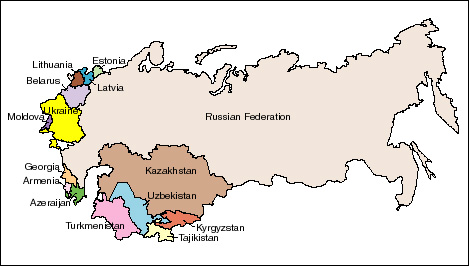
Today the response is in the Crimea. Logically, the EU and NATO expansion pressure will invite Russia to exercise even more control over the Eastern Ukraine, Kazakhstan, Belarus, Kyrgyzstan, Uzbekistan, Tadjikistan and Turkmenistan.

1. Expansion of the EU.

2. Expansion of Nato

nato expansion (image mike faille)

nato expansion (image mike faille)

3. Where will Russia push-back?

where next for Russia

where next for Russia