Posts Tagged ‘global warming’

Contrary to alarmist rumour, Greenland ice sheet melt lower and mass higher than the long term average

June 16, 2016

We have had an El Niño year which has only just reached neutral or slightly negative conditions. Whether it will be followed by a La Niña will not be clear until the negative conditions persist for some 9 months.

Recently we have had screaming headlines claiming that the Greenland ice melt in April was unprecedented and the region was experiencing its hottest year ever and catastrophe was nigh (here, here and here). Arctic amplification was to blame. The world was about to be swamped. But it was all just nonsense. All just the usual alarmist exaggerations. Some of it was just the usual editorial creativity and some was misconduct bordering on fraud.

The melt area according to the Danish Meteorological Institute had a peak or two – as it does – but is running well under the mean:

The percentage of the total area of the ice where the melting occurred from January 1 until today (in blue). For comparison the average for the period 1990-2013 is shown in the dark grey curve.

The percentage of the total area of the ice where the melting occurred from January 1 until today (in blue). For comparison the average for the period 1990-2013 is shown in the dark grey curve. (Source DMI)

Similarly the surface ice mass balance shows that it is currently running well above the long term mean (1990 – 2013):

The accumulated surface mass balance from September 1st to now (blue line, Gt) and the season 2011-12 (red) which had very high summer melt in Greenland. For comparison, the mean curve from the period 1990-2013 is shown (dark grey). (Source DMI)

The accumulated surface mass balance from September 1st to now (blue line, Gt) and the season 2011-12 (red) which had very high summer melt in Greenland. For comparison, the mean curve from the period 1990-2013 is shown (dark grey). (Source DMI)

Since September 1st, the Greenland ice sheet has gained about 550 billion tonnes (Gt) of mass, which is higher than the long term mean by some 5 -10%.

Ah Well!

I give it about 5 years before the global warming pendulum swings back to an alarmist global freezing meme.


“Imminent Catastrophe” by Clive James

March 20, 2016

Clive James has a new poem in The New Statesman, which begins

The imminent catastrophe goes on
Not showing many signs of happening.
The ice at the North Pole that should be gone
By now, is awkwardly still lingering,

And though sometimes the weather is extreme
It seems no more so than when we were young
Who soon will hear no more of this grim theme
Reiterated in the special tongue


Anthropogenic effects no threat to Indian monsoon “for a century or two” as Potsdam alarmism is debunked

January 28, 2016

The Potsdam Institute for Climate Impact Research in Germany is the most rabid disseminator of global warming alarm especially about sea-level rise. Stefan Rahmstorf is the Grand Mufti of this religion and most of its”science” is little more than conjecture based on speculation. They have also been forecasting increased variability and catastrophic effects on the Indian monsoon by computer simulations from 20 different climate models (none of which has succeeded in predicting the current temperature hiatus).

A new study now shows that previous Potsdam Institute monsoon forecasts were badly flawed and omitted “a dominant term in the equations of motion” no less. The equations of motion are about as basic as one can get.  The new study goes on to show that both a corrected theory and an ensemble of global climate model simulations exhibit no abrupt shift in monsoon strength in response to large changes in various forcings”. The authors don’t expect any drastic failure of the monsoon for the “next century or two”.

William R. Boosand Trude Storelvmo, Near-linear response of mean monsoon strength to a broad range of radiative forcingsPNAS January 25, 2016, doi:10.1073/pnas.1517143113

Significance

Previous studies have argued that monsoons, which are continental-scale atmospheric circulations that deliver water to billions of people, will abruptly shut down when aerosol emissions, land use change, or greenhouse gas concentrations reach a critical threshold. Here it is shown that the theory used to predict such “tipping points” omits a dominant term in the equations of motion, and that both a corrected theory and an ensemble of global climate model simulations exhibit no abrupt shift in monsoon strength in response to large changes in various forcings. Therefore, although monsoons are expected to change in response to anthropogenic forcings, there is no reason to expect an abrupt shift into a dry regime in the next century or two.

The Calcutta Telegraph reports:

India’s monsoon is in no danger of catastrophic collapse in response to global warming and air pollution, two atmospheric scientists said today, refuting earlier predictions that the monsoon could shut down within 100 years.

The scientists at Yale University in the US who used computers to model the Earth’s atmosphere, land and oceans have found that the expected changes in the monsoon will not abruptly alter their strength or their water volume.

Their results contradict earlier forecasts by scientists at the Potsdam Institute for Climate Impact Research in Germany portending frequent and severe failures and even a breakdown of the monsoon, which is critical to India’s food, water resources and economy.

“Our models show that monsoon rainfall will change smoothly in response to rising greenhouse gas concentrations, air pollution, and changes in land use,” William Boos, an associate professor at Yale University told The Telegraph“We should expect changes in the monsoon rainfall in response to changes in the global mean temperature in the coming decades, but there is no reason to expect those changes to be abrupt,” Boos said.

The earlier modelling exercises had predicted that the monsoon, under the influence of global warming and air pollution, would experience a “tipping point” that would lead to a sharp drop in rainfall over India.

Boos and his colleague Trude Storelvmo have now shown that the theory and models that were used to predict such “tipping points” had omitted a key term in climate behaviour, ignoring the fact that air cools as it rises in the atmosphere. …… 

….. A decade ago, a study by Potsdam Institute researchers suggested that increasing air pollution and forest loss could lead to a sharp reduction in rainfall within a span of decades. And three years ago, another study from the Potsdam Institute predicted a 40 to 70 per cent reduction in rainfall.

The Potsdam Institute is just one of the many so-called institutes which ensure funding by generating alarmist theories which cannot be tested.


New study debunks Himalayan glacier melting alarm – again

January 27, 2016

Over the next two decades we are going to see the gradual disappearance of global warming as the favourite meme for alarmists (after all, global warming has been solved by the Paris Agreement). Every alarmist theme over the last 80 years has been debunked, but the eco fascists merely move on to the next doomsday scenario. Whatever happened to peak oil and a world without energy? or the population bomb and the death of humanity? or peak food, mass starvation and starving billions? or the banning of DDT for the now failed elimination of mosquito borne threats? One wonders what the next alarmist theme will be? Global cooling could always come back. Vaccinations or GMO or gene selection for humans perhaps. Radiation from cellphones?

One of the much hyped stories in the last decade was the “melting of the Himalayan glaciers” and the consequent loss of clean water for one billion or more people. This story was hyped and overhyped before it was shown to be based on newspaper speculation put out by the usual suspects (WWF, Greenpeace, FoE and similar ecofascists). The IPCC – with Pachauri at its head – made idiots of themselves – again. Now comes a new paper in Nature – Global and Planetary Change that in Tibet water supplies will be stable and may even increase in the coming decades”.

EurekAlert:

University of Gothenburg Press Release

The Tibetan Plateau has long been seen as a “hotspot” for international environmental research, and there have been fears that water supplies in the major Asian rivers would drastically decline in the near future. However, new research now shows that water supplies will be stable and may even increase in the coming decades.

A report by the International Panel on Climate Change (IPCC) from 2007 suggests that the glaciers in the Himalayas will be gone by 2035. This statement was questioned and caused a great stir. …..

 ….. Since the statement by IPCC in 2007, the Tibetan Plateau has been a focus of international environmental research.

A research group led by Professor Deliang Chen at the University of Gothenburg, in close collaboration with researchers from the Institute of Tibetan Plateau Research at the Chinese Academy of Sciences, headed by Professor Fengge Su, has studied future climate change and its effect on the water balance in the region. The great Asian rivers have their source on the Plateau or in the neighbouring mountains.

The researchers recently published a study in Global and Planetary Change which modelled the water flows upstream in the Yellow River, the Yangtze, the Mekong, the Salween, the Brahmaputra and the Indus. The studies include both data from past decades and simulations for future decades.

The results show that water flows in the rivers in the coming decades would either be stable or would increase compared to the period from 1971-2000. …..

….. Dr. Tinghai Ou, who was responsible for the climate projections in the study, has commented that increased precipitation and meltwater from glaciers and snowfall are contributing to increased water flows in the region.

Ah well!

Time to find a new doomsday scenario.


India says that OECD claim of $57 billion in 2013/14 for “climate finance” was grossly exaggerated and actually only $2.2 billion

November 30, 2015

The propaganda tsunami for the Paris climate conference is reaching a peak just in time for the 147 leaders who fly in for today’s opening. Many organisations and lobby groups and newspapers have brought out special issues and reports to sell their viewpoint. No matter how little Paris agrees on, it will be presented as a major breakthrough (too many have now invested too much to allow any other spin).

The OECD is one such organisation and they have just issued a report “Climate Finance in 2013-14 and the USD 100 billion goal” to try and show the position of the developed nations that a great deal of “climate finance” is already flowing.

OECD Climate-Finance in 2013-14

The OECD claims that developed countries and their private sectors had provided $62 billion in climate finance flows in 2014 — up from $52 billion in 2013 — and an average of $57 billion annually over 2013-14.

But this is all spin and hot air. All kinds of money flows are, by tortuous reasoning, allocated to “climate finance”. The Indian government’s Department of Economic Affairs is not amused.  They have performed a due diligence on the OECD’s claims of $57 billion disbursement in 2013/14. They find double-counting, mislabelling and misreporting and find that  “the only hard number currently available in this regard is $2.2 billion in gross climate fund disbursements from 17 special climate change finance multilateral, bilateral and multilateral development bank funds created for the specific purpose”The DEA report goes on to say “the Paris Conference and negotiators will unfortunately need to worry about the credibility of the new OECD report”.

Of course the OECD wants to show numbers bigger than they are and developing countries such as India want to show them as small as possible. The very concept that man-made emissions are going to control climate is arrogant, decadent and deeply flawed.  But climate conferences are about money flows not about climate.

The Hindu

The estimate of $57billion in assistance during 2013-14 is flawed; the only number available is $2.2bn, says Finance Ministry paper.

On a day when Prime Minister Narendra Modi left for Paris to participate in the global climate change conference beginning Monday, Economic Affairs Secretary Shaktikanta Das said that India has questioned the correctness of the recent Organisation for Economic Co-operation and Development (OECD) report which claimed that significant progress had been made on a roadmap towards the goal of $100 billion in climate change finance flows annually by 2020.

In the foreword of a discussion paper titled, ‘Climate Change Finance, Analysis of a Recent OECD Report: Some Credible Facts Needed’, the Secretary said: “We asked our Climate Change Finance Unit of the Department of Economic Affairs (DEA), Ministry of Finance, and its experts to undertake a careful review of that OECD report. Their conclusion: the OECD report appears to have over-stated progress.” ….. 

The DEA paper said the OECD report had mentioned that developed countries and their private sector had provided $62 billion in climate finance flows in 2014 — up from $52 billion in 2013 — and an average of $57 billion annually over 2013-14.

The DEA paper quoted the French Foreign Minister as saying, “estimates demonstrate that considerable progress has been made. We must mobilize our efforts to provide the remaining $40 billion.” The paper then countered these claims saying, “We are very far from the goal of $100 billion in climate change finance flows annually by 2020.”

Describing the OECD as ‘a club of the rich countries’, the DEA paper said the Paris Conference and negotiators will unfortunately need to worry about the credibility of the new OECD report. …… 

Terming the figure of $57 billion average for 2013-14 as one that was exaggeratedly reported by the OECD, the DEA paper said the only hard number currently available in this regard is $2.2 billion in gross climate fund disbursements from 17 special climate change finance multilateral, bilateral and multilateral development bank funds created for the specific purpose. ……

The OECD report is deeply flawed and unacceptable, the DEA paper said, adding that the OECD report repeats a previous experience of double-counting, mislabelling and misreporting when rich countries provided exaggerated claims of ‘fast-start climate financing’ in during 2010-12 which were widely criticized by independent observers.

Reporting of the Paris conference will see a lot of spin. But there are only 2 real questions

  1. Are any emissions targets legally binding? and
  2. Are any money flows legally binding?

And I expect nothing of substance will be legally binding – thank goodness.

Paris climate conference has failed before it has begun: No “treaty” and no legally binding emission limits to be set

November 28, 2015

My opinion (here and here for example) is that the UN’s Paris conference on global warming  (since climate change which is not global warming is not even being considered) has no purpose and is a waste of time. No matter what is agreed or not, global fossil fuel use will double in the next 20 years or so. And it will have no significant impact on “global temperature”.

The EU (Holy European Empire – blessed be its name) in the shape of France, which is to chair the conference, has been adamant that Paris must come up with legally binding emission limits to be more than just hot air. Well, France has now caved in to the US position that no legally binding limits are practical and that any agreement must not be given the status of a treaty.

Why bother then?

The Financial Times (paywalled), has just reported that France has given in. Laurent Fabius will chair the conference and he has, according to the FT, made a major climbdown and accepted that signatories will not commit to any legally binding emission limits.

France bows to Obama and backs down on climate ‘treaty’

My view that this is all a massive and pointless conference is further strengthened by the confirmation that Canada has joined the US in wanting no legally binding agreements from Paris. France- as Conference Chair and representing the EU –  has been one of the strongest proponents of legally binding agreements (which is easy for them with their recourse to nuclear power). Just two weeks ago, the EU warned the US:

Paris climate deal must be legally binding, EU tells John Kerry

Earlier today, the French foreign minister, Laurent Fabius , had said it was obvious that any agreement in Paris would contain lawful elements, and suggested that Kerry was “confused” about the point. 

But now, with France also accepting that any Paris agreement will not be given the status of a treaty and will not require any legally binding emission limits, there seems little point in all the world’s leaders flying in at the end of next week to put their names to an empty document. Don’t expect any legally binding agreement on the provision of funds either.

The only legally binding agreements that Paris may now produce are agreements to meet again and to continue to waste money.

The Hindu Business LineCanada backs US: climate deal should not be legally binding

Canada on Friday backed the US approach to major climate change talks in Paris, saying any carbon reduction targets agreed at the negotiations should not be legally binding. The announcement by Environment Minister Catherine McKenna could irritate host nation France, which wants any deal to be enforceable.

That would be politically impossible for the administration of US President Barack Obama, however, since it is clear the Republican-dominated Congress would not ratify any treaty imposing legally binding cuts on the US.

“Everyone wants to see the US be part of this treaty,” McKenna told reporters on a conference call before flying to Paris. “There are political realities in the US … they cannot have legally binding targets. We don’t expect that the targets will be internationally legally binding,” she said.

Signatories to a Paris agreement should agree to update their climate change goals every five years, she added.

US Secretary of State John Kerry told the Financial Times this month that any deal reached in Paris was “definitively not going to be a treaty”. His remarks drew a stern response from French President Francois Hollande.

The Paris conference might as well not take place. It is certainly time-consuming, expensive and completely irrelevant as far as any man-made global warming is concerned.


New Nature paper: Polar ice melt would only raise sea level by 10cm (4″) by 2100

November 25, 2015

I am surprised first that Nature, given its blatant bias, accepted such a paper for publication, and second that it was published so close to the Paris conference (end of this week). Perhaps they felt it would just get lost among the massive propaganda blitz that is currently going on.

  • Catherine Ritz, Tamsin L. Edwards, Gaël Durand, Antony J. Payne, Vincent Peyaud, Richard C. A. Hindmarsh. Potential sea-level rise from Antarctic ice-sheet instability constrained by observations. Nature, 2015; DOI: 10.1038/nature16147

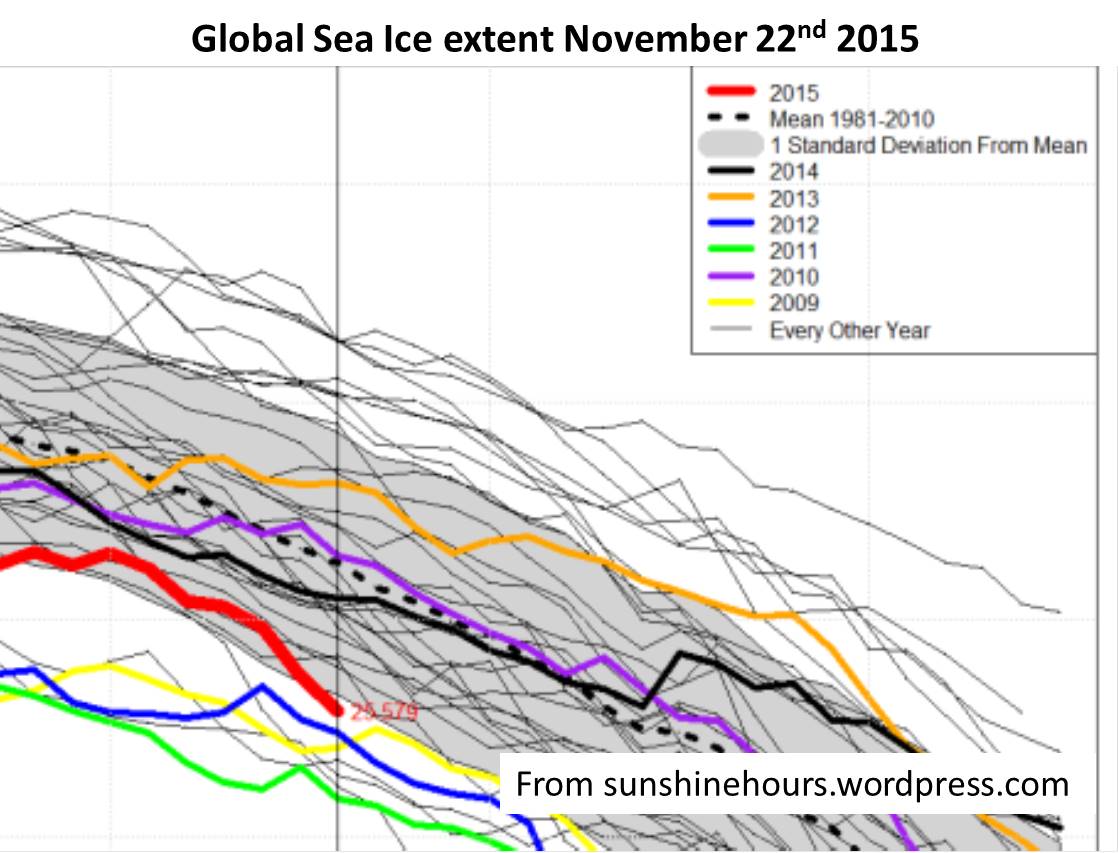
Right now the ice cover at the poles (Antarctic and Arctic) are each within one SD of the long-term average. So is the global ice cover. If now any future excess melt, if it occurs, can only cause a rise of sea level of 4 inches by 2100, one wonders what the IPCC and the Paris conference are actually trying to prevent.

Global ice cover 22Nov2015  From sunshinehours

Global ice cover 22Nov2015 From sunshinehours 

It is not the first time that the IPCC has exaggerated (and it won’t be the last). But their scare scenarios of 1 metre sea level rise are themselves plain rubbish; which make the doomsday scenarios put out by the global warming “enthusiasts”, of upto 10 metres (30 feet) or more of sea level rise by 2100 just religious fantasy.

Four inches of seal level rise is what is at stake.

GWPF:

The risk of the Antarctic ice sheet collapsing and flooding coasts around the world has been exaggerated, according to researchers.

Previous studies had claimed that melting Antarctic ice could contribute one metre to the rising sea levels by the end of the century, flooding the homes of 150 million people and threatening dozens of coastal cities.

However, a team of British and French scientists has found that the collapse in the ice sheet is likely to raise sea levels by 10cm by 2100. An increase in sea levels from the ice sheet becoming unstable is “extremely unlikely to be higher than 30cm” this century, they say, describing previous, more apocalyptic predictions, as implausible.

The study, published in the journal Nature, found that there was a one in 20 chance that parts of the ice sheet breaking off could contribute more than 30cm to the sea level by the end of the century and more than 72cm by 2200.

The sea level has already risen by 19cm since 1901 and the annual rate has almost doubled since then to about 3.2mm a year, according to the Intergovernmental Panel on Climate Change.

The UN agency predicted in 2013 that sea levels would rise by about another 60cm by 2100. The panel was unable to calculate, and did not include in its prediction, the risk of substantial parts of the Antarctic ice sheet collapsing.

Some studies suggested that the risk was high and that the overall increase in the sea level would be well over a metre by 2100 once the collapse of the ice sheet was included.

Tamsin Edwards, an author of the new study — which involved scientists from the University of Bristol and Grenoble Alpes University — said that earlier reports were likely to be wrong because they were based on simpler computer models which contained many uncertainties.

India objects to, and chastises Kerry for, his climate bullying

November 23, 2015

It is -12ºC outside my window right now on a bright winter’s day, but it is -29ºC in the North of Sweden and I am not complaining. There has been no “global” warming for 19 years while fossil fuel utilisation has almost doubled. If “climate change” is about global warming, then why the panic? And if “climate change” is not about global warming, then why the panic?

We have had a couple of months of concentrated, strident, alarmist propaganda in the media and from the global warming mafia as preparation for the Paris climate conference beginning at the end of this week. It is reaching a crescendo this week. That the mainstream media led by The Guardian, and followed slavishly by Swedish media, have been particularly alarmist is not so surprising. Today the Guardian runs an article claiming that the “Paris climate change conference can save the planet”. It happens to be by Ed Miliband which is less than convincing since his judgements are more than a little suspect. The rich and the famous have been “harnessed”, like so many talking puppets, to parrot “the cause”. (Childhood memories of “Francis, the talking mule” come to mind). Yesterday it was first the Swedish King calling on people to stop bathing and then Prince Charles stated that global warming (euphemistically “climate change”) was one of the causes of the Syrian conflict. He could just as well claim that the terrorist attacks in Paris were due to “climate change”. (In fact someone has already done that). John Kerry wanders around the globe intimating that his foreign policy problems would disappear if only governments would do as he says.

(I have to admit that for almost any proposed action in any field, having Prince Charles’ support, is proof positive for me that that the action is going to be counterproductive. John Kerry with his blunders in Syria and in the Ukraine is approaching the same class).

I don’t pay too much attention to the hype. Ultimately, after 2 or 3 decades of global cooling, the pointlessness and futility of the fight against “carbon emissions” will become obvious. Of course vast sums of money would have been wasted. Global growth and the elimination of poverty would have been hampered for a time – but so what? Coal, oil and gas production and utilisation by the developing world will only continue, and continue to spread.

I don’t much care about Paris either. It has almost become irrelevant. Especially since “success” at the Paris conference will actually mean that the doubling of carbon dioxide emissions over the next 15 years will have been assured and sanctioned. China and India have already won. The “success” of Paris would provide them with official sanction to increase their use of fossil fuel under the cloak of reducing emissions per unit of gdp growth. The developed world will effectively commit itself to increased costs and reduced growth to no purpose. While this will depress global growth (mainly Europe) it should make the developing world even more competitive and that will be some mitigation. The US is somewhat immune since it can just ramp up the use of gas.

But the constant nagging by the global warming brigade is getting irritating and coercive. The sanctimonious preaching by John Kerry has finally crossed the line. So much so that India has had to resort to formally chastising him,

The Hindu:

India has reacted strongly to U.S. Secretary of State John Kerry’s statement that the country will be a “challenge” in the coming climate change talks in Paris.

“It is in a way unfair to say that India will be a challenge. It is actually not doing justice to India,” Union Environment Minister Prakash Javadekar told PTI. “The U.S. is our great friend and strategic partner. His [Kerry’s] comment is unwarranted and unfair. The attitude of some of the developed countries is the challenge for the Paris conclusion,” the Minister said.

Mr. Javadekar said there was no question of compromising on India’s stand on climate change. He blamed the “attitude” of the developed countries for the problem. India was trying to “proactively” forge a consensus on the issue. ……..

…… While the developed world has been looking at increased emission cuts from developing countries, the latter — including India — have sought common but differentiated responsibility. Shorn of jargon, it means that the developed world has been the prime polluter since its early lead in industrialisation and stays way ahead in emissions per capita to this day, meaning that it cannot expect nations now industrialising to forget this skew.

I really do dislike those who know best what others should do.

Statistician issues a $100,000 challenge for anyone to prove that global warming is statistically significant

November 20, 2015

Doug Keenan used to do research on financial trading and is now an independent statistician. He has on a number of occasions pointed out the very poor statistical analysis carried out by “scientists” in drawing unwarranted conclusions. He has challenged the statistics used for example in radiocarbon dating, the use of proxies such as grape harvests for temperatures, early Chinese chronologies based on planetary conjunctions and the like. He has for a long time criticised the “global warming” community for dodgy statistics in dealing with temperature time-series. Most famously he showed that the IPCC 2013 (AR5) report was statistically incompetent.

He has now issued a challenge to the global warming community to prove that their statistical, data manipulation methods are valid and can distinguish between real trends and purely random time-series. He contends that global warming trends are mere assertions and are not statistically justified. He is putting his money where his mouth is and has offered $100,000 for anyone who can do that.

There have been many claims of observational evidence for global-warming alarmism. I have argued that all such claims rely on invalid statistical analyses. Some people, though, have asserted that the analyses are valid. Those people assert, in particular, that they can determine, via statistical analysis, whether global temperatures are increasing more than would be reasonably expected by random natural variation. Those people do not present any counter to my argument, but they make their assertions anyway.

In response to that, I am sponsoring a contest: the prize is $100 000. In essence, the prize will be awarded to anyone who can demonstrate, via statistical analysis, that the increase in global temperatures is probably not due to random natural variation.

Competition

The file Series1000.txt contains 1000 time series. Each series has length 135 (the same as that of the most commonly studied series of global temperatures). The series were generated as follows. First, 1000 series were obtained via trendless statistical models fit for global temperatures. Then, some randomly-chosen series had a trend added to them. Some trends were positive; others were negative. Each individual trend averaged (in magnitude) 1°C/century—which is greater than the trend claimed for global temperatures.

A prize of $100 000 (one hundred thousand U.S. dollars) will be awarded to the first person, or group of people, who correctly identifies at least 900 series: which series were generated by a trendless process and which were generated by a trending process.

Contest entries should be emailed to me (doug dot keenan at informath.org). Each entry in the contest must be accompanied by a payment of $10; this is being done to inhibit non-serious entries.

The contest closes at the end of 30 November 2016, or when someone submits a prize-winning answer, whichever comes first.

When the contest closes, the computer program (including the random seed) that generated the 1000 series will be posted here. As an additional check, the file Answers1000.txt identifies which series were generated by a trendless process and which by a trending process. The file is encrypted. The encryption key and method will also be posted here when the contest closes.

Contestants have until November 2016. However, I don’t expect any current “climate scientist” to rise to the challenge. I don’t expect that the “climate politicians” such as John Kerry to even understand the issue.


Addendum on 18th August 2016 from Doug Keenan:

18 August 2016
A paper by Lovejoy et al. was published in Geophysical Research Letters. The paper is about the Contest.

The paper is based on the assertion that “Keenan claims to have used a stochastic model with some realism”; the paper then argues that the Contest model has inadequate realism. The paper provides no evidence that I have claimed that the Contest model has adequate realism; indeed, I do not make such a claim. Moreover, my critique of the IPCC statistical analyses (discussed above) argues that no one can choose a model with adequate realism. Thus, the basis for the paper is invalid. The lead author of the paper, Shaun Lovejoy, was aware of that, but published the paper anyway.

When doing statistical analysis, the first step is to choose a model of the process that generated the data. The IPCC did indeed choose a model. I have only claimed that the model used in the Contest is more realistic than the model chosen by the IPCC. Thus, if the Contest model is unrealistic (as it is), then the IPCC model is even more unrealistic. Hence, the IPCC model should not be used. Ergo, the statistical analyses in the IPCC Assessment Report are untenable, as the critique argues.

For an illustration, consider the following. Lovejoy et al. assert that the Contest model implies a typical temperature change of 4 °C every 6400 years—which is too large to be realistic. Yet the IPCC model implies a temperature change of about 41 °C every 6400 years. (To confirm this, see Section 8 of the critique and note that 0.85×6400/133 = 41.) Thus, the IPCC model is far more unrealistic than the Contest model, according to the test advocated by Lovejoy et al. Hence, if the test advocated by Lovejoy et al. were adopted, then the IPCC statistical analyses are untenable.


China has been burning more coal than reported – and any Paris “agreement” will have no significance

November 4, 2015

The NYT reports that in the last 10 years China has admitted it has been burning about 17% more coal than has been reported. The extra one billion tons burned every year is equivalent to what is consumed by Germany. But the global temperature (the satellite measurement based calculated temperature, not the calculated land based measurements which are fudged every year to keep cooling the past) has been flat for over 18 years. Antarctica is gaining ice mass. Ice cover in the Arctic is at the highest level for the last 10 years. Sea levels are not rising any faster than they have been for the last 500 years. Apart from shifting money between countries it is difficult to see what Paris is all about.

Irrespective of what Paris may “agree”, it will be non-binding and will allow India to treble its coal consumption and China to double its coal burn. Both will however “reduce” their carbon emission intensity per unit of GDP (how not?). Energy growth exceeds GDP growth at low levels of development (and fuels GDP growth) but then flattens out as the GDP increases. Thus reducing carbon emission intensity per unit of GDP is easy (and virtually impossible to avoid) when GDP is growing and development has reached the point where growth in electricity (or energy) consumption is lower than GDP growth.

energy to gdp growth as function of gdp

energy to gdp growth as function of gdp

The trebling and doubling respectively of India and China’s coal consumption over the next 20 or so years is an inevitability. Carbon emissions will follow no matter how they are packaged to seem to be “a reduction of emissions per unit of gdp”.

What European countries do to cut their fossil fuel use – and increase their electricity costs – is pointless and with no measurable objectives. European actions are no longer of any significance in terms of global emissions. Moreover nothing “agreed to” in Paris will give any measurable impact on any climate parameter over the next 50 years. The only measurable results of any Paris deal are the inputs – money flows between countries and the changes in fuel use. None of the desired “climate changes” are measurable. Truly policies without any measurable objectives.

china - revised coal consumption - graphic NYT

china – revised coal consumption – graphic NYT

NYT: 

China, the world’s leading emitter of greenhouse gases from coal, has been burning up to 17 percent more coal a year than the government previously disclosed, according to newly released data. The finding could complicate the already difficult efforts to limit global warming.

Even for a country of China’s size, the scale of the correction is immense. The sharp upward revision in official figures means that China has released much more carbon dioxide — almost a billion more tons a year according to initial calculations — than previously estimated.

The increase alone is greater than the whole German economy emits annually from fossil fuels.