We are still struggling to explain what initiates an ice age (glaciation) and what causes them to end and the ice sheets to withdraw giving the interglacials.
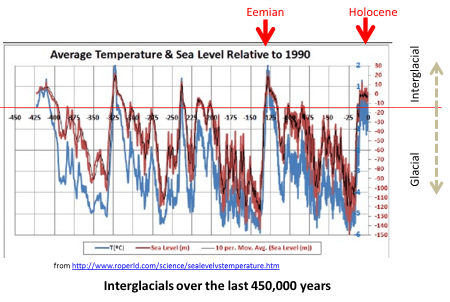
That the Milankovitch cycles and variations of insolation are involved in the onset and retreat of glacial periods is clear but the “how” is still elusive. Now a new paper describes a model where the ice sheets and the mutual feedbacks with climate are considered.
“Carbon dioxide is involved, but is not determinative, in the evolution of the 100,000-year glacial cycles”.
Abe-Ouchi A, Saito F, Kawamura K, Raymo ME, Okuno J, Takahashi K, Blatter H: Insolation-driven 100,000-year glacial cycles and hysteresis of ice-sheet volume. Nature, 2013, 500: 190-193, doi: 10.1038/nature12374
ETH Press Release:
Ice ages and warm periods have alternated fairly regularly in the Earth’s history: the Earth’s climate cools roughly every 100,000 years, with vast areas of North America, Europe and Asia being buried under thick ice sheets. Eventually, the pendulum swings back: it gets warmer and the ice masses melt. While geologists and climate physicists found solid evidence of this 100,000-year cycle in glacial moraines, marine sediments and arctic ice, until now they were unable to find a plausible explanation for it.
Using computer simulations, a Japanese, Swiss and American team including Heinz Blatter, an emeritus professor of physical climatology at ETH Zurich, has now managed to demonstrate that the ice-age/warm-period interchange depends heavily on the alternating influence of continental ice sheets and climate.
“If an entire continent is covered in a layer of ice that is 2,000 to 3,000 metres thick, the topography is completely different,” says Blatter, explaining this feedback effect. “This and the different albedo of glacial ice compared to ice-free earth lead to considerable changes in the surface temperature and the air circulation in the atmosphere.” Moreover, large-scale glaciation also alters the sea level and therefore the ocean currents, which also affects the climate.
As the scientists from Tokyo University, ETH Zurich and Columbia University demonstrated in their paper published in the journal Nature, these feedback effects between the Earth and the climate occur on top of other known mechanisms. It has long been clear that the climate is greatly influenced by insolation on long-term time scales. Because the Earth’s rotation and its orbit around the sun periodically change slightly, the insolation also varies. If you examine this variation in detail, different overlapping cycles of around 20,000, 40,000 and 100,000 years are recognisable (see box).
Given the fact that the 100,000-year insolation cycle is comparatively weak, scientists could not easily explain the prominent 100,000-year-cycle of the ice ages with this information alone. With the aid of the feedback effects, however, this is now possible.
The researchers obtained their results from a comprehensive computer model, where they combined an ice-sheet simulation with an existing climate model, which enabled them to calculate the glaciation of the northern hemisphere for the last 400,000 years. The model not only takes the astronomical parameter values, ground topography and the physical flow properties of glacial ice into account but also especially the climate and feedback effects. “It’s the first time that the glaciation of the entire northern hemisphere has been simulated with a climate model that includes all the major aspects,” says Blatter.
Using the model, the researchers were also able to explain why ice ages always begin slowly and end relatively quickly. The ice-age ice masses accumulate over tens of thousands of years and recede within the space of a few thousand years. Now we know why: it is not only the surface temperature and precipitation that determine whether an ice sheet grows or shrinks. Due to the aforementioned feedback effects, its fate also depends on its size. “The larger the ice sheet, the colder the climate has to be to preserve it,” says Blatter. In the case of smaller continental ice sheets that are still forming, periods with a warmer climate are less likely to melt them. It is a different story with a large ice sheet that stretches into lower geographic latitudes: a comparatively brief warm spell of a few thousand years can be enough to cause an ice sheet to melt and herald the end of an ice age.
The Milankovitch cycles
The explanation for the cyclical alternation of ice and warm periods stems from Serbian mathematician Milutin Milankovitch (1879-1958), who calculated the changes in the Earth’s orbit and the resulting insolation on Earth, thus becoming the first to describe that the cyclical changes in insolation are the result of an overlapping of a whole series of cycles: the tilt of the Earth’s axis fluctuates by around two degrees in a 41,000-year cycle. Moreover, the Earth’s axis gyrates in a cycle of 26,000 years, much like a spinning top. Finally, the Earth’s elliptical orbit around the sun changes in a cycle of around 100,000 years in two respects: on the one hand, it changes from a weaker elliptical (circular) form into a stronger one. On the other hand, the axis of this ellipsis turns in the plane of the Earth’s orbit. The spinning of the Earth’s axis and the elliptical rotation of the axes cause the day on which the Earth is closest to the sun (perihelion) to migrate through the calendar year in a cycle of around 20,000 years: currently, it is at the beginning of January; in around 10,000 years, however, it will be at the beginning of July.
Based on his calculations, in 1941 Milankovitch postulated that insolation in the summer characterises the ice and warm periods at sixty-five degrees north, a theory that was rejected by the science community during his lifetime. From the 1970s, however, it gradually became clearer that it essentially coincides with the climate archives in marine sediments and ice cores. Nowadays, Milankovitch’s theory is widely accepted. “Milankovitch’s idea that insolation determines the ice ages was right in principle,” says Blatter. “However, science soon recognised that additional feedback effects in the climate system were necessary to explain ice ages. We are now able to name and identify these effects accurately.”
Download video:
Simulated ice sheet change during the last glacial cycle (mov file, video: Abe-Ouchi et al. 2013)
Abstract: The growth and reduction of Northern Hemisphere ice sheets over the past million years is dominated by an approximately 100,000-year periodicity and a sawtooth pattern (gradual growth and fast termination). Milankovitch theory proposes that summer insolation at high northern latitudes drives the glacial cycles, and statistical tests have demonstrated that the glacial cycles are indeed linked to eccentricity, obliquity and precession cycles. Yet insolation alone cannot explain the strong 100,000-year cycle, suggesting that internal climatic feedbacks may also be at work. Earlier conceptual models, for example, showed that glacial terminations are associated with the build-up of Northern Hemisphere ‘excess ice’, but the physical mechanisms underpinning the 100,000-year cycle remain unclear. Here we show, using comprehensive climate and ice-sheet models, that insolation and internal feedbacks between the climate, the ice sheets and the lithosphere–asthenosphere system explain the 100,000-year periodicity. The responses of equilibrium states of ice sheets to summer insolation show hysteresis, with the shape and position of the hysteresis loop playing a key part in determining the periodicities of glacial cycles. The hysteresis loop of the North American ice sheet is such that after inception of the ice sheet, its mass balance remains mostly positive through several precession cycles, whose amplitudes decrease towards an eccentricity minimum. The larger the ice sheet grows and extends towards lower latitudes, the smaller is the insolation required to make the mass balance negative. Therefore, once a large ice sheet is established, a moderate increase in insolation is sufficient to trigger a negative mass balance, leading to an almost complete retreat of the ice sheet within several thousand years. This fast retreat is governed mainly by rapid ablation due to the lowered surface elevation resulting from delayed isostatic rebound, which is the lithosphere–asthenosphere response. Carbon dioxide is involved, but is not determinative, in the evolution of the 100,000-year glacial cycles.


 The k2p blog