Posts Tagged ‘India’

BRICS is losing BIS as the financial crisis bites

August 20, 2013

Emerging markets have the fundamental problem that their own domestic markets – while promising – are not large enough yet to raise the finances needed to drive their entire economies. They are critically dependent upon foreign investment. And now as funds return to the dollar, India, Brazil, South Africa and other emerging markets are feeling the global financial heat – and some of the heat is intense enough to cause some currency meltdowns.

The Indian economy is shrinking in real terms. Currency controls are on the way though the Indian government is – as usual – doing too little too late. Sovereign ratings of these countries are likely to be degraded which will reduce foreign investment further and raise the cost of foreign borrowing. A vicious downward spiral could ensue.

BRICS is losing BIS.

Economic Times:

A fierce selloff in many emerging currencies shows no sign of abating as the expected withdrawal of US monetary stimulus prompts investors to shun markets seen as riskier because of funding deficits, slowing economies and inflation. 

The rupee fits that bill, as do the Indonesian rupiah, the South African rand and theBrazilian real. The rupiah plunged to four-year troughs on Monday while the rand lost another 1 percent to bring year-to-date losses to almost 17 percent against the dollar. 

Brazil’s real extended last week’s fall of more than 5 percent fall to trade at its weakest level since March 2009 even as the central bank sold nearly $3 billion worth of currency swaps, which are derivatives that mimic an injection of dollars in the futures market. Like the rupee, it has been hammered by doubts over the efficacy of policy actions to stem the rout. 

The rupee and the real, respectively, have been the worst performers in Asia and Latin America since late May when the Fed first signalled that it may begin winding down its monetary stimulus this year. India’s currency has lost 13 percent against the dollar this year while the real has plunged 15 percent in the same period. 

A decline in the Fed’s bond purchases will push government debt yields higher, which should raise the attractiveness of the dollar and dollar-denominated assets. In Brazil, the currency weakness has complicated policymakers’ efforts to rein in inflation, leading many investors to bet the central bank may speed up the pace of monetary tightening next week.  

In India, the rupee’s sell-off threatens to drive Asia’s third-largest economy towards a full-blown crisis. 

“Our primary concern is that the policy authorities still don’t ‘get it’ – thinking this is a fairly minor squall which will simmer down relatively quickly with fairly minor actions,” Robert Prior-Wandesforde, an economist at Credit Suisse in Singapore, wrote in a note on the Indian currency on Monday. 


Rebranding of Narendra Modi is well under way

July 26, 2013

Back in 2011 I posted about the rebranding of Narendra Modi being orchestrated by Steven King and APCO Worldwide and which had started in 2009. His chances then of overcoming his Gujarat-riots reputation to become the BJP’s candidate for Prime Minister  were small at that time.

That has all changed now and the odds of his being the PM candidate are very high and his chances of becoming the next PM of India must be better than 50%.

Modi is not only the leading candidate to be the BJP’s candidate for PM for the 2014 elections, he has also been appointed the head of BJP’s campaign. He has started his efforts to gain acceptance across the country and regional parties are beginning to position themselves and even if they are not all rushing to show their support for him, they are certainly busy getting onto the fence so that they could support him if it becomes necessary or it could be beneficial. (Indian political parties all strictly follow the ideology of Opportunism).

Steven King – after his plagiarism fiasco – is no longer shown on APCO Worldwides’s website. If APCO are still working for Modi they are not doing it directly. During the floods in Uttarakhand a rather stupid effort was made to show Modi as a hero in the rescue of flood victims. This quickly backfired as in this article in the Times of India. The article mentioned APCO Worldwide  and led to APCO denying that they had anything to do with the rescue story or that they were working for Modi.

India is a big market for APCO and they are going to very careful in the run-up to the election to keep their ties to all political parties alive.  APCO India Brochure

Whatever the truth of APCO’s involvement (and I think the rescue story was a little crude for APCO) some PR group is certainly trying to orchestrate the rebranding of the Modi image. I would not be at all surprised that such a PR Group had – or has – links to APCO.

The latest story about 65 MP’s writing to Obama to ensure that Modi was not granted a US visa followed by 9 MP’s claiming that their signatures on the letter were forged is sufficiently convoluted to make me suspect the guiding hand of a well experienced PR exponent. The result of the circus is that the 65 MP’s look petty and vindictive and are all on the defensive. The Congress Party and the Left parties are busy distancing themselves from the writing of such a letter. Even the BJP has had to point out that they have no significant differences in foreign policy from that of the present government. Modi comes out very nicely with the faint glow of a halo beginning to appear.

Even the reports in the media that Nobel laureate Amartya Sen has stated that he does not believe in Modi’s economics and does not want him to be his Prime Minister are actually working to Modi’s advantage. (Sen’s attack on the real achievements in Gujarat is particularly silly – but I note in passing that it is not at all uncommon for Nobel laureates in Economics to make idiots of themselves). In fact, Sen now being “associated” in the public mind with Rahul Gandhi, is to Gandhi’s disadvantage. In my suspicious mind I see the hand of a skilled PR man again, who has successfully provoked Sen into making a silly – almost stupid – attack on Modi – to Modi’s eventual benefit. If Amartya Sen is really opposed to Modi, he has just scored an own goal – or three.

If the 2014 election becomes a personality contest between Narendra Modi and Rahul Gandhi, it would – I think – be a walk-over for Modi. The real skill of Modi’s PR strategists will show in their ability to marshall the diverse regional parties behind Modi. Exactly how they can mobilise and align the different caste groups will be particularly convoluted and fascinating to watch.

Indian monsoon starts early and vigorously

June 17, 2013

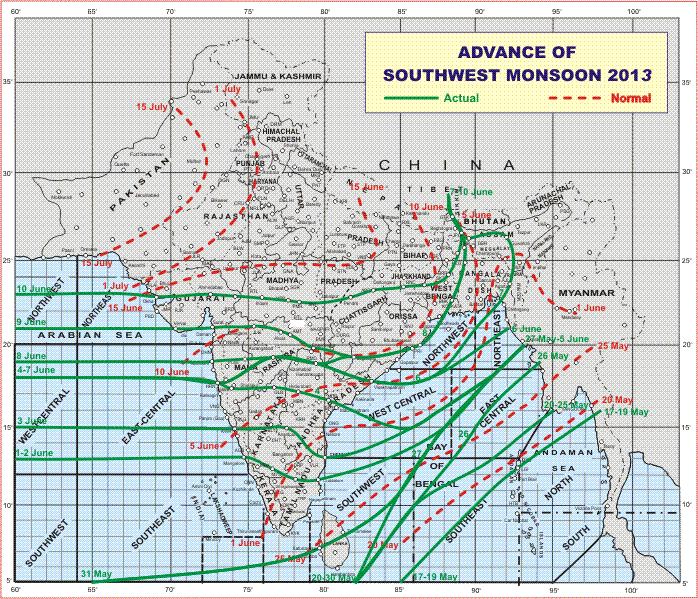
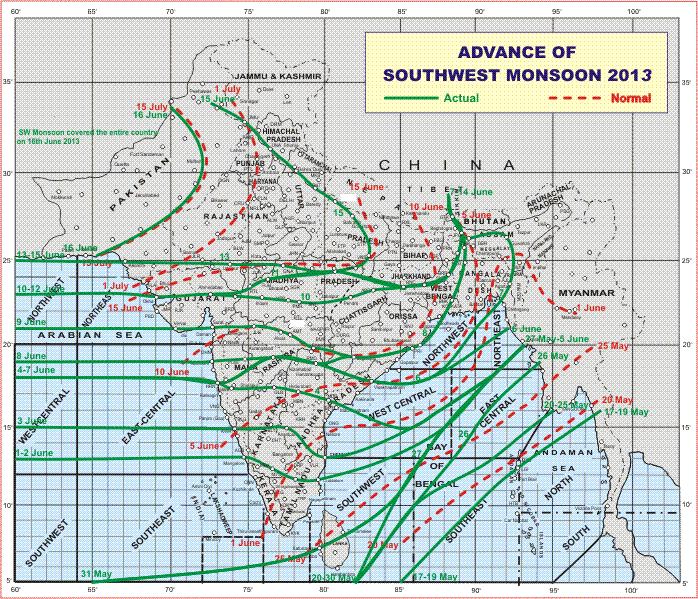
An almost spectacular start to the Indian monsoon and Delhi has received heavy rains almost two weeks earlier than expected. Two weeks of the official 4 month monsoon period (about 15%) are over and the welcome rains have covered the entire country around one month ahead of schedule. Over 30% of the total expected rainfall for a “normal” monsoon has already been received. So much so that the new airport in Delhi was flooded yesterday, not so much because of problems at the airport but because the drainage in the surrounding areas could not cope with the flow draining out of the airport and caused a back-flow!

Temperatures have dropped to a “pleasant” 31°C and it augurs well for my trip to Delhi in a couple of weeks.

Expectations for a “good” monsoon and a subsequently high level of agricultural growth are high.

ToI:The monsoon hit Delhi and its neighbourhood on Sunday, two weeks before time — and in a record sweep, swiftly covered all of northwest India. 

Besides reaching the capital well before the initially predicted date of June 29, a record occurrence unfolded in a span of 24 hours with the rain bearing system reaching the ends ofnorthwest India a full month before the usual July 15 date. The progress of rains to cover all of India as rapidly as happened over Saturday and Sunday last occurred in 1961. 

Delhi recorded 6.1 mm rain till 8.30 am and 45 mm in the next 12 hours. Palam recorded a day’s highest rainfall in the city in two years with 117.8 mm between 8.30 am and 5.30 pm. The showers have been so plentiful that Delhi will see the Yamuna cross the warning level and maybe even touch the danger mark by June 18. 

The city’s maximum temperature sharply fell to 31.5 degrees Celsius, eight degrees below normal while the minimum was 23.7 degrees.

From IMD:

monsoon 16 June 2013

monsoon 16 June 2013

Indian monsoon on schedule

June 10, 2013

The Indian monsoon season has just started and officially runs from June to September. It seems to be on schedule and perhaps a little early in the west and a few days late in the east. Mumbai is seeing heavy rains a few days early.  Last year the monsoon was somewhat delayed and not too regular though it was “average” taken over the entire 4 months. With industrial growth still somewhat in the doldrums a boost to agricultural output will be very welcome.

( from IMD).

Monsoon progress 10th June 2013

Monsoon progress 10th June 2013

There are no signs of the catastrophe scenarios that climate models take delight in forecasting about the effects of global warming on the Indian monsoon.

The youth of the world in 2100

June 8, 2013

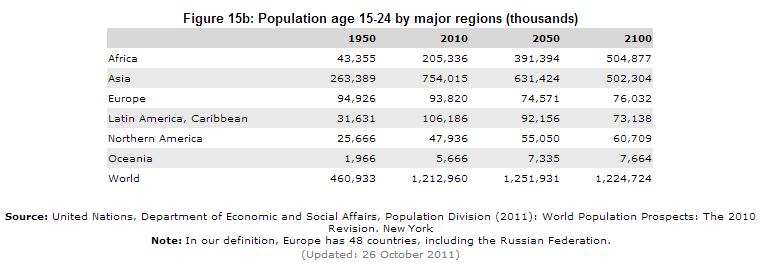
In China the youth (age 15 – 24) population is already declining. In India it will keep increasing till about 2050 and then decline. In Africa it will be growing until about 2100. Most of the youth of today will not be around in 2100 but the youth of that time who will see the world through to 2200 will be 500 million each in Africa and Asia and less than 300 million in the rest of the world – subject of course to any geographical population shifts that might take place. In the period till 2100 such migrations will probably not be so significant.

From the UN’s World Population Prospects (2012 Revision):

Population age 15-24

youth of the world 2100

India’s plummeting birth rates illustrate the coming population decline

May 9, 2013

Fertility rates are dropping sharply across the world and simple arithmetic tells us that by 2100 world population will be steady or declining slightly. In fact, rather than facing a population explosion and food shortages we will be facing the demographic challenges of a stable or declining population together with an increase in longevity. A new flexibility in the patterns of working will be needed as the populations in work reduce in proportion to those beyond retirement age. Retirement age itself will have to increase.

Yet it seems to me that the utterly alarmist, Malthusian, catastrophe scenarios for world population put forward in the 1970’s and 80’s by the Club of Rome, Ehrlich and other doom-mongers still prevail as “conventional wisdom” – even though it has long been established that their basic assumptions were plain wrong. For some reason environmentalists are the most ardent deniers of what the arithmetic says. They are the first to proclaim the dangers of population explosions yet are extremely loth to abandon catastrophe scenarios they have espoused when they are shown to be exaggerated or false.

I was therefore glad to see the subject getting attention in GeoCurrents where Martin W Lewis addresses and presents the sharply falling fertility rates around the world and in the various States in India. His maps are particularly well put together. The average fertlity rate in India is now down to 2.5 but many of the States fall well below the “replacement rate” of 2.2. The variation of fertility rates is impacted by the “usual suspects”; GDP, female literacy, proportion of urban dwellers, life expectancy, the Human Development Index (HDI) and the availability of electricity. But as Lewis shows there is also a striking correlation between fertility and TV ownership (seems plausible) and between fertility rates and the exposure of women to the media (also very plausible).

India’s Plummeting Birthrate: A Television-Induced Transformation?

…. It can be deceptive, however, to view India as an undivided whole. As shown on the map posted here, fertility figures for half of India are actually below replacement level. Were it not for the Hindi-speaking heartland, India would already be looking at population stabilization and even decline. All the states of southern India post TFR figures below 1.9. A number of states in the far north and the northeast boast similarly low fertility levels, including West Bengal, noted for its swarming metropolis of Calcutta (Kolkata).

(from GeoCurrents)

India’s geographical birthrate disparities, coupled with the country’s admirable ability to collect socio-economic data, allow us to carefully examine ideas about fertility decline. The remainder of this post will do so through cartography, comparing the Indian fertility-rate map with maps of other social and economic indicators. ……. 

……

Some scholars have argued that recent fertility decreases in India and elsewhere in the Third World are more specifically linked to one technological innovation: television. The TV hypothesis is well-known in the field, discussed, for example, in the LiveScience article on the African population explosion mentioned above. In regard to India, Robert Jensen and Emily Oster argue persuasively that television works this magic mostly by enhancing the social position of women. As they state in their abstract:

This paper explores the effect of the introduction of cable television on women’s status in rural India. Using a three-year, individual-level panel dataset, we find that the introduction of cable television is associated with significant decreases in the reported acceptability of domestic violence towards women and son preference, as well as increases in women’s autonomy and decreases in fertility. We also find suggestive evidence that exposure to cable increases school enrollment for younger children, perhaps through increased participation of women in household decision-making. We argue that the results are not driven by pre-existing differential trends.

As it turns out, the map of television ownership in India does bear a particularly close resemblance to the fertility map. Two anomalously low-fertility states with low levels of female education, Andhra Pradesh and Jammu and Kashmir, score relatively high on TV penetration, as does West Bengal, which lags on several other important socio-economic indicators. The correlation is far from perfect: Mizoram ranks higher on the TV chart than its fertility figures would indicate, whereas Odisha and Assam rank lower. Odisha and Assam turn out to be a bit less exceptional in a related but broader and more gender-focused metric, that of “female exposure to media.” These figures, which include a television component, seem to provide the best overall correlation with the spatial patterns of Indian fertility.

(from GeoCurrents)

Indian surrogate mother dies after delivery of child for a Norwegian couple

April 2, 2013

UPDATE – from the Norwegian press

The surrogate mother bore twins but one of them died after birth.

The Norwegian Embassy in India confirmed that preparations were underway for the other child to be taken to Norway.

The surrogate mother was apparently paid 31,000 Norwegian Kronor (about $6,000) (corrected below)

================================

This report in the Svenska Dagbladet today is disturbing not because there is anything inherently wrong with surrogacy but because it smacks of exploitation – of wealth being used to pass on the risks of childbirth to a “poor” surrogate mother. There are some very gray ethics involved in a “rich” Norwegian couple exploiting the poverty of a “poor” surrogate mother who dies – especially in doing something not permitted in Norway. No doubt the surrogate was paid the “going rate” for surrogacy (about $6,000). But I doubt the surrogate had made any real assessment of the risk of losing her life or that the “contract” had a clause to cover for the death of the surrogate.

Svenska DagbladetAn Indian woman who was the surrogate for a Norwegian couple died shortly after birth. The woman, who was married and had children of  her own developed Hepatitis E during the pregnancy. 

“Pregnancy and childbirth is unpredictable for us all. Unforseen things can happen and the surrogate contract and the parties should take this into account”, says anthropologist Kristin Engh Førde.

Surrogates are not allowed in Norway and Norwegians make use of egg donation abroad.

The article does not report on the condition of the baby nor on the condition of the surrogate’s own children.

I hope the Norwegian couple get their child — but what is their responsibility for those other children?

I am not sure if the quote from anthropologist Kristin Engh Førde is meant to imply – and I hope it does not – that it is the responsibility of every surrogate mother to accept the risk of dying and contract accordingly.

Would the surrogate have died if she had been giving birth at a Norwegian hospital? Would her Hepatitis E have been treated in time?

Mortality rates are generally low, for hepatitis E is a “self-limiting” disease. …  However, during the duration of the infection (usually several weeks), the disease severely impairs a person’s ability to work, care for family members, and obtain food. Hepatitis E occasionally develops into an acute, severe liver disease, and is fatal in about 2% of all cases. Clinically, it is comparable to hepatitis A, but in pregnant women the disease is more often severe and is associated with a clinical syndrome called fulminant hepatic failure. Pregnant women, especially those in the third trimester, suffer an elevated mortality rate from the disease of around 20%.

Border-Gavaskar trophy: Australia win 4 in a row but get white-washed

March 24, 2013

The first time ever that India has managed a white-wash on their opponents in a test series. They won 4 tests of the 4 test series at home against Australia. (They already know how to be white washed!)

But the Australian team can take comfort in the fact that practice paid-off and they won the toss 4 times in a row – and elected to bat each time and lost each time. 

And they all learned how to use PowerPoint.

Cricket by PowerPoint

Cricket by PowerPoint

Cricinfo: 

  • This is the first time India have won four Tests in a series. They’ve won three in a series on three occasions, two of which were clean sweeps at home – against England in 1992-93, and against Sri Lanka the following season.
  • For Australia, this is only their second clean-sweep defeat in a series, after their 4-0 rout in South Africa in 1969-70. This is the sixth time they’ve lost four or more Tests in a series, and the first such instance since the Ashes at home in 1978-79, when an Australian team depleted by the Kerry Packer exodus lost 5-1.

  • This is only the second time in Test history that a team has won four or more tosses in a series, and lost four or more Tests in the same series. The only previous such instance was in the Ashes series of 1978-79 mentioned above, when Australia won the toss in five out of six Tests, but lost the series 5-1.
  • India have won 12 Tests at the Feroz Shah Kotla, which is next only to the MA Chidambaram Stadium in Chennai, where they’ve won 13. Of their last ten Tests here, India have won nine and drawn one. Their last defeat at this venue was in 1987, against West Indies.
  • Cheteshwar Pujara was not only one of the Indian heroes for the match and the series, but also for the entire season: he scored 857 runs in eight Tests 85.70, which puts him in 15th place in the all-time list forruns scored in a season for India. With a 600-run cut-off for a season, Pujara’s average of 85.70 puts him inseventh place.
  • Pujara’s unbeaten 82 in the fourth innings came off only 92 balls. His strike rate of 89.13 is the third-best for India in fourth-innings knocks of 75 or more.
  • The 104-run stand between Pujara and Virat Kohli is the tenth century stand for India for the second wicket in the fourth innings of a Test match.
  • R Ashwin’s series haul of 29 wickets is the seventh-best for India in a Test series, and the best since Harbhajan Singh’s 32 against Australia in 2001. The only Indian bowlers who’ve taken more wickets in a series are BS Chandrasekhar, Vinoo Mankad, Subhash Gupte, Kapil Dev, Harbhajan and Bishan Singh Bedi.
  • There were five five-fors for India in the series; only three times have there been more five-fors in a series for India.
  • Peter Siddle became the first batsman in Test history to score at least a half-century in each innings of a Test. He scored 51 in the first innings and 50 in the second, top-scoring for Australia in each innings.
  • Glenn Maxwell became the first Australian to open the batting and bowling in the same Test since Percy Hornibrook in 1929. Hornibrook, a left-arm bowler who bowled some medium-pace and spin, opened the batting and bowling at the MCG Test against England.
  • For only the third time in their entire Test history, Australia opened the attack with two spinners. The last such instance for Australia was in Georgetown in 2003 against West Indies, when Stuart MacGill and Brad Hogg opened the bowling in West Indies’ second innings.

Fire Ice (methane hydrate) success in Japan gets India all excited

March 17, 2013

I get the impression that not only the oil and gas industry but also countries with limited energy resources have not been this energised about prospects for energy independence for a long time ( and perhaps not since the discovery of North Sea Gas). First came Shale gas and then Shale oil and now Fire Ice is catching the imagination. The sheer abundance of methane hydrates around the globe and the thought that much of this gas could soon be economically extractable is almost intoxicating for those involved.

“The worldwide amounts of carbon bound in gas hydrates is conservatively estimated to total twice the amount of carbon to be found in all known fossil fuels on Earth”.

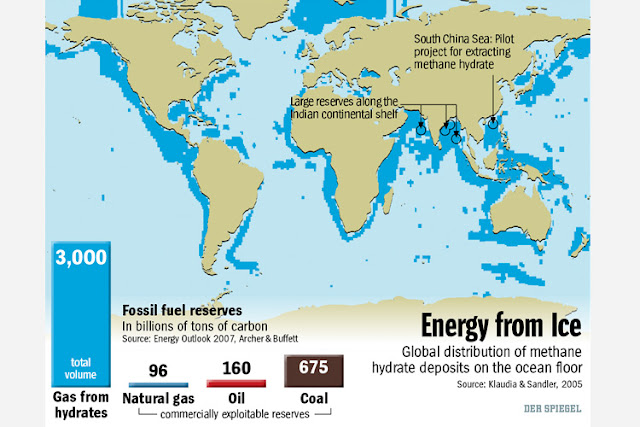
I posted recently about the successful flow test for extracting gas from deep sea methane hydrate conducted in Japan. Of course commercialisation of this technology is still many years away (though Japan hopes this could be as early as 2016). Deposits of methane hydrate are known to be extensive and generally exist either under permafrost or under the sea. The deep sea deposits were laid down under conditions of high pressure (deep sea conditions). India is known to have substantial deposits and this is now getting some people very excited:

Types of methane hydrates deposits

Economic Times:

Estimates of global reserves are sketchy, but range from 2,800 trillion to 8 billion trillion cu.metres of natural gas. This is several times higher than global reserves of 440 trillion cu. metres of conventional gas. However, only a small fraction of hydrate reserves will be exploitable.

Methane hydrate is a mixture of natural gas and water that becomes a solid in cold, high-pressure conditions in deep sea-beds (where the temperature falls to 2 degrees centigrade). It is also found in onshore deposits in the permafrost of northern Canada and Russia. Heating the deposits or lowering the pressure (the technique used by JOGMEC) will release gas from the solid. One litre of solid hydrate releases around 165 litres of gas.

India has long been known to have massive deposits of methane hydrate. These are tentatively estimated at 1,890 trillion cu.m. An Indo-US scientific joint venture in 2006 explored four areas: the Kerala-Konkan basin, the Krishna-Godavari basin, the Mahanadi basin and the seas off the Andaman Islands. The deposits in the Krishna Godavari basin turned out to be among the richest and biggest in the world. The Andamans yielded the thickest-ever deposits 600 metres below the seabed in volcanic ash sediments. Hydrates were also found in the Mahanadi basin.

Formidable economic and environmental challenges lie ahead. Nobody has yet found an economic way of extracting gas from hydrates. Industry guesstimates suggest the initial cost may be about $30/ mmBTU, double the spot rate in Asia and nine times higher than the US domestic price. JOGMEC is optimistic that the cost can be cut with new technology and scale economies.

The Indian National Gas Hydrate Program (NGHP) Expedition was conducted together with the US Geological Service

The World’s Largest Potential Energy Resource
Released: 2/7/2008 9:21:21 AM

An international team led by the U.S. Geological Survey (USGS) and the Directorate General of Hydrocarbons, which is under the government of India’s Ministry of Petroleum and Natural Gas, conducted the expedition.

Highlights include:

  • gas hydrate was discovered in numerous complex geologic settings, and an unprecedented number of gas hydrate cores and scientific data were collected;
  • one of the richest marine gas hydrate accumulations ever discovered was delineated and sampled in the Krishna-Godavari Basin;
  • one of the thickest and deepest gas hydrate occurrences yet known was discovered offshore of the Andaman Islands and revealed gas hydrate-bearing volcanic ash layers as deep as 600 meters below the seafloor;
  • and for the first time, a fully developed gas hydrate system was established in the Mahanadi Basin of the Bay of Bengal.

“NGHP Expedition 01 marks a monumental step forward in the realization of gas hydrates becoming a viable energy source,” said USGS Director Mark Myers. “This partnership combines the expertise of two organizations dedicated to understanding gas hydrates, and research results provide new and exciting information about this important potential energy resource.”

Directorate General of Hydrocarbons Director General and NGHP Program Coordinator V. K. Sibal said, “The global gas hydrate resources are estimated to be huge. Although the exploration and exploitation of gas hydrates pose significant challenges, the opportunities are unlimited. The combined wisdom of the scientific community from across the world could provide the answers and solutions to many of these challenges. The Indian gas hydrate program has been fortunate in having the benefits of a truly global collaboration in the form of the first gas hydrate expedition in Indian waters. The results of the studies are not only encouraging, but also very exciting. I believe that the time to realize gas hydrate as a critical energy resource has come.”

Methane hydrate deposits around the world: Graphic Der Spiegel


Jaguar Land Rover poised to “make in India, export to the emerging world”

March 2, 2013

Jaguar Land Rover sells around 250,000 Land Rovers and about 55,000 Jaguars worldwide.  In 2011/12 this generated about £13.5 billion sales with a profit of £1.5 billion.  They will spend around £2 billion in the 2013 financial year on new products including a new £350 million engine plant in the West Midlands.

JLR’s Strategy (Sustainability Report), JLR Strategy, states:

In 2011 we expanded assembly operations into India, one of our key markets, and announced plans for our first manufacturing facility abroad in another key market, China, through a joint venture with Chery Automobile Company Ltd. We predict Jaguar Land Rover sales will more than double in volume by 2020, largely due to increasing demand in emerging markets.

Now Reuters reports that the emerging market strategy is progressing fast and that JLR is poised to move from just assembly to the complete manufacture of some brands in India. They join the growing number of players who now see India as a sort of export hub to emerging markets.

Jaguar Land Rover (JLR) is investigating the potential of manufacturing cars in India, company sources said, as the British luxury carmaker looks to build on its growth in emerging markets with the help of Indian parent Tata Motors.

JLR, which has ridden a wave of surging demand in China and other emerging markets to post record profits over the past year, is “actively exploring the possibility” of building cars from scratch in India, said one company source.

“The idea is being looked into, with the (Jaguar) XF and (Land Rover) Freelander the obvious candidates,” said another source with knowledge of the matter.

The British brands, which already assemble two models in India using parts and engines shipped from factories in the UK, will also begin assembling its popular Range Rover Evoque in the country soon, the first source said without providing details.

Building cars in India, which has developed into an emerging market export hub for many global carmakers, would allow JLR to skirt high import taxes on luxury cars, which the country’s finance minister proposed raising to 100 percent from 75 percent in his budget speech last week.

… JLR will exhibit a new 9-speed automatic Evoque and an electric-powered version of its Land Rover Defender at the Geneva Motor Show next week.

Bought by Tata for $2.3 billion from Ford in 2008, JLR has defied those skeptical of its future under Indian ownership to roar back into profit over the past three years as the main growth driver for its now-struggling parent.

Continued growth in emerging markets such as India and China, which accounted for 22.3 percent of its sales in the December quarter, is key for JLR as it embarks on an expensive overhaul of its production and product clout. The carmaker is investing $1.7 billion with local partner Chery Automobile Co in a factory in China.

JLR lags rivals BMW AG, Volkswagen AG’s Audi and Daimler AG’s Mercedes-Benz in assembling cars in India, where the luxury market is expected to swell by around six times by 2020 to 300,000 cars a year, according to business consultancy Frost & Sullivan. ….

…. Earlier this year JLR started the assembly of the 2.2-litre diesel version of the Jaguar XF saloon at a plant in Pune, west India, tucked away in a corner of a sprawling production site where Tata builds its heavy duty trucks and hatchbacks.

Screwed together using engines and components shipped from JLR’s Castle Bromwich plant in Birmingham, central England, the company has also been assembling its Land Rover Freelander 2 in Pune since May 2011.

The XF and the Freelander 2 are JLR’s best-selling models in India, where it sold 2,288 cars in the year to March 2012, up 157 percent from the previous year. …..