Posts Tagged ‘Monsoon’

2013 monsoon begins withdrawal across India – Bumper crops after a “good” monsoon year

September 30, 2013

The official 4 month monsoon season ends today and the rains will withdraw across India over the next 3 months. Though monsoon statistics are usually focused on the 4 months from June to September, many parts of the country get significant rainfall during the withdrawal. For example the South-East coast will get significant rainfall during December. The entire monsoon cycle lasts about 7 months and the withdrawal has started. Over the 4 months rainfall has been 5% higher than the long term average and this would class this monsoon as a good monsoon.

Conventional wisdom has it that a “good” monsoon year adds 2% or more to GDP growth while a “bad” monsoon (>15% less than the long term average) can reduce the GDP growth by over 2%. Many industries are directly affected by agricultural growth. Not only fertlisers and pesticides but even farm vehicles and equipment. A good monsoon even impacts consumer goods which the rural population are waiting to get their hands on. With the slowdown in the economy many in the now lame-duck government are hoping for a monsoon boost without any action on their part and in time for the benefits to show before the general election next year. In any event, the monsoon or divine intervention cannot be blamed by ineffective politicians seeking reelection. But there is little doubt that a good monsoon has an enormous “feel-good” effect.

The monsoon is now withdrawing – perhaps a week or so behind its normal schedule (which means that some precipitation will continue to occur in Central India after the official season is over).

Withdrawal of 2013 monsoon September 30th source IMD

Withdrawal of 2013 monsoon September 30th source IMD

Crop yields are expected to be at record levels after this good monsoon.

Reuters: Grains production this summer is likely to be just short of an all-time high, according to a preliminary government forecast on Tuesday, leaving plenty for exports and helping to boost growth and trim inflation ahead of elections due by May. A heavy monsoon has ensured bumper harvests even though rice output could be lower than last year as rains were patchy over the rice-growing areas of some eastern states. The monsoon waters 55 percent of farmland without irrigation.

“Growth in agriculture … will rebound this year because rains are good,” Agriculture Minister Sharad Pawar told reporters as he announced the output forecast, which is usually conservative. “Today’s estimates are the first projections for 2013/14 and invariably we have seen that final estimates are 5-10 percent higher than the first estimate,” Pawar said.

Total output of summer-sown grains is likely to be 129.3 million tonnes in the current crop year from July, Farm Commissioner J.S. Sandhu said on Tuesday, just below the record 131.3 million tonnes of 2011/12 and up 0.9 percent on last year. Bumper output should mean India can continue exporting crops such as cotton, corn, rice and sugar.

Output of oilseeds, which could trim India’s imports of edible oils, should rise around 15 percent. Production of lentils – another foodstuff that India imports – should be up 3.2 percent.

Rice production is seen at 92.3 million tonnes against 92.8 million tonnes in the previous year. That marginal fall in rice output is not a great concern as India’s stocks are 21 million tonnes, more than double its target for September 1.

The government is relying on a bumper harvest to push agricultural growth and help the wider economy, as well as provide ample supplies of rice and wheat to support food subsidy programmes and cool double-digit food inflation. …… 
Apocalypse delayed – Himalayan researchers reverse earlier predictions of water shortages

August 6, 2013

I sense that some of the alarmism and the apocalyptic futures always associated with global warming hysteria are beginning to moderate.

Earlier predictions of water shortages due to the shrinkage of Himalayan glaciers are being reversed by new research which now predicts increased water flow in two Himalayan watersheds.

W. W. Immerzeel, F. Pellicciotti & M. F. P. Bierkens, Rising river flows throughout the twenty-first century in two Himalayan glacierized watersheds, Published online 04 August 2013, Nature Geoscience  (2013) doi:10.1038/ngeo1896

EnergyWire comments:

One of the big unknowns of climate change predictions — and one that has led to considerable contention — lies in knowing the future of water runoff from the Himalayas. The snow- and ice-rich region supplies water for billions of people in Asia and is sometimes referred to as the Earth’s “Third Pole.”

For years, scientists struggled to understand how precipitation will change in these mountains (ClimateWire, Oct. 24, 2011). They have also had difficulty determining how much glacier melt from the mountains contributes to water supply. 

A study out yesterday in Nature Geoscience by Walter Immerzeel, a physical geographer at Utrecht University, suggests that, in at least two major Himalayan watersheds, river flows and runoff should rise until 2100.

“We show that the peak in meltwater is later than we previously thought, which in combination with a projected increase in precipitation results in an increase in water availability until the end of the century,” he said.

The two watersheds Immerzeel reports on in the paper are those of the Baltoro and Langtang glaciers, which feed the Indus and Ganges rivers, respectively. In the Baltoro watershed, this is largely due to more glacier runoff from melt. In the Langtang, increased precipitation drives the extra runoff.

Immerzeel and his co-authors used the output of the latest global climate models from the Coupled Model Intercomparison Project (CMIP5) to look at temperature and precipitation projections. They combined that data with a hydrologic model of glacier responses to climate change.

They found that in both watersheds, runoff from glaciers should increase until the 2040s or 2060s, later than previous estimates, depending on which climate scenarios are applied.

….. In the paper, Immerzeel points out that his new finding contradicts previous work he has published, suggesting that runoff in the Indus and Ganges basin would decrease. At least for now, this is good news for people and farmers who rely on that water, he said.

“Strong increases in water demand are projected in the Indus as the food production needs to grow to feed the quickly rising population,” Immerzeel said. “An increased water availability from the mountains may help to sustain this growing demand.”

Abstract: Greater Himalayan glaciers are retreating and losing mass at rates comparable to glaciers in other regions of the world. Assessments of future changes and their associated hydrological impacts are scarce, oversimplify glacier dynamics or include a limited number of climate models. Here, we use results from the latest ensemble of climate models in combination with a high-resolution glacio-hydrological model to assess the hydrological impact of climate change on two climatically contrasting watersheds in the Greater Himalaya, the Baltoro and Langtang watersheds that drain into the Indus and Ganges rivers, respectively. We show that the largest uncertainty in future runoff is a result of variations in projected precipitation between climate models. In both watersheds, strong, but highly variable, increases in future runoff are projected and, despite the different characteristics of the watersheds, their responses are surprisingly similar. In both cases, glaciers will recede but net glacier melt runoff is on a rising limb at least until 2050. In combination with a positive change in precipitation, water availability during this century is not likely to decline. We conclude that river basins that depend on monsoon rains and glacier melt will continue to sustain the increasing water demands expected in these areas.

Indian monsoon starts early and vigorously

June 17, 2013

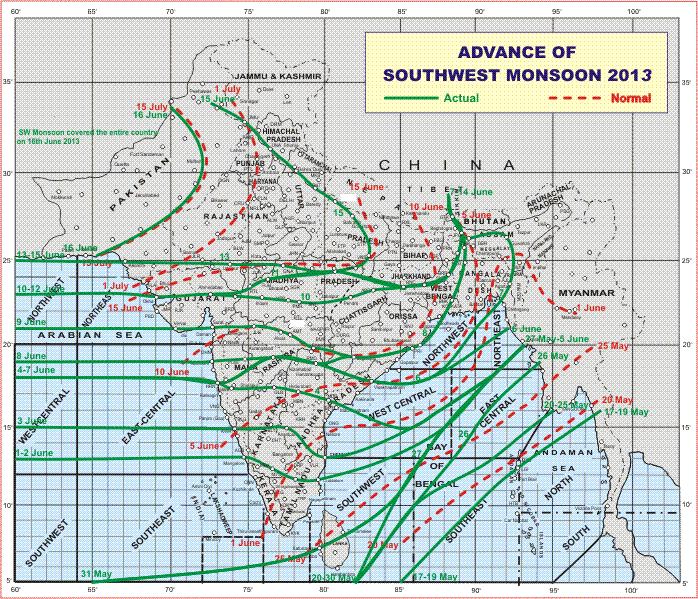
An almost spectacular start to the Indian monsoon and Delhi has received heavy rains almost two weeks earlier than expected. Two weeks of the official 4 month monsoon period (about 15%) are over and the welcome rains have covered the entire country around one month ahead of schedule. Over 30% of the total expected rainfall for a “normal” monsoon has already been received. So much so that the new airport in Delhi was flooded yesterday, not so much because of problems at the airport but because the drainage in the surrounding areas could not cope with the flow draining out of the airport and caused a back-flow!

Temperatures have dropped to a “pleasant” 31°C and it augurs well for my trip to Delhi in a couple of weeks.

Expectations for a “good” monsoon and a subsequently high level of agricultural growth are high.

ToI:The monsoon hit Delhi and its neighbourhood on Sunday, two weeks before time — and in a record sweep, swiftly covered all of northwest India. 

Besides reaching the capital well before the initially predicted date of June 29, a record occurrence unfolded in a span of 24 hours with the rain bearing system reaching the ends ofnorthwest India a full month before the usual July 15 date. The progress of rains to cover all of India as rapidly as happened over Saturday and Sunday last occurred in 1961. 

Delhi recorded 6.1 mm rain till 8.30 am and 45 mm in the next 12 hours. Palam recorded a day’s highest rainfall in the city in two years with 117.8 mm between 8.30 am and 5.30 pm. The showers have been so plentiful that Delhi will see the Yamuna cross the warning level and maybe even touch the danger mark by June 18. 

The city’s maximum temperature sharply fell to 31.5 degrees Celsius, eight degrees below normal while the minimum was 23.7 degrees.

From IMD:

monsoon 16 June 2013

monsoon 16 June 2013

Indian monsoon on schedule

June 10, 2013

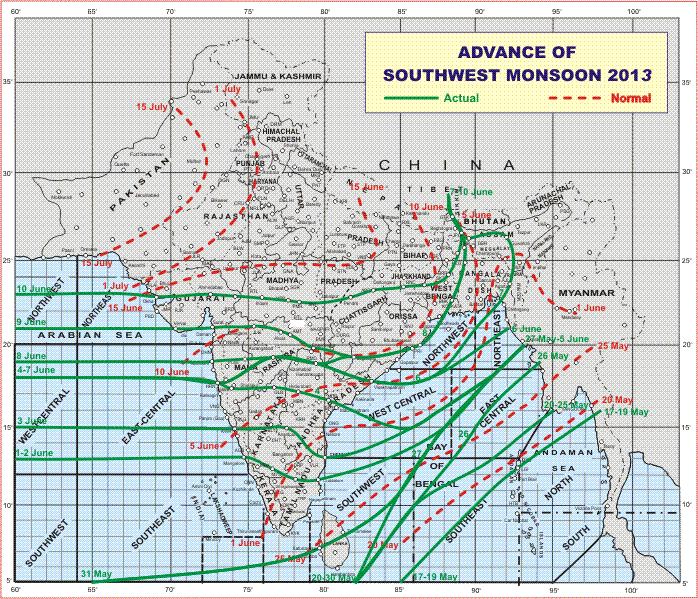
The Indian monsoon season has just started and officially runs from June to September. It seems to be on schedule and perhaps a little early in the west and a few days late in the east. Mumbai is seeing heavy rains a few days early.  Last year the monsoon was somewhat delayed and not too regular though it was “average” taken over the entire 4 months. With industrial growth still somewhat in the doldrums a boost to agricultural output will be very welcome.

( from IMD).

Monsoon progress 10th June 2013

Monsoon progress 10th June 2013

There are no signs of the catastrophe scenarios that climate models take delight in forecasting about the effects of global warming on the Indian monsoon.

Late surge gives some flooding but overall a “normal” 2012 Indian monsoon

September 30, 2012


The official 4-month monsoon season in India ends today and the IMD has issued its last press release for this season.

Rainfall was lower than normal in the first two months (-22% at the end of July) and surged somewhat in the final two.  The monsoon takes the shape of a skewed “U” and advances N-W and withdraws to the S-E. The withdrawal of the South-West monsoon is underway but it is slightly delayed and this late withdrawal also helps in bringing additional rainfall especially at the ends of the “U”  in the North-West and the North-East (with flooding recently in Pakistan and Assam).

Withdrawal of 2012 monsoon: IMD

Until September 26th, total rainfall was running about 7% less than the long-term average and within “normal” limits.

2012 Monsoon – Cumulative rainfall till 26th September : IMD

Though total rainfall will be almost “normal”, agricultural production will be slightly disturbed because of the uneven rainfall during the 4 months.

Related: https://ktwop.wordpress.com/2012/09/10/with-3-weeks-to-go-the-indian-monsoon-rains-have-recovered-somewhat/


With 3 weeks to go the Indian monsoon rains have recovered somewhat

September 10, 2012

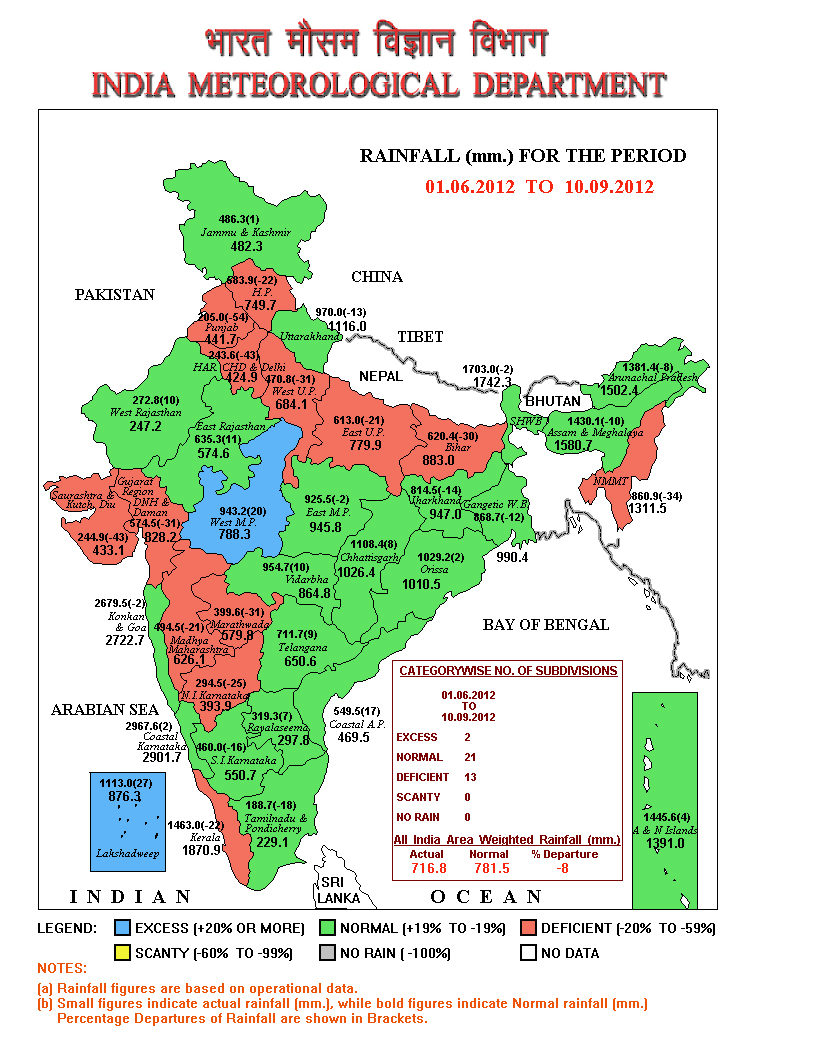
The Indian monsoon season officially covers the 4 months from June to September. Rainfall after the first 2 months was running some 25% less than “normal” and there were fears of severe effects not only directly on agricultural output but also for the knock-on effects on agriculture-related industry. But with 3 weeks left to go the rains seem to have recovered partially such that the total rainfall is running only 8% less than”normal”.

From IMD

2012 monsoon rainfall till 10th September / image IMD

At the end of July the rainfall map was dominated by “pink” deficient states and with even a couple of “yellow” scanty states. The situation has improved considerably though the late rains will not be as beneficial as they could have been a few weeks ago. Nevertheless, 2012 will probably be considered – statistically – a pretty average year and this monsoon will not be a “bad” one. Since the difference between a “good” monsoon (about +10 -15%) and a bad one (-15%)  is thought to about 2% for the annual GDP, this partial recovery will come as a relief to many.

With a “good” monsoon in the bag Indian GDP should exceed 11%

October 11, 2010

The 4 month monsoon season in India ended on 30th September and total rainfall was 2% over the long term average, about 25% higher than last year and about 5% above the long range forecast made in the spring.


Total rainfall 2010 Monsoon: IMD


Expectations that a good monsoon could lead to double digit growth are stronger with the IMF now predicting a 9.7% growth rate for the calendar year 2010.

“India’s macroeconomic performance has been vigorous, with industrial production at a two-year high. Leading indicators — the production manufacturing index and measures of business and consumer confidence — continue to point up,” the IMF said.

“Growth is projected at 9.7 per cent in 2010 and 8.4 per cent in 2011, led increasingly by domestic demand. Robust corporate profits and favorable external financing will encourage investment,” it said.

“Recent activity (10 per cent year-over year growth in real GDP at market prices in the second quarter) was driven largely by investment and the contribution from net exports is projected to turn negative in 2011 as the strength in investment further boosts imports,” the IMF said.

But in spite of the IMF’s caveat on net exports turning down, I think the trickle-down effects of a good monsoon may have been under-estimated. Agricultural growth which was low should pick up and domestic demand will ensure the industrial growth continues. For the Fiscal Year 2010/11 (till 31st March 2011) I fully expect that the GDP will grow by just over 11%.

The establishing La Niña probably helped the monsoon somewhat.

A “moderate to strong” La Niña, which appeared in July, was now well estabished according to the WMO, and forecasts showed “rather a strengthening of this La Niña episode for the next four to six months.” La Niña is characterised by unusually cool ocean temperatures in the eastern equatorial Pacific and has been associated with strong rainfall in Asia and Australia, bitter cold snaps in North America, as well as drought in South America.


Indian monsoon has been “good”: 10%+ growth possible

September 12, 2010

The Indian monsoon season officially lasts from June to September. When average rainfall over these 4 months is close to or slightly above the long term average ( from about -5% to about +10%), the monsoon can be termed to be “good”.

With 3 weeks to go rainfall is running at 1% above the long term average and has been reasonably uniform over the whole country.

http://www.imd.gov.in/section/nhac/dynamic/Monsoon_frame.htm

Despite a steady decline in the share of agriculture and allied activities in GDP to about 14.6 percent, it continues to be the mainstay of majority of the population, of about 52 percent of the work force, and remains critical from the point of view of achieving the objectives of food security and price stability.

In 2009-10, there was a poor monsoon with rainfall being about 22% less than the long term average. Consequently the Agricultural growth rate was less than 2% (1.86%). The total GDP growth was held back to around 6%. The difference between a good monsoon year and a poor year is thought to be around 2% points for GDP:

For this year the pre-monsoon forecast was for 98% rainfall but with the La Niña conditions now prevailing, this has increased. Currently Agricultural growth (April – June  2010) is at 2.78% and the “good” monsoon is likely to see this increase sharply through the rest of the year.

Currently GDP is running at over 9% with industry and manufacturing each showing growth rates of close to 12%.

Inflation in food prices should now reduce sharply and if industry and manufacturing maintain their spurt, a total 10%+  GDP growth for 2010 -11 becomes probable.

High probability of La Nina: Good news for the Indian monsoon

June 26, 2010

Good news for the Indian monsoon

The Indian Meteorological Department has increased their rainfall forecast from being 98% of normal to being 102% of normal because of the La Nina conditions developing from the cooling of  the Central Pacific. The monsoon is expected to be “on time” and Northern India will get some relief from the sweltering temperatures they have been suffering.

Development of La Nina will also lead to global temperatures continuing to show the decline which has been apparent for the last decade.

The monsoon is formally defined to last for the 4 months of June to September every year and the onset and progress of the northern front of the monsoon is closely watched and can have a major impact. Even though the Indian economy is not as vulnerable to bad monsoons as it used to be, the importance of the monsoon to agriculture (and therefore also to related industries such as fertilisers, pesticides,pumps and even tractors) means that the difference between a “good” monsoon and a “bad” monsoon can be as much as 2% of annual GDP.

‘‘The latest forecasts from a majority of the dynamical and statistical models indicate continued and rapid cooling of the equatorial Pacific to below La Nina threshholds. There is a very high probablity (about 60%) for the La Nina conditions to develop during the monsoon season, which favours stronger than normal monsoon,’’ said IMD Director General Ajit Tyagi.

(photo credit: worldslatestnews.com/…/)

La Nina is also expected to bring more rain to Australia.

While La Nina will be welcomed in India and may disrupt the Ashes Tests in Australia it is not good news for the soya bean crops in Brazil.