Posts Tagged ‘Narendra Modi’

Markets surge as Indian exit polls are awaited after close of polls today

May 12, 2014

UPDATE!

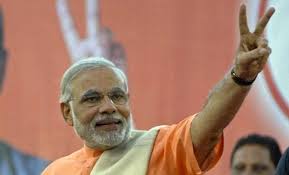
Narendra Modi - The next Indian Prime Minister (photo Forbes)

Narendra Modi – The next Indian Prime Minister (photo Forbes)

The real results have to wait till Friday but early exit poll results suggest that

  • the BJP led alliance (NDA) will get over 280 seats in the Lok Sabha (272 needed for majority) while the Congress led alliance (UPA) will get less than 120 seats. 
  • BJP will be the largest single party
  • the AAP may get 5 seats
  • Narendra Modi will be the next Prime Minister

The markets rose over 3% today.

Turnout was a record at just over 66% (of an electorate of over 800 million voters).

========================================

The Indian markets are reacting to rumours and “inside information” as to what the exit polls will reveal when they are published later today. The Election Commission has confirmed that the results of exit polls – which have been carried out over the last 6 weeks of polling and are prepared and waiting to be released – can be released after the polls close at 1830 local time (1500 CET) on the last day of the last phase of voting today.

Exit polls don’t have a very good record in predicting the result of Indian elections – especially when they are extrapolated. But we have the peculiar situation of markets being driven by the expectations of what the exit polls will say and where the actual results will not be known till Friday. Capital inflow from overseas has been particularly high and there is a feeling that this cannot be just on the advice of local investors without any special knowledge. There is a suggestion – not at all implausible – that some large investors and their overseas partners may well have carried out their own, private, exit polls. And, the story goes, these show that Narendra Modi and the BJP will get close to an absolute majority.

On Friday the BSE Sensex rose over 3% and so far today has risen another 2+%  – over 1000 points in a day and a half of trading.
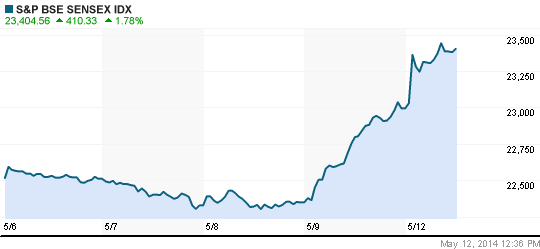
BSE Sensex 12th May noon

BSE Sensex 12th May noon (Reuters)

NDTV

It seems that investors are betting that the BJP-led NDA will emerge victorious on May 16, when results are announced, analysts say.

“There is a lot of political hope that has got baked in valuations. Markets are factoring numbers close to 230-240 seats for the BJP alone, and if that is the case, the NDA will get a majority on its own. That will lead to pro-growth, right of central, stable formation, which is enthusing for the investors,” said Manishi Raychaudhri, strategist and head of research at BNP Paribas Securities.

Polls have consistently shown the BJP and its prime ministerial candidate Narendra Modi ahead, raising expectations that the opposition party, which is seen by markets as being more investor- and business-friendly, will either win or come close to an outright majority. The surprising part, however, is markets seem to be factoring in the best possible scenario (stable government led by Mr Modi) even before exit poll results, due later in the day. 

 One possibility why markets have not waited for exit poll results might have to do with speculation that big investors have already got a whiff of what results would be. In fact, overseas investors bought shares worth Rs. 1,268.78 crore in the cash market on Friday, their biggest purchase since March 28. Friday’s gains came at a time when markets had shed 2 per cent after hitting a record high of April 25. Clearly, smart money had some information. 

Deven Choksey, managing director of brokerage KR Choksey told NDTV that somewhere from the media, numbers suggesting that the BJP will get 260-270 seats, came out. It was in circulation on social media and markets took advantage of that, he said.


Indian business hoping for/predicting a Modi/BJP landslide

May 10, 2014

The Great Indian Election Tamasha comes to an end on Monday and the results will be announced by the Election Commission on Friday, May 16th.

The Indian Stock Exchange (BSE Sensex) is riding very high. On Friday the index reached record levels and rose almost 3%. Business is looking for a stable and effective government. The last term of the Congress led government was one of the most ineffective terms of any government. Not least due to the coalition government which was virtually paralysed in the arms of its many and varied partners. Each of the regional coalition partners were more interested in cashing-in (politically and economically) than in governing or governance. The BJP in opposition was a party of disruption and their objective was to ensure and show that the government was ineffective. Parliament was more often disrupted than in session.

Insofar as the Stock Exchange reflects the hopes and predictions of the business community, a Narendra Modi / BJP government is certain. Two years ago I would have thought this was not possible but by December 2012, I became convinced that Narendra Modi would be the next Prime Minister.  As the election has progressed and the Modi wave has been sustained, the stock exchange has moved inexorably upwards. The new kids on the block – the Aam Admi Party – had threatened to be a spoiler for Modi (and it could still happen) but they are increasingly looking lost. Their leader’s resignation as Chief Minister of Delhi has only strengthened the view that the party lacks substance. They can make a noise and oppose anybody and anything, but they are scared of – and incapable of – governing.

Back in February this year it became clear that the election would be held at the end of the government’s mandate in April. The actual dates were announced by the Election Commission on March 7th. The optimism in the markets has grown steadily.

Sensex after election announcement 2014 (chart from Bloomberg)

Sensex after election announcement 2014 (chart from Bloomberg)

Indian business, in my experience, is more concerned about the stability and rationality and continuity of government rather than the manifestos of the various parties. They dislike subsidy policies introduced just to woo voters – but are expert at milking subsidies when available. They prefer the slightly more free-market approach of the BJP and are suspicious of ideological socialism and protectionism. But they have had no difficulty with working with Congress led governments as well. What they just don’t want is another government which cannot overcome the internal strains of a coalition and cannot govern. Uncertainty is the prime enemy.

So if the stock exchange is a predictor of the election result then we can expect that Narendra Modi and his BJP will not only win but may even come close to an outright majority. If that happens we can expect a sharp index spike on Monday 19th May – perhaps +4-5%. But if there is no overall majority for Narendra Modi, then we could see the markets fall also very sharply. The Sensex reached 23,000 last Friday. By next Friday it could have crept upto about 24,000. Then depending upon Modi’s majority it could spike to over 25,000. But if Modi has no clear majority and another wishy-washy government is in prospect, it could drop to around 22,000 (-10%).

US Ambassador to India apparently sacked

March 31, 2014

It seems the US Ambassador to India, Nancy J Powell,  has been forced to resign by the Obama Administration (read John Kerry’s State Department) after just 2 years in her position. The story doing the rounds is that she earned the displeasure of her bosses for

  1. totally misjudging and underestimating the Indian reaction to the diplomat Khobragade’s prosecution in New York,
  2. misjudging the political developments and therefore not patching up and developing a proper relationship with Narendra Modi who is likely to be the next Prime Minister of India after the imminent general election, and
  3. being “missing from the action” by going off on long trekking excursions.

The thinking is that Washington wants to “reboot” the US/India relationship which is currently “frozen” and that requires a new, more politically savvy person – though Nancy Powell was herself a career diplomat. During her 37 year career, Powell, has served as US ambassador to Uganda, Ghana, Pakistan, Nepal and India. Also if Narendra Modi does become the next Prime Minister, Nancy Powell continuing as Ambassador would not be possible. It would be better therefore if she was already out of the way and did not present a potential liability.

These at least are the reasons which can openly be deduced. However there has also been an involvement of the US Embassy consular staff in support of getting US visas for the family of the maid who Devayani Khobragade was accused of mistreating. Apparently members of the maid’s family worked for some consular officials in India and the whole prosecution may have been engineered by US consular officials breaking many of their internal rules – and the buck for that stops with Nancy Powell.

IndiaToday: It was a series of diplomatic cables sent on behalf of US ambassador Nancy Powell that led to her being forced to resign by the US State Department, which didn’t want to be saddled with the Nancy legacy for doing business with a new government in New Delhi.

 Top diplomatic sources said that Powell authorised cables during diplomat Devyani Khobragade arrest row described the Indian position as weak and that it will not escalate the matter as the country was in an election mode, the reverse happened because of elections round the corner there was an unprecedented Indian anger and response which dipped the relationship to an all time low.

Earlier too Powell was blamed for not advising the Washington to do business with Narendra Modi and the US only courted Narendra Modi recently after the intervention of the US State Department.

The envoy was also blamed for being on frequent trekking tours and even the Ministry of External Affairs in New Delhi had informed the interlocutors in Washington that her conduct was not helpful to the relationship.

The Obama Administration has said  – as they had to – that they had no differences with Powell and that her retirement was a planned event.

Will buying “likes” on Facebook and Twitter translate into votes?

November 29, 2013

Perception can be reality. And fake “likes” are being used to generate fake perceptions of popularity and goodness. Whether humans are dumb enough to be taken in by fake perceptions and whether perceptions can be converted into real voters and customers remains to be seen.

The assumption within the public relations and advertising industry is that  buying “likes” on social media actually leads to some advantage for the person/thing/company being liked. Clearly some companies perceive “likes” as being an effective – if unproven -advertising form. There seems to be no shortage of people offering ways of buying and boosting “likes”. Offers are readily available to arrange “2000 Facebook likes for only $17, or 5000 for $35 or 100,000 for $500”. Carlo De Micheli and Andrea Stroppa have been looking at Twitter and the underground market

De Micheli and Stroppa

De Micheli and Stroppa


We estimated fake accounts make up for 4% of Twitter’s user base

Does this make sense?

  • Facebook makes it harder to create fake accounts yet openly declares: “As of June 30, 2012, we estimate user-misclassified accounts may have represented approximately 2.4% of our worldwide MAUs and undesirable accounts may have represented approximately 1.5% of our worldwide MAUs. 
  • Every account can follow up to 2000 people. 
  • By statistically excluding overlapping fake accounts, just on the 12 main marketplaces (Fiverr, SeoClerks, InterTwitter, FanMeNow, LikedSocial, SocialPresence, SocializeUk,  ViralMediaBoost), it turns out there are around 20M fake followers on sale right now. 
  • Followers are sold at an average price of $18/1000 followers (barracudalabs). 
  • Sellers can make between $2 and $36 per fake account 
  • Multiplying it out definitely shows a multi-million-dollar market

Apart from entertainment figures wanting to boost their apparent popularity, the buying of “likes” has now become a routine matter for politicians facing elections. They are relying on the herd mentality to lead  to an increase of votes in their favour. The risk they take is that humans – when acting as a mob or a herd – don’t like acknowledging or being accused of acting like dumb animals. But the risk of this backlash is being taken as being small. Politicians in India are now all rushing to buy “likes” – as just another legitimate advertising ploy. They have been paying for favourable articles about themselves and negative articles about their opponents in the print media for many years. But even the most socially illiterate politicians – who wouldn’t know a tweet from a twit – are spending a great deal of money to be able to show huge numbers of “likes”!

What part fake likes and dislikes are going to have in the Delhi elections next week and the national elections next year, remains to be seen. It could be quite effective in a city like Delhi where the penetration of social media among the new urban population is high  but among whom political awareness is still relatively new.

FirstPostIn a new sting operation, Cobrapost has revealed how certain IT companies in India are working to manipulate social media campaigns by buying fake FB likes and followers on Twitter, and running negative campaigns against rivals of their clients and also engaging in creating panic among minority groups. The report states that the most of these companies are working on the behest of BJP and Modi, but also work for Congress sometimes, and in addition manage campaigns for multinational firms, corporations etc as well. …….  In a statement to Firstpost, Facebook said that where fake likes and profiles are concerned, “It’s a violation of our policies to use a fake name or operate under a false identity, and we encourage people to report anyone they think is doing this.

CobrapostOperation Blue Virus also makes certain stunning revelations. If the claims of the companies exposed are to be believed, among political parties, BJP is at the forefront in social media campaign, so is its Prime Ministerial candidate Narendra Modi, with scores of companies working overtime for him. This puts a question mark on the claims of the BJP leadership that there is a wind blowing in favour of their party and Narendra Modi. The larger-than-life-image that Team Modi has assiduously carved out for Modi over the past one decade may not be that real, rather invented, and is reminiscent of the Goebbellian propaganda, to sway the opinion of gullible public. It is no surprise then that even a milder criticism of the BJP’s star campaigner invites scathing attacks from his followers on social media, claimed to be in millions in count. 

Paul Joseph Goebbels would have been in his element.


Finally! Toilets before temples says Modi

October 3, 2013

Narendra Modi may have announced his candidature a little early but he knows what needs to be done. Paradoxically, in spite of his image as a Hindu Nationalist and the support he has from the RSS, he may actually have the clout to break the stranglehold that religious mores and nonsense has on development in India. Certainly, judging from his track record in Gujarat, the RSS and the VHP may find Modi rather too hot to handle if he becomes Prime Minister.

In my estimation at least half – and maybe 90% – of the roadside shrines and mosques and temples that spring up at the slightest provocation are eyesores, worthless structures and illegal occupation of land. They usually have more to do with real estate politics than any religious intention. Nearly all new “religious” structures have a motive other than religion. But nobody dares to demolish them. Anything smelling of religious intolerance brings all the cowardice possible to the fore.

This appeal to urban India by Narendra Modi is quite clever. The same message has been put forward by others and they have immediately been opposed by the shirt-sleeve religious sentiments of the RSS and the VHP. But they will not dare oppose Modi. The appeal may not go down quite so well in rural India – but it may not carry many negatives.

DNA: Speaking at a function organised here for the youth, Modi said he dared to say so even though his image as a Hindutva leader did not allow him.

Build toilets first and temples later, said Hindutva icon and BJP’s Prime Ministerial candidate Narendra Modi on Wednesday.

Speaking at a function organised here for the youth, Modi said he dared to say so even though his image as a Hindutva leader did not allow him.

“I am known to be a Hindutva leader. My image does not permit to say so, but I dare to say. My real thought is– Pehle shauchalaya, phir devalaya’ (toilets first,  temples later),” he said.

The Gujarat Chief Minister’s comment could well stoke a controversy from within his party and sister organisations, which are keen to rake up the “temple issue” again ahead of next general elections.

A similar comment on toilets from Union Rural Development Minister Jairam Ramesh that the country needs more toilets than temples had stirred a row with a large number of women organisations and NGOs protesting against the remark.

Touting the slogan of development that could take the country on the path of speedy progress, Modi said lakhs of rupees were spent on temples in villages, but there were no toilets there.

Invoking Mahatma Gandhi’s thoughts, he lamented that it was ironic that women in the country had to go in the open for easing themselves in the absence of toilets.

Modi said it was the quality of a real leader to have the strength to handle all problems and lead the way forward.

He said that for good governance and speedy progress, it was necessary for planners to focus on outlay, outcome and social audit.


Friday 13th, seven sentenced to death and Narendra Modi chosen as PM candidate

September 14, 2013

In Delhi, 4 of the 5 adults accused of the Delhi rape were sentenced to death. The 5th died earlier in custody. It waas as uicide according to the authorities and an “execution” according to the defence lawyers. The 6th accused – a juevenile – received tham maximum 3 year sentence. The odds oh his surviving his sentence must be considered far from certain.

In Madhya Pradesh a court sentenced 3 to death and a 4th to life in prison. Thry were bus employees who in a dispute with another bus driver torched that bus driver’s bus. That bus was packed with passengers and the accused barricaded the doors. 15 died.

And the BJP announcd the selection of Narendra Modi as their PM candidate for the 2014 elections over the opposition of LK Advani. I suspect Advani may be correct in thinkng it a strategic mistake and too early. I think Modi would have been better served by a few more months of speculation without offering a clear target for the Congess and other parties. The opposition to Modi now has time to mobilise.

It was Friday 13th September 2013 yesterday.

it remains to be seen if it was a Black Friday.

Rebranding of Narendra Modi is well under way

July 26, 2013

Back in 2011 I posted about the rebranding of Narendra Modi being orchestrated by Steven King and APCO Worldwide and which had started in 2009. His chances then of overcoming his Gujarat-riots reputation to become the BJP’s candidate for Prime Minister  were small at that time.

That has all changed now and the odds of his being the PM candidate are very high and his chances of becoming the next PM of India must be better than 50%.

Modi is not only the leading candidate to be the BJP’s candidate for PM for the 2014 elections, he has also been appointed the head of BJP’s campaign. He has started his efforts to gain acceptance across the country and regional parties are beginning to position themselves and even if they are not all rushing to show their support for him, they are certainly busy getting onto the fence so that they could support him if it becomes necessary or it could be beneficial. (Indian political parties all strictly follow the ideology of Opportunism).

Steven King – after his plagiarism fiasco – is no longer shown on APCO Worldwides’s website. If APCO are still working for Modi they are not doing it directly. During the floods in Uttarakhand a rather stupid effort was made to show Modi as a hero in the rescue of flood victims. This quickly backfired as in this article in the Times of India. The article mentioned APCO Worldwide  and led to APCO denying that they had anything to do with the rescue story or that they were working for Modi.

India is a big market for APCO and they are going to very careful in the run-up to the election to keep their ties to all political parties alive.  APCO India Brochure

Whatever the truth of APCO’s involvement (and I think the rescue story was a little crude for APCO) some PR group is certainly trying to orchestrate the rebranding of the Modi image. I would not be at all surprised that such a PR Group had – or has – links to APCO.

The latest story about 65 MP’s writing to Obama to ensure that Modi was not granted a US visa followed by 9 MP’s claiming that their signatures on the letter were forged is sufficiently convoluted to make me suspect the guiding hand of a well experienced PR exponent. The result of the circus is that the 65 MP’s look petty and vindictive and are all on the defensive. The Congress Party and the Left parties are busy distancing themselves from the writing of such a letter. Even the BJP has had to point out that they have no significant differences in foreign policy from that of the present government. Modi comes out very nicely with the faint glow of a halo beginning to appear.

Even the reports in the media that Nobel laureate Amartya Sen has stated that he does not believe in Modi’s economics and does not want him to be his Prime Minister are actually working to Modi’s advantage. (Sen’s attack on the real achievements in Gujarat is particularly silly – but I note in passing that it is not at all uncommon for Nobel laureates in Economics to make idiots of themselves). In fact, Sen now being “associated” in the public mind with Rahul Gandhi, is to Gandhi’s disadvantage. In my suspicious mind I see the hand of a skilled PR man again, who has successfully provoked Sen into making a silly – almost stupid – attack on Modi – to Modi’s eventual benefit. If Amartya Sen is really opposed to Modi, he has just scored an own goal – or three.

If the 2014 election becomes a personality contest between Narendra Modi and Rahul Gandhi, it would – I think – be a walk-over for Modi. The real skill of Modi’s PR strategists will show in their ability to marshall the diverse regional parties behind Modi. Exactly how they can mobilise and align the different caste groups will be particularly convoluted and fascinating to watch.

Narendra Modi could be the next Prime Minister of India

December 26, 2012
English: Image of Narendra Modi at the World E...

Narendra Modi – Wikipedia

If the Gujarat riots of 2002 had not happened, Narendra Modi would have an easy- and almost pre-ordained path – to becoming the nominated Prime Minister of the Bharatiya Janata Party. With his record in Gujarat he ought to be the “natural” choice of his party. As the only other political party having a national presence, the BJP has a very good chance of replacing the Indian Congress Party as the largest party and the party of government at the next general elections in 2014.  But the BJP lacks leaders of any stature – apart from Modi. The party President is himself badly tainted by corruption charges. The leaders of the past are approaching senility. Their Young Turks of 10 years ago come across as a whiny bunch who oppose for the sake of opposing and have no convictions of their own. Without a credible PM candidate having some national appeal the BJP may – at best –  only just get to be the largest party but would have the most horrendous task of creating a majority in Parliament. But there are still strong factions within the party who do not much like him. Not because of the “anti-Muslim” taint which hangs over Modi as the legacy of the Gujarat riots; but because he is just a little bit too efficient, too decisive and most of all, too “incorruptible”.

The BJP have few other leaders who have Modi’s undoubted competence and his ability to assemble competence. They have no other leaders with his charisma. He has been one of the very few regional leaders who has had the nerve to be a leader – with some kind of vision of where he wants to go – rather than a populist follower (like Mamata Banerjee). In India, populist politicians – no matter how criminal or venal or incompetent – have usually been able to ride the wave of their vote-banks into power. But that is changing as the Indian electorate becomes more discerning and more sophisticated though still dominated by caste. So it seems likely that the BJP establishment will reluctantly – and with some fears for their own futures – unite behind Modi. They have little choice with his unprecedented success in Gujarat:

Narendra Modi will take oath a fourth time as Gujarat Chief Minister at 11 am today. …. Mr Modi began his morning by tweeting a Vivekananda quote, as he is wont to do. “To make a great future India, the whole secret lies in organization…co-ordination of wills,” he said on Twitter.

It has been conventional wisdom that Modi has been fatally tainted by the Gujarat riots. But this is the conventional wisdom of the urban, semi-liberal middle-class. But I see this view changing mainly because even the urban middle-class see – especially in comparisons with China –  that a chaotic democracy holds back economic development. Political decisiveness a la Modi is seen as something which could unlock the Indian potential which is being held stagnant by corruption and the constant interplay of opposing factional interests. There is a mood abroad in the urban, middle-classes that “a Modi” is needed to bring an end to the institutionalised corruption in the country. There is a groundswell of support for the movement started by Anna Hazare but neither he nor Kejriwal are seen as being capable of implementing the ideals of the anti-corruption movement. These two forces – unlocking economic development and the fight against corruption – will convince the liberal-left middle-class to rationalise their views of Modi. He will not be completely forgiven for his role in the Gujarat riots but the taint will fade. Just as the Congress leaders implicated in the anti-Sikh riots following the assassination of Indira Gandhi reinstated themselves with the help of supportive Sikhs, Modi is rebranding himself with the help of supportive Muslims. His former opponents are applying selective memory. Already other non-Congress regional leaders are positioning themselves to be able to support Modi  when – no longer “if” – he becomes the PM candidate for the BJP.

Internationally, Modi was condemned in many quarters. But international politics is ultimately about pragmatic self-interest. If he becomes Prime Minister, it will not take long for countries – especially in Europe to come around. After all, to be seen to be anti-Muslim is quite acceptable in Europe even if Modi would like to tone down that perception. He already has the sympathy of China and Russia who struggle with containing their own Muslim minorities. His visa to the US was revoked in 2005 and the UK avoided him like a pariah for 10 years before reinstating contact in October this year.

But it his acceptance across India which counts. If he can succeed in getting some support from the Muslims across India – and this is not implausible – and if he can gain the support of the urban middle-class – which is already happening – the regional party leaders will also back him and the rest of their sheep will fall in line. For the elections in 2014, to be seen as being incorruptible, a “fighter against corruption” and to be seen as being an efficient CEO could trump all other perceived sins.

And that could make Narendra Modi the first Prime Minister after Rajiv Gandhi having a national stature, an administrative competence and a vision of his own that could be fun to watch.

Birds of a feather? Steven King, plagiarism, Apco Worldwide, Narendra Modi and asbestos

October 10, 2011

Narendra Modi is the  chief minister of Gujarat state in India and has overseen impressive development successes in his state, but he is considered a staunch member of the right-wing nationalistic Hindu camp and was indirectly – if not directly – responsible for the vicious anti-Muslim riots and killings in the state in 2002.

Steven King works for APCO Worldwide, a public relations and communications group, and is based in Delhi. His weekly column for the Irish Examiner has been revealed to contain widespread plagiarism and he has now apparently gone into hiding. Now it seems that part of his work at APCO includes an effort to rebrand Narendra Modi who has aspirations to be the next Prime Minister.

Tehelka reports:

…. the US Congressional Research Service (CRS) report that portrayed Gujarat Chief Minister Narendra Modi as a messiah of economic reforms. …. This glory, however, is largely a consequence of the brand-building exercise that Modi had adopted in 2007 through the help of a Washington-based Public Relations (PR) and lobbyist firm APCO worldwide. APCO, which is the second largest independent PR firm in America, took on the responsibility of taking care of PR for both Modi as well as the biennial industrial summit ‘Vibrant Gujarat’ in 2007. The firm, known for intensive lobbying, brought in investment commitment of up to Rs 20.83 lakh crore (ed. about $4.1 billion) in the 2011 summit. The Gujarat government has been paying nearly Rs 15 lakh rupees (ed. about $31,000) a month to ( APCO) since 2009 in order to bring about the image makeover.

APCO has also been managing Modi’s own behaviour and projection, for which the cost has been over $25,000 per month since 2007. Curiously, APCO was chosen over 10 other firms that also included Weber Shandwick, Grey Worldwide, Twenty-Twenty and Vaishnavi Communications owned by the controversial publicist Niira Radia. The firm, which also specialises in political PR, is notorious for having dictators such as former Nigerian dictator Sani Abacha amongst its clients. The firm, which keenly observes political conditions across the world, also boasts about changing its clients’ fortunes.

“We have a deep understanding of how governments make decisions and how to shape those decisions. It is through this extensive experience that we are able to advise sovereign nations on how best to tell their stories to the rest of the world,” claims the APCO Worldwide website. When asked about Narendra Modi, Steven King of APCO told TEHELKA that he could not divulge any detail on his clients.

APCO is involved in promoting other dubious causes as well:

The Department of Occupational Safety & Health in Malaysia has called for a ban on all forms of asbestos in order to save people’s lives. …. 

APCO Worldwide is lobbying the government of Malaysia, on behalf of an undisclosed client, to exclude chrysotile asbestos from the ban. Chrysotile asbestos represents 100% of the global asbestos trade today… The scientific consensus is clear – just as it is on tobacco – that all forms of asbestos, including chrysotile asbestos, cause mesothelioma, lung cancer, other cancers and asbestosis and that safe use is not possible.

Only lobby organizations that have a financial interest in selling asbestos claim that asbestos can be safely used, just as the lobby organizations acting on behalf of the tobacco industry have denied the clear science on tobacco harm.

APCO Worldwide has refused requests to disclose who is the client who has hired APCO Worldwide to carry out this political lobbying.

We understand that the client who has hired APCO Worldwide to oppose the ban is, in fact, the International Chrysotile Association, which represents the global asbestos industry.

As the Consumer Association of Penang has stated, “It is imperative that Malaysia joins this global campaign to ban the use of all types of asbestos and not bow to pressure by groups that place financial gains before public health.” ….

Whether Steven King is the  greater liability to APCO or whether it is vice versa is debatable.