Posts Tagged ‘Population’

By 2100, 8 million could be over 100 years old

November 13, 2013

The 2012 review of the UN’s World Population Prospects was released in August this year.

World Population Prospects 2012 (pdf – 3.53Mb)

Charts are still – presumably – being prepared since the interactive charts from the 2010 review are no longer available on the UN site and have not yet been replaced by new charts.

The basic picture is still of fertility rates decreasing steadily with the medium scenario giving a world population stabilising at about 10.8 billion around 2100. Chinese population is just about at its peak and will now be reducing till 2100. Indian population will reach its peak around 2060 and then start declining. African population will reach its peak only around 2100.

WPP12 Fertlity

WPP12 Fertlity

There is a massive amount of data and projections, and the interesting thing about demographic forecasts done on this scale is that the “inertia” is high. Consequently much of the “forecast” is inevitable and the key parameter is the fertility rate. In 1953, 99.9% of the world population exhibited a fertility rate greater than 2.1 children per woman (the static population replenishment rate). Now in 2013, 49% of the world’s population have a fertility rate lower than 2.1. Half the world’s population is already shrinking. By 2100 this will be 81% and the world population as a whole will be shrinking.

A significant proportion of those under ten years old today will still be around in 2100. Today about 20% of the world population is under 10 years old ( approximately 1,400 million). In 2100 around 8% of 10.8 billion will be over 80 years old. Assuming that say 3% are older than 87 years, it would mean that 320 million (or 23% of those under 10 or about 5% of everybody) living today will still be around in 2100. Today about 14% of the world’s population is over 60 and about 2% are over 80. By 2100, 35% will be over 60 and about 8% over 80 years old. The 950 million over 60 today will become 3,800 million by 2100.

More than 800 million people will be over 80 and I would estimate that around 1% of these  – or 8 million – could be over 100 years old!

Bloomberg (2012)Unicharm Corp.’s sales of adult diapers in Japan exceeded those for babies for the first time last year.

Just the demographics is changing the make up of the world and its genetic mix.

WPP12 population mix

WPP12 population mix

The human genetic pool in 2100 will be geographically placed 40% in Africa, 40% in Asia with the remaining 20% spread between The Americas, Oceania and Europe. And while there will be some migration and genetic mixing, this basic distribution will be maintained. Moreover, fertility rates will be stable and close to (even if just under) 2.1 in all regions. Median age is also on the way up world-wide.
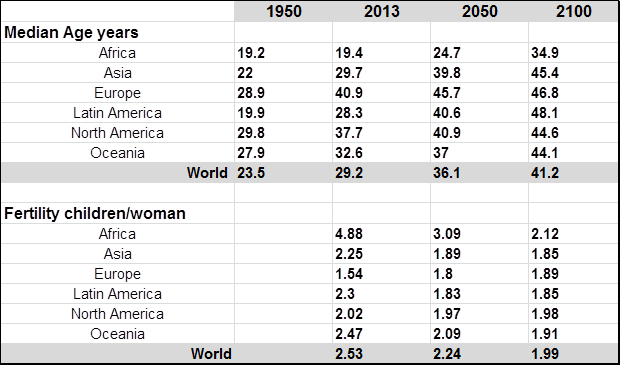
WPP12 median age

WPP12 median age

Life expectancy is rising across the world:

The twentieth century witnessed the most rapid decline in mortality in human history. In 1950-1955, life expectancy at the world level was 47 years and it had reached 69 years by 2005-2010. Over the next 40 years, life expectancy at birth at the global level is expected to reach 76 years in 2045-2050 and 82 years in 2095-2100 (table III.1 and figure III.1). The more developed regions already had a high expectation of life in 1950-1955 (64.7 years) and have since experienced further gains in longevity. By 2005-2010 their life expectancy stood at 76.9 years, 10 years higher than in the less developed regions where the expectation of life at birth was 67.0 years. Although the gap between the two groups is expected to narrow between 2005 and mid-century, in 2045-2050 the more developed regions are still expected to have considerably higher life expectancy at birth than the less developed regions (82.8 years versus 74.8 years). Throughout 2010-2100, systematic progress against mortality is further expected to increase life expectancy at birth up to 88.9 years in the more developed regions and 80.8 years in the less developed regions thereby further reducing the gap in mortality between the two groups.

What occurs to me also is that famine, disease, war and the effects of natural catastrophes are becoming less and less relevant demographically. But I shall return to that subject in another post.

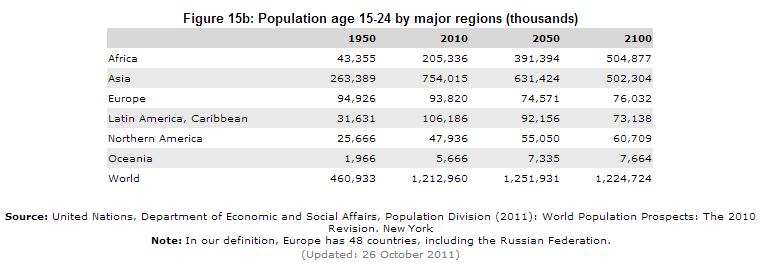
The youth of the world in 2100

June 8, 2013

In China the youth (age 15 – 24) population is already declining. In India it will keep increasing till about 2050 and then decline. In Africa it will be growing until about 2100. Most of the youth of today will not be around in 2100 but the youth of that time who will see the world through to 2200 will be 500 million each in Africa and Asia and less than 300 million in the rest of the world – subject of course to any geographical population shifts that might take place. In the period till 2100 such migrations will probably not be so significant.

From the UN’s World Population Prospects (2012 Revision):

Population age 15-24

youth of the world 2100

Population decline is looming

April 6, 2013

I have posted earlier regarding the population decline that is inevitable if the fertility rates around the world continue to decline as they are doing. The declining fertility combined with the increase in longevity and the problems of aging pose new challenges of maintaining the growth and maintenance of the infrastructure that we would have become used to. In a hundred years from now the challenge could be a real shortage of labour.

The challenge in 2100 will be to maintain the balance between those “producing” to those “supported” in a declining and aging population. Perhaps immigration or population migrations or  productivity increases by the use of robots and an increase in the age one joins the “supported” population will be parts of the solution. I have no doubt that solutions will be found, but the “overpopulation problem” would have left the stage. ….

The majority of children being born today in the developed world will live to be over 100 years old.

Now as Science 2.0 reports another model simulation shows that  The Looming Population Implosion is inevitable and just a mathematical consequence of falling fertility rates.

Total fertility by major regions, 1950-2100 (children per woman) (UN)

A model based on global population data spanning the years from 1900 to 2010 has caused a research team to predict the opposite of what Doomsday Prophets of the 1960s and beyond insisted would happen –  the number of people on Earth will stabilize around the middle of the century and perhaps even start to decline. 

The results coincide with the United Nation’s downward estimates, which claim that by 2100 Earth’s population will be 6.2 billion, if low fertility and birth rate continues on its current path, below the 7 billion we are at now. 

The numerical model developed by a team from the Autonomous University of Madrid (UAM) and the CEU-San Pablo University seems to confirm the lower estimate, in addition to a standstill and even a slight drop in the number of people on Earth by the mid-21st century. The population prospects between 1950 and 2100 provided by the UN were used to conduct the analysis published in the journal Simulation. 

“This is a model that describes the evolution of a two-level system in which there is a probability of passing from one level to another,” as explained to SINC by Félix F. Muñoz, UAM researcher and co-author of the project. …… 

……. The team considered the Earth as a closed and finite system where the migration of people within the system has no impact and where the fundamental principle of the conservation of mass –biomass in this case– and energy is fulfilled.

“Within this general principle, the variables that limit the upper and lower zone of the system’s two levels are the birth and mortality rates,” Muñoz pointed out and recalled the change that occurred in the ratio between the two variables throughout the last century.

“We started with a general situation where both the birth rate and mortality rate were high, with slow growth favouring the former,” he added, “but the mortality rate fell sharply in the second half of the 20th century as a result of advances in healthcare and increased life expectancy and it seemed that the population would grow a lot.

However, the past three decades have also seen a steep drop-off in the number of children being born worldwide.”

By 2100 a world population decline and a shortage of a “productive population” will be the problem

November 3, 2012

There are still alarmists and Malthusians who believe that the world will face catastrophe due to overpopulation. They believe that the carrying capacity of the earth has been exceeded, that there will be food shortages, energy shortages and resource shortages in every field; that – in short – the population will not be able to sustain itself let alone to maintain growth.

But like so many alarmist theories (be it global warming or peak oil or peak gas or GM crops) the overpopulation meme builds on beliefs and ignores evidence. The environmentalists are increasingly taking faith-based and anti-science positions. Alarmism invokes political correctness and “consensus beliefs” rather than evidence to silence criticism . Even hard-core environmentalists are beginning to question this myopic adhesion to ideology (Environment360).

Just taking the overpopulation myth as an example, the data and projections in the United Nations, Department of Economic and Social Affairs, Population Division (2011): World Population Prospects: The 2010 Revision. New York (Updated: 15 April 2011) are pretty unambiguous and revealing. Within 100 years world population will be declining. The majority of children being born today in the developed world will live to be over 100 years old. There will begin to be a shortage of  the required “productive population” relative to the “supported populations of the young and the retired” – a problem already evident in Japan and other developed countries. In Sweden (and some other European countries) for example, this proportion is being maintained only by means of immigration and the slight consequent increase in average fertility rates. The “productive population” in Germany would be below the required level were it not for the “guest workers”. The 11 million or so “illegal immigrants” who are nearly all part of the “productive population” in the US  are a vital part of maintaining this balance.

The challenge in 2100 will be to maintain the balance between those “producing” to those “supported” in a declining and aging population. Perhaps immigration or population migrations or  productivity increases by the use of robots and an increase in the age one joins the “supported” population will be parts of the solution. I have no doubt that solutions will be found, but the “overpopulation problem” would have left the stage.

(more…)

120 years on and Chekhov’s depressive alarmism has not changed

October 13, 2012

I was listening to BBC radio this morning where somebody was talking about a new production of Chekhov’s Uncle Vanya. The play was written in 1896 and the speaker quoted this line from the play:

“There are fewer and fewer forests, rivers are drying up, wildlife has become extinct, the climate is ruined, and the earth is becoming ever poorer and uglier.”

“Prescient” commented the speaker.

Prescient? I wondered. There is no shortage of forests, climate continues its normal cycles, some species have died and new ones found and the world has become richer and cleaner. No, just a depressed Russian of the 1890’s, and one without hope or any belief in the ingenuity of humans. Not prescient, just another alarmist now proven wrong.  And his kind of Malthusianism is alive and well even today – and is just as wrong.

In 1897 the world population was 1.5 billion with about 60% living in poverty. Life expectancy was about 32 years (average). At that time some 600 million people were being fed clothed and supported in a reasonably satisfactory way. In 2012 the world population has grown to 7 billion with about 25% still living in poverty (and the threshold for poverty has changed drastically). Average life expectancy is now 67 years. Today some 5 billion people are fed and clothed and supported in a reasonably satisfactory way. Almost 10 times as many as in 1896.

In another 120 years the current sayings of the Malthusians, the climate alarmists, the energy alarmists, the food alarmists, the resource alarmists and the bio-diversity alarmists will seem equally ridiculous. World population will probably stabilise at about 10 billion (at the current rate at which fertility rates are reducing) in the next 50 years or so. The challenges then will be the complete eradication of poverty and the biggest barrier may then be a shortage of “working” population.

By 2140 we will be close to 2.1 children per woman, studying longer (say till 27), working  for 45 years (till say 72) and living much longer – say 85 years (on average). Maybe less than 5% of 10 billion people will be living in poverty. Hunger and malnourishment will have almost disappeared. It may well be that it is the proportion of “working population”  which becomes the limiting factor in satisfactorily maintaining the young and the elderly.

But there will  still be no Malthusian resource crunch.


What population problem? More brains and hands could well cater for the extra mouths to feed

July 30, 2011

Malthus’ ideas haven’t quite been discredited but his alarmism certainly has. As world population increases from the current 6 billion and approaches around 9 to 10 billion by 2100 studies suggest that population growth can have economic and environmental benefits.

A new article in  Science 29 July 2011: Vol. 333 no. 6042 pp. 544-546

DOI: 10.1126/science.333.6042.544

Are More People Necessarily a Problem?

by David Malakoff

In 1937, A bureaucrat serving in the British Empire’s Kenya Colony penned an alarming memo to his bosses about conditions in the Machakos Reserve, a hilly, drought-prone farming region 50 kilo meters south of Nairobi. “Benevolent British rule” had encouraged the explosive “multiplication” of the “natives,” he reported, leading to massive environmental degradation. “Every phase of misuse of land is vividly and poignantly displayed in this Reserve, the inhabitants of which are rapidly drifting to a state of hopeless and miserable poverty and their land to a parching desert of rocks, stones and sand.” The apocalyptic warning came as the region’s population approached 250,000.

Today, more than 1.5 million people call Machakos home. Rather than a cautionary example of the perils of overpopulation, however, for some experts Machakos has become a symbol of something very different: the idea that rapid human population growth, even in some of Earth’s driest, most challenging environments, is not necessarily a recipe for disaster—and can even bring benefits. They argue that, over the past 75 years, population growth in Machakos and nearby Nairobi has triggered social and economic shifts that have made it possible for residents to regreen once-barren hillsides, reinvigorate failing soils, reduce birth rates, and increase crop production and incomes. “A landscape that was once declared good for nothing is now like a garden when the rain falls,” says Michael Mortimore, a geographer with Drylands Research, a United Kingdom–based nonprofit organization, who helped document the turnaround in More People, Less Erosion, a 1994 study that is still influential—and controversial—today. “Too many people still have the simplistic notion that too many people is a problem,” he says. “What happened in Machakos challenges that pessimism.”…..

 ……. Many see crisis looming in those numbers for people and the environment. Others, however, see some hope for a transition to more sustainable livelihoods and cite Ester Boserup, a Danish economist who died in 1999, as one source of their optimism. In 1965, the then-little-known Boserup, who spent most of her career consulting for international development institutions, published a slim volume titled The Conditions of Agricultural Growth: The Economics of Agrarian Change under Population Pressure(pdf Boserup1965) It examined the history of subsistence farming and offered a theory that essentially turned Malthus upside down. Instead of rising population density leading to barren fields and starvation, Boserup suggested it could naturally trigger “intensification”: the use of new technologies and more labor to get bigger harvests from less land.

“The idea was that people weren’t just mouths to feed but also brains that could think and hands and legs that could work very hard”.

….. In some parts of Africa, meanwhile, researchers are documenting a notable, Machakos-like “regreening” of arid areas with fast-growing populations. …. There’s some evidence that the extra greenery is helping to make poor farm communities more resilient to droughts and economic setbacks, but the long-term outlook remains at best unclear.

In the forest frontiers of South and Central America, researchers have found both Malthusian and Boserupian forces at work in deforestation. Depending on local circumstances, families faced with growing population densities have responded by both migrating to clear new farms in forested areas, the agricultural “extensification” predicted by Malthus, and intensified land use à la Boserup, a team led by David Carr of the University of California, Santa Barbara, reported in a 2009 study in Population and Development. Paradoxically, the result is that areas with relatively low population densities can have much higher deforestation rates than those with higher densities.

Read the whole article 

Related:

 Sustainable growth in Machakos by Francis Gichuki , Mary Tiffen , Michael Mortimore, ILEIA Newsletter • 9 nº 4 • December 1993

More People, Less Erosion, Overseas Development Institute UK, 1994