Posts Tagged ‘robotics’

Robovie-PC wins robot marathon by one second

February 26, 2011

From AFP via PhysOrg

Five bipedal machines began the non-stop 42.2-kilometre contest on a 100-metre indoor track in Osaka

Robovie PC (right) beats his brother Robovie PC-Lite by one second

Robovie-PC, a toy-sized humanoid, won the world’s first full-length marathon for two-legged robots by a whisker Saturday, beating its closest rival by a single second after more than two days of racing.

Five bipedal machines began the non-stop 42.2-kilometre (26.2-mile) contest on a 100-metre indoor track in the western Japanese city of Osaka Thursday morning after doing knee bends or raising their hands to greet spectators.

One of the competitors retired after finishing only the first lap, but the others continued running day and night, getting up by themselves every time they fell to the floor or got into collisions with rivals.

Robovie-PC, 40 centimetres (16 inches) tall and weighing 2.4 kilograms (5.3 pounds), stormed into first place with only a few laps to go after Robovie-PC Lite, which had established a comfortable lead and appeared to have secured an easy victory, suddenly locked up.

Robovie-PC Lite managed to return to the track and fiercely chased the leader, but after 422 laps Robovie-PC crossed the line in 54 hours 57 minutes 50 seconds, organisers said, one second ahead of its rival.

Their average speed was 0.77 kilometres per hour.

After the dramatic finish the two robots — both made by Vstone Co., a robot technology firm based in the industrial city which also organised the “Robo Mara Full” race — waved their arms and bowed, to wild applause from the crowd.

According to the event’s regulations, competitors were allowed to change batteries and the servomotors which control the robots’ speed and other functions.

The other two robots still running had yet to complete the race Saturday evening.


Robot Marathon underway

February 24, 2011

The world’s first full-length marathon for two-legged robots kicked off in Japan on Thursday, with the toy-sized humanoids were due to run 42.195 kilometres (26 miles) over four days.

http://www.physorg.com/news/2011-02-robot-marathon.html

Five robots are competing. Results will be reported in 4 days.

A humanoid robot named "Robovie-PC" (R) leads in a race against other robots during the world's first full-length marathon for two-legged robots, in Osaka. image:physorg.com

Divabot – debut for the all singing, all dancing robot

November 8, 2010

(PhysOrg.com) — A singing, dancing humanoid recently joined a live group of dancers to perform.

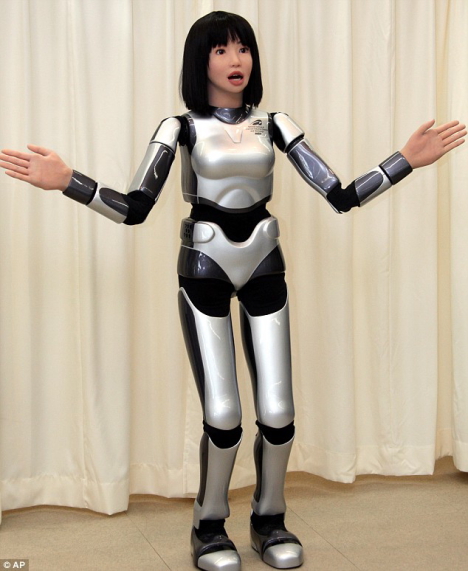
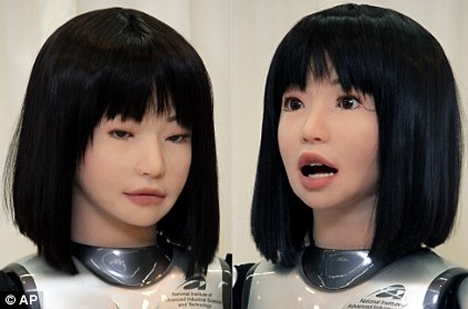
Developed by the country’s biggest public research organization, Japan’s National Institute of Advanced Industrial Science and Technology (AIST), the new variant of HRP-4, the female robot HRP-4C deemed “Divabot,” has a realistic face, movable features and even mimics human-sounding breaths.

Diva-bot’s intricate software creates complicated movements such as jumping, dancing and even balancing. Using a mouse, those with zero robotic expertise are meant to find Diva-bot easily operable, which may or may not be a good thing considering how complex the robot is.Comparable to the software commonly used in CG character animation, Diva-bot’s positioning can be controlled by clicking on the different parts and dragging them to the desired position, creating a sequence of key poses that the software generates, making the robot move.

http://pinktentacle.com/2009/03/video-hrp-4c-fashion-model-robot/


The HRP-4C, a walking, talking humanoid fashion model fembot developed by Japan’s National Institute of Advanced Industrial Science and Technology (AIST), is ready for the runway.

Video here.

With 30 motors in her body, the 158-centimeter (62-in) tall, 43-kilogram (95-lb) HRP-4C can walk around and strike a range of poses.

The black-haired robot also has 8 motors in her face, allowing her to wow the crowds with expressions of simple emotions like anger and surprise.


HRP-4C fashion model robot --

Anger // Surprise: HRP-4C


Robonaut 2 on Discovery’s last flight (rescheduled launch on 4th November)

November 2, 2010

Update!

The U.S. National Aeronautics and Space Administration (NASA) Wednesday greenlighted a launch of space shuttle Discovery on Thursday 4th November, to begin its 11-day mission to the International Space Station. The Prelaunch Mission Management Team (MMT) now is confident since a main engine controller problem on Discovery has been solved, said Mike Moses, chairman of the MMT. Therefore, the team gave a unanimous “go” for Discovery’s launch due to start at 3:29 p.m. EDT (1929 GMT) on Thursday.

Robonaut 2, a dexterous, humanoid astronaut helper, will fly to the International Space Station aboard space shuttle Discovery on the STS-133 mission. Although it will initially only participate in operational tests, upgrades could eventually allow the robot to realize its true purpose — helping spacewalking astronauts with tasks outside the space station.


 Face-Off

Face-off with Robonaut 2: Image Credit: NASA/JSC Robert Markowitz


Associated Press:

CAPE CANAVERAL, Fla. (AP) — NASA celebrated 10 years of continuous human presence at the International Space Station on Tuesday while readying shuttle Discovery for one last trip into orbit. Lift off is set for Wednesday afternoon.

Discovery is bound for the space station, currently home to six U.S. astronauts and Russian cosmonauts who fielded calls of congratulations on this special anniversary.

Breaking !

On Tuesday an electrical problem cropped up again aboard space shuttle Discovery and could jeopardize Wednesday’s launch. The trouble appears to be with a backup controller for one of the shuttle’s three main engines. NASA ordered last-minute reviews and hurriedly scheduled a mid-afternoon meeting of top managers.

A NASA spokeswoman said it’s too soon to know whether Wednesday afternoon’s planned launch will remain on track. Discovery’s final launch originally was scheduled for Monday, but was delayed by shuttle gas leaks.

The controller was sluggish early Tuesday morning. But after turning a circuit breaker and switch on and off several times, everything seemed to be fine. Later, voltage irregularities were noted.

Underwater robot will dive down to 6,000m

November 2, 2010

The Fraunhofer Institute issued a press release today regarding their new underwater robot POSEIDON which will be able to dive down to 6,000m.

Robots do not have to breathe. For this reason they can dive longer than any human. Equipped with the necessary sensor technology they inspect docks or venture down to the ocean fl oor to search for raw materials. At present, researchers are developing a model which will carry out routine tasks independently, without help from humans.


The torpedo-shaped underwater robot will be able to dive down to 6,000 meters. (© Fraunhofer AST)


Even when equipped with compressed-air bottles and diving regulators, humans reach their limits very quickly under water. In contrast, unmanned submarine vehicles that are connected by cable to the control center permit long and deep dives. Today remote-controlled diving robots are used for research, inspection and maintenance work. The possible applications of this technology are limited, however, by the length of the cable and the instinct of the navigator. No wonder that researchers are working on autonomous underwater robots which orient themselves under water and carry out jobs without any help from humans.

In the meantime, there are AUVs (autonomous underwater vehicles) which collect data independently or take samples before they return to the starting points. “For the time being, the technology is too expensive to carry out routine work, such as inspections of bulkheads, dams or ships’ bellies,” explains Dr. Thomas Rauschenbach, Director of the Application Center System Technology AST Ilmenau, Germany at the Fraunhofer Institute for Optronics, System Technologies and Image Exploitation IOSB. This may change soon. Together with the researchers at four Fraunhofer Institutes, Rauschenbach’s team is presently working on a generation of autonomous underwater robots which will be smaller, more robust and cheaper than the previous models. The AUVs shall be able to find their bearings in clear mountain reservoirs equally well as in turbid harbor water. They will be suitable for work on the floor of the deep sea as well as for inspections of shallow concrete bases that offshore wind power station have been mounted on.

The engineers from Fraunhofer Institute for Optronics, System Technologies and Image Exploitation in Karlsruhe, Germany are working on the “eyes” for underwater robots. Optical perception is based on a special exposure and analysis technology which even permits orientation in turbid water as well. First of all, it determines the distance to the object, and then the camera emits a laser impulse which is reflected by the object, such as a wall. Microseconds before the reflected light flash arrives, the camera opens the aperture and the sensors capture the incident light pulses. At the Ilmenau branch of the Fraunhofer Institute for Optronics, System Technologies and Image Exploitation, Rauschenbach‘s team is developing the “brain“ of the robot: a control program that keeps the AUV on course in currents such as at a certain distance to the wall that is to be examined. The Fraunhofer Institute for Biomedical Engineering IBMT in St. Ingbert provides the silicone encapsulation for the pressure-tolerant construction of electronic circuits as well as the “ears” of the new robot: ultrasound sensors permit the inspection of objects. Contrary to the previously conventional sonar technology, researchers are now using high-frequency sound waves which are reflected by the obstacles and registered by the sensor. The powerful but lightweight lithium batteries of the Fraunhofer ISIT in Itzehoe that supply the AUV with energy are encapsulated by silicone. A special energy management system that researchers at the Fraunhofer Institute for Environmental, Safety and Energy Technology UMSICHT in Oberhausen, Germany have developed saves power and ensures that the data are saved in emergencies before the robot runs out of energy and has to surface.

A torpedo-shaped prototype two meters long that is equipped with eyes, ears, a brain, a motor and batteries will go on its maiden voyage this year in a new tank in Ilmenau. The tank is only three meters deep, but “that’s enough to test the decisive functions,“ affirms Dr. Rauschenbach. In autumn 2011, the autonomous diving robot will put to sea for the first time from the research vessel POSEIDON: Several dives up to a depth of 6,000 meters have been planned.