Posts Tagged ‘Satellite’

German twin satellites now orbiting in close formation

October 15, 2010

The German aerospace centre announced today that

On 14 October 2010, the radar satellite TanDEM-X moved into close formation with its ‘twin’, TerraSAR-X. Before this, the two satellites were orbiting 20 kilometres apart – a flight time of almost three seconds. Now, there are only 350 metres separating the pair, which means their antennas are able to acquire radar images of the same area simultaneously.


 Premiere – TerraSAR-X and TanDEM-X now flying in close formation

Premiere – TerraSAR-X and TanDEM-X now flying in close formation


The objective of the mission is to create a high-precision, three-dimensional digital elevation model of Earth’s land surface. The project needs the satellites to operate in parallel for a period of three years. The transition to close formation flight marks the beginning of the final preparatory stage of the TanDEM-X mission. The routine operations phase is due to start in early January next year.

The TerraSAR-X and TanDEM-X orbit trajectories, patented by DLR researchers, are like the strands of a double helix – they circle around one another without crossing. The team of scientists based in DLR Oberpfaffenhofen took just three days to carry out the approach in preparation for the final formation flight. “First, we had to manoeuvre TanDEM-X to reduce its orbital period, so that the satellite could ‘catch up’, reducing the 20 kilometre gap between it and TerraSAR-X. After two further manoeuvres we brought the distance between the pair down to 350 metres,” explains DLR flight dynamics expert Ralph Kahle.

The reduced distance between the satellites means that the two radar systems can be synchronised for the first time. TerraSAR-X and TanDEM-X can also monitor each other’s ‘health’ via an inter-satellite link. “This is completely uncharted territory. Never before have two satellites worked in such close formation over a period of several years,” says Manfred Zink, Project Manager for the TanDEM-X Ground Segment. Eckard Settelmeyer, Director of Earth Observation and Science at Astrium, adds: “This dual mission will give another boost to satellite-supported applications and science.”

Read the whole article:

http://www.dlr.de/en/desktopdefault.aspx/tabid-1/117_read-27086/

Chang’e-2 enters 12 hour lunar orbit

October 6, 2010

Chang’e-2 enters 12 hour lunar orbit

China’s second unmanned lunar probe  Chang’e-2, completed its first braking Wednesday, which decelerated the spacecraft and successfully allowed it to enter a 12-hour orbit, according to the Beijing Aerospace Control Center (BACC). Chang’e-2, following instructions from the center, started the first braking at 11:06 a.m. and entered the 12-hour elliptical moon orbit 32 minutes later. It was the first braking for Chang’e-2. The space- probe needs to brake another two times before it can enter the designed 118-minute working orbit. The braking “laid a solid foundation” for Chang’e-2 to carry out scientific explorations in its final orbit, BACC said in a press release.

Compared with Chang’e-1, it is more challenging for Chang’e-2 to brake as it must do so at a closer distance to the moon and at a higher speed. A Long-March-3C carrier rocket carried Chang’e-2 into space blasting off from the Xichang Satellite Launch Center, in southwest China’s Sichuan Province, at about 7 p.m. Friday.

To acquire more detailed moon data, Chang’e-2 will enter a lower lunar orbit about 100 km above the surface, compared with the 200-km altitude of Chang’e-1, according to the control center. Before its first braking, the lunar probe had traveled nearly 350,000 km.

Screen shows the virtual animation of the first braking of Chang'e II lunar probe in Beijing Aerospace Control Center in Beijing, capital of China, Oct. 6, 2010. China's second unmanned lunar probe, Chang'e II, completed its first braking Wednesday, which decelerated the satellite and successfully made it enter a 12-hour orbit, according to the Beijing Aerospace Control Center. (Xinhua/Tian Zhaoyun) (xzj)

Cheng'e - 2 enters 12 hour lunar borbit

Two satellites into orbit

In other news today a Long March 4B rocket carrying two satellites of the “Shijian VI-04” group lifted off from the launch pad in Taiyuan, capital of north China’s Shanxi Province, Oct. 6, 2010. The satellites which have entered their space orbits will carry out probes on space environment and radiation and conduct space science experiments, according to the Taiyuan Satellite Launch Center.

Michibiki navigation satellite in position over Japan

September 30, 2010

Japan’s first navigation satellite has arrived on station more than 20,000 miles over Asia to improve positioning coverage in mountainous terrain and urban centers.

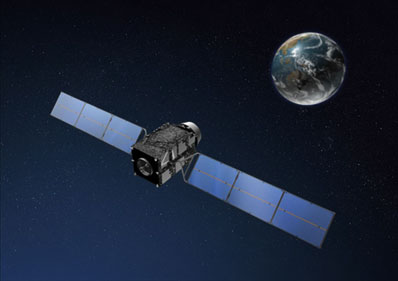
Artist's concept of the Michibiki satellite. Credit: JAXA

MICHIBIKI injected into the quasi-zenith orbit with its center longitude of about 135 degrees.

The First Quasi-Zenith Satellite MICHIBIKI, which was launched by the H-IIA Launch Vehicle No. 18 on Sept. 11 (JST,) has been maneuvered to shift its orbit from the drift orbit to the quasi-zenith orbit starting on the 21st. The satellite is now confirmed to be inserted into the quasi-zenith orbit over Japan with its center longitude of about 135 degrees through the final orbit control performed at 6:28 a.m. on Sept. 27. The MICHIBIKI was launched from the Tanegashima Space Center at 8:17 p.m. on September 11, 2010 (JST.)

Yoshinobu Launch Complex

Yoshinobu Launch Complex at the Tanegashima Space Center: JAXA

JAXA’s press release is here:

http://www.jaxa.jp/press/2010/09/20100927_michibiki_e.html