Posts Tagged ‘Shale gas’

Low energy prices with shale gas leading to shift of jobs from Europe to US

December 28, 2012

It is inevitable that investment and jobs – and especially in energy intensive industries – will migrate to regions of low energy costs. Over the next few years the lead that the US has developed over the rest of the world in the exploitation of shale gas will cause European companies to shun the high energy costs at home and shift to the US.

Reuters: Austria’s group Voestalpine is considering a plan to build a $1 billion plant in the United States that would convert iron ore into concentrate used in steelmaking, Trend magazine reported. ………. Trend said the plant was envisioned for a coastal city in the southern United States, given cheap and reliable supplies of natural gas, political stability and efficient port infrastructure.

And the problem has been the unnecessary and misguided European obsession with chasing a mirage.  A meaningless and unjustified pursuit of “low carbon” energy; profligate subsidies for ineffective renewable energy; wasteful – and eventually corrupt – attempts to bias the market with carbon credits and the shutting down of perfectly viable coal and nuclear power plants has given the highest energy costs in the world. Gas prices in Europe are 4 or 5 times as high as in the US. Europe has plenty of shale gas potential but development is lagging far behind the US largely because of the political opposition from the “Green” lobbies. As the New York Times reports:

High Energy Costs Plaguing Europe

.. Asked whether he had considered building the plant in Europe, Voestalpine’s chief executive, Wolfgang Eder, said that that “calculation does not make sense from the very beginning.” Gas in Europe is much more expensive, he said.

High energy costs are emerging as an issue in Europe that is prompting debate, including questioning of the Continent’s clean energy initiatives. Over the past few years, Europe has spent tens of billions of euros in an effort to reduce carbon dioxide emissions. The bulk of the spending has gone into low-carbon energy sources like wind and solar power that have needed special tariffs or other subsidies to be commercially viable.

“We embarked on a big transition to a low-carbon economy without taking into account the cost and without factoring in the competitive impact,” says Fabien Roques, head of European power and carbon at the energy consulting firm IHS CERA in Paris. “I think there will be a critical review of some of these policies in the next few years.” 

Both consumers and the industry are upset about high energy costs. Energy-intensive industries like chemicals and steel are, if not closing European plants outright, looking toward places like the United States that have lower energy costs as they pursue new investments.

BASF, the German chemical giant, has been outspoken about the consequences of energy costs for competitiveness and is building a new plant in Louisiana.

“We Europeans are currently paying up to four or five times more for natural gas than the Americans,” Harald Schwager, a member of the executive board at BASF, said last month. “Energy efficiency alone will not allow us to compensate for this. Of course, that means increased competition for all the European manufacturing sites.”

And it beomes increasingly clear that the chase for politically correct “brownie points” by European  governments as they have demonised carbon dioxide quite needlessly while spending massively on renewable subsidies is not sustainable. Just as Japan must now waste political energy in “reviewing” their hasty decisions about the use of nuclear energy after Fukushima , Europe will have to spend the next decade in “reviewing and reversing” the spate of bad decisions made based on climate alarmism.

The expansion in renewables will probably ensure that Europe will meet its target of reducing greenhouse gases 20 percent from their 1990 levels by 2020. But it has been a disappointment on other levels. For one thing, emissions continue to rise globally. In a sense, Europe is likely to have exported its emissions to places like China, where polluting economic activity continues to increase while the European economy stagnates.

A striking indicator that the European effort has not achieved all that it intended to is the continued rise in the burning of coal, by far the biggest polluter among fossil fuels.

The International Energy Agency, a Paris-based group formed by consumer nations, recently said that coal was likely to catch up with oil as the world’s largest source of energy in a decade.

Much of the increase in coal use can be blamed on China and India, but not all of it. Europe has increased its coal use this year, and that has led to an increase of about 7 percent in carbon dioxide emissions from power generation, according to IHS. Coal use is increasing in all regions except the United States, the I.E.A. said.

Shale gas boosts petrochemical developments as fracking proves as important as catalytic cracking

December 19, 2012

The advent of shale gas (and shale oil) is having more profound effects than just on the production of energy or electric power. The development of “fracking” technology is providing an impetus for developments in the petrochemical industry which can be compared to the “golden years” which followed the introduction of catalytic cracking.  Petrochemical processing costs are now lower in the US than in many other countries and there has been a sharp increase in projects for the “cracking” of ethane to make ethylene as a feedstock.

As put by the Financial Times: “The international chemicals industry is undergoing its most profound upheaval for 75 years, according to Kevin Swift of the American Chemistry Council. Not since the years before the second world war, when there was a flood of discoveries including nylon, synthetic rubber, PVC plastic and polystyrene, has there been technological change with such far-reaching consequences.”

The American Chemistry Council has just published its Year End 2012 Situation and Outlook and issued this press release.

HydrocarbonProcessing writes:

Favorable oil-to-gas price ratios driven by the production of natural gas from shale will drive a renewed US competitiveness that will boost exports and fuel greater domestic investment, economic growth and job creation within the business of chemistry.

(more…)

European Parliament defeats alarmist scare-mongering that shale gas will “destroy the future of mankind”

November 22, 2012

Rational thinking still can prevail over alarmist hyperbole.

It is heartening to see that the European Parliament – which is not my favourite institution – has rejected a moratorium on the exploitation of shale gas and has approved the right of each member state to decide for itself on shale gas exploitation. It has been “green” fanaticism and the environmentalists propensity for myopic adhesion to ideology which has caused Europe to forget the simple reality that “the lower the cost of energy the greater the growth”.

On 20th November the EU Parliament debated reports

(more…)

Russia losing the shale gas wars

October 1, 2012

The advent of shale gas is not only a game-changer regarding power generation but also a game-changer in the area of energy and geopolitics. The Russian dominance in the European gas markets is being threatened and they are now joining forces with various environmental groups in an unholy alliance to restrain the development of shale gas production in Europe.

But in the long-term I expect Russia will join the shale-gas movement. They have larger resources of oil and gas bearing shales  than most others.

Wall Street Journal (Associated Press):

The Kremlin is watching, European nations are rebelling, and some suspect Moscow is secretly bankrolling a campaign to derail the West’s strategic plans. It’s not some Cold War movie; it’s about the U.S. boom in natural gas drilling, and the political implications are enormous. Like falling dominoes, the drilling process called hydraulic fracturing, or fracking, is shaking up world energy markets from Washington to Moscow to Beijing. Some predict what was once unthinkable: that the U.S. won’t need to import natural gas in the near future, and that Russia could be the big loser.

(more…)

Opposition to shale gas and cheap US coal only leads to greater use of coal in Europe

September 26, 2012

Not that there is anything wrong with using coal when it makes commercial sense. The demonisation of carbon dioxide is a religion built on a hypothesis which in turn is based on “it must be the cause of global warming” and not on any evidence whatever. In consequence the world-wide drive to reduce carbon dioxide emissions is an unnecessary, expensive and ultimately pointless exercise.

The religious and thoughtless opposition of the “greens” to any use of fossil fuels has led them – especially in Europe – to trying to block exploration, production and exploitation of shale gas. But as with so many “environmentally correct” decisions it turns out to be counter-productive to their own misguided objectives. In Europe this together with the availability of cheap US coals has only served to promote the greater use of coal and an increase in carbon dioxide emissions. The blind pursuit of renewable energy in Europe has already given the highest electricity prices in the world. While the increased emissions of carbon dioxide through greater coal use does not itself matter, the consumer will have to pay even higher electricity prices than would prevail if shale gas were exploited.

Reuters reports:

BRUSSELS/LONDON, Sept 25 (Reuters) – Shale gas has jolted traditional roles in the planet’s climate drama, giving cleaner fuel to the United States, whose displaced coal has headed to Europe to pollute the old continent.

It is an ironic twist for the European Union, whose energy policy is largely based on promoting renewables and a target to cut emissions b y 20 percent by 2020. The U.S. did not ratify the Kyoto Protocol to combat global emissions and its national goals are far less ambitious than Europe’s.

(more…)

Momentum for shale gas builds in Europe

September 22, 2012

The momentum is now growing fast and it is difficult to keep up with the number of parties coming out in favour of the exploitation of shale gas in Europe. However the self-righteousness behind the “environmental correctness” of the European political establishment will not be overcome without a struggle.

France: Bosses demand shale gas rethink:

BUSINESS leaders have signed up to a call to reopen debate on the extraction of shale gas in France. 
The move comes shortly after President Hollande said he will halt exploration during his five-year term and announced refusals of seven oil company applications for drilling permits in the south, because they were thought to be looking for shale gas. …..

UK: IoD: Shale gas could provide 35,000 UK jobs :

The Government is expected to give the green light for more fracking in the UK to access shale reserves within weeks as it publishes a new gas strategy, but energy secretary Ed Davey warned yesterday that it was no “silver bullet”.

The IoD has released a new report on the process this morning which claims there will be an upward revision in the estimate of the size of the UK’s shale gas reserves later this year, up from 5.3 trillion cubic feet. It also suggests there would be “environmental benefits” to using shale gas over coal-fired power plants.

Russia: Gazprom Rethinks Shale as European Gas Prices Sink:

Gazprom has admitted it might yet adjust its attitude towards shale gas, as Russian policy makers assess new dangers to the country’s petro-dollar economy. First, Russia’s Economic Ministry warned that the increasing supply of shale gas on world markets will start hurting Gazprom’s pipeline sales to Europe in 2014. And it seems Gazprom might now be weighing the pros and cons of jumping onto the shale gas bandwagon.

Long term investment: Avoid the carbon taxers (Australia) and follow the shale gas (US)

August 24, 2012

It is electricity price – rather than energy price – which is I think the more telling parameter for growth and investment. And it is electricity price which matters fundamentally. Winning “brownie points” for being virtuous and politically correct is irrelevant and often counter-productive.

Historically, a  low (unsubsidised) electricity price has nearly always given high growth, increased exports to regions with higher electricity prices and an attractive climate to invest in. This simple observation will now lead to my shifting my (small) investments away from  Australia for some time – at least as long they continue with their virtuous but meaningless carbon tax. On the other hand, the relatively low electricity prices resulting from the advent of shale gas  in the US augur well for the US economy and for US exporters – irrespective of which party the President comes from.

In my own field of power generation I expect a gas turbine combined cycle boom in the US in 2014/15 (which will also be a boom for steam turbine manufacturers). So my message for the next 5 or 6 years is to shift your investments away from Australia (and other virtuous but economically silly countries) and into countries promoting low energy prices (US and other countries where the environmental regulations and tax regimes allow  production of electricity at the lowest possible cost).

Sydney Morning Herald: 

BHP Billiton head Marius Kloppers has told European investors that Australia’s carbon and mining taxes have helped to render the nation’s coal industry unworthy of further investment at this time. ……. 

In comments that appeared to be more pointed than those given in his Australian media conference, Mr Kloppers put some of the blame on the federal government’s two controversial new taxes.

”What I am seeing on the eastern seaboard in Australia is that the coal industry has been very heavily impacted by lower prices, higher operating costs, carbon taxes and increased royalties,” he said.

Royalties were increased by the New South Wales government as it sought to exploit a loophole in the federal government’s new mining tax, and a similar tactic is now being considered by the Queensland government. ….

Financial Times:

….. Today, few realise that the US stands on the cusp of significant economic gains stimulated by low energy costs. High quality global journalism requires investment.  …..

The consensus view discounts the economic boost from natural gas, arguing that the energy sector cannot generate so many jobs. The doubters wear blinkers; they see nothing but the energy market. They commit the mistake made by forecasters in 1991. They miss the tectonic shifts in trade,  ….

(The shale gas) advantage gives manufacturing plants in the US a 60 per cent, 70 per cent or even 80 per cent cost advantage over those operating in China, Japan, South Korea or European countries.

Read more: http://www.ft.com/intl/cms/s/0/09fbb2ac-87b8-11e1-ade2-00144feab49a.html#axzz24QutnD2A

The Luddite shades of Green

August 5, 2012


The Leader of the Luddites, engraving of 1812: Wikipedia

This editorial in The Australian about shale gas got me to wondering how it has come to pass that what were once very laudable anti-pollution goals have morphed  into an anti-technology and essentially anti-human movement. Luddites have always been among us and always need – and have always needed – a cloak of righteousness under which to operate. The current demonisation of technological advance has its roots – I think – in the politicisation of the concern for “the environment” which probably began in the 1960’s. As long as “environmentalism” focused on improvement of local conditions it did much good. It has contributed much to the clean-up of air and water pollution which had resulted from the speed of industrialisation. While industrialisation and technological development were necessary for growth and to ensure that humans could put food on their tables, the drive against pollution did much to improve their quality of life. But then the Luddites – who have always been around – “found” evironmentalism. The destructive forces had found a new righteous cover – this time coloured green. Politicisation and globalisation have now transformed what was once a relatively simple anti-pollution campaign focused on improving the quality of life for humans into something else – a fanatical movement with religious overtones. A coercive, destructive, backward-looking, anti-development, anti-human Green Monster.

The Green movement has become the cloak under which modern Luddites can hide and operate.

The Australian:

POLITICAL parties preoccupied with environmental protection, including the Greens, should take on board the benefits of breakthrough technology that is already allowing easier access to shale gas in the US.

As environment editor Graham Lloyd reports today, with 250 years’ worth of gas reserves now in play, the shale revolution is cutting power costs and carbon emissions and increasing energy supplies. In the longer term, it promises energy security, export earnings and stability as the West’s dependence on Middle East oil diminishes.

The unexpected emergence of shale, foreseen by very few four or five years ago, underlines the folly of governments trying to “pick winners” by investing in various forms of renewable energy, such as wind and solar power, which will only be viable on a large scale if technology improves.

Too little attention has been paid to Australia’s vast shale reserves, which are potentially far bigger than coal-seam gas. Apart from the volume of water needed to access it, shale poses fewer environmental problems than coal-seam gas. The geological formations are more stable and located in more remote areas. Given the reluctance of our politicians to pursue nuclear power, shale has the potential to be an important energy source for decades.

OED:

Luddite – In modern usage, “Luddite” is a term describing those opposed to industrialisation, automation, computerisation or new technologies in general

Greenie – a person who campaigns for protection of the environment

the environment – the surroundings or conditions in which a person, animal, or plant lives or operates; the natural world, as a whole or in a particular geographical area, especially as affected by human activity


Vast shale oil deposits in Siberia

June 6, 2012

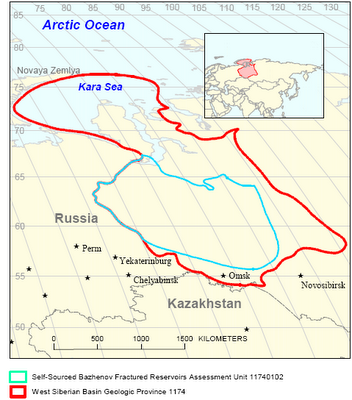
While oil from Siberia is nothing new the vast shale resources in the Bazhenov – containing oil and gas – have yet to be exploited. But fracking technology to extract these is now available. The West Siberian basin is the largest petroleum basin in the world.

Bazhenov basin Western Siberia

The shale in Western Siberia also contains large amounts of gas. Shale gas and oil are already flowing in the US, the shale gas potential in China and India is being explored and developed and now vast reserves of  oil and gas are available from shale deposits in Russia. Europe also has large deposits of shale gas but are dithering under the influence of alarmist environmentalism. They will have little choice but to join the brave new world of shale – or be left far behind.

Forbes reports:

(more…)

With gas from methane hydrates added to shale and natural gas, the world has gas for a thousand years

May 3, 2012

Methane hydrates represent the largest source of hydrocarbons in the earth’s crust.

Methane clathrate (CH4•5.75H2O), also called methane hydratehydromethanemethane icefire icenatural gas hydrate, or gas hydrate is a solid clathrate compound (more specifically, a clathrate hydrate) in which a large amount of methane is trapped within a crystal structure of water, forming a solid similar to ice. Originally thought to occur only in the outer regions of the Solar System where temperatures are low and water ice is common, significant deposits of methane clathrate have been found under sediments on the ocean floors of Earth. 

The worldwide amounts of carbon bound in gas hydrates is conservatively estimated to total twice the amount of carbon to be found in all known fossil fuels on Earth.

(more…)