Posts Tagged ‘Shale gas’
April 8, 2012
Common sense and simple economics are beginning to reassert themselves as the the fundamental weaknesses in the fashionable – but subsidised – expansion of solar and wind power plants are revealed. The expensive, intermittent and unpredictable generation that derives from solar and wind power plants can – at best – be used to augment an existing system. They are actually useful as an auxiliary heat and power source as small decentralised units. But in a large power grid they are more of a nuisance than an asset and can only increase the cost to the consumer.
China has now published a policy document changing direction towards nuclear and hydro power and an accelerated development of shale gas use. Solar and wind power are downgraded.
Electric Light & Power
China will accelerate the use of new-energy sources such as nuclear energy and put an end to blind expansion in industries such as solar energy and wind power in 2012, Chinese Premier Wen Jiabao says in a government report published on March 5.
(more…)
Tags:China, Energy, Energy development, Hydro Power, Nuclear power, Shale gas, Solar power, wind power
Posted in China, Energy, Nuclear Power, Renewable Energy | Comments Off on China downgrades solar and wind power – pushes for nuclear, hydro and shale gas
March 9, 2012

Karoo, South Africa: image Wikipedia
The Karoo is a semi-desert natural region of South Africa with two main sub-regions – the Great Karoo in the north and the Little Karoo in the south. The region is known to contain shale-gas deposits some 4,000m below the surface but the extent of the deposits have yet to be fully investigated.
Now Econometrix has published a new report on the potential for growth that Karoo shale gas could provide. The report is supported by Shell who are planning to explore the deposits. A pdf version of the report is available from Shell here: Karoo Shale Gas Report – February 2012
To put quantitities in perspective the 485 trillion cubic feet of gas (14 trillion cubic metres) thought to be in the Karoo compares with 25 trillion cubic metres in China and about 13 trillion cubic metres in the US. (The Age of Gas: China has enough shale gas for 200 years).
IOL, South Africa reports:
(more…)
Tags:Karoo, Natural gas, Royal Dutch Shell, Shale gas, shale gas reserves, South Africa
Posted in Business, Energy, Environment, South Africa | Comments Off on South Africa could join the shale gas band-wagon
March 2, 2012
The Age of Gas is not just dawning but is well and truly underway with China revealing reserves sufficient for 200 years. At 25 trillion cubic meters (875 trillion cubic feet) of recoverable reserves these could be almost twice the recoverable reserves in the US.
As shale gas comes into play all over the globe there is going to be a run on large gas turbines for power generation. Gas turbine manufacturers (and the big 4 are GE, Siemens, Alstom and MHI) can expect a sellers market within 2 or 3 years as the economic recovery pressurises generation capacity.

from Wikipedia
The Telegraph:
China is planning an investment blitz to unlock its vast reserves of shale gas, convinced it can match the energy revolution under way in the US and meet a significant part of its fast-growing fuel needs.
(more…)
Tags:Age of Gas, China, dash for gas, gas glut, gas turbines, sellers market, Shale gas
Posted in China, Energy, Engineering, Gas | 2 Comments »
February 20, 2012
Oil production from oil shales in North Dakota is increasing rapidly and the much-heralded “peak” of oil production may have to be postponed. Alarmists will not be pleased.
“Peak Oil” and “Peak Gas” are the points in time where the production of oil and gas respectively reach a peak and then decline to zero. The concept is based on the normal production cycle of an individual well extrapolated to all the oil and gas existing. The fundamental flaw in these hypotheses when trying to apply them to “finite” and exhaustible resources of any product is of course that:
- new sources of the product are discovered
- new extraction technologies enhance what can be recovered from existing sources,
- new technologies make non-viable sources viable
- new technologies allow the synthesis or alternative production of the product (price driven)
- consumption is modified by pricing

Moving peaks
In recent times the development of fracking technology and the discovery of huge deposits of gas-bearing shales together with the discovery of new deep-sea sources of natural gas have pushed the “peak” for gas production beyond the visible horizon and into the distant future (a few hundred years). When – rather than if – methane hydrates become available for gas production, the “peak” will shift further into the future.
In the case of oil there are already many feasible alternatives which are technically feasible but where commercial production by these methods can only be triggered by the sustainable price being higher than the production cost. For example bio-diesel costs are commercial with oil prices above about $70 per barrel but there is a hidden cost in decreased or disrupted food production. Coal liquefaction would need oil prices above $120 per barrel while oil extraction from oil shales and oil sands become commercial at about $90 and $100 respectively. Deep sea wells (new exploration) are increasingly commercial as the price increases.
The alternatives are now coming into play:
(more…)
Tags:"Peak" gas, Energy, oil shale, Peak oil, Shale gas
Posted in Alarmism, Energy, Gas, Oil, Oil price | Comments Off on “Peak Oil” hypothesis is following “Peak Gas” into oblivion
February 14, 2012
China has reserves of shale gas at least 50% greater than in the US and is the latest country hopping onto the fracking band-wagon. The Chinese are looking to acquire minority interests in technology companies owning fracking technology in the US and are pushing ahead with their plans for production of shale gas. It seems quite clear now that whenever the global economic recovery finally gets going, the availability of shale gas will be one of the contributing factors. I expect we shall see a boom in exploration for shale gas reserves, in increasing production of shale gas and a boom in gas-fired power generation. There may well be a boom in the sales of gas turbines for power generation within the next 2 -3 years.
“Peak” gas is nowhere in sight. And the fracking technology developments seem to have application even for the recovery of large amounts of gas from methane gas hydrates which are found under deep sea-beds (>500m deep) and even under thick layers of permafrost. While this may take another 10+ years to develop, it makes it even more unlikely that any “peak” gas scenario can develop.

Shale gas reserves: Reuters graphic
Forbes reports:
(more…)
Tags:"Peak" gas, China, fracking, Hydraulic fracturing, Natural gas, Shale gas
Posted in Business, China, Energy, Gas | 1 Comment »
January 18, 2012
The advent of shale gas has moved the peak of “peak-gas” into the future by some 250 years. This together with the fact that gas-fired power plant have the shortest construction times and the lowest investment costs of any form of power generation provides the possibility to hold down electricity generation costs. The increase in generation costs in recent times has been the natural consequence of the subsidy regimes for wind and solar power plants and the opportunistic rush to renewable power. Huge fortunes have been made by “green” developers as the subsidies have been milked – but consumers have only seen rising electricity prices.
Bloomberg reports:
A shale-driven glut of natural gas has cut electricity prices for the U.S. power industry by 50 percent and reduced investment in costlier sources of energy. With abundant new supplies of gas making it the cheapest option for new power generation, the largest U.S. wind-energy producer, NextEra Energy Inc. (NEE), has shelved plans for new U.S. wind projects next year and Exelon Corp. (EXC) called off plans to expand two nuclear plants. Michigan utility CMS Energy Corp. (CMS) canceled a $2 billion coal plant after deciding it wasn’t financially viable in a time of “low natural-gas prices linked to expanded shale-gas supplies,” according to a company statement.
(more…)
Tags:Electricity generation, Energy, gas glut, Gas price, gas turbine boom, Natural gas, Shale gas, Utilities
Posted in Energy, Engineering, Gas | 2 Comments »
September 22, 2011
“Peak-gas” moves further into the future as recoverable reserves of shale-gas are found in more countries. The coming gas glut is getting ever more real. Now the UK – which was thought to have little shale gas – has found reserves of about 5,700 billion cubic metres of shale gas in Lancashire. Poland -which was thought to be the richest in shale gas resources in Europe has recoverable reserves of about 5,400 billion cubic metres. Till now the British Geological Survey had thought the country possessed only about 150 billion cubic metres.
The map of the world’s shale gas reserves is changing rapidly as exploration for this previously ignored resource intensifies. The gas glut is going to provide relatively cheap options for the use of gas based electricity generation into the foreseeable future. In fact the increase in the cost of electricity which has been driven by the use of renewables and misplaced penalties for fossil fuel could finally be reversed. Needless to say the “environmental” industry – instead of welcoming the finding of new resources – is in a state of denial – and looking for every possible objection to the use of shale gas. The use of intermittent wind and solar power – apart from being so expensive when deployed – always needs back-up capacity and gas fired power generation is the only real option. The gas glut comes just in time for the recovery of the world economy which is now badly needed.
Wall Street Journal: An area in northwest England may contain 200 trillion cubic feet of shale gas, putting it in the same league as some of the vast shale-gas plays that have transformed the U.S. energy industry. The figure for the area near Blackpool, released Wednesday by Cuadrilla Resources, a small oil-and-gas company with operations in England’s Bowland Shale, highlights the U.K.’s emerging position as a new frontier for unconventional gas exploration. But it inflamed environmental groups who say the technology used to extract shale gas is environmentally damaging.
The discovery of such vast resources—200 trillion cubic feet would be enough to meet U.K. gas demand for 64 years—comes at a time when the U.K.’s conventional gas fields are in steep decline and as it is becoming increasingly dependent on imports such as liquefied natural gas from Qatar and piped gas from Norway.
The response from the World Wildlife Fund was predictably alarmist.
In response to Cuadrilla’s announcement, the environmental group WWF called Wednesday for a moratorium on shale-gas production in the U.K. and said the country should be more focused on investing in renewables than increasing its reliance on fossil fuels. “The government should at the very least halt shale gas exploration in Britain until more research can be undertaken on both the climate-change impacts and contamination risks associated with shale gas,” said Jenny Banks, WWF-UK’s energy- and climate-change policy officer.
Tags:"Peak" gas, gas glut, Lancashire, Shale gas, WWF Alarmism
Posted in Energy, Gas, UK | 2 Comments »
September 19, 2011
An estimate of the world’s recoverable shale gas reserves in 32 countries is as at least as much again as the world’s proven natural gas reserves as of 2010. This does not include large parts of Africa and Russia, the Middle East and SE Asia. It does not include known resources within the 32 countries but which have not yet been assessed. Fears of any kind of “peak” gas scenario being attained are rapidly disappearing into the future.

US EIA: The initial estimate of technically recoverable shale gas resources in the 32 countries examined is 5,760 trillion cubic feet. Adding the U.S. estimate of the shale gas technically recoverable resources of 862 trillion cubic feet results in a total shale resource base estimate of 6,622 trillion cubic feet for the United States and the other 32 countries assessed. To put this shale gas resource estimate in some perspective, world proven reserves of natural gas as of January 1, 2010 are about 6,609 trillion cubic feet, and world technically recoverable gas resources are roughly 16,000 trillion cubic feet, largely excluding shale gas. Thus, adding the identified shale gas resources to other gas resources increases total world technically recoverable gas resources by over 40 percent to 22,600 trillion cubic feet.
Outside of the US the recovery of shale gas is being planned in many countries. In Europe the rush to recover and use shale gas is being led by Poland which has been dependant upon its own coal and on Russian gas. The shale is not very deep down and is mainly in thinly populated areas. And now the recovery has started and commercial production should start within 10 – 20 months.

Shale gas is abundant in Poland: map via Wikipedia
Wall Street Journal: Shale gas is burning in Poland after gas firm PGNiG SA torched a flare on one of its rigs. Poland wants to become one of the major players in the European gas market within the next two decades, with the state-controlled natural gas firm starting commercial production in 2014.
PGNiG has begun technical production of natural gas from its shale gas concession in Lubocino, a village in northern Poland, and plans successive drilling as the company hopes to tap the country’s potentially vast unconventional hydrocarbon reserves.
Outside the U.S., Poland is the first country where companies are making a serious effort to develop shale gas, which Polish Prime Minister Donald Tusk has called the country’s “great chance,” as it could reduce Poland’s dependence on Russia for gas, create tens of thousands of jobs and fill state coffers.
PGNiG now plans to drill horizontally and conduct further fracturing procedures on this concession, which may be completed in 10-20 months and will enable commercial extraction. …….
Prime Minister Tusk Sunday said he was “moderately optimistic” commercial shale gas production would begin in 2014, which would by 2035 free it from its overreliance on Russia’s OAO Gazprom for natural gas supplies and allow it to be a major player in Europe’s gas.
“After years of dependence on our large neighbor, today we can say that my generation will see the day when we will be independent in the area of natural gas and we will be setting terms,” Mr. Tusk said. Poland’s domestically produced shale gas should be competitively priced compared to gas imported from Russia, a government official said earlier. Exploration in Poland won’t pose a danger to the environment, he added.
China and India have not yet even fully mapped all the shale gas reserves they have but plans for commercial gas production from the reserves already known to exist are being prepared. With the slow-down expected in building nuclear plant the gas “glut” comes just in time for the gas based power production that will be needed when the economic recovery is established. Moreover all intermittent, subsidised renewable energy (solar and wind) need capacity back-up and the only viable option is gas based power plants.
Tags:"Peak" gas, Energy Information Administration, gas glut, Poland, Shale gas, shale gas reserves
Posted in Energy, Gas, Geosciences, Technology | 2 Comments »
June 3, 2011
A little bit over the top from Michael Lind in Salon but still fundamentally not wrong:
Are we living at the beginning of the Age of Fossil Fuels, not its final decades? The very thought goes against everything that politicians and the educated public have been taught to believe in the past generation. According to the conventional wisdom, the U.S. and other industrial nations must undertake a rapid and expensive transition from fossil fuels to renewable energy for three reasons: The imminent depletion of fossil fuels, national security and the danger of global warming.
What if the conventional wisdom about the energy future of America and the world has been completely wrong?
As everyone who follows news about energy knows by now, in the last decade the technique of hydraulic fracturing or “fracking,” long used in the oil industry, has evolved to permit energy companies to access reserves of previously-unrecoverable “shale gas” or unconventional natural gas. According to the U.S. Energy Information Administration, these advances mean there is at least six times as much recoverable natural gas today as there was a decade ago.
Natural gas, which emits less carbon dioxide than coal, can be used in both electricity generation and as a fuel for automobiles.
……
Two arguments for switching to renewable energy — the depletion of fossil fuels and national security — are no longer plausible. What about the claim that a rapid transition to wind and solar energy is necessary, to avert catastrophic global warming?
The scenarios with the most catastrophic outcomes of global warming are low probability outcomes — a fact that explains why the world’s governments in practice treat reducing CO2 emissions as a low priority, despite paying lip service to it. But even if the worst outcomes were likely, the rational response would not be a conversion to wind and solar power but a massive build-out of nuclear power. Nuclear energy already provides around 13-14 percent of the world’s electricity and nearly 3 percent of global final energy consumption, while wind, solar and geothermal power combined account for less than one percent of global final energy consumption. ….
In the meantime, it appears that the prophets of an age of renewable energy following Peak Oil got things backwards. We may be living in the era of Peak Renewables, which will be followed by a very long Age of Fossil Fuels that has only just begun.
Read complete article
Tags:Electricity generation, Fossil fuel, Renewable energy, Shale gas
Posted in Energy, Engineering, Technology | 1 Comment »
May 31, 2011
The capital cost of building different types of power plants is a reality that cannot be wished away:
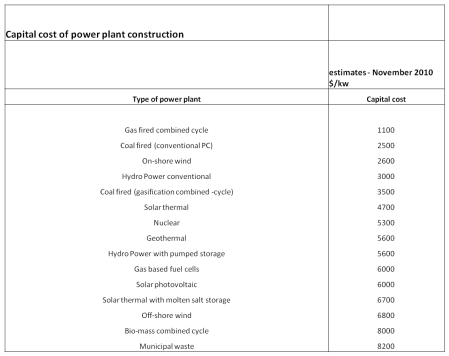
November 2010 Capital costs for power plants
Gas fired combined cycle plant use the least capital of all power generation plants. With shale gas set to become even cheaper than natural gas and with gas fired plants having capacity factors well above 90% compared to the 25% of wind power or the 30% of solar plants, it is a no-brainer to conclude that wherever shale gas is available it is going to be used for power generation.
Where it is not available coal fired plants and nuclear plants will continue to be used.
Intermittent renewable power plants are going to need subsidies for a long time to come to get anywhere near the cost of electricity from gas. At best they could be useful to augment production of electricity but being intermittent cannot really contribute to reliable capacity.
Tags:Electricity generation, Energy, Power plant capital costs, Shale gas
Posted in Energy, Engineering, Gas, Technology | 2 Comments »


 The k2p blog