Posts Tagged ‘shale oil’

Less than $60 – but where’s the bottom for oil price

December 12, 2014

I reckon the bottom is about 6 months away and probably less than $40 per barrel before there is some recovery. If the price does not fall that much, or if it recovers faster, then Saudi Arabia will have lost its battle against shale oil. In any event, shale oil is here to stay and all Saudi Arabia can hope for is to restrict new and small oil shale wells. Even a steep fall to around $40, held for a period of only 6 – 12 months, will not be enough to put all shale oil producers out of business and win the battle against shale oil.

oil price bottom

Break-even price for shale oil could be as low as $40 per barrel

November 28, 2014

UPDATE: Reuters – Saudi Arabia’s oil Minister Ali al-Naimi declares war on US Shale OIL


Yesterday Saudi Arabia got its way at the OPEC meeting and successfully resisted all calls for a cut in production to try and stop the decline of world oil prices.  It seems Saudi Arabia (which has the lowest oil production cost in the world) has chosen the strategy of maintaining an oil price low enough to put a cap on US shale oil production and provide a disincentive for new shale oil wells.

This strategy is premised on the break-even price for shale oil being at or above $80 per barrel for small production sites down to about $30 per barrel for large production sites. For example Credit Suisse estimated these levels as varying between $24 and $85 earlier this year.

shale oil break even estimates credit suisse

shale oil break even estimates credit suisse sep 2014


The US department of Energy puts sustainable break even values between $35 and $54. The Saudi calculations seem to be based on similar estimates. They appear to believe that with current oil prices moving down to about $70 per barrel, some of the smaller US oil shale wells are already uneconomic and that at this price new investment for further production sites will dry up.

But shale oil production costs are declining – fast. Costs are coming down following the learning curve for both capital costs and running costs. The analyst estimates are already out of date. My estimate is that actual break-even points are already down about 20% from those in the Credit Suisse estimate.

So I believe the Saudis have miscalculated. The average break-even world price for shale oil is probably – already – closer to $40 per barrel rather than $60-70 per barrel being assumed. While new investment in shale oil wells may well be toned down by world oil consumption, it will probably not be because world oil price is below some critical threshold. If the Saudis believe that any uptick in consumption will bring the oil price back up to over $80 per barrel, they are following a flawed strategy. We could be in for a decade of relatively low oil prices perhaps with a floor at around $40 per barrel and set by the average break-even for shale oil.

Consumers are still very wary. They are not sure that the reduction in oil price will be sustained and is not just a temporary dip which might lure them into a higher and more vulnerable consumption level. It will take a few months for them to see that OPEC has actually lost control over the world oil price but is still in denial about that. A sustained low oil price is what will trigger a new – and sustained – wave of global growth that is now so badly needed. The cartel is shrinking. New shale oil producers will all be outside the cartel – and the sooner Europe, China and India start production the better. But it is the beginning of the end of the OPEC cartel power.

History will – I think – show that the OPEC cartel lasted for 50 years. It will show that the cartel started in 1973 and that market forces of supply and demand were re-established around 2020.

Are shale oil and low prices the beginning of the end of the OPEC cartel?

November 24, 2014

Currently US crude is at just above $76 per barrel and Brent oil is at about $80. OPEC members are meeting this week in Vienna and it is thought that cuts to oil production of between 0.5 million and 1.5 million barrels per day (bpd) are possible. The drop in oil prices since June (from around $110 per barrel is due to a glut which in turn is due to over production, large quantities of US shale oil becoming available and simultaneously a reduced demand from China and others. Saudi Arabia is conspicuous by not having made any significant production cuts so far. This could be due to one of 3 reasons:

  1. Saudi Arabia is testing the breaking point for some of the shale oil producers since some of the smaller shale wells probably have a break-even level of around $60-70 per barrel, or
  2. Saudi Arabia and the US are targeting Russia and Iran whose economies are vulnerable and very dependent on the oil price (and the Russians alone would lose some $100 billion in oil revenues per year), or
  3. Saudi Arabia is tired of bearing the brunt of the production cuts and is forcing some of the smaller OPEC producers to take their share of the pain of production cuts.

If cuts of less than 0.5 million barrels per day are made it is thought that the prices are headed down to about $60 per barrel. One analyst estimates that a cut of 2 million bpd is needed to get back up to $80 per barrel. Something in between will be – well – something in between.

I just don’t like cartels and especially when they are state sponsored cartels. So far shale oil production is just from the US, and the OPEC strangle-hold on oil price has yet to be broken. But, over time, I expect this cartel to weaken as other countries produce oil and gas from shale. I remain of the opinion that the OPEC cartel has – no doubt – enriched the oil producing countries but has only done so at the expense of the rate of development of non-producers. OPEC has done the global economy a disservice by holding back the developing countries and the strongest correlation in geopolitics is the link between energy consumption and development (not just GDP but also virtually every development parameter).

It may cause some short term turbulence but in the long run it will be a “good thing” even if oil price were to collapse to below $50 per barrel. Some producers will be hard hit but the net result for the global economy will be positive. So I shall be quite happy if OPEC cannot reach agreement on how much oil production to cut or if they make just a small cut. It is time for some of the the developing countries to get a break from the oil price extortion which has been in place since 1973. The sooner the OPEC cartel is rendered obsolete the better.

Reuters:

Some commodity fund managers believe oil prices could slide to $60 per barrel if OPEC does not agree a significant output cut when it meets in Vienna this week. Brent crude futures have fallen by a third since June, touching a four-year low of $76.76 a barrel on Nov. 14. They could tumble further if OPEC does not agree to cut at least one million barrels per day (bpd), according to some commodity fund managers’ forecasts. ….. 

Yet fund managers and brokerage analysts are divided over whether OPEC will reach an agreement on cutting output. Bathe put the likelihood at no more than 50 percent. Oil prices have been falling since the summer due to abundant supply, partly from U.S. shale oil, and because of low demand growth, particularly in Europe and Asia. As a result, some investors believe a small cut of around 500,000 bpd would not be enough to calm the markets. Doug King, chief investment officer of RCMA Capital, sees Brent falling to $70 per barrel even with a cut of one million bpd.

“With this, I would expect lower prices in the first half of 2015,” he said. If OPEC fails to agree a cut, prices will drop “further and quite quickly”, with U.S. crude possibly sliding to $60, he said. U.S. crude closed at $76.51 on Friday, with Brent just above $80. ……..

The market has been awash with conspiracy theories as to why Saudi Arabia has not already intervened. New York Times columnist Thomas Friedman hinted at “a global oil war under way pitting the United States and Saudi Arabia on one side against Russia and Iran on the other”. Hepworth argued that Saudi Arabia appeared pretty happy with current pricing levels and suggested they were waiting to see where the cut-off point for U.S. production was. “Time is on their side, they can afford to wait,” he said, stressing he was talking months, not years, but added if oil fell below $70 that waiting time “shrinks to weeks”.

Tom Nelson, of Investec Global Energy Fund, said he believed Saudi Arabia had allowed the price to fall to incentivise smaller OPEC producers, which often rely on the biggest producer to intervene, to join Riyadh in cutting output. “They (the Saudis) want to cut but they don’t want to cut alone,” Nelson said, adding that a cut of between one million and 1.5 million bpd should be sufficient to balance the market.

“The market really wants to see that OPEC is still functioning … if there is a small cut, with an accompanying statement of coherence from OPEC that presents a united front, and talks about seeing demand recovery, and some moderation of supply growth, then Brent could move up to $80-$90.”

Saudi attack on shale oil could backfire

November 12, 2014

If the recent drop in oil price has been engineered (even in part) by Saudi Arabia as an attempt to put some of the burgeoning shale oil production sites out of business they will need to go much further. A break-even for shale oil production is probably at less than $50 per barrel. In any event the drop so far (25%+ in 6 months) is just the fillip the world economy needs. Saudi Arabia is probably not as vulnerable as other oil producing countries but increasing production to drive down the oil price is a dangerous game which could be self-defeating. Whether the current glut is just due to reduced world (read Chinese) demand and increased shale oil (US) production or has also been exacerbated by increased Saudi production, the oil consumer wins. Consumption will increase – and that will automatically reduce the glut and further increase the production of oil from shale.

If the global economy is to come out of the doldrums it needs the Asian economies – the tigers, the dragon and the elephant – to start prowling in earnest. Increasing consumption in the developing world seems to be one of the most effective ways of stimulating the world economy. It inevitably leads to increased production of consumer goods in the developed countries. And this current step-reduction of oil price could be just the trigger that is needed.

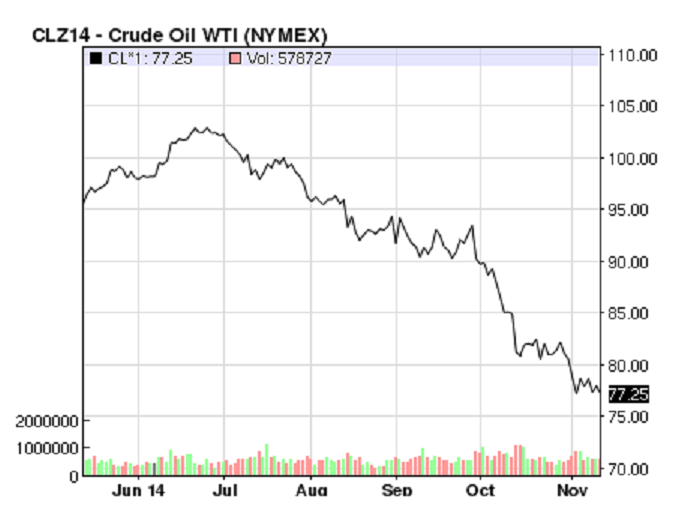
Yesterday the price of crude (WTI) was at about $77 per barrel and that price is sufficient to keep even the small shale oil wells in operation.

crude oil price Nov 2014

crude oil price Nov 2014


Two years of $70 oil could be the boost the global economy needs desperately

October 27, 2014

There are two questions here of course:

  1. How will oil price develop over the next 2 years? And the only certain thing is that forecasts will be wrong, and
  2. Can the net difference between the positive effect on oil consuming countries and the negative effects on oil producing countries be sufficient to lift the global ecoonmy out of its doldrums?

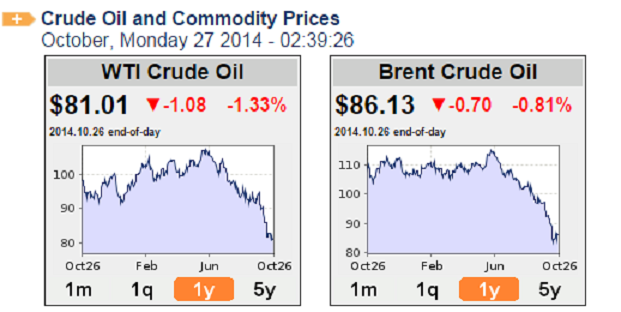
Oil prices have dropped 25% since June and currently WTI crude is at $81 and Brent crude is at $86 – down from around $110 – 115 in June. How far can prices drop and for how long? Of course this depends on supply and demand. But I think there is a new paradigm here and created by the injection of shale oil into the mix. I suspect that shale oil production now establishes a new floor price which means that the prices cannot drop lower than about $60 or possibly even $70. Oil from the traditional, large oil wells can still be produced profitably at much lower prices. But shale oil is more expensive to produce partly due to the costs of fracking but also due to smaller individual wells which last for shorter periods than the large oil wells. This in turn means that there is both a higher investment cost and a higher operating cost for shale oil compared to “traditional” oil. It is thought that as shale oil increases its contribution to the total mix, this production cost will set a floor for all oil at around $60-70 instead of the $30-40 needed for break-even (zero exploration) with traditional oil. The oil companies will maintain profits and dividends by scaling down jobs and their new exploration costs which is the variable they can play with . It is the oil producing countries who will lose tax revenues (offset by increased production – if any).

oil price 2710214 oil-price.net

oil price 27102014 oil-price.net

Goldman Sachs have forecast in a new research report that prices could drop to $70 by the second quarter of 2015.

Reuters 27/10: Brent crude futures fell below $86 a barrel on Monday after Goldman Sachs cut its price forecasts for the contract and for U.S. oil in the first quarter of next year by $15.

The U.S. investment bank said in a research note on Sunday that it had cut its forecast for West Texas Intermediate to $75 a barrel from $90 and that for Brent to $85 from $100, with rising production in non-OPEC countries outside North America expected to outstrip demand.

The bank expects WTI to fall as low as $70 a barrel and Brent to hit $80 in the second quarter of 2015, when it expects oversupply to be most pronounced.

Even Saudi Arabia now seems to have accepted that a regime of low prices will last  1 – 2 years.

Reuters 26/10The recent decline in global oil prices will prove temporary even if it lasts a year or so, since population growth will ultimately bring higher consumption and prices, the chief executive of Saudi Basic Industries Corp said on Sunday.

Mohamed al-Mady was speaking to reporters after the company, one of the world’s largest petrochemicals groups and the Gulf’s largest listed company, reported a 4.5 percent drop in third-quarter net income, missing analysts’ forecasts.

At these price levels for 2 years almost $3 trillion will shift from the “few” producers to the “many” consumers.  But most of this could fuel consumer growth (which it would not do to the same extent when in the hands of the oil producers). The consumer countries will also lose the foreign exchange constraints they must operate under for purchase of oil in US Dollars. It could release monies desperately needed for infrastructure projects. But the consumer countries need the prices to stay low for some time – and I would guess that 2 years is a minimum – for the public funds released to be utilised in “growth” projects.

The EconomistFor governments in consuming countries the price fall offers some budgetary breathing-room. Fuel subsidies hog scandalous amounts of money in many developing countries—20% of public spending in Indonesia and 14% in India (including fertiliser and food). Lower prices give governments the opportunity to spend the money more productively or return it to the taxpayers. This week India led the way by announcing an end to diesel subsidies. Others should follow Narendra Modi’s lead.

Producer countries will be hit. Russia has actually been helped by the fall in the rouble which has cushioned – a little – the rouble values of the dropping oil revenue.

The most vulnerable are Venezuela, Iran and Russia.

The first to crack could be Venezuela, home to the anti-American “Bolivarian revolution”, which the late Hugo Chávez tried to export around his region. Venezuela’s budget is based on oil at $120 a barrel. Even before the price fall it was struggling to pay its debts. Foreign-exchange reserves are dwindling, inflation is rampant and Venezuelans are enduring shortages of everyday goods such as flour and toilet paper.

Iran is also in a tricky position. It needs oil at about $140 a barrel to balance a profligate budget padded with the extravagant spending schemes of its former president, Mahmoud Ahmedinejad. Sanctions designed to curb its nuclear programme make it especially vulnerable. Some claim that Sunni Saudi Arabia is conspiring with America to use the oil price to put pressure on its Shia rival. Whatever the motivation, the falling price is certainly having that effect.

Compared with these two, Russia can bide its time. A falling currency means that the rouble value of oil sales has dropped less than its dollar value, cushioning tax revenues and limiting the budget deficit.

There are a number of other effects of $70 per barrel for oil.

Bio-fuels and bio-diesel, which are fundamentally unsound, have stayed alive on the back of subsidies on the one hand and a high oil price on the other. If the prices stay at $70 for 2 years or longer, land currently being wasted on bio-fuels could revert to food production. With lower fertiliser and transport costs in addition, a great deal of pressure on food prices go away. If the floor price is set by shale oil production costs, it may be too low for oil production from tar sands to take off in any big way. Electricity production costs will be bench-marked against the cost of gas turbine combined cycle plants.

But most importantly, another 2 years or longer with the public spending pressures reduced will allow a number of other countries to get their own shale oil (and gas) production going. And that will make Opec and the oil cartel obsolete. Oil and gas price speculation will no longer be possible.

It could provide the start for a long sustained period – perhaps even a decade or two – with oil prices stable at around $70 per barrel.

US shale oil boom visible from space

October 21, 2014

The drop in oil prices continues though somewhat slowed down by Chinese import demand:

WSJU.S. and global crude benchmarks ended lower Monday amid choppy trading and concerns that member nations of the Organization of the Petroleum Exporting Countries will maintain high production levels in a bid to compete for market share despite growing global crude supplies.

The current drop in oil prices is put down to a glut on the market caused by the boom in shale oil production in the US and the slow-down in the global economy.

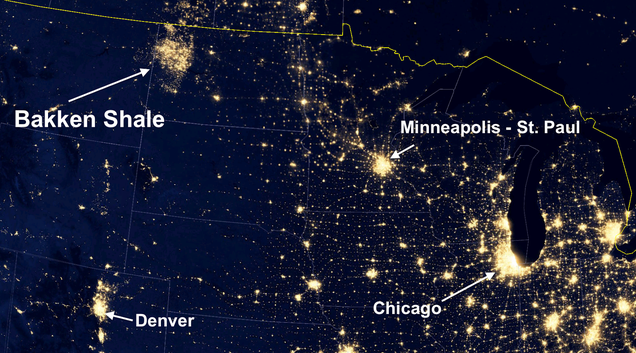
The boom in shale oil production is even visible from space.

Satellite Images Reveal How the U.S. Oil Boom Is Creating New Cities

bakken shale field shows up from space Image NASA/io9

io9This image from NASA reveals a massive cluster of lights in what was — until recently — desolate prairie. This is the Bakken Shale, an oil-rich rock formation stretching across parts of North Dakota, Montana and Canada. The lights are from the illuminated derricks, local boomtowns and gas flares of the oil fields.

Misguided alarmists who have demonised fossil fuels don’t like this. But I find the picture and the visibility of the shale production greatly encouraging. Carbon dioxide has no significant deleterious impact on climate and the availability of fossil energy is what will ensure continued human development.

The Bakken Shale field is a vast resource across Montana, North Dakota, Sasketchewan and Manitoba and a significant contributor to the game changing advent of shale oil and shale gas.

The Bakken Shale ranks as one of the largest oil developments in the U.S. in the past 40 years. The play has single-handedly driven North Dakota’s oil production to levels four times higher than previous peaks in the 1980s. As of 2012, ND is second to Texas in terms of oil production and boasts the lowest unemployment rate in the country at ~3%.

The Bakken Shale Play is located in Eastern Montana and Western North Dakota, as well as parts of Saskatchewan and Manitoba in the Williston Basin. Oil was initially discovered in the Bakken play in 1951, but was not commercial on a large scale until the past ten years.

… The Bakken is estimated to hold as much as 400 billion barrels of oil equivalent in place.

US shale fields map EIA


Can consumer countries fuel global growth with sharply reduced oil prices?

October 20, 2014

Oil prices have “crashed”.

Currently prices are at less than $80 per barrel compared to over $110 in June and the peak of $147 just before the financial bubble burst in 2008. It seems that it is due to the oil glut brought about by the shale oil revolution in the US together with a downturn in global growth. The $147 peak was, I think, more of a trial balloon by the oil producers to test where the resistance lay and the producers concluded that a level of a little over $100 would maximise profits and was sustainable. But I suspect that this $100 level itself has contributed to delaying and prolonging the recovery. Not only because of the increased direct costs to the oil consumer but also due to its knock-on effects which have unnecessarily raised the cost to all electricity consumers. The prolongation of the path to recovery in Europe is certainly – if only partly – due to the very high energy prices that prevail. But right now it is the abundance of shale oil and gas which seems dominant.

BloombergBut the bigger factor appears to be surging global oil production, which outpaced demand last year and is shaping up to do so again in 2014. To try to keep prices high, Saudi Arabia, the world’s biggest petroleum exporter, has reduced its oil production from 10 million barrels a day—a record high—in September 2013 to 9.6 million as of Sept. 30. That hasn’t done much to raise prices, mostly because other OPEC countries are pumping more crude as the Saudis try to slow down. Sharply higher production increases from Libya and Angola, along with surprisingly steady flows out of war-torn Iraq, have pushed OPEC’s total output to almost 31 million barrels a day, its highest level this year and 352,000 barrels a day higher than last September. Combined with the continued increase in U.S. oil production, the world has more than enough oil to satisfy current demand.

crude oil price history 2000-2014

crude oil price history 2000-2014

But this crash in oil prices is probably a “good thing”.

The additional revenues from increasing oil price to the few in the oil producing countries have not been sufficient to counter the hit to the many in the consuming countries. Much of the additional revenue has gone not to fuelling growth but in blowing up new real-estate bubbles.

The additional spending power in consumer countries with reducing oil price is spread among the many (at the lower end of the wealth scale) whereas the reduction in producer oil revenues is generally spread among an affluent few. My contention is that the additional revenues with high oil price in – for example –  the Middle East does not need to be spent on real things which could fuel growth. Revenues in Saudi Arabia and Qatar and other countries have fuelled bubbles and jihad instead of just growth. A great deal went instead into very high margin, weapons systems and to the imaginary values of real estate. In Russia the oil revenue did contribute to some growth but there was still a large proportion spent on imaginary values of various bubbles (which by definition cannot contribute to growth). My simple calculation tells me that 1000 people buying washing machines in China contribute more to global growth than one person spending the same amount on an apartment (his second or third home) in London. A $10 drop in oil price is said to shift 0.5% GDP growth from producer countries to consumer countries. But the pattern of consumption where the “few” fuel the bubbles of imaginary value while the “many” consume mundane goods and services means that the real effect on growth is greater than a net zero. It is shifting an ineffective 0.5% to a more efficient consumption for growth. The net effect is probably a growth in global GDP of 0.2 – 0.3%. Similarly the purchase of large-volume, low-margin goods and services provides more growth and jobs than spending the same amount on low-volume, high margin goods and services. Spending $1000 on an 80% margin Gucci handbag provides less direct growth and fewer direct jobs than buying ten $100, 10% margin travel bags.

Historically – though it is a relatively crude generalisation – low oil price has usually given – or coincided with – consumer-led growth and stability.

crude oil price history 1970-2014

crude oil price history 1970-2014

Some oil producers are more vulnerable than others to the fall in expected revenues. Russia’s budget needs an oil price of over $100 to be balanced. Venezuela spends nearly all of its revenues as it is generated and has nothing put by. The war-torn areas of the Middle East also have nothing put by. Saudi Arabia and the Gulf States have put by vast reserves though some of it is in “bubble” values. A pricking of some of the bubbles they have inflated is probably no bad thing. It is also no bad thing if they have to fall back on reserves and have less excess cash to fund jihadists from Afghanistan to Libya.

Most Asian countries are oil importers and gain from a low oil price.

Clarion Ledger: The picture is reversed in Asia, where most countries are major importers and some subsidize the price of fuels.

China is the second-largest oil consumer and on track to become the largest net importer of oil. Falling prices will provide China’s economy some relief, according to Huang Bingjie, professor from the School of Economics and Management at China University of Petroleum. But lower oil prices won’t fully offset the far wider effects of a slowing economy.

India imports three-quarters of its oil and analysts say falling oil prices will ease the country’s chronic current account deficit. Samiran Chakraborty, head of research in India for Standard Chartered Bank, also says the cost of India’s fuel subsidies would fall by $2.5 billion during its current fiscal year if oil prices stay low.

Japan imports nearly all of the oil it uses. Following the accident at the Fukushima Dai-Ichi nuclear power plant in 2011, Japan has turned more to oil and natural gas, which is priced based on oil, to generate electric power.

The picture is a little more mixed in the Americas and Europe:

Low prices could eventually threaten the boom in oil production in such countries as the U.S., Canada, and Brazil because that oil is expensive to produce. Investors have dumped shares of energy companies in recent weeks, helping to drag global stock markets lower.

For now, lower crude oil and fuel prices are a boon for consumers. In the U.S., still the world’s biggest oil user, consumer spending accounts for two-thirds of the U.S. economy, and lower energy prices give consumers more money to spend on things other than fuel.

The same is true in Europe. Christian Schulz, senior economist at Berenberg Bank, says that a 10 percent fall in oil prices would lead to a 0.1 percent increase in economic output. That’s meaningful because the 18-country currency union didn’t grow at all in the second quarter.

There could be another market crash coming though it is not likely to be as deep as the 2008 crash. But to get back onto a solid, sustainable growth path again it does need the oil consumer countries to grow. And that probably needs a steady oil price at less than $70 per barrel. The oil producer countries will have to revamp their economies to live with the loss of their monopoly as the production of oil from shale spreads.

Huge shale deposits confirmed in the South of England

May 23, 2014
Map of the Weald Basin

Shale deposits in South of England and Wales (BBC)

The British Geological Survey (BGS) has now confirmed the huge deposits of oil bearing shale in the South of England . Ironically this comes just days after the BBC also reported on the idiot report by the self-styled Global Sustainability Institute that the UK would run out of oil, coal and gas in 5 years!!!

BBC (23rd May)The BBC’s John Moylan said that although the BGS study will say that there are several billion barrels of oil in place, is not clear how much would be economically recoverable. ….. By way of comparison, the equivalent of around 45 billion barrels of oil has been extracted from the North Sea over the past 40 years.

Last year, a BGS study of the North of England suggested there could be as much as 1,300 trillion cubic feet of gas contained in shale rocks. ….

Andrew Austin, chief executive of the onshore energy IGAS, said it had long been known that southern England had extensive resources.

He told the BBC: “We’ve known that there’s a big potential for oil and gas explorations across the country but particularly in terms of oil in the Weald Basin which is the area that stretches roughly from Winchester across towards Gatwick, up to the M25 and down to the coast at Chichester.

“There’s been a long history of oil and gas exploration in this area. We as a company produce oil and gas from around 20 sites across that area. Around 40 million barrels have been recovered from that area to date.”

In the US, fracking for oil and gas has created an energy boom and led to speculation that the country could overtake Saudi Arabia as the world’s biggest producer by 2020, or even sooner.

Gas prices in the US have fallen sharply as a result, and other countries are now hoping that shale oil and gas could also lead to lower domestic energy prices.

And just a few days ago the BBC chose to present this nonsense.

BBC (16th May)In just over five years Britain will have run out of oil, coal and gas, researchers have warned. …… There should be a “Europe-wide drive” towards wind, tidal, solar and other sources of renewable power, the institute’s Prof Victor Anderson said. ….

……. Professor Anderson said: “Coal, oil and gas resources in Europe are running down and we need alternatives.

“The UK urgently needs to be part of a Europe-wide drive to expand renewable energy sources such as wave, wind, tidal, and solar power.”

However, Jim Skea, Research Councils fellow in UK Energy Strategy. cast doubt on the findings of the report.

He told BBC News: “This sounds very unlikely. What’s more, it’s irrelevant – the UK has a stable supply of imported energy, even if it is a good idea to increase our own supplies.”

The government recently announced it was cutting subsidies for large-scale solar energy and the Conservatives have said there will be no funding for new onshore wind farms if they win the next election.

Ministers are hoping that enough shale gas – extracted by fracking – will be obtained to make a difference, the BBC’s environment analyst Roger Harrabin says.

Professor Victor Anderson is an alarmist economist who used to work for the World Wildlife Fund. But to develop a catastrophe theory and predict that the UK will run out coal, oil and gas in 5 years is just stupidity.

Prior to taking up his current position Professor Anderson had worked as Senior Policy Officer for One Planet Economy at WWF-UK, a Lecturer at Goldsmith’s College, London University, an Economist at the Sustainable Development Commission, a Senior Parliamentary Researcher at Plaid Cymru Group of MPs, Board Member at London Development Agency and an elected Assembly Member at the Greater London Authority. He is also currently a Member of the Planetary Boundaries Initiative Advisory Group.

Total to enter fracking in the UK

January 12, 2014

The shale boom (gas and oil) in the US has changed the energy landscape not only in the US but also in the export of cheap oil and now even coal from the US.

us petroleum production boom

us petroleum production boom

But so far only the US has seen significant production of gas and oil from shale. In Europe the Green lobby is desperately trying to stop the advent of fracking even though their misguided policies  have – so far – only led to an increased use of coal and an increased price of electricity to the consumer. But the UK, Poland and other countries have huge reserves of shale and the exploitation of these reserves is both necessary and inevitable. Russia, China, South America and India also have shale reserves which will – in time – be recovered. Russia is going slow with fracking because they have large amounts of natural gas to be sold first to recover the investment in their gas pipelines to Western Europe. China is forging steadily ahead and will soon produce shale gas in earnest. India has not even finished mapping its reserves. Both China and India have some technology transfer to be achieved. Japan is spending real development money to be able eventually to use under-sea methane hydrates since they have no shale.

Fox Business: Russia is estimated to have the largest shale oil reserves of 75 billion barrels, according to the Energy Information Administration. The U.S. is No. 2 with 58 billion barrels, followed at a distance by China, Argentina and Libya.

China is believed to have 1,115 trillion cubic feet of recoverable shale gas. The EIA estimates that Argentina has 802 trillion cubic feet, while the U.S. is fourth at 665 trillion. Algeria likely has the third-largest shale gas reserves.

While the U.S. energy industry has roared ahead, shale reserves overseas face several development hurdles such as a lack of drilling resources, land ownership issues and government regulations.

In Europe, the UK will probably lead the way – even though the “politically correct” opposition in Europe will continue to live in their dream worlds. The French oil majors – stopped in their own country by Francois Hollande – are moving in.

BBCFrench oil and gas company Total is to invest in the UK’s shale gas industry, it is to be announced on Monday. Total will be the first of the so-called “oil majors” to invest in shale gas in the UK, the BBC has confirmed. The British Geological Survey estimates there may be 1,300 trillion cubic feet of shale gas present in the north of England.

…. Total is to spend tens of millions of pounds buying substantial stakes in firms with drilling licences in the north of England, where other large energy firms such as Centrica and Gaz de France have already invested.

It comes as the government is expected to introduce more incentives to encourage local authorities to allow drilling for shale gas …… Under the measures, local authorities would keep all income from business rates paid by companies drilling for shale gas, instead of giving it to the UK treasury.

In December, a report commissioned by the Department of Energy and Climate Change (DECC), said more than half of the UK could be suitable for fracking.

In his analysis, Joe Lynam writes:

That Total is now getting involved in the UK shale gas industry is not insignificant. The oil majors (BP, Shell, Total, Exxon, and Chevron) waited in the wings for five years in the US while smaller exploration companies drilled for shale gas.

When it became clear there were major commercial flows in America, then the majors piled in. Now it looks like the majors are getting interested in Britain at a very early stage – thanks in no small part to the confident reserve estimates from the British Geological Survey and the open arms of the UK government. The large energy players bring deep pockets and serious expertise with them and will be able to extract, sell and distribute any found gas quicker than smaller companies.

The advantage for the consumer could also be mouth watering – US energy costs are now a third of those in Europe. If Britain can extract 10% of the estimated reserves it could supply the entire country for almost 50 years.

UK Shale Regions

UK Shale Regions

Related Posts.

Shale Oil leading to real jobs and real investment in the US

July 1, 2013

“Artificial” jobs created by subsidies and government inspired market distortions are never sustainable. As is being evidenced by the boom and bust of solar energy and wind turbines riding the wave of subsidies. But the advent of shale oil (and shale gas) is a game changer in many many ways. Fossil fuels are now no longer all “bad” (though some of this sentiment is leading to another inane “War on Coal”), and the fundamental truth that true sustainability – of necessity – requires being commercially sound and not just subsidised is taking hold again.

The US is at least 3 years ahead of Europe in exploiting shale gas and shale oil – even though the deposits in Europe are quite considerable. But Europe is still stuck in the self-righteous and self-delusional “green” policy regimes which have raised energy prices unnecessarily, helped to sustain economic stagnation and have prevented some 15 million jobs from being created. Without a paradigm shift in energy policies and a whole-hearted pursuit of shale gas and nuclear power, Europe’s return to sustainable growth is difficult to define.

Reuters: 

Thanks to the U.S. shale energy boom, the once-quiet niche of U.S.-flagged oil tankers is in unprecedented flux.

A half-dozen vessels that typically carried gasoline to Florida are now rushing crude oil along the Texas coast. Major investment at the port of Corpus Christi, which now exports more than half of all Eagle Ford shale oil, suggests more to come even as new pipeline projects promise further market shifts.

The shale oil revolution, now in its third year, has already scrambled the inland U.S. crude market, forcing pipelines to reverse direction and fuelling a revival in railway oil trade. ….. 

(more…)