It seems that a Petrobras geologist – Dr. Jorge Figueiredo – does not like all the attention that Hamza and Pimental are getting. He may well have a point but there seems to be a touch of “sour grapes” about his carping. The data was Petrobras data available to their own geologists after all. Perhaps if the river had been named after him Dr. Figueiredo would not be quite so petulant.
If the flow is regular and serves to drain the Amazon then I think it can be called a river even if it is only a tiny seepage through the pores in rocks. The key is that the flow should be regular. Continuity of flow or the velocity of flow cannot be the arbiter. Even surface rivers can be seasonal and discontinuous, can completely dry up at times but they all regularly return from the same source to the same sink.
…. Valiya Hamza and Elizabeth Tavares Pimentel, from the Brazilian National Observatory, deduced the existence of the “river” by using temperature data from boreholes across the Amazon region. The holes were dug by the Brazilian oil company Petrobras in the search for new oil and gas fields, and Petrobras has since released its data to the scientific community.
Using mathematical models relating temperature differences to water movement, the scientists inferred that water must be moving downwards through the ground around the holes, and then flowing horizontally at a depth of several km.
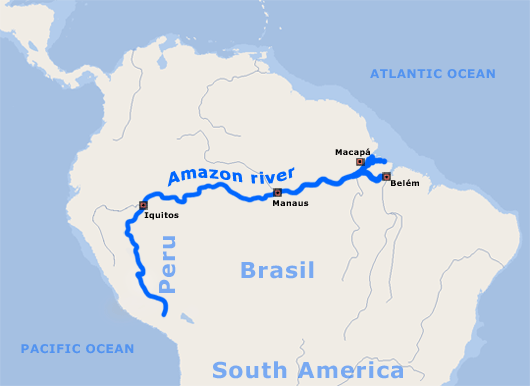
They concluded that this movement had to be from West to East, mimicking the mighty Amazon itself. A true underground river on this scale – 6,000km (4,000 miles) long – would be the longest of its kind in the world by far. But Professor Hamza told BBC News that it was not a river in the conventional sense. “We have used the term ‘river’ in a more generic sense than the popular notion,” he said.
In the Amazon, he said, water was transported by three kinds of “river” – the Amazon itself, as water vapour in atmospheric circulation, and as moving groundwater. “According to the lithologic sequences representative of Amazon [underground sedimentary] basins, the medium is permeable and the flow is through pores… we assume that the medium has enough permeability to allow for significant subsurface flows.”
The total calculated volume of the flow – about 4,000 cubic metres per second – is significant, although just a few percent of the amount of water transported by the Amazon proper. The underground flow could be confirmed with coastal measurements, scientists suggest. But the speed of movement is even slower than glaciers usually display, never mind rivers.
And whether water really is transported right across the region in this way is disputed by Jorge Figueiredo, a geologist with Petrobras. “First of all, the word ‘river’ should be burned from the work – it’s not a river whatsoever,” he told BBC News.
Water and other fluids could indeed flow through the porous sedimentary rock, he said, but would be unlikely to reach the Atlantic Ocean because the sedimentary basins containing the porous rock were separated by older rock deposits that would form an impermeable barrier. “But the main problem is that at depths of 4,000m, there is no possibility that we have fresh water – we have direct data that this water is saline,” said Dr Figueiredo. “My colleagues and I think this work is very arguable – we have a high level of criticism.” …
The research – Indications of an Underground “River” beneath the Amazon River: Inferences from Results of Geothermal Studies – was presented at the 12th International Congress of the Brazilian Geophysical Society in Rio de Janeiro, and has not been published in a peer-reviewed scientific journal.
The team has named the underground flow the “Hamza River”.

 The k2p blog