Posts Tagged ‘Sweden’

Climate change costs are not that critical compared to economic development of poor countries – Prof. Per Krussel

January 11, 2013

Swedish Radio is one of the more rabid and unthinking supporters of global warming orthodoxy (as are all the main stream media in Sweden). So I was rather surprised to see them giving prominence today to Per Krussel, Professor of Economics at Stockholm University. Normally Swedish Radio is so biased and bigoted on this subject that they would have made no mention of this if Krussel had not been a Swedish Professor. Of course – for balance – they then also interviewed a Professor on Environmental Economy who just happens to be a member of the IPCC and clearly backed the alarmist line — what else? He was less than impressive. For representing the IPCC they might just as well have interviewed someone from Greenpeace!

Krussel skewers the Stern Report on fundamental methodology but this itself is nothing new. The Stern Report from 2006 is another one where the content has been massaged to come to a pre-determined conclusion and is almost embarrassingly bad. In my view any document today which cites the Stern Report as support is itself discredited.

Swedish Radio: (free translation from the Swedish)

Many researchers believe that the threat from climate change is the critical issue of our time. But Per Krusell, professor of economics at Stockholm University, and leading a major international effort to calculate the economic costs of climate change, believes that the threat is not that critical in financial terms

“Climate change is a threat, it’s pretty big, but it’s not that huge when translated  into dollars and cents”  says Per Krusell.

Per Krusell leads an international research project to develop an economic model, which the world’s countries can use to figure out their future costs of climate change. The model should be finished in about a year and will be the world’s most advanced tools in this context, according to Per Krusell. So far, they have concluded that GDP in the worst case will only drop by a few percent in most countries, such as Sweden. This differs from the widely publicized Stern Report in 2006 pointing to significantly higher costs.

……..  above all, Krusell is critical of Stern for putting  together all anticipated costs, without discounting these costs  properly in the way economists usually do for future costs. … 

(The Stern report used a discounting factor of 0.1% – but it is normal to use a discount rate of 1%, which therefore lowers the cost of future generations substantially.) …. Economist Per Krusell agrees that climate change is a big problem, but thinks it’s more important to focus on the economic development of the poor countries rather than combating climate change.

“When we consider the effects of climate change, we expect also that there will be a cost especially in poor countries, but it sums up to no great critical issue for the world. It is more important to get the poor countries to develop. I’m a little worried that “environmental thinking” leads to more important issues being ignored.”
The first 200 year old human has already been born

December 27, 2012

The journalist Henrik Lennart has a new book out  in Swedish – “Åldrandets gåta” (The Mystery of Aging), where he interviews the worlds leading researchers and demographers about aging. Our descendants will have to learn to have many careers within their lifetimes.

Science has long envisaged a limit to how long a person can live – around 120 years. But now research is catching up with our fantasies. Henrik Lennart interviews the world’s leading researchers specializing in aging. They all come to the same conclusion: We, and especially our children, will live far longer than is common today.

Why? Improved standards of living come into play but also our lifestyles. Advice from the experts can differ: eat fewer calories, stand up when you are working, fast or cut down on meat and sugar. These choices certainly affect the aging of cells, and when researchers finally find the genes that control lifespan and have learned how to control them, the question will become:

How old would we like to be?

Aftonbladet reports:

Some researchers believe that the first human who will live to be 200 years old is already living.

“According to our calculation, half of the children born in Sweden in 2012 will live to be 104 years old”, says demographer James Vaupel.  Life expectancy has increased steadily over the past hundred years. ….. Today, the average life expectancy in Sweden is 83 years for women and 79 for men.

In a new book “The Mystery of Aging” journalist Henrik Lennart has  interviewed demographers and scientists who believe that statisticians world-wide have systematically underestimated the rate of increase of life expectancy and that this has been going on for a very long time.

Statisticians have not fully considered the influence of welfare reforms, better living conditions and more efficient healthcare. To get a more accurate picture one of the world’s best-known demographers James Vaupel, along with a group of prestigious scientists have made new calculations where they have added a factor to reflect the impact of as yet unknown developments – not dramatic but which can be expected in the future.

Their calculations show that half of all the children born in Sweden this year will live to be 104 years old. “In the future, we could live to be ten times older. Why not? It will take time to get there but it is certainly not impossible. In my opinion it is quite likely that there is a rather small child already born somewhere who will live to be more than 200 years old”, says James Vaupel who is interviewed in “The Mystery of Aging.”

Svenska Dagbladet adds:

James Vaupel and Cambridge researcher Jim Oeppen have previously shown that the curve of women’s life expectancy in the Western world has increased at an even and steady pace of three months per year for 160 years. Swedish statistics extend further back than in most other countries, and this increase has been by an average of 2.5 months per year since 1751.

Previously, scientists believed that there was a ceiling for the average life expectancy of  a little over 80 years. Today this ceiling has shifted up at least a decade, and continues to rise.

“We no longer know if there is any ceiling and where it lies if it does exist”, says James Vaupel.

At this rate everybody will be living to around 200 years by 2500.

Too “mentally ill” to sell hot-dogs but he can cope with being a Swedish MP!

December 20, 2012

The behaviour of some parliamentarians and all that they get away with never ceases to amaze (whether fiddling expenses in the UK or being convicted criminals in India or being benefit spongers in Sweden).

He was mentally incapable of working at a hot-dog stand (for which he drew sickness benefits) but perfectly able to cope with the strains of being a Member of the Swedish Parliament (which commands a generous salary with no demands).

The Sweden Democrats are riding very high in the polls even though their “junkies and hooligans” image is being further embellished by revelations that one of their leading lights has been living off benefits for most of his adult life. Apparently Johnny Skalin was too mentally disturbed to be able to stand the rigours of working at a hot-dog stand. A stint of 4 hours required 2 days to recover! But working for the party during this time was not too onerous (and he received fees from the party in addition to his “sickness” benefits”).  But after living off benefits for some 13 years he found he was quite able to cope with the tough life of being a Member of Parliament.  He explained in an interview with Aftonbladet that he didn’t want to talk about his illness but it that it took a very long time for him to recover! He has now given up his benefits and can manage on his salary as an MP (about $9000 per month).

The Local has the story:

Sweden Democrat MP Johnny Skalin, whose party describes unemployed immigrants as being “a burden on society”, has lived on state benefits most of his adult life. 

Swedish authorities said in 1997 that Johnny Skalin, who is now 34, was suffering from a mental disorder that prevented him from carrying out his duties in a hotdog stand where he was employed at the time. It was then that he began receiving disability benefits, local newspaper Sundsvalls Tidning wrote. Ten years later, he told the Swedish Social Insurance Agency (Försäkringskassan) that he suffered from extreme tiredness and needed up to two days of rest after working a four-hour shift.

However, that same year he became the head of the Sweden Democrat local chapter in the northeastern town of Sundsvall. “It was naturally a lot of work,” Skalin told the same newspaper.

Skalin also began to study sociology, and went on to co-author a party platform that helped the Sweden Democrats get into parliament in the 2010 election, when it got 5.7 percent of the vote and won 20 seats in the Swedish Riksdag.

Two months into the job as an MP, he told authorities that he no longer needed any benefits for his mental disability.

But the fundamental truism is that voters get the politicians they deserve. And convicted criminals or junkies or hooligans or benefit spongers are as entitled to be members of Parliament as anybody else who can get the votes of the discerning electorate.

A short hiatus in warmer climes

December 8, 2012

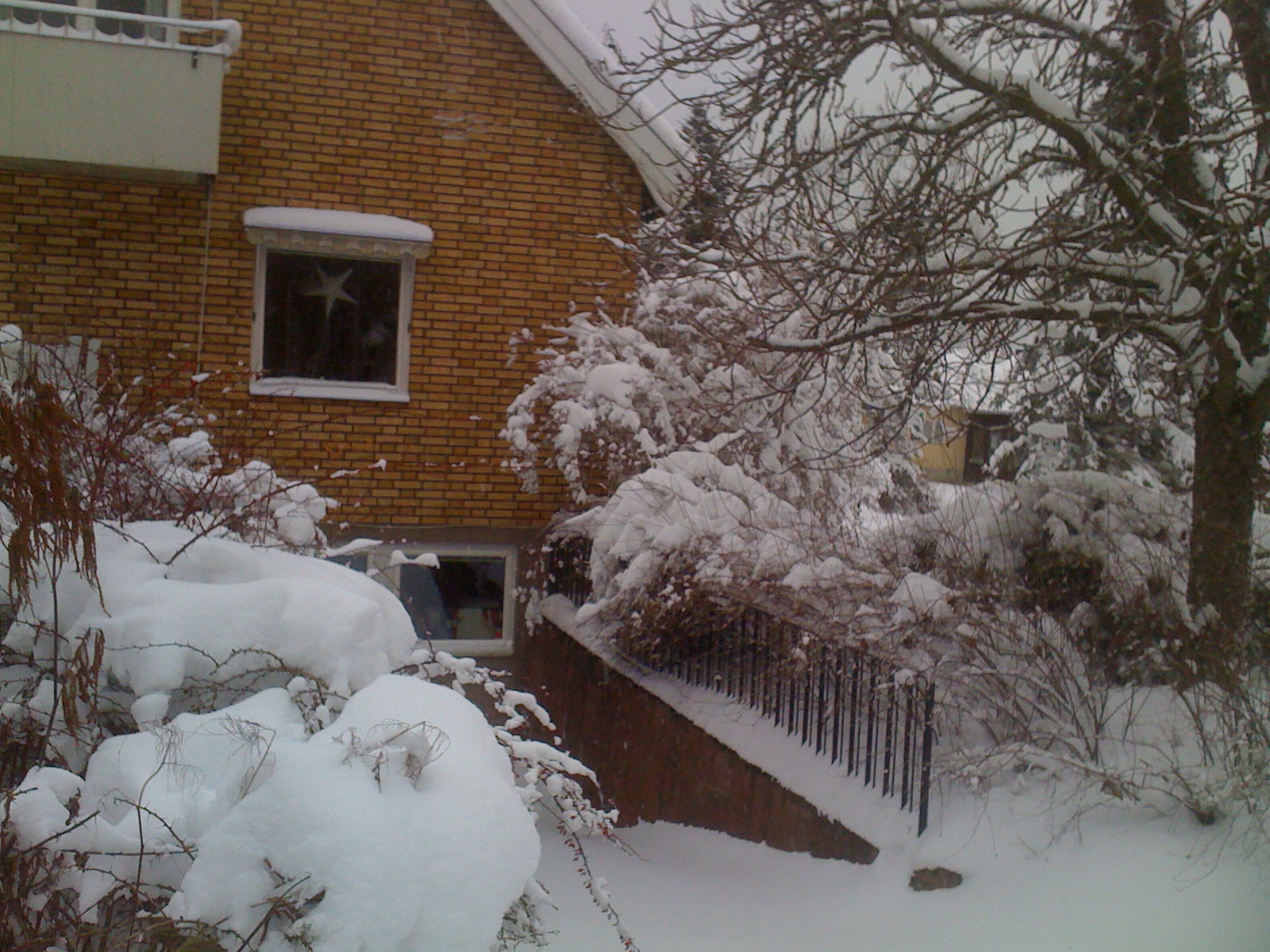
Here in Sweden we are in the depths of winter and the days are getting pretty short. Sunrise is at 0834 today and sunset at 1503.

Still, in another two weeks the days will start getting longer again.

It’s been down to -20 °C and we have had our share of snow which needed some not inconsiderable shovelling but I probably needed the exercise.

Blogging will be very light for a week as I travel on an assignment to somewhat warmer climes.

I plan to be back before THE END OF THE WORLD.

Must be global warming

Must be global warming

Sweden Democrats bring Swedish Parliament into disrepute

November 15, 2012

Political behaviour is always worth observing and fascinating though the line between high-farce and tragedy is quite thin.

The Sweden Democrats is one of the recent wave of far-right, anti-immigration, vaguely neo-nazi, political parties that have been been voted into parliaments around Europe over the last 15 years or so. (One of the characteristics of European politics has been the over-representation of marginal and extreme groups but in general – I think – countries just get the representation they deserve).

(more…)

Swedish judicial system looks amateurish as recusal of lay judges is sought again

November 8, 2012

The Swedish judicial system is looking increasingly amateurish. The criminal Södertälje network – found guilty in Sweden’s most expensive trial – first succeeded in getting a retrial by claiming that one of the lay judges had a conflict of interest and should have been recused and is now delaying the retrial by fresh claims of bias against the new lay judges and even against the judge who approved their appointment to the trial bench!

After one of Sweden’s most expensive trials and criminal investigations ever, 16 of 20 defendants received prison sentences, two were ordered into juvenile detention, and two were found not guilty. They were accused of crimes including murder, kidnapping and extortion.

Sverigesradio 5th October: 

The most costly court case in Swedish legal history which has been called Sweden’s biggest criminal gang case, and lasted six months at a cost of more than SEK 200 million, is to be retried. The Court of Appeals ruled on Friday that one of the lay judges from the trial had a conflict of interest.  

“We have found that a lay judge on the court, who was also a member of the Police Board in Södertälje, had a conflict of interest in the issue and is therefore disqualified,” says Court of Appeals judge Sven Jönsson.

Sverigesradio 31st October:

All witnesses in a high-profile murder case in Södertälje must testify again when the case gets retried in the district court next week, according to a decision Wednesday.

The murder case – involving the so-called “Södertälje Network” – is the most expensive in Swedish legal history. A retrial was ordered after a lay judge was found to have a conflict of interest, having sat on the police board.

The new trial started again today in a farcical manner as the new lay judges were again accused by the defence lawyers for having conflicts of interest. It did not help matters that the professional chairman of the judges seemed completely unprepared to handle arguments about conflicts of interest (Svenska Dagbladet). To make matters worse, the two professional judges were unable to make a ruling about the conflicts of interest of the lay members because they were themselves accused of having conflicts of interest because – wait for it – they had approved the appointment of the lay judges accused of bias to the bench!!

Svenska Dagbladet:

Even two of the new lay judges should be recused for bias, claimed lawyers. Instead of a trial a confused discussion about conflicts of interest arose.

An already frustrated crowd of defendants, lawyers, prosecutors and paralegals on Thursday saw the case being delayed again in an almost farcical form.

 Jan Karlsson, lawyer for one of the defendants submitted late on Wednesday a motion for recusal for bias. He claimed that two of the new lay judges could also be biased because they had participated, in a meeting  of the Association of Lay Judges where the head of the police operation talked about organized  crime. ….

When the motion was taken up in a courtroom packed with close to a hundred people the two professional judges, Lars Lindhe and Jan-Erik Oja, were to take a decision regarding the conflict of interest. But then it came to a stop again. The lawyers now claimed that the judges could not take such a decision because they were themselves disqualified.

It does look as if the Södertällje criminal network and their lawyers are having a field day in exploiting the weaknesses of the Swedish judicial system. Certainly the judiciary – and by inference even the prosecution –   are looking decidedly amateurish.

The Swedish system of using lay judges, who are often local politicians, has been getting some very bad press lately for incompetence and the entire handling of this case does not impress.

The price of longevity is degradation of the elderly

October 7, 2012

The care of the elderly passing from family members to institutions is one of the apparently irreversible  developments in all cultures today. It is not just a phenomenon of “Western” civilization but is a trend across the globe. As “joint families” have given way to nuclear families and as couples have both gone out “to work” and as the elderly desire greater independence and as people live longer, the responsibility for the care of the elderly has passed to institutions from ever-more burdened children or relations.

But a model for institutional care – whether by private players or the State – which works without the degradation of the elderly has yet to be found. I suppose the fundamental reasons are that

  1. to die quietly and with some dignity and with as little discomfort as possible is only of value to the dying,
  2. those who are “in care” have limited opportunities to make themselves heard, let alone to complain,
  3. those “in care” are no longer worth very much to the society they live in and are only seen as a cost,
  4. even for the relatives and children of those in institutional care, the elderly are seen primarily as “duties”  and they would rather not complain if the only solution is a responsibility devolving upon themselves, and
  5. for institutions providing care there is always a  financial benefit to not providing care and they get no “extra bonus” when they do provide care.

(more…)

Arrogant and overbearing political correctness censures Tintin from Stockholm library

September 25, 2012

See update below:

I have little patience with the “do-gooders” who always know best what is good for others. But impatience turns to an active dislike when an arrogant young man (a certain Behrang Meri) presumes that his world-view shall prevail and takes it upon himself to be a censor by removing all copies of Tintin from the shelves of the 10-13 year old library of Stockholm’s Culture Centre. Of course he claims he is doing this “for their own good”. Arrogance and coercion are the stock-in-trade of the “do-gooders” and is wide-spread in Sweden. Banning things for the “good of others” is the order of the day. Some of the coercive tactics employed – even if now coming from the left of the political spectrum – are indistinguishable from those employed by the fascists in Europe almost 100 years ago.

Dagens Nyheter reports (my free translation):

Tintin has been ejected from the Culture Centre in Stockholm. DN can report that the beloved cartoon character has been cleaned out from the library shelves. Now the staff have been instructed to look for any more books which have racist or homophobic values.

The 10-13 year old library of Stockholm’s Culture Centre has  removed Tintin books from the shelves. In consultation with their staff, the artistic director with responsibility for children and activities for the young made ​​the decision.

“That’s right. The picture Tintin books give for example of Africans is afrofobisk. Africans are shown to be a bit silly while Arabs are sitting on flying carpets and Turks smoke water pipes. The image of  the “forest Turk” is still there. It’s about exoticism and Orientalism”, says Behrang Miri, who leads efforts to develop Child and Youth Culture activities in the sections for children, “Tiotretton” and “Lava”. ……. 

Behrang Meri, the self-appointed censor in this case, was appointed to his position in February this year.

He was on the radio this morning and tried to babble his way through by insisting that he was removing the books so that children could actually go deeper into the questions of racism!!  He seemed to be avoiding all questions and merely spouting a practised defence. I would have thought that deepening children’s understanding would only be possible by exposure to the books and not by his over-bearing, over-protectiveness denying exposure to the books. In any case the Tintin serials – which I greatly enjoyed through my childhood – were written in a colonial time and had no racist intentions. It depicted the world-view that existed at the time. Censorship will not change history or cause those times to disappear.

He failed to impress and I cannot help feeling that his ego has got the better of him and his objective is mere self-promotion rather than the cultural enrichment of 10-13 year old children.

UPDATE!

Following a storm of media criticism, officials at the Kulturhuset library in Stockholm have reversed their decision to remove Tintin comic books from its shelves, saying the move happened “too fast”.

I note that it was the head of the Culture Centre who reversed the censorship and Bahrang Meri has accepted being overruled. In spite of his vehement defence of his decision on the radio this morning this was clearly not a resigning issue. Some damage control is ongoing but damage there certainly is:

“I wanted to highlight an opinion piece about issues of discrimination, but realize now that it’s wrong to ban books,” Meri said in a statement. However, Kulturhuset head Sjöström applauded Meri for prompting a discussion about discrimination. 
“The issues of discrimination, equality and norms continue to be debated and discussed,” Sjöström said in a statement.

The year when “hot air avoided Sweden with uncanny precision.”

September 5, 2012

One summer (or one winter) does not a climate make – but ……..

The Swedish Meteorological and Hydrological Institute (SMHI) has posted its summary of the 2102 summer.

In summary, one can say that the summer of 2012 was the year when “hot air avoided Sweden with uncanny precision.”

The summer of 2012 was not one of the wettest and coldest, but was probably still a disappointment for most vacationers. There was not a single extended period of warmth, sunshine and clear blue skies throughout the summer. It is twelve years since it happened last. Previously, this type of summer occurred more frequently. 1987, 1993, 1998 and 2000 are examples.

Otherwise, there was absolutely no shortage of hot air over the Northern Hemisphere. But it avoided Sweden with uncanny precision.

(more…)

On tour during coldest June in Sweden in 92 years

June 29, 2012
Sami flag.svg

Sami flag

Just back from our “Midsommar” tour of Northern Sweden. A fascinating 3,500km trip and I learned a little more about the Sami peoples and their history. I had not known how coercive and oppressive it had once been in Sweden when the Sami religion and language(s) were banned. There are some 80,000 Samis today ranging across Norway, Sweden, Finland and Russia.

Wikipedia

….. In 1913-1920, the Swedish race-segregation politic created a race biological institute that collected research material from living people, graves, and sterilized Sami women. …… 

The strongest pressure took place from around 1900 to 1940, when Norway invested considerable money and effort to wipe out Sami culture. Notably, anyone who wanted to buy or lease state lands for agriculture in Finnmark had to prove knowledge of the Norwegian language and had to register with a Norwegian name. This and similar actions in Scandinavian countries, e.g., the sterilization of Sami women by Swedish authorities, are debated to be an act of ethnic cleansing, and perhaps a genocide. 

We did not have too much rain but it was never very warm. Reindeer had calved (a little late this year) and the Sami were busy marking the new calves. While we saw many reindeer we only saw one moose (a large male) munching by the roadside but we were travelling too fast to get any good pictures. Midsommar itself was a very traditional Swedish experience in Sundborn.

Raising the Midsommar pole in Sundborn June 2012

June has been a cool month throughout Sweden (the coldest June in 92 years):

Temperatures have remained below average for the month, at just 13.3 degrees Celsius, compared with the usual 15.2 degrees, SMHI said. 
For the month of June, Stockholm usually has an average of 5.3 days with temperatures above 25 degrees, but this year the high for the month was just 21.6 degrees. 
That is only the second time since 1920 that the temperature has failed to hit 25 degrees in June in Sweden.