Archive for September, 2011

The coming gas glut: Shale gas gets going in Poland

September 19, 2011

An estimate of the world’s recoverable shale gas reserves in 32 countries is as at least as much again as the world’s proven natural gas reserves as of 2010. This does not include large parts of Africa and Russia, the Middle East and SE Asia. It does not include known resources within the 32 countries but which have not yet been assessed. Fears of any kind of “peak” gas scenario being attained are rapidly disappearing into the future.

US EIA: The initial estimate of technically recoverable shale gas resources in the 32 countries examined is 5,760 trillion cubic feet. Adding the U.S. estimate of the shale gas technically recoverable resources of 862 trillion cubic feet results in a total shale resource base estimate of 6,622 trillion cubic feet for the United States and the other 32 countries assessed. To put this shale gas resource estimate in some perspective, world proven reserves of natural gas as of January 1, 2010 are about 6,609 trillion cubic feet, and world technically recoverable gas resources are roughly 16,000 trillion cubic feet, largely excluding shale gas. Thus, adding the identified shale gas resources to other gas resources increases total world technically recoverable gas resources by over 40 percent to 22,600 trillion cubic feet.

Outside of the US the recovery of shale gas is being planned in many countries. In Europe the rush to recover and use shale gas is being led by Poland which has been dependant upon its own coal and on Russian gas. The shale is not very deep down and is mainly in thinly populated areas. And now the recovery has started and commercial production should start within 10 – 20 months.

Shale gas is abundant in Poland: map via Wikipedia

Wall Street Journal: Shale gas is burning in Poland after gas firm PGNiG SA torched a flare on one of its rigs. Poland wants to become one of the major players in the European gas market within the next two decades, with the state-controlled natural gas firm starting commercial production in 2014.

PGNiG has begun technical production of natural gas from its shale gas concession in Lubocino, a village in northern Poland, and plans successive drilling as the company hopes to tap the country’s potentially vast unconventional hydrocarbon reserves.

Outside the U.S., Poland is the first country where companies are making a serious effort to develop shale gas, which Polish Prime Minister Donald Tusk has called the country’s “great chance,” as it could reduce Poland’s dependence on Russia for gas, create tens of thousands of jobs and fill state coffers.

PGNiG now plans to drill horizontally and conduct further fracturing procedures on this concession, which may be completed in 10-20 months and will enable commercial extraction. …….

Prime Minister Tusk Sunday said he was “moderately optimistic” commercial shale gas production would begin in 2014, which would by 2035 free it from its overreliance on Russia’s OAO Gazprom for natural gas supplies and allow it to be a major player in Europe’s gas.

“After years of dependence on our large neighbor, today we can say that my generation will see the day when we will be independent in the area of natural gas and we will be setting terms,” Mr. Tusk said. Poland’s domestically produced shale gas should be competitively priced compared to gas imported from Russia, a government official said earlier. Exploration in Poland won’t pose a danger to the environment, he added.

China and India have not yet even fully mapped all the shale gas reserves they have but plans for commercial gas production from the reserves already known to exist are being prepared. With the slow-down expected in building nuclear plant the gas “glut” comes just in time for the gas based power production that will be needed when the economic recovery is established. Moreover all intermittent, subsidised renewable energy (solar and wind) need capacity back-up and the only viable option is gas based power plants.

New computer simulations to find new excuses for recent lack of global warming

September 19, 2011

The lack of any global warming over the last decade while carbon dioxide emissions have been increasing is extremely worrying to the global warming orthodoxy. Recently “peer-reviewed” papers have attempted to find excuses for this lack of warming. Sulphur emissions from coal plants in China it has been suggested have been cooling the earth! The effects of soot in the atmosphere have also been blamed for reality and measurements not corresponding to the (sometimes fanciful) results of climate models. Needless to say it would not be politically correct to accept that solar influences – through clouds for example – may be so powerful as to make any anthropogenic effects quite insignificant with regard to climate.

One school of global warming believers believe that the missing heat is being hidden like some Loch Ness monster in the deep oceans and will come back to haunt us in due course. Of course measurements can not find this “hidden” deep ocean heat. It is far too well hidden for that. But the “unhidden” measurable ocean heat content (upto a depth of 700m) also confirm the flattening out of global warming.

As Bob Tisdale had pointed out in WUWT: Global Ocean Heat Content Is Still Flat

Figure 1 is a time-series graph of the NODC Global Ocean Heat Content Anomalies from the start of the dataset (1st Quarter of 1955) to present (2nd Quarter of 2011).

Figure 1: Global Heat content

And as many are aware, Climate Model Projections of Ocean Heat Content anomalies did not anticipate this flattening. Figure 2 compares the ARGO-era (2003 to present) NODC Global Ocean Heat Content anomalies to the GISS Model-E Projection of 0.7*10^22 Joules per year. The linear trend of the observations is approximately 7% of the trend projected by the model mean of the GISS Model-E.

Figure 2 - Ocean heat content:measurements compared to models

But the heat cannot hide from the speculative computer models of our intrepid global warmers. And since they cannot find this heat they have instead programmed a super-computer to tell us that it exists and will appear again in a decade or two. A new paper entitled Deep oceans can mask global warming for decade-long periods is to be published online on September 18 in Nature Climate Change. The title itself illustrates the defense. The  National Center for Atmospheric Research/University Corporation for Atmospheric Research has issued a press release which states:

Yet emissions of greenhouse gases continued to climb during the 2000s, and satellite measurements showed that the discrepancy between incoming sunshine and outgoing radiation from Earth actually increased. This implied that heat was building up somewhere on Earth, according to a 2010 study published in Science by NCAR researchers Kevin Trenberth and John Fasullo. 

The two scientists, who are coauthors on the new study, suggested that the oceans might be storing some of the heat that would otherwise go toward other processes, such as warming the atmosphere or land, or melting more ice and snow. Observations from a global network of buoys showed some warming in the upper ocean, but not enough to account for the global build-up of heat.

And when there are no measurements to back up some speculation a new computer model is deployed:

The study, based on computer simulations of global climate, points to ocean layers deeper than 1,000 feet (300 meters) as the main location of the “missing heat” during periods such as the past decade when global air temperatures showed little trend. The findings also suggest that several more intervals like this can be expected over the next century, even as the trend toward overall warming continues.

“We will see global warming go through hiatus periods in the future,” says NCAR’s Gerald Meehl, lead author of the study. “However, these periods would likely last only about a decade or so, and warming would then resume. This study illustrates one reason why global temperatures do not simply rise in a straight line.”

The simulations, which were based on projections of future greenhouse gas emissions from human activities, indicated that temperatures would rise by several degrees during this century. But each simulation also showed periods in which temperatures would stabilize for about a decade before climbing again. For example, one simulation showed the global average rising by about 2.5 degrees Fahrenheit (1.4 degrees Celsius) between 2000 and 2100, but with two decade-long hiatus periods during the century.

During these hiatus periods, simulations showed that extra energy entered the oceans, with deeper layers absorbing a disproportionate amount of heat due to changes in oceanic circulation. The vast area of ocean below about 1,000 feet (300 meters) warmed by 18% to 19% more during hiatus periods than at other times. In contrast, the shallower global ocean above 1,000 feet warmed by 60% less than during non-hiatus periods in the simulation.

“This study suggests the missing energy has indeed been buried in the ocean,” Trenberth says. “The heat has not disappeared, and so it cannot be ignored. It must have consequences.”

This is plain speculation. And it looks to me that these simulations are only done for the sake of rescuing previous computer models which are beginning to be shining examples of GIGO. Even super-computers can only produce rubbish when the models are developed by zealots. And as Bob Tisdale comments:

An explanation for why Global Ocean Heat Content Is Still Flat. … I’d like to see some supporting observations, otherwise this is just speculation for something that Trenberth is doggedly trying to explain away. My question is; show me why some years the deep ocean doesn’t mask global warming. It’s not like that big heat sink was suddenly removed.

S. Korea acts to recover from Hwang Woo-suk stem-cell debacle

September 19, 2011

Hwang Woo-suk “is a South Korean veterinarian and researcher. He was a professor of theriogenology and biotechnology at Seoul National University (dismissed on March 20, 2006) who became infamous for fabricating a series of experiments, which appeared in high-profile journals, in the field of stem cell research. Until November 2005, he was considered one of the pioneering experts in the field, best known for two articles published in the journal Science in 2004 and 2005 where he reported to have succeeded in creating human embryonic stem cells by cloning”.

Now the S. Korean government has introduced new regulations and is pumping more money into stem-cell research in an effort to rebuild the pre-eminent position that the country once had. The potential  for financial benefits for the technology leaders in  stem-cell based medical treatment is enormous and the government is responding to pressure from the country’s health care industry. The government sees potential for revenues for the country from stem-cell based treatments equalling or surpassing even that from its IT industry.

FCB-Pharmicell is a leading Korean company trying to use stem-cell based techniques for medical treatments and in July their Hearticellgram-AMI treatment was approved by the Korean Food and Drug Administration for the clinical treatment of heart-attack victims.

InvestorStemCell: More than five years after South Korea’s scientific reputation was shattered by a cloning research scandal, the country has approved stem cell medication in the form of a treatment for heart attack victims for the world’s first clinical use. …. Unlike embryonic stem cells, the use of somatic — or adult — stem cells, as in this case, is not controversial as they are derived from adult tissue samples and not destroyed human embryos. ….

Countries such as the United States and Germany are using this radical form of treatment in a ‘research’ capacity. What puts the South Korean team ahead is that it has shown the treatment as being good enough to win regulatory approval and make it available for clinical use.

…. After six years of clinical trials, the KFDA said it had finalized all procedures needed to permit the sale of Hearticellgram-AMI, a stem cell therapy for acute myocardial infarction, commonly known as heart attack.

Now the government is taking regulatory action to strengthen the oversight provisions but also to simplify licencing. The objective is to try and regain the reputation and credibility of the S. Korean researchers and the companies poised to commercialise the new techniques:

Reuters: South Korea’s president vowed on Monday a series of regulatory reforms to help regain its place as a stem cell research powerhouse, trying to reclaim momentum five years after a cloning scandal. President Lee Myung-bak said that by breathing new life into the industry, it could become “core new growth engine” for Asia’s fourth biggest economy along the same lines as its lucrative IT sector.

“Just a decade ago, Korea took the lead in stem cell research in the world along with the United States,” Lee said in a bi-weekly radio address. “Unfortunately, there was a disappointing incident, which caused inevitable damage to the entire stem-cell research community in Korea,” Lee said, referring to the scandal involving the pre-eminent scientist, Hwang Woo-suk. … As a result of the scandal, South Korea all but put stem cell research into the deep freeze. Lee said the lapse had allowed other countries such as the United States, Japan, Britain and China to get the jump on South Korea, depriving the country of valuable revenue. “While we were faltering in our quest for stem cell research, other nations streamlined their regulations and aggressively expanded their investments in research,” he said.

Lee said the government would invest nearly 100 billion won ($90 million) in stem cell research next year and that it would reform related regulations to make clinical and licensing procedures easier. He said the reforms would help the Korea Food and Drug Administration (KFDA) and other agencies “to ensure that they proactively adapt to the changes in the international environment”. 

“The government has decided to foster the stem cell industry as a core new growth engine following the footsteps of the IT industry,” he said.


Jaguar Land-Rover thrives under Tata and fuels Tata Motors profits

September 18, 2011

When the Tata Group with Ratan Tata acquired Jaguar Land-Rover (JLR) in 2008 there were many disturbing and even depressing omens. The financial crisis of 2008 was just beginning to emerge. JLR was bleeding cash and Ford Motor Company were happy to bail out for the $2.3 billion that the Tata Group paid. In India Tata shareholders and analysts were concerned that they had bitten off more than they could chew. The Tata Group had relatively low debt and the levels of debt that they would have to take on not only for the acquisition but almost as much again for investment in JLR raised the fears that JLR could bring not only Tata Motors but the whole group down. The price was seen as being too high for what was considered a “vanity” acquisition. In the UK there were fears that the strong Jaguar and Land-Rover brands would be hurt badly by coming under Indian ownership. Jobs would be lost to Mumbai and technology would be stolen the story went. The company culture would be destroyed and innovation would come to an end. How could an Indian company messing around with a car like the Nano have the audacity to think that they could offer anything to two thoroughbred brands such as Jaguar and Land-Rover?

But 3 years on the story of JLR under Tata is an island of optimism in a gloomy sea. And it is not just optimism. The “vanity” acquisition has a gilded edge. JLR profits are up sharply and it contributes more than 50% of Tata Motors profits. An Indian company that dealt primarily with cheap small cars and trucks succeeded where Ford Motor Co and few others before had failed.

The Telegraph: Jaguar Land Rover is poised to deliver a major boost to the Government’s plans to boost growth by confirming this week that it will build a £400m engine plant in the Midlands that will potentially create up to 2,000 jobs.

JLR’s fortunes have undergone a dramatic transformation under the ownership of Indian group, Tata Motors, which bought Jaguar and Land Rover from Ford in 2008. …. 

The company was forced to turn to the Government for support in 2009 when car sales around the world crashed, but walked away from negotiations when Lord Peter Mandelson, the trade secretary, demanded strict terms including the right to appoint the chairman. The company then secured debt from commercial lenders and was able to reap the benefits of a surge in demand for Jaguars and Land Rovers in Asia.

In the year to March 31, JLR made a record pre-tax profit of £1.1bn after increasing sales by 26pc to 243,621. Under the leadership of chief executive Ralf Speth and Tata chairman Ratan Tata, JLR is investing £1.5bn a year in new products and has ambitions to drive production at its three Midland plants to 500,000 vehicles a year. The company has already hired 3,000 staff this year, including a record 350 graduates, and now employs almost 21,000 people in the UK.

JLR’s engines are currently supplied by Ford from plants including Bridgend and Dagenham in the UK…… 

Mr Tata also played down the loss of Carl-Peter Forster, who has stepped down as Tata Motors chief executive. He said: “The credit for the turnaround of Jaguar Land Rover goes to the management team and workforce. No single person can or should take credit.”

And the culture-clash that was feared just did not happen. Instead a new spirit seemed to be infused into JLR. Kevin Stride, the chief engineer of the highly-acclaimed XF program said in 2009

“There’s a real buzz around the brand at the moment, Even in a difficult world, there’s a buzz because we’re feeling empowered, we’ve got the right product line-up to go and tackle the world and we’re gaining some confidence. 
“If you went to people at different function levels in Jaguar Land Rover and asked what they thought of Tata, you’d get a big thumbs-up. It’s a good place to be at the moment. For individuals like myself, it’s changed for the better. We had a great relationship under Ford. People were cynical about that, but they were a very good company to work for. With Tata, it’s different, but different in a good way. …. We are held accountable very clearly as an independent company, whether in engineering or marketing or finance, we are held accountable for proper business performance, which in the old regime was a little filtered. It was very difficult to see cause and effect. We were not able to be as focused as we are now. ….. Tata has a very healthy way of approaching all the businesses they own. They don’t centralise it, they don’t put layers of bureaucracy in it. They evaluate the business model; if they like it, they buy the company and demand that they deliver on the business plan. You can’t just meander off and fail. ……. Cultural change is the hardest thing to do. It does take time. But we’ve been with Tata for a year, we are more agile already, people (within JLR) are questioning why we do things and if it adds value, and we are feeling more empowered to go and attack it. If it doesn’t make any sense and it adds another layer, let’s not do it any more.

…. Since Tata have come in, we’ve now got an insight into how they deal with Indian sources and sources within the whole of South-East Asia. My perception is that they are extremely focused businessmen and extremely principled in what they do, which is great coaching for us as a company. We’ve gone and looked at how they operate as a company – how they source components, how they design them, how they manufacture them – and we’ve got quite a bit to learn from them on the business side.

Jaguar is able to offer an insight into quality processes in the premium world. In terms of our engineering simulation and development, we’re pretty advanced for a company the size of Jaguar Land Rover. That’s something we’ll be able to provide benefit to the Tata Group in years to come”.

And the story is far from over yet. While cash management is the mantra of the moment, there are ambitious plans for the introduction of new models and upgrades of the existing ones in a long-term plan that runs until 2014. Tata Motors and JLR are now in “very intensive discussions” with a leading Chinese car maker about forming a historic joint venture that would see the company also produce its luxury cars in China.

CarAdvice: With tough economic times hurting sales of Tato’s famous Nano, Jaguar Land Rover are now generating a massive 57 percent of Tata’s revenue. The British brands have seen their pretax profit increase 20-fold to 1.12 billion pounds ($1.76 billion) for the fiscal year. As it stands today, Tata and its Jaguar Land Rover division is valued at over $12 billion.

It wasn’t just a matter of good fortune that the brands have become successful, in fact, Jaguar is still striving to improve with sales down 27 percent for the last quarter. Land Rover on the other hand, has seen significant growth (up 22 percent for last quarter) following strong demand for its upmarket SUVs.

The Range Rover Evoque  has already seen more than 20,000 pre-orders, despite not going on sale till September.

Tata is investing a massive $2.5 billion into Jaguar Land Rover product development each year to keep the flow of new products coming. This should see Jaguar offer a significantly larger range to turn the sales slide around. The multi-billion dollar annual investment will see the development or upgrade of 40 new vehicles across the two brands over the next five years. The two that we look forward to the most are the Jaguar C-X75 supercar and an entry-level sedan to rival the Mercedes-Benz C-Class and BMW 3 Series.

The C-X75 is meant to showcase Jaguar’s engineering prowess and build its brand credibility to compete with its German rivals. The hybrid supercar can accelerate from 0-100km/h in under three seconds and run on electric power alone for around 50km: image CarAdvice.com.au

It will be tough for Jaguar to mount a serious challenge to Audi, BMW and Mercedes-Benz but perhaps with Tata Motors this is not impossible. And it will be a healthy and welcome development for the car industry.

On biodiversity and conservation and the number of frog species

September 17, 2011

One of the politically correct and alarmist themes that pervades the conservation movement is that biodiversity is vital and is dangerously threatened. Generally biodiversity can be considered to include

  1. gene diversity within a particular species, and
  2. species diversity within some particular region
Sometimes having different ecosystems and environments within a particular region is also included as being a form of ecological biodiversity. Yet it has always been inexplicable to me as to why human intervention for the protection of a species which has been out-competed by other species is not considered unnatural and artificial. Extinction of species happens naturally as a consequence of natural selection and evolution as some species succeed and others fail. If species did not fail and become extinct there would be diminishing space for evolution of other species. More species are thought to have become extinct than are in existence today.
I find that there is a fundamental conflict between allowing evolution to happen naturally with successful species (and that includes humans) eliminating unsuccessful species and the conservationist view of interfering with this normal development in favour of artificially maintaining failed species.
Conservationism at heart is a conservative (with a small “c”) and backward looking philosophy trying to prevent development and evolution because of fear. I suppose that is why I find “conservationsim” unattractive – because it is based on fear subordinating actions and that – by definition – is cowardice. King Canute trying to hold back the tide!
As I have posted earlier: The problem is not only that we have not identified all the eukaryote species in existence (and about 1.3 million have been classified and named) but we have no idea whether the number in existence is to be measured in millions or in hundreds of millions. About 15,000 new species are identified and catalogued each year. If  Bacteria and Archaea are added to eukaryotes, the total number of species could be in the billions.
Vub night frog
And with so many species around why should humans interfere to protect some but not others. In fact some species are considered interlopers in some regions and then conservation is all about exterminating these.
We do not know how many frog species exist and new species are being “discovered” continuously. Species thought to have become extinct are rediscovered. Of course a “discovery” of a species has nothing to say about how long that species has been in existence. And the importance of any particular species to the future of humans and the environment humans survive and thrive in is an unknown unknown.
Wired  – which is a very politically correct on-line journal – reports that 12 New and 3 Lost Night-Frog Species Discovered in India. Researchers in India have found a dozen new frog species belonging to the night frog group, named for their nocturnal habits, and rediscovered three species, one of which had not been seen in nearly a century. The findings appeared in the journal Zootaxa on Sept. 15. …… half of the newly discovered species reproduce without any physical contact between the sexes, with the female depositing her eggs on a leaf and the males later fertilizing them.
All the frogs were spotted in a region known as the Western Ghats, a mountain range than runs along the western coast of India that has been identified as one of the ten hottest biodiversity hotspots in the world. Because of the small area they occupy, at least six of the new species are sensitive to habitat loss and will require immediate steps toward conservation.
I find the conclusion that “the new species are sensitive to habitat loss and will require immediate steps toward conservation”  illogical and inexplicable.
Why interfere?
Just the number of articles about frogs in Wired in recent times further deepens the mystery. It only demonstrates all we don’t know that we don’t know. Even if out of fear of what is to come, humans were to try and intervene and protect every discovered species, the intervention would still fail and would not return us to the time of the dinosaurs.

Conservationism – as an ism – has no clear purpose that I can see.

Bruno Frey and his habitual self-plagiarising by the “cloning” of papers

September 16, 2011

Handelsblatt, Germany’s business daily has been investigating Bruno Frey and his habitual self-plagiarising for some months now. Bruno Frey is an economics professor at the University of Zurich and has been making a habit of publishing the same paper in multiple journals. He is also apparently a potential candidate for a Nobel prize!! Frey apparently carried out a fairly trivial analysis of the people who survived the Titanic sinking but then went and got it published – with very minor variations – in 5 different journals. That such mundane and repetitive material would be published in fairly heavyweight journals does not say much for their review processes.

Olaf Storbeck is an author and Economics editor with Handelsblatt and is responsible for the weekly economics section. He has been leading the charge and he writes in Economics Intelligence:

One of the most senior economists of the German speaking world faces serious questions about his scientific modus operandi. Bruno Frey and his research team are accused of self-plagiarism. Additionally, they at least showed an amazing degree of sloppiness with regard to literature research. Five older publications from different authors on exactly the same research question are missing from the references.

This blog (among others, especially Andrew Gelman’s as well as “Economic Logic” and the EJMR forum) has played a role in making the whole thing public. On Wednesday, 6 July the University of Zurich has started a formal investigation against Frey, based on the “suspicion of unethical scientific conduct”.

Bruno Frey (University of Zurich), Benno Torgler (Queensland University of Technology) and Torgler’s Ph.D. student David Savage simultaneously published a series of papers dealing with the sinking of the Titanic, but neither cross-reference their own work nor  cite a number of older papers by other researcher addressing exactly the same topic.

The articles by Frey, Torgler and Savage appeared in the “Journal of Economic Behaviour and Organization”“PNAS”“Rationality and Society” and the“Journal of Economic Perspectives” in 2010 and 2011. They used individual-level passenger data showing the age, gender, ticket class and nationality of 2207 people sailing on the Titanic and employed an econometrical analysis on the determinants of survival. For several months the authors have been criticised because they simultaneously published nearly identical papers in four different journals without mentioning their other work on the same topic to the editors.

the article continues>>>>

Professor Debra Weber-Wulff comments on Bruno Frey on her blog:

The “Journal of Economic Perspectives” (JEP) has formally censured him, the “Journal of Economic Behaviour and Organization” (JEBO) has blacklisted the authors and will not accept any further papers from them. Frey and Torgler have said that Savage is not at fault and have tendered excuses at 3 of the 4 journals [German language detail: The article says that they “excused themselves”, I always thought you had to ask the other party to excuse you –dww]. Apparently, Frey had not gotten around to writing to the “Proceedings of the National Academy of Sciences” (PNAS) before the Handelsblatt started its investigations. 

The whole issue seems to have started with the blog Economic Logic and an entry entitled On the ethics of research cloning. The author of the blog had a good look at the CVs of the senior authors and finds evidence both of slicing results very thin in order to get much publication mileage out of them, as well as republishing the same results multiple times. In the comments a number of other clones showed up, and a  FreyPlagWiki (the currently popular German way to collect evidence on scientific misconduct and plagiarism) was set up. 

Interesting things have popped up, such as Frey exempting his doctoral students from coursework now required by the University in Zürich, or his being dropped from an editorial board without explanation.

Olaf Storbeck has found further examples of Frey’s multiple publications which he documents in this  Google Table  describing the “cloning” of 5 publications. But Storbeck’s article contains some disturbing reports of the behaviour of Journal Editors – in particular Jürgen Backhaus Professor of Finance and Fiscal Sociology at the Political Sciences Faculty of the University of Erfurt and Editor-in-chief of Springer’s European Journal of Law and Economics (EJLE).

Bruno Frey: More cases of self-plagiarism unveiled …. However, when I talked to Jürgen Backhaus on Sunday, the editor-in-chief was strongly backing Bruno Frey. Backhaus argued that Frey is known for his new and unconventional ideas. According to Backhaus, it was necessary to repeat them again and again to get them through to a reluctant audience. Backhaus told me:

“It is well known in the profession that Bruno Frey works like this.”

He said that it was an honour to be able to publish an article by Frey:

“He is an internationally renown academic who is a candidate for the Nobel prize.”

According to Backhaus, publishing an article by Frey enhances the attention for other articles in the journal. I asked him how he would explain to a PhD student that the official submission guidelines of the journals apparently are not applicable to Frey. His answer was:

“Bruno Frey is a trademark. The PhD student still has to build one.”

I was really stunned by these remarks. I emailed those quotes (in German) to Backhaus prior to publication. He confirmed that I quote him correctly. (Translations from German into English were done by me, however.) …… If the EJLE wants to retain any credibility and if Springer takes the COPE guidelines seriously, they won’t have any choice but to officially retract both articles. Additionally, I don’t see how Frey can stay on the editorial board of a journal which submission guidelines he repeatedly has clearly violated.


To “terja”: time to introduce a new verb into English from the Swedish?

September 16, 2011

One result of the revelations of the fraudulent manipulation of images by Terje Hellesö – a former award winning photographer (with the award now retracted) by the on-line community on the Swedish Flashback forum has been the introduction of a whole new vocabulary in Swedish with variations of his first name to describe stolen and manipulated images.

A comment on my earlier post led me to look at

  1. English words which were of Swedish and Scandinavian origin, and
  2. English words dealing with manipulation of images.
The Viking legacy has left many place names which are Scandinavian in whole or in part. In modern times many English words have been assimilated into all the Scandinavian languages. I have the impression that there may be more words of Scandinavian origin perhaps in the Celtic languages. But I was a little surprised that the list of English words emanating from Swedish or the old Scandinavian languages was not very long.

List of English words of Swedish origin

List of English words of Scandinavian origin 

Coming then to the manipulation of images there are a number of words in English which refer to some specific type of image manipulation. Manipulation has been evident from the onset of photography. Initially these referred to multiple-exposures or various dark-room techniques such as retouching , splicing negatives, scratching or air-brushing. The advent of computers and digital technology has led to “photoshopping” now becoming an accepted word (v. to photoshop which is an example of a noun becoming a verb). Digital manipulation may include resizing, shadowing, duplicating, cropping, re-scaling, retouching, emphasising, enhancing, splicing, color balancing, painting or “editing” all or part of the images being manipulated.

But there does not seem to be a word which particularly describes the act of stealing an image and then manipulating and combining it with other images. It seems therefore that there is space in English for a new word to describe the specific type of manipulation that Hellesö has carried out. My perception is that this form of manipulation may be quite wide-spread. It is also probably high time that Swedish contributed a new word to come into English usage. From the proposed verb “terja” I have chosen to go to “terjading” in preference to “terjaing” as being less difficult to pronounce.

ter.ja (tair – yah)

verb – to terja

the manipulation of a digital image by stealing images available on the internet and creating a montage of  stolen and or manipulated images together with other images and the representation of such images as one’s own original work without attribution to the original image creator.

Related forms – terjad ¦ terjas ¦ terjading

Adjective – terjad

Origin(2011) after Terje Hellesö and his theft and manipulation of  wild-life images disclosed on an internet forum

Examples :

I terjad yesterday, I terja today , he terjas always, he will terja tomorrow.

To terja an image is as reprehensible as to plagiarise.

Terje terjad his images probably starting from when he acquired his first digital camera. 

While image manipulation may well be permissible, terjading is always unethical. The penalties for terjading  however are not enshrined in law except – incidentally – for any theft or intentional fraud that can be proven.

His terjad photographs won him an award.

Diamonds from the deep: Carbon cycle extends down to earth’s lower mantle

September 16, 2011
S-waves do not pass through the Earth's core, ...

Image via Wikipedia

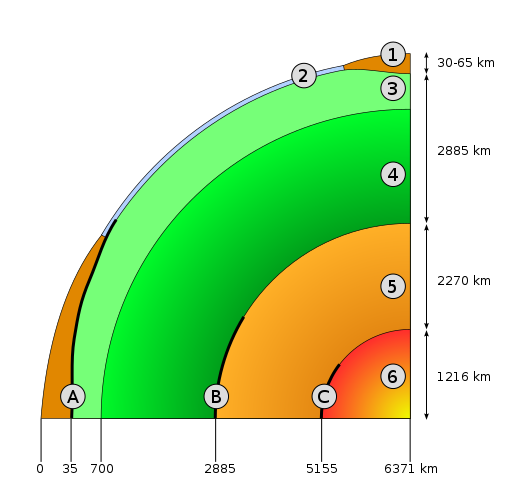
What we know about the layers forming the interior of the earth are mostly inferred from mapping the propagation and refraction of earthquake waves. The earth’s lower mantle starts some 700km down and extends to a depth of about 2900km. The upper and lower mantle demonstrate – in fluid dynamic terms – a viscous chaotic flow but the mechanisms by which material is exchanged between the upper and lower mantle are not fully understood.

Science Daily: Michael Walter of the University of Bristol and colleagues in Brazil and the United States analyzed a set of “superdeep” diamonds from the Juina kimberlite field in Brazil. Most diamonds excavated at Earth’s surface originated at depths of less than 200 kilometers. Some parts of the world, however, have produced rare, superdeep diamonds, containing tiny inclusions of other material whose chemistry indicates that the diamonds formed at far greater depths

M. J. Walter, S. C. Kohn, D. Araujo, G. P. Bulanova, C. B. Smith, E. Gaillou, J. Wang, A. Steele, S. B. Shirey. Deep Mantle Cycling of Oceanic Crust: Evidence from Diamonds and their Mineral Inclusions. Science, 2011; DOI: 10.1126/science.1209300

ABSTRACT

A primary consequence of plate tectonics is that basaltic oceanic crust subducts with lithospheric slabs into the mantle. Seismological studies extend this process to the lower mantle, and geochemical observations indicate return of oceanic crust to the upper mantle in plumes. There has been no direct petrologic evidence, however, of the return of subducted oceanic crustal components from the lower mantle. We analyzed superdeep diamonds from Juina-5 kimberlite, Brazil, which host inclusions with compositions comprising the entire phase assemblage expected to crystallize from basalt under lower mantle conditions. The inclusion mineralogies require exhumation from the lower to upper mantle. Because the diamond hosts have carbon isotope signatures consistent with surface-derived carbon, we conclude that the deep carbon cycle extends into the lower mantle.

“This study shows the extent of Earth’s carbon cycle on the scale of the entire planet, connecting the chemical and biological processes that occur on the surface and in the oceans to the far depths of Earth’s interior,” according to Nick Wigginton, associate editor at Science.

The carbon cycle generally refers to the movement of carbon through the atmosphere, oceans, and the crust. Previous observations suggested that the carbon cycle may even extend to the upper mantle, which extends roughly 400 kilometers into Earth. In this region, plates of ocean crust — bearing a carbon-rich sediment layer — sink beneath other tectonic plates and mix with the molten rock of the mantle.

Seismological and geochemical studies have suggested that oceanic crust can sink all the way to the lower mantle, more than 660 kilometers down. But actual rock samples with this history have been hard to come by

File:Slice earth.svg

Schematic view of the interior of Earth. 1. continental crust - 2. oceanic crust - 3. upper mantle - 4. lower mantle - 5. outer core - 6. inner core - A: Mohorovičić discontinuity - B: Gutenberg Discontinuity - C: Lehmann discontinuity: image Wikipedia

PhysOrg: The diamonds were analyzed for carbon at Carnegie. Four of the diamonds contained low amounts of carbon-13, a signature not found in the lower mantle and consistent with an ocean-crust origin at Earth’s surface. “The carbon identified in other super-deep, lower mantle diamonds is chiefly mantle-like in composition,” remarked co-author Steven Shirey  at Carnegie. “We looked at the variations in the isotopes of the carbon atoms in the diamonds. Carbon originating in a rock called basalt, which forms from lava at the surface, is often different from that which originates in the mantle, in containing relatively less carbon-13. These super-deep diamonds contained much less carbon-13, which is most consistent with an origin in the organic component found in altered oceanic crust.

Tilburg University on terms of reference for Diederik Stapel misconduct inquiry

September 15, 2011

Following the suspension (pending dismissal) of Diederik Stapel for faking data, Tilburg University has published the terms of reference of the Levelt investigation committee and which is to report latest by the end of October.

Universiteit van Tilburg

Rector Magnificus of Tilburg University Prof. P. Eijlander has asked the Levelt Committee to investigate the extent and nature of the breach of scientific integrity committed by mr. Stapel. There are two elements to the task:

  1. The committee will examine which publications are based on fictitious data or fictitious scientific studies and during which period the misconduct took place.
  2. The committee should form a view on the methods and the research culture that facilitated this breach of scientific integrity, and make recommendations on how to prevent any recurrence of this.

The committee will publish its (interim) report by the end of October at the latest. The universities of Groningen and Amsterdam have both appointed staff members responsible for communication with the inquiry. 

Members committee
Prof.dr. W.J.M. Levelt, Prof.mr. M.S. Groenhuijsen, Prof.dr. J.A.P. Hagenaars,

Dr.ir. S.A.M. Baert (secretary)

Prof. Levelt is a psycho-linguist and former president of the Royal Netherlands Academy of Arts and Sciences while Prof. Groenhuijsen and Prof. Hagenaars are from Tilburg’s Law School.

Stapel has agreed to cooperate fully with the investigation and to help identify every instance of data fabrication. There are likely to be a number of retractions to come from among his published papers. It would though be a good sign if the Journals involved were to be pro-active in identifying these rather than starting their processes only after the investigation was complete. Some of the journals involved could be ScienceEuropean Journal of Social Psychology, Journal of Personality and Social Psychology and Journal of Experimental Social Psychology.

Nobel laureate resigns from American Physical Society because of its stand on global warming

September 14, 2011

In October last year Professor Hal Lewis resigned from the American Physical Society because “It is of course, the global warming scam, with the (literally) trillions of dollars driving it, that has corrupted so many scientists, and has carried APS before it like a rogue wave”.

Yesterday another high profile member (Nobel prize winner for physics in 1973  Dr. Ivar Giaever) also resigned for much the same reason.

WUWT:

Nobel prize winner for physics in 1973 Dr. Ivar Giaever resigned as a Fellow from the American Physical Society (APS) on September 13, 2011 in disgust over the group’s promotion of man-made global warming fears. 

Here’s the resignation letter:

From: Ivar Giaever [ mailto:giaever@XXXX.com]
Sent: Tuesday, September 13, 2011 3:42 PM
To: kirby@xxx.xxx
Cc: Robert H. Austin; ‘William Happer’; ‘Larry Gould’; ‘S. Fred Singer’; Roger Cohen
Subject: I resign from APS
Dear Ms. Kirby
Thank you for your letter inquiring about my membership. I did not renew it because I can not live with the statement below:
“Emissions of greenhouse gases from human activities are changing the atmosphere in ways that affect the Earth’s climate. Greenhouse gases include carbon dioxide as well as methane, nitrous oxide and other gases. They are emitted from fossil fuel combustion and a range of industrial and agricultural processes.
The evidence is incontrovertible: Global warming is occurring.
If no mitigating actions are taken, significant disruptions in the Earth’s physical and ecological systems, social systems, security and human health are likely to occur. We must reduce emissions of greenhouse gases beginning now”.
In the APS it is ok to discuss whether the mass of the proton changes over time and how a multi-universe behaves, but the evidence of global warming is incontrovertible? The claim (how can you measure the average temperature of the whole earth for a whole year?) is that the temperature has changed from ~288.0 to ~288.8 degree Kelvin in about 150 years, which (if true) means to me is that the temperature has been amazingly stable, and both human health and happiness have definitely improved in this ‘warming’ period.Best regards,
Ivar Giaever
Nobel Laureate 1973PS. I included a copy to a few people in case they feel like using the information.
Ivar Giaever
XXX XXX
XXX
USA
Phone XXX XXX XXX
Fax XXX XXX XXX  

The supposedly “settled” science is looking decidedly wobbly.  And any science justifed on the basis of a “consensus” is fundamentally suspect .