The Covid-19 virus was first encountered at the end of 2019 though the World Health Organization only declared the outbreak a Public Health Emergency of International Concern on 30 January 2020, and a pandemic on 11 March 2020. Total global deaths now exceed 5.6 million and after over 2 years, the pandemic continues. We received our first doses of vaccine in April 2021, the second dose in June 2021 and the third, booster shot in December 2021.
The major difference – for a layman – between the Spanish flu pandemic of 1918-1920 and this Covid pandemic is that there were no vaccines available 100 years ago. The Spanish flu hit in 4 major waves; one in March 1918, the second (the deadliest) in August 1918, a third, mainly in Australia, in January 1919 and the final fourth wave in early 1920. By March 1920 the Spanish flu was less deadly than common influenza and the pandemic was over. With no vaccines of any sort available, the Spanish influenza pandemic lasted just 2 years. It is estimated that the total number of deaths was somewhere between 17 and 50 million and that up to 500 million were infected.
With Covid-19, vaccines were available first about 11 months after the outbreak though most received vaccines in the second year of the outbreak. A remarkable achievement. The logistics of carrying out mass vaccinations has been equally impressive. So far over 5 billion of the 7.3 billion global population have received at least one dose. Around 4 billion have received two doses. Close to 60% of the global population has been vaccinated to some extent. Around 360 million are thought to have been infected and around 5.6 million have lost their lives.
There is little doubt that the quality of health care after being infected is orders of magnitude more effective than 100 years ago. It is also reasonable to conclude that the vaccines have prevented many deaths. Numbers infected are similar to 100 years ago (360 m / 500 m) but number of deaths are drastically lower (5.6m / 17 – 50 m). Yet the pandemic continues and the earliest it may recede – we think – is this autumn of 2022 which will be 3 years after it started.
It would seem that vaccines have not reduced the length of the pandemic at all. In spite of all the advances in health care and the huge medical/pharmaceutical efforts in understanding the virus and creating vaccines, we are entirely reactive in our response. Vaccine development is reactive. Getting vaccinated is proactive but defensive and does not harm the virus. Health care is reactive. We have no means, it would seem, of taking the initiative and attacking the virus. We are forced to rely on natural mutations eventually reducing its virulence. Our actions, being reactive, would seem to have no impact on the length of the pandemic. Epidemiology has not impressed me during this pandemic. Every so-called mathematical model (which depends finally upon human behaviour) was wrong. (Of course epidemiology is a discipline of clerks and statistics – a social “science” if it must be called a science). They have not been able to do more than regurgitate the same advice as from 700 years ago at the time of the Black Death. Avoid the infected, wash your hands, wear a mask, burn your dead!
Within 50 years population decline will prevail in most of the world except for some countries in Africa. Within 100 years population decline would have set in across the entire globe. The demographic reality is that the long-term decline in fertility levels cannot be reversed very quickly and the coming peaks and declines cannot be averted. However catastrophic population declines will surely be avoided by most countries. Some have already started taking mitigating actions. The optimistic view would be that population enhancing measures will increase fertility sufficiently so that populations will not drop to lower than about 70-80% of the peak levels reached during this century between 2010 and 2100. As an illustrative example, Japan reached its peak in 2010 when the population reached 128.6 million. The decline has started and population is now about 3 million less. The projections are for a population of around 90 million in 2060 and, without any mitigating actions, down to a catastrophic level of less than 60 million by 2100. China’s population is peaking this year (2021/22) and could halve within another 100 years. India’s population will peak in about 2050 though there are some indications that this may happen as early as 2040. Some countries in Africa will reach their peak towards the end of this century but by 2100 all countries will be in decline.
The question is no longer whether populations will decline, but how fast will they decline? The interconnected nature of our societies means that a too rapid decline could lead to a breakdown of the fabric of society. A resilient society might be able to cope with, say, a 30% decline in about 100 years (<0.3%/year). The projected Japanese decline of 50% over 90 years would be catastrophic.
Some aspects of societal strains are already evident in Japan and parts of Europe. Public Services are gradually withdrawn from peripheral areas which, in turn, leads to people moving from remote areas towards urban conglomerations. The decline of schools, health services, clinics, public transport and other services in remote, rural areas is already happening in Japan and parts of Europe. Remote areas are seeing depopulation as services decline or get more expensive. The increase of aged populations compared to working-age numbers is an additional stress factor for provision of services.
Population decline is an existential threat far more difficult to handle than a population increase.
Mitigation measures focus on keeping society functioning despite a declining population. Increasing automation and the use of distributed artificial intelligence is a way of coping with a decline, but that does not change the demographic trend. Nevertheless, working from home, distance learning, the use of distributed diagnostic machines, and smart unmanned vehicles will all increase with the use of AI in smart devices. Even more automation in farming, industry and the provision of basic services can be expected. However, mitigation actions can only help in tolerating a population decline and cannot reverse the demographic trend. Immigration has been seen as a mitigation action. Populations only move from regions of lower to regions of higher economic development. Such immigration of people of child-bearing ages, usually brings an increase of fertility rates. However this increase disappears very quickly with the next generation and is only a short-term benefit. But increased immigration of working-age populations does provide short-term gains which can help to prevent the collapse of societal structures.
The root problem, though, is the declining fertility rate and to have any chance of arresting the population decline will need actions to arrest and reverse the underlying fertility trend. Some possible actions are already being tried. It can be expected that we will see increasing attempts in the next 100 years to provide incentives for having children. It will be quite different from the last 100 years where the fear of population growth has led to an unhealthy emphasis on disincentives for having children and even incentives for terminating pregnancies. For a hundred years, the scare-mongers (such as The Club of Rome) have promoted the apocalyptic vision of exploding populations starving to death in a world unable to feed itself. The doom-sayers have hijacked the perception of virtue. Having many children has invited ridicule. Being a mother has been denigrated while being a childless “career-woman” has been glorified. The nuclear family has been maligned as being damaging to freedom and sustainability. But the bleak and cowardly narratives of population-explosion and peak-oil and peak-water and peak-food and peak-energy have all been false, malicious and insidious. The last 100 years have seen incentives for sterilisation and even forced sterilisations. Since the end of WW II, it has become, not just socially acceptable, but admirable, socially responsible and virtuous, not to have children. Abortion has become fashionable. From being a last-resort medical procedure to protect the life of the mother, abortion on demand and for convenience has become just another alternative to contraception. There are circles where having had an abortion is a badge of honour. There are around 60 million deaths every year and this will increase to about 120 million in 2100 as the world ages. There are around 115 million births per year and these will decline slowly through the rest of this century. In addition, according to the WHO, there are an estimated 40-50 million abortions per year. This is incongruous in a world where a false “sustainability” has become a fashionable buzz-word. But it is economic development, not encouraged or forced sterilisations, which has reduced fertility rates. Not having children, it is being finally acknowledged, is not sustainable.
Can public policy break the inexorable demographic trend and increase the fertility rate?
This will become the great challenge of the next 100 years. Financial incentives, often in the form of tax breaks, for having children are increasingly being introduced in many countries with low birth rates. These include Finland, Estonia, Italy, Japan, S Korea, Turkey, Iran and Australia among others. How successful they are remains to be seen. I suspect that financial incentives will not be enough. They will need to be provided together with strong social incentives to reverse the trend. Not having children cannot be a badge of honour. It is only when having children becomes a matter of social admiration that women will want to be mothers. It is only when having children becomes fashionable again that the declining trend can be reversed.
It is fairly obvious that Sergei Lavrov and the Russian strategists are making a very precise calculation of what they can get away with with Joe Biden. I suspect that they have been surprised that Biden is even more risk averse than Obama and at how far they can push. They were fairly accurate with the multitude of red lines drawn by Obama in Syria which they knew could be crossed with impunity. Now that Joe Biden has confirmed that “minor incursions” by Russia into Ukraine would be acceptable, it only remains to define what a “minor” incursion is. They would have received some further proof from the German Foreign Minister recently that Europe will do little without firm backing from the US and that this backing would be very lukewarm.
It now remains to make a case for “minor” including all the clearly Russian speaking areas of Ukraine.
Vienna (AFP) – Austria’s parliament on Thursday approved making Covid-19 vaccinations mandatory for adults from next month, becoming the first European country to do so despite a wave of protests opposing the measure. Tens of thousands have demonstrated against mandatory vaccination in regular weekend rallies since the measure was announced in November in a bid to drive up the country’s vaccination rate. But all parties, except the far-right, supported the measure, with the new legislation passing with 137 votes in favour and 33 votes against it.
I wonder what they will do with the unvaccinated. First, brand them by pinning a coloured label on them so they can be avoided? If they persist, they could vaccinated by force? If they still resist, their property could be confiscated and they could be sent to special internment camps?
A final solution for the pandemic?
You would think the Austrians might have learned their lesson.
…….. It stands to reason that forcible vaccination of the reluctant is preferable to their incarceration. A quick execution would be much cheaper if a little unethical. Deprival of employment is already here for some. Deprival of citizenship has been suggested for others. Maybe they could be branded with a yellow star and used – forcibly – for the trial of untested vaccines?
There is a reality TV show about the Australian Border Force which I sometime come across when I am avoiding commercial breaks on other channels. I am amazed at the unfeeling incompetence on display (but perhaps that is just what counts as “good” TV).
My own experience with the ABF is very limited but even that limited exposure to them has not impressed. They confiscated packets of liquor chocolates and Malaysian nuts that I was carrying. A friend had a packet of cornflakes confiscated.
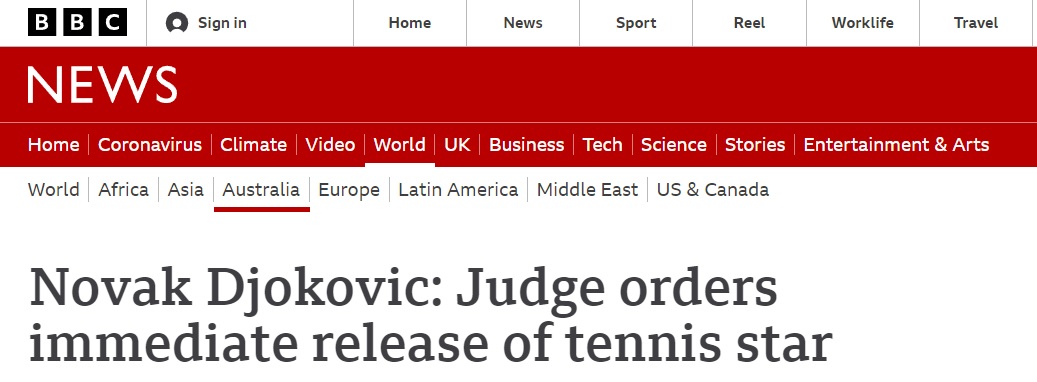
Their latest escapade with Novak Djokovic only confirms my perception of a an arrogant, bureaucratic gang who have not realised that brains are intended to be used. Of course it does not help with idiot politicians at the helm.
There is more than a whiff of hypocrisy about wildlife conservation. In today’s world it has become the protection of failing or failed species (tigers, elephants and the like), the culling of inconvenient but successful species growing in numbers (wolves, moose, deer, …) and the extermination of highly successful species classed as pests (mosquitos, killer bees, …).
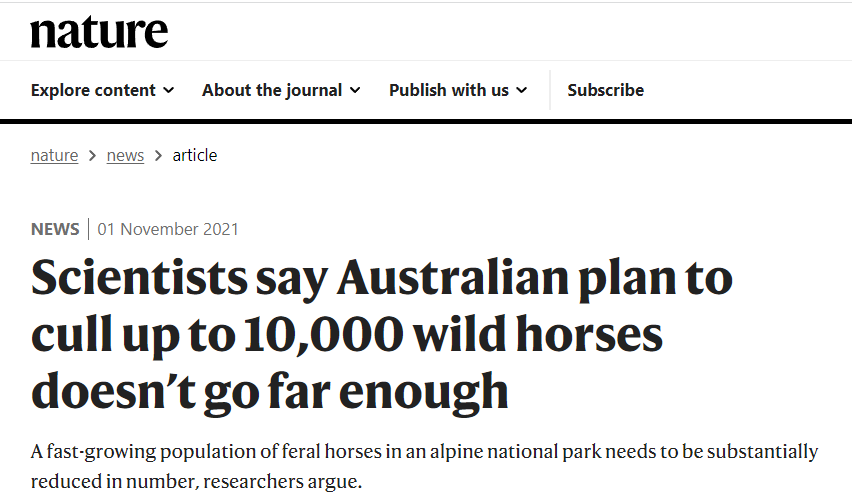
A plan to kill 10,000 wild horses in Australia is now being put into effect. Apparently a little too much biodiversity.
But to be labeled a conservationist is to be on the side of the angels.
So what then is the objection to – say – tigers becoming extinct which is not just an emotional reaction to the disappearance of a magnificent but anachronistic creature? The bio-diversity argument is not very convincing and is of little relevance. To artificially keep an unsuccessful species alive in a specially protected environment has no genetic value. It increases the mis-match between the existing environment and the genetic profile needed to survive in that environment. In fact the biodiversity argument is only relevant for “life” in general and never for any particular species or group of species. It can serve to maintain a very wide range of genetic material in the event of a catastrophe such that some form of life has a chance of continuing. But given a particular environment biodiversity in itself is of little value. …….
Italy will now make it mandatory for over 50s to be vaccinated. If it is mandatory I expect that appropriate force will be used. One would expect that a single 20 year old should be able to subdue and jab around fifty 80 year-olds per day. It might take 2 to subdue a 50 year-old.
Macron has been mouthing off (apparently literally) about making life as difficult as possible for the unvaccinated. Sweden has now made it perfectly legal for any establishment to discriminate as desired against those without proof of full vaccination (thought it is unclear if “full” means 2, 3 or 4 shots). The market for fake vaccination certificates has been given a boost and is booming. The Australians have made idiots of themselves with the Novak Djokovic affair. (Of course, Novak has been a little idiotic himself).
It is apparent that, among the politically correct and the unthinking, the unvaccinated are the new scum of the earth – even if vaccinations provide no great protection from being infected by the Omicron variant. I wonder what the hierarchy of incorrectness is?
Unvaccinated, infected are clearly the worst sort.
Unvaccinated, uninfected are somewhat better
Unvaccinated with natural immunity are not to be assumed to exist
Infected though vaccinated
Vaccinated and uninfected have a place reserved in heaven.
It stands to reason that forcible vaccination of the reluctant is preferable to their incarceration. A quick execution would be much cheaper if a little unethical. Deprival of employment is already here for some. Deprival of citizenship has been suggested for others. Maybe they could be branded with a yellow star and used – forcibly – for the trial of untested vaccines?



 The k2p blog