Archive for the ‘Academic misconduct’ Category

What’s in an “e”? Berkley vs. Berkeley

August 12, 2013

From Copy, Shake and Paste

Everyone knows that Berkley is an excellent university in the United States. Or was that Berkeley? Whatever, if someone is sporting a degree that looks impressive, it must be from that place. 

Except when it is not.

It has come to light, as the Swiss daily paper Tages-Anzeiger noted on 9 August 2013, that the IT-boss at the University Hospital in Zürich has stepped down because of a missing ‘e’. The University of California, Berkeley, is indeed one of the top universities in the US. But it did not grant a doctoral degree to Jürgen Müller. Müller had been working on his doctorate at the University of Passau in Germany when his financing ran out.

Müller then heard about the University of Berkley, and for only $ 3000 in fees he was soon the proud owner of a sheepskin declaring him to be a “Doctor of Science”, according to the Tages-Anzeiger

…… 

…. The Tages-Anzeiger article ends with an interesting note. It seems that in March of 2013 a whistleblower tried to contact Müller’s boss about his purchased degree. Müller, as IT boss, apparently had this person on a blacklist, so that emails from him did not bounce, but were just silently destroyed. 

I suppose the University Hospital in Zürich is glad that he has resigned. The question is, where will he pop up again where people don’t know the difference one letter can make?

The University of Berkley’s rates for purchasing degrees are below. It’s best to buy your Master’s and Doctor’s degrees together and in advance!!

Buying your Berkley degree

Buying your Berkley degree

The University of Berkley is a diploma mill and the subject of many scam reports and warnings such as this one:

University of Berkley Distance Learning Accreditation Report

CAUTION: You should be aware… this college is NOT ACCREDITED by any agency recognized by the Council on Higher Education Accreditation or the US Department of Education to award degrees.
Distance learning accreditation claims include:

  • New Accrediting Partnership for Educators Worldwide (NAPEW)

You should be aware that this agency is NOT RECOGNIZED by the Council on Higher Education or the US Department of Education as a college accreditation institution. What does this mean? For you, as a consumer, this means credentials earned at this college might not meet with wide acceptance at other CHEA-accredited online colleges and might not meet with academic or employment acceptance across the USA. You should be aware that in some states and for some professions it may be illegal to use a degree from an non accredited school for employment purposes.

CAUTION: the following State Warnings apply to this online college

  • Michigan State Warning: CAUTION! The State of Michigan classifies this online college as an UNACCEPTABLE INSTITUTION for credentialing for those seeking jobs in the State’s Department of Civil Service: (Consult Michigan’s NON ACCREDITED COLLEGES/UNIVERSITIES – “Degrees from these institutions will not be accepted by the Department of Civil Service as satisfying any educational requirements indicated on job specifications”:  http://www.michigan.gov/documents/Non-accreditedSchools_78090_7.pdf)
  • Texas State Warning: CAUTION! The State of Texas classifies this online college as an ILLEGAL SUPPLIER of educational credentials in the State of Texas (Consult: Texas Higher Education Coordinating Board Institutions Whose Degrees are Illegal to Use in Texas:  http://www.thecb.state.tx.us/AAR/PrivateInstitutions/NoTX.cfm)

“Romantic relationships” and their permissibility defined by UConn

August 9, 2013

A minefield where even angels would fear to tread – not that I am saying that the University of Connecticut is being foolish. In fact it is a move that many other Universities have already implemented.

Following the sexual misconduct and child molestation charges against a UConn professor, the University has taken the step of trying to define “romantic relationships” and what is permissible and what is not by adopting a new “Policy Against Discrimination, Harassment and Inappropriate Romantic Relationships”.

UConn romantic policy

Bustle: The University of Connecticut has officially banned romantic relationships between students and faculty members in their “Policy Against Discrimination, Harassment and Inappropriate Romantic Relationships.”

.. The Hartford Courant reports that UConn is defining romantic relationships fairly broadly, quoting Associate Vice President Elizabeth Conklin:

“Romantic is a term of art under the policy — but it is any sexual, intimate, amorous proposal or encounter. The relationship can be once, it can be short term, it can be long term, it can be a marriage — everything in between,” she said. “The intent is to capture it all … When you see it, you know it.”

Undergraduate relationships with faculty are totally banned, while graduate student-faculty relationships are a no-go only if the faculty member is in a position of power over the graduate student. So, in other words, I guess a chemistry grad student could have a relationship with an English professor, as long as they don’t have any kind of professional relationship.

The Courant: 

“The power difference between faculty and staff as compared to students means that any romantic relationship between a faculty or staff member and a student is potentially exploitative or could at any time be perceived as exploitative,” Herbst said.

A romantic relationship, as defined by the policy, “doesn’t have to involve champagne and flowers ……

In the wake of the still-unfolding Miller scandal, UConn said that even suspected relationships may fall under scrutiny.

“Deans, department heads, directors and supervisors should exercise great caution when choosing not to report a rumor of discrimination, harassment or inappropriate romantic relationships,” the university advised.

However, the university will not try to force the breakup of preexisting romantic relationships that would be banned under the new policy. But it will require any employee involved in one to report it within three months of Wednesday’s action by the trustees.

“The faculty member, staff member or graduate student in a position of authority must declare the existence of the relationship to the Office of Diversity and Equity … or the Office of Faculty and Staff Labor Relations,” according to a fact sheet released by UConn.

Also, the university said: “The appropriate dean or vice president … will consider whether steps can be taken to eliminate or minimize the conflict. … All parties will be told that not all conflicts can be eliminated, potentially limiting career or academic options for both of the parties involved in the relationship.”

“Just make up an elemental analysis…..”

August 8, 2013

ChemBark has the details of this case where sloppy writing and/or editing shows up some not so ethical behaviour:

Just make up the data..

Just make up the data ……

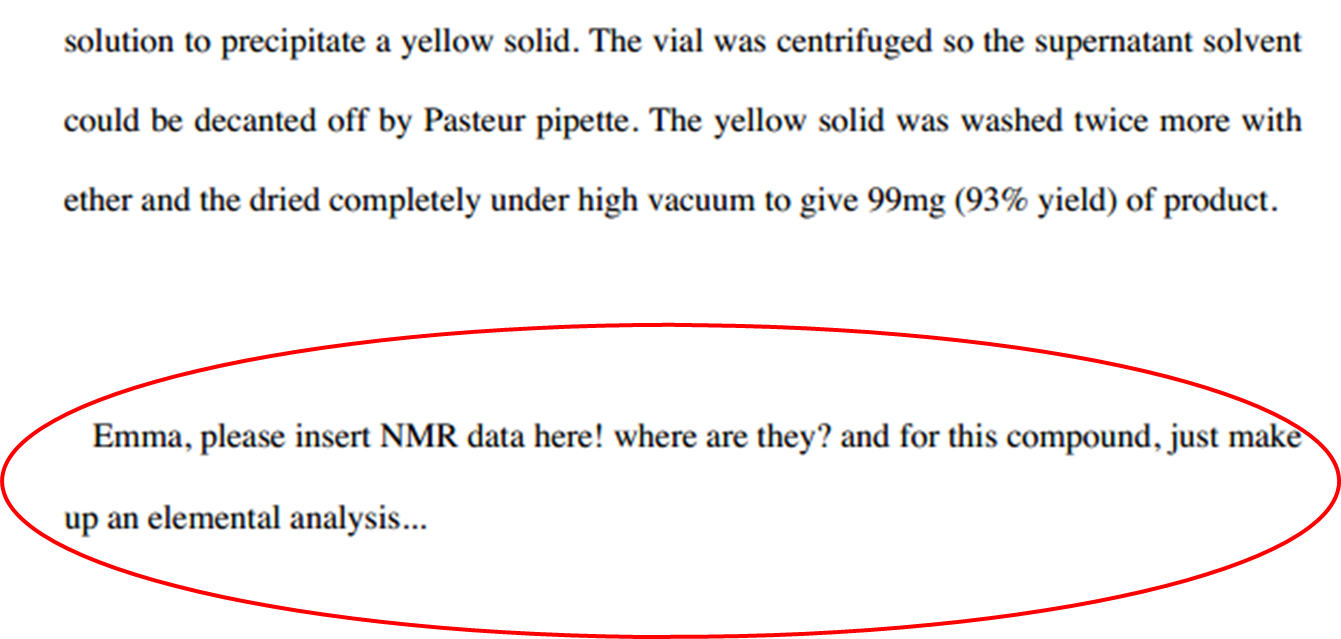
This instruction apparently from the senior author to the first author was found inadvertently left in the Supplemental Information for this paper – which has been archived here in case it disappears: SI Emma E Drinkel et al.

What is particularly noteworthy is the casual nature of the instruction to “just make up the data…”. It would almost appear that faking data is a routine and regular procedure. Less shocking but a telling commentary on the review process is that such a statement made it all the way to publication.

Emma E. Drinkel, Linglin Wu, Anthony Linden and Reto Dorta, Synthesis, Structure and Catalytic Studies of Palladium and Platinum Bissulfoxide Complexes, Organometallics, Article ASAP, DOI: 10.1021/om4000067

The affiliations of the authors is given as  the University of Zurich, but the senior author, Professor Reto Dorta now seems to be at the University of Western Australia while Emma Drinkel is in Brazil at the Universidade Federal de Santa Catarina.

ChemBark:

A recently published ASAP article in the journal Organometallics is sure to raise some eyebrows in the chemical community. While the paper itself is a straightforward study of palladium and platinum bis-sulfoxide complexes, page 12 of the corresponding Supporting Information file contains what appears to be an editorial note that was inadvertently left in the published document:

Emma, please insert NMR data here! where are they? and for this compound, just make up an elemental analysis…

This statement goes beyond a simple embarrassing failure to properly edit the manuscript, as it appears the first author is being instructed to fabricate data. Elemental analyses would be very easy to fabricate, and long-time readers of this blog will recall how fake elemental analyses were pivotal to Bengu Sezen’s campaign of fraud in the work she published from 2002 to 2005 out of Dalibor Sames’ lab at Columbia.

The compound labeled 14 (an acac complex) in the main paper does not appear to correspond to compound 14 in the SI. In fact, the bridged-dichloride compound appears to be listed an as unlabeled intermediate in Scheme 5, which should raise more eyebrows. Did the authors unlist the compound in order to avoid having to provide robust characterization for it? ….

Related:

 Insert data here … Did researcher instruct co-author to make up results for chemistry paper?

When Authors Forget to Fake an Elemental Analysis

Another headline chasing psychologist is censured

August 7, 2013

What is it about social psychology and psychologists that causes them particularly to chase notoriety and public attention even to the extent of faking data? Diedrik Stapel and Marc Hauser being recent high profile cases. Could it just be that they are all suffer from a narcissism which can only be satisfied by generating headlines and generally being in the limelight?

Now a certain Geoffrey Miller – supposedly an “evolutionary psychologist” – has been publicly censured by New York University  for essentially behaving like an idiot and then lying about it. After tweeting a stupid and offensive remark he then tried to pass it off as part of a research project! He has now apologised – a bit late – and deleted the tweet. But his self-promotional intentions were recognised. Apparently he researches into how the human mind evolved. (Or as is pretty obvious –  didn’t evolve for some).

“The Tweeting activities of associate professor Geoffrey Miller did not rise to the level of research,” said a statement from the IRB on the university’s website.

“The board concluded that Miller’s Tweets were self-promotional in nature and did not follow research criteria which require specific research questions or hypotheses, systematic methods for collection quantitative and/or qualitative data and criteria for selecting respondents.”

He is an Associate Professor at the University of New Mexico and visiting NYU

The Times Higher Education covers the developments:

A US professor who Tweeted that if overweight PhD applicants “didn’t have the willpower to stop eating carbs” then they “won’t have the willpower to do a dissertation” has been formally censured by his university.

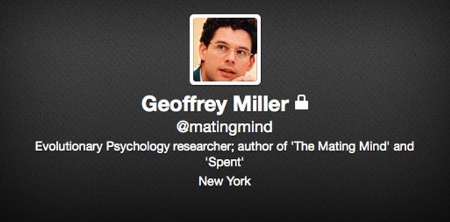
Geoffrey Miller Twitter page

Geoffrey Miller Twitter page

Geoffrey Miller, associate professor of psychology at the University of New Mexico, apologised after sending the Tweet, which he subsequently deleted. He later told UNM it had been part of a research project – a claim dismissed by the university

The institution has now formally censured Professor Miller for “misrepresenting to his department chair and colleagues the motivation for a Tweet”. 

“Miller at first claimed his Tweet was part of a research project, but investigations by the Institutional Review Board at New York University where he was a visiting professor, and the IRB at UNM where he is a tenured professor, concluded that was not correct,” a statement from his university read. 

As part of the censure, Professor Miller will be required to develop “a plan for sensitivity training as it pertains to obesity” in cooperation with the UNM psychology department, and apologise to colleagues for his behavior. 

Professor Miller, who can appeal the censure, will also have his work monitored by the chair of the psychology department, and will be assigned a faculty mentor for three years, with whom he will meet on a regular basis to discuss potential problems.

VitroGro, Tissue Therapies and QUT’s “inadvertent” data falsification?

August 4, 2013

The mysterious goings-on at the  whistle-blower fracas at the Queensland University of Technology seem to run quite deep. The mystery is apparently compounded by commercial interests. The elements include a company spun-off from QUT (Tissue Therapies), University staff owning stock in the company, the company raising start-up money, listed on the stock exchange and having a value entirely dependent upon the prospects for one breakthrough product (VitroGro).

The latest revelation suggests that the whistle- blowers, Luke Cormack and another – whose identity is protected but was “inadvertently” revealed by the University Vice Chancellor –  have been spied upon. Cormack was given “counselling” organised by the University – which counselling was never confidential. The contents of these discussions were apparently reported by the counselor to the University authorities!! Seems to be a remarkable absence of ethical standards at the University and – more particularly – with the counselor. Perhaps it was all “inadvertent”.

A summary of the story is here in the Courier-Mail.

His colleagues had discovered a cheaper and more reliable way to grow human tissue, with huge implications for biology and medicine. Cormack’s research concerning stem cells aimed to build on their findings.

But no matter what he tried, his cells refused to grow. He later failed his PhD.

The key question is whether VitroGro has real prospects or is just hype. It is supposed to be used in healing wounds by helping cells to grow. If VitroGro’s potential benefits have knowingly been hyped by the “inadvertently” manipulated data, then there is a risk that this is all a start-up scam.

Business start-up scams depend upon inflating the apparent value of a start-up company by promoting perceptions of a bright future such that investment money can be attracted.

(more…)

Results falsified but only “inadvertently” by researchers at Queensland University of Technology

July 31, 2013

There are strange goings-on down under at the Queensland University of Technology (QUT).

The story has all the necessary ingredients for a genuine scandal. Falsified results in a grant application and a paper, the paper retracted, grant money awarded on the basis of the alleged results, a University with commercial interests in the alleged results of the alleged research, a whistleblower’s name illegally revealed by the Vice Chancellor of the University, and the Crime and Misconduct Commission accused of colluding with the University.

The University has found that the falsification of results was inadvertent and not fraud and nothing to worry about.

===============

UPDATE: Now the QUT “investigation” which came to the “finding” that the falsification was “inadvertent” and not fraud is itself being questioned by the federal agency that gave the scientists a $275,000 grant for stem cell work.

31st July: The National Health and Medical Research Council is not satisfied with some of QUT’s investigative procedures and wants a review by the Australian Research Integrity Committee. The move is unusual, with the ARIC set up in 2011 to ensure research allegations of misconduct are investigated properly taking on just a handful of cases.

============================

It is compelling reading and lives up to the convoluted tradition of Australian politics. But I have some difficulty in telling the “good guys” from the “bad guys” – if there are any “good guys” in this saga at all!

29th July: QUT reputation at risk after grant application and research mistakes

RESEARCHERS at one of Queensland’s top universities have admitted to incorrectly filling out a lucrative grant application in a mistake that could cost the university hundreds of thousands of dollars.

The “inadvertent” mistake by Queensland University of Technology scientists has put the university’s reputation at risk, the Vice-Chancellor says. The National Health and Medical Research Council is examining the circumstances under which it awarded QUT a $275,000 grant for research, and QUT boss Peter Coaldrake said the university faced having to pay it back. 

Whistleblowers have exposed errors in the reporting of embryonic stem cell research, prompting an internal probe into alleged misconduct and the retraction of a key research paper. The lead researcher has admitted to The Courier-Mail that an “inadvertent mistake” occurred in the writing of the grant application and an associated scientific paper published in 2010.

The NHMRC awarded the money to fund research into stem cell cultivation at QUT’s prestigious Institute for Health and Biomedical Innovation. The scientists were working on developing a “world-first” product to safely grow human cells in the lab without the use of risky animal proteins.

However, university insiders accused the researchers of exaggerating some results. “It was alleged that some data in the grant application had been falsified,” Prof Coaldrake said.

The scientists were subsequently cleared by a QUT inquiry. QUT later told the NHMRC there was no misconduct in the grant application. The journal involved has since retracted the article, a highly unusual step. …

30th July: QUT researchers cleared of fraud

AN “inadvertent” mistake in filling out a grant application by researchers at Queensland University of Technology saw the university awarded $275,000 for stem cell research and which has subsequently lead to an internal probe into research misconduct and the retraction of a research paper, the Courier Mail reported yesterday.

The NHMRC awarded the grant for research into stem cell cultivation at QUT’s Institute for Health and Biomedical Innovation. The scientists were working on developing a “world-first” product to safely grow human cells in the lab without the use of risky animal proteins, the Courier Mail said.

But the researchers were accused of falsifying some results, even though the scientists were subsequently cleared by an internal inquiry of any wrongdoing.

The whistleblowers who drew attention to irregularities in the research say QUT has a conflict of interest because it is a shareholder in a company called Tissue Therapies which was set up with the express purpose of developing and commercialising products based on the research.

30th July: Premier Peter Beattie gave QUT researchers in grant controversy an extra $225,000 for related work

QUT scientists at the centre of a controversy over a $275,000 federal grant for a now discredited journal paper also received $225,000 from then premier Peter Beattie for related work, as part of a 2007 funding package worth more than $1 million.

But while QUT has informed the Crime and Misconduct Commission and the National Health and Medical Research Council about errors in the application for the federal grant and the retraction of a key research paper, the university has not told the State Government.

31st July: QUT vice-chancellor Peter Coaldrake reports himself to CMC for disclosing whistleblower’s identity

QUT Vice-Chancellor Peter Coaldrake has reported himself to the Crime and Misconduct Commission after disclosing the identity of a protected whistleblower.

Prof Coaldrake named the person in an interview with The Courier-Mail in which he discussed the allegations by the whistleblower of research misconduct by QUT scientists. Prof Coaldrake later turned himself in to the CMC.

QUT later confirmed the employee’s status as a whistleblower protected by the Public Interest Disclosure Act. This law makes it an offence for public officials to disclose the person’s identity without their consent, except for the purposes of official investigations. The offence carries a fine of up to $9000. …… In the same interview Professor Coaldrake declined to name four academics from other universities involved in investigating research misconduct allegations involving a retracted scientific paper. He said this was because he wasn’t sure if the academics’ identities were known by the stem cell researchers being investigated. … QUT has declined to explain why Prof Coaldrake volunteered the name of the whistleblower.

Ahluwalia’s PhD cleared of fraud by Imperial College

July 31, 2013

I have posted extensively about Dr. Jatinder Ahluwalia’s scientific misconduct while at University College London and earlier at Cambridge. He was awarded his PhD by Imperial College London in a collaborative industrial doctorate with Novartis as his sponsor.

Following the ruckus, Imperial College investigated his PhD but have now cleared him of any fraud but their report does complain that access to Ahluwalia’s lab books was restricted by Novartis and only supervised access was permitted. Ahluwalia’s career in academia has virtually come to an end but I do have a suspicion that his PhD supervisors at Imperial College (Dr. Istvan Nagy) and at Novartis ( Dr Marco Compagna) cannot be completely free of all blame.

On the atmosphere in the research group, Dr Nagy suggests that Jatinder Ahluwalia was under no pressure to publish or to produce results in Dr Nagy’s group and Dr Nagy felt that a climate to produce fraudulent data did not exist, since there was no reason to produce papers in a hurry.
From discussions with Dr Nagy on the set-up of Dr Ahluwalia’s supervision arrangements it appears that the separation between Novartis and Imperial may have led to errors in supervision, where any mistakes that Jatinder Ahluwalia may have made in methodology and interpretation could not easily be checked.

THES and Retraction Watch cover the story.

THES: 

Imperial College London has cleared disgraced researcher Jatinder Ahluwalia of committing fraud during his industrial doctorate at the institution. 

However, a report setting out the finding also reveals that Imperial experienced considerable difficulties in investigating its suspicions due to the reluctance of the industrial collaborator on Dr Ahluwalia’s studentship to grant access to his lab books.

The investigation was announced in August 2011, after Dr Ahluwalia’s co-authors agreed to retract a 2003 Journal of Neurochemistry paper, of which he was first author, following the failure of his former supervisor, Istvan Nagy, to replicate its findings.

In 2010 a paper written while Dr Ahluwalia was a postdoctoral researcher at University College London was retracted by his former boss, Anthony Segal, after a UCL committee found that he had manipulated his results and had probably interfered with colleagues’ experiments to cover his tracks.

It subsequently emerged that Dr Ahluwalia had been dismissed from the University of Cambridge’s PhD programme in 1997 after his supervisor suspected him of faking results.

He then did a PhD at Imperial between 1999 and 2002, funded by a Medical Research Council “Case” studentship, in collaboration with the pharmaceutical company Novartis.

In 2009, while the UCL investigation was ongoing, Professor Segal informed Imperial of his suspicions about the 2003 paper. No misconduct was found during a subsequent investigation, but the paper was corrected in 2010 after “an arithmetical error” was identified.

Following its 2011 retraction, a six-person panel investigation panel – which included Imperial’s pro-rector for education, dean of students and student union president – was formed to check Dr Ahluwalia’s PhD work for fraud. None was found. …..

Dr Ahluwalia left the University of East London, where he had been a senior lecturer in pharmacology, in 2011 following an internal investigation. His current whereabouts are unknown.

Retraction Watch: 

We’ve uploaded the entire report here.

Ahluwalia, as Retraction Watch readers may recall, has had a paper in Nature retracted, as well as one in theJournal of Neurochemistry. The Nature retraction followed an investigation at University College London, where he was a postdoc, and he then left the University of East London after we reported that he had been dismissed from Cambridge the first time he had tried to get a PhD.

Imperial, where he earned his doctorate, began investigating more than two years ago. They began looking in whether he should lose his PhD after the Journal of Neurochemistry retraction, because that paper formed the basis of his thesis. They found:

The panel determined that there was no evidence of research misconduct in Dr Ahluwalia’s thesis. It noted that fraudulent activity by Dr Ahluwalia had been reported elsewhere but that this did not suggest that misconduct had occurred at Imperial. As no evidence of fraud or misconduct at Imperial had been identified, the award of the PhD should stand.

Part of the reason the investigation took so long was because of problems accessing Ahluwalia’s data, given that his supervisor was a :

An initial confidential review of the thesis and publications was carried out by a private firm contracted for the purpose and identified the need for further investigation. In parallel to this a protracted negotiation ensued between the College and Novartis for the panel to have access to Dr Ahluwalia’s notebooks which were in Novartis’ possession. Eventually supervised access to the notebooks on Novartis’ premises was agreed by Novartis.

A retraction can achieve more publicity than the original paper

July 30, 2013

A jaundiced view of retractions and questions of a cynical kind:

  1. Could an article or paper be deliberately written so as to be retracted later for the ensuing publicity?
  2. Can a deliberate retraction be managed so as to generate credit for the journal or the author who requests the retraction?
  3. And is it not “perfectly correct” to cite a retracted paper in a subsequent paper as a  “publication (retracted)”?

A retraction – if sufficiently “interesting” – can get more publicity than the original paper. It may be a cliche but it is nonetheless true  that there is no such thing as bad publicity. And if the retraction is at the “request of the authors” the author may actually demonstrate and even build a reputation for integrity!

This story at Retraction Watch of an article pulled by Slate raises my suspicions that just publicity was actually the objective.

RetractionWatch: 

Slate has retracted an essay they published as part of a partnership with Quora, an online question-and-answer site, after acknowledging that they “did not vet the piece properly.”

The piece garnered hundreds of comments, many of which questioned whether its claims were legit, and some of which pointed out that the author may have posted questionable material on the web before.

This now appears where the article, originally published at 5:01 p.m. on Thursday, July 25, originally did:

Editor’s note: On July 25, Slate published in this space an essay from its partner site Quora titled “Are Doctors Biased Against Obese People?” Because the piece did not meet our editorial standards, we have taken it down.

On Friday at 6:09 p.m., brandchannel started a post about the article with a quote from the piece:

When I was pregnant, one OB called me disgusting and told me to have an abortion.

brandchannel doesn’t mention the retraction, which Slate tells us happened Friday night, just over 24 hours after it as originally posted. But brandchannel anticipated that move, including the entire Slate-Quora piece saved for posterity, …..

I note also from Professor Debora Weber-Wulff’s blog that retracted papers still show up being cited – as retractions – in other papers. The paper is in PLoS and is supposedly a peer-reviewed online publication.

36. Rathinam C, Klein C (2012) Retraction: transcriptional repressor gfi1 integrates cytokine-receptor signals controlling B-cell differentiation. PLoS One 7.

Retraction? Are they citing the retraction of the article as a reference for what had been stated in the article retracted? 

Retracted papers are also being included in CV’s! I suppose that the paper was accepted for publication – even if later retracted – is some kind of an achievement!

It reminds me of the old story where CV’s in India would regularly include something like

“BA, 1943, University of Aligarh (fail)”.

This was considered – socially and academically – acceptable as proof that the author had at least done the course and had appeared for the examination!

Vatican — duping or duped about VSEL stem cells?

July 29, 2013

Vatican theologians have a long history of going to extraordinary lengths and convolutions to align theology with every new scientific advance. It has not been unknown for theologians to try and massage the facts and to direct new research along theologically “acceptable” paths.

The Vatican – and other religious organisations – consider the use of adult stem cells to be ethically quite acceptable whereas they consider the use of embryonic stem cells to be unethical since it involves the “murder” of the embryos. And they have put their weight behind VSEL (very small embryonic-like) stem cells. But they have gone overboard in promoting the possible benefits of the use of adult stem cells even to the extent of holding conferences about the potential benefits. But many researchers are appalled by theology overriding science and holding out false hopes.

Nature: April 2013

The Second International Vatican Adult Stem Cell meeting, held on 11–13 April in Vatican City, was a shamelessly choreographed performance. Sick children were paraded for television, sharing the stage with stem-cell companies and scientists desperate to hawk a message that their therapies must be speeded to clinical use. ….

A kilometre away at the Italian senate, meanwhile, parliamentarians further eroded protection for vulnerable patients targeted by stem-cell companies. On 10 April, they amended an already controversial ministerial decree (see Nature 495, 418–419; 2013) with a clause that would redefine stem-cell therapy as tissue transplantation, thereby releasing it from any regulatory oversight. If the second parliamentary chamber endorses this amendment, Italy will be out of step with the rules of the European Union and the US Food and Drug Administration, both of which define stem cells modified outside the body as medicines.

Many scientists around the world were appalled by the events in Rome, and rightly so. It is wrong to exploit the desperation of the disabled and the terminally ill and to raise false hopes of quick fixes, as some at the Vatican meeting tried to do. It is also wrong to try to use such patients as experimental animals by bypassing regulatory agencies, as the Italian parliament seems to want to do. ….

Now it seems that the Vatican has either been duped about very small embryonic-like stem cells or has been involved in perpetuating the myth that these cells even exist and offer an alternative.

RawStory:

Scientists at Stanford University School of Medicine issued a report this month that said a type of stem-cell alternative approved by the Vatican and other theologians has turned out to be a myth. According to an essay by bioethicist Arthur Caplan, Dr. Irving Weissman and his team have concluded that so-called very small embryonic-like (VSEL) stem cells are at best a laboratory error and at worst a deliberate fraud perpetrated on the scientific and religious communities.

In 2011, the Vatican called a press conference to present Polish stem cell biologist Mariusz Z. Ratajczak, who claimed that he had discovered heretofore unknown stem cells present in adult cells. These tiny cells, he claimed, could perform the same tasks as embryonic stem cells, including tissue regeneration and the miraculous capacity that embryonic stem cells have to mimic other types of cell tissue. Moreover, these VSEL cells, said Ratajczak, could be harvested from adult cells without harming human embryos or relying on them for cell material.

“The theologians,” wrote Caplan, “were delighted.” They believed that the new technology could halt what they see as the murder of unborn children. The Vatican took the unprecedented step of investing heavily in NeoStem, a company claiming to specialize in VSEL research and production, in hopes that the new technology would render the destruction of embryos for stem cells obsolete. ….. The trouble is, the cells don’t exist. At least, according to Weissman, who said that his team not only hasn’t been able to make VSELs perform their tissue-regenerative miracles in the laboratory, they can’t find them at all. …

….. Rüdiger Alt, head of research at Vita 34, an umbilical cord blood bank in Leipzig, Germany — whose team also failed to get results from Ratajczak’s methods — told the journal Nature, “Weissman’s evidence is a clincher — it is the end of the road for VSELs.”

Bioethicist Caplan wrote that supporters of VSEL research “say their peers just don’t have the techniques down for finding them. But it is just as likely that in their hope to find a solution to stem cell research acceptable to the Roman Catholic Church and other religious groups they have let themselves find something that is just not there.”

He concluded, “Until someone other then those tied to the power of VSELS for religious or business reasons can find them, be wary of any claims about their power to heal.”

Successful owl species to be killed off to assist an unsuccessful owl species!

July 24, 2013

“Conservation” is fundamentally anti-evolution if human intervention is to protect unviable species while killing off the successful ones. And here it would seem that the intervention by the US Fish and Wildlife Service is more to atone for their past sins than for any sound principles. All in the name of “Conservation”.

Barred owl

A barred owl is seen near Index, Wash. The federal government is considering killing some of the owls in the Pacific Northwest to aid the smaller northern spotted owl in the area. (Barton Glasser / Associated Press)LATimes: 

LA Times: Federal wildlife officials have moved one step closer to their plan to play referee in a habitat supremacy contest that has pitted two species of owl against one another in the forests of the Pacific Northwest.

On Tuesday, the U.S. Fish and Wildlife Service released a final environmental review of an experiment planned in three states to see if killing barred owls will assist the northern spotted owls, which are threatened with extinction after a major loss of territory since the 1970s.

The agency’s preferred course of action calls for killing 3,603 barred owls in four study areas in Oregon, Washington and Northern California over the next four years. At a cost of $3 million, the plan requires a special permit under the Migratory Bird Treaty Act, which prohibits killing non-game birds.

“It’s a fair assessment to say that going after the barred owls is the plan we’d prefer to pursue,” Robin Bown, a federal wildlife biologist, told the Los Angeles Times.

The agency began evaluating alternatives in 2009, gathering public comment and consulting ethicists, focus groups and conduction scientific studies.

It will issue a final decision on the plan in 30 days.

…..