Archive for the ‘Alarmism’ Category

Finally, the BBC begins to get it, and maybe even the Washington Post

September 24, 2013

From the BBC 10 o’clock News on September 23rd

BBC News 23rd September

BBC News 23rd September

Washington Post September 23rd

Antarctic sea ice hit 35-year record high Saturday

The comments are quite entertaining as well.

I am not getting my hopes up but little shoots of sanity are always welcome.

Nature hypes the IPCC

September 24, 2013

It could not have escaped anybody’s notice that the summary of the IPCC’s 5th Assessment Report (AR5) is due out at the end of this week in Stockholm on 27th September. The hype around this release is building up and by all the usual suspects. And the prime suspect is Nature. It has released a special issue on the 25 years of the IPCC. But nearly all these usual outlets are all in a state of denial or cover-up or both.

The IPCC faces a dilemma. Should they mention that while carbon dioxide keeps increasing global temperatures have been at a standstill and their fantasised link between fossil fuel combustion and global temperature seems to be broken. Not likely since the usual suspects have far too much invested in this hypothesis. Should they just ignore that global warming has stalled for the last 17 years and lose even more of their fast evaporating credibility. Or should they mention it and then enter into an orgy of contortion to show that their models are still valid because the missing heat has been swallowed by the Monsters of the Deep. It looks like they will choose the latter since the contortions have already begun.

The simple but inconvenient truth is that the IPCC has misled and wasted the world’s resources for  25 years.

Nature Special Issue

OUTLOOK FOR EARTH: A NATURE SPECIAL ISSUE ON THE IPCC
This Nature special issue explores the Intergovernmental Panel on Climate Change (IPCC) – an international body of hundreds of scientists and policy experts that regularly assesses the state of knowledge about how climate is changing, what impacts that will have, and how nations can mitigate the problem. A graphical introduction chronicles the history of the IPCC and how climate science has evolved over the past 25 years. One news feature examines the latest research on rising sea levels and another profiles Ottmar Edenhofer, a leader of the IPCC’s upcoming report on mitigation. In a Commentary, Elliot Diringer proposes that individual actions by nations to tackle the causes of climate change can set the stage for international action. And K. John Holmes looks at the history of large-scale environmental assessments.
Image credit: Carl De Torres


FEATURES

Outlook for Earth

As the IPCC finalizes its next big climate-science assessment, Nature looks at the past and future of the planet’s watchdog.

25 years of the IPCC

A graphical tour through the history of the Intergovernmental Panel on Climate Change and the science that underlies it.

Rising tide

Researchers struggle to project how fast, how high and how far the oceans will rise.

The climate chairman

Getting hundreds of experts to agree is never easy. Ottmar Edenhofer takes a firm, philosophical approach to the task.

COMMENT

A patchwork of emissions cuts

Home-made national approaches can be effective for climate-change mitigation if countries agree on rules and build trust, says Elliot Diringer.

Pushing the climate frontier

The first large-scale environmental surveys, carried out on the US arid lands, hold scientific lessons for policy-making still relevant today, explains K. John Holmes.


After fleecing the taxpayer, Tim Flannery is now set to fleece the public

September 24, 2013

Tim Flannery who has just been sacked by the Tony Abbot government from his position at the Climate Change Commission, is another self-proclaimed “climate expert” and general doom-monger. Not so very different from Pachauri.

He completed a Bachelor of Arts degree in English at La Trobe University in 1977, and then took a change of direction to complete a Master of Science degree in Earth Science at Monash University in 1981. He then left Melbourne for Sydney, enjoying its subtropical climate and species diversity. In 1984, Flannery earned a doctorate at the University of New South Wales in Palaeontology for his work on the evolution of macropods (kangaroos)

But he is not taking his ignominious sacking lying down. Instead of donning sack-cloth and ashes and doing penance to seek absolution for his many sins, he finds that he needs to generate some income to keep himself in the style he is accustomed to. He received an annual salary of A$ 180,000 for his 3 day week at the Climate Change Commission. He needs to replace that. He will therefore get out his begging bowl and solicit money directly from the public in “Obama style” as he calls it. I’m not sure precisely what that means other than many small contributions from many small pockets to make a large sum for his large pocket!

A parasitic existence sucking money from small contributors without actually producing anything of real value to anyone except himself!

Flannery is one of those who deny the global warming hiatus. His tenure in his well-paid sinecure has been characterised by a closed and narrow mind parroting the politically correct dogma that – of course – he was appointed by Julia Gillard to do. JoNova has kept track of his silliness during his reign.

BBC:

An Australian climate change body scrapped by the new government has been relaunched as a non-profit organisation reliant on public donations.

Prime Minister Tony Abbott axed the Climate Commission, set up by the previous government, last week.

But the group resurrected itself as the Climate Council, saying it hoped “Obama-style” public donations raised online would keep it open

Australia is the developed world’s worst polluter per head of population.

The Climate Commission was set up to provide “an independent and reliable source of information about the science of climate change” under former Prime Minister Julia Gillard.

Speaking at Tuesday’s launch, scientist Tim Flannery, who headed up the Climate Commission, said: “We are raising money Obama-style in small donations online from the public.”

Move over Nessie! Make way for the Heat Monster in the deep oceans

September 23, 2013
Heat Monster of the Deep

Heat Monster of the Deep (Artist’s impression because it has never been seen)

Global warming has stalled. Global temperatures have been static and may have declined slightly over the last 17-18 years.

Antarctic ice extent is higher than it has been for many years.

Arctic ice extent has just reached its annual minimum and has grown by about 70% from last year’s low.

Polar bears are thriving. Sea levels are increasing ever so slightly and are matching the expected levels for the recovery from the last ice age. The oceans are not getting very acidic (and remain alkaline). Harvests are higher than they have ever been before. The world is feeding more people than ever before. The developing world is crying out for available and affordable energy.

Global warming has gone negative.

But Global Warmists, the IPCC and the policy makers who have been duped for the last 2 decades are in a state of complete denial.

The Guardian (who else?):

“The heat is still coming in, but it appears to have gone into the deep ocean and, frustratingly, we do not have the instruments to measure there,” said Professor Ted Shepherd of Reading University. “Global warming has certainly not gone away.”

How very scientific!

We know the warming is there because our models must be correct. We can’t see it, we can’t measure it and we don’t know how it got to the deep ocean from the surface but we are sure it’s there!!!!!! The Heat Monster of the Deep ate it.

We seem to have entered a cooling cycle – courtesy of the Sun – and settled climate science is reducing to inventing new monsters of the deep. We may even be entering a new Little Ice Age but the policy makers are continuing with useless measures to restrict carbon dioxide emissions which seem to have little impact – if any – on our climate cycles.

Move over Nessie!

The Heat Monster of the Deep is here. It comes to the surface every so often and swallows the heat and dives straight down to to the deep ocean.

Simple truths are becoming highly inconvenient for the IPCC

September 21, 2013

The simple truths are

  1. Global temperatures exhibit no warming for the last 17-18 years, and
  2. Carbon dioxide concentrations in the atmosphere have increased continuously during the same period  noting that man made carbon dioxide emissions constitute about (at most) 5% of all carbon dioxide emissions.

The tag of “Denier” is now shifting to the Global Warmists who are denying that there is a hiatus in “global warming”. And to those who deny that the causal link between carbon dioxide concentration and global warming – which itself is highly speculative – is now clearly broken.

The Global Warming brigade are now putting pressure on the IPCC and “learned” journals to conceal, cover up, explain away and generally deny these two simple truths for the upcoming release (in parts) of the AR5 report. It is a full-court denialist press to try and ensure that AR5 is not treated as scrap even before it is released.

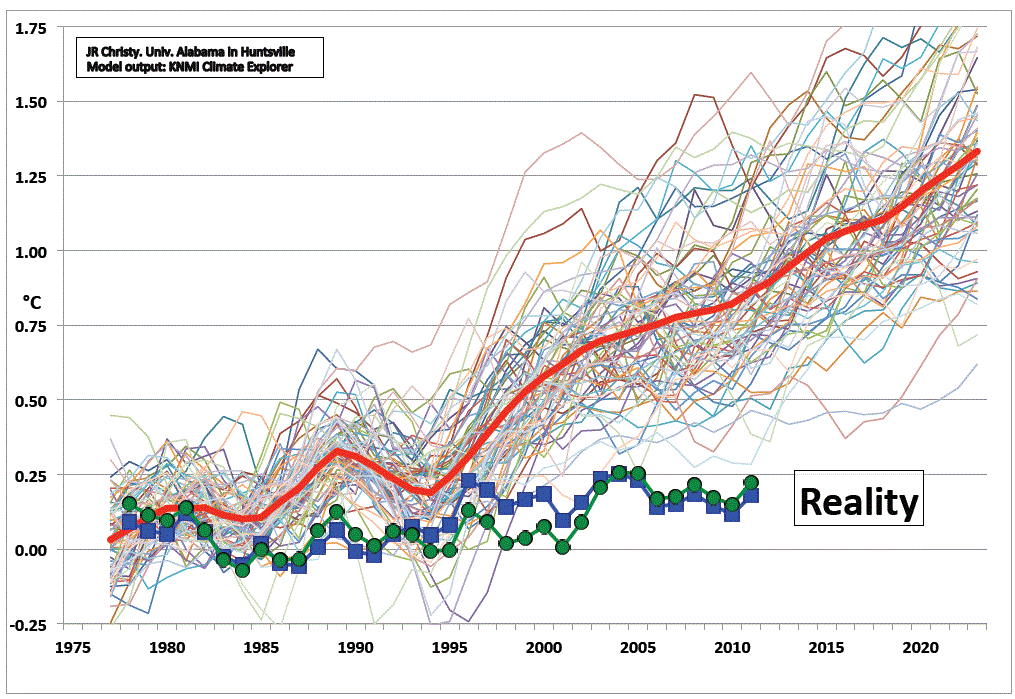
The reality of global temperatures is increasingly diverging from increasingly discredited climate models. In fact the reality of global temperature measurements since about 1978 would not provide any convincing evidence that any concern regarding “global warming” was justified.

Climate Models versus Reality

Not only are temperatures not increasing as the models  – and their religious adherents – would like but atmospheric concentrations of carbon dioxide have continued to increase unabated.

Global temparature and carbon dioxide – last 17 years

The two simple truths lead to two simple – but inescapable – conclusions

  1. There is no evidence that “global warming” is an irreversible phenomenon. There is no evidence either that global warming or global cooling are anything other than “natural” variations of climate.
  2. Carbon dioxide concentration in the atmosphere is not strongly indicated – if at all – as anything but a very small component of the very many which affect global temperature. The man made contribution to global carbon dioxide emissions itself  is about 5% of all carbon dioxide emissions.

Hurricanes hardly (h)ever happen!

September 11, 2013

Irresistable.

Lack of hurricanes helps climate change skeptics

Hurricanes have been largely absent this year.

For the first time in 11 years, August came and went without a single hurricane forming in the Atlantic. The last intense hurricane (Category 3 or above) to hit the United States was Hurricane Wilma, in 2005. According to Phil Klotzbach, head of Colorado State University’s seasonal hurricane forecast, accumulated cyclone energy is 70 percent below normal this year.

Hurricanes have become a major part of the public relations campaign for radical action on climate change. After Hurricane Sandy hit the Eastern Seaboard last fall, the left quickly dubbed it a “Frankenstorm,” and nearly fell over itself attempting to claim that the intensity of the storm was a result of greenhouse gas emissions.

That’s not so surprising. Despite decades of effort, the environmental movement has largely failed to persuade the American public to accept the draconian restrictions that stopping climate change would entail, and linking hurricanes to climate change may be their best chance to change all that.

A look at the science, however, tells a somewhat different story. While the overall number of recorded hurricanes has increased since 1878 (when existing records begin), this is at least partly due to an improved ability to observe storms rather than an increase in the number of storms.

…… Similarly, the increase in damages from storms over time has less to do with their increased frequency or intensity than with the fact that we have gotten richer. Had Hurricane Sandy swept through New Jersey 100 years ago, it would have done far less damage simply because, back then, there was less of value to destroy. These days Americans are not only wealthier, but we are more inclined to build closer to the water, due to subsidized flood insurance. When University of Colorado professor Roger Pielke looked at the numbers, he found that correcting for these factors completely eliminated the supposed increase in hurricane damage.

Unsurprisingly, then, a leaked draft of the Fifth Assessment Report of the United Nations’ Intergovernmental Panel on Climate Change (due to be released later this month) downgraded the likelihood of a connection between past temperature rises and extreme weather events. According to the report, there is “low confidence” in any association between climate change and hurricane frequency or intensity. …….

Read the article

Arctic Ice is increasing, Antarctic ice is high and breaking records, warming is missing while Carbon dioxide is still increasing —

It must be difficult for a rational being to believe in the global warming hypothesis — it requires an abundance of faith and a minimum of critical thinking!!

David Attenborough is my hero but humans are not “a plague on earth”

September 10, 2013

David Attenborough is reported in the Guardian as being rather pessimistic about the future of humans.

Sir David Attenborough warns things will only get worse

People should be persuaded against having large families, says the broadcaster and naturalist

Much of what he is reported to have said is perfectly sound but many of the conclusions then present a pessimistic and apocryphal – a very Guardianesque – view. In fact I suspect that the spin is entirely due to the Guardian’s reporter and the Guardian’s remarkable ability to see a looming catastrophe in every advance.

That with falling fertility rates, world population will continue to rise at a decreasing rate and stabilise by 2100 is just a matter of arithmetic. But a 100 years from now we will face the challenges of a slowly declining population. That natural selection is “defeated” when even weak individuals are cared for and are not allowed to die is not something to regret. We are in the process of artificial selection over-riding natural selection and at a quite different pace, but it is just another challenge for humans – not something to wring our hands over. In fact we are already practicing a sort of eugenics by default.

Sir David Attenborough has said that he is not optimistic about the future and that people should be persuaded against having large families.

The broadcaster and naturalist, who earlier this year described humans as a plague on Earth”, also said he believed humans have stopped evolving physically and genetically because of birth control and abortion, but that cultural evolution is proceeding “with extraordinary swiftness”.

“We stopped natural selection as soon as we started being able to rear 90-95% of our babies that are born. We are the only species to have put a halt to natural selection, of its own free will, as it were,” he tells this week’s Radio Times.

“Stopping natural selection is not as important, or depressing, as it might sound – because our evolution is now cultural … We can inherit a knowledge of computers or television, electronics, aeroplanes and so on.”

Attenborough said he was not optimistic about the future and “things are going to get worse”.

“I don’t think we are going to become extinct. We’re very clever and extremely resourceful – and we will find ways of preserving ourselves, of that I’m sure. But whether our lives will be as rich as they are now is another question.

“We may reduce in numbers; that would actually be a help, though the chances of it happening within the next century is very small. I should think it’s impossible, in fact.”

… he also appeared to express qualified support for the one-child policy in China.

He said: “It’s the degree to which it has been enforced which is terrible, and there’s no question it’s produced all kinds of personal tragedies. There’s no question about that. On the other hand, the Chinese themselves recognise that had they not done so there would be several million more mouths in the world today than there are now.”

He added: “If you were able to persuade people that it is irresponsible to have large families in this day and age, and if material wealth and material conditions are such that people value their materialistic life and don’t suffer as a consequence, then that’s all to the good. But I’m not particularly optimistic about the future. I think we’re lucky to be living when we are, because things are going to get worse.”

“Worse” is a matter of judgement.

We will feed and house more people than ever before. We will take care of more of the elderly than ever before. We will each have more and affordable energy available to us than ever before. We will educate and empower more people than ever before. More of us will see more of this world than ever before. We will face more challenges than ever before.  That’s not “worse”.

Is the “bee crisis” yet another alarmist fiction?

September 9, 2013

I don’t really know a great deal about bees. I have been stung by bees twice in my life. I was not threatening them in any way and both paid the price of their insolence and died. Every year we have ” a lot” of bees in our garden where ” a lot” is my subjective assessment of the number of times I have to swat them away or have to move while dozing in the sun. I have not noticed any great difference – this summer – in the number of bees that I have “interacted” with. I am well aware that they play a very important  (but not indispensable) role in pollination and I do like honey even if I have to watch my sugar intake.

In the last year or so I have been bombarded with articles greatly alarmed about the catastrophic decline of honey bees and strident calls  – especially in the over-bureaucratic EU – for the banning of various pesticides (neonicotinoids) which are decimating the bee population.  A new “syndrome” has been invented – Colony Collapse Disorder (CCD). The UK has not gone along with the ban so far.

“The two-year European Union ban on neonicotinoids was justified as a way to tackle CCD. It is perhaps worth pointing out that France banned the neonicotinoids in the 1990s, and it has seen no marked reduction in CCD.”

But it could all be just another case of what may well be a perfectly “natural” variation being blown up by alarmist environmentalists. I am coming to the view that every time an “environmentalist” invents a new catastrophe it is just to inflate the importance of his own advocacy.

Bjorn Lomborg writes:

There is no bee crisis

Contrary to what you may have heard, there is no “bee-pocalypse.” There is lots of alarmist talk about colony collapse disorder, people are blaming pesticides and talking about hundreds of billions of dollars at risk. But a closer look tells a very different story.

Yes, honeybees are dying in above-average numbers, but the most likely cause is the varroa mite and associated viruses.

Moreover, if you look at the actual numbers, they undermine much of the catastrophic rhetoric. In the United States, where we have good data, beekeepers have adapted to CCD. Colony numbers were higher in 2010 than any year since 1999. The beekeepers are not passive victims.

Instead, they have actively rebuilt their colonies in response to increased mortality from CCD. Although average winter mortality rates have increased from around 15 per cent before 2006 to more than 30 per cent, beekeepers have been able to adapt to these changes at fairly low cost and to maintain colony numbers.

Honeybee deaths are also nothing new. The Breakthrough Institute reports that, in 1853, Lorenzo Langstroth, the 19th-century bee-keeper who invented the modern hive, described colonies that were “found, on being examined one morning, to be utterly deserted. The comb was empty, and the only symptom of life was the poor queen herself.” In 1891 and 1896, large clusters of bees vanished in a case known as May Disease.

In the 1960s, bees vanished mysteriously in Texas, Louisiana and California. In 1975, a similar epidemic cropped up in Australia, Mexico and 27 U.S. states. There were heavy losses in France from 1998 to 2000 and also in California in 2005, just two years before CCD was first diagnosed. ….

…… Many have pointed toward pesticides as the main reason of colony collapse disorder. The two-year European Union ban on neonicotinoids was justified as a way to tackle CCD. It is perhaps worth pointing out that France banned the neonicotinoids in the 1990s, and it has seen no marked reduction in CCD.

Recent science articles instead point clearly to mites and viruses: “Varroa mites and viruses are the currently the high-profile suspects in collapsing bee colonies.”

Overall, the CCD is a problem we need to tackle, but it is not by any stretch of the imagination as bad as it is made out. …. 

CCD – it seems – may be an over-exaggerated and alarmist figment of an over-fertile “green” imagination.

Arctic sea ice reaches minimum for 2013 – about a week early

September 6, 2013

A late spring and a short summer has led to Arctic ice melting much slower than for many years: IS ARCTIC SEA ICE REBOUNDING? 

It would seem that the minimum ice extent in the Arctic which usually happens around the middle of September has already been reached – about a week early.

From DMI – Centre for Ocean and Ice (coastal zones masked)

Arctic Sea Ice Extent 2013 minimum

Arctic Sea Ice Extent 2013 minimum

A real rebound in the ice extent and almost back to the level of 2005.

And of course the Antarctic which is reaching its maximum ice extent seems to be at a level significantly higher than the average for 1981 -2010. (NSIDC, Boulder).

Antarctic sea ice extent 20130904

Antarctic sea ice extent 20130904

These levels of ice extent correspond to the lack of significant increase in sea levels.

There does not seem to be very much to be alarmed about.


Christianity should do more for biodiversity!

September 5, 2013

I kid you not.

A new paper at Oryx – The International Journal of Conservation by Swedish and Australian researchers.

 ” … the Roman Catholic and Orthodox Churches appear to have the greatest per capita opportunity to influence discourse on biodiversity… “

Does this count as science? or advocacy? or is it theological economics?

What were they thinking?

Grzegorz Mikusiński, Hugh P. Possingham and Malgorzata Blicharska, Biodiversity priority areas and religions—a global analysis of spatial overlapOryx, available on CJO2013. doi:10.1017/S0030605312000993. 

Abstract:Numerous solutions have been proposed to slow the accelerating loss of biodiversity. Thinking about biodiversity conservation has not, however, been incorporated into the everyday activities of most individuals and nations. Conservation scientists need to refocus on strategies that reshape ethical attitudes to nature and encourage pro-environmental thinking and lifestyles. Religions are central to basic beliefs and ethics that influence people’s behaviour and should be considered more seriously in biodiversity discourse. Using data from the World Religion Database we conducted an analysis of the spatial overlap between major global religions and seven templates for prioritizing biodiversity action. Our analysis indicated that the majority of these focal areas are situated in countries dominated by Christianity, and particularly the Roman Catholic denomination. Moreover, the Roman Catholic and Orthodox Churches appear to have the greatest per capita opportunity to influence discourse on biodiversity, notwithstanding the role of other religious communities in some key biodiversity areas.

From EurekAlert:

A new study carried out by ecologists at the Swedish University of Agricultural Sciences, among others, indicates that if the world’s religious leaders wished to bring about a change, they would be ideally positioned to do so

Leaders of the major world religions can play a key role in preserving biological diversity. A new study carried out by ecologists at the Swedish University of Agricultural Sciences (SLU), among others, indicates that if the world’s religious leaders wished to bring about a change, they would be ideally positioned to do so. …. 

…. Religions strive to be morally good and for centuries have led people in terms of right and wrong. Therefore, says Grzegorz Mikusinski, they have the potential to guide them to “miracles” also when it comes to conservation in the places where the religion has a great influence on society.

– The results show that Roman Catholics, per capita, have the greatest potential to preserve biological diversity where they live, says Hugh Possingham, a researcher at University of Queensland, Australia, and a co-author of the study.

The Catholic Church has just elected a pope, Francis – a name associated with the Catholic Church’s “greenest” saint, Francis of Assisi, the special patron saint of ecology. Let us hope that he and other religious leaders seriously consider the possibility of becoming more involved in the conservation debate. But at the same time scientists need to more actively encourage religious leaders to take part in such a debate.

Many solutions have been proposed to halt the loss of biological diversity. But the notion of conservation has seldom become part of daily life, either among individuals or among nations.

– Conservation research needs to adjust its focus, toward strategies that can change people’s ethical attitudes toward nature and encourage modes of thinking and lifestyles that are good for the environment, says Malgorzata Blicharska, a researcher at SLU and a co-author of the study. Religions are central to fundamental beliefs and ethics that influence people, and they should be taken more seriously in the debate about biological diversity.

Or these religious leaders could just lead the prayers!