Archive for the ‘Astronomy’ Category

New pictures show the return of Jupiter’s lost stripe

November 26, 2010

In May this year one of Jupiter’s characteristic stripes (the South Equatorial Belt) disappeared. Then  two weeks ago a turbulent plume was observed breaking through the giant planet’s cloudtops in the south equatorial zone heralding the possible re-emergence of the stripe.

Now the latest infrared pictures of Jupiter show the turbulent plume developing into a “trail” suggesting that the SEB is re-emerging from under the ammonia clouds. The BBC reports:

Jupiter's returning stripe highlighted (JPL, University of Oxford, UC Berkeley, Gemini Observatory, University of San Carlos)

Jupiter's returning stripe highlighted (JPL, University of Oxford, UC Berkeley, Gemini Observatory, University of San Carlos)

The South Equatorial Belt had blended into surrounding white clouds but an “outbreak” spotted by an amateur astronomer heralds the stripe’s return. The stripe’s disappearing act is due to clouds shifting altitudes, with white ammonia clouds obscuring clouds below. This performance will give astronomers their first chance to study the weather and chemistry behind the phenomenon.

As part of the show, the Great Red Spot has darkened, but astronomers say it will lighten again as the South Equatorial Belt comes back. The stripe has come and gone several times in recent decades but the mechanism by which it returns remains mysterious. The first signs of the return were spotted by Christopher Go of the Philippines and was confirmed by the Infrared Telescope Facility and Gemini and Keck telescopes in Hawaii.

“At infrared wavelengths, images in reflected sunlight show that the spot is a tremendously energetic ‘outburst,’ a vigorous storm that reaches extreme high altitudes,” said Imke de Pater, professor of astronomy at the University of California, Berkeley. “The storms are surrounded by darker areas, bluish-grey in the visible, indicative of ‘clearings’ in the cloud deck.”

Jupiter’s lost stripe may be returning

November 16, 2010

In May this year, one of Jupiter’s characteristic stripes – the South Equatorial Belt (SEB) disappeared.

http://science.nasa.gov/science-news/science-at-nasa/2010/20may_loststripe/

May 20, 2010: In a development that has transformed the appearance of the solar system’s largest planet, one of Jupiter’s two main cloud belts has completely disappeared. Known as the South Equatorial Belt (SEB), the brown cloudy band is twice as wide as Earth and more than twenty times as long. The loss of such an enormous “stripe” can be seen with ease halfway across the solar system.

These side by side images of Jupiter taken by Australian astrophotographer Anthony Wesley show the SEB in August 2009, but not in May 2010.Individual images: Aug. 4, 2009; May 8, 2010.

Anthony Wesley is a veteran observer of Jupiter, famous for his discovery of a comet hitting the planet in 2009. Like many other astronomers, he noticed the belt fading late last year, “but I certainly didn’t expect to see it completely disappear,” he says. “Jupiter continues to surprise.” Planetary scientist Glenn Orton of NASA’s Jet Propulsion Lab thinks the belt is not actually gone, but may be just hiding underneath some higher clouds.

“It’s possible,” he hypothesizes, “that some ‘ammonia cirrus’ has formed on top of the SEB, hiding the SEB from view.” On Earth, white wispy cirrus clouds are made of ice crystals. On Jupiter, the same sort of clouds can form, but the crystals are made of ammonia (NH3) instead of water (H2O).

But now the SEB may be breaking through again.

http://www.spaceweather.com/

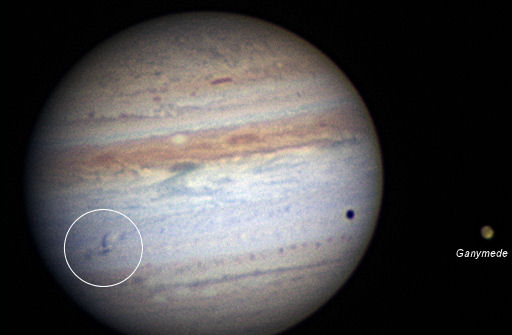
Tuesday, Nov. 16, 2010: A turbulent plume is breaking through the giant planet’s cloudtops in the south equatorial zone, heralding the emergence of … what? This Nov. 14th photo from astrophotographer Paul Haese of Glenalta, South Australia shows the plume.

The SEB revival is now underway. Tonight I captured the revival transiting the face of Jupiter. To boot I was lucky enough to include Ganymede with detail and Europa's shadow after a double transit. What a night. Taken with peltier cooled C14 and Skynyx 2-0: Paul Haese

The plume, circled in Haese’s photo and known to astronomers as the “SEB Revival Spot,” is a sign that Jupiter’s South Equatorial Belt (SEB) is about to return. The great brown belt disappeared earlier this year, leaving Jupiter without one of its signature stripes. No one knows where the SEB went, although some researchers have speculated that it sank beneath high altitude clouds and might now be bobbing back to the top.

Christopher Go of the Philippines first noticed the Revival Spot on Nov. 9th. At first it was small and white and required careful astrophotography to detect. Only five days later, it is expanding rapidly and darkening; soon, it could become visible to novices in the eyepieces of backyard telescopes.

Hayabusa particles are extra-terrestrial

November 16, 2010

The particles found in Hayabusa have now been confirmed to be extra-terrestrial from the asteroid 25143 Itokawa.

Nikkei News reports:

Capsule from the Hayabusa probe contained particles from the Itokawa asteroid (Kyodo)

The Japan Aerospace Exploration Agency said Tuesday it has confirmed that the particles retrieved from the Hayabusa unmanned space probe after its seven-year space trip are from the asteroid Itokawa.

JAXA says the roughly 1,500 particles it analyzed using electron microscopes are totally different from substances found on Earth. The particles measure only about 10 micrometers in diameter.

The Hayabusa probe is the first exploratory spacecraft to land on a celestial body other than the Moon and then return to Earth.

Son of Hubble may not launch till after 2015

November 11, 2010

Earlier this year it became clear the the son of Hubble the James Webb Space Telescope, was late and over budget. Costs had ballooned to 5 billion dollars (from the earlier 3.5 billion dollars) and launch was expected in 2014. It has now been acknowledged that costs will be not less than 6.5 billion dollars and launch even in 2015 is optimistic. The management is now being changed and reorganised.

The BBC has the story:

The scale of the delay and cost overrun blighting Nasa’s James Webb Space Telescope has been laid bare by a panel called in to review the project. The successor to Hubble will probably cost at least $6.5bn to launch and operate, and may get into orbit by September 2015.

But even that assessment is optimistic, say the panel members. The head of the US space agency has accepted that “cost performance and coordination have been lacking”. Charles Bolden has ordered a reorganising of the project and has changed the management at its top. Estimates for JWST’s total cost to build, launch and operate have steadily increased over the years from $3.5bn to $5bn. Along with the cost growth, the schedule has also eroded.

The most recent projected launch of 2014 has looked under pressure for some time. The independent panel chaired by John Casani of Nasa’s Jet Propulsion Laboratory (JPL) in Pasadena, California, believes it to be unrealistic. The group was convened to examine the root causes of JWST’s problems. It found the original budget for the project to be insufficient and poorly phased, and blamed the management for failing to pick up and deal with the issue.

“This is a very large complex project and to estimate something with any real degree of precision that’s never been done before is a tough job,” John Casani told reporters. “But the bottom line is that there was never enough money in the budget to execute the work that was required. The panel did however commend the technical success of the project. Mr Casani said the technology on JWST was in “very good shape”. The telescope was always regarded as major undertaking. Its primary mirror is 6.5m (21ft) across – close to three times wider than Hubble’s. The huge reflector will sit behind an even more expansive sun shield, the area of a tennis court. This structure will protect the observatory from radiation from the Sun and the Earth. Whereas Hubble sees the Universe mostly in visible light, JWST will observe the cosmos at longer wavelengths, in the infrared. It will see deeper into space and further back in time, to the very first population of stars.

When it is finally built, it will be launched on Europe’s Ariane 5 rocket and sent to an observing position 1.5 million km from Earth. It is expected to have a 10-year lifespan. Its distance from Earth means the telescope cannot be serviced by astronauts, as was the case with Hubble.

Herschel (BBC)

Twin planets around binary star system

October 29, 2010

From Space.com http://www.space.com/scienceastronomy/alien-planets-orbit-binary-star-system-101026.html

Rendering of NN Serpentis system: image Wikipedia Tyrogthekreeper


Two massive Jupiter-like planets were recently discovered orbiting around two extremely close sister stars – an unexpected find, given the disturbing gravitational effects within most binary star systems that usually disrupt planets from forming.

The alien planets were found to orbit around the binary star system NN Serpentis, which is located about 1,670 light-years from Earth.

The more massive of the two stars is a very small white dwarf – the burnt-out remnant that is left over when a sun-like star dies. The star is 2.3 times the diameter of Earth, but has a temperature of more than 89,500 degrees Fahrenheit (49,700 degrees Celsius) – almost nine times hotter than the surface of the sun. The other star in the pair is a larger but cooler star, with a mass only one-tenth that of the sun. The two stars are joined in a very tight mutual orbit.

The astronomers caught a lucky break in observing this binary star system because it happens to lie in the same plane as Earth, creating an eclipse every 3 hours and 7 minutes when the larger star moves in front of the smaller one.

The resulting change in the brightness of the system acts like a highly precise clock. By monitoring the eclipses, the team of astronomers was able to detect small changes in the timing caused by the gravitational pull of two planets orbiting the stellar pair and tugging them out of whack, altering the eclipse schedule.

The larger planet in the system is about 5.9 times more massive than Jupiter. It orbits the binary stars every 15.5 Earth years at a staggering distance of roughly 558 million miles. Closer in, the second planet orbits every the binary pair every 7.75 Earth years, and is about 1.6 times more massive than Jupiter.

…. (read the full article)

In a separate discovery, a Jupiter-sized alien planet was recently found orbiting the star HR 7162, which is a binary star system located 49 light-years away, in the constellation Lyra. These recent findings are forcing astronomers to rethink their theories about how gas giant planets form.


Lunar activity: Chang’e-2 starts mission and Nasa revives 2 satellites

October 29, 2010

Xinhua reports

Scientists successfully activated four attitude control engines on Chang’e-2 and sent the satellite into the orbit with a perilune of just 15 kilometer above the moon, according to a flight control official in Beijing. It will photograph the Bay of Rainbows region with its CCD cameras from Wednesday, according to the center.

NASA has revived 2 satellites that were dying and sent them to the moon creating the ARTEMIS mission:

A pair of NASA spacecraft that were supposed to be dead a year ago are instead flying to the Moon for a breakthrough mission in lunar orbit. “Their real names are THEMIS P1 and P2, but I call them ‘dead spacecraft walking,'” says Vassilis Angelopoulos of UCLA, principal investigator of the THEMIS mission. “Not so long ago, we thought they were goners. Now they are beginning a whole new adventure.”

The story begins in 2007 when NASA launched a fleet of five spacecraft into Earth’s magnetosphere to study the physics of geomagnetic storms. Collectively, they were called THEMIS, short for “Time History of Events and Macroscale Interactions during Substorms.” P1 and P2 were the outermost members of the quintet. Working together, the probes quickly discovered a cornucopia of previously unknown phenomena such as colliding aurorasmagnetic spacequakes, and plasma bullets shooting up and down Earth’s magnetic tail. These findings allowed researchers to solve several longstanding mysteries of the Northern Lights.

The mission was going splendidly, except for one thing: Occasionally, P1 and P2 would pass through the shadow of Earth. The solar powered spacecraft were designed to go without sunlight for as much as three hours at a time, so a small amount of shadowing was no problem. But as the mission wore on, their orbits evolved and by 2009 the pair was spending as much as 8 hours a day in the dark. “The two spacecraft were running out of power and freezing to death,” says Angelopoulos. “We had to do something to save them.”

Because the mission had gone so well, the spacecraft still had an ample supply of fuel–enough to go to the Moon. “We could do some great science from lunar orbit,” he says. NASA approved the trip and in late 2009, P1 and P2 headed away from the shadows of Earth.

With a new destination, the mission needed a new name. The team selected ARTEMIS, the Greek goddess of the Moon. It also stands for “Acceleration, Reconnection, Turbulence and Electrodynamics of the Moon’s Interaction with the Sun.”

The first big events of the ARTEMIS mission are underway now. On August 25, 2010, ARTEMIS-P1 reached the L2 Lagrange point on the far side of the Moon. Following close behind, ARTEMIS-P2 entered the opposite L1 Lagrange point on Oct. 22nd. Lagrange points are places where the gravity of Earth and Moon balance, creating a sort of gravitational parking spot for spacecraft.


Artemis (Lagrange Points, 550px)

The ARTEMIS spacecraft are currently located at the L1 and L2 Earth-Moon Lagrange points: NASA


http://science.nasa.gov/science-news/science-at-nasa/2010/27oct_artemis/


Black holes, white holes, sinks and sources

October 20, 2010

There is hope for mankind when the Universe can be modelled in your kitchen!

From New Scientist

A black hole is a dense concentration of mass surrounded by an extremely powerful gravitational field. Nothing that falls within a certain radius surrounding it, known as the event horizon, escapes. A white hole is the opposite: its event horizon allows things to escape but prevents anything from entering. However, so far white holes only exist in theory, so cannot be studied observationally.

Horizon effects with surface waves on moving water is a  new paper by Germain Rousseaux1, Philippe Maïssa1, Christian Mathis1, Pierre Coullet1, Thomas G Philbin2 and Ulf Leonhardt2 (Affiliations 1 Université de Nice-Sophia Antipolis, France, 2 School of Physics and Astronomy, University of St Andrews, UK ), 2010 New J. Phys. 12 095018

doi: 10.1088/1367-2630/12/9/095018

From Wired Science:

The ring-like ridge formed when a stream of fluid hits a flat surface behaves like a white hole event horizon (Image: Germain Rousseaux/U. Nice-Sophia Antipolis)

The ring-like ridge formed when a stream of fluid hits a flat surface behaves like a white hole event horizon (Image: Germain Rousseaux/U. Nice-Sophia Antipolis)

When a stream of tap water hits the flat surface of the sink, it spreads out into a thin disc bounded by a raised lip, called the hydraulic jump. Physicists’ puzzlement with this jump dates back to Lord Rayleigh in 1914. More recently, physicists have suggested that, if the water waves inside the disc move faster than the waves outside, the jump could serve as an analogue event horizon. Water can approach the ring from outside, but it can’t get in.

“The jump would therefore constitute a one-directional membrane or white hole,” wrote physicist Gil Jannes and Germain Rousseaux of the University of Nice Sophia Antipolis in France and colleagues in a study on ArXiv Oct. 8. “Surface waves outside the jump cannot penetrate in the inner region; they are trapped outside in precisely the same sense as light is trapped inside a black hole.”

The analogy is not just surface-deep. The math describing both situations is exactly equivalent. But so far, no one had been able to prove experimentally that what’s going on in the kitchen sink really represents a white hole.

plumber in the sky

plumber in the sky

If fluid mechanics provides the correct analogy for physics, then a black hole can be considered a “sink” and a white hole is then a “source”. In fluid mechanics flow is always out of a source and into a sink. So black holes in the universe provide the way out of the universe for matter into some great Cosmic Drain exhausting into some other universe. Then white holes must be the taps from which matter flows into our universe from the Great Unknown.

The only time that a backflow of fluids occurs through a sink is when the drains are backed up or a reverse pressure surge drives fluid back through the sink-hole.

Which begs the question: “What happens in a black hole when the Cosmic Drain gets clogged?”.

Which in turn leads to the answer “Just call the Great Plumber in the sky”!


Habitable exoplanet Gleise 581g may not exist

October 13, 2010


Artist's impression of the planetary system ar...

Gleise 581 system: Image via Wikipedia


An earlier post reported on the finding of a potentially habitable exoplanet.

But the planet may not exist:

Yesterday at an exoplanet meeting in Turin, Italy, Switzerland-based astronomers announced that they could find no trace of the prized planet in their observations of the same planetary system.

All the excitement has been over the subtlest of wiggles in the motion of the star Gliese 581 that lies just 20 light-years from the sun in the direction of the constellation Libra. A consortium of institutions led by the Observatory of Geneva in Switzerland had already discovered four planets circling Gliese 581 by sorting out the subtle motions of the star that are induced by the gravitational tugs of any orbiting planets.

On 29 September, a U.S.-based team led by astronomer Steven Vogt of the University of California, Santa Cruz, announced that it had discovered a fifth planet. The American team used a combined set of observations: One 11-year-long set consisted of 122 measurements made by the team, while the other set was 4.3 years long and consisted of 119 measurements published by the consortium.

Designated Gliese 581g, the new planet has at least three times the mass of Earth—large enough to hold on to a watery atmosphere—and orbits at a distance from its star that would allow any water to remain liquid. That would make 581g a happy home for life as we know it.

But at this week’s Astrophysics of Planetary Systems meeting, astronomer Francesco Pepe of the Geneva Observatory and the Swiss group reported that he and his colleagues could find no reliable sign of a fifth planet in Gliese 581’s habitable zone. They used only their own observations, but they expanded their published data set from what the U.S. group included in its analysis to a length of 6.5 years and 180 measurements. “We do not see any evidence for a fifth planet … as announced by Vogt et al.,” Pepe wrote Science in an e-mail from the meeting. On the other hand, “we can’t prove there is no fifth planet.” No one yet has the required precision in their observations to prove the absence of such a small exoplanet, he notes.

Hayabusa particles could be extraterrestrial

October 10, 2010

I posted earlier on the return of the ion engine powered Hayabusa.

Hayabusa started its journey in 2003 and met up with the asteroid Itokawa in 2005. The plan was to fire small metal projectiles at the asteroid to generate small pea size samples of the asteroid. This plan failed when the projectile firing device failed to function. After a long journey the spacecraft returned to Earth in June this year.

The sample capsule released by the Hayabusa asteroid probe. (Mainichi)

The sample capsule released by the Hayabusa asteroid probe. (Mainichi)


Though the inner capsule had no mm sized particles as hoped, some dust was found in the sealed container. Until recently, many of the fine particles found in the capsule had been believed to be aluminum powder or dust that had slipped into the capsule on Earth during manufacturing or Hayabusa’s launch reports the Mainichi Daily News.

However, the research team collected some 100 particles that are smaller than 0.001 millimeters in size from the inner cylinder of the capsule, called the “sample catcher,” and concluded some of them may be cosmic materials. The particles, which are invisible to the human eye, were collected by remote control using a special Teflon spatula — about 6 millimeters long and 3 millimeters wide — and examined with an electron microscope. Japan Aerospace Exploration Agency (JAXA) plans to further analyze the samples by splitting each particle and examining their crystal structure at Spring 8, a large-scale synchrotron radiation facility in Hyogo Prefecture, starting next month to determine where they are from. The procedure may also provide new information on the birth of the solar system.

“We cannot yet tell (whether the particles are from Itokawa) from their external features, but we have found many particles and there is a chance (that they are extraterrestrial),” said Munetaka Ueno, a researcher at JAXA’s Institute of Space and Astronautical Science.

Today Mainichi reports that:

Rocky particles (circled) are seen on the tip of a spatula used to scrape materials off of the sample capsule. (Photo courtesy of JAXA).

Rocky particles (circled) are seen on the tip of a spatula used to scrape materials off of the sample capsule. (Photo courtesy of JAXA).

The particles in a sample capsule released by the Hayabusa asteroid probe on its return to Earth were largely rocky materials, researchers have announced. At a lecture of the Japanese Society for Planetary Sciences in Nagoya on Oct. 8, a team of researchers released electron micrographs of the particles that were retrieved from the capsule, reporting that most of them were rocky.

According to the research team, including experts from the Japan Aerospace Exploration Agency (JAXA), they have detected at least 100 particles from the capsule, with most of them measuring less than 0.001 millimeters in size.

Since the rocky particles are diverse in composition, researchers will further inspect them at SPring-8, a large synchrotron radiation facility in Sayo, Hyogo Prefecture, to determine if they are terrestrial or from the asteroid Itokawa.

The Sun moves to its own music

October 6, 2010

Totally impervious to vulgar 10:10 videos, biodiversity 10.10 campaigns, 0% interest rates and other goings-on on Earth, the Sun moves to its own music.

It was spotless again.

Spotless Sun 5th October 2010: NASA image

Sunspot numbers and 10.7 flux continue to be significantly lower than forecast (and the forecast for Cycle 24 were pretty low to begin with).

2010/10/05 08:00 Today was spotless although Locarno managed to see two groups. The specks were tiny and would be on the fringe of visibility on the original Wolf 64x telescope on a perfect day. What could be old area 1106 may be returning in the next two days.

Yesterday’s adjusted F10.7 flux figures recorded a high of 76.6 (81.4) and a low of 74.7 (78.8), unbelievably low.

F10.7 Radio Flux (including September 2010)

That we are in a solar minimum (the Landscheidt minimum) seems clear but whether it will be a grand minimum remains to be seen.

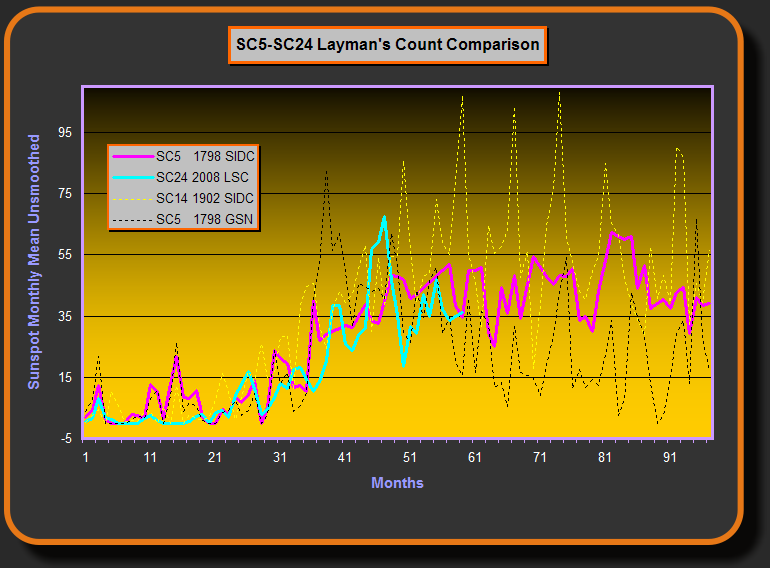
sc5 sc24 comparison

sc5,sc14 comparison with sc24

And the sun will surely impact our climate — but how?

And in any case the sun gets no feedback and it does not much care.