Archive for the ‘Aviation’ Category

Another theory: MH370 nosedived into the ocean with no resulting debris

June 10, 2015

Another theory about the MH370 disappearance. Mathematics shows that if the pilot nosedived vertically into the ocean, it might explain why no debris has been found.

“The true final moments of MH370 are likely to remain a mystery until someday when its black box is finally recovered and decoded. But forensics strongly supports that MH370 plunged into the ocean in a nosedive.”

Goong Chen, Texas A&M mathematician

Texas A&M University at Qatar mathematician Goong Chen has theorized the ill-fated plane plunged vertically into the southern Indian Ocean in March 2014.

The researchers’ computer simulations lead to the forensic assertion that a 90-degree nosedive explains the lack of debris or spilled oil in the water near where the plane is presumed to have crashed. The research was the cover story in the April 2015 issue of Notices of the American Mathematical Society (see the team’s paper here.)

Chen is an applied mathematician teaching and researching at Texas A&M at Qatar who has been a faculty member in the Department of Mathematics at Texas A&M University’s main campus in College Station, Texas, USA since 1987. He led the interdisciplinary team of collaborators from Texas A&M, Penn State, Virginia Tech, MIT and the Qatar Environment and Energy Research Institute (QEERI) in simulating and modeling what might have happened to the plane. His research is supported by the QNRF National Priority Research Project Grant #5-674-1-114.

The researchers used applied mathematics and computational fluid dynamics to conduct numerical simulations on the RAAD Supercomputer at Texas A&M at Qatar of a Boeing 777 plunging into the ocean, a so-called “water entry” problem in applied mathematics and aerospace engineering. The team simulated five different scenarios, including a gliding water entry similar to the one Capt. Chesley B. “Sully” Sullenberger skillfully performed when US Airways flight 1549 landed in the middle of New York City’s Hudson River, a feat that’s referred to as “the miracle on the Hudson.”

Chen said based on all available evidence — especially the lack of floating debris or oil spills near the area of the presumed crash — the mostly likely theory is that the plane entered the water at a vertical or steep angle.

……. The fluid dynamics simulations indicate, for a vertical water entry of the plane, that there would be no large bending moment, which is what happens when an external force, or moment, is applied to a structural element (such as a plane), which then causes the fuselage to buckle and break up. As the vertical water-entry is the smoothest with only small bending moment in contrast with other angles of entry, the aircraft is less likely to experience “global failure,” or break-up on entry near the ocean surface, which would explain the lack of debris or oil near the presumed crash site.

Based also on the suggestions of other aviation experts, Chen said in such a situation the wings would have broken off almost immediately and, along with other heavy debris, would have sunk to the bottom of the ocean, leaving little or no trace to be spotted.
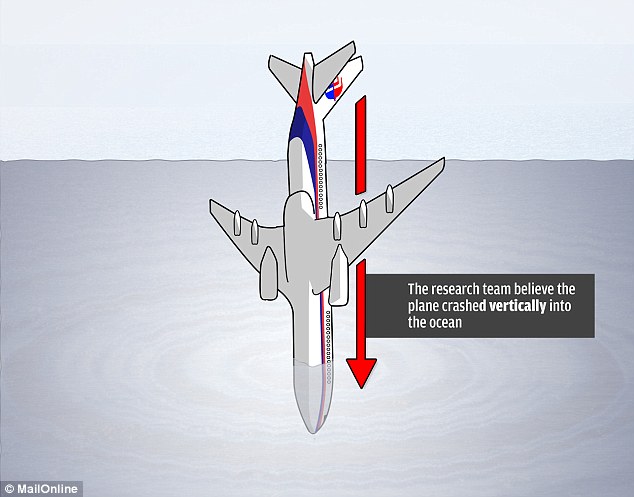
MH370 nose dive -- Daily Mail

MH370 nose dive — graphic by Daily Mail


German Wings 4U9525: Could Andreas Lubitz even be innocent?

March 31, 2015

I wrote a few days ago that though the guilt of Andreas Lubitz was being taken as proved beyond all reasonable doubt, I felt that even if it was so, the French prosecutor was rushing a little too fast to judgement. I wrote then:

Maybe there are no other alternatives and all the conclusions being reached are perfectly justified. Maybe the sounds of his breathing which are being used to state that he was fully conscious and breathing normally are absolutely conclusive. Maybe there was no possibility that he could have been incapacitated and still have that breathing pattern. Maybe his 5 month break from his training for what a friend has called “depression and burn-out” is conclusive proof – as the media seem to assume – that he was mentally disturbed.

Maybe.

I am far from any kind of expert on airplanes and on the black boxes and what they can and can’t reveal, but my discomfort with the rush to judgement is apparently shared by some who are experts:

Helsingborgs Dagblad:

The German co-pilot Andreas Lubitz has been painted as being solely responsible for the plane crash in the French Alps. But now some voices claim that it is too early to rule out technical problems.  “It is too early to judge anyone” says flight safety expert Hans Kjäll.

Investigations are continuing in the French Alps where 150 people died in plane crash a week ago. The German co-pilot Andreas Lubitz is suspected of deliberately crashing the plane and, among other things,  it has been revealed that he had been treated for suicidal tendencies and suffered from a psychosomatic illness.

Meanwhile, only one of the two so-called black boxes has been found, which means that it can not be completely ruled out that some technical fault on the plane may have been significant.

“Currently no hypothesis about a technical fault can be entirely ruled out”, admits one of the French prosecutors to EKOT. According to Hans Kjäll it is only when the second black box is found that the plane’s flight data can provide the answers as to exactly when the disaster occurred and what data was input by the co-pilot can be determined.

“It is argued that 100 feet was set as the minimum height, but then that would mean flying below the ground surface. But how do we know?” Another possible reason for the crash is that there was a lack of oxygen in the cabin and that was why Lubitz began a descent. “He could have suffered from a lack of oxygen and passed out” says Hans Kjäll.

That the first pilot was not allowed into the cockpit may then have a natural explanation and then Lubitz can not be held responsible for the crash. “The first pilot may actually have left the cockpit to get an extra oxygen mask or oxygen bottle and then found the door locked” says Kjäll.

He believes that the scenario of how the co-pilot has been convicted before the completion of the investigation is similar to that with the missing Malaysian plane MH370, where the captain was very early on blamed for the incident. But later reports then showed no evidence that the pilot did anything intentionally.

Kjäll believes that Swedish prosecutors would have been more cautious in their statements than the French after the air disaster in the Alps.

“They probably should not have gone out so early with details. The Accident Investigation Commission probably would not have said anything at all before finding the flight data recorder”, he says.

Maybe Andreas Lubitz is as guilty as everyone seems to believe. But he has not received his due process before he has been indicted and his guilt has been proclaimed as a settled fact. I understand that French prosecutors are not just investigators and prosecutors but also judges to some extent. Brice Robin, the French prosecutor (full transcript here) may be entirely right in his assessment of Lubitz’s guilt, but I still feel his press conference was not merely to allege guilt as a prosecutor but to pronounce guilt as a judge – and in that he went too fast, too far.

“Terrain, terrain!” and George assumes control

March 29, 2015

The German Wings 4U9525 tragedy is now leading to a discussion on whether and how depressive and suicidal tendencies of a pilot can be screened for, which in turn is leading to a discussion of what occupations should or could be forbidden to those having such tendencies. And what degree of disability is disabling for an occupation is the question that follows. Many military and  law enforcement bodies do have such bans. In some US states you can’t pass the bar exams if you have been diagnosed as depressive. (But you can continue to practice if you become depressive the day after you pass your bar exams). Should a person with suicidal tendencies be permitted to become a President or a Prime Minister or a Finance Minister? or a surgeon or a hedge fund manager for that matter?

Every human has some bouts of some level of depression. I am sure psychological profiling has become very sophisticated and can be very successful in general screening. I have even used such profiling – albeit very crudely – when screening applicants for a job. If one applied the precautionary principle – which is about the most unscientific mumbo-jumbo as can be found – very few would ever be deemed suitable for any sensitive occupation. I cannot see that psychological testing will ever eliminate all potential cases of determined, suicidal pilots. It will also give many false positives.

I suspect that the solution lies not in expecting psychological profiling to find the “needle in the haystack” but in ensuring that even if he appears he can do no harm. The regulation for always having two people in the cockpit goes down that road. It is said that for commercial flights today the pilots spend only about 5 minutes actually flying the plane themselves. And much of that time is spent in plugging in what George, the autopilot, is supposed to do. Most of their time is spent in monitoring and checking systems rather than actively flying. In theory, apart from taxiing before take-off and after landing, George could fly the entire flight. His side-kick Mary – if she was present – could do all the monitoring that pilots currently do. George would fly and Mary would – independently – provide the checks.

Coming from the power generation world I am familiar with all the “forbidden modes of operation” that are embedded within the control systems of gas and steam turbines to avoid zones of dangerous vibration or even of operating at “uneconomic” conditions. Once open a time – 100 years ago – measurements were physically monitored by operators. A very few mechanical – but automatic – governors were used, for example to restrict turbine overspeed (by restricting flow). Later – but before the electronic age – physical measurements were converted into electrical signals, displayed in control rooms and provided the operator with many, many alarms of potentially dangerous conditions. Some operating modes were automatically avoided by these measurement signals leading to the corrective operation of motorised valves. Now in the electronics age and with the speed of computing that is available, it is software in the control system – which the operator cannot override – which takes care of “enforcing” the avoidance of the most dangerous forbidden zones.

Pilotless drones are booming. Pilotless commercial planes are not yet in use not because of technical barriers but because of lack of acceptance by passengers and by society in general. Cargo planes are not pilotless yet, but only because of the concerns of air traffic control and airports and of those under the flight-path. But pilotless planes will surely come (even if pilots’ unions will not much care for this). No doubt pilotless planes will pose new challenges such as the avoidance of hacking or some unauthorised assumption of control. But these are all technical, technology, system and societal challenges rather than insurmountable barriers. No technology breakthroughs or invention of new materials are required for introducing the use of pilotless commercial aircraft.

But as a first step maybe George could enforce avoidance of some forbidden modes of flying even with a suicidal pilot at the controls. We may well see that the “Terrain, terrain!” warning will become obsolete. George (and Mary) would have taken over control of the aircraft long before the proximity warning alarms go off.


German Wings 4U9525: Why this rush to judgement?

March 26, 2015

Ever since the French prosecutor’s press conference this morning, there has been a rush to judgement and the guilt of Andreas Lubitz is taken as being proved beyond any doubt. It may well be so but the rush leaves me feeling a little uncomfortable. There has even been a competition in the media to use ever more sensational adjectives. “Mass murderer” and “killer” are common. But what the French prosecutor actually said is:

According to Marseille prosecutor Brice Robin, Lubitz acted “for a reason we cannot fathom right now but which looks like intent to destroy this aircraft. He voluntarily … allowed the loss of altitude of the plane, which he had no reason to do. He had … no reason to stop the pilot-in-command from coming back into the cockpit. He had no reason to refuse to answer to the air controller who was alerting him on the loss of altitude,” 

Maybe there are no other alternatives and all the conclusions being reached are perfectly justified. Maybe the sounds of his breathing which are being used to state that he was fully conscious and breathing normally are absolutely conclusive. Maybe there was no possibility that he could have been incapacitated and still have that breathing pattern. Maybe his 5 month break from his training for what a friend has called “depression and burn-out” is conclusive proof – as the media seem to assume – that he was mentally disturbed.

Maybe.

Now the assumption of his guilt itself will colour the consideration of any mechanical fault or any other possibility.

I would have preferred to have seen a more considered elimination of all other alternatives before this unseemly rush to judgement. Rushing to name him the killer and the mass-murderer will not help any of the victims. But it could lead to incomplete investigations of other relevant areas.

German Wings 4U9525: Was cockpit security just too secure?

March 26, 2015

UPDATE:

A French prosecutor has now said that the pilot in the cockpit disabled the code (usually 7 digits) which would have allowed the pilot outside to override the door lock and come in, and that the plane was crashed deliberately!


The New York Times and AFP are reporting that the cockpit recordings show:

  • Normal conversation between the pilots initially
  • sound of a chair being pushed back and one pilot leaving the cockpit (toilet visit perhaps?)
  • knocking and then pounding on the door as he tried to get back in
  • no response from the pilot left inside

And that suggests that maybe, and as a very unhappy coincidence, the pilot left inside fell ill or was otherwise incapacitated while his colleague was outside.

Which would suggest that security arrangements where the cockpit door can only be opened from the inside have not been entirely thought through. The security prevents anyone rescuing or taking over from a lone incapacitated pilot locked inside the cockpit.

NYTimes:

A senior military official involved in the investigation described “very smooth, very cool” conversation between the pilots during the early part of the flight from Barcelona, Spain, to Düsseldorf, Germany. Then the audio indicated that one of the pilots left the cockpit and could not re-enter.

“The guy outside is knocking lightly on the door, and there is no answer,” the investigator said. “And then he hits the door stronger, and no answer. There is never an answer.”

He said, “You can hear he is trying to smash the door down.” ……..

…….. The data from the voice recorder seems only to deepen the mystery surrounding the crash and provides no indication of the condition or activity of the pilot who remained in the cockpit. The descent from 38,000 feet over about 10 minutes was alarming but still gradual enough to indicate that the twin-engine Airbus A320 had not been damaged catastrophically. At no point during the descent was there any communication from the cockpit to air traffic controllers or any other signal of an emergency.

Solar Impulse 2 is more fossil than solar

March 18, 2015

The BBC reports that the much hyped, Swiss Solar Impulse 2 is crossing India on its way to Myanmar:

BBCThe solar-powered plane attempting to fly around the world is in the air again, crossing India and hoping to make it to Myanmar on Thursday. Solar Impulse, with Andre Borschberg at the controls, took off from Ahmedabad at 07:18 local time (01:48 GMT).

It is heading to Varanasi in India’s Uttar Pradesh region, where it will make a short “pit stop” before pushing on over the Bay of Bengal. The leg to Mandalay in Myanmar (Burma) will be flown by Bertrand Piccard. The two pilots are taking it in turns to guide Solar Impulse on its circumnavigation of the globe.

So far, they have covered about 2,000km in two segments since beginning the adventure in Abu Dhabi. It will likely be another five months before they return to the United Arab Emirates, having crossed both the Pacific and Atlantic oceans in the process.

It is surely a challenging piloting exercise but it is worth noting, as Pierre Gosselin points out, that some tens of thousands of litres of aviation fuel will be burned to keep Solar Impulse 2 in the air. For safety reasons the batteries on board will probably be fully charged at each take-off. It is not clear as to what extent the batteries will be topped up by using electrical power (which will be predominantly fossil fuel based) at each of the stops.

NoTricksZoneAccording to an audio report by SRF Swiss Radio and Television the Solar Impulse 2 mission involves the substitute pilot, a technical ground crew “of dozens of people” and tonnes of equipment and logistical supplies that have to be flown behind using conventional charter flights. The “fossil fuel-free” Solar Impulse 2 journey is in fact being made possible only with the use of tens of thousands of litres of aviation fuel. This is a fact that is being almost entirely ignored by the media.

The SRF reporter tells listeners:

“It is so that the entire group, the team members, are multiple dozens of men and women, have to fly behind in charter planes. This naturally is the less sustainable aspect of the entire project, but it just isn’t possible any other way. This involves one cargo plane for transporting all the equipment, and a small passenger plane on which the entire group travels to the destinations.”

A promotion video here shows how the aircraft was transported from Europe to its start point in Abu Dhabi earlier this year: With a Boeing 747!

Global map

source Solar Impulse via BBC

Five months, no cargo and no luggage beside the 2 pilots, a large support staff and a great deal of fossil energy somehow seems much less impressive than Jules Verne’s story (published in 1873) envisaging Phileas Fogg and Passepartout circumnavigating the world, with all their luggage and later an Indian princess, in just 80 days.

Green has become the colour of deception.


MH370: One year on and those who know still aren’t telling

March 8, 2015

Some few do know what happened to MH370 a year ago.

My post from April 13th last year speculating that this was a state sponsored and highly successful hijacking, is just as valid or invalid as it was then. There has been much speculation since but no new, certain, evidence has appeared. In fact even the “handshake” tracking which places the plane in the Southern Indian Ocean turns out to be fairly speculative in itself.

Whatever happened to MH370 was no accident. In one year there has been no evidence to alter my belief that this was the most successful hijacking and “disappearing” of a commercial airline and its 239 passengers and crew. And the objective – which was clearly achieved – was to prevent some passengers or cargo or both from reaching Beijing.

MH370: Emirates CEO suggests plane’s flight was controlled, October 11, 2014

MH370: Further indications of a deliberate event to prevent technology reaching Beijing, June 22, 2014

MH370: Very short preliminary report issued – could have been “laundered, May 2, 2014

MH370: The most successful, state-sponsored hijacking ever?, April 13, 2014

MH370: The altitude excursion which could have rendered most unconscious, April 1, 2014

A deliberate excursion?

The calculations leading to the search area are speculative


MH 370: Anything but an “accident” as Malaysian government abandons reason

January 30, 2015

I have been traveling for the last few days and blogging will be light for a few days yet.

Yesterday the Malaysian government declared the vanishing of MH370 to have been an “accident”!

There are many theories, but the one thing that is certain is that this was no accident. It is entirely impossible that the aircraft could have changed direction and flown westwards or that it could have performed its altitude changes by “accident”.

The Malaysian government has done many, many silly things, but this announcement abandons reason. It also assumes that all the world is a fool.

Deliberate action was involved.

The Ukrainian pilot who shot down MH17?

January 11, 2015

The MH17 shooting down “mystery” may not remain a mystery for ever.

Further details are emerging (from the Russian side of the divide) about the shooting down of MH17 by a Ukrainian Air Force Su-25 attack aircraft piloted by Captain Vladislav Valerjevych Voloshin as narrated by a “secret” witness.

Captain Vladislav Valerjevych Voloshin image Komsomolskaya Pravda

The Russian sources are not, in themselves, entirely trustworthy but what adds to their credibility is the lack of any pushback from NATO, the Dutch prosecutor or the Malaysians. There is denial from the Ukrainians of course but the following seem to be established (with varying degrees of reliability):

  1. Captain Voloshin is a pilot in the Ukrainian Air Force
  2. He did fly a mission that day at that time
  3. He took off in his Su-25 combat jet on 17th July 2014 from Dnipropetrovsk air base
  4. His plane carried 2 air-to-air missiles on take-off
  5. His plane returned without the missiles,
  6. A passenger on MH17 was wearing an oxygen mask which had had time to deploy,
  7. The MH17 fuselage was riddled with many very regularly spaced holes of a diameter consistent with cannon fire.

The missiles were probably R-60 air-to-air missiles.

The full interview with the mystery witness is translated by Kristina Rus for FortRuss.blogspot.com from the article in  Komsomolskaya Pravda

Sorrow – and some relief – as debris and bodies from QZ8501 found

December 30, 2014

It is a tragic accident and 162 people lost their lives. That is an event causing great pain and sorrow. But there will be some closure for the relatives and friends of the victims.

There is also some relief. It is not a complete and mystifying vanishing act as for MH370. There was no conspiracy and the possibility that it was a terrorist act is very low. It was primarily a thunderstorm ( and possibly some pilot or air traffic error) which was responsible. There was no encounter of the third kind. It was not an Asian version of the Bermuda Triangle.

Reuters:

Indonesian rescuers saw bodies and luggage off the coast of Borneo island on Tuesday and officials said they were “95 percent sure” debris spotted in the sea was from a missing AirAsia plane with 162 people on board.

Indonesia AirAsia’s Flight QZ8501, an Airbus A320-200, lost contact with air traffic control early on Sunday during bad weather on a flight from the Indonesian city of Surabaya to Singapore.

Pictures of floating bodies were broadcast on television and relatives of the missing gathered at the crisis center in Surabaya were shown weeping, their heads in their hands. …..

Online discussion among pilots has centered on unconfirmed secondary radar data from Malaysia that suggested the aircraft was climbing at a speed of 353 knots, about 100 knots too slow, and that it might have stalled. ……

On board Flight QZ8501 were 155 Indonesians, three South Koreans, and one person each from Singapore, Malaysia and Britain. The co-pilot was French.

It seems the pilot was climbing to avoid the thunderstorm and had reached 36,300 feet but may have been flying too slow:

Geoffrey Thomas, an aviation expert and editor of airlineratings.com, believes that while climbing to avoid the storm it encountered, the pilots could have induced an aerodynamic stall, similar to how the Air France AF447 crashed in 2009.

On Sunday, Indonesian aviation consultant Gerry Soejatman tweeted out a “leaked” picture of an air traffic control screen showing the QZ8501.

“Leaked photo of ATCscreen on #QZ8501, it ended up at 36300ft and climbing but ground speed only 353 knots! Uh oh!,” he wrote on Twitter.

An Emirates flight on the same screen was flying at a similar altitude but was much faster at 503 knots.

“The QZ8501 was flying too slow, about 100 knots which is about 160km/h too slow. At that altitude, that’s exceedingly dangerous,” Thomas told Australia’s Herald Sun.