Archive for the ‘Behaviour’ Category

In India 2,000 female foetuses are aborted every day

January 22, 2015

What used to be female infanticide 100 years ago has now become gender selection by abortion of female foetuses in India today. The male/female ratio is skewed towards males (on average around 900 females / 1000 males). However in some of the northern States the ratio is alarmingly below this level and in some districts the ratio is less than 800 females / 1000 males. Not only in rural India but even in urban areas, gender determination of a foetus (which is illegal) is offered by unscrupulous doctors along with abortions of unwanted female foetuses. Ancient levels of female infanticide have been more than replaced by the abortion of female foetuses. It has been suggested that this practice may even have been exported into the immigrant population of the UK of Indian origin. Even though the fertility rate in India is declining strongly the demographics show some clear danger signs.

Some of the demographics are worrying.

  1. The ratio of women to men is low (average 909 women per 1000 men). Haryana, Rajasthan, Punjab and Uttar Pradesh have women /men ratios of less than 900 per 1000. I suspect that it is these states which have the lowest levels of emancipation of women and tend to have the highest fertility rates as well. It is clearly the level of development in the state – and not least the emancipation of women – which impacts the fertility rate.
  2. The shortage of women in urban areas (Delhi – 887/ 1000), is probably also due to the general shift of young males seeking employment from rural to urban areas. I wonder if this is also one of the contributing causes for the higher incidence of rape and sexual harassment in places like Delhi.
  3. Countrywide, the mortality rates for infants and children upto 5 years old is higher for girls than for boys.
  4. Abortion rates for female foetuses are also higher than for male foetuses.

In 2010 it was estimated that about 600,000 female foetuses were aborted every year. Now in 2015, it is thought that this is up to 2,000 female foetuses being aborted every day!

Expressing concern over the adverse sex ratio in the country, Union minister Maneka Gandhi today called for a need to fight the scourge of female foeticide which claims “2000 lives of girls daily.” …….

…. “The situation is so alarming that in 70 villages, not even a single girl can be found for the past many years,” she said, adding while in some villages the sex ratio was as low as 500.

Now Prime Minister Modi is leading a campaign to “Save your daughters, educate your daughters” (‘Beti Bachao Beti Padhao’). In the 12 districts of Haryana  State chosen for the initial campaign, the sex ratio varies between 775 to 837 females per 1,000 males.

(The) Government’s ambitious ‘Beti Bachao Beti Padhao Scheme’ to improve the child sex ratio (CSR) will be launched by Prime Minister Narendra Modi on January 22. The issue of decline in CSR is complex and multi-dimensional and the scheme will address the issue within the broad framework of survival, protection and education of girl children.

Under the scheme, a multi-sectoral strategy governed by the core principles of respecting, protecting and fulfilling the rights of girls and women, including the ending of gender based violence will be adopted, a statement issued by Women and Child Development Ministry said.

Modern technology in the hands of a medieval mind can be rather dangerous.

Saudi Arabia is a role model for IS

January 22, 2015

The main difference is that Saudi Arabia is a very rich country and is recognised by every other country as a legitimate state. It is an important “ally” of the US and Europe. It is still a monarchy. Women drivers are considered so dangerous that they are tried in terrorism courts. But the punishments for crimes, and what they consider crimes are remarkably similar to the self-proclaimed Islamic State.

Barbarous behaviour remains barbarous.

If the behaviour which is characteristic of being barbarous or being civilised is a matter of genetics, there is a very good case for eugenics.

Washington Post reports:

Following the lashing of blogger Raif Badawi and leaked footage that showed the public execution of a woman accused of beating her daughter, Saudi Arabia’s harsh interpretation of sharia law and its use of capital punishment have come under international scrutiny.

For many, the Saudi justice system sounds not unlike that of the Islamic State, the extremist Islamist group which has struck fear in much of the Middle East.

This week, Middle East Eye, a Web site that focuses on news from the region and is frequently critical of Saudi Arabia, contrasted a set of legal punishments recently announced by the Islamic State with the corresponding punishments in Saudi Arabia.

IS vs Saudia Arabia Middle East Eye

IS vs Saudia Arabia Middle East Eye

While Saudi Arabia isn’t particularly forthcoming about its use of capital punishment (and Middle East Eye doesn’t cite its source) and accurate information from within the Islamic State’s self-proclaimed caliphate is hard to ascertain, information from news sources and human rights organizations suggest the chart is at least broadly accurate.

One key difference between the Islamic State and Saudi Arabia, of course, is that the latter is a key U.S. ally in the region – and a member of the U.S.-led coalition fighting the Islamic State. Some experts argue that the fundamentalist brand of Islam practiced by both has theological links, however, and Riyadh’s recent crackdown has been interpreted as an act of appeasement for Saudi hard-liners.

Wealth inequality: The poor are not poor “because” the rich are rich

January 21, 2015

In the run-up to Davos, the headlines have been about 1% of the world’s population owning half the world’s wealth. (The Wealth “bible” is the Credit Suisse Wealth Report). The richest 80 people (0.1% of the 1%) have more wealth than the poorest half of the world’s population. Obama is talking about an additional tax on the wealthy. In his State of the Union address yesterday he declared that the economic crisis was over and about “spreading the wealth”. He prioritised the working families and the “middle class”. In Davos, 2,500 delegates arrived in 1,700 private jets.

Most people on the left of the political divide want more to be taken from the rich to be “given” to the poor. The Robin Hood syndrome. Note that when the intention is to “give to the poor” and not for “making the poor greater creators of wealth”, the driving force is mainly envy. It is when the desire to deprive the rich is more important than any desire to improve the lot of the poor. Concern is over-ridden by envy. Sometimes it seems to me that the real difference between left and right is that the left wants to spread the consumption of existing wealth (and hope that total wealth increases), while the right want to focus on creating wealth (and hope that it trickles down and gets equitably distributed).

But there is a fundamental fallacy in the view that the poor are poor because the rich are rich. There may well be some of the rich who are exploiting some of the poor and where the poor are not getting a just opportunity to be creators of wealth. There may well be members of the rich who create no wealth but remain rich because of inherited wealth. But by far the greatest majority of the rich are rich because they created more wealth than others. The real question is whether each individual gets an equitable opportunity to create wealth and then gets to retain an equitable portion of the wealth he has created. (It is a different matter but I still do not understand why it is the creation and the retention of wealth that attracts more penalties in the form of taxation than the destruction or consumption of wealth).

What constitutes wealth is a different matter, but no matter what definition is used, wealth is not something static. The “wealth of the world” is always changing. It is constantly being created and consumed and destroyed. The key point is not how much the rich have but whether the “poor” are increasing their creation of and their stock of wealth.

And the simple fact is that the “poorer half” of the world has been steadily increasing its wealth creation and its wealth retention. Between 2000 and 2014 the total stock of “wealth” in the world increased by over 250%!

Wealth Report Figure 1 Credit Suisse

Wealth Report Figure 1 Credit Suisse

It is during periods of growth that inequality reduces and this is very striking when comparing the 2000-2007 period with the 2007-2014 period.

Inequality trends for individual countries are explored in more detail in Table 2, with countries listed in order of the increase in inequality since 2000. The most striking feature is the contrast in experience before and after the financial crisis. In the period from 2000 to 2007, 12 countries saw a rise in inequality while 34 recorded a reduction. Between 2007 and 2014, the overall pattern reversed: wealth inequality rose in 35 countries and fell in only 11. The reason for this abrupt change is not well understood, but it is likely to be linked to the downward trend in the share of financial assets in the early years of this century, and the strong recovery in financial assets since 2007.

The “poor” have to leave the ranks of the poor. They are not poor because the rich are rich – but because they do not have the opportunities to create and retain wealth. And that will only come in growing economies and not by increasing public expenditure where the emphasis is on consuming existing wealth rather than creating new wealth.

Who do you write your CV for?

January 20, 2015

The Independent today carries an article pointing out that for entry level positions the screener/employer spends 8.8 seconds on average on the first assessment of a CV.

It is my experience that far too often CV’s are written to satisfy the ego of the author rather than to suit the employment process that is being entered into. If done properly the CV can even be a tool to first ensure selection for interview and then to steer the interview process towards the strengths of the aspirant. In fact the first page must be written primarily to get past a screener and be called for an interview. Thereafter the entire CV can help to steer the subsequent process.

Writing Your CV

How to use your CV to “control” the subsequent interview

…… The process must start not with the applicant’s credentials and his capabilities but with the capabilities and experience being sought. Every CV – before being written – must consider that it has to be directed at two classes of readers and has two principal objectives:

  1. First it must lead a “screener” to select the applicant for a subsequent interview.
  2. Second it must encourage the interviewer – either before the interview or even during the interview – to travel down preferred paths leading to a conclusion in favour of the applicant.

A screener who is selecting candidates to be called for interview may spend less than a minute on looking at a CV. He rarely gets past the first page.

Independant:

Young people may spend hours preparing their CV for employers to pore over, but research shows that just 8.8 seconds is spent studying any one person’s curriculum vitae in a process that has become “Tinderised”.

According to the UK’s youth programme, National Citizen Service, the pressure on employers to get through hundreds of CVs for entry level jobs has doubled, leading to less time being spent on prospective employees’ initial applications.

The average number of applications to these roles over the past two years leaped from 46 in 2013 to 93 today, and out of the 500 employers surveyed, one in 10 larger businesses, who staff more than 250 people, say they are seeing more than 400 applications for entry level jobs advertised.

Iran prepares to resist Saudi Arabia even with $25 oil price

January 19, 2015

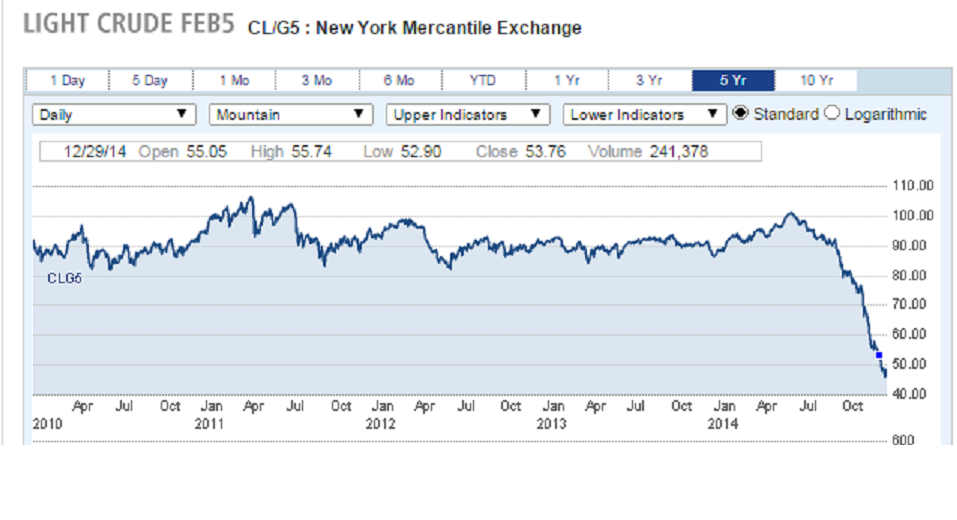
Iran needs $72 per barrel for its budget. That Iran (along with oil shale production) is one of the targets of Saudi Arabia’s oil price strategy seems very clear. They have the lowest cost of extraction and with their accumulated reserves they could probably withstand 5 -8 years with a price lower than $50. However their strategy will be completely nullified if there is growth in demand (for example with an economic recovery in China) before they have brought the shale oil producers and Iran to their knees. The question now is how low the price can go?

Light crude price February 2015

Light crude price February 2015

The Iranians are girding their loins for a battle and are adjusting their budgets to be able to withstand a longer period with relatively low prices. Iran probably wants to avoid precipitating a further fall but I suspect that just mentioning their worst fears – in the present atmosphere – will only ensure that those fears come true. It would seem, from the almost belligerent Iranian stance, that prices will now almost certainly drop to around $25 per barrel within the next 6 -12 months.

Reuters:

Iran sees no sign of a shift within OPEC toward action to support oil prices, its oil minister said, adding its oil industry could ride out a further price slump to $25 a barrel.

The comments are a further sign that despite lobbying by Iranand Venezuela, there is little chance of collective action by the 12-member OPEC to prop up prices – entrenching the reluctance of individual members to curb their own supplies.

In remarks posted on the Iranian oil ministry’s website SHANA, Oil Minister Bijan Zanganeh called for increased cooperation between members of the Organization of the Petroleum Exporting Countries. ……. 

Oil has plunged by more than half since June 2014 to below $50 a barrel on Monday, pressured by a global glut and OPEC’s refusal at its last meeting in November to cut its output. ……. 

OPEC decided against a production cut despite misgivings from non-Gulf members such as Iran and Venezuela, after top producer Saudi Arabia argued the group needed to defend market share against U.S. shale oil and other competing sources. ……… 

Zanganeh said Iran had no plans to cut its own oil production and that it had no further meetings with Saudi Arabia – Iran’s main political rival in the Gulf – since the OPEC meeting.

Last week, Iranian President Hassan Rouhani said countries behind the price fall would regret their decision and warned that Saudi Arabia and Kuwait would suffer alongside Iran from the price drop.

Zanganeh said Iran’s budget should be based on oil at $72 per barrel, but Iran could withstand lower oil prices. “Even if the oil price goes down to $25 a barrel, the oil industry will not be threatened,” the Fars news agency quoted him as saying.

You cannot kill for free speech but you have to be prepared to die for it

January 16, 2015

The Pope just said that, if the limits to free speech are exceeded, then violence is to be expected. In spite of his separate statement that violence in the name of God was never justified, he has effectively condoned a violent reaction if and when some limit to “free speech” is exceeded.

Pope Francis says freedom of speech has limits

Pope Francis has defended freedom of expression following last week’s attack on French satirical magazine Charlie Hebdo – but also stressed its limits. The pontiff said religions had to be treated with respect, so that people’s faiths were not insulted or ridiculed.

To illustrate his point, he told journalists that his assistant could expect a punch if he cursed his mother.

But his handlers at the Vatican soon realised that he was effectively saying that at some level of perceived insult, a violent reaction was to be expected and, by implication, justified. They tried to put the cat back in the bag, but they cannot get away from the fact that even a playful punch at an assistant was, and was intended to, represent a violent reaction:

Yahoo News: The Rev. Thomas Rosica, who collaborates with the Vatican press office, issued a statement early Friday stressing that the pope was by no means justifying the attack on Charlie Hebdo.

“Pope Francis has not advocated violence with his words on the flight,” he said in a statement.

He said Francis’ words were “spoken colloquially and in a friendly, intimate manner among colleagues and friends on the journey.” He noted that Francis has spoken out clearly against the Paris attacks and that violence in God’s name can never be justified.

Leaving aside this Pope’s attempts at populism, he does not address the fact that all organised religions – and not least Catholicism – are fundamentally opposed to and deny free speech. They are all concerned with telling, and imposing on their members, what to think and how to behave.

Those who like to quote Voltaire and his “I do not agree with what you have to say, but I’ll defend to the death your right to say it”, need to admit that what he actually said was not that “free speech” was a right, but that “free speech was worth dying for”.

It could be argued that the Pope was saying the same thing. You cannot kill for free speech but you have to be prepared to die for it. The terrorists in Paris were killing because they felt insulted not because they were for or against free speech. The Charlie Hebdo journalists died for their right to express whatever they wished.

(Sometimes I wonder why something so simple is made so complicated. Of course, every individual can say or express whatever he likes. And of course he must take responsibility for that. He is not immune to the consequences of what he says. The problem comes only when the “free speaker” demands immunity from any prosecution and protection from any unpleasant consequence. The risk of retaliation – whether legal or not – must be taken by the speaker. Equally, the retaliator has no “right” not to be offended. The offense lies in his mind and he must take responsibility for his actions.)

But the Pope is not alone in being confused. His confused message is just an example of the many confused responses to the brutal murders at Charlie Hebdo’s office and the Jewish supermarket in Paris. Initially, there was universal condemnation of the killings and the “Je suis Charlie” meme was used to show solidarity with the victims and as a manifestation of support for free speech.

But it soon became clear that the manifestations of support were not as simple and unified as all that. The Left were – in their confused minds – supporting free speech and condemning violence by Islamic terrorists. But by some mental calisthenics they were also showing solidarity with moderate Islam. The confused Prime Minister of Turkey went to Paris and stood arm-in-arm with Hollande and other leaders and then went home and condemned the journalists for their insults to Islam and for the new Charlie Hebdo issue. The confused members of Pegida suppressed their dislike of the media and joined the wave of manifestations, to demonstrate their opposition to the Islamicisation of Europe. For them the attack was proof of the evil in Islam. They tried not to show too much sympathy for the Jewish victims but focused on the evil attackers. A confused Barack Obama did not know what to do and so – as usual – did nothing. Confused orthodox Jewish papers removed all women from their pictures of the Paris manifestation. A confused Angela Merkel joined the Paris manifestation and then went home and joined a pro-Muslim demonstration for balance. A confused David Cameron joined the Paris manifestation and then was quick to point out that he was only against the Islamic terrorists.

Al Qaeda in the Yemen claimed that they were responsible.

After a few days, while the support for free speech in the face of Islamic barbarism continues as the main theme, the message has now started to be diluted. Charlie Hebdo had gone too far and the reaction – while not justified – was to be expected. In other words the irresponsible journalists were – to some extent – culpable. By their racism and irresponsibility they had invited retaliation. The co-founder of Charlie Hebdo accused the editor of dragging himself and others to their deaths. The Pope said much the same.

SalonThe previously ubiquitous hashtags of #JeSuisCharlie were suddenly replaced by declarations that “I am not Charlie Hebdo, and torn commentators searched for alternative symbols to cling to in the wake of tragedy, such as Ahmed Merebat, the Muslim police officer killed by the terrorists as they made their getaway.

In the matter of three days, the staff of Charlie Hebdo had transformed from heroic symbols of free expression to the latest in a long line of racists whose right to say what they say we’ll defend to the death, even if we don’t particularly like what they’re saying.

But the events of Paris were not about free speech. They were – primarily – about Islamic terrorists who killed to satisfy their warped and twisted view of the world. They killed innocent Jews in a supermarket and journalists with a rather juvenile sense of humour. And while the Islamic fanatics may not represent the main body of moderate Muslims, the fringe that is radical Islam exists where it does because the main body of Islam exists where it does.

And the origins of most of the Sunni Islamic extremism are still rabid Saudi Arabian clerics and Saudi Arabian money.

Laws are only as “good” as the compliance they command

January 15, 2015

There are always examples illustrating where the “law is an ass”. Recently there was the case of the Saudi Arabian cleric who has issued a fatwa against the building of a snowman since this would be an “image of man” and a blasphemy! Laws are nearly always about achieving a balance between the needs of individuals and those of the larger society, and which can often be in conflict. It is always the larger society which makes the law (never the individual) and it is always the larger society which assumes for itself the right to make laws and coerce the behaviour of the individuals making up the society. I got to wondering about how the “goodness” of a law could be measured.

The objective of creating a law is to get compliance. Man-made laws (and even all the laws of all the gods – inevitably interpreted by men) are fundamentally coercive towards the end of compliance. They try to shape human behaviour – and only human behaviour – by threats of consequences for non-compliance with the law (if found out). They are a tool of organised societies and usually only try to coerce the behaviour of members of that society (including temporary members or others within the power of that society). The purpose is usually the smooth operation or the (perceived) well-being of that society.  Laws have specified jurisdictions. They do not – usually – try to coerce the behaviour of entities not within the coercive power of the law-making body. There have been cases of misguided lawmakers and Kings trying to create laws to govern animals and birds, or to control the tides or to ban eclipses and volcano eruptions, but these examples of idiocy are relatively few. (But such idiocies are present even today as with those who try to make laws to control the climate).

There is a hierarchy to these laws with the laws of any society generally being subordinate to those of any larger society it is part of. Town laws are subordinate to county laws which are subordinate to country laws. (But it is noteworthy that no country gives precedence to the laws of a god over the laws of a country. Even some Islamic States which claim to give such precedence first merge the supposed laws of their god into the laws of the country. Saudi Arabia is a legal chaos unto itself where women drivers are treated as dissenters and tried in terrorism courts). The supposed “sanctity of the law” is merely a concept which presupposes the supreme goal as being the well being of the society making the law. The laws of a failed or discredited society are discredited and discarded along with that society. Courts of Law deal with compliance or non-compliance with the Law and Justice is served only incidentally.

But all man-made laws are formulated only because compliance with the law is not assured and the society wishes to have such compliance. Only the “laws of nature” command full compliance and are 100% effective. In fact, the laws of nature are only discerned by humans because they are always complied with – without any measures to ensure compliance. Coercion is always zero. Gravity always applies – but we still don’t know quite how it does. The laws of nature are fully complied with even if the law is not discerned or formulated. Man-made laws cannot negate or defy gravity or any of the laws of nature. Neither can the laws supposed to be of the gods. (Which begs the question as to why a law supposed to have been made by an all-powerful god cannot ensure full compliance without any coercion? Going by the ability to command compliance, all imagined gods are subject to natural law!)

It occurs to me that “compliance” is the “benefit” when assessing a law and the “cost” is the amount of coercion that has to be applied to get that compliance. Taking the laws of nature as my benchmark – 100% compliance with zero coercion – leads me to think that the “goodness” of a law can then be defined as the ratio of the compliance it achieves to the cost of the coercion it has to use to achieve that compliance.  A Compliance/Coercion Ratio is then effectively a benefit/cost ratio. The greater the ratio the greater the “goodness” of a law. Note that the cost to society of some non-compliance may indicate the need for a law in that area but is irrelevant for estimating the “goodness” of that law once made.

“Goodness” is clearly infinity for laws of nature where the compliance is full and the amount of coercion in the denominator is zero. At the other end of the scale, for “bad” laws, the C/C Ratio would go to zero if either the numerator was zero or where the amount of coercion was very high and approached infinity. Clearly if there was no compliance, the C/C ratio would be zero and the law would be a “bad law”. Equally if coercion is “unlimited” (mass executions for example), the “goodness” would be zero no matter what level of compliance was achieved.

Compliance and coercion are not impossible to measure. Compliance is simply the proportion of those complying among the total population subject to the law. The amount of coercion applied could be measured by estimating the cost of the penalty/punishment levied – or to be levied – and the number of times it would be applied. A law against murder – for example – would need to estimate the amount of coercion as the punishment level multiplied by the number of times the punishment was – or would be – applied. It would need some imagination to compare the total cost to society of – say – an execution to that of a life-term, but it would not be beyond the wit of man to estimate the “amount of coercion”. A successful law would show a clear increase of the C/C ratio over time. It would quantify and demonstrate how behaviour changed such that there was more compliance with less coercion.

Perhaps every new law that is proposed should be judged for its “goodness” by estimating its Compliance/Coercion Ratio. Laws are only as “good” as the compliance they command and as “bad” as the coercion they need to apply.

Politicians and pseudoscience

January 14, 2015

I hadn’t realised just how far Obama and McCain were prepared to go in accepting pseudoscience when chasing votes and political power.

Washington Post Fact Checker:

“We’ve seen just a skyrocketing autism rate. Some people are suspicious that it’s connected to the vaccines. This person included. The science right now is inconclusive, but we have to research it.” –Barack Obama, Pennsylvania Rally, April 21, 2008.

“It’s indisputable that (autism) is on the rise among children, the question is what’s causing it. And we go back and forth and there’s strong evidence that indicates it’s got to do with a preservative in vaccines.” –John McCain, Texas town hall meeting, February 29, 2008.

There is no proven link between vaccinations and autism just as there is no proven link between man-made carbon dioxide emissions and global warming.

You also can say whatever I like

January 13, 2015

Voltaire: I do not agree with what you have to say, but I’ll defend to the death your right to say it.

The world pays lip service to the “freedom of speech” or the “freedom of expression”. No country in the world today actually lives up to Voltaire.

The only reality that is universally held is

I can say whatever I like. You also can say whatever I like. 

  1. You can say what you like but you cannot reveal what I consider confidential. (US)
  2. You can say what you like but we will flog you if you “like” the facebook page of Arab Christians. (Saudi Arabia)
  3. You can say what you like but you cannot call for a boycott of Israel. (Israel)
  4. You can say whatever you like but I can always sue you for libel or slander or obscenity or pornography. (most countries)
  5. You can say what you like but you cannot speak against me, Robert Mugabe. (Zimbabwe)
  6. You can say whatever you like but we will put you in prison if you incite others to violence. (most countries)
  7. You can say whatever you like, but if you say that the Holocaust did not happen we will put you in prison. (most Western European countries)
  8. You can say whatever you like but if you offend my sensibilities I am justified in beating you up. (India, Malaysia, Indonesia, Iran, Russia, China, Vietnam, Burma).
  9. You can say whatever you like but if you insult our King we can lock you up and throw away the key. (Thailand)
  10. You can say whatever you like but if I perceive that Islam has been insulted I can kill you or authorise your killing by anybody. (all Islamic countries)

Who is Charlie?

January 13, 2015

JE SUIS CHARLIE

Omslaget på tidningen Charlie Hebdos nya nummer, Charlie Hebdo och tidningen Liberations redaktioner. Foto: TT/AP och Charlie Hebdo.

The cover of the new issue of Charlie Hebdo, Charlie Hebdo and the newspaper Liberation editors. Photo: TT / AP and Charlie Hebdo (via Swedish Radio)

 PEGIDA ALSO CLAIMS TO BE CHARLIE 

A protestor holds a poster showing German Chancellor Angela Merkel wearing a head scarf in front of the Reichtstags building with a crescent on top and the writing "Mrs Merkel here is the people" during a rally of the group Patriotic Europeans against the Islamization of the West, or PEGIDA, in Dresden, Germany, Monday, Jan. 12, 2015.

A record 25,000 attended the Pegida demonstration in Dresden on 12th January 2015 BBC/AP

 BUT, HE IS NOT CHARLIE

Right-wing Polish MEP Janusz Korwin-Mikke

Right-wing Polish MEP Janusz Korwin-Mikke at the European Parliament 12th January 2015 BBC/Reuters

Nigel Farage the UKIP leader, who is a clown in many ways and on many issues, does have a point regarding integration (not immigration). It is not mass immigration – as he believes – but the blind worship of a soppy, separatist, “multi-culturism” which has removed the incentive and need for immigrants to integrate. The grooming rings of Pakistani immigrants and the attempted take-over of Birmingham schools have certainly been enabled – perhaps only partly – by the cowardly worship of “multi-culturism”. Like it or not, Europe is and will continue to be multiethnic. That requires the separate cultures to be subordinated to a single over-riding culture, which in turn has to be something new which evolves from the various new inputs. Immigration inevitably gives multi-ethnicity but it is the blind worship of multi-culturism which hinders integration. No doubt prejudice and racism also hinder integration but even here, the separatist nature of multi-culturism entrenches racism.

I love the fact that in the UK, chicken tikka massala has gone mainstream and I can get it at M&S and at the pub. But I am equally glad that the pub remains a pub and has not been converted into a dhaba. When I want channa – bhatura my favourite dhaba is in Handsworth, but thankfully that dhaba will never be a pub. There is a place for the dhaba to exist, but it is the pub serving the chicken tikka massala which is integration in motion.

(I shall leave my ranting about all organised religions for another time and another post).

It is not immigration but integration which is the real issue.

BBC: Mr Farage, leader of the anti-EU UK Independence Party, said mass immigration had “made it frankly impossible for many new communities to integrate”.

“We do have, I’m afraid, I’m sad to say, a fifth column that is living within our own countries, that is utterly opposed to our values,” he said.

He is quite correct that in Europe, the supporters of radical Islam are self-confessed fifth-columnists (defined as any group of people organised to undermine a larger group).