Archive for the ‘Behaviour’ Category

The father it was who was classless

November 30, 2014

The Obama daughters were clearly not very interested and were wishing they weren’t there. But to call them classless was, as Elizabeth Lauten did, just silly. She got dumped on and apologised and deserved the censure she got as due recompense for her stupidity.

The lack of class though is with Barack Obama (or his idiot advisors but the buck stops with him) who insisted on the totally uninterested girls being there. What were they expecting? If the traditional pardoning of the Thanksgiving turkey was intended to be a mock-sombre but actually comic occasion, then the girls, their costumes and their posture had nothing to contribute. And that could have been predicted. If the intention was to be scornful of the tradition, then the inclusion of a couple of listless girls could make some sense, but he could surely have done a better job of being sarcastic.

As it is I am left with the impression that Thanksgiving is not very important to the Obamas. Pardoning the turkey is a tradition that he does not care very much about and which he follows (including the presence of his reluctant daughters) just as a matter of form. His only objective was then to follow precedent maintaining form but with no substance. Presumably he also forced his daughters to attend as a matter of form.

And that is lacking in class.

Mind you, I have no great expectations of the elegance of behaviour which constitutes class, from current Presidents and Prime Ministers. Barack Obama is not

“as time requireth, a man of marvellous mirth and pastimes and sometime of as sad gravity. A man for all seasons”

Robert Whittington

President Barack Obama, joined by his daughters Malia, right, and Sasha, center, speaks at the White House, in Washington, Wednesday, Nov. 26, 2014, during the presidential turkey pardon ceremony, an annual Thanksgiving tradition. (AP Photo/Jacquelyn Martin)

President Barack Obama, joined by his daughters Malia, right, and Sasha, center, speaks at the White House, in Washington, Wednesday, Nov. 26, 2014, during the presidential turkey pardon ceremony, an annual Thanksgiving tradition. (AP Photo/Jacquelyn Martin)


Tragic death of Phillip Hughes triggers memories of Nari Contractor

November 28, 2014

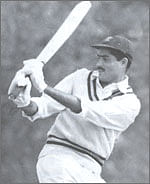
Phillip Hughes image rediff.com

The tragic death of Phillip Hughes has triggered some discussion about safety and the design of helmets. But I am not sure that this is the right discussion to have. Hughes was hit on the top of his neck, behind his ear but just below his helmet. He was hooking and had hooked a little early so that he was almost facing long leg at the moment of impact.

I know first hand just how hard a cricket ball is. Forty years ago I was hit on the head by a cricket ball while playing a club match in Birmingham. It was not the bowler in this case and I was not wearing a helmet. I was running between the wickets and the ball was thrown in by a fielder and caught me on the top of my skull – a little forward of centre. Apparently I just crumpled to the ground but came to a few minutes later. I was kept in hospital for a few hours for observation but fortunately suffered only a mild concussion. But I am told that if the point of impact had been an inch further forward or an inch further back, the result could have been far more serious.

Nari Contractor image sportskeeda.com

But after the Phillip Hughes accident, what comes to my mind is not my little accident but the Charlie Griffith bouncer which caught Nari Contractor on the back of his skull in March 1962. Like Hughes, Contractor was a left-hand bat. This was 52 years ago when as a schoolboy avidly following the tour of the West Indies, I was up at all hours listening to the live radio commentary whenever I could. Helmets were not in use in 1962. India were playing Barbados between the second and third Test matches. Contractor was leading the side after a series win against England and he opened the innings with Dilip Sardesai. Contractor seems to have turned his head due to some distraction from the pavilion. But he was, like Hughes, facing sideways with the back of his head exposed at the time of impact. He suffered a fractured skull and was unconscious for 6 days.  A neuro-surgeon had to be flown in from Trinidad and he went some 24 hours – unconscious – before proper medical treatment began. He needed a blood transfusion and Sir Frank Worrell – the West Indies captain but who was only a spectator at this match – was the first to donate blood. Later Contractor had to have a metal plate inserted for the fracture. He survived and went on to play first class cricket but never again played a Test match.

Contractor is now 80 and spoke about the Hughes accident to the Mumbai Mirror:

“I am not sure if any technology or better technology can prevent such injuries. My injury took place in 1962 and it has taken 52 years for another such injury. You cannot ensure anything in cricket.”

I do agree that safety and safety standards should be reviewed. But without trying in any way to minimise the tragedy of Phillip Hughes demise, it is nether opportune or appropriate, I think, for any knee-jerk reactions.

My point is that all rules for safety or safety equipment are inextricably linked to the skills of the game. Every new rule or new piece of equipment suppresses some skills and encourages others. There is nothing wrong with that of course but it does change the game. There is little doubt that the advent of helmets and chest pads has suppressed the skill of weaving and dodging to avoid being hit by the ball while not taking your eyes off it. On the other hand the use of helmets and other protection has allowed the hook shot – among other shots –  to be played much more confidently and – for the best players –  has led to the development of new skills of shot making. Shot making has never been as inventive as today (to the chagrin of many bowlers) and this is partly due to the lower level of physical risk perceived by the batsmen. For the less skilled players, it could be argued, it has led to a greater proportion of injudicious shot selections because the downside is low. More players try to hook today and fail – but it is safer to do so. The balance between “avoidance” and “playing the shot” is different to that when there were no helmets. The skill of “avoidance” is needed less and is therefore less well developed.

Phillip Hughes was certainly one of the better players of the game. But the game today is not the same game as it was in 1962 when Nari Contractor suffered his injury. But would a player of the 1962 game, brought up without the use of helmets, make the same shot selection that Phillip Hughes did? It is impossible to know but the 1962 batsman would surely have had a different background of risk assessment and a different basis for selecting when to play the hook shot and when to avoid the ball.

Changing the risk level in any game changes the game. But – lest we forget – without risk there is no game.

Break-even price for shale oil could be as low as $40 per barrel

November 28, 2014

UPDATE: Reuters – Saudi Arabia’s oil Minister Ali al-Naimi declares war on US Shale OIL


Yesterday Saudi Arabia got its way at the OPEC meeting and successfully resisted all calls for a cut in production to try and stop the decline of world oil prices.  It seems Saudi Arabia (which has the lowest oil production cost in the world) has chosen the strategy of maintaining an oil price low enough to put a cap on US shale oil production and provide a disincentive for new shale oil wells.

This strategy is premised on the break-even price for shale oil being at or above $80 per barrel for small production sites down to about $30 per barrel for large production sites. For example Credit Suisse estimated these levels as varying between $24 and $85 earlier this year.

shale oil break even estimates credit suisse

shale oil break even estimates credit suisse sep 2014


The US department of Energy puts sustainable break even values between $35 and $54. The Saudi calculations seem to be based on similar estimates. They appear to believe that with current oil prices moving down to about $70 per barrel, some of the smaller US oil shale wells are already uneconomic and that at this price new investment for further production sites will dry up.

But shale oil production costs are declining – fast. Costs are coming down following the learning curve for both capital costs and running costs. The analyst estimates are already out of date. My estimate is that actual break-even points are already down about 20% from those in the Credit Suisse estimate.

So I believe the Saudis have miscalculated. The average break-even world price for shale oil is probably – already – closer to $40 per barrel rather than $60-70 per barrel being assumed. While new investment in shale oil wells may well be toned down by world oil consumption, it will probably not be because world oil price is below some critical threshold. If the Saudis believe that any uptick in consumption will bring the oil price back up to over $80 per barrel, they are following a flawed strategy. We could be in for a decade of relatively low oil prices perhaps with a floor at around $40 per barrel and set by the average break-even for shale oil.

Consumers are still very wary. They are not sure that the reduction in oil price will be sustained and is not just a temporary dip which might lure them into a higher and more vulnerable consumption level. It will take a few months for them to see that OPEC has actually lost control over the world oil price but is still in denial about that. A sustained low oil price is what will trigger a new – and sustained – wave of global growth that is now so badly needed. The cartel is shrinking. New shale oil producers will all be outside the cartel – and the sooner Europe, China and India start production the better. But it is the beginning of the end of the OPEC cartel power.

History will – I think – show that the OPEC cartel lasted for 50 years. It will show that the cartel started in 1973 and that market forces of supply and demand were re-established around 2020.

Minus 52ºC and passengers have to push their plane: Just another day in the Russian Arctic

November 27, 2014

Minus 52ºC and passengers have to push their plane: Just another day in the Russian Arctic

Men pushing aircraft

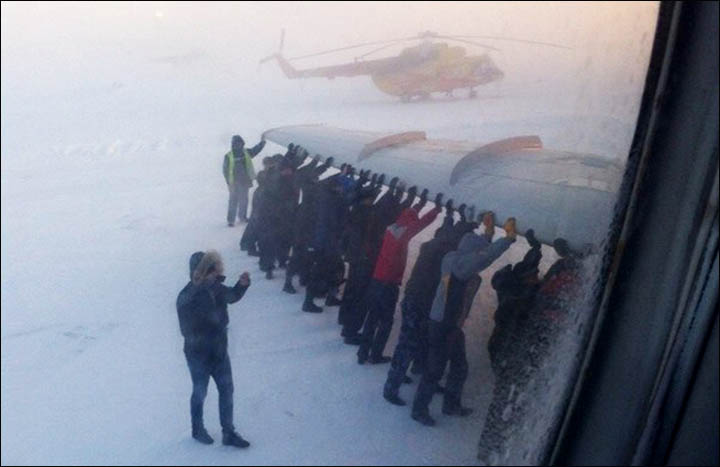
Fearing the UTair service to regional capital Krasnoyarsk could be delayed, many of the 70 passengers used brute strength to free the 30-ton Tupolev 134. Picture: Ivan Ivanov

The Siberian Times:

When their plane literally froze on the ground at Igarka airport, above the Arctic Circle, there was no need to panic. Fearing the UTair service to regional capital Krasnoyarsk could be delayed, many of the 70 passengers used brute strength to free the 30-ton Tupolev 134. ….. 

Vladimir Artemenko, technical director of Katekavia, which ran the flight jointly with UTair, said that the plane was technically serviceable, but the chilly temperatures led it to freeze up.

The airport’s tractor could not move the Tu-134 because its brake pads were frozen. ‘When people pushed the plane, the wheel cranked out, and then the aircraft could continue to move,’ he explained.

The plane later took off and landed safely in Krasnoyarsk. Most of the passengers were oil and gas workers on their way home after a stint in the Arctic production flields. Reports of the incident led to worldwide praise for the stoic Siberians for their ‘can-do chutzpah’, in the words of Agence France Presse. ‘Siberians are so tough that for them pushing a frozen plane along a runway is a piece of cake,’ added Russian daily newspaper Komsomolskaya Pravda.

But the authorities were not amused.

igarska to Krasnoyarsk

igarka to Krasnoyarsk

The amusement did not extend to some officials, however. West Siberian transport prosecutor’s aide Oksana Gorbunova rebuked the plane movers. ‘Passengers were asked to leave the plane and go to the bus standing nearby,’ she said. ‘After that, some of them voluntarily left the bus and went to the plane, trying to assist in moving it using physical force.

‘Naturally, the plane was moved by the truck, because people physically could not do it. It looks like a joke. It would be funny if it could not have dire consequences: people could damage the casing and flaps of the aircraft.’

Airport chief Maxim Aksyonov claimed: ‘Most likely, the plane’s passengers, oil workers, decided to do a kind of ‘selfie’. It was a good joke and it became a big thing on the Internet.’

However, one of the ‘hero’ passengers told Life News insisted the passengers did push the plane. ‘We were on the bus that took us on the plane when we were asked to help the tractor,’ he said. ‘Before that, we had already spent one day at the airport, waiting for our departure.

‘We pushed it a short distance – about five metres, maybe more. I worked for four years on shifts, but do not recall that we pushed the plane previously.’

Video below:


Status of German women directors degraded to be “quota directors”

November 27, 2014

German companies have a reputation for excellence. But this is being sacrificed for the sake of political correctness. Currently every woman company director in Germany can be assumed to be of exceptional competence. When a new quota law goes into force in 2016, every woman director in Germany will be nothing more than a “quota employee”.

Discrimination to fight discrimination is an invitation to failure. I do not find any case of “affirmative action” – which is a euphemism for introducing a new, institutionalised and unjust discrimination ostensibly to correct the effects of some other unjust discrimination – which has actually achieved its objective. No program of enforced quotas has yet succeeded in achieving a condition where the “affirmative action” becomes unnecessary because the original injustice has been eliminated. Quotas or confiscation and rationing, enforced by the state and based on irrelevant criteria, remain a favourite tool of those with socialistic aspirations. But not only don’t they work, they also perpetuate the “injustice” that they are intended to correct.

Fifty years of quotas for the “scheduled castes” in India have only become entrenched and have been counter-productive. Rather than ensuring that the lot of the “disadvantaged” groups have improved such that they can compete fairly for jobs or education places, the “affirmative action” has instead ensured that competence and ability have been removed as requirements for selection. Even worse, the “system” is self-perpetuating and encourages the reduction of standards. Those who were to be helped now only need to be the “best of a bad lot” to be selected. Instead of raising standards, “affirmative action” allows and enables lower standards to become “acceptable”. To be classified as a “scheduled caste” has now become a path to privilege.

The experience  in the US with reservation of places in education and in the work-place for minorities has been no different. Even after over 25 years of “affirmative action” the SAT scores of African-Americans admitted to the top US universities remains significantly lower than the average of all those admitted. But this is only to be expected. Effectively the SAT scores to be targeted by aspirants for admission have been reduced for those qualifying for the privilege. Aiming high has no longer any value. Reserving jobs for women or Latinos or other “disadvantaged” minorities has only succeeded in lowering standards but – what is worst – also in making these lower standards acceptable. The quotas for the employing of ethnic Malays in Malaysia has removed any incentive for such “quota employees” to excel at anything other than being Malay. Quota students or quota employees are not burdened by requirements of superior performance or competence – let alone any expectations of excellence.

It should be obvious by now that I believe that quotas based on having an irrelevant characteristic are counter-productive and contribute to equalising standards only by lowering them. Even when quotas try to bring in minimum qualification requirements, it is inevitable that the criterion becomes being “just good enough” and not “to be best”. The use of quotas automatically and inevitably downgrades the quest for excellence. It is settling for the mediocre.

So I am not very impressed by the new German law which will now force the largest companies to have women constituting 30% of their supervisory boards from 2016.. Again the justification is that it will be a trigger for social change and anyway that there are enough women who are qualified. That misses the point. Women directors for these companies have now been effectively degraded to become quota directors – even where they are there for their competence. They can no longer claim to be the “best available” even if they are. Angela Merkel has had to give in to the socialists on this point. Forty percent of the German cabinet is women. Angela Merkel herself is there because she was the “best” for the job. But note that many of her female cabinet colleagues are there not because of their competence or excellence but only to fill an unwritten quota. Other countries are also considering quotas for women directors – not least in “politically correct” Sweden. For example, I observe when I watch Swedish TV – which is very politically correct – that it is easy to discern when a female presenter or a news reporter has been selected to fill some gender quota rather than for her excellence.

But why stop at women quotas? Why not quotas also for other minorities and abandon excellence or competence? Why should women be more privileged than some other disadvantaged minority? Is the disadvantage suffered by women more important to correct than the disadvantage suffered by a gay person? or an immigrant? Perhaps there will come a day when a German Supervisory Board will have to be at least 30% female, 10% gay, 5% transgender and 15% of immigrant origin! That will be the time when I shall sell any German stocks that I might have.

As an investor in any company I would prefer that the Directors be the best available and affordable and not “just good enough” to fill a compulsory quota.

Juncker’s Christmas present for Europe: used goods in an imaginary wrapping

November 27, 2014

Jean-Claude Juncker announced – with great fanfare – a Christmas present for Europe yesterday. It was a €315 billion investment plan which would generate 1.3 million new jobs.  Sleight of hand is what he is good at as he has proved during his time as Prime Minister of Luxembourg. Do one thing and call it something else. Provide and attract users for clever schemes for tax evasion but call it tax avoidance.

Yesterday’s announcements don’t surprise. They don’t provide any credit for Juncker, the European Commission or the European Parliament. They do confirm for me that the “old” dream of a new European hegemony – mainly shared by French and German and some Italian politicians – is crippling the EU.  Trying to recreate the past with another Holy Roman Empire or a Fourth Reich will only lead to a spurt for separatism and further internal conflicts.

Right now European companies are awash with money which is not being invested. It is not being invested because the political environment does not provide any confidence that a return can be earned. Angela Merkel is seen as being forced to accept wasteful spending because of her grand coalition with the socialists. German energy policy is in a shambles and Germans pay the highest electricity prices in Europe. Even reductions in oil price don’t get passed on to the consumer because the Energiewende has locked the country into an era of high prices to support the unsupportable shift to renewables. The German economy has been stagnating since the coalition assumed office. Francois Hollande is desperately trying to spend more money that France does not have. Northern Italy is being held down by spending in southern parts. In Sweden a new Red/Green minority coalition depends upon support from the far left (a euphemism for old communists) and is busy stopping infrastructure development projects to keep the Greens happy and planning a splurge of public spending to keep the far left happy.

And then comes Juncker with his claim that Europe would have an early Christmas. The European Fund for Strategic Investment (EFSI) is the brainchild of the EU Commissioners and will keep them happy and the bureaucracy growing in a time of “austerity”. And the idiot EU parliament approved it.

Juncker's EFSI

Juncker’s EFSI

The fund is supposed to stimulate infrastructure projects (road, rail, energy, IT, …) but it needs new legislation in each country and will cause a competition between the countries to get their share of the new EU pig-trough. But his €315 billion turns out not to be €315 billion. It is just €21 billion. Oh, and by the way, even this is not real. It is not any new money but just an arithmetic subterfuge. It is just reallocated from other  areas of the EU budget. And if the massive leveraging to get private investment to produce the rest of the €294 billion does not materialise – as it won’t – then the European taxpayer has to pick up the tab. Those few investors who come in will be protected – by taxpayers money – and will lead to further exploitation of EU money by the few. As wih most such grand EU spending schemes new scams will be developed. A few developers and the EU bureaucrats will enrich themselves. And the EU taxpayers will pay – and continue to pay.

Juncker sees himself as Santa Claus. But as Pope Francis said a couple of days ago, Europe is becoming “haggard”. Not that the Roman Catholic Church has much to crow about but with Juncker at the helm it could become an expensive Christmas for Europe. He faces a no-confidence motion today but I don’t hold out any great hopes that he will be rejected by a compliant and self-serving European Parliament.

The EU has become just another cult.

Prey-predator relationships 30,000 years ago

November 26, 2014

New research at the paleolithic Předmostí I archaeological site near Brno in the Czech Republic provides a fascinating picture of the prey-predator relationships of that time.

Thirty thousand years ago, humans had domesticated dogs, they hunted mammoths, bison, musk ox and reindeer. They probably did not herd reindeer extensively in central Europe (but they did in the far north as the ice sheets retreated), but they may have occasionally followed reindeer herds. Mammoth meat clearly had a high value and was not fed to their dogs who – instead – had to make do with reindeer or musk ox meat – presumably controlled and provided by their human owners. But the dogs were probably an important participant in human hunts. Lions preyed primarily on musk oxen and reindeer but not on mammoth or much else. Other predators such as wolves, wolverines and bears ate mammoth (human leavings perhaps), rhinos, horse and bison. That lions and humans hunted musk oxen but not so much bison suggests that the musk ox was a little less aggressive (more stupid?) and easier to hunt than bison.

Simplified prey-predator relationships for prehistoric humans and large mammals in Předmostí I 30,000 years ago, deduced from stable isotopic data. Illustration: Hervé Bocherens with credits to: Wooly mammoth, wooly rhino, horse & cave lion: Mauricio Antón/DOI:10.1371/journal.pbio.0060099, Muskox: U.S. Fish and Wildlife Service; Reindeer: Alexandre Buisse; Wolf: Santiago Atienza; Wolverine: Matthias Kabel; Brown bear: Jean-Noël Lafargue; Dogs: Margo Peron; Bison: Michael Gäbler; Prehistoric man: Hervé Bocherens.

Simplified prey-predator relationships for prehistoric humans and large mammals in Předmostí I 30,000 years ago, deduced from stable isotopic data. Illustration: Hervé Bocherens with credits to: Wooly mammoth, wooly rhino, horse & cave lion: Mauricio Antón/DOI:10.1371/journal.pbio.0060099, Muskox: U.S. Fish and Wildlife Service; Reindeer: Alexandre Buisse; Wolf: Santiago Atienza; Wolverine: Matthias Kabel; Brown bear: Jean-Noël Lafargue; Dogs: Margo Peron; Bison: Michael Gäbler; Prehistoric man: Hervé Bocherens.


Are shale oil and low prices the beginning of the end of the OPEC cartel?

November 24, 2014

Currently US crude is at just above $76 per barrel and Brent oil is at about $80. OPEC members are meeting this week in Vienna and it is thought that cuts to oil production of between 0.5 million and 1.5 million barrels per day (bpd) are possible. The drop in oil prices since June (from around $110 per barrel is due to a glut which in turn is due to over production, large quantities of US shale oil becoming available and simultaneously a reduced demand from China and others. Saudi Arabia is conspicuous by not having made any significant production cuts so far. This could be due to one of 3 reasons:

  1. Saudi Arabia is testing the breaking point for some of the shale oil producers since some of the smaller shale wells probably have a break-even level of around $60-70 per barrel, or
  2. Saudi Arabia and the US are targeting Russia and Iran whose economies are vulnerable and very dependent on the oil price (and the Russians alone would lose some $100 billion in oil revenues per year), or
  3. Saudi Arabia is tired of bearing the brunt of the production cuts and is forcing some of the smaller OPEC producers to take their share of the pain of production cuts.

If cuts of less than 0.5 million barrels per day are made it is thought that the prices are headed down to about $60 per barrel. One analyst estimates that a cut of 2 million bpd is needed to get back up to $80 per barrel. Something in between will be – well – something in between.

I just don’t like cartels and especially when they are state sponsored cartels. So far shale oil production is just from the US, and the OPEC strangle-hold on oil price has yet to be broken. But, over time, I expect this cartel to weaken as other countries produce oil and gas from shale. I remain of the opinion that the OPEC cartel has – no doubt – enriched the oil producing countries but has only done so at the expense of the rate of development of non-producers. OPEC has done the global economy a disservice by holding back the developing countries and the strongest correlation in geopolitics is the link between energy consumption and development (not just GDP but also virtually every development parameter).

It may cause some short term turbulence but in the long run it will be a “good thing” even if oil price were to collapse to below $50 per barrel. Some producers will be hard hit but the net result for the global economy will be positive. So I shall be quite happy if OPEC cannot reach agreement on how much oil production to cut or if they make just a small cut. It is time for some of the the developing countries to get a break from the oil price extortion which has been in place since 1973. The sooner the OPEC cartel is rendered obsolete the better.

Reuters:

Some commodity fund managers believe oil prices could slide to $60 per barrel if OPEC does not agree a significant output cut when it meets in Vienna this week. Brent crude futures have fallen by a third since June, touching a four-year low of $76.76 a barrel on Nov. 14. They could tumble further if OPEC does not agree to cut at least one million barrels per day (bpd), according to some commodity fund managers’ forecasts. ….. 

Yet fund managers and brokerage analysts are divided over whether OPEC will reach an agreement on cutting output. Bathe put the likelihood at no more than 50 percent. Oil prices have been falling since the summer due to abundant supply, partly from U.S. shale oil, and because of low demand growth, particularly in Europe and Asia. As a result, some investors believe a small cut of around 500,000 bpd would not be enough to calm the markets. Doug King, chief investment officer of RCMA Capital, sees Brent falling to $70 per barrel even with a cut of one million bpd.

“With this, I would expect lower prices in the first half of 2015,” he said. If OPEC fails to agree a cut, prices will drop “further and quite quickly”, with U.S. crude possibly sliding to $60, he said. U.S. crude closed at $76.51 on Friday, with Brent just above $80. ……..

The market has been awash with conspiracy theories as to why Saudi Arabia has not already intervened. New York Times columnist Thomas Friedman hinted at “a global oil war under way pitting the United States and Saudi Arabia on one side against Russia and Iran on the other”. Hepworth argued that Saudi Arabia appeared pretty happy with current pricing levels and suggested they were waiting to see where the cut-off point for U.S. production was. “Time is on their side, they can afford to wait,” he said, stressing he was talking months, not years, but added if oil fell below $70 that waiting time “shrinks to weeks”.

Tom Nelson, of Investec Global Energy Fund, said he believed Saudi Arabia had allowed the price to fall to incentivise smaller OPEC producers, which often rely on the biggest producer to intervene, to join Riyadh in cutting output. “They (the Saudis) want to cut but they don’t want to cut alone,” Nelson said, adding that a cut of between one million and 1.5 million bpd should be sufficient to balance the market.

“The market really wants to see that OPEC is still functioning … if there is a small cut, with an accompanying statement of coherence from OPEC that presents a united front, and talks about seeing demand recovery, and some moderation of supply growth, then Brent could move up to $80-$90.”

Is Backdoor Regin the US/Israeli successor to the Stuxnet virus?

November 24, 2014

A sophisticated, spying virus, most probably developed by one or more nation states, has been discovered by Symantec. It has been in use since at least 2008 and targets have been in at least 10 countries (mainly in Russia and Saudi Arabia). The virus called Backdoor Regin is a modular tool and is designed to be loaded in multiple stages which is an architecture similar to that used by the Duqu/Stuxnet family of threats. Symantec has released a white paper on Backdoor Regin. Some analysts see industrial targets as the logical next stage after the targeting of state organisations such as by Stuxnet. Backdoor Regin seems to be targeted at businesses and telecom ssytems. Symantec warns that “many components of Regin remain undiscovered and additional functionality and versions may exist.”

fig2-sectors.png

Confirmed Regin infections by sector – Symantec


An advanced spying tool, Regin displays a degree of technical competence rarely seen and has been used in spying operations against governments, infrastructure operators, businesses, researchers, and private individuals. 

An advanced piece of malware, known as Regin, has been used in systematic spying campaigns against a range of international targets since at least 2008. A back door-type Trojan, Regin is a complex piece of malware whose structure displays a degree of technical competence rarely seen. Customizable with an extensive range of capabilities depending on the target, it provides its controllers with a powerful framework for mass surveillance and has been used in spying operations against government organizations, infrastructure operators, businesses, researchers, and private individuals.

It is likely that its development took months, if not years, to complete and its authors have gone to great lengths to cover its tracks. Its capabilities and the level of resources behind Regin indicate that it is one of the main cyberespionage tools used by a nation state.

The Stuxnet family was developed by the US and Israel and targeted the centrifuges at the Iranian nuclear fuel enrichment facility. Here too the second stage was deployed only after years of undetected operation with Stage 1.

Stuxnet, a joint U.S.-Israel project, is known for reportedly destroying roughly a fifth of Iran’s nuclear centrifuges by causing them to spin out of control. …

(The worm was reportedly tested at Israel’s Dimona nuclear facility.) 

Only after years of undetected infiltration did the U.S. and Israel unleash the second variation to attack the centrifuges themselves and self-replicate to all sorts of computers. And the first version of Stuxnet was only detected with the knowledge of the second. ….. 

The target countries reported by Symantec suggest to me that like Stuxnet, the Backdoor Regin spying tool is a US / Israeli development.

Regin uses a modular approach, giving flexibility to the threat operators as they can load custom features tailored to individual targets when required. Some custom payloads are very advanced and exhibit a high degree of expertise in specialist sectors, further evidence of the level of resources available to Regin’s authors.

There are dozens of Regin payloads. The threat’s standard capabilities include several Remote Access Trojan (RAT) features, such as capturing screenshots, taking control of the mouse’s point-and-click functions, stealing passwords, monitoring network traffic, and recovering deleted files. 

More specific and advanced payload modules were also discovered, such as a Microsoft IIS web server traffic monitor and a traffic sniffer of the administration of mobile telephone base station controllers.

fig3-countries.png

Confirmed Regin Infections by Country — Symantec

Regin is a highly-complex threat which has been used in systematic data collection or intelligence gathering campaigns. The development and operation of this malware would have required a significant investment of time and resources, indicating that a nation state is responsible. Its design makes it highly suited for persistent, long term surveillance operations against targets.

The discovery of Regin highlights how significant investments continue to be made into the development of tools for use in intelligence gathering. Symantec believes that many components of Regin remain undiscovered and additional functionality and versions may exist.  Additional analysis continues and Symantec will post any updates on future discoveries


A phrase for Cosby? – “a darker shade of black”

November 22, 2014

The richness of a language lies not only in the number of words it commands but also in the manner in which they can be modified or combined to convey some nuance of meaning and which nuance is then understood as intended.  The modification of or combining of words can be by following existing rules or current conventions of usage and even by the breaking of current conventions. A new modification or word combination only becomes part of the language if

  1. the intended meaning is successfully conveyed, and
  2. the usage of the new word(s)/usage spreads.

Thus while reading about the collapse of the House of Cosby as story follows story about his predatory behaviour with younger girls, the words of one of my favourite songs from the 60s came to mind – Procol Harum’s “A whiter shade of pale”  which was a thinly disguised song about a drunken seduction.

And so it was that later,
As the miller told his tale,
That her face, at first just ghostly,
Turned a whiter shade of pale.

What the word combination “a whiter shade of pale” conveys depends on how it is interpreted in the recipient’s mind. Part of the impact of this song at that time lay in the strange and psychedelic pictures that that particular phrase conjured up. And it triggered for me the thought that Bill Cosby’s past behaviour was proving to be “a darker shade of black”.

And so it was that later,
As the facade began to crack,
that the soul of William Cosby,
showed as a darker shade of black.

Both these phrases use the powerful linguistic trick of invoking something impossible – a state beyond some absolute limit.  The listener/reader gets the point. (Strictly it ought to be “a paler shade of white” since paler than white should be impossible while whiter than pale is not). Other variants of the same linguistic form could be:

  • a blacker shade of dark
  • better than the best
  • worse than the worst
  • greater than the infinite
  • harder than diamond
  • softer than a feather
  • faster than lightning
  • stronger than steel
  • over the top
  • under the bottom
  • hotter than hell
  • colder than space
  • before the beginning
  • after the end
  • rounder than a sphere …….

Equally powerful is the use of antonyms, with one as an adjective for another but which serves to emphasise rather than negate some characteristic.

  • Infinitely small
  • Expanding infinity
  • The living dead
  • An evil goodness
  • A brilliant darkness
  • Surreptitious refulgence
  • A tumultuous lethargy
  • Brawny erudition
  • A restive calm
  • Relaxed turbulence
  • Solicitous indifference
  • An awakening ignorance
  • A concentrated diffusion
  • A historical future
  • A caring predator
  • Robust fragility
  • Enlightened disillusion …..

In the case of Bill Cosby, he is now being engulfed by his past and is surrounded by an expanding halo of an aggressive, licentious and debauched history.