Archive for the ‘Behaviour’ Category

For charities, charity begins at home

August 7, 2013

There are very few charities and NGO’s that command my unquestioning admiration. There are many where the stated objectives are something I would like to support. But in most cases their objectives do not withstand too much scrutiny. And whenever I try to do some background checks I end up finding that a political agenda lies behind the apparently worthy objective. Distortion of data to suit a political “cause” is all too common. In some cases they have merely become advocacy groups where their ends justify their means. Greenpeace, Friends of the Earth and the World Wildlife Fund – for many of their projects – have embraced coercion and are no longer trustworthy. Even the main stream organisations like the Red Cross in Sweden or Save the Children – for example – have had their share of scandals and cases of embezzlement of funds.

I am always amazed at how little of what is contributed by the general public ends up being disbursed on the ground. There are people with “sticky fingers” at every step of the “charity money trail”.

This in the Guardian only goes to support my view that many of the so-called charities have become organisations where the primary goal is to take care of their own. Once upon a time a charity-worker was one who commanded some admiration for his care for those in need.. No longer. For charities and many NGO’s, top executives – and staff in general – get salaries at such high levels that it can no longer be assumed that altruism plays any part.

Even with charities it seems that Greed – not Altruism – is the name of the game.

Leading charities have defended the income of their chief executives after research revealed that the number receiving six-figure salaries at Britain’s 14 biggest foreign aid charities has risen by nearly 60%, from 19 to 30, over the past three years.

The number of staff on salaries of more than £60,000 at charities – which form the 50-year-old Disasters Emergency Committee (DEC) and co-ordinate disaster relief during global emergencies – increased by 16%, to 192, between 2010 and 2012, the Daily Telegraph reported. Eleven of the executives were paid more than the prime minister’s salary of £142,500 a year in 2013, while some senior staff at some charities had pay rises despite falling revenues and donations.

William Shawcross, the chairman of the Charity Commission, said trustees of the charities should assess pay to judge if it is appropriate. “It is not for the commission to tell charities how much they should pay their executives. That is a matter for their trustees,” he told the newspaper. “However, in these difficult times, when many charities are experiencing shortfalls, trustees should consider whether very high salaries are really appropriate, and fair to both the donors and the taxpayers who fund charities. Disproportionate salaries risk bringing organisations and the wider charitable world into disrepute.”

…. The top earners whose pay increased included Sir Nicholas Young, the chief executive of the British Red Cross, who has received a 12% pay rise to £184,000 since 2010, despite a 1% fall in donations and a 3% fall in revenues.

Justin Forsyth, the chief executive of Save the Children, received £163,000 last year, while Anabel Hoult, its chief operating officer, was paid £168,653. Revenue at the charity has fallen by 3% since 2010, although donations are significantly up. A Save the Children spokesman said the charity paid competitive wages benchmarked against two external salary surveys. “We want to save more children’s lives. We can’t – and shouldn’t – compete with salaries in the private sector, but we need to pay enough to ensure we get the best people to help our work to stop children dying needless deaths.”

The salary of Chris Bain, the director of the Catholic aid charity Cafod, increased by 9% between 2010 and 2012, from £80,000 to £87,000. Over the same period donations and revenue rose 16% and 24% respectively. A Cafod spokesman said its director’s pay “remains much lower than any of his counterparts in the biggest non-governmental organisations, and has only risen in recent years in line with the increase for other Cafod members of staff”.

Richard Miller, the director at ActionAid, saw his pay rise by 8% to nearly £89,000 a year, while revenues and donations fell by 11%. Janet Convery, ActionAid’s director of communications, said: “Richard Miller’s salary is well below the market rate for a chief executive of a major development charity.”

The top paid executive at Christian Aid was Loretta Minghella, a former chief executive of the Financial Services Compensation Scheme, who was paid £126,072 this year, up from £119,123 in 2011. A Christian Aid spokesman said the charity had a “strict policy that requires us to set salaries at or below the median of other church-based and/or international development agencies”.
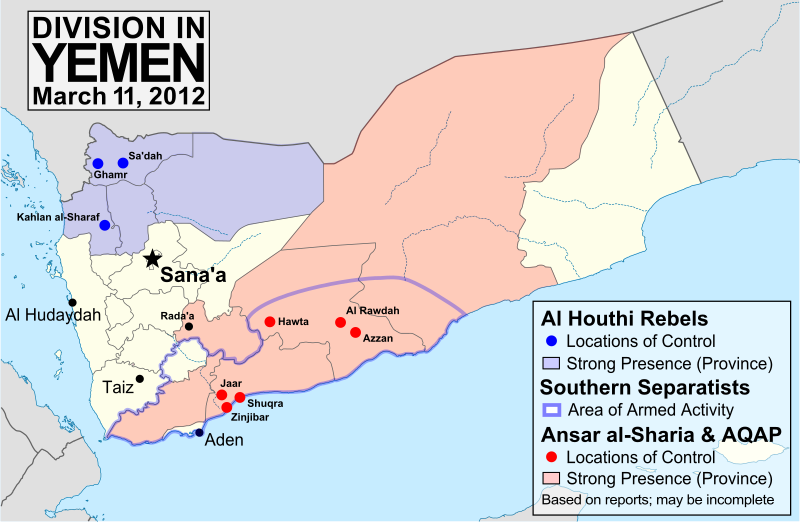
Yemen a clear target in US drone sights

August 6, 2013

Perhaps it is all connected to the current global alert and threats of terrorist actions supposedly emanating from Yemen, but there certainly seems to be a major US operation ongoing in Yemen.

File:Yemen division 2012-3-11.svg

Yemen Divisions – wikipedia

UPDATE 2:

Drone strikes kill eight suspected militants in Yemen on Thursday 8th August

UPDATE!

Another 7 were killed in Yemen by US drone attacks on Wednesday, 7th August.

============================================

In the last 10 days since July 27th , there have been at least 4 drone attacks killing 17 people in Yemen.

  • July 27th: 6 killed in Abyan province
  • July 30th: 3 killed in drone attack on a car in Shabwa
  • August 1st: 4 killed in drone attack in Habramawt
  • 5th August: 4 killed on Tuesday when two unmanned aircraft fired four missiles at two vehicles in Wadi Abidah district. 

According to the Washington-based New America Foundation, the US killer drone attacks in Yemen almost tripled in 2012. 

The advantage with drone attacks is that they are impersonal, supposed to be clinically accurate, relatively cheap and put no personnel from the attacking side at risk. The downside is that they pre-empt any due process, are subject to the accuracy of very fallible intelligence gatherers and are inherently inhumane being “untouched by human hands”. And the civilians and children who frequently are killed on the ground get brushed under the carpet of “collateral damage”.

All those who have been killed recently in Yemen are said to have been affiliated with Al Qaeda.

But the dead cannot deny their alleged guilt and we will never know.

“Plastic” beer losing ground in the US

August 5, 2013

Many of the mass produced US beers are – to my unsophisticated taste – little better than coloured dish water.

It is high time for a Campaign for Real Ale in the US.

From the Washington Post

Alcohol consumption in the US (Gallup)

Fairly stunning data from Gallup on Americans’ declining taste for beer compared to wine and hard liquor.

There are some interesting demographic internals, too. Back in the early nineties 71 percent of the 18-29 cohort preferred beer. Just 41 percent of today’s youth cohort says beer is their favorite, as do only 43 percent of 30 to 49 year olds. In other words, a cohort of beer lovers lost their taste for it as they became middle aged and was replaced by a new youth cohort that doesn’t like beer that much either.

What will be interesting to see is whether today’s young people follow their elders in becoming more beer-averse as they age.


Internet chatter leads to US diplomatic lockdown

August 5, 2013

Following my post a few days ago, it would seem that others also question the US Global Terror Alert.  I discern a faint whiff of alarmism and a strong smell of “CYA”.

Reblogged from Bloomberg

Warning to Americans: Be Afraid, Very Afraid

By Jeffrey Goldberg Aug 5, 2013 2:40 AM GMT+0200

Jeffrey Goldberg is a Bloomberg View columnist. He is the author of “Prisoners: A Story of Friendship and Terror” 

It seems as if al-Qaeda, or its Arabian Peninsula branch, has succeeded in terrorizing the United States of America again, but this time without – as of this writing – detonating an ounce of C4. It doesn’t strike me as a wise idea to preemptively shutter 21 different American embassies across the Middle East and North Africa in response to NSA-collected terrorist chatter. What message does this post-Benghazi, “don’t say we didn’t tell you” move send to the citizens of the Middle East, who, it is our hope, understand the United States to be a powerful and fearless country dedicated to openness and to the defeat of fanaticism? We have already muddied any message of fearlessness by turning our embassies into bunkers. Now, we are admitting that these bunkers aren’t safe. What next? Virtual embassies on Facebook? Ambassadors who never leave Washington?

The Administration tells us that the heightened threat of al-Qaeda terror extends through the end of the month. Is the State Department going to keep its diplomatic fortresses closed through September 1? Late this afternoon, State announced that 19 diplomatic posts are going to stay closed until August 10; others, including those in Baghdad, and Kabul, of all places, are scheduled to reopen Monday. It is unclear if these closings will be extended, or if the reopening embassies and consulates will again be closed. It could be that many of our diplomats — who, by the way, are still living in the target countries, just in less secure locations, generally, than embassy compounds – will not be at work for awhile. 

It is plausible that the intelligence community is fearful of this weekend in particular, because, as Bloomberg’s Nicole Gaouette and David Lerman have noted, Sunday is the Muslim holiday known as the Night of Power, and al-Qaeda-type extremists sometimes mark important holidays on the Muslim calendar by trying to kill people. So after the holiday passes, things could return to normal. It will be interesting to watch how the State Department manages this crisis – and, this time, it is being managed directly out of Washington. Usually, diplomatic posts are allowed to make their own judgments about security, independent of State Department headquarters. Not any more.

It will also be interesting to watch whether State clarifies its travelers’ alert to the American public. A couple of days ago, the department issued a warning to American travelers that was notable both for its implied dread and its maddening vagueness: “Terrorists may elect to use a variety of means and weapons and target both official and private interests,’ the warning reads. “U.S. citizens are reminded of the potential for terrorists to attack public transportation systems and other tourist infrastructure. Terrorists have targeted and attacked subway and rail systems, as well as aviation and maritime services. U.S. citizens should take every precaution to be aware of their surroundings and to adopt appropriate safety measures to protect themselves when traveling.”

As a public service, let me translate this warning for you: “Dear U.S. citizen: So, it turns out that al-Qaeda has not been defeated. In fact, its operatives want to kill you. Mainly, they want to kill you if you happen to be in one of the following 21 countries. Also, by the way, they want to kill you in the U.S., but right now let’s not talk about that, and focus on the immediate threat. We don’t know where, when or how al-Qaeda is going to try to kill you – probably August, if it makes you feel any better. In the past, al-Qaeda terrorists have targeted planes, trains, and automobiles, as well as large buildings, and small buildings. Also, boats. Our suggestion is that you not leave your hotel. And stay out of the lobby! Lobbies are dangerous. Actually, come to think of it, al-Qaeda has also targeted hotels in the past, so maybe you should just leave your hotel now, but through the kitchen, or the service entrance. But try to avoid people, and also places where there are people, once you have left your hotel. If you want to come home, please do so, but just be very careful at the airport. Thank you for your attention to this matter.”

In truth, the State Department is in a tough spot: If it doesn’t publicly issue warnings, and something dreadful, God forbid, does happen, the Obama Administration will be blamed by opportunists for not telling Americans they were in danger. But perhaps there is a way to issue these warnings in way that doesn’t fear-monger, and in a way that helps Americans make informed decisions. And perhaps there is a way to manage diplomatic security so as to avoid conveying to the world the idea that al-Qaeda can unhinge us quite so easily.

VitroGro, Tissue Therapies and QUT’s “inadvertent” data falsification?

August 4, 2013

The mysterious goings-on at the  whistle-blower fracas at the Queensland University of Technology seem to run quite deep. The mystery is apparently compounded by commercial interests. The elements include a company spun-off from QUT (Tissue Therapies), University staff owning stock in the company, the company raising start-up money, listed on the stock exchange and having a value entirely dependent upon the prospects for one breakthrough product (VitroGro).

The latest revelation suggests that the whistle- blowers, Luke Cormack and another – whose identity is protected but was “inadvertently” revealed by the University Vice Chancellor –  have been spied upon. Cormack was given “counselling” organised by the University – which counselling was never confidential. The contents of these discussions were apparently reported by the counselor to the University authorities!! Seems to be a remarkable absence of ethical standards at the University and – more particularly – with the counselor. Perhaps it was all “inadvertent”.

A summary of the story is here in the Courier-Mail.

His colleagues had discovered a cheaper and more reliable way to grow human tissue, with huge implications for biology and medicine. Cormack’s research concerning stem cells aimed to build on their findings.

But no matter what he tried, his cells refused to grow. He later failed his PhD.

The key question is whether VitroGro has real prospects or is just hype. It is supposed to be used in healing wounds by helping cells to grow. If VitroGro’s potential benefits have knowingly been hyped by the “inadvertently” manipulated data, then there is a risk that this is all a start-up scam.

Business start-up scams depend upon inflating the apparent value of a start-up company by promoting perceptions of a bright future such that investment money can be attracted.

(more…)

Twitter effectively accepts that it is a publisher and responsible for content

August 3, 2013

I have no doubt in my mind that social media such as Facebook, Twitter and LinkedIn are – in fact – publishers. They benefit from the advertising revenues raised on the back of their “reach” and must be responsible – and accountable – for the content they publish.

The abuse of a number of women on Twitter in the UK has now led the head of Twitter UK to personally apologise and for Twitter to now take a number of steps to prevent this kind of abuse. It is a tacit admission of responsibility for their content and completely undermines their previous stand that they are not a publisher. Even though Twitter is “requesting” its users to exercise restraint, their “commitment” makes it clear that Twitter is taking responsibility – even if only implicitly – for ensuring that their users exercise the proper restraint.

A well deserved pat on the back for Twitter (assuming they don’t back away from this commitment and later try to pin the blame on irresponsible users).

Tony Wang apology (Twitter UK)

Tony Wang apology (Twitter UK)

BBCThe boss of Twitter UK has said sorry to women who have experienced abuse on the social networking site. Tony Wang said the threats were “simply not acceptable” and pledged to do more to tackle abusive behaviour.

The apology came as Twitter updated its rules and confirmed it would introduce an in-tweet “report abuse” button on all platforms, including desktops. Police are investigating eight allegations of abuse including bomb and rape threats made against women.

Two people have been arrested in relation to Twitter rape threats against Labour MP Stella Creasy and feminist campaigner Caroline Criado-Perez, who received the threats after a campaign to have Jane Austen on the new £10 note.

Three female journalists said they were subjected to bomb threats on the site.

The revelations sparked a backlash online, with a petition calling for Twitter to add a “report abuse” button to tweets attracting more than 124,000 signatures. In a series of tweets, Twitter UK general manager Mr Wang said: 

  • “I personally apologize to the women who have experienced abuse on Twitter and for what they have gone through. The abuse they’ve received is simply not acceptable”.
  • “It’s not acceptable in the real world, and it’s not acceptable on Twitter”.
  • “There is more we can and will be doing to protect our users against abuse. That is our commitment.”

In an earlier message posted on its blog, Twitter’s senior director for trust and safety Del Harvey and Mr Wang said the company had clarified its anti-harassment policy in light of feedback from customers.

They said: “It comes down to this: people deserve to feel safe on Twitter.”

The company has clarified its guidance on abuse and spam – reiterating that users “may not engage in targeted abuse or harassment”.

The “report abuse” button already available on the iOS Twitter app and mobile site will also be rolled out to the main website and Android app from September, Twitter said.

Ms Harvey and Mr Wang wrote in their blog: “We want people to feel safe on Twitter, and we want the Twitter rules to send a clear message to anyone who thought that such behaviour was, or could ever be, acceptable.”

Is there an element of anti-Snowden PR in the current US security alert?

August 3, 2013

We shall never know of course.

Edward Snowden has revealed the absolutely massive scale on which the NSA gathers information – almost indiscriminately. The UK government and German government agencies are apparently complicit in this dredging of information. But in spite of this the US and its allies were not capable of anticipating events in North Africa and the Middle East. The Arab spring in particular seems to have caught all the Western intelligence agencies napping. The apparent lack of intelligence analysis about Egypt is particularly interesting. The threat to Mubarak – as close an ally of the US as you could get outside of Israel – was not anticipated. The threat of the Muslim Brotherhood was not anticipated. The dethronement of Mursi by the Army was not anticipated. The attack on the US Embassy in Libya – which was not some spontaneous mob action, but a planned attack  – was not anticipated.

The indiscriminate volume of intelligence gathering does not seem to be matched by the analytical capabilities of the intelligence gatherers. But they did find Osama – even if it took ten years. They did find the Boston bombers – very quickly but only after the event. But the intelligence for the drone attacks does not seem – from the number of civilians and children killed – to be very precise.

Post Snowden there is now considerable criticism even within the US about the level of intelligence gathering and leaves Obama and the Democrats looking like the enemies of civil liberties. The “escape” of Snowden and his asylum application in Russia leaves the Democratic administration in Washington looking inept at worst and severely embarrassed at best. After Snowden was granted a years residence in Russia, the White House media response was mere thrashing about. A summit meeting to be held this fall was threatened (does Putin even care?). Even the venue of next G20 meeing planned for St. Petersberg was “questioned” by a blustering White House spokesman.

And now comes this announcement of a Security Alert and an Al Qaida threat (unspecified) in North Africa and the Middle East. Perhaps there is a real threat. If it does not materialise then the NSA can take credit for thwarting the threat (even if it never existed). If some act of terror does materialise during August, the intelligence agencies will pat themselves on the back (but someone else will be blamed for not preventing the event).

BBC: The US state department has issued a global travel alert because of an unspecified al-Qaeda threat.

In a statement, the department said the potential for an attack was particularly strong in the Middle East and North Africa. It comes shortly after the US announced nearly two dozen embassies and consulates would be shut on Sunday.

The alert expires on 31 August 2013, the department said. It recommended US citizens travelling abroad be vigilant. “Current information suggests that al-Qaeda and affiliated organisations continue to plan terrorist attacks both in the region and beyond, and that they may focus efforts to conduct attacks in the period between now and the end of August,” the statement said.

Maybe there is a real threat — and maybe there is not. Certainly the track record of the intelligence agencies correctly forecasting events in the Middle East and North Africa is not terribly impressive.

The White House clearly does see an increasing need to justify the scope of its intelligence gathering activities. Obama needs to show his own left wing that he is not a “bad guy”. The Administration also needs to show that Snowden is not a hero and a defender of civil liberties and that he has actually put national security at risk. All these are matters of perception and can be addressed by “spin”.  I just observe that this current Security Alert – whether the threat is real or not – does achieve that – if only partially.

Idiot Science! Human conflict caused by cooler climate and/or by hotter climate

August 2, 2013

Silly science can sometimes just be idiot “science” and no science at all.

One says warmer temperatures cause human conflict, another that colder climate does so.

The idiocy lies first in assuming that climate is the determining factor for the political, economic, social and behavioural stresses that cause conflict among humans and second in the classic idiocy that correlation is equal to causation.

1. Solomon M. Hsiang, Marshall Burke and Edward Miguel, Quantifying the Influence of Climate on Human ConflictPublished Online August 1 2013, Science DOI: 10.1126/science.1235367

Abstract: A rapidly growing body of research examines whether human conflict can be affected by climatic changes. Drawing from archaeology, criminology, economics, geography, history, political science, and psychology, we assemble and analyze the 60 most rigorous quantitative studies and document, for the first time, a remarkable convergence of results. We find strong causal evidence linking climatic events to human conflict across a range of spatial and temporal scales and across all major regions of the world. The magnitude of climate’s influence is substantial: for each 1 standard deviation (1σ) change in climate toward warmer temperatures or more extreme rainfall, median estimates indicate that the frequency of interpersonal violence rises 4% and the frequency of intergroup conflict rises 14%. Because locations throughout the inhabited world are expected to warm 2 to 4σ by 2050, amplified rates of human conflict could represent a large and critical impact of anthropogenic climate change.

2. Ulf Büntgena, Tomáš Kyncld, Christian Ginzlera, David S. Jackse, Jan Esperf, Willy Tegelg, Karl-Uwe Heussnerh, and Josef Kyncld, Filling the Eastern European gap in millennium-long temperature reconstructions. Published online January 14, 2013, Proceedings of the National Academy of Sciences. doi:10.1073/pnas.1211485110.

Abstract: Tree ring–based temperature reconstructions form the scientific backbone of the current global change debate. Although some European records extend into medieval times, high-resolution, long-term, regional-scale paleoclimatic evidence is missing for the eastern part of the continent. Here we compile 545 samples of living trees and historical timbers from the greater Tatra region to reconstruct interannual to centennial-long variations in Eastern European May–June temperature back to 1040 AD. Recent anthropogenic warming exceeds the range of past natural climate variability. Increased plague outbreaks and political conflicts, as well as decreased settlement activities, coincided with temperature depressions. The Black Death in the mid-14th century, the Thirty Years War in the early 17th century, and the French Invasion of Russia in the early 19th century all occurred during the coldest episodes of the last millennium. A comparison with summer temperature reconstructions from Scandinavia, the Alps, and the Pyrenees emphasizes the seasonal and spatial specificity of our results, questioning those large-scale reconstructions that simply average individual sites.

Silly science? Evolution does not favour the selfish

August 1, 2013

Silly season is upon us.

Two Michigan University researchers claim that evolution will not sustain a “selfish gene” but will eventually select for cooperation.

Why am I not in the least bit convinced?

If either selfishness or cooperation was genetically determined, and if survival was dependent upon such a choice, then one or the other should have become extinct a long time ago.  The silliness of this work lies first in the assumption that a behavioural characteristic – even if crucial for survival – is merely determined by genetics.  Second, evolution never selects for excellence – whether in superlative selfishness or for unstinting cooperation. It represents the minimum of behavioural traits needed to survive till reproduction.

Evolution couldn’t care less if individuals are selfish or cooperative. It only results from those individuals sufficiently selfish or sufficiently cooperative for survival until reproduction. 

Of course the Daily Mail manages to put it in a remarkably silly headline:

Selfish people ‘will eventually die out’ because evolution favours cooperation

The paper is published in Nature Communications.

Christoph Adami, Arend Hintze. Evolutionary instability of zero-determinant strategies demonstrates that winning is not everythingNature Communications, 2013; 4 DOI:10.1038/ncomms3193

The accompanying press release trumpets

Evolution will punish you if you’re selfish and mean 

Two Michigan State University evolutionary biologists offer new evidence that evolution doesn’t favor the selfish, disproving a theory popularized in 2012.

“We found evolution will punish you if you’re selfish and mean,” said lead author Christoph Adami, MSU professor of microbiology and molecular genetics. “For a short time and against a specific set of opponents, some selfish organisms may come out ahead. But selfishness isn’t evolutionarily sustainable.”

The paper appears in the current issue of Nature Communications and focuses on game theory, which is used in biology, economics, political science and other disciplines. Much of the last 30 years of research has focused on how cooperation came to be, since it’s found in many forms of life, from single-cell organisms to people.

In 2012, a scientific paper unveiled a newly discovered strategy – called zero-determinant – that gave selfish players a guaranteed way to beat cooperative players.

“The paper caused quite a stir,” said Adami, who co-authored the paper with Arend Hintze, molecular and microbiology research associate. “The main result appeared to be completely new, despite 30 years of intense research in this area.”

Adami and Hintze had their doubts about whether following a zero determinant strategy (ZD) would essentially eliminate cooperation and create a world full of selfish beings. So they used high-powered computing to run hundreds of thousands of games and found ZD strategies can never be the product of evolution. While ZD strategies offer advantages when they’re used against non-ZD opponents, they don’t work well against other ZD opponents.

“In an evolutionary setting, with populations of strategies, you need extra information to distinguish each other,” Adami said.

So ZD strategies only worked if players knew who their opponents were and adapted their strategies accordingly. A ZD player would play one way against another ZD player and a different way against a cooperative player.

“The only way ZD strategists could survive would be if they could recognize their opponents,” Hintze said. “And even if ZD strategists kept winning so that only ZD strategists were left, in the long run they would have to evolve away from being ZD and become more cooperative. So they wouldn’t be ZD strategists anymore.” 

Game theory for an individual game or even for a succession of games is one thing but evolution does not care how selfish or how cooperative an individual is.

Economists are – by and large – religious or political advocates

August 1, 2013

A recent article by March Buchanan in Bloomberg got me to wondering why “Economists” and “Economics” – in spite of their gross and sometimes spectacular failures – have the high status they do. I come to the conclusion that “Economists” are – by and large – just religious or political advocates and “Economics” is no more than a study of social behaviour.

Is Economics a Science or a Religion?

The idea of economics as religion harks back to at least 2001, when economist Robert Nelson published a book on the subject. Nelson argued that the policy advice economists draw from their theories is never “value-neutral” but foists their values, dressed up to look like objective science, on the rest of us.

Take, for example, free trade. In judging its desirability, economists weigh projected costs and benefits, an approach that superficially seems objective. Yet economists decide what enters the analysis and what gets ignored. Such things as savings in wages or transport lend themselves easily to measurement in monetary terms, while others, such as the social disruption of a community, do not. The mathematical calculations give the analysis a scientific wrapping, even when the content is just an expression of values.

Similar biases influence policy considerations on everything from labor laws to climate change. As Nelson put it, “the priesthood of a modern secular religion of economic progress” has pushed a narrow vision of economic “efficiency,” wholly undeterred by a history of disastrous outcomes.

The practice of the black-magic that is considered economics – for it is certainly no science in the Popper sense – gets much of its cloak of respectability from the fact that the Nobel Prize exists (more correctly the Sveriges Riksbank Prize in Economic Sciences in Memory of Alfred Nobel).  

The Nobel prize in Economics should never have been created. In fact Nobel never wanted one and he is probably spinning in his grave as prize winners, one after another, prove – at best – to be mere historians and – at worst – religious or political zealots.  The prize adds more stature to the discipline of economics than it deserves. Almost every economic theorist has developed wonderful hindcasts but few – if any – have produced theories which can consistently make correct forecasts.

WikipediaThe Prize in Economics is not one of the original Nobel Prizes created by the will of Alfred Nobel. ……. In his speech at the 1974 Nobel Banquet Friedrich Hayek stated that if he had been consulted whether to establish a Nobel Prize in economics he would “have decidedly advised against it” primarily because “the Nobel Prize confers on an individual an authority which in economics no man ought to possess… This does not matter in the natural sciences. Here the influence exercised by an individual is chiefly an influence on his fellow experts; and they will soon cut him down to size if he exceeds his competence. But the influence of the economist that mainly matters is an influence over laymen: politicians, journalists, civil servants and the public generally.”

The Nobel family are among the harshest critics of the Economics Prize being associated with Alfred Nobel:

“The Economics Prize has nestled itself in and is awarded as if it were a Nobel Prize. But it’s a PR coup by economists to improve their reputation,” Nobel’s great great nephew Peter Nobel  told AFP in 2005, adding that “It’s most often awarded to stock market speculators …. There is nothing to indicate that [Alfred Nobel] would have wanted such a prize.”

Members of the Nobel family are among the harshest, most persistent critics of the economics prize, and members of the family have repeatedly called for the prize to be abolished or renamed. In 2001, on the 100th anniversery of the Nobel Prizes, four family members published a letter in the Swedish paper  Svenska Dagbladet, arguing that the economics prize degrades and cheapens the real Nobel Prizes. They aren’t the only ones.

To make it worse the Prize  is now “available to researchers in such topics as political science, psychology, and sociology”.

The political advocacy which is inherent in the theses promoted by Nobel Economics laureates have led to spectacular failures. Milton Friedman and his rabid monetarism gave rise to many of the crises today, Muhammad Yunus and the Grameen bank with their concept and practice of microcredit have exacerbated the risks of the debt trap into which so many small farmers have fallen. Krugman’s politics are essentially of the left and usually encourage profligacy. His analyses are more destructive than constructive and he has fault to find with almost every other theorist cutting across all political boundaries. He himself has yet to advocate any consistently successful theories. Amartya Sen focuses on analysing the “economics of poverty” but has nothing real to offer for its alleviation beyond platitudes representing his own political values from his ivory tower.

The world’s economies lurch from one crisis to the next but rarely are the crises foreseen. The only constant that can be observed is that growth – when it happens – leads to the improvement of the human condition but no “economic theory” has been able to deliver sustained growth. Growth – when it happens – achieves more for poverty alleviation than any social welfare program. Real wealth creation achieves more in achieving full employment or achieving social equality than merely redistributing a static pot of wealth.

As Mark Buchanan writes:

There’s a real danger in seeing economics as an objective science from which all values have been stripped.

It may be that “economics” will always be subject to the vagaries of human attitudes and behaviour and – since these are never constant or rational – that economics theory applied to political reality can never be more than a very short-term action plan.