Archive for the ‘Biodiversity’ Category

Too much biodiversity – time to let some species die out

July 28, 2014

Conservationists would have us believe that the earth is losing species at an alarming rate and that evil humanity is to blame and therefore more and more species must be protected by “freezing” them into an unnatural existence. Alarmist “conservationism” has led to the ridiculous situation where successful species are termed pests and are eradicated. Hopelessly unfit species – if they are cuddly or otherwise attractive to watch – are protected by being sentenced to a “frozen” existence in zoos or in “protected” and totally unnatural and anachronistic habitats.

I was just watching a program about the highly successful urban coyotes of N. America. They have found a new prey in domestic pets and are thriving. But having adapted successfully to the changing environment they have – needless to say – earned  the status of being declared a pest to be wiped out!!

And yet there have never been more species alive than there are today.

A new review paper warns with great alarm about another impending mass extinction due to the loss of fauna that man has caused. The press release for this paper (why do scientific papers need press releases?) begins thus:

Stanford biologist warns of early stages of Earth’s 6th mass extinction event

The planet’s current biodiversity, the product of 3.5 billion years of evolutionary trial and error, is the highest in the history of life. But it may be reaching a tipping point.

In a new review of scientific literature and analysis of data published in Science, an international team of scientists cautions that the loss and decline of animals is contributing to what appears to be the early days of the planet’s sixth mass biological extinction event.

If biodiversity “is the highest in the history of life” and many species are incapable of adapting to the world they live in, perhaps it is time for them to exit gracefully.

Perhaps the progress of humankind requires that some of these obsolete species must be allowed to disappear.

The dangers of reducing biodiversity are being hyped to a ridiculous extent. Without the mass extinctions of the past, most of the species living today would never have evolved. If the dinosaurs had not gone extinct we would not be around. And the disappearance of the dodo has not increased any threat to humanity.

Related:

Fighting against species extinction is to deny evolution

Genetic adaptation – not stagnating conservation – is the way to help threatened species

Polar bears neither threatened nor endangered

June 10, 2014

It has become increasingly clear that polar bear numbers have been grossly (and probably intentionally) underestimated and that reality is beginning to displace the alarmist myth of the species being under threat. Canada has declined to classify the polar bears as being “threatened or endangered”.

This has not pleased the environmental priesthood  at all. The Center for Biological Diversity has lobbied heavily in the US against the Canadian decision not to toe the politically correct lineThey appealed to an international NAFTA environmental panel to “investigate”  Canada’s failure to implement NAFTA rules by failing to classify the thriving polar bears as “threatened and endangered”.

This appeal has been rejected.

Polar bears remain unthreatened and unendangered in Canada.

An international trade panel has decided not to review whether Canada is enforcing its own environmental legislation to protect its polar bear population.

photo Geoff York/Reuters

cbcnews:

An international trade panel has decided not to review whether Canada is enforcing its own environmental legislation to protect its polar bear population.

The Commission for Environmental Co-operation voted 2-1 to reject a request for an investigation into why Canada has chosen not to designate the bears as threatened or endangered. A U.S. environmental group had filed a submission claiming that decision leaves the bears without protection, despite the ongoing loss of their sea-ice habitat and resulting projections of declining numbers.

Related:

Activists pressure tactics to force Canada to list polar bears as ‘threatened’ have failed June 7th, 2014

Canada under international pressure to list polar bears as threatened, so far holds out January 27, 2013

Canada again under international pressure to list polar bears as threatened November 24, 2013

Plant and virus life revived after 30,000 years in the Siberian permafrost

March 4, 2014

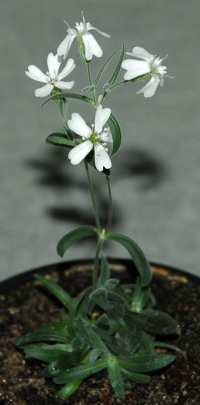
Two years ago we heard about plants being grown from seeds and pods preserved for 30,000 years in the Siberian permafrost. And now comes the news that a giant virus of that time has also been revived and is still capable of infecting other life.

This would have been about 1,500 generations ago. 30,000 years ago the Neanderthals had just disappeared, mammoths, woolly rhinoceros and long-horned bison roamed in Siberia. Modern humans had reached Europe but had not reached the Americas. It was at the peak of the last glacial and the spread of agriculture was still some 15,000 years in the future.

A prehistoric plant resurrected from frozen tissue. S. Yashina et al. Proc. Natl Acad. Sci. USA

1. Wild flower blooms again after 30,000 years on ice 

During the Ice Age, Earth’s northern reaches were covered by chilly, arid grasslands roamed by mammoths, woolly rhinoceros and long-horned bison. That ecosystem, known by palaeontologists as the mammoth steppe, vanished about 13,000 years ago. It has no modern counterpart.

Yet one of its plants has reportedly been resurrected by a team of scientists who tapped a treasure trove of fruits and seeds, buried some 30,000 years ago by ground squirrels and preserved in the permafrost 

The plant would be by far the most ancient ever revived; the previous record holder was a date palm grown from seeds roughly 2,000 years old. ….. . took samples of placental tissue from S. stenophylla fruits. The plant placenta — an example of which is the white matter inside a bell pepper — gives rise to and holds the seeds. The tissue produced shoots when it was cultivated in vitro, and the scientists used these to propagate more plants. They are the oldest living multicellular organisms on Earth, the team says.

The plants have already blossomed to produce fertile seeds, which were grown into a second generation of fertile plants. During propagation, the ancient form of the wild flower produced more buds but was slower to put out roots than modern S. stenophylla, which is found along the banks of the Kolyma. This suggests that the original has a distinct phenotype, adapted to the extreme environment of the Ice Age.

(S. Yashina et al. Proc. Natl Acad. Sci. USA http://dx.doi.org/10.1073/pnas.1118386109; 2012).

2. Giant virus resurrected from 30,000-year-old ice

In what seems like a plot straight out of a low-budget science-fiction film, scientists have revived a giant virus that was buried in Siberian ice for 30,000 years — and it is still infectious. Its targets, fortunately, are amoebae… The newly thawed virus is the biggest one ever found. At 1.5 micrometres long, it is comparable in size to a small bacterium. Evolutionary biologists Jean-Michel Claverie and Chantal Abergel, the husband-and-wife team at Aix-Marseille University in France who led the work, named it Pithovirus sibericum, inspired by the Greek word ‘pithos’ for the large container used by the ancient Greeks to store wine and food. “We’re French, so we had to put wine in the story,” says Claverie. The results are published in Proceedings of the National Academy of Sciences.

Legendre, M. et al. Proc. Natl Acad. Sci. USA http://dx.doi.org/10.1073/pnas.1320670111(2014).

Under a microscope, Pithovirus appears as a thick-walled oval with an opening at one end, much like the Pandoraviruses. But despite their similar shapes, Abergel notes that “they are totally different viruses”. …. Pithovirus has a ‘cork’ with a honeycomb structure capping its opening (see electron-microscope image). It copies itself by building replication ‘factories’ in its host’s cytoplasm, rather than by taking over the nucleus, as most viruses do. Only one-third of its proteins bear any similarity to those of other viruses. And, to the team’s surprise, its genome is much smaller than those of the Pandoraviruses, despite its larger size. ….

While “cloning” of ancient and extinct species is not really possible, it is not too fanciful to imagine that ancient DNA and modern hosts could give rise to creatures having characteristics beneficial during an ice age. And perhaps that could be of some interest when this interglacial ends – as it must – and we do enter into another glacial period.

Cold resistant, woolly cattle and well trained sabre-tooth tigers to mange the wandering herds perhaps. Maybe we might then even want some extra Neanderthal DNA injected into us!! Finally a use for biodiversity!

The Pirates of Greenpeace

October 3, 2013

Greenpeace is not just becoming, it already is , a comic soap opera.

This is to be sung to the tune of I am the Very Model of a Modern Major-General” from The Pirates of Penzance.

Preferably after dinner with a cognac (or two) and a good cigar!

(With thanks and apologies of course to Gilbert and Sullivan)

The Pirates of Greenpeace or I am the very model of a modern Environ-Mentalist

I am the very model of a modern Environ-Mentalist
I’ve information vegetable, animal, and min’ralist,
I know the Sins of Nations, and I quote the fights rightorical
From Vancouver to Murmansk, in order categorical;
I’m very well acquainted, too, with crises hypothetical,
I understand ecology, both the stupid and the fanciful,
About bio-diversity I’m teeming with a lot o’ fears
With many, many made-up facts ’bout the dying of the polar bears
I’m very good at man-made global warming ideology;
I know the sensitivity of fossil fuel combustology:
In short, in matters vegetable, animal, and min’ralist,
I am the very model of a modern Environ-Mentalist
I know our mythic history, and Nuclear power efficacy; 
I answer hard acrostics, I’ve a pretty taste for Piracy,
I can quote in haiku all the crimes of Big Petroleum;
Genetic crops to feed the poor meet with my opprobrium;
I can tell undoubted radicals from all the evil conservatives;
For all the problems of the world, I have the simple preservatives!
Then I can hum a fugue of which I’ve heard the music’s din afore, 
And whistle all the airs from that infernal nonsense Pinafore.
Then I can write an alarmist screed in IPCC complexity,
And tell you ev’ry detail of Pachauri’s Nobel perplexity.
In short, in matters vegetable, animal, and min’ralist,
I am the very model of a modern Environ-Mentalist.
In fact, when I know what is meant by “Decadal” and “Oscillatus”,
When I can tell at sight a hockey-stick from a hiatus,
When with such affairs as PDO’s and ADO’s I’m more adept,
And when with cosmic rays and clouds I’m a little more abreast,
When I have learnt what progress has been made in modern statistickery,
When I know more of tactics than a novice in a nunnery –
In short, when I’ve a smattering of physics elementary
You’ll say a better Environ-Mentalist was never so exemplary
For my scientific knowledge, though I’m plucky and adventury,
Has only been brought down to the start of the last century;
But still, in matters vegetable, animal, and min’ralist,
I am the very model of a modern Environ-Mentalist.

Christianity should do more for biodiversity!

September 5, 2013

I kid you not.

A new paper at Oryx – The International Journal of Conservation by Swedish and Australian researchers.

 ” … the Roman Catholic and Orthodox Churches appear to have the greatest per capita opportunity to influence discourse on biodiversity… “

Does this count as science? or advocacy? or is it theological economics?

What were they thinking?

Grzegorz Mikusiński, Hugh P. Possingham and Malgorzata Blicharska, Biodiversity priority areas and religions—a global analysis of spatial overlapOryx, available on CJO2013. doi:10.1017/S0030605312000993. 

Abstract:Numerous solutions have been proposed to slow the accelerating loss of biodiversity. Thinking about biodiversity conservation has not, however, been incorporated into the everyday activities of most individuals and nations. Conservation scientists need to refocus on strategies that reshape ethical attitudes to nature and encourage pro-environmental thinking and lifestyles. Religions are central to basic beliefs and ethics that influence people’s behaviour and should be considered more seriously in biodiversity discourse. Using data from the World Religion Database we conducted an analysis of the spatial overlap between major global religions and seven templates for prioritizing biodiversity action. Our analysis indicated that the majority of these focal areas are situated in countries dominated by Christianity, and particularly the Roman Catholic denomination. Moreover, the Roman Catholic and Orthodox Churches appear to have the greatest per capita opportunity to influence discourse on biodiversity, notwithstanding the role of other religious communities in some key biodiversity areas.

From EurekAlert:

A new study carried out by ecologists at the Swedish University of Agricultural Sciences, among others, indicates that if the world’s religious leaders wished to bring about a change, they would be ideally positioned to do so

Leaders of the major world religions can play a key role in preserving biological diversity. A new study carried out by ecologists at the Swedish University of Agricultural Sciences (SLU), among others, indicates that if the world’s religious leaders wished to bring about a change, they would be ideally positioned to do so. …. 

…. Religions strive to be morally good and for centuries have led people in terms of right and wrong. Therefore, says Grzegorz Mikusinski, they have the potential to guide them to “miracles” also when it comes to conservation in the places where the religion has a great influence on society.

– The results show that Roman Catholics, per capita, have the greatest potential to preserve biological diversity where they live, says Hugh Possingham, a researcher at University of Queensland, Australia, and a co-author of the study.

The Catholic Church has just elected a pope, Francis – a name associated with the Catholic Church’s “greenest” saint, Francis of Assisi, the special patron saint of ecology. Let us hope that he and other religious leaders seriously consider the possibility of becoming more involved in the conservation debate. But at the same time scientists need to more actively encourage religious leaders to take part in such a debate.

Many solutions have been proposed to halt the loss of biological diversity. But the notion of conservation has seldom become part of daily life, either among individuals or among nations.

– Conservation research needs to adjust its focus, toward strategies that can change people’s ethical attitudes toward nature and encourage modes of thinking and lifestyles that are good for the environment, says Malgorzata Blicharska, a researcher at SLU and a co-author of the study. Religions are central to fundamental beliefs and ethics that influence people, and they should be taken more seriously in the debate about biological diversity.

Or these religious leaders could just lead the prayers!

100 Viking queens to be trapped and transported to England

May 1, 2013

It’s the first of May and May is when they emerge from hibernation and are most abundant in Skåne in southern Sweden. But for some of them the freedom they are enjoying will be short lived.

Trappers from the UK have been given permission to capture 100 queens, refrigerate them to induce an artificial hibernation for travel and then transport them to the UK to “rape and pillage” the country-side and hopefully repopulate parts of Kent. A programme was started in 2009 to reintroduce them to the United Kingdom with queens from New Zealand. However this was not a success as many of the queens died during hibernation. DNA analysis of the New Zealand queens showed they lacked genetic diversity.

The queens of the short-haired bumblebee, Bombus subterraneus, are the unfortunate creatures being hunted. It remains to be seen if the Viking queens fare any better than their Antipodean sisters.

Swedish Radio reports:

British scientists have been allowed to capture and bring home 100 Queens of the short-haired bumblebee, fairly common in Skåne but extinct in England. Bumblebees are needed to pollinate plants and vegetables, said Nikki Gammans from Natural England, who leads this unusual hunt, when she presented the project to a large press contingent  today outside Lund . When the British began this effort last year, it was not everybody who applauded, but the resistance was mainlydue to misunderstandings according to the provincial government in Skåne.

From Natural England:

Short-haired bumblebee (c) Nikki Gammans

Short-haired bumblebee (c) Nikki Gammans

After months of careful planning and negotiations, a team of experts led by Dr Nikki Gammans have embarked on a special mission to bring short-haired bumblebee queens back to the UK from the south of Sweden.

After a period of quarantine, It is hoped the bees can then be released on the RSPB Dungeness reserve in May 2012 and eventually colonise the surrounding area – see press release. …..

…. The Short-haired bumblebee, Bombus subterraneus, was last seen at Dungeness in Kent in 1988 and was officially declared extinct in 2000 after many repeated searches. We believe this bee species along with the other threatened bumblebee species have suffered due to the loss of flower-rich habitats such as meadows.

Over the last 60 years, the UK has lost over 97% of its wild flower meadows due to intensifying agricultural practices. It is also likely that the removal of hedgerows from the UK may have reduced the available nesting and hibernation sites for short-haired bumblebees.

While I can see that such a project could be fascinating and challenging, the purpose of the exercise as described by Natural England is rather vague and fuzzy and well-meaning and not at all very convincing. Vague claims of being “critical” to our farming economy read like a sales pitch. These bumblebees failed to adapt / evolve to survive in the UK. Yet they are being  re-introduced without any actions to make the species more likely – genetically – to survive in its new environment. All that has been done is to create some protected habitat (flower corridors). It seems to me that the “conservation” movement is far too backward-looking and must focus more on helping threatened species to evolve genetically rather than trying to prevent the changes to habitat which are inevitable:

Bumblebees pollinate many important agricultural crops and are critical to our farming economy. More bumblebees = better crop pollination – there is evidence that the shortage of pollinators is reducing crop yields. By creating corridors of flower-rich habitat across Romney Marsh area, we have seen an increase and spread in the numbers of bumblebee species in Kent. Five threatened species, which include England’s rarest bumblebee the shrill carder bee, have all increased their geographic range in this area after decades of decline.

Conservation movement’s focus is anachronistic and counterproductive – Peter Kareiva, Chief Scientist of the The Nature Conservancy.

April 4, 2012

The environmental and conservation movements lost their way when they moved to imposing their vision of the world onto others by fashioning people rather than fashioning a world to suit the needs of people. They started – in a formal sense – perhaps 60 – 70 years ago with the best of motives but became heavily politicised through the 80’s and since then have been more concerned about moulding people to fit their world view rather than serving the needs of human development. The environment – in some idealised and pristine form – even without man has been priorotised instead of being the surroundings to meet the needs of humans.  Biodiversity has been made into a false god and human development has been condemned as a demon. Alarmism has been used as the vehicle for imposing change.

An article in Breakthrough Journal is causing a few waves. This essay is full of “common sense” but what makes it noteworthy is that its authors – Peter Kareiva, Robert Lalasz and Michelle Marvier – are all senior figures in The Nature Conservancy. Common sense from the environmental and conservations “movements” has been sadly absent in recent times.The essay is posted at the Breakthrough Journal and the Journal’s publicity states:

 “By its own measures, conservation is failing. Biodiversity on Earth continues its rapid decline. We continue to lose forests in Africa, Asia, and Latin America. There are so few wild tigers and apes that they will be lost forever if current trends continue. Simply put, we are losing many more special places and species than we’re saving.”

So begins a searing indictment by the unlikeliest of sources: Peter Kareiva, chief scientist of The Nature Conservancy, the world’s largest conservation organization. …. Conservationists need to work with development, not condemn it as leading to the end of nature. In truth, nature’s resilience has been overlooked, its fragility “grossly overstated.” Areas blasted by nuclear radiation are bio-diverse. Forest cover is rising in the Northern Hemisphere even as it declines globally. …. 
And it’s time to stop prioritizing being alone over being with others.

The essay itself is well worth reading and selected extracts are reproduced below:

(more…)

On biodiversity and conservation and the number of frog species

September 17, 2011

One of the politically correct and alarmist themes that pervades the conservation movement is that biodiversity is vital and is dangerously threatened. Generally biodiversity can be considered to include

  1. gene diversity within a particular species, and
  2. species diversity within some particular region
Sometimes having different ecosystems and environments within a particular region is also included as being a form of ecological biodiversity. Yet it has always been inexplicable to me as to why human intervention for the protection of a species which has been out-competed by other species is not considered unnatural and artificial. Extinction of species happens naturally as a consequence of natural selection and evolution as some species succeed and others fail. If species did not fail and become extinct there would be diminishing space for evolution of other species. More species are thought to have become extinct than are in existence today.
I find that there is a fundamental conflict between allowing evolution to happen naturally with successful species (and that includes humans) eliminating unsuccessful species and the conservationist view of interfering with this normal development in favour of artificially maintaining failed species.
Conservationism at heart is a conservative (with a small “c”) and backward looking philosophy trying to prevent development and evolution because of fear. I suppose that is why I find “conservationsim” unattractive – because it is based on fear subordinating actions and that – by definition – is cowardice. King Canute trying to hold back the tide!
As I have posted earlier: The problem is not only that we have not identified all the eukaryote species in existence (and about 1.3 million have been classified and named) but we have no idea whether the number in existence is to be measured in millions or in hundreds of millions. About 15,000 new species are identified and catalogued each year. If  Bacteria and Archaea are added to eukaryotes, the total number of species could be in the billions.
Vub night frog
And with so many species around why should humans interfere to protect some but not others. In fact some species are considered interlopers in some regions and then conservation is all about exterminating these.
We do not know how many frog species exist and new species are being “discovered” continuously. Species thought to have become extinct are rediscovered. Of course a “discovery” of a species has nothing to say about how long that species has been in existence. And the importance of any particular species to the future of humans and the environment humans survive and thrive in is an unknown unknown.
Wired  – which is a very politically correct on-line journal – reports that 12 New and 3 Lost Night-Frog Species Discovered in India. Researchers in India have found a dozen new frog species belonging to the night frog group, named for their nocturnal habits, and rediscovered three species, one of which had not been seen in nearly a century. The findings appeared in the journal Zootaxa on Sept. 15. …… half of the newly discovered species reproduce without any physical contact between the sexes, with the female depositing her eggs on a leaf and the males later fertilizing them.
All the frogs were spotted in a region known as the Western Ghats, a mountain range than runs along the western coast of India that has been identified as one of the ten hottest biodiversity hotspots in the world. Because of the small area they occupy, at least six of the new species are sensitive to habitat loss and will require immediate steps toward conservation.
I find the conclusion that “the new species are sensitive to habitat loss and will require immediate steps toward conservation”  illogical and inexplicable.
Why interfere?
Just the number of articles about frogs in Wired in recent times further deepens the mystery. It only demonstrates all we don’t know that we don’t know. Even if out of fear of what is to come, humans were to try and intervene and protect every discovered species, the intervention would still fail and would not return us to the time of the dinosaurs.

Conservationism – as an ism – has no clear purpose that I can see.

Number of species on the planet is an unknown unknown – so what is the importance of biodiversity?

August 24, 2011
PLoS Biology_front page_2010-03-01

Image by Bettaman via Flickr

The importance of biodiversity and the loss of species as humans take over their habitats is one of the favourite themes of the environmental movement. But I have yet to see a clear exposition as to why the natural loss of species unable to cope with change is something to be opposed. The diversity of life is certainly one of the most striking aspects of our planet and it is not hard to accept that knowing how many species inhabit Earth is a fundamental question in science. In fact, without knowing this number any comments – let alone conclusions – about the danger of loss of species or the importance of bio-diversity to humanity can only be speculation.

The problem is not only that we have not identified all the eukaryote species in existence (and about 1.3 million have been classified and named) but we have no idea whether the number in existence is to be measured in millions or in hundreds of millions. About 15,000 new species are identified and catalogued each year. If  Bacteria and Archaea are added to eukaryotes, the total number of species could be in the billions.

A new paper in PLoS Biology using a relatively new methodology predicts the total number of species that exist. They claim that “the higher taxonomic classification of species (i.e., the assignment of species to phylum, class, order, family, and genus) follows a consistent and predictable pattern from which the total number of species in a taxonomic group can be estimated”. Using this approach they conclude that “there are ~8.7 million (±1.3 million SE) eukaryotic species globally, of which ~2.2 million (±0.18 million SE) are marine. …. (and) some 86% of existing species on Earth and 91% of species in the ocean still await description”.

Mora C, Tittensor DP, Adl S, Simpson AGB, Worm B (2011) How Many Species Are There on Earth and in the Ocean? PLoS Biol 9(8): e1001127. doi:10.1371/journal.pbio.1001127 

But the paper is already facing objections. The methodology – some claim – actually only estmates human activity in classifying species and not the species themselves. It does seem like an extrapolation from “what has been found” to predict “all that can possibly be found” and the argument is somewhat circular and not fully convincing. It brings to mind the quotation from Donald Rumsfeld which he was castigated for but which I am finding increasingly profound:

There are known knowns; there are things we know we know.
We also know there are known unknowns; that is to say we know there are some things we do not know.
But there are also unknown unknowns – the ones we don’t know we don’t know.

I think we are still in the state of not knowing what we do not know.

NY Times

“It’s astounding that we don’t know the most basic thing about life,” said Boris Worm, a marine biologist at Dalhousie University in Nova Scotia. On Tuesday, Dr. Worm, Dr. Mora and their colleagues presented the latest estimate of how many species there are, based on a new method they have developed. They estimate there are 8.7 million species on the planet, plus or minus 1.3 million.

In 1833, a British entomologist named John Obadiah Westwood made the earliest known estimate of global biodiversity by guessing how many insect species there are. He estimated how many species of insects lived on each plant species in England, and then extrapolated that figure across the whole planet. “If we say 400,000, we shall, perhaps, not be very wide of the truth,” he wrote. Today, scientists know the Westwood figure is far too low. They’ve already found more than a million insect species, and their discovery rate shows no signs of slowing down.

In 1988, Robert May, an evolutionary biologist at the University of Oxford, observed that the diversity of land animals increases as they get smaller. He reasoned that we probably have found most of the species of big animals, like mammals and birds, so he used their diversity to calculate the diversity of smaller animals. He ended up with an estimate 10 to 50 million species of land animals.

For the new estimate, the scientists came up with a method of their own, based on how taxonomists classify species. Each species belongs to a larger group called a genus, which belongs to a larger group called a family, and so on. .. In 2002, researchers at the University of Rome published a paper in which they used these higher groups to estimate the diversity of plants around Italy. There were fewer higher-level groups than lower ones at each site, like the layers of a pyramid. The scientists could estimate how many species there were at each site, much as it’s possible to estimate how big the bottom layer of a pyramid based on the rest of it. . … The scientists built a taxonomic pyramid to estimate the total number of species in well-studied groups, like mammals and birds. (They) then used it on all major groups of species, coming up with estimates of 7.7 million species of animals, for example, and 298,000 species of plants.

Terry Erwin, an entomologist at the Smithsonian Institution, think there’s a big flaw in the study. There’s no reason to assume that the diversity in little-studied groups will follow the rules of well-studied ones. “They’re measuring human activity, not biodiversity,” he said. David Pollock, an evolutionary biologist at the University of Colorado who studies fungi — a particularly understudied group — agrees. “This appears to be an incredibly ill-founded approach,” he said. There are 43,271 cataloged species of fungi, based on which Dr. Mora and his colleagues estimate there are 660,000 species of fungi on Earth. But other studies on fungus diversity suggest the number may be as high as 5.1 million species. ….

Jonathan Eisen, an expert on microbial diversity at the University of California, Davis, said he found the new paper disappointing. “This is akin to saying, ‘Dinosaurs roamed the Earth more than 500 years ago,’ ” he said. “While true, what is the point of saying it?”

At least it could be argued that there are not less than 8.7 million eukaryotic species. This is not likely to be the end of this story. Nevertheless it does at least show the scale of the problem and that the number of all living species (and not just eukaryotes) is still in the realm of the unknown.

And the importance of the disappearance of unsuccessful species and of the resulting bio-diversity on humanity is still an unknown unknown.

Manatees threatened by cold Florida waters – must be global warming

December 30, 2010

Manatees clearly are not too impressed by the effects of global warming and are swimming out of the chilly Gulf of Mexico waters and into warmer springs and power plant discharge canals. On Tuesday, more than 300 manatees floated into the outflow of Tampa Electric’s Big Bend Power Station reports Physorg.com:

Manatees paddle to warm water to escape Fla. chill (AP)

Manatees congregate in a canal where discharge from a nearby Florida Power & Light plant warms the water in Fort Lauderdale, Fla. Tuesday, Dec. 28, 2010.

“It’s like a warm bathtub for them,” said Wendy Anastasiou, an environmental specialist at the power station’s manatee viewing center. “They come in here and hang out and loll around.”

Cold weather can weaken manatees’ immune systems and eventually kill them. State officials said 2010 has been a deadly year for the beloved animals: between Jan. 1 and Dec. 17, 246 manatees died from so-called “cold stress.” During the same time period in 2009, only 55 manatees died from the cold. In 2008, only 22 manatees succumbed to chilly temperatures.

Manatee deaths documented from Jan. 1 through Dec. 5 are nearly double the five-year average for that time period, according to Florida Fish and Wildlife Conservation Commission statistics.

“Obviously we’re very concerned as an agency about the unusually high number of manatee deaths this year,” said Wendy Quigley, a spokeswoman with the state-run Fish and Wildlife Research Institute in St. Petersburg.

A total of 699 manatees were found dead between Jan. 1 and Dec. 5; state officials say it’s likely the cold temperatures also contributed to many of the 203 deaths in the “undetermined” category and the 68 deaths of manatees whose bodies could not be recovered.

Quigley noted that the statistics don’t even include this week’s cold snap, which sent temperatures plummeting into the 30s in parts of South Florida overnight and into the teens in the central part of the state.

Tampa Bay and Gulf water temperatures are hovering around 50 degrees, said Anastasiou. When the water dips below 68, manatees seek warmer waters – usually springs or the power plant discharge canals. The water temperature in the power plant’s Big Bend canal ranges from about 65-75 degrees, Anastasiou said. Even though they’re huge animals, manatees are very cold sensitive……… During last year’s cold snap, some 329 manatees congregated at the Tampa Electric power station. In Broward County on Tuesday, some 50 manatees gathered in the outfall of a Florida Power and Light plant.