Archive for the ‘Business’ Category

Trent 900: European Aviation Safety Agency (EASA) relaxed earlier directive and reduced inspection frequency

November 13, 2010

Now that it seems that the main cause of the uncontained failure of the Trent 900 on Qantas Airbus QF32 has been diagnosed, and that a remedy is being implemented, attention is turning to the Regulators.

In September the FAA issued an Airworthiness Directive (AD) for the Trent 900 based on an AD issued in August by the European Aviation Safety Agency (EASA). Since the incident EASA has now issued an Emergency AD regarding the inspection of wear within the Trent 900.

Yesterday  Joerg Handwerg, a spokesman for the pilots’ union for Lufthansa said that minor problems are routine for any jet engine, but it is possible that the issues were an indication that regulators did not adequately check the engine before approving it for commercial use. “When you see we have a problem with not just one of these engines but several then it points towards that we have a problem in the certification process,” Handwerg said.

Today Business Week (carrying an AP report) writes that “Air agency issued engine warning then eased checks”

Three months before a superjumbo jet engine blew apart and forced an emergency landing, European safety regulators had relaxed their inspection order for the same section of the engine implicated in the dangerous mishap. In January, the European Aviation Safety Agency required airlines to inspect for wear on the shaft that holds one of the Rolls-Royce Trent 900 engine’s turbine discs. The more wear they found, the sooner future inspections would be required.

In August, after Rolls-Royce had inspected several engines, EASA revised its directive. Previously, airlines had to calculate how worn out the part was based on the worst spot. Under the revised directive they calculate the average wear over the entire part. And previously they had to assume the part was wearing out at a worst-case rate. The new rule allows them to calculate the wear rate on each engine. That meant less frequent inspections, which the revised directive said were “sufficient to prevent unacceptable wear.”

The implication here is that the airlines (or Rolls Royce) were finding the inspection regime onerous and EASA responded by rationalising the change to base the frequency of future inspections on “average” wear rather than the “worst case wear” observed. Inspections of course require skilled resources, cost money and increase the down-time of aircraft. It becomes essentially an issue of operational cost. EASA – like all regulators – has to walk the tightrope balancing between public safety interests and the airlines’ need to keep costs reasonable.

Business Week continues that EASA apparently avoided the use of the word “uncontained” in its AD whereas the FAA Directive was more sharply worded:

The European directives warned of the potential for “in-flight shut down, oil migration and oil fire.” The U.S. Federal Aviation Administration went further in adopting a version of the European directive in September, warning of an “uncontained failure of the engine, and damage to the airplane.” Some of the parts inside jet engines rotate faster than the speed of sound. Engines are designed so that even if part of one shatters, pieces of metal aren’t sent rocketing away from the engine. An “uncontained engine failure” with shrapnel-like engine pieces that can damage other parts of the plane is both rare and extremely dangerous.

That’s what happened Nov. 4. Investigators have said that leaking oil caused a fire in the engine of a Qantas A380 that heated metal parts and made the motor disintegrate over Indonesia last week before the jetliner returned safely to Singapore. Experts say the mishap damaged vital systems on the plane, which had been bound for Sydney.

The safety order wasn’t addressing the exact same problem that caused the Qantas engine to disintegrate, but is very similar and involved a turbine next to the one that broke apart, said Chuck Eastlake, a former professor of aerospace engineering at Embry-Riddle University in Daytona Beach, Fla.

The decision to relax the EASA order was likely based on inspections that gave engineers confidence that the wear on parts that could cause an oil leak was predictable enough to allow more time to elapse, Eastlake said. In hindsight that appears not to have been the case, he said.

“That kind of stuff is always a judgment call based on experience,” Eastlake said. “It’s hard to specifically justify a decision like that because it isn’t a matter of plugging numbers into a calculator and out comes an answer.”

John Cox, an aviation safety consultant and former airline pilot, said it’s a question of balancing “what is reasonable to ask the airlines to do against safety. The problem is we had a catastrophic failure. It turned out that apparently at least one engine had substantial wear that inspections didn’t pick up,” he said in a telephone interview from London.

No one from EASA was available to talk about the directive late Friday.

The different communications strategies used by the players involved have varied greatly. Rolls Royce have said remarkably little and even their latest statement was baked into a Trading Report for investors. In such a report the objective is to reassure the audience so that share price holds up and doesn’t crash. The conclusions – in consequence – have to be tailored to these objectives.  In this case the focus was on showing that while there will be some costs, profits for the year will not be hit too hard. Investors – and not passengers – were clearly the audience for this Rolls Royce communication and that is of some concern.

The other players – the airlines, Airbus and the Regulators – have all issued communications according to their interests. In fact, the most detailed information about the accident has come from Airbus sources and not from Qantas or from Rolls Royce. But that is coincidental, since clearly Airbus is greatly concerned that the aircraft not be “unfairly” blamed.  Other manufacturers of parts for the Trent 900 have also been quick to point out that “they are not at fault”. Yesterday SKF and Volvo Aero who are both sub-suppliers to Rolls Royce Trent 900 engines rushed to point out that the components they supply were not involved.

But of course the relationship between the airlines and the manufacturers is a symbiotic one. Business Week goes on:

Qantas spokesman Tom Woodward said Qantas has complied with all safety orders. Rolls-Royce Group PLC said in an update to investors Friday that the Qantas engine incident last week was due to failure in a specific component that caused an engine fire and “the release of the intermediate pressure turbine disc.” The company will be replacing the relevant part “according to an agreed program” as inspections on the engine continue in association with aviation regulators, it said. The company did not provide details. The disc, a plate that holds the turbine blades that move air through the motor, broke apart in last week’s mishap. Lufthansa spokesman Thomas Jachnow said the German airline has been told “that Rolls-Royce will gradually replace a modular part of the engine on all Trent 900 engines.” He added that the “exact parts to be replaced haven’t been finalized yet.”

Airbus Chief Operating Officer John Leahy told reporters in Sydney that new versions of the Trent 900 engine that powers the Airbus A380 superjumbo will not suffer from the oil leaks that appear to have caused the fire on the Qantas flight. He said Rolls-Royce was equipping Trent 900s with software that would shut down a motor with leaking oil before it was put at risk of disintegration. Airbus said it planned to take newer versions of the Trent engine off its A380 production line and ship them to Qantas so that the airline could change the engines on some of its superjumbos.

“We think the engines on the production line will be fine,” The Age newspaper of Melbourne, Australia, quoted Leahy as saying. “The new engines should not have that issue … in terms of this one part that seems to have had a problem with leaking oil.”

The Herald Sun of Melbourne reported that Leahy said Rolls-Royce had made changes to some versions of engine to prevent such problems before the Nov. 4 mishap, but Airbus spokesman Justin Dubon denied the report. He said Leahy was referring to changes to the engines being made in light of the mishap.

Leahy, when asked whether he was suggesting that Rolls-Royce knew about problems with the engines before the Qantas incident, said, “Absolutely not,” according to Dubon. Dubon would not comment on whether changes had been made before the Qantas engine disintegrated, or whether the software Leahy described would be installed on engines already in service, referring those questions to Rolls-Royce. Rolls-Royce and the EASA declined repeated requests to comment about Leahy’s remarks.

A mechanic who works for an airline that uses the engine told The Associated Press, however, that Rolls-Royce made modifications to the oil lubrication system on Trent 900s delivered starting in the second half of 2009. The mechanic spoke on condition of anonymity because he was not permitted to speak to the media. The Qantas flight whose engine blew apart came into service in 2007.

Before last week’s disintegration there were four malfunctions involving Trent 900 engines dating to 2008, three of which centered on the turbines or oil system. All the planes landed safely.

Two of the malfunctions led to EASA warnings, including the directive issued in January and revised in August.

There are three turbines in the Trent 900 engine. The EASA order said wear had been found on parts in the intermediate turbine that could cause an oil leak. The order warned that oil leaking from the intermediate turbine could cause a fire under the adjacent lower turbine, causing the disc in that turbine to fail. Instead, there was an oil fire in the Qantas plane, but it was the intermediate turbine disc that failed. The two turbines are just a few inches apart, said Eastlake, the former aerospace engineering professor.

London-based Rolls-Royce said in an update to investors Friday that the incident will cause full year profit growth “to be slightly lower than previously guided,” but it also said that the company’s other operations will help to offset any losses.

Shares in the company rose after the update — a signal that investors are happy to see a definitive statement after days of silence from the world’s second-biggest engine maker behind General Electric.

There is clearly a need for looking again at the role of Regulators and how they create the balance between “public concern” and the interests of the industry they regulate. This is not unlike the balance in the financial world that regulators and auditors have spectacularly failed to achieve in recent years. This failure has been perhaps the primary cause of the financial crisis.

I cannot help thinking also that when the number of players is limited (as with aircraft suppliers or engine manufacturers) that there is a point beyond which competitive pressure can become counter-productive.


“KPMG are stupid” – How valuations are made

November 11, 2010

Sydney Morning Herald.

KPMG and regulators are too stupid to notice if an asset is overvalued and investment bankers are leeches, say the characters in an online video lampooning the working culture inside international investment banks.

I have seen how the Big 4 accounting firms behave over the last 30 years and this video thought to be made by employees of an investment bank is not so far away from reality.

SMH continues:

BusinessDay is not implying these events took place, but our source claims the videos were made as an in joke by current staff of a large multinational investment bank for former employees. Another video pokes fun at job descriptions in the corporate world after one of the characters meets a “business accelerator”, who was “somewhat vague in his description of his services, but he was very compelling”.

“Investment bankers are generally perceived to be sharks,” the man then says.

“We are also leeches, but we are leeches with a lot of smaller leeches clinging to our backs,” the lady responds.

The videos end with investment bankers heading out for a typical after-work activity – drinking beer and playing ping pong.

EU Fines 11 Airlines for running a freight cartel

November 9, 2010

Bloomberg:

Air France-KLM Group and British Airways Plc were among 11 carriers fined a total of 799.4 million euros ($1.1 billion) by European Union regulators for coordinating fuel and security fees following the 2001 terrorist attacks.

Air France and its units got the biggest fine of 339.6 million euros. British Airways was fined 104 million euros and SAS Group AB got a 70.2 million-euros penalty, the European Commission said. Cargolux Airlines International SA, Europe’s third-biggest air-freight carrier, was fined 79.9 million euros.

“It is deplorable that so many major airlines coordinated their pricing,” EU Competition Commissioner Joaquin Almuniasaid. The extra costs in the aftermath of the attacks on Sept. 11, 2001, weren’t “an acceptable reason to stop competing,” Almunia told reporters.

U.S. authorities have already fined 18 airlines at least $1.6 billion and filed criminal charges against 14 executives for price-fixing.

Under EU rules, companies can be fined 10 percent of annual sales for antitrust violations. The commission typically opts for a penalty of from 2 percent to 3 percent of sales in cartel cases. Companies may appeal to EU courts.

The Journal of Commerce:

Air France KLM and British Airways, which were fined $350 million and $300 million respectively in the U.S., are among airlines facing substantial fines from the EU. Cathay Pacific, Japan Airlines, Alitalia and All Nippon Airways have earlier confirmed they have been investigated.

Lufthansa, Europe’s largest cargo carrier, is not facing a fine as it informed the Commission about the cartel’s activities.

The Commission’s decision will have an impact on several pending legal actions by shippers seeking damages they suffered due to the cartel’s activities. Several hundred European shippers, led by Swedish telecoms group Ericsson and Dutch electronics giant Philips, are suing Air France-KLM and its Martinair subsidiary for $560 million.

In spite of strong yen, Japan Inc’s sales and profits soar

November 9, 2010

From Asahi News:

Japanese companies posted huge increases in sales and profits in the first half of fiscal 2010, but the “China risks” coupled with the strong yen threaten to pummel performances in the second half.

photo

Toyota Motor Executive Vice President Satoshi Ozawa releases business results in Tokyo on Friday. (The Asahi Shimbun)

Aggregate sales rose 11.6 percent from a year ago, while pretax profits increased 131.7 percent and net profits soared 179.8 percent, according to Nikko Cordial Securities Inc.’s survey of 650 companies listed in the First Section of the Tokyo Stock Exchange that had released their half-year results by Thursday.

But the companies say the business turnaround could be short-lived depending on what happens in China. Chinese exports of rare earth minerals, vital ingredients in high-tech production, were stalled in September when Beijing demanded the release of a Chinese captain whose fishing boat rammed Japan Coast Guard vessels near the disputed Senkaku Islands in the East China Sea. The de facto ban on rare earth exports to Japan came on top of China’s increasingly tight export quotas on the materials.

Chinese imports account for more than 80 percent of clothes sold in supermarkets and other stores operated by Aeon.

Many manufacturers say they have secured rare earth supplies for the short term, but a prolonged delay in delivery would inevitably hit them hard.

Japan is pursuing alternative supply sources in India and elsewhere to reduce Japan’s reliance on China, which accounts for 97 percent of the world’s supply. But such development will take time.

While trading firm Toyota Tsusho Corp. is developing rare earth mines in Vietnam, Executive Vice President Kenji Takanashi said the work “will take at least two to three years.”

Meanwhile, export-oriented companies say their efforts to fend off the impact from the yen’s appreciation are reaching their limits. Toyota Motor Corp., for example, expects currency exchange losses to total 320 billion yen ($3.94 billion) for the year ending in March, which will more than offset its estimated profit rise from sales increases totaling 280 billion yen.

Obama concludes India visit – leaves for Indonesia

November 9, 2010

The Hindu:

U.S. President Barack Obama on Tuesday left here for Indonesia after his three-day visit to India, during which he announced support for New Delhi’s bid for a permanent seat in the UN Security Council and asked Pakistan to bring perpetrators of 26/11 attacks to justice.

Barack Obama with wife

President and Mrs. Obama leaving India

Mr. Obama and his wife Michelle were given a warm send-off by Minister-in-Waiting Salman Khursheed, Foreign Secretary Nirupama Rao and other officials. U.S. Ambassador to India Timothy J Roemer was also present.

The Air Force One carrying the US First Couple took off from the Delhi Airport at 8.54 AM.

BBC:

The Indian media has hailed US President Barack Obama’s trip to India, saying it had helped forge an “enduring partnership” between the two countries. It lauded Mr Obama for backing India’s ambition for permanent membership of the UN Security Council.

In an address to India’s parliament at the end of a three-day visit on Monday, Mr Obama backed India’s bid to gain a permanent seat on the UN Security council and lavished praised on the country. He also said safe havens for militants in Pakistan were “unacceptable”.

The Hindu said that Mr Obama’s support for a permanent UN Security Council seat for India “represents a significant evolution of American policy towards both India and the world body”.

“Even if he has essentially handed the Indians a cheque that cannot be easily cashed, the US President’s words will strengthen India’s hand as it seeks to press for reform in the UN,” the newspaper said.

Reality check: Orders for wind turbines to fall by 93%

November 8, 2010

Reality and common sense are returning to dampen the mad rush to wind power. The fact that connecting intermittent power sources to the grid is a source of dangerous instabilities and that intermittent power sources do not actually contribute to any secure generating capacity are bringing a “cap” into play. Following the drop of orders in the US, the UK is also expecting sharp reductions in installations.

From The Guardian:

Britain recently overtook Denmark to become the world’s largest offshore windfarm player, implying the tripling of capacity in the next two years. But new projects will dry up in 2013. Only 90 megawatts (MW) of newly installed capacity, which is enough to supply 30,000 homes when the wind blows, is being forecast compared with 1,368Mw the year before. Analysts are forecasting a 93% drop in the installation of new offshore windfarms in 2013 compared with the previous year. As orders for cables, foundations and other equipment are typically made two to three years ahead of the project being completed, the slowdown will start to bite among UK suppliers next year.

There are other extra projects on the drawing board which are supposed to fill this gap. But planning problems, difficulties securing finance and cost overruns on existing projects mean that these plans could be scaled back. Swedish firm Vattenfall said last month that it would not take up the option of expanding its Thanet windfarm – the largest offshore project in the world – blaming problems securing access to the grid.

The availability of bank finance for offshore projects – at least twice as costly as onshore windfarms – has still not returned to pre-credit crunch levels. Now there are only 10-14 banks actively lending, compared with almost 40 before 2008, each lending about half what they were lending before.

Just a few days ago Reuters reported:

The wind energy industry continues to struggle and Vestas Wind is confirming what General Electric is seeing… weak demand. GE went so far as to say the US wind energy market has collapsed. Vestas hasn’t made similar claims, but their actions speak much louder than words.

The company is cutting 3000 jobs and shutting plants due to shrinking power demand, rising component costs and uncertain US policy. While the company posted a smaller than expected loss in 3rd quarter profits, they indicated that the European wind energy market won’t live up to expectations either. Shares of Vestas were down nearly 10 percent Tuesday despite beating analyst earnings estimates and trading very close to the 2008 lows.


Obama in India: Day2: Networking aplenty but no new contracts announced today

November 7, 2010

Plenty of activity and a full schedule for President and Mrs Obama in Mumbai and Delhi today. There were no new announcements of any agreements or any business deals but no doubt these will be saved up for the final, ritual press conference.

Fielding questions from students on issues ranging from Pakistan to jehad, establishing an e-connect with farmers and breaking into an impromptu jig, US President Barack Obama got into the groove in more ways than one as he ended the first leg of his India visit here before heading for New Delhi Sunday afternoon. Obama took on a host of sharp questions from eager students at the St Xavier’s College this morning in Mumbai.

Obama met hundreds of American and Indian business leaders yesterday at the USIBC event. “India is the United States’ 12th largest trading partner. It could be number one or two if the conditions for trade between these two giant economies continue to improve,” said The McGraw-Hill Companies Chairman and CEO Harold Terry McGraw III, who is also the Chairman of the US-India Business Council (USIBC). Along with the USIBC Chairman, the meeting was attended by GE CEO Jeff Immelt, PepsiCo CEO Indra Nooyi, Honeywell Chairman David Cote, Reliance Industries Ltd Chairman Mukesh Ambani and Bharti Enterprises Vice Chairman Rajan Bharti Mittal.

Having mixed serious business with interactions with schoolchildren and a town hall-style meeting at St Xavier’s College, U.S. President Barack Obama and First Lady Michelle Obama began the second leg of their Indian trip in New Delhi.

President Obama has now arrived in Delhi where he was met at the airport by the Prime Minister.


Humayun's Tomb, Delhi: tripadvisor.com


It was as close to the slum-dog moment as the Obamas could get in their India tour. The US President Barack Obama and First Lady Michelle Obama met with 16 children of labourers at  Humayun’s tomb in New Delhi today. The children, aged between five and seven, do not go to a regular school because they are too poor. They receive informal education due to the voluntary efforts of Mr K.K. Mohammad, the Superintendent of the Archaeological Survey of India who has taken upon himself to get some basic literacy tools to these kids. At Humayun’s tomb, the children attired in uniforms of checked shirt and shorts spoke in Hindi to the U.S. President and the First Lady. They had small slate tablets in their hands and scribbled with white chalk on those tablets were the words “Welcome to India, Obamajee”. The President spoke to one eight-year-old Vishal, whose father Ram Das is a restoration worker at the Humayun’s tomb.

On the eve of their formal talks, Prime Minister Manmohan Singh and US President Barack Obama had a meeting in New Delhi on Sunday during which the two leaders are understood to have taken stock of bilateral ties and ways to push these to higher levels of strategic partnership.  Singh and Obama had a one-on-one meeting for about 25 minutes before the private dinner hosted by the Prime Minister for the visiting leader and his wife Michelle at his 7, Race Course Road residence.

Obama in India: day 1: 10 billion $ of contracts worth 54,000 jobs in US

November 6, 2010

Reuters:

President Barack Obama announced $10 billion in business deals on Saturday as he arrived in India to boost U.S. exports and jobs after a mauling in mid-term polls, but he ran into immediate controversy over Pakistan. Obama flew into Mumbai, India’s financial hub, and announced the United States would also relax export controls over sensitive technology, a demand of India’s that will help deepen U.S. ties with the emerging global power and its trillion dollar economy.

Obama’s first act was to pay tribute to victims of the 2008 Mumbai attacks, but he was criticized for making no reference to India’s traditional foe Pakistan, which New Delhi blames for harboring anti-India militants. Pakistan-based militants killed 166 people in a 60-hour rampage through India’s financial hub, gunning down their victims at luxury hotels, a train station and a Jewish center. India says elements in the Pakistan state were behind the attacks.

But Obama’s trip is also about business, with China now ahead of the United States in trade with India. The $10 billion in deals will support 54,000 jobs in the United States, White House aide Michael Froman said. The White House also announced Obama would support India’s membership of four global non-proliferation organizations, a move that will reassure New Delhi — left out of these groups after its 1998 nuclear tests — that Washington is recognizing its global clout.

He spends the night at the The Taj Hotel and flies to Delhi tomorrow afternoon. I expect a few more contracts to be settled with the 215 strong corporate leaders who make up the accompanying business delegation.

Obama travels to India looking to boost US jobs

November 6, 2010

The Times of India carries a smug story about President Obama’s visit to India which starts today:

President Barack Obama hasn’t been able to drive down unemployment in America, so he’s coming to India in search of US jobs. Four days after his party suffered heavy, economy-influenced losses in Congress, the president will arrive Saturday in Mumbai, India’s booming financial center, where he will meet with local business leaders and with American executives who have traveled to India in search of billions of dollars in trade deals.

The White House hopes to announce agreements on aircraft and other exports. The administration says that jobs and the US economy are the focus of Obama’s 10-day Asia trip, a message aimed at inoculating him against any criticism that he is concentrating on foreign affairs while Americans are suffering with unemployment at 9.6 percent. He left Washington shortly after the government reported the economy added 151,000 jobs in October but still not enough to lower the jobless rate.

Obama will be speaking to a gathering of Indian and American chief executives on Saturday, and he’s expected to announce the completion of job-producing commercial deals. The US has been looking for India to finalize purchases of Boeing aircraft and marine engines produced by Caterpillar, among other exports. However, serious disagreements remain, and they appear unlikely to be resolved during Obama’s visit.

President Obama will arrive in New Delhi with his largest business delegation ever to a country. The 215-member team of US business leaders will be looking to deepen commercial ties with India. Mr Obama will also address India’s Parliament – only the second US president to do so after Bill Clinton. India is hoping for an announcement on the lifting of nuclear curbs during the visit. New Delhi has long lobbied for Washington to allow the sale of sensitive technology that was denied to the country after it conducted a nuclear test.


Taj Hotel, Mumbai: Wikimedia Commons


The US wish list includes Defence agreements worth $ 12 billion among contracts creating upto 60,000 jobs in the US, verification processes for Indian nuclear plants and Indian promises for more market access.

On Saturday night President Obama will stay at the Taj Hotel in Mumbai which was the target of the terror attack on 26th November 2008 where 173 people were killed. India will be looking for the US support for Pakistan to be less forgiving of the terrorist training camps in Pakistan.

Internecine litigation: Pratt & Whitney counter-sue Rolls Royce

November 5, 2010

Bloomberg reports:

United Technologies Corp.’s Pratt & Whitney jet-engine unit filed patent-infringement complaints against Rolls-Royce Group Plc, a counterpunch in a dispute that may affect delivery of Boeing Co.’s Dreamliner airplanes.

Pratt & Whitney said it filed a complaint today at the U.S. International Trade Commission in Washington that claims the Trent 900 and Trent 1000 model engines made by London-based Rolls-Royce are infringing a patent for a swept-fan blade. A complaint making similar allegations was filed at the U.K. High Court in London, according to the company.

That the timing of the filing is unconnected and entirely coincidental with the current technical issues faced by Rolls Royce on their Trent 900 and 1000 engines is possible but unlikely. I am sure Pratt & Whitney’s lawyers are perfectly aware of the advantages of hitting an opponent when he is down.


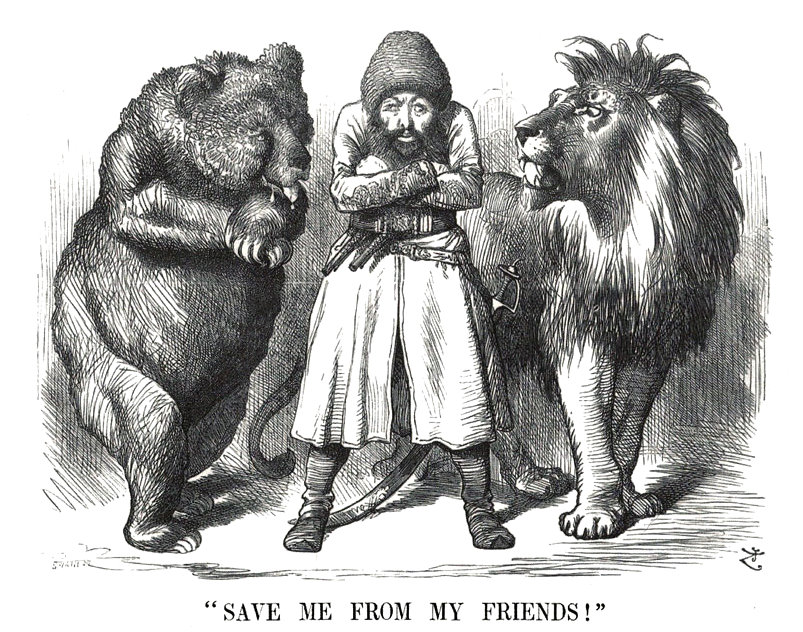
File:Great Game cartoon from 1878.jpg

The Great Game: wikimedia


Bloomberg continues:

A ruling in favor of Pratt & Whitney by the ITC would mean Rolls-Royce would be blocked from shipping engines for Boeing’s 787 Dreamliner, now in the final stages of flight testing. The U.K. lawsuit may limit shipments for the Airbus SAS A380, now in use by international carriers including Qantas Airways Ltd., and the Airbus A350XWB model powered solely by another version of the Trent engine.

“Pratt & Whitney’s case is very strong and we were left with no choice but to take these actions in light of Rolls- Royce’s aggression,” said Katy Padgett, a spokeswoman for East Hartford, Connecticut-based Pratt & Whitney. “We regret that these actions are necessary, and we continue to be willing to discuss a mutually acceptable resolution to this dispute.”

The complaints escalate a legal battle that started when Rolls-Royce sued Pratt & Whitney in May, claiming the GP7200 Fan Stage infringed a patent for a design that gives the largest part of a jet engine greater resistance to damage by foreign objects, more stability and lower noise levels. It later added Pratt’s Geared TurboFan engines, as Airbus and Boeing consider getting more efficient engines on the bestselling A320 and 737 planes.

Patent infringements must no doubt be fought but an internecine battle of this kind among the few engine manufacturers left may lead to some immediate competitive advantages to one or the other, but in the long-term could damage the entire industry to the ultimate detriment of the the consumers. The dispute has the potential of delaying engines to a variety of aircraft and to a number of airlines.