Archive for the ‘Business’ Category

Guardians of Peace -1 Sony + Hollywood – 0

December 18, 2014

Well Sony and the US theatre owners caved in and the release of The Interview has been cancelled for now and put off indefinitely. It will not even be released as a Video on Demand. There is a wave of indignant voices about the attack on “free speech”.

By all accounts the film itself was of little artistic merit. It is apparently the imbecilic, tasteless but clever form of humour that teenagers and tabloids love. But I am no longer a teenager and I am bored by the tabloids. So I feel no great sense of loss with the cancellation of the release. It is not a movie that I would have watched anyway.

HuffPo: Sony Pictures will not release “The Interview” on Christmas Day, and the studio has “no further release plans” for the film, this according to a studio spokesperson. It had been speculated that Sony would consider releasing the film either via on-demand services or in theaters at a later date.

Sony announced “The Interview” will not come out as planned in a statement:

In light of the decision by the majority of our exhibitors not to show the film The Interview, we have decided not to move forward with the planned December 25 theatrical release. We respect and understand our partners’ decision and, of course, completely share their paramount interest in the safety of employees and theater-goers.

Sony Pictures has been the victim of an unprecedented criminal assault against our employees, our customers, and our business. Those who attacked us stole our intellectual property, private emails, and sensitive and proprietary material, and sought to destroy our spirit and our morale – all apparently to thwart the release of a movie they did not like. We are deeply saddened at this brazen effort to suppress the distribution of a movie, and in the process do damage to our company, our employees, and the American public. We stand by our filmmakers and their right to free expression and are extremely disappointed by this outcome.  

Sony’s decision caps a whirlwind day, which saw the nation’s five biggest theater chains cancel plans to screen “The Interview.” Regal Entertainment, AMC Entertainment, Cinemark, Cineplex Entertainment and Carmike Cinemas pulled the comedy following a terror threat made Tuesday by hackers who had attacked Sony Pictures.

The indignation is not about the film but about the “spineless caving-in to terrorism”. I am not so sure about that. Big Entertainment, with Sony as a leading light, has been quite ruthless in bullying and killing any move when their music revenues have been threatened by smaller and more innovative players. They have lobbied and obtained extensions of copyright protection to quite unjustifiably long periods. They have brought their clout to bear and cracked down viciously on “piracy” in films and music. Even where the so-called piracy has been quite trivial. Nothing wrong with any of that of course. Any enterprise is justified in protecting its market. But they have relied too much on on their “power” and size. They have used the threat of legal action to terrorise the small entrepreneur who has no possibility of bearing the cost of defending against their big legal guns.

So when a group of hackers brings one of the Entertainment Giants to its knees – mainly because they were complacent and thought thought they were invincible – I may not be moved to cheer but I am inclined to smile quietly. I have a tiny bit of sympathy for the makers of the film but none for Sony. And if the hackers – Guardians of Peace – are really an off-shoot of the North Korean government, it is even more remarkable.

Less than $60 – but where’s the bottom for oil price

December 12, 2014

I reckon the bottom is about 6 months away and probably less than $40 per barrel before there is some recovery. If the price does not fall that much, or if it recovers faster, then Saudi Arabia will have lost its battle against shale oil. In any event, shale oil is here to stay and all Saudi Arabia can hope for is to restrict new and small oil shale wells. Even a steep fall to around $40, held for a period of only 6 – 12 months, will not be enough to put all shale oil producers out of business and win the battle against shale oil.

oil price bottom

Marketing terrorism is becoming obsolete

December 1, 2014

Black Friday is over, today is Cyber Monday and tomorrow is Giving Tuesday. But this kind of marketing terrorism is becoming obsolete.

Obviously the marketing terrorism involving special days has worked – but it has worked not to increase total sales but only to shift consumption patterns. Sales are a little more concentrated on these days and to those stores who offer discounts. They encourage those chasing discounts but discourage those who don’t rely on the discount to make their purchases.

I suspect that rather than representing additional sales which would not otherwise happen, these “discount” days have only shifted buying – which would have happened anyway – to be concentrated to these “special” days and to those stores with the largest discounts. Imbuing artificial meaning into Valentine’s Day, Father’s Day and Mother’s Day, the invention of Black Friday, Cyber Monday and Giving Tuesday, having special “Sales” days after Christmas and the New Year, have all certainly served to change consumption patterns. But they have not really contributed to increasing the total sales. With the new buying pattern no store can afford to be the one that nobody comes to. I suspect also that the increased sale of discounted goods on these special days at just a particular store or chain is no longer worth the additional advertising and promotion costs.

But this kind of marketing is already obsolete. There is no more to be gained by inventing a Brother’s Day or a Sister’s Day or a Cousin’s day or a Children’s Day. On-line information gathering and on-line shopping have taken over. High street stores and even stores in shopping malls are increasingly showrooms for goods where the sales are actually consummated on-line. A few stores have caught on. They are converting their stores to become places to view goods and services and places to pick-up the goods bought on-line. They have realised that the “consumer commitment” has shifted from the store. The real capture of the sale happens on-line and no longer in the store. The store still has a role to play but this role is changing. The store needs to complement the on-line presence and to provide those bits that are missing from the on-line experience (viewing the goods and delivery of the goods). Walk-ins to the store have to be led inexorably to the web-site.

Those who have caught on have realised that the on-line store is open 24/7. The web site has to do an “IKEA” and ensure that the visitor is led through every part of the site and that he willingly parts with his money as he comes across little extras as he buys!!

Break-even price for shale oil could be as low as $40 per barrel

November 28, 2014

UPDATE: Reuters – Saudi Arabia’s oil Minister Ali al-Naimi declares war on US Shale OIL


Yesterday Saudi Arabia got its way at the OPEC meeting and successfully resisted all calls for a cut in production to try and stop the decline of world oil prices.  It seems Saudi Arabia (which has the lowest oil production cost in the world) has chosen the strategy of maintaining an oil price low enough to put a cap on US shale oil production and provide a disincentive for new shale oil wells.

This strategy is premised on the break-even price for shale oil being at or above $80 per barrel for small production sites down to about $30 per barrel for large production sites. For example Credit Suisse estimated these levels as varying between $24 and $85 earlier this year.

shale oil break even estimates credit suisse

shale oil break even estimates credit suisse sep 2014


The US department of Energy puts sustainable break even values between $35 and $54. The Saudi calculations seem to be based on similar estimates. They appear to believe that with current oil prices moving down to about $70 per barrel, some of the smaller US oil shale wells are already uneconomic and that at this price new investment for further production sites will dry up.

But shale oil production costs are declining – fast. Costs are coming down following the learning curve for both capital costs and running costs. The analyst estimates are already out of date. My estimate is that actual break-even points are already down about 20% from those in the Credit Suisse estimate.

So I believe the Saudis have miscalculated. The average break-even world price for shale oil is probably – already – closer to $40 per barrel rather than $60-70 per barrel being assumed. While new investment in shale oil wells may well be toned down by world oil consumption, it will probably not be because world oil price is below some critical threshold. If the Saudis believe that any uptick in consumption will bring the oil price back up to over $80 per barrel, they are following a flawed strategy. We could be in for a decade of relatively low oil prices perhaps with a floor at around $40 per barrel and set by the average break-even for shale oil.

Consumers are still very wary. They are not sure that the reduction in oil price will be sustained and is not just a temporary dip which might lure them into a higher and more vulnerable consumption level. It will take a few months for them to see that OPEC has actually lost control over the world oil price but is still in denial about that. A sustained low oil price is what will trigger a new – and sustained – wave of global growth that is now so badly needed. The cartel is shrinking. New shale oil producers will all be outside the cartel – and the sooner Europe, China and India start production the better. But it is the beginning of the end of the OPEC cartel power.

History will – I think – show that the OPEC cartel lasted for 50 years. It will show that the cartel started in 1973 and that market forces of supply and demand were re-established around 2020.

Status of German women directors degraded to be “quota directors”

November 27, 2014

German companies have a reputation for excellence. But this is being sacrificed for the sake of political correctness. Currently every woman company director in Germany can be assumed to be of exceptional competence. When a new quota law goes into force in 2016, every woman director in Germany will be nothing more than a “quota employee”.

Discrimination to fight discrimination is an invitation to failure. I do not find any case of “affirmative action” – which is a euphemism for introducing a new, institutionalised and unjust discrimination ostensibly to correct the effects of some other unjust discrimination – which has actually achieved its objective. No program of enforced quotas has yet succeeded in achieving a condition where the “affirmative action” becomes unnecessary because the original injustice has been eliminated. Quotas or confiscation and rationing, enforced by the state and based on irrelevant criteria, remain a favourite tool of those with socialistic aspirations. But not only don’t they work, they also perpetuate the “injustice” that they are intended to correct.

Fifty years of quotas for the “scheduled castes” in India have only become entrenched and have been counter-productive. Rather than ensuring that the lot of the “disadvantaged” groups have improved such that they can compete fairly for jobs or education places, the “affirmative action” has instead ensured that competence and ability have been removed as requirements for selection. Even worse, the “system” is self-perpetuating and encourages the reduction of standards. Those who were to be helped now only need to be the “best of a bad lot” to be selected. Instead of raising standards, “affirmative action” allows and enables lower standards to become “acceptable”. To be classified as a “scheduled caste” has now become a path to privilege.

The experience  in the US with reservation of places in education and in the work-place for minorities has been no different. Even after over 25 years of “affirmative action” the SAT scores of African-Americans admitted to the top US universities remains significantly lower than the average of all those admitted. But this is only to be expected. Effectively the SAT scores to be targeted by aspirants for admission have been reduced for those qualifying for the privilege. Aiming high has no longer any value. Reserving jobs for women or Latinos or other “disadvantaged” minorities has only succeeded in lowering standards but – what is worst – also in making these lower standards acceptable. The quotas for the employing of ethnic Malays in Malaysia has removed any incentive for such “quota employees” to excel at anything other than being Malay. Quota students or quota employees are not burdened by requirements of superior performance or competence – let alone any expectations of excellence.

It should be obvious by now that I believe that quotas based on having an irrelevant characteristic are counter-productive and contribute to equalising standards only by lowering them. Even when quotas try to bring in minimum qualification requirements, it is inevitable that the criterion becomes being “just good enough” and not “to be best”. The use of quotas automatically and inevitably downgrades the quest for excellence. It is settling for the mediocre.

So I am not very impressed by the new German law which will now force the largest companies to have women constituting 30% of their supervisory boards from 2016.. Again the justification is that it will be a trigger for social change and anyway that there are enough women who are qualified. That misses the point. Women directors for these companies have now been effectively degraded to become quota directors – even where they are there for their competence. They can no longer claim to be the “best available” even if they are. Angela Merkel has had to give in to the socialists on this point. Forty percent of the German cabinet is women. Angela Merkel herself is there because she was the “best” for the job. But note that many of her female cabinet colleagues are there not because of their competence or excellence but only to fill an unwritten quota. Other countries are also considering quotas for women directors – not least in “politically correct” Sweden. For example, I observe when I watch Swedish TV – which is very politically correct – that it is easy to discern when a female presenter or a news reporter has been selected to fill some gender quota rather than for her excellence.

But why stop at women quotas? Why not quotas also for other minorities and abandon excellence or competence? Why should women be more privileged than some other disadvantaged minority? Is the disadvantage suffered by women more important to correct than the disadvantage suffered by a gay person? or an immigrant? Perhaps there will come a day when a German Supervisory Board will have to be at least 30% female, 10% gay, 5% transgender and 15% of immigrant origin! That will be the time when I shall sell any German stocks that I might have.

As an investor in any company I would prefer that the Directors be the best available and affordable and not “just good enough” to fill a compulsory quota.

Are shale oil and low prices the beginning of the end of the OPEC cartel?

November 24, 2014

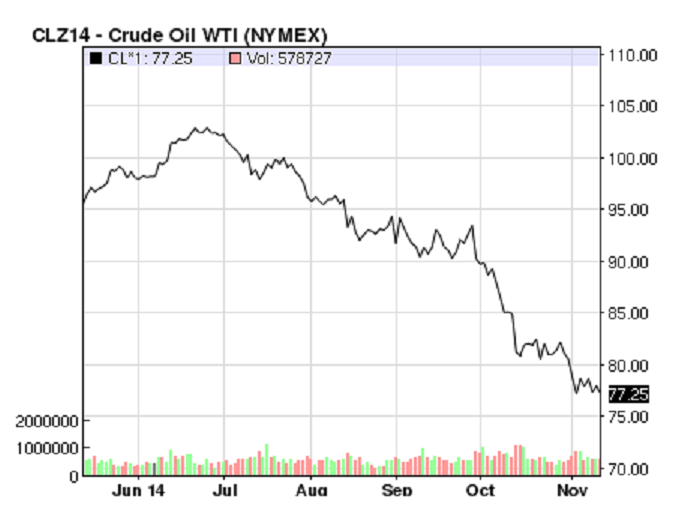
Currently US crude is at just above $76 per barrel and Brent oil is at about $80. OPEC members are meeting this week in Vienna and it is thought that cuts to oil production of between 0.5 million and 1.5 million barrels per day (bpd) are possible. The drop in oil prices since June (from around $110 per barrel is due to a glut which in turn is due to over production, large quantities of US shale oil becoming available and simultaneously a reduced demand from China and others. Saudi Arabia is conspicuous by not having made any significant production cuts so far. This could be due to one of 3 reasons:

  1. Saudi Arabia is testing the breaking point for some of the shale oil producers since some of the smaller shale wells probably have a break-even level of around $60-70 per barrel, or
  2. Saudi Arabia and the US are targeting Russia and Iran whose economies are vulnerable and very dependent on the oil price (and the Russians alone would lose some $100 billion in oil revenues per year), or
  3. Saudi Arabia is tired of bearing the brunt of the production cuts and is forcing some of the smaller OPEC producers to take their share of the pain of production cuts.

If cuts of less than 0.5 million barrels per day are made it is thought that the prices are headed down to about $60 per barrel. One analyst estimates that a cut of 2 million bpd is needed to get back up to $80 per barrel. Something in between will be – well – something in between.

I just don’t like cartels and especially when they are state sponsored cartels. So far shale oil production is just from the US, and the OPEC strangle-hold on oil price has yet to be broken. But, over time, I expect this cartel to weaken as other countries produce oil and gas from shale. I remain of the opinion that the OPEC cartel has – no doubt – enriched the oil producing countries but has only done so at the expense of the rate of development of non-producers. OPEC has done the global economy a disservice by holding back the developing countries and the strongest correlation in geopolitics is the link between energy consumption and development (not just GDP but also virtually every development parameter).

It may cause some short term turbulence but in the long run it will be a “good thing” even if oil price were to collapse to below $50 per barrel. Some producers will be hard hit but the net result for the global economy will be positive. So I shall be quite happy if OPEC cannot reach agreement on how much oil production to cut or if they make just a small cut. It is time for some of the the developing countries to get a break from the oil price extortion which has been in place since 1973. The sooner the OPEC cartel is rendered obsolete the better.

Reuters:

Some commodity fund managers believe oil prices could slide to $60 per barrel if OPEC does not agree a significant output cut when it meets in Vienna this week. Brent crude futures have fallen by a third since June, touching a four-year low of $76.76 a barrel on Nov. 14. They could tumble further if OPEC does not agree to cut at least one million barrels per day (bpd), according to some commodity fund managers’ forecasts. ….. 

Yet fund managers and brokerage analysts are divided over whether OPEC will reach an agreement on cutting output. Bathe put the likelihood at no more than 50 percent. Oil prices have been falling since the summer due to abundant supply, partly from U.S. shale oil, and because of low demand growth, particularly in Europe and Asia. As a result, some investors believe a small cut of around 500,000 bpd would not be enough to calm the markets. Doug King, chief investment officer of RCMA Capital, sees Brent falling to $70 per barrel even with a cut of one million bpd.

“With this, I would expect lower prices in the first half of 2015,” he said. If OPEC fails to agree a cut, prices will drop “further and quite quickly”, with U.S. crude possibly sliding to $60, he said. U.S. crude closed at $76.51 on Friday, with Brent just above $80. ……..

The market has been awash with conspiracy theories as to why Saudi Arabia has not already intervened. New York Times columnist Thomas Friedman hinted at “a global oil war under way pitting the United States and Saudi Arabia on one side against Russia and Iran on the other”. Hepworth argued that Saudi Arabia appeared pretty happy with current pricing levels and suggested they were waiting to see where the cut-off point for U.S. production was. “Time is on their side, they can afford to wait,” he said, stressing he was talking months, not years, but added if oil fell below $70 that waiting time “shrinks to weeks”.

Tom Nelson, of Investec Global Energy Fund, said he believed Saudi Arabia had allowed the price to fall to incentivise smaller OPEC producers, which often rely on the biggest producer to intervene, to join Riyadh in cutting output. “They (the Saudis) want to cut but they don’t want to cut alone,” Nelson said, adding that a cut of between one million and 1.5 million bpd should be sufficient to balance the market.

“The market really wants to see that OPEC is still functioning … if there is a small cut, with an accompanying statement of coherence from OPEC that presents a united front, and talks about seeing demand recovery, and some moderation of supply growth, then Brent could move up to $80-$90.”

Saudi attack on shale oil could backfire

November 12, 2014

If the recent drop in oil price has been engineered (even in part) by Saudi Arabia as an attempt to put some of the burgeoning shale oil production sites out of business they will need to go much further. A break-even for shale oil production is probably at less than $50 per barrel. In any event the drop so far (25%+ in 6 months) is just the fillip the world economy needs. Saudi Arabia is probably not as vulnerable as other oil producing countries but increasing production to drive down the oil price is a dangerous game which could be self-defeating. Whether the current glut is just due to reduced world (read Chinese) demand and increased shale oil (US) production or has also been exacerbated by increased Saudi production, the oil consumer wins. Consumption will increase – and that will automatically reduce the glut and further increase the production of oil from shale.

If the global economy is to come out of the doldrums it needs the Asian economies – the tigers, the dragon and the elephant – to start prowling in earnest. Increasing consumption in the developing world seems to be one of the most effective ways of stimulating the world economy. It inevitably leads to increased production of consumer goods in the developed countries. And this current step-reduction of oil price could be just the trigger that is needed.

Yesterday the price of crude (WTI) was at about $77 per barrel and that price is sufficient to keep even the small shale oil wells in operation.

crude oil price Nov 2014

crude oil price Nov 2014


Supreme Court rules against Bollywood union ban on women make-up artists

November 4, 2014

I posted recently about the challenge to the Bollywood union’s ban on women make up artists. The Supreme Court in India has now ruled that this ban is illegal (but in India labour laws are still among the most restrictive in the world though the new Modi government is beginning to address them). The court has given the union one week to delete their own rule restricting women and has assured the petitioners that if the union does not, the Court will.

Indian Express:

The 59-year-old practice in the Indian film industry that bars women from being classified as make-up artists is set to end with the Supreme Court stating on Monday that it would not allow this “constitutionally impermissible discrimination” to continue.

In the film industry, only men are allowed to become make-up artists while women are classified as hairdressers. The trade unions say this is to ensure that the men are not deprived of work.

“How can this discrimination continue? We will not permit this. It cannot be allowed under our Constitution. Why should only a male artist be allowed to put make-up? How can it be said that only men can be make-up artists and women can be hairdressers? We don’t see a reason to prohibit a woman from becoming a make-up artist if she is qualified,” said a bench of Justices Dipak Misra and U U Lalit.

“You better delete this clause on your own. Remove this immediately. We are in 2014, not in 1935. Such things cannot continue even for a day,” the court told the Cine Costume Make-up Artists and Hair Dressers Association (CCMAA). The court said the film industry, as a unit, could not be allowed to prolong this “gender bias”.

The court was hearing a petition by Charu Khurana and other women make-up artists, who were rebuffed by the CCMAA when they sought make-up artist cards. Khurana qualified from the Cinema Make-up School, California, but her application for membership was rejected by the CCMAA in 2009 because she is a woman.

The bench directed the body to come back with a “positive response” within a week. Khurana’s counsel, Jyotika Kalra, complained that Maharashtra’s union refused to delete the clause even after a state government order. “Don’t worry. If they don’t do it this time, we will order deletion,” assured the bench.

In the meantime the new Modi government has initiated moves to rationalise some of India’s archaic and restrictive labour laws:

India’s labour laws are restrictive in nature and hurt investments in the manufacturing sector. The Industrial Disputes Act (1947) has rigid provisions such as compulsory and prior government approval in the case of layoffs, retrenchment and closure of industrial establishments employing more than 100 workers. This clause applies even when there is a good reason to shut shop, or worker productivity is seriously low.

The Contract Labour (Regulation and Abolition) Act (1970) states that if the job content or nature of work of employees needs to be changed, 21 days’ notice must be given. The changes also require the consent of the employees, and this can be tricky.

While the right of workers to associate is important, the Trade Union Act (1926) provides for the creation of trade unions where even outsiders can be office-bearers. This hurts investor faith and restricts economic growth.

Rigid labour laws discourage firms from trying to introduce new technology, requiring some workers to be retrenched. This deters FDI because of the fear that it would not be possible to dismiss unproductive workers or to downsize during a downturn. Hence getting FDI into export-oriented labour-intensive sectors in India has not been fully achieved.

In contrast, China has succeeded in attracting FDI to export-oriented labour-intensive manufacturing, in part because of flexible labour laws such as the contract labour system implemented in 1995. Whereas in India, employers have taken to hiring workers on contract outside the institutional and legislative ambit, resulting in informalisation of the labour market. This hampers worker well-being. ……

To undo the malady in India’s labour market, some changes have recently been initiated in the three acts that largely govern India’s labour market: the Factories Act (1948), the Labour Laws Act (1988) and the Apprenticeship Act (1961). Amendments to some restrictive provisions of all these acts have been cleared by the Cabinet and are set to be tabled in Parliament. Key changes proposed include dropping the punitive clause that calls for the imprisonment of company directors who fail to implement the Apprenticeship Act of 1961.

The Government is also going to do away with a proposed amendment to the Act that would mandate employers to absorb at least half of its apprentices in regular jobs.

In order to provide flexibility to managers and employers, the amendment to the Factories Act includes doubling the provision of overtime from 50 hours a quarter to 100 hours in some cases and from 75 hours to 125 hours in others involving work of public interest. This is seen by some as being anti-labour as it imposes greater working hours without ensuring their security and welfare. …..

Big Pharma’s “Pay-for-delay” tactics delay generic drugs and kill people

October 30, 2014

It is not often that the Huffington Post can bring itself to criticise President Obama. But even their usual blind support for Democrats in general and for Barack Obama in particular has taken a back-seat to their outrage over Obama’s support for Big Pharma and his opposition to generic drugs (often from India) and to Medicines Sans Frontiers (Doctors without borders).

Much of their indignation is due to the collusive practice of “pay-for delay” agreements made by Big Pharma with drug manufacturers – often in developing countries – to delay the introduction of generic medicines – many for life threatening conditions. The purpose of course is to keep their prices high and to maximise their profits on their successful drugs. They delayed the introduction of generic AIDS drugs and are now opposing the introduction of cancer fighting generics.

ThinkProgress: ….. the widespread and arguably collusive practice of “reverse payment” settlements — commonly referred to as “pay for delay” — between brand name drug manufacturers and their cheaper generic drug counterparts. Such arrangements involve brand name drug makers paying off generic manufacturers to delay a generic drug’s release into the market, allowing the brand name producers to further profit off of their significantly more expensive drugs. …..

The practice has been quite successful in maintaining profits. But in the developed world the high – and protected – cost of medicines take away from other resources (people and equipment). In the developing world it denies treatment to many who need it. The difference in price between a generic drug and a “brand name” drug is almost obscene. AIDS treatments of over $12,000 per year reduced to less than $400 using generics from India. A generic version of Nexavar (for treatment of liver and kidney cancer) reduced cost of treatment from $5,000 per month to just $157 per month.

A generic drug only enters the market after patent protection has expired. The original developer has by then had his time to exploit his invention. Production costs at Big Pharma are perhaps upto twice that at low-cost manufacturers – but not much more. Yet they often have support from their governments in the developed countries (in extension of patent protection through patent “bombing” and in global and bi-lateral trade agreements) in maintaining prices which are hundreds of times higher than the production cost.

In an article today HuffPo writes:

Obama Has Been Fighting Doctors Without Borders For Years

It’s a little unusual to see the Obama administration singing the praises of Doctors Without Borders, the Nobel Peace Prize-winning nonprofit that is shipping doctors, drugs and supplies to West Africa to combat the Ebola outbreak. …… But the recent executive branch acclaim for Doctors Without Borders obscures a long-running struggle between the humanitarian group and the White House over global drug prices. Through trade talks, meetings with foreign governments and negotiations with multiple U.N. bodies, the Obama administration has aggressively pursued policies that prevent poor countries from accessing low-cost generic versions of expensive name-brand medications, despite persistent calls from Doctors Without Borders for the White House to reverse course.

Americans pay the highest prescription drug prices in the world. Those prices are elevated in large part by aggressive intellectual property standards that grant pharmaceutical companies long-term monopolies on new drugs, letting firms charge whatever they want without regard to traditional market pressures. Generic drugs can’t enter the market whenever those monopolies are in place. Doctors Without Borders, along with many other medical groups and nonprofits, has spent years advocating for looser standards and greater flexibility for developing countries.

Drug companies, of course, argue that they need patents and other government perks to recoup their research and development costs. Large U.S. drug companies don’t seem to be having trouble breaking even, however. Pfizer made $22 billion in 2013, while Merck & Co. posted a $4.5 billion profit and Eli Lilly & Co. earned $4.7 billion.

India’s generic drug market has been at the center of disputes between the White House and Doctors Without Borders. AIDS and HIV medication was wildly expensive in developing countries in the late 1990s — about $12,000 a year per patient in South Africa, a country with an average income of just $2,600 a year, for instance. When Indian generics entered the global market, they were priced as low as $1 a day, enabling programs like George W. Bush’s global AIDS relief plan to serve millions of people.

U.S. drug companies are particularly concerned about repeating that experience with expensive cancer treatments, and they’ve been backed up by the Obama administration, which has placed India on it’s international trade blacklist. In the spring of 2012, U.S. Patent and Trademark Office Deputy Director Teresa Stanek Rea attacked India’s government in congressional testimony for approving a generic version of a Bayer AG cancer drug called Nexavar. The generic version cost patients$157 a month. Bayer had been charging over $5,000 a month there, in a country with a per capita income of just $1,410 per year, a price so high that less than 2 percent of potential patients were able to access the drug. But before Congress, Rea falsely called the generic approval an “egregious” violation of World Trade Organization treaties.

Doctors Without Borders called it “unprecedented, really shocking testimony,” but it wasn’t a one-time gaffe from an obscure agency official. In the summer of 2013, Secretary of State John Kerry went to India to pressure its government over its approval of generic versions of patented U.S. and European drugs. When India’s new prime minister, Narendra Modi, made his first visit to the United States in September of this year, Doctors Without Borders urged him to resist the Obama administration’s demands on generic medicine.

“India’s production of affordable medicines is a vital life-line for MSF’s medical humanitarian operations and millions of people in developing countries,” said Rohit Malpani, director of policy and analysis for MSF’s Access Campaign. “India’s patent laws and policies have fostered robust generic competition over the past decade, which has brought the price of medicines down substantially — in the case of HIV, by more than 90 percent. The world can’t afford to see India’s pharmacy shut down by U.S. commercial interests.”

Big Pharma is surely entitled to make a reasonable profit from its inventions. The development costs of unsuccessful drugs also has to be paid for. But any concept of Intellectual Property (which itself is deeply flawed) can be defended when it is based on the denial of the benefits of the invention to other than a privileged few. A denial to the point of loss of life.

Silicon Valley’s EFI pays Indian workers $1.21 per hour for a 122 hour week

October 24, 2014
About

Sweatshop in California: Electronics for Imaging in Silicon Valley

The land of milk and honey has a seamy side of its own. There are sweat shops in Silicon Valley in California as well. And this particular sweat shop – Electronics for Imaging (EFI) – which paid workers imported from India $1.21 per hour (in Rupees) and worked them upto 122 hours per week, is no fly-by-night operation but a  company listed on Nasdaq and generated about $200 million in revenue in its last quarter. Taking the cost of living into account and the relative salaries in California and Bangladesh, EFI is worse than the textile companies in Bangladesh.

Business Journal

Electronics for Imaging Inc. has been ordered by the U.S. Department of Labor to pay $40,156 in back wages to employees who had allegedly received as little as $1.21 an hour, the San Jose Mercury News reported.

EFI also paid a fine of $3,500 following a federal investigation into its wage and hour practices, which had included paying its workers in Indian rupees and having them work up to 122 hours in the Fremont company’s IT department. …. 

The EFI violations of state and federal labor laws concerned eight employees who were paid to help install a computer network when the company moved its home office from Foster City to Fremont, according to the Mercury News. The data storage provider said that it had brought in some of its IT employees from Bangalore, India, to do the jobs in Fremont between Sept. 8, 2013 and Dec. 21, 2013.

You couldn’t get the hours worked into a 5 day week. 122 hours a week averages to over 17 hours a day for a 7 day week. The EFI defence is remarkable for its callousness – “we unintentionally overlooked laws that require even foreign employees to be paid based on local U.S. standards” the company said in a statement. Who in their right minds would expect foreign workers in California to be paid the local Californian wage?

Not so very different from conditions in Bangladesh:

WarOnWant:

The majority of garment workers in Bangladesh earn little more than the minimum wage, set at 3,000 taka a month (approximately £25), far below what is considered a living wage, calculated at 5,000 taka a month (approximately £45), which would be the minimum required to provide a family with shelter, food and education. 

As well as earning a pittance, Bangladeshi factory workers face appalling conditions. Many are forced to work 14-16 hours a day seven days a week, with some workers finishing at 3am only to start again the same morning at 7.30am.