Archive for the ‘China’ Category

Beijing turns the screw on rare earth materials

February 18, 2011
Wen Jiabao (温家宝), Chinese Premier

Wen Jiabao: Image via Wikipedia

The Chinese Government is taking steps to keep control of the development, production and export of rare earth materials under state corporations.  Until production from alternate sources in Vietnam, Afghanistan, India, Sweden and other countries are ramped up, production and export of rare earth materials is likely to be used as an instrument of Chinese foreign policy. This leaves Japan particularly vulnerable and is likely to speed up the Japanes investment in the production of these materials in other countries.

Asahi reports:

CHONGQING, China–In a move likely to strain already scarce supplies of rare earth materials worldwide, China will introduce new controls on production and export of the elements crucial for electronics and environmental technologies.

According to the state-run Xinhua News Agency, Chinese Premier Wen Jiabao instructed a State Council standing committee meeting Wednesday to designate rare earth materials as an important strategic resource, and implement measures to strengthen government control over the materials.

With many players fighting over the largely unregulated market, from state corporations to small firms, Beijing, worried about smuggling and rampant environmental destruction, has decided to step in. Beijing plans to grant authority to develop and manage rare earths to state corporations to allow better oversight and control.

The state will also decide export volumes each year after assessing domestic demand and price trends in global markets. Watchers have said the measures are primarily designed to allow Beijing to use its control over the materials as a strategic diplomatic tool.

China has already taken steps to further its control over rare earths production this year, by designating Jiangxi province a nationally administered mining district for rare earths. Under the arrangement, natural deposits will be monitored by Beijing, and exploration and mining will be conducted under close control by the government.

Related: China and the use of rare earth elements trade as a tool for diplomacy

Nice work if you can get it! The rewards of whistle-blowing?

February 15, 2011

Free-loading civil servants are present everywhere and are the rotten apples among the many millions who are actually civil and who do actually serve but this case from China stands out. Though it is somewhat unclear as to whether he is a heroic whistle-blower or just a free-loader.

“Chinas most capable civil servant”

Jiang Jinxiang - "Chinas most capable civil servant"

WhatsonXiamen.com reports:

File:Longyan.png
A civil servant from Longyan, Fujian Province, who collected a monthly salary for nearly nine years without lifting a finger, intends to go back to work Monday.
Jiang Jinxiang, a former director at the Urban Construction Commission in the Standing Committee of Longyan People’s Congress, was suspended on May 16, 2002 and never returned to work.
Internet users exposed him after they learned he still received a monthly salary of 2,700 yuan ($410) from the local government even though he stayed home. Jiang, 55, who was suspended for trying to expose quality control problems at a city project during a local People’s Congress session in 2002. He told the Global Times Sunday that he stopped going to work in 2002 because his colleagues did not talk to him, which made him unhappy.
“I couldn’t accept the government’s treatment. I felt it was unfair because what I exposed was true,” Jiang said. Jiang saw a government notice in the Minxi Daily on Saturday that ordered him to show up for work within 15 days. Zheng Lixin, head of the Longyan Construction Bureau, which oversees Jiang’s section, said that they kept sending him payments on humanitarian grounds since his family was poor, according to the Xinhua News Agency.

China retracts a national scientific award for plagiarism

February 14, 2011

From Xinhua News:

Li Liansheng: photo China Daily

BEIJING, Feb. 10 (Xinhua) — The recent revocation of a national scientific award due to academic fraud was the first of its kind in China, National Office for Science and Technology Awards told Xinhua Thursday.

China’s Ministry of Science and Technology, on Feb. 1, issued a statement revoking the State Scientific and Technological Progress Award (SSTPA) given to Li Liansheng, former professor of Xi’an Jiaotong University.

According to the statement, the investigation found Li had plagiarized others’ works and fabricated data in his winning project, and his prize will be canceled and money awarded retrieved.

Zhao Baojing, senior officer with the National Office for S&T Award, told Xinhua that it was the first time China had withdrawn a national scientific honor.

Li Liansheng, former professor and doctoral tutor of Xi’an Jiaotong University, received the second-place prize of the SSTPA in 2005 for his research on key technologies for designing and manufacturing scroll compressors.

In 2008, he was accused of plagiarism and providing false data in the winning project by six professors of Xi’an Jiaotong University. An investigation was later carried out.

Xi’an Jiaotong University suspended Li from working at the university and rescinded his employment contract in March, 2010.

AsiaOne.com writes:

News that the ministry is stripping him of his award for scientific and technological progress comes three years after six colleagues first claimed that the energy and power studies expert had plagiarized the work of others.

Wan Gang, the minister of science and technology, had earlier vowed that there would be a “zero tolerance” policy toward research frauds and academic plagiarism amid growing criticism about the country’s academic integrity.

“We will dig up the past of those researchers who fake their works and punish them,” he told China Daily in November 2010.

The country has more than 2.3 million workers in the science and technology field and the number of research papers published on the subject has topped the world.

The intense competition to get work published has led some researchers to exaggerate their achievements, said critics.

“In China, we care whether a paper is published in a magazine more than we care about the paper’s quality and academic influence,” Rao Yi, dean of the School of Life Sciences at Peking University, was quoted as saying in a report in China Youth Daily.

Universities and colleges are ranked according to the number of academic papers their staff can get published and the number of references they get in influential journals

Related:

https://ktwop.wordpress.com/2010/10/13/chinese-science-ministry-vindicates-academic-fraud-journalists/

Carrefour and Walmart branded as cheats in China

January 31, 2011

Xinhua reports that Carrefour and Walmart have damaged their own reputations by trying to cheat Chinese consumers by overpricing. With the New Year to be celebrated on 3rd February, they are being seen as trying to exploit the traditional Chinese generosity during the festival holiday:

Carrefour and Walmart swindle Chinese consumers

Over the crowds of holiday shoppers in China’s big stores this Spring Festival lingers an atmosphere of suspicion. With charges of price deception hanging over the big chains of Carrefour and Wal-Mart and local authorities moving to levy fines, many Chinese — normally averse to be pinching pennies during the Lunar New Year — are checking their receipts at the tills.

The New Year, which falls on Feb. 3 this year, is normally a time of largesse and excess — all the more reason why many shoppers feel so betrayed. Customers can be seen recording label prices in notebooks or calculating their final bill on their mobile phones as they walk the aisles. At outlets of Carrefour and Wal-Mart in cities such as Beijing, Shanghai and Chengdu, the check out queues have grown as customers doublecheck prices at the tills.

“I would never have imagined global firms would do this intentionally and I have to be cautious,” said a woman surnamed Wang, after shopping at a foreign-owned supermarket in Chengdu, southwest China’s Sichuan Province.

From KamCity:

Carrefour and Walmart have issued public statements of apology to their customers in China, after local regulators found that several of their outlets were overcharging customers. The National Development and Reform Commission had found several instances of overpricing at 11 Carrefour and three Walmart outlets, on products including tea, underwear, and household products.

Carrefour said it “sincerely apologises” for the errors, and offered to refund customers five times the difference between the price charged and that on the label. Meanwhile, Walmart also expressed its “sincere apology” to those affected, adding that it has “launched self-examinations” and “will strengthen its price monitoring.”

The NDRC ordered local authorities to fine the individual outlets and confiscate their “illegal income”, with fines amounting to five times the amount confiscated, or up to 500,000 yuan if the amount cannot be calculated.

In the Chinese government’s battle against inflation, the Western retailers are building up a reputation for being a significant part of the problem.


Goldman Sachs cools on China and India

January 18, 2011

The growing inflation in India and China is a clear signal of overheating in their economies and Goldman Sachs (who are credited with inventing the term “BRIC”) are reducing their exposure to the BRIC countries.

The BRIC countries (Brazil, Russia, India, China)

The Telegraph reports:

Goldman Sachs has issued a short-term alert on China and India as inflation rears its ugly head, advising clients to rotate into Wall Street and Old World bourses as a safer bet over coming months.

“We’re not as tactically positive on the BRICs as we have been,” said Tim Moe, the bank’s chief Asia-Pacific strategist, referring to the quartet of Brazil, Russia, India, and China.

“To be frank, we may have held on too long to our overweight position in China last year. We have decided that discretion is the better part of valour and have tactically reduced our weight. Asia is not in the sweet part of the cycle. The longer-term picture of Asia outperforming the US is taking a breather,” he said, speaking at a Goldman conference in London.

The cooling ardour for China is significant shift for the bank that invented the term BRICs and has been the cheerleader of the emerging market story over the past decade.

India is an even bigger worry, with yawning twin deficits, and overheating visible on all fronts. The nation’s central bank warned this week of “surging inflation”.

“India’s current account deficit is running at a record pace of 4.1pc of GDP and it is 100pc funded by short-term portfolio flows, which cannot be relied on indefinitely,” said Mr Moe, describing Mumbai’s bourse as “crowded”.

Read more….

Beijing introduces number plate lottery to cut car sales by 75%

January 16, 2011

Last year 890, 000 cars hit Beijing’s streets contributing to the city’s legendary gridlock and traffic emissions.

Gridlock in Beijing: image care2.com

From 1st January this year a lottery for number plates will provide only 20,000 winners each month restricting sales of both new and second-hand cars in the city to 240,000 this year. 210,000 people have applied for the 20,000 licenses available for January. Winners must buy a car within six months. Losers in this month’s lottery will be included in next month’s drawing along with all new applicants.

CRIenglish reports:

Car dealerships in Beijing may opt to shift their focus on boosting sales to neighboring cities after the municipal government imposed an annual quota on new car license plates as part of efforts to ease traffic gridlock in the capital city.

Some car dealerships, especially of domestic brands, are making plans to expand sales to areas outside Beijing where the policy restriction does not apply, the China Business Times reported. The new limit means buyers will favor high-end and luxury types of cars once they obtain the hard-to-get licenses. Domestic brands and small cars, which sell mostly at below 100,000 yuan, will see lower sales in Beijing, the newspaper article said.

The policy stipulates that buyers of secondhand cars must go through the monthly lottery system to obtain a license and sellers of used cars will see their license annulled in a year if they make no new purchases. That puts dealers of both new and used cars to compete in the same arena for the annual 240,000 new car license plates.

The combined factors have driven many companies to stock up cars, including used cars, in preparation for the coming hike in rental businesses. Car dealerships are tapping into this market, putting types of cars idling for sale ready for renting….. Meanwhile, industry experts predict the big automakers will likely adapt by focusing more on smaller cities further inland, the China Daily quoted Zhong Shi, an independent analyst in Beijing as saying.

“The best and most efficient way for automakers to offset the declining sales in Beijing and maybe other first-tier cities in the near future is to shift rapidly their dealer network expansion inland,” said Zhong.

Besides easing traffic jams, the new policy will help address serious air pollution problems in the Chinese capital city. Car emissions account for around 50 percent of the air pollution in Beijing.


Sundog (parhelion) as seen in N. China

January 11, 2011

A parhelion (sundog) combined with a halo is seen in Changchun, capital of northeast China's Jilin Province, Jan. 8, 2011. (Xinhua/Lin Hong)


From Wikipedia:

Sundogs are formed by plate-shaped hexagonal ice crystals in high and cold cirrus clouds or, during very cold weather, by ice crystals called diamond dust drifting in the air at low levels. These crystals act as prisms, bending the light rays passing through them by 22°. If the crystals are randomly oriented, a complete ring around the sun is seen — a halo. But often, as the crystals sink through the air they become vertically aligned, so sunlight is refracted horizontally — in this case, sundogs are seen.

As the sun rises higher, the rays passing through the crystals are increasingly skewed from the horizontal plane. Their angle of deviation increases and the sundogs move further from the sun. However, they always stay at the same altitude as the sun.

Sundogs are red-colored at the side nearest the sun. Farther out the colors grade through oranges to blue. However, the colors overlap considerably and so are muted, never pure or saturated. The colors of the sundog finally merge into the white of the parhelic circle (if the latter is visible).

It is theoretically possible to predict the forms of sundogs as would be seen on other planets and moons. Mars might have sundogs formed by both water-ice and CO2-ice. On the giant gas planets — Jupiter, Saturn, Uranus and Neptune — other crystals form the clouds of ammonia, methane, and other substances that can produce halos with four or more sundogs.

Development of stealth fighter aircraft moves East

January 10, 2011

Both China and India are developing 5th Generation stealth fighters; China on its own and India as part of a joint development programme together with Russia.

From http://china-defense.blogspot.com/2010/12/latest-batch-of-j-20-photos.html

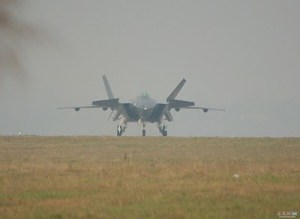
Chinese Chengdu J20 - 5th generation stealth fighter: image http://china-defense.blogspot.com

Rumours from China’s Chengdu Aerospace Corporation (CAC) and the adjoining Aircraft Plant No 132 suggest that a flight of a Chinese-developed fifth-generation fighter prototype would take place by the end of the year. Reportedly, two airframes (numbered 2001 and 2002) have been assembled at the 132 plant.

In August 2008 it was reported that 611 Institute was selected to be the main contractor for the development of the fifth-generation stealthy J-20, and that 601 Institute was the sub-contractor. It was rumored that 611 Institute has started to issue manufacturing drawings for constructing the first prototype, which is expected to fly by 2012, even though the full configuration one won’t fly until a few years later. The latest rumor suggested that a full-scale mock-up had been built at CAC.

From http://www.globalsecurity.org/military/world/china/j-xx.htm

File:Pak fa.jpg

Sukhoi PAK FA T50: image wikipedia

Russia and India are jointly developing the Sukhoi PAK FA / T-50 , which first flew in January 2010. In June 2001, India was offered ‘joint development and production’ of this new 5th generation fighter by Russia. Russia had been trying to sell this concept both to China and India for some time. It seems probable that China declined to participate in this project given a belief that Russia stood to gain more from Chinese participation than did China. That is, it would seem that China had determined that it could produce a superior product without Russian help. With the first flight of the Russian stealth fighter in 2010, an arguably superior Chinese steath fighter might be expected to take to the skies not too long thereafter.

Chinese combat aviation has made remarkable strides in recent years, moving from a collection of obsolete aircraft that would have provided a target-rich environment to potential adversaries. Today China flies hundreds of first rate aircraft, and even flies more Sukhoi Flankers [the aircraft the American F-22 was designed to counter] than does Russia. The Chinese stealth fighter has arrived right on schedule. Chinese military technology is generally rated about two decades behind that of the United States. while the advent of a Chinese counterpart to the F-22 fighter might be disconcerting, the first flight of the prototype American F-22 stealth fighter came on September 29, 1990.

From the Hindustan Times:
New Delhi, December 21, 2010: India and Russia on Tuesday finalised a contract for the biggest defence programme in the country’s history — a $30-billion (Rs 1,35,000-crore) project involving the joint production of 200-250 fifth generation fighter aircraft (FGFA). The aircraft, being called the perspective multi-role fighter (PMF), will exploit the basic design of the Russian Sukhoi T-50 PAK-FA prototype, with modifications thrown in to meet the Indian Air Force’s “more stringent specifications”. The 30-tonne aircraft will be a swing-role fighter with stealth features for increased survivability, advanced avionics, smart weapons, top-end mission computers and 360-degree situational awareness. What will put the co-produced fighter in a different league is its ability to supercruise, i.e. sustain supersonic speeds in combat configuration without kicking in fuel-guzzling afterburners. Currently, the US Air Force’s F-22 Raptor is the only fighter in the world that can supercruise.
The contract for the joint design and development of the FGFA was signed between Hindustan Aeronautics Limited and two Russian firms, Sukhoi Design Bureau and Rosoboronexport. The fighter will be jointly marketed to international air forces. The first prototype flew its maiden sortie in January 2010 and has conducted more than 40 flights. The IAF hopes to induct it by 2018.
A joint statement issued by the ministry of external affairs said Prime Minister Manmohan Singh and Russian President Dmitry Medvedev agreed that the December 2009 pact covering bilateral military cooperation during the next decade would lead to a more substantive engagement cutting across joint research and development, manufacturing and marketing activities.
In the meantime DNA reports:
 

HAL Tejas at Aero India 2009

HAL Tejas: Image via Wikipedia

India today joined a select group of nations manufacturing warplanes with the home-grown Light Combat Aircraft ‘Tejas’ moving a step closer to its induction into the Indian Air Force after getting its Initial Operational Clearance (IOC) here. 

27 years after the project was initiated, defence minister AK Antony handed over the IOC certificate to Air Chief Marshal PV Naik at the HAL airport in Bangalore.

“This is only the semi-finals”, Antony said, adding the LCA would enhance national security and build the country’s own fighter aircraft capabilities.

The aircraft, with an investment of over Rs 14,500 crore ($3.2 billion), has been developed by DRDO’s Aeronautical Development Agency after battling technology denial regimes and sanctions for nearly three decades. “After crossing a number of challenges and accomplishing a significant series of milestones including weapon delivery, in over 1500 sorties, the country is poised for a major turning point with the declaration of the IOC,” Antony said.

The IAF has plans to induct a total of around 200 planes of which orders for the initial 40 have already been placed by the IAF.

The aircraft, which costs between Rs 180 to 200  crore ($45 million)  per piece, is presently powered by American GE-F 404 engine and the advanced GE-414 engines have been chosen for powering the LCA Mk II aircraft, which are likely to be developed by 2014.


Russian oil pipeline to China in operation

January 2, 2011

Xinhua News:

MOHE, Heilongjiang, Jan. 2 (Xinhua) — Some 42,000 tonnes of crude oil had as of 5:48 a.m. Sunday flowed through an oil pipeline linking Russia’s far east and northeast China, 24 hours after the pipeline began operating, a spokesman for the Chinese operator of the pipeline said.

Pipelines and oil storage tanks of China and Russia crude oil pipeline in Mohe, northeast China's Heilongjiang Province, Jan. 1, 2011: (Xinhua/Wang Jianwei)

The pipeline, which originates in the Russian town of Skovorodino in the far-eastern Amur region, enters China at Mohe and terminates at northeast China’s Daqing City. A total of 1.32 million tonnes of oil is scheduled to be transported to China through the pipeline in January, said a spokesman for Pipeline Branch of Petro China Co., Ltd. (PBPC), the operator of the Chinese section of the pipeline.

The 1,000-km-long pipeline will transport 15 million tonnes of crude oil from Russia to China per year from 2011 until 2030, according to an agreement signed between the two countries. Some 72 kilometers of the pipeline is in Russia while 927 km of it is in China.


488km of high speed railway completed in 2years – must be China

December 30, 2010

Kashi  (Kashgar) and Hotan are major towns on the old Silk Road. To complete 488km of high-speed railway line in just 2 years of construction  – even for China – must be some kind of a record.

From Xinhua News:

kashgar regional map

Kashgar Region: Hotan to Kashi

A railway linking Kashi and Hotan in northwest China’s Xinjiang Uygur Autonomous Region opened Thursday for cargo transportation, and passenger transport is expected to begin in June, according to a local official.

The railway, with a cost about 5.1 billion yuan (773 million U.S. dollars), covers 488.27 kilometers running through the south part of Xinjiang, an important section of the ancient Silk Road. The railroad is expected to have an annual freight volume of 15 million tons, and carry ten passenger trains every day, said Tang Shisheng, director of the Urumqi Railway Bureau. The Kashi-Hotan railway will help promote the development of Xinjiang’ s mining industry, tourism and agriculture, said Tang.

Construction of the railway began in December 2008.

The Ministry of Railways and Xinjiang regional government will invest 310 billion yuan to build more than 8,000 kilometers of railway in Xinjiang during the next 10 years.