Archive for the ‘Climate’ Category

CO2 increasing + no increase of global temperature = idiot climate policies

September 9, 2014

The UN has a special summit on climate on 23rd September and the alarmist wind-up has started (though the leaders of India, China and Gernany will not attend). The World Meteorological Organisation (WMO) has kicked off on the hype with a bulletin pointing out that CO2 concentration in the atmosphere has reached 396 ppm(v/v) which is an increase of 3 ppm from the previous year. It is – they say – the fastest rate of increase since 1984.

The WMO is just another advocacy group and their conclusions seem to be based more on wishful thinking rather than on any knowledge.

(My comments in red)

Comment 1: If this rate of increase occurred also thirty years ago in 1984 when the world’s consumption of fossil fuels was an order of magnitude less than today then the increased use of fossil fuels is clearly not as great a contributor to CO2 concentration in the atmosphere than previously thought.

BBCA surge in atmospheric CO2 saw levels of greenhouse gases reach record levels in 2013, according to new figures. Concentrations of carbon dioxide in the atmosphere between 2012 and 2013 grew at their fastest rate since 1984. The World Meteorological Organisation (WMO) says that it highlights the need for a global climate treaty. ….. 

According to the bulletin, the globally averaged amount of carbon dioxide in the atmosphere reached 396 parts per million (ppm) in 2013, an increase of almost 3ppm over the previous year. “The Greenhouse Gas Bulletin shows that, far from falling, the concentration of carbon dioxide in the atmosphere actually increased last year at the fastest rate for nearly 30 years,” said Michel Jarraud, secretary general of the WMO. ….. However, global average temperatures have not risen in concert with the sustained growth in CO2, leading to many voices claiming that global warming has paused.

Comment 2: The logical conclusion is that CO2 concentration has little impact on global temperature. The undoubted “greenhouse” effect of CO2 is clearly being suppressed by other negative feedbacks.

“The climate system is not linear, it is not straightforward. It is not necessarily reflected in the temperature in the atmosphere, but if you look at the temperature profile in the ocean, the heat is going in the oceans,” said Oksana Tarasova, chief of the atmospheric research division at the WMO.

Comment 3: This is now “global warming” restricted by magic mechanisms to hiding in the deep oceans and which is no longer visible in the atmosphere!!!! “Climate science” is trying to rewrite the laws of thermodynamics and heat flows.

The bulletin suggests that in 2013, the increase in CO2 was due not only to increased emissions but also to a reduced carbon uptake by the Earth’s biosphere. The scientists at the WMO are puzzled by this development. That last time there was a reduction in the biosphere’s ability to absorb carbon was 1998, when there was extensive burning of biomass worldwide, coupled with El Nino conditions.

“In 2013 there are no obvious impacts on the biosphere so it is more worrying,” said Oksana Tarasova. “We don’t understand if this is temporary or if it is a permanent state, and we are a bit worried about that.”

“It could be that the biosphere is at its limit but we cannot tell that at the moment.” The WMO data indicates that between 1990 and 2013 there was an 34% increase in the warming impact on the climate because carbon dioxide and other gases like methane and nitrous oxide survive for such a long time in the atmosphere.

Comment 4: Fundamentally the WMO does not know very much about the biosphere and its impact on CO2, and even less about the impact of CO2 on global temperature. Why is the WMO then advocating action on parameters, the effects of which are unknown?

The only things that the WMO bulletin demonstrates are that the linkage between CO2 concentration and global temperature is unknown (if it is even significant), and that the linkage between fossil fuel combustion and atmospheric CO2 concentraion is uncertain.

Hardly a sound basis for the idiotic demonisation of fossil fuel combustion.

El Niño expectations have collapsed from “monster” and “super” to “weak – if at all”

September 8, 2014

Alarmists had a great time in spring this year as they looked forward eagerly to a “super” or a “monster” El Niño. For some the very foundations of global warming ideology was at stake. Global temperatures have not risen now for 18 years and have shown a slight decline for the last ten years. An El Niño was seen, by the more rabid alarmists, not just as another regular weather event (which we cannot predict very well) but as a way of shoring up their temple – an edifice that is now crumbling. Catastrophe scenarios for the Indian monsoon began doing the rounds.

And still they claim this is a settled science!

The alarmists such as Joe Romm went to town with dire predictions just 3 months ago and were predicting a “super” and a Monster” El Niño for 2014. Of course, dire predictions which never ever materialise are the stuff of alarmism.  The clever alarmist is the one who makes unverifiable predictions which will never happen but which cannot be disproved.

Joe Romm, 26th March:Is A Super El Niño Coming That Will Shatter Extreme Weather And Global Temperature Records?

Signs are increasingly pointing to the formation of an El Niño in the next few months, possibly a very strong one. When combined with the long-term global warming trend, a strong El Niño would mean 2015 is very likely to become the hottest year on record by far. ……. 

John Upton, May 16th:A monster El Niño could be on its way, and it will likely have a complicated effect on the world’s breadbaskets.

Something fierce is rising out of the Pacific Ocean, and its appetite for the world’s major carb crops could be even more ravenous than that of a monstrous mythical sea creature. …… A dinosaurian belch of warm water thousands of miles wide has appeared at the surface of the Pacific Ocean near the equator. The warming ocean conditions have spurred NOAA to project a two-thirds chance that an El Niño will form by summer’s end. It’s tipped to be of the monster variety—the extreme type that could become more common with global warming.

But they were all crying “Wolf” again. They will have to swallow their disappointment as the WMO has now reduced its expectations for El Niño to be just a “weak event if at all”.

ETThe World Meteorological Organization (WMO) now sees less chance of El Nino conditions forming this year than it did three months ago and expects only a weak El Nino event if it occurs at all, it said in a statement on Monday.

During El Nino events, surface temperatures in the central and eastern tropical Pacific become substantially warmer than normal, a phenomenon that is strongly linked to major climate fluctuations around the world and can last for a year or more. 

“Despite warming of the Tropical Pacific Ocean up until June, the overlaying atmosphere largely failed to respond. As a result, ocean temperature anomalies along the equator have decreased over the past two months,” the WMO statement said.

“Changes in the wind patterns in early-August brought some weak re-warming, but winds have now returned to near normal in the western Pacific, while the pattern of cloudiness has remained largely neutral.”

The downgraded WMO forecast follows a similar easing of expectations by several national weather agencies. The WMO, which aggregates data from climate models around the world and expert opinion, said Pacific Ocean surface temperatures may yet warm towards El Nino levels in the next few months.

It will not be a “good” Indian monsoon this year but rainfall has recovered during the second half and the official monsoon season still has 3 weeks to go. The current rainfall is on the edge of shifting from “deficient” to “normal”. (Green is normal and red is deficient. Blue is excess)

Monsoon status September 8th 2014

Monsoon status September 8th 2014

Narendra Modi gets it (so does Abe but Obama doesn’t)

September 6, 2014

“Climate has not changed.

We have changed.

Our habits have changed.

Our habits have got spoiled.”

Narendra Modi, India Today, 5th September 2014

How much of global warming is due to data corruption?

August 27, 2014

The Australian Bureau of Meteorology (BOM) is scrabbling trying to defend why the intentional corruption of data is justified. Dr. Jennifer Marohasy has a new post demonstrating that the excuses being offered do not hold up.

Whereas the Australian establishment uses “homogenisation” as their euphemism for “intentional data corruption”, the US uses “adjustment” : How NOAA Data Tampering Destroys Science

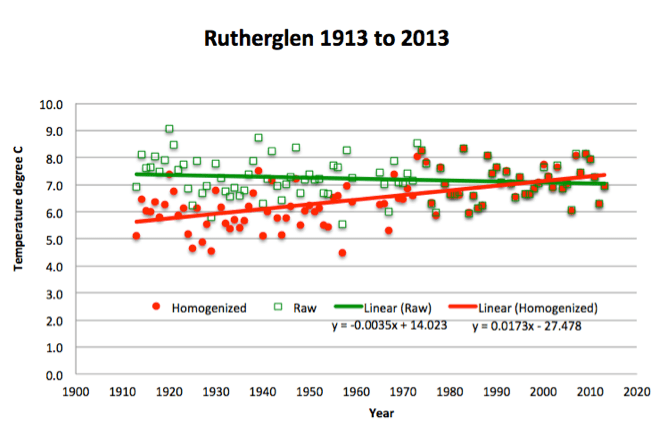
The temperature record at Rutherglen has been corrupted by managers at the Australian Bureau of Meteorology.

Of course raw data often needs to be adjusted but when the magnitude of the data adjustment is greater than the magnitude of the conclusion, then the adjustments or homogenisation become “data corruption” or ” data tampering”. As my Professor, Doug Elliott,  once told me – some 40 years ago – when I wanted to make calculated corrections for presumed errors due to radiation in flame temperature measurements, “You can argue for whatever corrections you want to make, but you cannot replace the measurement. The measurement is the measurement is the measurement”.

A “science” built on the falsification of data?

As was recently pointed out, fudging both data and model results seems endemic in “climate science”:

a recent paper from ETH Zurich.

If the model data is corrected downwards, as suggested by the ETH researchers, and

the measurement data is corrected upwards, as suggested by the British and Canadian researchers,

then the model and actual observations are very similar.


Heat is on over weather bureau ‘homogenising temperature records’

August 23, 2014

Reblogged from jennifermarohasy.com.

It really needs little comment, except perhaps that the magnitude of  “homogenisation” or “adjustments”, or “corrections” as applied to the temperature record makes up most of the “global warming” that is claimed.

Homogenisation in Australia, Adjustments in the US. Fancy algorithms to “correct” data, with not a little confirmation bias, could be better described as “fudging”.

Heat is on over weather bureau ‘homogenising temperature records

EARLIER this year Tim Flannery said “the pause” in global warming was a myth, leading medical scientists called for stronger action on climate change, and the Australian Bureau of Meteorology declared 2013 the hottest year on record. All of this was reported without any discussion of the actual temperature data. It has been assumed that there is basically one temperature series and that it’s genuine.But I’m hoping that after today, with both a feature (page 20) and a news piece (page 9) in The Weekend Australia things have changed forever.

I’m hoping that next time Professor Flannery is interviewed he will be asked by journalists which data series he is relying on: the actual recorded temperatures or the homogenized remodeled series. Because as many skeptics have known for a long time, and as Graham Lloyd reports today for News Ltd, for any one site across this wide-brown land Australia, while the raw data may show a pause, or even cooling, the truncated and homogenized data often shows dramatic warming.

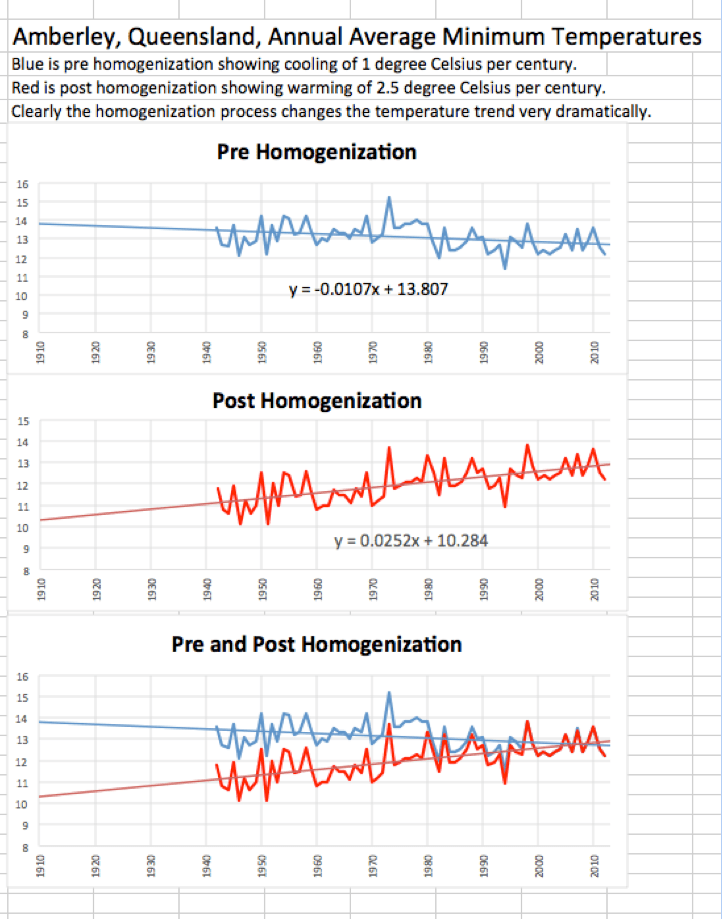
When I first sent Graham Lloyd some examples of the remodeling of the temperature series I think he may have been somewhat skeptical. I know he on-forwarded this information to the Bureau for comment, including three charts showing the homogenization of the minimum temperature series for Amberley.

Mr Lloyd is the Environment Editor for The Australian newspaper and he may have been concerned I got the numbers wrong. He sought comment and clarification from the Bureau, not just for Amberley but also for my numbers pertaining to Rutherglen and Bourke.

I understand that by way of response to Mr Lloyd, the Bureau has not disputed these calculations.

This is significant. The Bureau now admits that it changes the temperature series and quite dramatically through the process of homogenisation.

I repeat the Bureau has not disputed the figures. The Bureau admits that the data is remodelled.

What the Bureau has done, however, is try and justify the changes. In particular, for Amberley the Bureau is claiming to Mr Lloyd that there is very little available documentation for Amberley before 1990 and that information before this time may be “classified”: as in top secret. That’s right, there is apparently a reason for jumping-up the minimum temperatures for Amberley but it just can’t provide Mr Lloyd with the supporting meta-data at this point in time.

Some of the charts I sent to Graham Lloyd earlier this week.

*****
The two articles in The Australian are behind a pay wall here and here. If you don’t already have a subscription to The Australian take one out today, because the articles are important and Graham Lloyd’s work is worth paying for.

If the globe is warming how come relative humidity is decreasing?

August 22, 2014

Increasing temperature leads to a greater capacity for air to hold moisture (the specific humidity). The actual amount of moisture held in a sample of air as a proportion of the capacity of that air to hold moisture is termed the relative humidity and is usually given as a percentage.

Specific humidity (g/kg) versus temperature for air  earthobservatory.nasa.gov

All climate computer models usually assume a constant relative humidity.

NasaIn climate modeling, scientists have assumed that the relative humidity of the atmosphere will stay the same regardless of how the climate changes. In other words, they assume that even though air will be able to hold more moisture as the temperature goes up, proportionally more water vapor will be evaporated from the ocean surface and carried through the atmosphere so that the percentage of water in the air remains constant. Climate models that assume that future relative humidity will remain constant predict greater increases in the Earth’s temperature in response to increased carbon dioxide than models that allow relative humidity to change. The constant-relative-humidity assumption places extra water in the equation, which increases the heating.

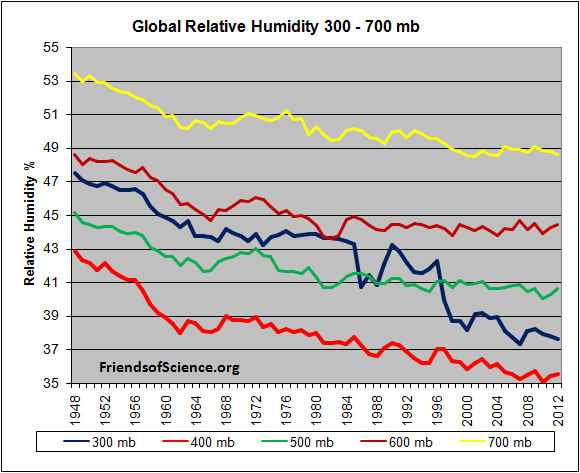
Relative humidity has decreased steadily for over 60 years. All computer models which assume constant relative humidity will overestimate the feedback and the degree of warming.

Forbes carries an article about the mismatch between computer models and actual observations.

ForbesWater vapor is a much more potent greenhouse gas than carbon dioxide, so substantial increases in atmospheric water vapor can certainly cause significant warming. United Nations computer models are programmed to assume that absolute humidity (the total amount of water vapor in the atmosphere) will rise so much that even relative humidity (the percent of water vapor in the atmosphere) will at least keep pace and perhaps even increase. Warmer air is able to hold more water than cooler air, so absolute water vapor would have to increase quite substantially for relative humidity to remain constant or increase in a warming world.

Scientists, however, have been measuring relative humidity for many decades. Rather than keeping pace with modestly warming temperatures, relative humidity is declining. This decline has been ongoing, without interruption, for more than 60 years. After more than six decades of consistent data, we can say with strong confidence that absolute humidity is not rising rapidly enough for relative humidity to keep pace with warming temperatures.

Global Relative Humidity 300 -700mb

Global Relative Humidity 300 – 700mb  (300mb corresponds to about 9,000 m altitude)

The failure of relative humidity to hold constant or rise during recent decades is a lethal dagger in the heart of alarmist global warming claims. According to the UN computer models, rapidly rising absolute humidity will cause substantially more global warming than the modest warming directly caused by rising carbon dioxide levels. Given the potency of water vapor, even a small overstatement of atmospheric humidity levels in UN computer models will cause a very significant overstatement of future warming. And the data show UN computer models assume too much atmospheric humidity.

The effects of this overstatement are apparent in real-world temperature data this century. Precise atmospheric temperature measurements compiled by NASA and NOAA satellite instruments show there has been no global warming since late in the 20th century


Climate modelling: Study shows that without access to water fish will die!

August 21, 2014

I am sure all the forecasts based on climate models applied to hydrological models and extrapolated to 2050 are all quite clever. But it is no evidence of anything.

I am not sure why their conclusions are confined to Arizona. I suspect it may be a profound and universal truth that: Without water fish will die!!

My reading of this study (which I put under Trivia):

If the climate develops as we have modelled,

and if the surface water flows are reduced,

and if the connectivity of the water streams is reduced as we have modelled,

then some fish will lose access to water,

and some of those fish will die.

K. L. Jaeger, J. D. Olden, N. A. Pelland. Climate change poised to threaten hydrologic connectivity and endemic fishes in dryland streams. Proceedings of the National Academy of Sciences, 2014; DOI: 10.1073/pnas.1320890111

Significance (In other words an abstract of the abstract)

We provide the first demonstration to our knowledge that projected changes in regional climate regimes will have significant consequences for patterns of intermittence and hydrologic connectivity in dryland streams of the American Southwest. By simulating fine-resolution streamflow responses to forecasted climate change, we simultaneously evaluate alterations in local flow continuity over time and network flow connectivity over space and relate how these changes may challenge the persistence of a globally endemic fish fauna. Given that human population growth in arid regions will only further increase surface and groundwater extraction during droughts, we expect even greater likelihood of flow intermittence and loss of habitat connectivity in the future.

(my bold)

The University of Ohio goes to town with its Press Release : Climate Change will threaten fish…

Fish species native to a major Arizona watershed may lose access to important segments of their habitat by 2050 as surface water flow is reduced by the effects of climate warming, new research suggests. ….. 

“If water is flowing throughout the network, fish are able to access all parts of it and make use of whatever resources are there. But when systems dry down, temporary fragmented systems develop that force fish into smaller, sometimes isolated channel reaches or pools until dry channels wet up again.”…….


How climate science models are validated

August 20, 2014

Mathematical and computer models are wonderful tools. Once they can be validated they are powerful methods of interpolation. They are useful methods of improving the understanding embodied in the models by extrapolation. The divergence between extrapolated model results and real data can then be used for improving the models to better account for real data. If model results do not fit real data it is time to change the model.

Extrapolated model results are never evidence. They are just indicators of what may come to pass provided that the model – in spite of all its simplifications – does truly apply.

And when climate model results are fudged to move towards climate data which, in turn, has to be fudged to move towards the model results, one wonders whether there is any scientific method left in “climate science”.

This is reported by WUWT from a recent paper from ETH Zurich.

If the model data is corrected downwards, as suggested by the ETH researchers, and

the measurement data is corrected upwards, as suggested by the British and Canadian researchers,

then the model and actual observations are very similar.

Shameless is one adjective that comes to mind.

Fraudulent is another.


Climate models wrong again in ignoring brown carbon from wildfires

August 11, 2014

So much for global warming being settled and the infallibility of incomplete and inadequate climate models.

Climate models generally take the effect of wildfires (brown carbon) on climate to be zero (it is not a parameter that is normally included). Both black and brown carbon particulates are products of incomplete combustion.

A new paper reports on experiments with the combustion of biomass and the brown carbon particulate matter in the smoke:

Saleh et alBrownness of organics in aerosols from biomass burning linked to their black carbon content. Nature Geoscience (2014) doi:10.1038/ngeo2220

The research provides information which can now be included in climate models but since it is a parameter which is not usually included, the obvious conclusion is that for any given level of warming some other effect (most likely that of man-made emissions of carbon dioxide) has been overestimated in the models.

But it is not the obvious conclusion that makes the headlines. Instead it is the ridiculous and alarmist statement that Forest fires can heat the climate that is the headline that Swedish Radio (which is about as orthodox as they come) chooses to lead with. They would clearly like to project the picture of a greater threat and not that of inadequate climate models.

Abstract: …. Here we present smog chamber experiments to characterize the effective absorptivity of organic aerosol from biomass burning under a range of conditions. We show that brown carbon in emissions from biomass burning is associated mostly with organic compounds of extremely low volatility. In addition, we find that the effective absorptivity of organic aerosol in biomass burning emissions can be parameterized as a function of the ratio of black carbon to organic aerosol, indicating that aerosol absorptivity depends largely on burn conditions, not fuel type. We conclude that brown carbon from biomass burning can be an important factor in aerosol radiative forcing.

The paper claims that brown carbon is a significant factor which must be taken into account and the more significant it is the less significant is man-made carbon dioxide.

Swedish Environmental Party makes a fool of itself (again)

August 9, 2014

The Swedish Environmental Party (Miljöpartiet) has not been slow in trying to cash in on the large forest fire in Västmanland. The Swedish General Elections are in September and “anything goes”. Especially if it is alarmist. I don’t expect much intellectual or scientific honesty from them any longer but I though their behaviour yesterday was particularly opportunistic and crass.

  1. Never mind that forest fires in Sweden reduced from over 250,000 hectares destroyed every year before 1850 to less than 1,000 hectares per year in recent times when forest “cultivation” increased.
  2. Never mind that because of the reduced incidence of forest fires the owners have reduced their fire watches.
  3. Never mind that the number of military helicopters suitable for fire fighting have reduced from 33 to 3 in the last 20 years.
  4. Never mind that Sweden no longer has any planes suitable for water bombing.
  5. Never mind that in the grip of complacency, fire fighting equipment has reduced under 3 successive governments.
  6. Never mind that global temperatures have been stagnant for the last 18 years and have actually reduced slightly in the last decade.
  7. Never mind that carbon dioxide emissions by humans are apparently having no impact on real global temperatures (but are absolutely fundamental to every climate model)
  8. Never mind that temperatures in Västmanland this summer are nothing out of the ordinary.

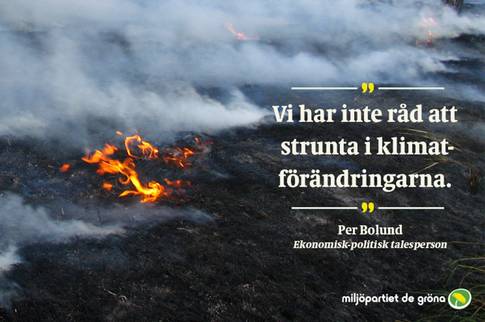
Never mind the facts, just feel the fear. They came out with this picture yesterday even though the Västmanland fire has yet to be brought under control.

“We cannot afford to ignore Climate Change” it reads.

I get the impression that the Swedish Greens have prostituted themselves on the altar of global warming orthodoxy (sorry – climate change >> sorry – extreme events >> sorry – global cooling?).

mp västmanland

mp västmanland

But the temperature anomalies in Västmanland are nothing out of the ordinary.

Västmanland temperatures - The Stockholm Initiative

Västmanland temperatures – The Stockholm Initiative