Archive for the ‘Climate’ Category

Cold records simultaneously in both hemispheres are inconsistent with global warming.

August 6, 2014

Cold records simultaneously in both hemispheres (Death Valley and Adelaide) don’t prove anything of course. They don’t prove that global cooling is underway but are not inconsistent with that hypothesis.

But they certainly are inconsistent with global warming.

Washington Post:

Death Valley, Calif., which is known for being the world’s hottest location, maxed out at a relatively chilly 89 degrees on Sunday. This temperature – nearly 30 degrees below average – was its coolest high temperature on record for the date by a whopping 15 degrees. The previous record of 104 was set in 1945.

This was only the eighth time that a high in the 80s has occurred in Death Valley in July or August, and there hasn’t been a high less than 90 since 1984. Weather records in Death Valley go back to 1911.

Locations that were hotter than Death Valley yesterday include Spokane Wash. (93), Missoula, Mont. (91),  Casper, Wy. (92), and Boise, Idaho (99).

The average June high in Death Valley is 110 degrees, July is 117 degrees, and August is 115. This makes Sunday’s high temperature a ridiculous 26 degrees below normal.

Death Valley set the world’s record hottest temperature of 134 degrees on July 10, 1913.

ABC News:

Adelaide has woken to its coldest start to an August day in 126 years and it was colder across other parts of South Australia.

The weather bureau said it was the coldest August morning since 1888. It was also the coldest day Adelaide has experienced in any month in six years.

Senior forecaster Mark Anolak said the low temperature has been brought on by cold air from the Antarctic moving over Adelaide. “Under a ridge of high pressure that we are experiencing at the moment, clear skies have led to very cold temperatures over the last couple of days,” he said. “Murray Bridge has had its coldest ever start to the day in August at -2.7 degrees this morning.”

Most of regional South Australia woke to cold and frosty conditions.

The weather bureau said it got down to -5.6C in Renmark, just above freezing in Lameroo and -3.9C in Loxton.

Swedish forest fire largest in recent times but a tiny fraction of pre-industrial times

August 6, 2014

Västmanland, Sweden

Increasing humidity and some rain has limited the spread of the largest forest fire which has been ongoing for 7 days in the northern part of Västmanland in Sweden. One person has been found dead  and some 4,000 homes were evacuated a few days ago. Some of those evacuated can now begin to return.

The fire followed 2 weeks of quite warm weather over the entire country with temperatures around 30ºC (high, but not unknown at this times of year and no records were broken).

What became quite clear was that the equipment available to the emergency services was sadly lacking. Three successive governments have taken the easy opportunity of cutting emergency services and there were just no helicopters or planes available in the country for containing the fire. One was requested from Italy yesterday but could not be sent. Another from France is only arriving today. Needless to say they will probably arrive after the point at which they could have done the most good. If it continues to rain today, they will be irrelevant.

Before 1850, fires consumed 250 times larger areas of forest in Sweden than today. It has been the “industrial harvesting” of forests which has drastically reduced the incidence of forest fires. And it has been the complacency brought about by the low incidence of forest fires which has led to a reduced preparedness to fight the fires when they do occur.

The climate alarmists (and there are many of them in Sweden) have not been slow to blame the fire on global warming. A little depressing to hear people so ready to switch off all their rational faculties and parroting what sounds like a climate catechism.!!

But a few sane voices can also be heard.

Swedish Radio:

Two hundred years ago forest fires raged much more freely in Swedish forests. It was when humans began to harvest the forest that fires reduced.

“Swedish forests burned much more in historical times”  says Bengt-Gunnar Jonsson, professor of plant ecology at Mid- University. “Just a few hundred years ago one percent of Swedish forests burned each year. 250 thousand hectares every year. Today only about a thousand acres are lost to forest fires every year“.

Bengt-Gunnar Jonsson sees three separate  eras of fires in the Swedish forests. From prehistoric times to the seventeenth century there were only a few but very large fires. From the seventeenth century until the mid-nineteenth century, when the population increased and people started residing there, the number of fires increased but they were smaller. In the mid-nineteenth century industrial forestry started and the number of forest fires declined sharply. There was a dramatic shift to a landscape where people – rather than fire – harvested the trees.

“Even the very first people in Sweden might have affected how much it burned in the woods”, according to Bengt-Gunnar Jonsson. “Although we have observed fires for several thousand years, we cannot really explain effects of climate and lightning. Many argue that even the ancient fires had a human footprint. It could be that humans have influenced fire history since the ice retreated”.

Västmanland forest fire 2014 - Jocke Berglund -TT

Västmanland forest fire 2014 – Jocke Berglund -TT

Predictions of a “super” or a “monster” El Niño are fizzling out

August 2, 2014

The latest forecast from the Australian Bureau of Meteorology has now downgraded any El Niño event in 2014 to be  – at worst – a normal or a weak El Niño. There is still a reasonable possibility that it will develop, but that itself means that there is now a significant probability that it may not even happen. The alarmist clamour of 3 months ago, enthusiastically disseminated around the globe was clearly somewhat exaggerated.

ENSO Wrap-Up – 29th July 2014:

Despite the tropical Pacific Ocean being primed for an El Niño during much of the first half of 2014, the atmosphere above has largely failed to respond, and hence the ocean and atmosphere have not reinforced each other. As a result, some cooling has now taken place in the central and eastern tropical Pacific Ocean, with most of the key NINO regions returning to neutral values.

While the chance of an El Niño in 2014 has clearly eased, warmer-than-average waters persist in parts of the tropical Pacific, and the (slight) majority of climate models suggest El Niño remains likely for spring. Hence the establishment of El Niño before year’s end cannot be ruled out. If an El Niño were to occur, it is increasingly unlikely to be a strong event.

Given the current observations and the climate model outlooks, the Bureau’s ENSO Tracker has shifted to El Niño WATCH status.

Back on 6th May, the ABM wrote ” The tropical Pacific Ocean has warmed steadily in recent months, with large warm anomalies in the ocean sub-surface (5-day values up to +6 °C) and increasingly warm sea surface temperatures. Climate models surveyed by the Bureau suggest El Niño development is possible as early as July”.

Climate models are not as robust as some would like us to believe.

The alarmists such as Joe Romm went to town with dire predictions just 3 months ago and were predicting a “super” and a Monster” El Niño for 2014. Of course, dire predictions which never ever materialise are the stuff of alarmism.  The clever alarmist is the one who makes unverifiable predictions which will never happen but which cannot be disproved.

Joe Romm, 26th March: Is A Super El Niño Coming That Will Shatter Extreme Weather And Global Temperature Records?

Signs are increasingly pointing to the formation of an El Niño in the next few months, possibly a very strong one. When combined with the long-term global warming trend, a strong El Niño would mean 2015 is very likely to become the hottest year on record by far. ……. 

John Upton, May 16th: A monster El Niño could be on its way, and it will likely have a complicated effect on the world’s breadbaskets.

Something fierce is rising out of the Pacific Ocean, and its appetite for the world’s major carb crops could be even more ravenous than that of a monstrous mythical sea creature. …… A dinosaurian belch of warm water thousands of miles wide has appeared at the surface of the Pacific Ocean near the equator. The warming ocean conditions have spurred NOAA to project a two-thirds chance that an El Niño will form by summer’s end. It’s tipped to be of the monster variety—the extreme type that could become more common with global warming.

El Niño events come regularly and we can expect that will continue. But in 2014 it will at worst be a “normal” or a weak El Niño. Its feared effects on the Indian monsoon have also been downgraded. The monsoon which is now half-way through its season has recovered somewhat.

But the simple truth is that not a single one of the dire predictions that global warming alarmists are wont to make has come to pass.

Adapting to climate change requires the further development and use of fossil fuels

July 31, 2014

The single thing that differentiates the human species from every other known species on earth has been the control and use of fire.The step change then from primitive to modern humans has been due not least to the control and development of the combustion process and the utilisation of fossil fuels. This in turn has multiplied many times the intensity of energy available to be harnessed by man. I would suggest that the human capability of handling change is largely a function of the power intensity available.

power intensity

power intensity

Fossil fuels have been demonised (by association with carbon dioxide emissions) for the last 30 years. In spite of that most  of the growth in the developing world has been – and continues to be – powered by fossil fuels. Fortunately the lack of evidence of any significant linkage between man-made carbon dioxide and global warming  (which is still the politically correct ideology) is beginning to be realised. The unnecessary, misplaced and ineffective increase of electricity prices in countries which have curtailed their use of fossil fuels has prolonged the recession and has cost many millions of jobs.

We have now had almost 20 years with the highest level ever of fossil fuel utilisation but “global temperature” has remained stubbornly static. In the last decade global temperatures have declined slightly. The hypothesised link between man-made carbon dioxide (which constitutes only about 3% of carbon dioxide emissions) and global temperature is well and truly broken. All the various climate computer models – which build on this link being amplified – have failed miserably.

The indicators of a global cooling cycle having started are piling up.

  1. There is more ice in the antarctic than has ever been measured
  2. There is more ice in the arctic than about a decade ago
  3. Total ice cover is higher now than has ever been measured
  4. Ice cover on the Great Lakes reached levels not seen for over 50 years and has persisted into the spring (even summer) later than has been observed for at least 40 years.
  5. The expected super El Nino forecast for this year has been dampened by a cooling Pacific and only a mild El Nino event – if at all – is now to be expected
  6. Sea level rises are no different to the long term average for sea level recovery since the last glacial minimum and may even have slowed.
  7. The deep oceans are cooling and are no repository of “hidden heat”
  8. The net cooling effect of clouds has been underestimated in nearly all models and cloud cover over the world is increasing (slightly).
  9. Man made water vapour is of greater significance than man made carbon dioxide for climate effects. But man made water vapour is almost insignificant compared to the water vapour flux due to evaporation and respiration.
  10. Solar effects are virtually ignored by all climate models but the sun does not much care for models and is reaching a low level of activity comparable to the Dalton or Maunder Minima.

Crying wolf about global warming has been the politically correct thing to do for 3 decades. Before that it was politically correct to be alarmist about the coming ice age. No doubt all the old fears about an ice age can be dusted off and recycled.

Climate change has been the most powerful force which has shaped human evolution and expansion. Sea level changes and patterns of precipitation and desertification have driven both evolution and migrations. Sea level during an ice age is about 120 m lower than it is today. More land is exposed in equatorial and tropical regions during a glacial period while land is rendered uninhabitable by the ice sheets of the north. But even primitive humanity survived during the glacials.

It is the global cooling cycles and not global warming cycles which will place the greatest demands on farming and energy. The greatest sea level change that humanity has had to – and will have to – adapt to  is the 120 m difference between glacial and interglacial conditions. During an ice age precipitation will drop sharply and river water flows will decline. Hydro power will all but dry up. It is the inevitable coming of the next ice age that will pose the real challenge – not the 1 m sea level rise that may come with another warming cycle. And when the ice age comes again it will be fossil fuels which will keep the home fires burning. It is the further exploitation of nuclear energy and fossil fuels in all its forms – coal, oil, natural gas, shale gas, gas from methane hydrates – that will be needed. It is the availability of power at the intensities provided by nuclear power and fossil fuel combustion which is what will provide humans with the wherewithal to cope with climate change, whether warming or cooling, but especially when the next ice age begins.

Whatever the alarmists would have us do in the short term, reality will eventually bite. The use of fossil fuels will – thankfully – continue as will the exploration for new sources of gas. The next generation of nuclear power plant will be developed – even though nuclear alarmism has led to a dearth of nuclear engineers. No doubt some market niches will be filled by wind and solar power but that will not be very significant in the large picture.


Indian monsoon rainfall recovering from deficit but strong El Niño no longer expected

July 18, 2014

Yesterday the monsoon covered the entire country but while this is only 2 days later than the “long term average”, the progress of the monsoon across south and central India has been around a week or 10 days late. Until last week the rainfall was in deficit by over 40%, but heavy rains this week are beginning to eat into this deficit. In the meantime the possibility of a strong El Niño  this year, which could have further depressed the monsoon rainfall, is receding.

With 2½ months of the monsoon season left, there is now a reasonable – and improving – probability that the shortfall will end up at less than 10% of the long term average and that the hit to the Indian GDP will not be too severe.

Climate alarmists (mainly the environmental mafia) have been hoping – and praying – for a strong El Niño, a disastrous monsoon, a strong blow to the agricultural sector and an increase in farmer suicides. They are increasingly likely to be disappointed. Fortunately the cost to consumers usually reduces and the good of society usually increases with the increasing disappointment of the loony green mafia.

The best thing to have happened for Australia in years is probably the recent repeal of the Carbon tax which has – surprise, surprise – caused great disappointment to the loony green mafia.

Monsoon covers entire country 17 July 2014 - IMD

Monsoon covers entire country 17 July 2014 – IMD

ET:The monsoon delivered this season’s heaviest showers on Tuesday, drenching southern and central India with 50 per cent more rainfall than normal, while international forecasters said the rain-disrupting El Nino phenomenon would be weaker than feared.

The northern and western parts of the country remained relatively dry, but for the country as a whole, Tuesday’s rainfall was 10 per cent above normal, reducing the season’s rain deficit to 40 per cent. The deficit is still abnormally high, but two days of heavy rainfall is expected to speed up crop planting, which was half of last year’s mid-July level. 

The weather office has forecast good rainfall in many parts of the country in the days ahead. Further, the latest forecast of Australia’s weather department could bring some relief to policy-makers as it has suggested that the El Nino weather phenomenon that curtails June-September rains is unlikely to be intense this year.

The Australian Bureau of Meteorology writes in its ENSO wrap-up:

Warming of the tropical Pacific Ocean over the past several months primed the climate system for an El Niño in 2014. However, a general lack of atmospheric response over the last month has resulted in some cooling of the tropical Pacific Ocean.

While the majority of climate models suggest El Niño remains likely for the spring of 2014, most have eased their predicted strength. If an El Niño were to occur, it is increasingly unlikely to be a strong event.

Changes are also occurring in the Indian Ocean. The Indian Ocean Dipole (IOD) index has been below −0.4 °C (the negative IOD threshold) since mid-June, but it would need to remain negative into August to be considered as an event. Negative values are rare when the central Pacific is warmer than average. Model outlooks suggest the IOD is likely to return to neutral by spring. Conditions in the Indian Ocean may have contributed to the above-average rainfall experienced in southeast Australia during June.


US temperature data are not real but “adjusted”

June 29, 2014

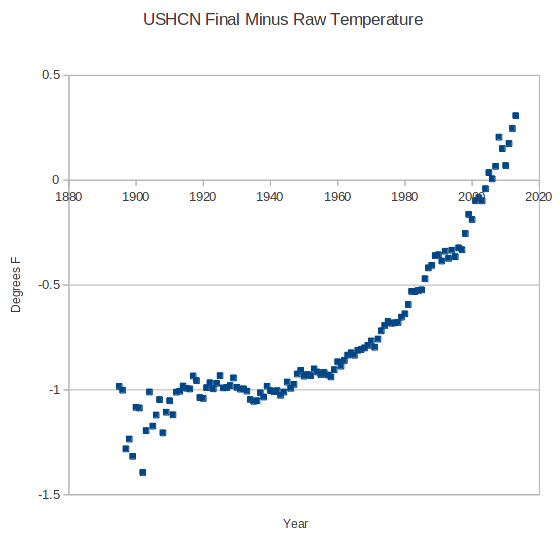
It would now seem to be confirmed that US temperature data are being “adjusted” to meet the requirements of the adjusters.

This is more than confirmation bias. It is the fabrication of data. 

Real Science:

I have posted this graph dozens of times, and hopefully this time it will be clear to everyone. The graph shows the average final temperature for all USHCN stations minus the average raw temperature for all USHCN stations.  This is a very simple calculation which shows the average adjustment for all USHCN stations.

It shouldn’t be a surprise to NOAA or anybody else that an exponential increase in adjustments is occurring, as I have been showing the same graph (crying wolf) for many years.
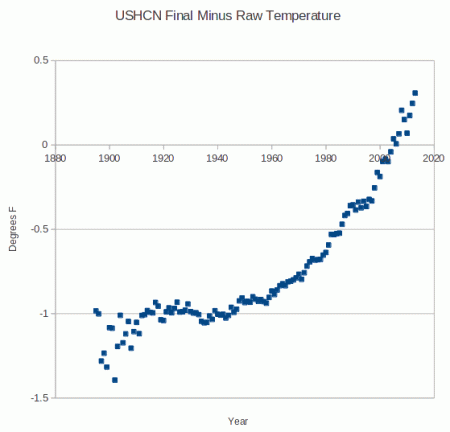
USHCN adjustments - Real Science

USHCN adjustments – Real Science

While Real Science has been claiming this fabrication of data for some time it is only recently that it has started receiving serious attention. And it would seem that there are no real temperatures any more across the continental US. Where measuring stations no longer exist, temperatures are just  made up for the purpose of “continuity”.

Paul Homewood has been looking at these and he posted this about the temperature adjustments at Kansas stations

Following much recent discussion on USHCN temperature adjustments, I have had a chance to analyse what has been going across the state of Kansas.

Altogether there are 30 USHCN stations, currently listed as operational in Kansas, and I have compared the mean temperatures from the USHCN Final dataset for January 2013, with the actual station measurements as listed in the State Climatological Reports. (There is one station at Lawrence, which I have excluded as the file seems to be corrupted). …..

  • Nearly every station has had the actual temperatures adjusted upwards by about half a degree centigrade.
  • There are 8, out of the 29 stations, which have “Estimated” temperatures on USHCN. This is a ratio of 28%, which seems to tie in with Steve Goddard’s country-wide assessment.
  • Of these eight estimates, five are because of missing data, as listed at the bottom. Four of these are now shut.
  • There seems to be no obvious reason why the other three estimates have been made , at Ellsworth, Liberal and Ottawa. The adjustments at these though don’t appear to be significantly different to the non estimated ones.

 In addition to recent temperatures being adjusted upwards, we also find that historical ones have been adjusted down. So, for instance we find that the January 1934 mean temperature at Ashland has been adjusted from 3.78C to 3.10C, whilst at Columbus there is a reduction from 4.00C to 3.52C.

In total, therefore, there has been a warming trend of about 1C added since 1934. It has always been my understanding that the various adjustments made for TOBS, etc, have been made to the historic data, and that present temperatures were left unaltered. Certainly, the cooling adjustments of about half a degree in the 1930’s would seem to tally with what NOAA have been publishing.

But this leaves the question of just why there is a need to continually adjust current temperatures upwards.

WUWT is also on the case:

What is going on is that the USHCN code is that while the RAW data file has the actual measurements, for some reason the final data they publish doesn’t get the memo that good data is actually present for these stations, so it “infills” it with estimated data using data from surrounding stations. It’s a bug, a big one. And as Zeke did a cursory analysis Thursday night, he discovered it was systemic to the entire record, and up to 10% of stations have “estimated” data spanning over a century. ……… And here is the real kicker, “Zombie weather stations” exist in the USHCN final data set that are still generating data, even though they have been closed. ……

There are quite a few “zombie weather stations” in the USHCN final dataset, possibly up to 25% out of the 1218 that is the total number of stations. In my conversations with NCDC on Friday, I’m told these were kept in and “reporting” as a policy decision to provide a “continuity” of data for scientific purposes. While there “might” be some justification for that sort of thinking, few people know about it there’s no disclaimer or caveat in the USHCN FTP folder at NCDC or in the readme file that describes this, they “hint” at it saying:

“The composition of the network remains unchanged at 1218 stations”

But that really isn’t true, as some USHCN stations out of the 1218 have been closed and are no longer reporting real data, but instead are reporting estimated data.

This is the fabrication of data – institutionalised – to satisfy a pre-determined conclusion.

Climate and the butterfly in Brazil

June 22, 2014

You may think that the weather outside your window is a consequence of the prevailing climate. But that would be the cart before the horse. Without weather there is no climate.

Climate is to weather as evolution is to reproduction.

Evolution is just a label given to the result of many, many individual survival and reproduction events. Evolution is not a “force” which directs who will survive and who will not or which individuals will reproduce and who will not. Evolution is then the name we give to the resultant changes in the genetic make-up of species as individuals of that species survive and reproduce (or fail to reproduce where  the species goes extinct). The survival and reproduction of individuals changes as the environment they live in changes. Evolution is thus the global, net result of the millions of successful, local, individual matings, and of the many more millions of failures to reproduce. Natural selection is merely a record of those that manged to survive and reproduce and thereby “deselected” all the failures. Without environmental change first causing a change in which individuals survive and then reproduce, there can be no evolutionary change (except due to random mutations).  Similarly there is no great driving force called climate which determines the weather outside your window. Climate is the label we give to the summation of all the local weathers in a region or around the globe as being the climate of that region or of the world. Just as resulting evolution and evolutionary change is impacted by the local survival or failure of a species, so is resulting climate impacted by weather and by changes to local weather patterns. Climate is a calculated result, an average, of  myriads of local weather events

Without reproduction and consequent genetic change there is nothing to be called evolution. There is no evolutionary change if a species is genetically static – if it’s surroundings and its growth are unchanged.  Similarly there is no climate change if local weather patterns remain static. And without individual events of local weather there can be no average to be called climate.

The weather we each experience locally outside our windows covers a very wide range. Within a few minutes, on any day of the year we can experience temperature changes of  5 – 10ºC as clouds appear or it starts blowing or if it rains or if it snows. Winds can vary from virtually still upto over 100km/h in the midst of a storm. Every single day we see a change of around 10ºC between day and night. Over a period of a week it would not be unusual to have a temperature change of even 20ºC. Over a year a temperature variation of 60ºC (+35ºC on the warmest day to – 25ºC on the coldest) could be expected at my latitude.

Politically correct “climate science” today takes it for granted that any unpleasant warming of the earth, or uncomfortable cooling of the earth, or increased frequency of storms, or copious amounts of rainfall and any resulting flood, or no rainfall and any resulting drought, or any unduly severe hurricanes is – by virtue of its unpleasantness – due to man-made climate change. And man’s evil influence is all manifested by the emissions of carbon dioxide from fossil fuel combustion and the atmospheric concentration of carbon dioxide!

But in the meantime it is mid-summers day and a cloud has passed over the sun. And when the cloud has passed I will feel a lot warmer than by increasing the carbon dioxide around me!!!!

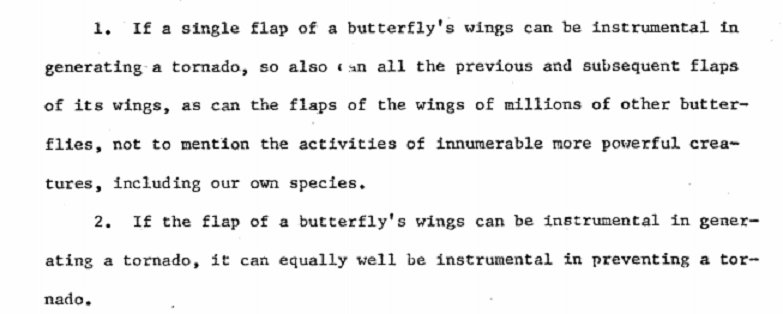
In the 1960’s Edward Lorenz developed his chaos theory and in 1972 gave his famous talk questioning if the flap of a butterfly’s wings in Brazil could set off a tornado in Texas. (Lorenz Butterfly 1972).

Lorenz 1972

Lorenz 1972

Without reproduction there is no evolution and without local weather there is no climate.

Blaming fossil fuel combustion for climate change is like blaming one poor butterfly in Brazil and ignoring every other bird and insect flapping its wings.


Fossil fuel combustion at an all time high (but global warming is absent)

June 18, 2014

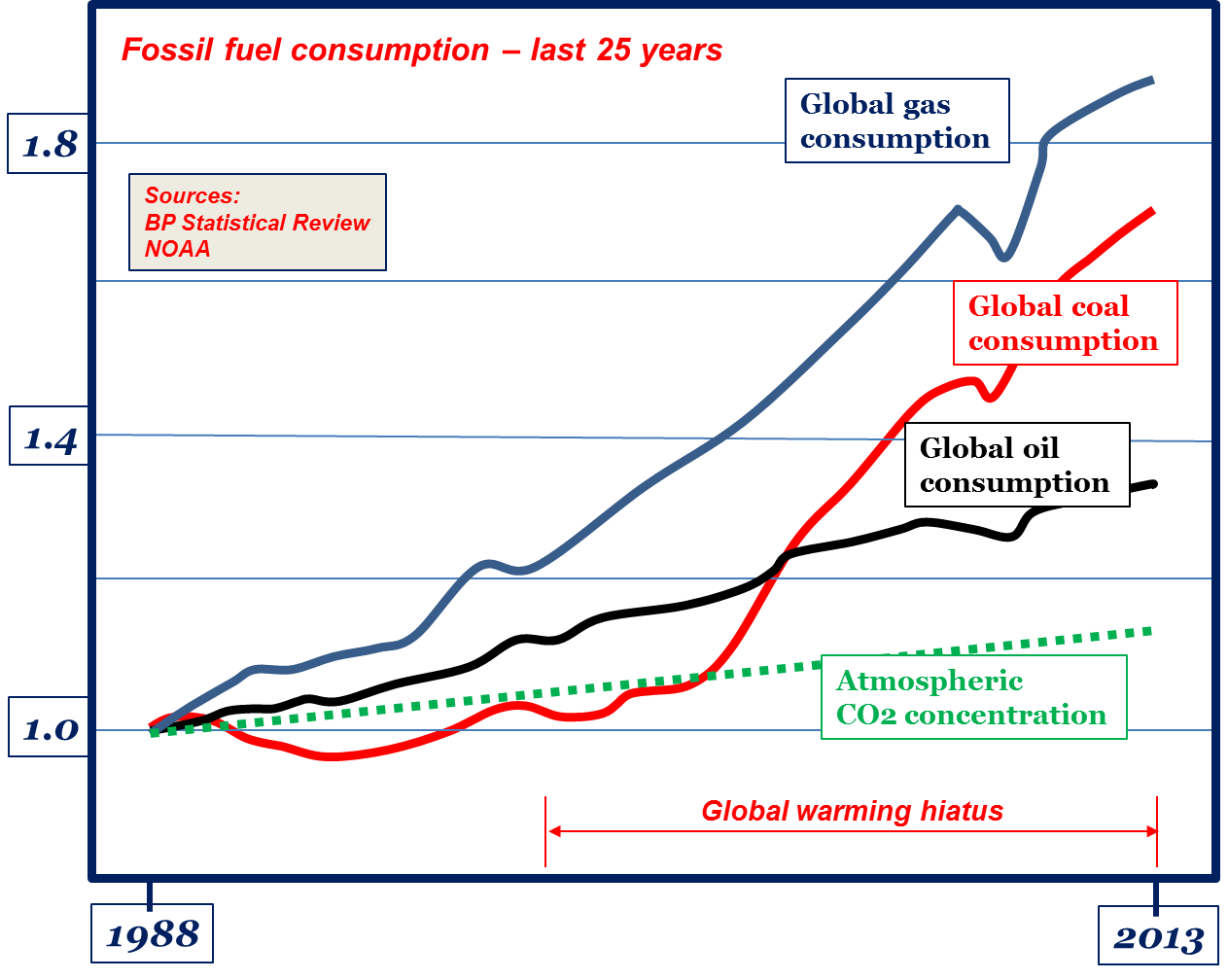
The BP Statistical Review of World Energy 2014 is now out and the consumption of all fossil fuels has never been higher. Coal and gas consumption are particularly strong. And – even though many are in a state of denial about it – global warming has come to a stop over the last 18 years. In the last 10 years global temperatures show a slight downward trend.

There seems to be no purpose to the demonisation of fossil fuels other than for pandering to the religion of global warming. Consider the last 25 years. (I use 1988 as a reference point not only because 25 years should be enough to see some trends but also because the BP data is readily available from that date). During this 25 year period gas consumption has increased by over 80%, coal consumption by 0ver 70% and oil consumption by over 30%. The increased global coal burn since about 1999 is particularly striking. In the same 25 year period the carbon dioxide concentration in the atmosphere has increased from about 355 ppm(v/v) to about 395 ppm(v/v) – a rise of about 11%. And global temperatures have not increased at all for almost 2 decades.

Climate policy is policy without any objectives and without any means of checking any achievements. What exactly could we achieve by not using fossil fuels?

There is not a single climate policy proposed by the IPCC or by any government in the world  which has a definable and measurable climate benefit.

25 years of fossil fuel consumption

25 years of fossil fuel consumption

The global warming hiatus now extends to at least 18 years.

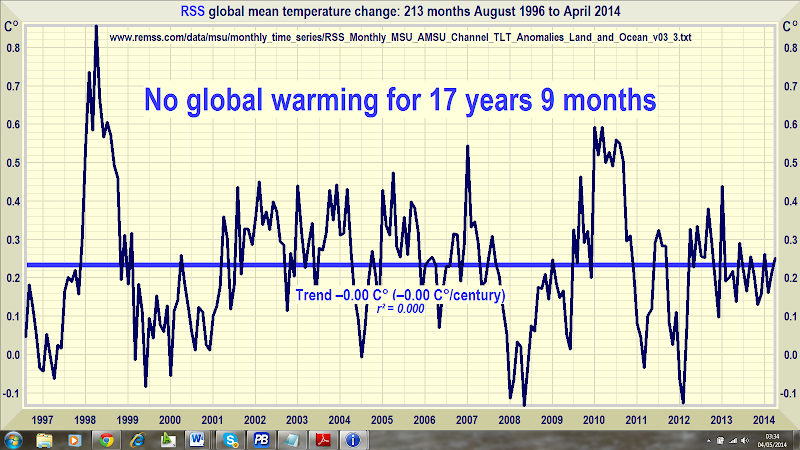
Global warming has gone missing

  • The RSS satellite dataset shows no global warming at all for 213 months from August 1996 to April 2014. That is more than half the entire 423-month satellite record.
  • The fastest centennial warming rate was in Central England from 1663-1762, at 0.9 Cº per century – before the industrial revolution began. It cannot have been our fault.
  • The global warming trend since 1900 is equivalent to 0.8 Cº per century. This is well within natural variability and may not have much to do with us.

Indian Monsoon arrives – as forecast but 5 days later than average

June 6, 2014

The long range monsoon forecast predicted that total rainfall would be at around 95% of the long term average and would arrive on 5th June at the coast of Kerala. For a normal monsoon landfall in Kerala is on the 1st of June. One fear was – and still is – that if an El Niño develops this year, then a further shortfall of rain in the 4 months of the monsoon season might occur.

It is still not clear if an El Niño will develop. But the monsoon which was stationary south of Sri Lanka a few days ago has developed rapidly in the last 24 hours and the northern limit has advanced well into southern India. The eastern  end of the northern limit is still relatively static compared to the western end, but is expected to develop in the next 2 or 3 days.

IMD: 

  1. Southwest monsoon has set in over Kerala today, i.e. 6th June 2014. The southwest monsoon has further advanced into most parts of south Arabian sea and Kerala, remaining parts of Maldives-Comorin areas, some parts of Tamilnadu, most parts of southwest Bay of Bengal and some parts of westcentral Bay of Bengal. 
  2. The northern limit of monsoon passes through 12.0°N/60.0°E, 12.0°N/70.0°E, 12.0°N/74.0°E, Kozhikode, Coimbatore, Cuddalore, 13.0°N/83.0°E, 16.0°N/87.0°E, 18.0°N/90.0°E and 21.0°N/92.0°E. 
  3. Conditions are becoming favourable for further advance of Southwest Monsoon into remaining parts of south Arabian sea, some parts of central Arabian sea, remaining parts of Kerala, some parts of south Karnataka, some more parts of Tamilnadu and Bay of Bengal during next 2-3 days. Conditions continue to remain favourable for further advance of Southwest monsoon into some parts of northeastern state during next 48 hours.
Monsoon advance  2014 June 6th - source IMD

Monsoon advance 2014 June 6th – source IMD

Sangeang Api erupts – and an intensity 5+ eruption is well overdue

May 31, 2014

Another volcanic eruption in Indonesia. The odds that the next volcanic eruption of intensity 5 or greater will occur in Indonesia must now be quite significant.

This time the eruption was at Sangeang Api.

VolcanoDiscoveryA major explosive eruption occurred at the remote volcano this morning at around 08:30 UTC. A subplinian eruption column quickly rose to an estimated 50-65,000 ft (15-20 km) altitude and drifted several hundred km to the east and southeast. 
Ash fall was reported in areas up to 30 km downwind from the volcano. 
Luckily, the island itself is largely uninhabited although visted by farmers who cultivate some land. Evacuations were ordered within 1.5 km radius from the volcano. 
Seismic activity preceding the eruption, including a nearby magnitude 4.5 earthquake at 03:05 UTC, was reported felt in the nearby city of Bima (Sumbawa Island) and even on Flores. 
Today’s explosion was the first at Sangeang Api volcano since its eruptions during 1997-99. Increased steaming and a number of earthquakes in recent years might have been precursors to today’s event.

sangeang-api-30may14 photo Bambang Bimawan

sangeang-api-30may14 photo Bambang Bimawan

It has now been 23 years since the eruption of a volcano with an eruption index of 5 or greater. Through the last century, intervals between VEI5+ eruptions were 7 years on average.

ktwopDuring the 19th century there were volcano eruptions having a Volcanic Explosivity Index (VEI) of 5 or greater on average every 11 years. During the 20th century the average was 7 years with the greatest interval between VEI5 eruptions being 23 years. The last VEI5 eruption was in 1991 and now – 22 years on – a VEI5 eruption is overdue.

Mt. Pinatubo and Mt. Hudson (both VEI6) erupted in 1991.

For climate, the net effect of volcanic eruptions – especially those with large dust clouds and aerosol producing gas emissions – is usually of global cooling. We have seen a standstill (and a slight decline) in global temperatures even through this relatively long interval without a VEI5 eruption.  The effects of the 1991 eruptions probably subsided around 1994. The effects of a single eruption on global temperature probably last 2 to 3 years. But any significant, single eruption may well be able to trigger a particular, semi-stable, climate regime. And when the next VEI5+ eruption does occur we are likely to see a more intensive global cooling regime.