Archive for the ‘Climate’ Category

74 questions from the Trump transition team which are bothering the Department of Energy

December 10, 2016

Whatever one may think of Trump, his transition team’s questions for the Department of Energy are penetrating. They are causing some little worry among the adherents of the man-made global warming religion.

Willis Eschenbach has the list of questions and his comments over at WUWT.

doe-vs-ugly-reality

Man-made climate change (actually the lack of such), vast grants to companies which go bankrupt in the night, jaunts to resorts for climate meetings, prolonging nuclear power …. are all apparently within the sights of the transition team.

The questions and Willis Eschenbach’s comments are reproduced below

Questions for DOE

This memo, as you might expect, is replete with acronyms. “DOE” is the Department of Energy. Here are the memo questions and my comments.

1. Can you provide a list of all boards, councils, commissions, working groups, and FACAs [Federal Advisory Committees] currently active at the Department? For each, can you please provide members, meeting schedules, and authority (statutory or otherwise) under which they were created? 

If I were at DOE, this first question would indeed set MY hair on fire. The easiest way to get rid of something is to show that it was not properly established … boom, it’s gone. As a businessman myself, this question shows me that the incoming people know their business, and that the first order of business is to jettison the useless lumber.

(more…)

Reading University shows Antarctic ice increased over last 3 decades and is largely unchanged over 100 years

November 24, 2016

You cannot have “global” warming which applies differently to different parts of the globe. If man-made CO2 is having any significant effect on “global” temperature it must be an effect that is visible in both the Arctic and the Antarctic. Even if all the Arctic ice melts but the Antarctic ice does not then “global” warming is clearly not “global”.

A new study by Reading University shows that Antarctic ice is largely unchanged over 100 years and increasing over the last 3 decades. The man-made “global” warming theory is just not possible with these results.

Research article
21 Nov 2016

Estimating the extent of Antarctic summer sea ice during the Heroic Age of Antarctic Exploration

Tom Edinburgh1,a and Jonathan J. Day11Department of Meteorology, University of Reading, Reading, UK
acurrently at: Department of Applied Mathematics and Theoretical Physics, University of Cambridge, Cambridge, UK

Abstract. In stark contrast to the sharp decline in Arctic sea ice, there has been a steady increase in ice extent around Antarctica during the last three decades, especially in the Weddell and Ross seas. In general, climate models do not to capture this trend and a lack of information about sea ice coverage in the pre-satellite period limits our ability to quantify the sensitivity of sea ice to climate change and robustly validate climate models. However, evidence of the presence and nature of sea ice was often recorded during early Antarctic exploration, though these sources have not previously been explored or exploited until now. We have analysed observations of the summer sea ice edge from the ship logbooks of explorers such as Robert Falcon Scott, Ernest Shackleton and their contemporaries during the Heroic Age of Antarctic Exploration(1897–1917), and in this study we compare these to satellite observations from the period 1989–2014, offering insight into the ice conditions of this period, from direct observations, for the first time. This comparison shows that the summer sea ice edge was between 1.0 and 1.7° further north in the Weddell Sea during this period but that ice conditions were surprisingly comparable to the present day in other sectors.


Citation: Edinburgh, T. and Day, J. J.: Estimating the extent of Antarctic summer sea ice during the Heroic Age of Antarctic Exploration, The Cryosphere, 10, 2721-2730, doi:10.5194/tc-10-2721-2016, 2016.

Ice observations recorded in the ships’ logbooks of explorers such as the British Captain Robert Scott and Ernest Shackleton and the German Erich von Drygalski have been used to compare where the Antarctic ice edge was during the Heroic Age of Antarctic Exploration (1897-1917) and where satellites show it is today.

The study, published in the European Geosciences Union journal The Cryosphere, suggests Antarctic sea ice is much less sensitive to the effects of climate change than that of the Arctic, which in stark contrast has experienced a dramatic decline during the 20th century. ……

……. Jonathan Day, who led the study, said: “The missions of Scott and Shackleton are remembered in history as heroic failures, yet the data collected by these and other explorers could profoundly change the way we view the ebb and flow of Antarctic sea ice.

“We know that sea ice in the Antarctic has increased slightly over the past 30 years, since satellite observations began. Scientists have been grappling to understand this trend in the context of global warming, but these new findings suggest it may not be anything new.

“If ice levels were as low a century ago as estimated in this research, then a similar increase may have occurred between then and the middle of the century, when previous studies suggest ice levels were far higher.”

The new study published in The Cryosphere is the first to shed light on sea ice extent in the period prior to the 1930s, and suggests the levels in the early 1900s were in fact similar to today, at between 5.3 and 7.4 million square kilometres. Although one region, the Weddell Sea, did have a significantly larger ice cover.

Published estimates suggest Antarctic sea ice extent was significantly higher during the 1950s, before a steep decline returned it to around 6 million square kilometres in recent decades.

The research suggests that the climate of Antarctica may have fluctuated significantly throughout the 20th century, swinging between decades of high ice cover and decades of low ice cover, rather than enduring a steady downward trend.


“Adjusting” temperatures is a political exercise in a politicised “science”

November 24, 2016

To pretend that politicised science does not exist is to be naive. To state as a religious conviction that man-made CO2 is causing global warming is little different to the religiously expressed beliefs by politically correct media that Brexit would not happen or that Trump could not win. Climate “scientists” and their gullible followers need to remember that all beliefs can only exist in the space of ignorance.

I dislike algorithms for “calculating” an artificial “global temperature” by “adjusting” and “weighting” raw data to suit pre-conceived notions of what final result should be. It gets worse when the “adjustments” about past temperatures are variable and are themselves “adjusted” every year. The reports about every year being hotter than the last are actually just a statement that “adjustments” every year are greater than the last.

I reproduce Tony Heller’s post about the US temperatures in realclimatescience:

NOAA Adjustments Correlate Exactly To Their Confirmation Bias

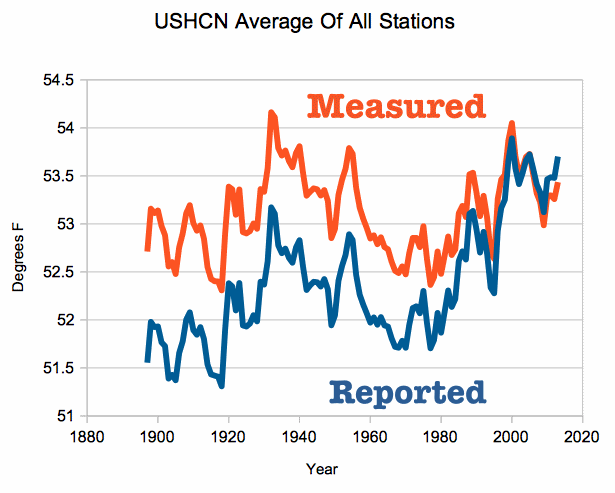
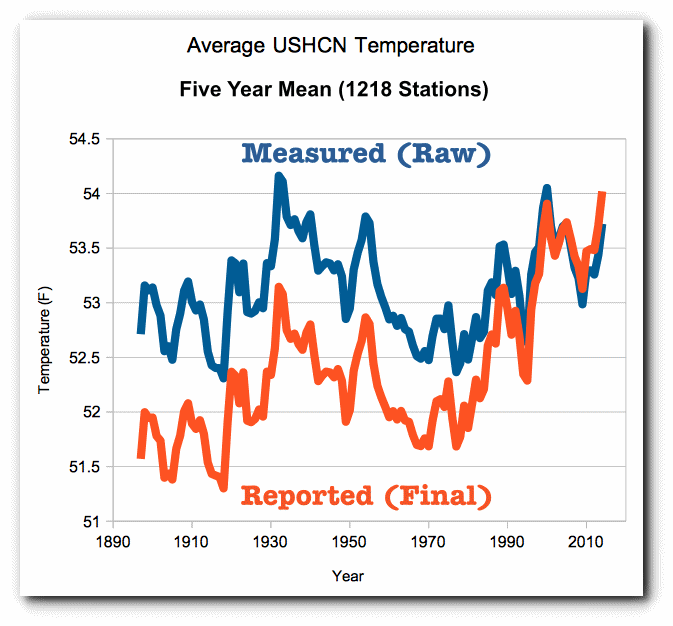
Thermometers show the US cooling since about 1920, but NOAA massively cools the past to create the appearance of a warming trend.

screen-shot-2016-11-21-at-9-31-19-am

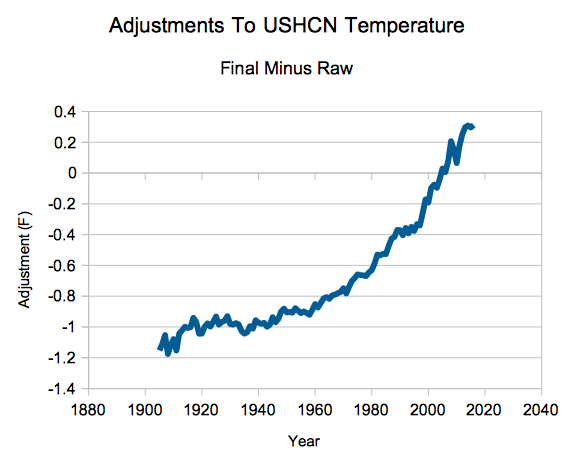
These adjustments make a spectacular hockey stick of data tampering.

screen-shot-2016-11-21-at-9-36-49-am

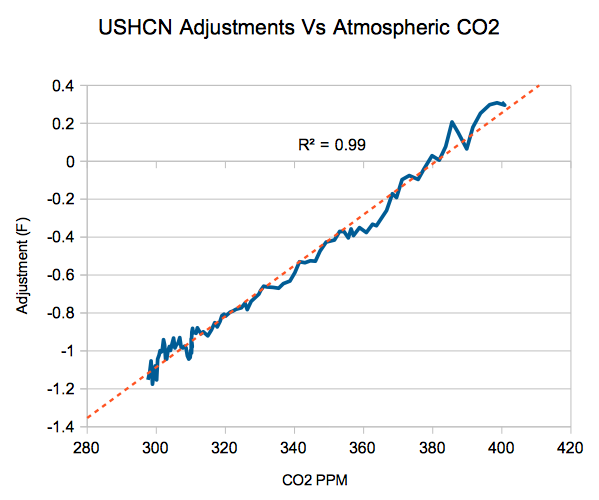
When plotted against atmospheric CO2, the correlation is almost perfect.  NOAA is tampering with the data exactly to match their theory.

screen-shot-2016-11-21-at-9-26-17-am


Judith Curry’s guide to climate models

November 13, 2016

Judith Curry’s guide to climate models.

Well worth reading.

Though written for lawyers, it might even be tough for many lawyers. However politicians should get their “science” aides to read, digest and summarise it for them (it would be far too ambitious to expect the politicians to be able to read so much, understand it or to digest so much in one go).

For me, the real issue with GCM’s is not that the modelling is done but that they are used for policy making. Assumed sensitivities are effectively used to fit the results for the immediate past. The forced fit is then taken as proof that the assumptions are true and are then projected into the future. The claimed objective of the resultant policies can neither be monitored nor measured.


Climate models for lawyers

by Judith Curry

I have been asked to write an Expert Report on climate models.

No, I can’t tell you the context for this request (at this time, anyways).  But the audience is lawyers.

Here are the specific questions I have been asked to respond to:

  1. What is a Global Climate Model (GCM)?
  2. What is the reliability of climate models?
  3. What are the failings of climate models?
  4. Are GCM’s are a reliable tool for predicting climate change?

I’ve appended my draft Report below. I tried to avoid giving a ‘science lesson’, and focus on what climate models can and can’t do, focusing on policy relevant applications of climate models.  I’ve tried write an essay that would be approved by most climate modelers; at the same time, it has to be understandable by lawyers. I would greatly appreciate your feedback on:

  • whether you think lawyers will understand this
  • whether the arguments I’ve made are the appropriate ones
  • whether I’m missing anything
  • anything that could be left out (its a bit long).

——–

What is a Global Climate Model (GCM)?

Global climate models (GCMs) simulate the Earth’s climate system, with modules that simulate the atmosphere, ocean, land surface, sea ice and glaciers.  The atmospheric module simulates evolution of the winds, temperature, humidity and atmospheric pressure using complex mathematical equations that can only be solved using computers. These equations are based on fundamental physical principles, such as Newton’s Laws of Motion and the First Law of Thermodynamics.

GCMs also include mathematical equations describing the three-dimensional oceanic circulation, how it transports heat, and how the ocean exchanges heat and moisture with the atmosphere. Climate models include a land surface model that describes how vegetation, soil, and snow or ice cover exchange energy and moisture with the atmosphere. GCMs also include models of sea ice and glacier ice.

To solve these equations on a computer, GCMs divide the atmosphere, oceans, and land into a 3-dimensional grid system (see Figure 1). The equations and are then calculated for each cell in the grid repeatedly for successive time steps that march forward in time throughout the simulation period.

slide1

Figure 1. Schematic of a global climate model.

The number of cells in the grid system determines the model ‘resolution.’ Common resolutions for a GCM include a horizontal resolution of about 100-200 km, a vertical resolution of about 1 km, and a time stepping resolution that is typically about 30 minutes. While GCMs represent processes more realistically at higher resolution, the computing time required to do the calculations increases substantially at higher resolutions. The coarseness of the model resolution is driven by the available computer resources, and tradeoffs between model resolution, model complexity and the length and number of simulations to be conducted.

Because of the relatively coarse spatial and temporal resolutions of the models, there are many important processes that occur on scales that are smaller than the model resolution (such as clouds and rainfall; see inset in Figure 1). These subgrid-scale processes are represented using ‘parameterizations.’ Parameterizations of subgrid-scale processes are simple formulas based on observations or derivations from more detailed process models. These parameterizations are ‘calibrated’ or ‘tuned’ so that the climate models perform adequately when compared with historical observations.

The actual equations used in the GCM computer codes are only approximations of the physical processes that occur in the climate system. While some of these approximations are highly accurate, others are unavoidably crude. This is because the real processes they represent are either poorly understood or too complex to include in the model given the constraints of the computer system. Of the processes that are most important for climate change, parameterizations related to clouds and precipitation remain the most challenging, and are the greatest source of disagreement among different GCMs.

GCMs are used for the following purposes:

  • Simulation of present and past climate states to understand planetary energetics and other complex interactions
  • Numerical experiments to understand how the climate system works. Sensitivity experiments are used to turn off, constrain or enhance certain physical processes or external forcings (e.g. CO2, volcanoes, solar output) to see how the system responds.
  • Understanding the causes of past climate variability and change (e.g. how much of the change can be attributed to human causes such as CO2, versus natural causes such as solar variations, volcanic eruptions, and slow circulations in the ocean).
  • Simulation of future climate states, from decades to centuries, e.g. simulations of future climate states under different emissions scenarios.
  • Prediction and attribution of the statistics extreme weather events (e.g. heat waves, droughts, hurricanes)
  • Projections of future regional climate variations to support decision making related adaptation to climate change
  • Guidance for emissions reduction policies
  • Projections of future risks of black swan events (e.g. climate surprises)

The specific objectives of a GCM vary with purpose of the simulation. Generally, when simulating the past climate using a GCM, the objective is to correctly simulate the spatial variation of climate conditions in some average sense.  When predicting future climate, the aim is not to simulate conditions in the climate system on any particular day, but to simulate conditions over a longer period—typically decades or more—in such a way that the statistics of the simulated climate will match the statistics of the actual future climate.

There are more than 20 climate modeling groups internationally, that contribute climate model simulations to the IPCC Assessment Reports. Further, many of the individual climate modeling groups contribute simulations from multiple different models. Why are there so many different climate models? Is it possible to pick a ‘best’ climate model?

There are literally thousands of different choices made in the construction of a climate model (e.g. resolution, complexity of the submodels, parameterizations). Each different set of choices produces a different model having different sensitivities. Further, different modeling groups have different focal interests, e.g. long paleoclimate simulations, details of ocean circulations, nuances of the interactions between aerosol particles and clouds, the carbon cycle. These different interests focus computational resources on a particular aspect of simulating the climate system, at the expense of others.

Is it possible to select a ‘best’ model? Well, several models generally show a poorer performance overall when compared with observations. However, the best model depends on how you define ‘best’, and no single model is the best at everything. The more germane issue is to assess model’s ‘fitness for purpose’, which is addressed in Sections 2-4.

The reliability of climate models ……

Read the whole post

at https://judithcurry.com/2016/11/12/climate-models-for-lawyers/


The US has not been hit by a “major” hurricane since 2005 as Matthew passes by Florida

October 7, 2016

Correction! “major hurricanes” rather than “hurricanes” as pointed out by a reader.


The devastation that Hurricane Matthew has wrought in Haiti was real and the death toll is approaching 500. However it has moved away and Florida has escaped landfall. It has now been over 4,000 days since Hurricane Wilma made landfall in Florida as a major hurricane with category 3 winds (wind speeds of categories 1 and 2 are considered storms and not hurricanes still hurricanes but not “major hurricanes”) in October 2005. “Hurricane Sandy” in 2012 had category 1 winds at landfall.

Florida has surely suffered damage from Matthew passing by – but it was not by the landfall of a major hurricane. Matthew’s winds are now at category 3 and are expected to reduce to strength 2 later today. The US major hurricane drought continues. Could that possibly be due to “global warming”? I would put any “hurricane season” down to weather and not to climate. That there is a hurricane season at all is surely a climate characteristic.

I am reproducing Dr. Roy Spencer’s post on his blog which says it all:

4,001 Days: The Major Hurricane Drought Continues

October 7th, 2016 by Roy W. Spencer, Ph. D.

Also, The Hurricane Center Doesn’t Overestimate…But It Does Over-warn

Today marks 4,001 days since the last major hurricane (Wilma in 2005) made landfall in the United States. A major hurricane (Category 3 to 5) has maximum sustained winds of at least 111 mph, and “landfall” means the center of the hurricane eye crosses the coastline.

This morning it looks like Matthew will probably not make landfall along the northeast coast of Florida. Even if it does, its intensity is forecast to fall below Cat 3 strength this evening. The National Hurricane Center reported at 7 a.m. EDT that Cape Canaveral in the western eyewall of Matthew experienced a wind gust of 107 mph.

(And pleeeze stop pestering me about The Storm Formerly Known as Hurricane Sandy, it was Category 1 at landfall. Ike was Cat 2.)

While coastal residents grow weary of “false alarms” when it comes to hurricane warnings, the National Weather Service has little choice when it comes to warning of severe weather events like tornadoes and hurricanes. Because of forecast uncertainty, the other option (under-warning) would inevitably lead to a catastrophic event that was not warned.

This would be unacceptable to the public. Most of us who live in “tornado alley” have experienced dozens if not hundreds of tornado warnings without ever seeing an actual tornado. I would wager that hurricane conditions are, on average, experienced a small fraction of the time that hurricane warnings are issued for any given location.

The “maximum sustained winds” problem

Another issue that is not new is the concern that the “maximum sustained winds” reported for hurricanes are overestimated. I doubt this is the case. But there is a very real problem that the area of maximum winds usually covers an extremely small portion of the hurricane. As a result, seldom does an actual anemometer (wind measuring device) on a tower measure anything close to what is reported as the maximum sustained winds. This is because there aren’t many anemometers with good exposure and the chances of the small patch of highest winds hitting an instrumented tower are pretty small.

It also raises the legitimate question of whether maximum sustained winds should be focused on so much when hurricane intensity is reported.

Media hype also exaggerates the problem. Even if the maximum sustained wind estimate was totally accurate, the area affected by it is typically quite small, yet most of the warned population is under the impression they, personally, are going to experience such extreme conditions.

How are maximum sustained winds estimated?

Research airplanes fly into western Atlantic hurricanes and measure winds at flight level in the regions most likely to have the highest winds, and then surface winds are estimated from average statistical relationships. Also, dropsonde probes are dropped into high wind regions and GPS tracking allows near-surface winds to be measured pretty accurately. Finally, a Stepped Frequency Microwave Radiometer (SFMR) on board the aircraft measures the roughness of the sea surface to estimate wind speed.

As the hurricane approaches the U.S. coastline, doppler radar also provides some ability to measure wind speeds from the speed of movement of precipitation blowing toward or away from the radar.

I don’t think we will solve the over-warning problem of severe weather events any time soon.

And it looks like the major hurricane drought for the U.S. is probably going to continue.


Monsoon season is over but the rain continues as withdrawal lags

October 3, 2016

The monsoon season “officially” runs through June, July, August and September. This year it was about a week late in being established and now, at the end of the season, total rainfall has been about 3% lower than the long-term average and it counts as a normal monsoon (just).

Predictions of a better than average monsoon have been proven wrong . But have they?

The monsoon does not much care about calendar dates and the withdrawal of the monsoon is running about 2 weeks behind its “average” schedule.

graphic imd

graphic imd

It looks like monsoon rains will continue sporadically over the next 15 – 20 days. Currently the rains stretch across central India from Gujarat to Bihar. The total rainfall – though not conforming to the official calendar – may well be slightly above average.

Once it has finally withdrawn the verdict is likely to be that the 2016 monsoon was “good”.


Statistician’s challenge for proof of global warming still stands

September 6, 2016

I have posted earlier in November 2015 about Doug Keenan’s challenge.

Nobody has taken up the challenge as yet.

Instead the hierarchy have merely tried to ignore his challenge, or to challenge the challenge itself.

Dough Keenan now has an addendum to his challenge:

18 August 2016
A paper by Lovejoy et al. was published in Geophysical Research Letters. The paper is about the Contest.

The paper is based on the assertion that “Keenan claims to have used a stochastic model with some realism”; the paper then argues that the Contest model has inadequate realism. The paper provides no evidence that I have claimed that the Contest model has adequate realism; indeed, I do not make such a claim. Moreover, my critique of the IPCC statistical analyses (discussed above) argues that no one can choose a model with adequate realism. Thus, the basis for the paper is invalid. The lead author of the paper, Shaun Lovejoy, was aware of that, but published the paper anyway.

When doing statistical analysis, the first step is to choose a model of the process that generated the data. The IPCC did indeed choose a model. I have only claimed that the model used in the Contest is more realistic than the model chosen by the IPCC. Thus, if the Contest model is unrealistic (as it is), then the IPCC model is even more unrealistic. Hence, the IPCC model should not be used. Ergo, the statistical analyses in the IPCC Assessment Report are untenable, as the critique argues.

For an illustration, consider the following. Lovejoy et al. assert that the Contest model implies a typical temperature change of 4 °C every 6400 years—which is too large to be realistic. Yet the IPCC model implies a temperature change of about 41 °C every 6400 years. (To confirm this, see Section 8 of the critique and note that 0.85×6400/133 = 41.) Thus, the IPCC model is far more unrealistic than the Contest model, according to the test advocated by Lovejoy et al. Hence, if the test advocated by Lovejoy et al. were adopted, then the IPCC statistical analyses are untenable.


A “good” monsoon and approach of La Niña augur well for extended Indian growth period

August 10, 2016

Half of the Indian monsoon season is over and “so far so good”. There is a good probability that 2016 is going to have a “good” monsoon.  A uniform rainfall over the entire country and an excess rainfall of over 5% from the long term average and less than 15% in excess of the LTA is most desirable. (More than 15% excess will almost certainly give some very serious flooding, while less than 5% excess would probably leave some parts of the country dangerously dry). The El Niño is clearly over and weak La Niña conditions are developing. If La Niña conditions continue to develop, and are established before the end of the year, then there is a good probability that India will even have a good monsson during 2017.

The harbingers for an extended period of good growth in India look promising.

There is an increasing possibility of a hard winter ahead in Europe. In Sweden, autumn seems to have come early and it could be a long, cold winter.

IMD

  1. Rainfall over the country as a whole for the 2016 southwest monsoon season (June to September) is most likely to be ABOVE NORMAL (>104% to 110% of long period average (LPA)).
  2. Quantitatively, monsoon season rainfall for the country as a whole is likely to be 106% of the long period average with a model error of ±4%.
  3. Region wise, the season rainfall is likely to be 108% of LPA over North-West India, 113% of LPA over Central India, 113% of LPA over South Peninsula and 94% of LPA over North-East India all with a model error of ± 8 %.
  4. The monthly rainfall over the country as whole is likely to be 107% of its LPA during July and 104% of LPA during August both with a model error of ± 9 %.
Monsoon cumulative rainfall till 9th august 2016

Monsoon cumulative rainfall till 9th august 2016

The El Niño conditions over the equatorial Pacific prevailing since April, 2015 reached to strong level in July, peaked in December 2015 and started declining thereafter. The rapidly declining El Nino conditions became moderate in early April 2016, weak in early May and now have turned to neutral ENSO conditions. Recent changes in the atmospheric conditions over the Pacific also reflect the weakening El Niño conditions. Latest forecast from IMD-IITM coupled model indicate ENSO neutral conditions are likely to continue and turn to weak La Nina conditions in the latter part of the monsoon season. There is about 50% probability of La Nina conditions to establish during the monsoon season. Most of the other models also suggest development of La Niña conditions during the latter part of the monsoon season. 

Over Indian Ocean, the sea surface temperatures are warmer than normal over most parts except along the coast off central and south Africa. Currently neutral Indian Ocean Dipole (IOD) conditions are prevailing. The latest forecast from IMD-IITM coupled model indicates positive IOD conditions are most likely during early part of the monsoon season and same to turn to negative IOD during the latter part of the monsoon season.

image nirapadnews

image nirapadnews


Philippines President rejects Paris agreement as “stupid” and “absurd”

July 20, 2016

The Paris climate agreement is absurd.

It is politically correct but has meaningless objectives based on ineffective (if not irrelevant) parameters. Its promises are non-binding. However the global warming religion is like a runaway train with people scrambling to get on because they mistakenly believe the train is headed for safety. It is only a matter of time – though it may take a decade or two of global cooling – before the arrogance and absurdity of the climate movement is eventually exposed.

In the meantime, it is only mavericks and heretics who have the nerve to reject the orthodoxy. The new President Duterte of the Philippines is one such:

Philippine Daily Inquirer:

PRESIDENT Duterte on Monday said his administration would not honor the historic Paris Agreement on climate change that the Philippines adopted along with about 200 countries in December 2015, saying the covenant was “stupid” and “absurd.”

The tough-talking President said the international treaty, signed by countries that participated in the 21st Conference of Parties in France, would only limit the country’s industrial growth. Speaking at sendoff ceremonies in Malacañang for Filipino athletes bound for the 2016 Olympics in Rio de Janeiro, Brazil, the President said a foreign ambassador recently reminded him of the country’s commitment to limit its carbon emissions.

He said he was angry with the ambassador and “wanted to kick him” when the diplomat, whom he did not identify, asked him if the Philippines could maintain the level of its carbon footprints. “I said, ‘No. I cannot tell … You don’t do it that way, Mr. Ambassador. [Your country] has reached the apex [of industrialization] and along the way put a lot of contaminants and emissions, and went ahead in destroying the climate,’” the President recalled as telling the ambassador.

“We have not reached the age of industrialization. We’re now going into it. But you are trying to stymie [our growth] with an agreement that says you can only go up to here,” he added. “That’s stupid. I will not honor that.”

When the ambassador told him that the Philippines was a signatory to the agreement, Mr. Duterte replied: “That was not my signature. It’s not mine … I will not follow.”  The President also said the climate change agreement was forged just when the Philippines was on its way to develop its own industries. “Now that we’re developing, you will impose a limit?” he said. “That’s absurd.”

“That’s how very competitive and constricted our lives now. It’s being controlled by the world, it’s being imposed upon us by the industrialized countries. They think that they can dictate the destiny of the rest of the [world],” he added.

The mavericks of this world have a role in keeping the world honest and have their uses. The man-made emissions / global warming lie has lived for almost 4 decades. Eventually the lie will die as its doomsday projections are continuously pushed into never-never-land.


Contrary to alarmist rumour, Greenland ice sheet melt lower and mass higher than the long term average

June 16, 2016

We have had an El Niño year which has only just reached neutral or slightly negative conditions. Whether it will be followed by a La Niña will not be clear until the negative conditions persist for some 9 months.

Recently we have had screaming headlines claiming that the Greenland ice melt in April was unprecedented and the region was experiencing its hottest year ever and catastrophe was nigh (here, here and here). Arctic amplification was to blame. The world was about to be swamped. But it was all just nonsense. All just the usual alarmist exaggerations. Some of it was just the usual editorial creativity and some was misconduct bordering on fraud.

The melt area according to the Danish Meteorological Institute had a peak or two – as it does – but is running well under the mean:

The percentage of the total area of the ice where the melting occurred from January 1 until today (in blue). For comparison the average for the period 1990-2013 is shown in the dark grey curve.

The percentage of the total area of the ice where the melting occurred from January 1 until today (in blue). For comparison the average for the period 1990-2013 is shown in the dark grey curve. (Source DMI)

Similarly the surface ice mass balance shows that it is currently running well above the long term mean (1990 – 2013):

The accumulated surface mass balance from September 1st to now (blue line, Gt) and the season 2011-12 (red) which had very high summer melt in Greenland. For comparison, the mean curve from the period 1990-2013 is shown (dark grey). (Source DMI)

The accumulated surface mass balance from September 1st to now (blue line, Gt) and the season 2011-12 (red) which had very high summer melt in Greenland. For comparison, the mean curve from the period 1990-2013 is shown (dark grey). (Source DMI)

Since September 1st, the Greenland ice sheet has gained about 550 billion tonnes (Gt) of mass, which is higher than the long term mean by some 5 -10%.

Ah Well!

I give it about 5 years before the global warming pendulum swings back to an alarmist global freezing meme.