Archive for the ‘Climate’ Category

UK Met Office to hold summit to redefine all weather events as climate (change)!

June 14, 2013

From the ever reliable Guardian (Leo Hickman) comes this story. All weather events will now be taken as evidence of global climate change!

Met Office brainstorms UK bad weather

Washout summers. Flash floods. Freezing winters. Snow in May. Droughts. There is a growing sense that something is happening to our weather. But is it simply down to natural variability, or is climate change to blame?

To try to answer the question the Met Office is hosting an unprecedented meeting of climate scientists and meteorologists next week to debate the possible causes of the UK’s “disappointing” weather over recent years, the Guardian has learned.

Tuesday’s meeting at the forecaster’s HQ in Exeter is being convened in response to this year’s cool spring, which, according to official records, was the coldest in 50 years.

The one-day gathering will be led by Stephen Belcher, head of the Met Office Hadley Centre and professor of meteorology at the University of Reading, and will include up to 20 experts from the UK’s leading climate research institutions.

The “roundtable workshop” will attempt to outline the “dynamical drivers of the cold spring of 2013”, but attendees are expected also to debate the “disappointing summers of the last seven years”. 

Official records show that above-average temperatures in summer last occurred in 2006, a season that had above-average sunshine hours, and below-average rainfall. The only summer since then to give us average conditions nationally was in 2010.

The meeting will also discuss the washout summer of 2012 and the freezing winter of 2010-11.

The Met Office said it had never held a formal meeting in this way to discuss possible causes behind the UK’s unusual weather of recent years. … 

But rather than admit that climate models have become a fiasco, it would seem that the “establishment” is now “circling the wagons” and rationalising to be able to connect all weather events to “man-made climate change” – defined as being anything over and above “natural variability”. Why would the “natural variability” of just the last 150 years be the benchmark. Why would the Little Ice Age or the Roman Warm Period or the Medieval Warm Period not be part of the “natural variability” to be used as the reference? If the flood levels in Germany this spring reached the same level in Passau 500 years ago, why wouldn’t the weather/climate of 500 years ago also be part of “natural variability”?

If the UK spring this year was the coldest since the 1890’s then it surely proves that weather events today are much the same as 130 years ago.  Even the great 2011 Tohoku quake and  tsunami were events that were a repeat of something that happens every 1000 years or so. It  was not “unnatural” just because it had not happened for 1000 years. Anytime a weather event today is merely a repeat of an event which has taken place in the past, then the preponderance of probability is that it is a part of natural variability.

Everything not within a discernible “natural” pattern is not due to anthropogenic effects. It may well be in the realm of what we don’t know that we don’t know.

The Guardian goes on:

…. One attendee at the meeting, Doug Parker, professor of meteorology at the University of Leeds, said: “We are universally finding that the links between the weather and climate communities are increasing and overlapping. Most climate issues reduce down to questions about what weather events are like, and the representation of short-term weather events is a key challenge in climate modelling. People are increasingly conscious that there is a change [to our weather]. There have been informal discussions in our communities about this for a while now. The key question is whether this is down to natural variability alone, or whether climate change is now projecting on to, and adding to, natural variability. I am going to the meeting with my eyes and ears open.”

But – it seems to me – with a closed mind!

A Met Office spokesman said: “We have seen a run of unusual seasons in the UK and northern Europe, such as the cold winter of 2010, last year’s wet weather and the cold spring this year. This may be nothing more than a run of natural variability, but there may be other factors impacting our weather there is emerging research which suggests there is a link between declining Arctic sea ice and European climate – but exactly how this process might work and how important it may be among a host of other factors remains unclear.”

“It should be warm but it’s cold so it must be global warming” – UN delegate

June 13, 2013

The perspicacity of our delegates to the UN  and their level of argumentation leaves more than a little to be desired.

This interview with the delegate of the Cook Islands to the UN Bonn climate conference (scuppered thankfully by the Russians)  comes courtesy of CFACT. 

Thank goodness for the Russians

June 12, 2013

It isn’t often that the Russian position is to be admired and even in this case they are doing – in my opinion – the right thing but for the wrong reasons. Anything which blocks the ridiculous UN Panel on Climate Change and its pointless and wasteful exercise in Bonn is welcome. Of course the Russians are only really concerned about the value of the Carbon credits they have stock-piled. Credits they received  for shutting down inefficient industries as being environmental “good guys” but where these were going to be shut down anyway.

This from AFP:

A key panel at UN climate talks in Bonn went into deep freeze on Tuesday as Russia ignored pleas to end a procedural protest, according to a webcast of the meeting and sources there. Supported by Belarus and Ukraine, Russia refused to let work start in the Subsidiary Body for Implementation (SBI), an important technical committee in the climate talks, more than a week after the 12-day negotiations began.

Observers said if the three countries did not back down, the future of the entire UN process to fight greenhouse-gas emissions would be at risk. “It’s a most unfortunate situation,” said Christiana Figueres, head of the UN Framework Convention on Climate Change (UNFCCC), as delegates admitted the panel will most likely have achieved nothing by Friday’s close.

The Russians are incensed by what happened at the UNFCCC’s last big annual meeting, held in Doha, Qatar, last December. They complain they were ignored by the conference’s Qatari chairman, who gavelled through a deal that extended the Kyoto Protocol.

The decision at Doha hamstrung Moscow’s planned sale of 5.8 billion tonnes of carbon credits that Russia had amassed under the first round of the Kyoto Protocol.

It had gained these credits not through emissions reductions efforts, but after market pressure forced the closure of CO2-spewing factories following the fall of the Soviet Union.

……..

“If these three countries maintain their positions until 2015, they could wreck the entire process,” one observer warned AFP.

“Lull in warming even as greenhouse gases have accumulated at a record pace”

June 11, 2013

It’s old news but it is heretical and fundamentally undermines the fanciful notion that man-made carbon dioxide emissions cause global warming. Plain denial of reality is no longer credible though the most orthodox of the warmists continue to maintain their beliefs. The real scientists just get back to work and try to understand what the models have missed and try to improve the models. The New York Times which has been one of the most ardent adherents to the orthodox line can no longer ignore reality.

The rise in the surface temperature of earth has been markedly slower over the last 15 years than in the 20 years before that. And that lull in warming has occurred even as greenhouse gases have accumulated in the atmosphere at a record pace. …

… in a climate system still dominated by natural variability, there is every reason to think the warming will proceed in fits and starts.

Of course the NYT cannot admit it was wrong or that the heretics were right. Instead it commends the “practitioners of climate science” for being “puzzled”. It will take much more before the NYT will reveal that many of these “practitioners” are little more than “charlatans of climate science”

But given how much is riding on the scientific forecast, the practitioners of climate science would like to understand exactly what is going on. They admit that they do not, even though some potential mechanisms of the slowdown have been suggested. The situation highlights important gaps in our knowledge of the climate system, some of which cannot be closed until we get better measurements from high in space and from deep in the ocean.

And then they make their most fundamental error when they write:

We certainly cannot conclude, as some people want to, that carbon dioxide is not actually a greenhouse gas. More than a century of research thoroughly disproves that claim.

But that is a fallacy. There is no direct evidence that carbon dioxide causes global warming. That is a conclusion reached because there was “no better explanation” given the assumption that man was causing global warming. This assumption came first as some kind of religious tenet and the rest has followed.

In fact the carbon cycle itself  is not very well understood as some would claim. We do not actually know how much is absorbed by the oceans. The number – and it is a very large number – used for that comes from equating carbon dioxide production and absorption in some assumed pre-industrial equilibrium which itself has never existed.

Instead of coming to the the most parsimonious explanation which is that the effect of carbon dioxide itself – let alone man-made carbon dioxide – on climate has been grossly exaggerated, the NYT repeats some of the most convoluted fantasies regarding the “lost heat”.

So the real question is where all that heat is going, if not to warm the surface. And a prime suspect is the deep ocean. Our measurements there are not good enough to confirm it absolutely, but a growing body of research suggests this may be an important part of the answer.

Exactly why the ocean would have started to draw down extra heat in recent years is a mystery, and one we badly need to understand. But the main ideas have to do with possible shifts in winds and currents that are causing surface heat to be pulled down faster than before.

The deep-ocean theory is one of a half-dozen explanations that have been proffered for the warming plateau. Perhaps the answer will turn out to be some mix of all of them. And in any event, computer forecasts of climate change suggest that pauses in warming lasting a couple of decades should not surprise us.

Perhaps the NYT would at least concede that the “science” is very far from being settled.

Murray Salby on carbon dioxide and temperature

June 11, 2013

Prof. Murray Salby’s presentation on 18th April 2013 in Hamburg explaining why carbon dioxide has little to do in causing global warming and in fact lags temperature both in the short term and in the long term.

 from NoTricksZone.

Models versus reality.

Climate Models and Pepsodent

June 10, 2013

You’ll wonder where the warming went

when you brush your models with excrement

                                                                                                                                         with apologies to Pepsodent

Climate models just aren’t good enough – yet.

As real observations increasingly diverge from model results, the global warming establishment is reacting in 2 ways:

  1. Denial by the Warmist orthodoxy who prefer model results to real data , and
  2. Real scientists who have begun to questions the assumptions on which these models are based.

Two articles have recently been published in the mainstream scientific literature which question climate models.

1. What Are Climate Models Missing?Bjorn Stevens and Sandrine BonyScience, 31 May 2013, Vol. 340 no. 6136 pp. 1053-1054 , DOI: 10.1126/science.1237554

Abstract: Fifty years ago, Joseph Smagorinsky published a landmark paper (1) describing numerical experiments using the primitive equations (a set of fluid equations that describe global atmospheric flows). In so doing, he introduced what later became known as a General Circulation Model (GCM). GCMs have come to provide a compelling framework for coupling the atmospheric circulation to a great variety of processes. Although early GCMs could only consider a small subset of these processes, it was widely appreciated that a more comprehensive treatment was necessary to adequately represent the drivers of the circulation. But how comprehensive this treatment must be was unclear and, as Smagorinsky realized (2), could only be determined through numerical experimentation. These types of experiments have since shown that an adequate description of basic processes like cloud formation, moist convection, and mixing is what climate models miss most.

2. Emerging selection bias in large-scale climate change simulations, Kyle L. Swanson, Geophysical Research Letters, online 16th May 2013, DOI: 10.1002/grl.50562

Abstract: Climate change simulations are the output of enormously complicated models containing resolved and parameterized physical processes ranging in scale from microns to the size of the Earth itself. Given this complexity, the application of subjective criteria in model development is inevitable. Here we show one danger of the use of such criteria in the construction of these simulations, namely the apparent emergence of a selection bias between generations of these simulations. Earlier generation ensembles of model simulations are shown to possess sufficient diversity to capture recent observed shifts in both the mean surface air temperature as well as the frequency of extreme monthly mean temperature events due to climate warming. However, current generation ensembles of model simulations are statistically inconsistent with these observed shifts, despite a marked reduction in the spread among ensemble members that by itself suggests convergence towards some common solution. This convergence indicates the possibility of a selection bias based upon warming rate. It is hypothesized that this bias is driven by the desire to more accurately capture the observed recent acceleration of warming in the Arctic and corresponding decline in Arctic sea ice. However, this convergence is difficult to justify given the significant and widening discrepancy between the modeled and observed warming rates outside of the Arctic.


Pots and Kettles or Yeo-ing the Gummer

June 9, 2013

The Gummer has been Yeo-d. I have to conclude that Tim Yeo is the pot and Gummer is the kettle. Now if “Lord Deben”  – aka John Selwyn Gummer – fights back it could become a case of Gumming the Yeo.

Two articles today which need to be juxtaposed. This is perhaps mostly of domestic interest in the UK but I am always interested when Parliamentarians live down to my expectations. Of more general interest could be the manner in which “green” subsidies have been sucked out by the owners and developers of  wind and solar projects with the aid of venal politicians who have willingly helped to make the “rules”.

Was there ever a time when politicians died of shame?

Daily Mail: 

  • Tim Yeo has complained about Lord Deben’s undisclosed green interests
  • Mr Yeo has been paid more than £400,000 by three green companies
  • Lord Deben is chairman of firm which connects windfarms to National Grid

Tim Yeo, chairman of the Energy and Climate Change select committee, has protested about Lord Deben remaining chairman of Veolia Water UK while also chairing the Committee on Climate Change, an independent body that advises the Government on the impact of climate change.

Mr Yeo’s critics will argue his protest smacks of hypocrisy as he has been paid more than £400,000 by three green companies since 2009.

Lord Deben, John Selwyn Gummer – who as Agriculture Minister in 1990 tried to persuade his daughter Cordelia to eat a hamburger during the BSE crisis – was required to undergo a ‘confirmation hearing’ before Yeo’s committee last September after being appointed chair of the Climate Change Committee. ….. 

and

The Telegraph: 

Tim Yeo, the chairman of the Commons Energy and Climate Change Committee, also said he had coached John Smith, managing director of GB Railfreight, before the executive gave evidence to the committee last month. Yeo is a paid director and shareholder of Eurotunnel — the firm’s parent company.

Mr Yeo was filmed by undercover reporters working for The Sunday Times saying: “I told him [Mr Smith] in advance what to say. Ha-ha.”

When asked if he would be interested in a £7,000-a-day consultancy contract with a solar company, the MP said: “If you want to meet the right people, I can facilitate all those introductions and I use the knowledge I get from what is quite an active network of connections.”

The reporters queried if this included Government figures. Mr Yeo replied “Yes”.

The House of Commons’ code of conduct forbids MPs from acting as paid advocates, including by lobbying ministers. ….. 

The reality of “climate change” for a gardener

June 8, 2013

Reality has this nasty habit of rudely intruding upon climate models – and the pronouncements of august bodies like the IPCC.

Reblogged from Bishop Hill:

A reader kindly points me to the blog of UK seed merchant Thompson and Morgan, where Emma Cooper is wondering what to plant this year:

Over the years in which climate change has been discussed in the media, there have been continual suggestions that it will be of benefit to gardeners – allowing us to grow fruit and vegetable crops that enjoy the continental climate, but fail to thrive in a traditional British summer. As those warm summer days have failed to materialise, and look increasing unlikely, I am eyeing up my new allotment with a view to planting crops that will enjoy our cool climate. ……

But 97% of the world’s “climate scientists” can’t be wrong – can they?

Climate models stretch credulity

June 6, 2013

What is perplexing is the blind faith in the climate models and reluctance to revisit the assumptions on which the clearly fallacious models are based.

UPDATE!!

Dr. Spencer has also provided the “un-linearised” data  and writes:

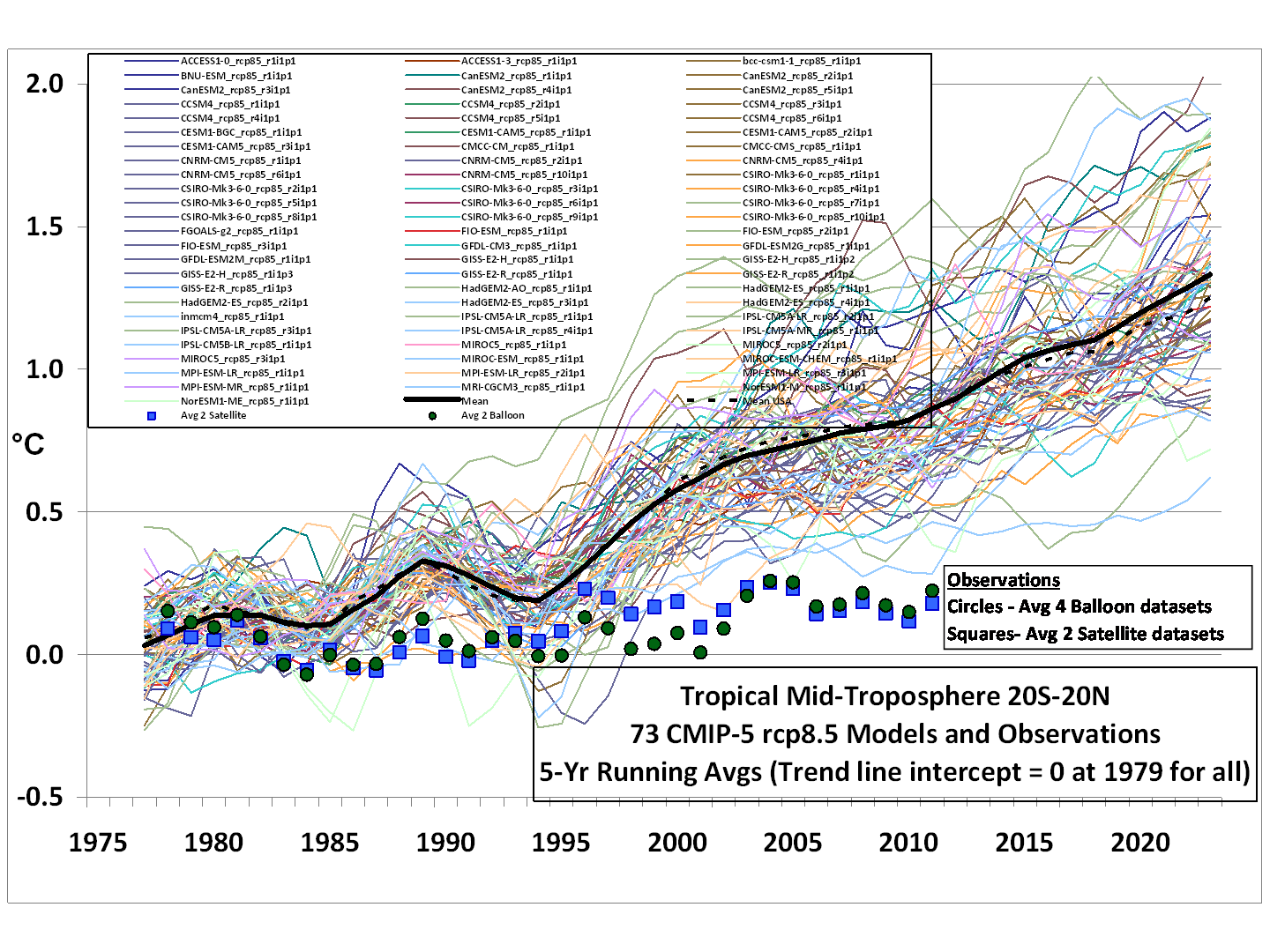
In response to those who complained in my recent post that linear trends are not a good way to compare the models to observations (even though the modelers have claimed that it’s the long-term behavior of the models we should focus on, not individual years), here are running 5-year averages for the tropical tropospheric temperature, models versus observations (click for full size):
CMIP5-73-models-vs-obs-20N-20S-MT-5-yr-means
In this case, the models and observations have been plotted so that their respective 1979-2012 trend lines all intersect in 1979, which we believe is the most meaningful way to simultaneously plot the models’ results for comparison to the observations.

In my opinion, the day of reckoning has arrived. The modellers and the IPCC have willingly ignored the evidence for low climate sensitivity for many years, despite the fact that some of us have shown that simply confusing cause and effect when examining cloud and temperature variations can totally mislead you on cloud feedbacks (e.g. Spencer & Braswell, 2010). The discrepancy between models and observations is not a new issue…just one that is becoming more glaring over time. ….

….

Reblogged from Dr. Roy Spencer

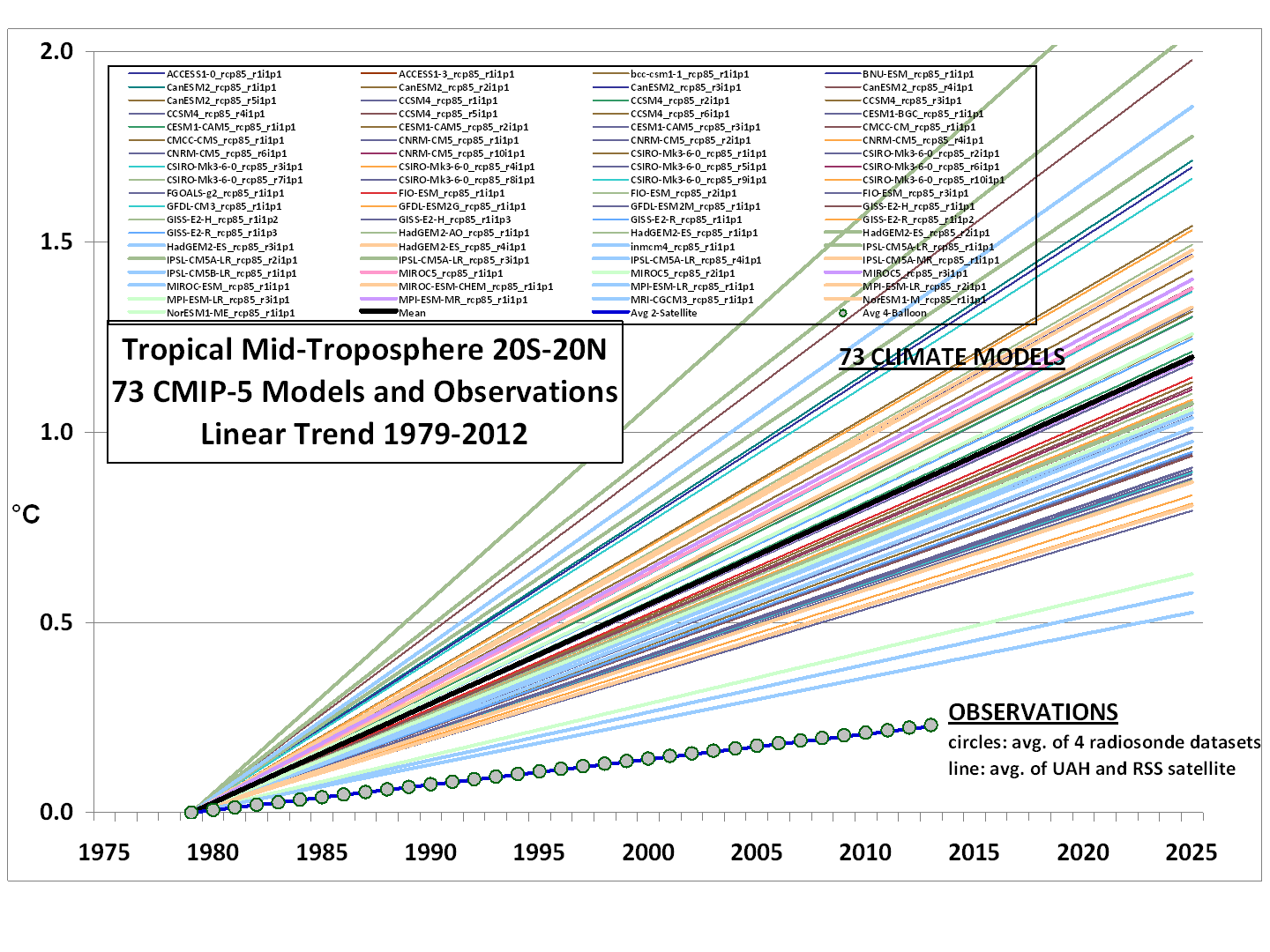
Courtesy of John Christy, a comparison between 73 CMIP5 models (archived at the KNMI Climate Explorer website) and observations for the tropical bulk tropospheric temperature (aka “MT”) since 1979 (click for large version):
CMIP5-73-models-vs-obs-20N-20S-MT
Rather than a spaghetti plot of the models’ individual years, we just plotted the linear temperature trend from each model and the observations for the period 1979-2012.

Note that the observations (which coincidentally give virtually identical trends) come from two very different observational systems: 4 radiosonde datasets, and 2 satellite datasets (UAH and RSS).

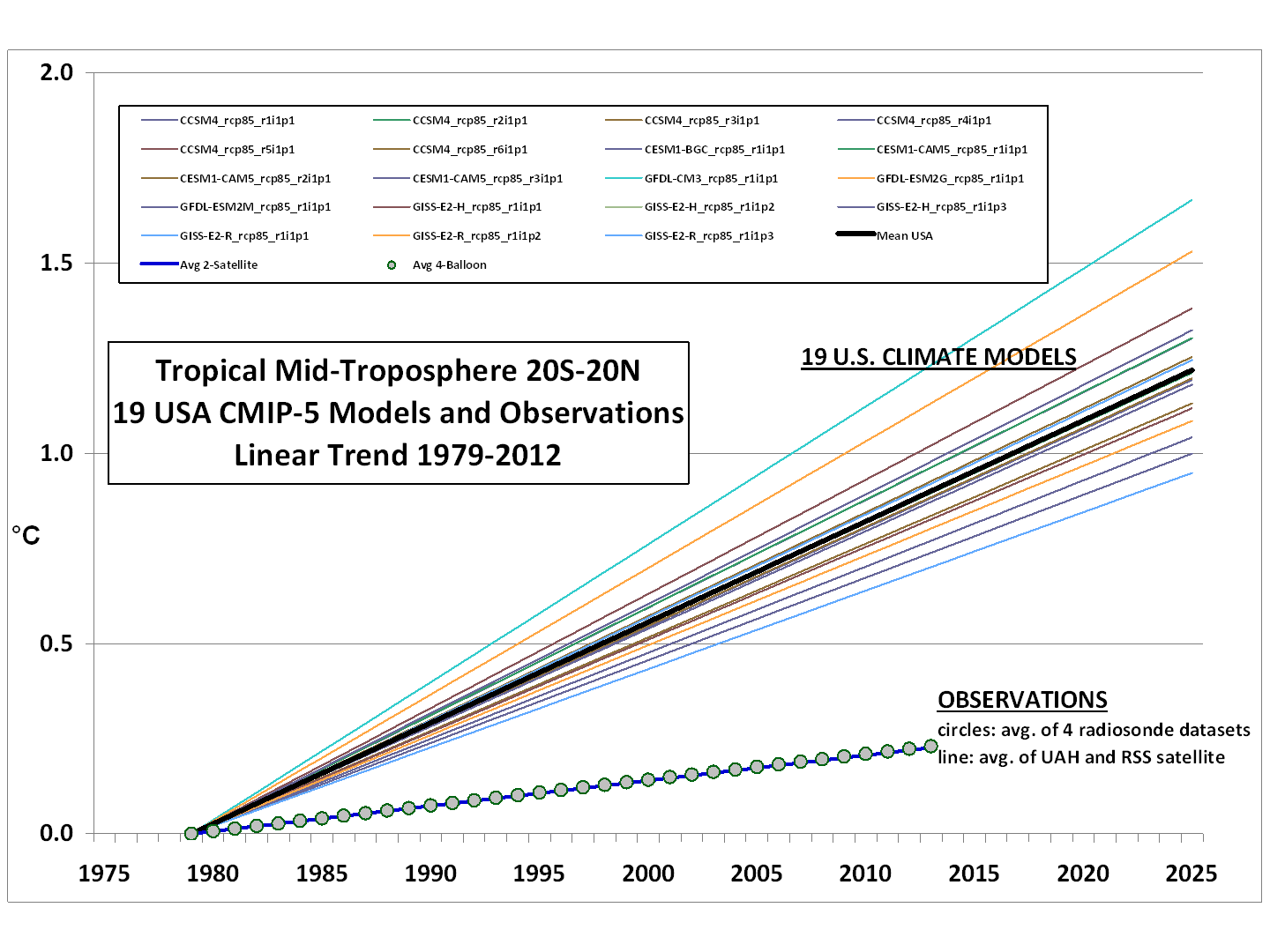
If we restrict the comparison to the 19 models produced by only U.S. research centers, the models are more tightly clustered:
CMIP5-19-USA-models-vs-obs-20N-20S-MT

Now, in what universe do the above results not represent an epic failure for the models?

I continue to suspect that the main source of disagreement is that the models’ positive feedbacks are too strong…and possibly of even the wrong sign.

The lack of a tropical upper tropospheric hotspot in the observations is the main reason for the disconnect in the above plots, and as I have been pointing out this is probably rooted in differences in water vapor feedback. The models exhibit strongly positive water vapor feedback, which ends up causing a strong upper tropospheric warming response (the “hot spot”), while the observation’s lack of a hot spot would be consistent with little water vapor feedback.

Three decades of needless “green” energy has cost some 15 million jobs in Europe

June 2, 2013

It has been a pointless waste. Just to pander to the superstition that controlling carbon dioxide emissions can control global temperature.

Temperatures have been flat since 1997 while human emissions of carbon dioxide have risen around 30%. Carbon dioxide concentrations in the atmosphere have also increased but have had little impact on global temperature – if any at all.

graphic Bert Rutan via WUWT

graphic Bert Rutan via WUWT

graphic source: WUWT

The last three decades have seen the vilification of carbon dioxide and the combustion of fossil fuels but it has been a pointless and expensive exercise. The profligate subsidies in favour of renewable energy and the shameless taxation of fossil fuel use and the consequent increase of energy prices have made their contributions to the economic slowdown and loss of jobs – particularly in Europe. The cowardly adoption of political correctness and of “green” energy is proving expensive – and has been quite needless.

Today electricity prices in Europe are at least 50% higher and perhaps twice as high as they need to be. The curbing of fossil fuel use and the hysteria about nuclear power together with the renewable profligacy are responsible for that. The cost of electricity is a fundamental parameter in our economies which feeds its way into every aspect of economic activity. It is the availability of affordable electricity which has been the driver of growth for over 100 years. A simple estimate of the growth that has been prevented by having unnecessarily high electricity prices gives the cost as being about 15 million jobs within the European Union.

Gerald Warner writes in The Scotsman: (my emphasis)

…. As the bottom falls out of the man-made climate change industry, those who were among its most bullish investors at the height of the scam are now covering their positions in a bear market.

Great damage was done to this much-hyped imposture by Climategate (“Hide the decline!”), by the discredited “hockey stick”, by the farce over “melting” Himalayan glaciers and the “decrease” in the polar bear population from 5,000 in 1970 to 25,000 today. Yet what has chiefly discredited the climate change superstition is the basic, inescapable fact that there has been no global warming since 1997.

The official face-saving response is that this is a “pause” in an otherwise menacing trend – a pause of a decade and a half. The warmist fanatics will freeze to death in their solar bunkers before they will admit defeat; but the more worldly wise, especially scientists anxious to preserve a vestige of academic credibility, are now striving to effect a withdrawal in good order.

Even the Intergovernmental Panel on Climate Change began to ratchet down its more extravagant predictions as early as 2007. In 2010 the Royal Society reviewed its stance on the Anthropogenic Global Warming theory and assumed a more neutral position. Since then, it has been like the retreat from Moscow: last month Oxford scientists, albeit in Delphic language, moderated forecasts of climate disaster. …..

….. The global warming hysteria began in the 1880s but was discredited when its prediction that CO2 would increase the mean global temperature by more than 1C by 1940 was not borne out. What gave it fresh life over the past two decades was the realisation by governments that it could provide a pretext for taxing citizens to unprecedented levels and by private entrepreneurs that government subsidies could supply a dripping roast. Of all the damage that politicians have inflicted on the public, the “green” scam has been among the most extreme.

The Renewables Obligation, introduced in Scotland in 2002, was scheduled to end in 2027, by which time UK energy customers will have been robbed of £32 billion. It has now been extended to 2037 for new projects. By 2011 Ofgem confirmed that 10 per cent of every electricity bill went towards “renewables”. Proliferating wind turbines are blighting the landscape despite being a wholly inefficient source of energy. Turbines operate at just 24 per cent of capacity – for more than a third of the time at only 10 per cent – and conventional power stations have to remain in service as backup: two energy systems pointlessly working in tandem. ……

…… South of the Border a modicum of sanity has entered government thinking since UK energy minister John Hayes’ “Enough is enough” remarks. In England and Wales turbines are falling out of favour. 

Not so in Scotland. ……. 

Local objections to wind farms are routinely overruled by central government (that would be the listening, accountable Scottish Nationalist government). At the end of last year only ten out of Scotland’s 32 local authorities admitted to knowing how many wind turbines were sited in their areas.

They could cover every inch of Scottish soil with Martian whirligigs and the lights will still go out, due to the SNP’s refusal to replace Hunterston B, due to close in 2016, and Torness, closing in 2023. All this to satisfy a superstition: if all mankind stopped producing CO2 (try selling that idea in China and India), 96.5 per cent would remain. The climate Anabaptists will never recant, but their mad creed is doomed all the same.

Wind turbines and solar energy have their place in the energy mix we should use.  But not at the expense of fossil fuel and nuclear use.