Archive for the ‘Climate’ Category

Statistician issues a $100,000 challenge for anyone to prove that global warming is statistically significant

November 20, 2015

Doug Keenan used to do research on financial trading and is now an independent statistician. He has on a number of occasions pointed out the very poor statistical analysis carried out by “scientists” in drawing unwarranted conclusions. He has challenged the statistics used for example in radiocarbon dating, the use of proxies such as grape harvests for temperatures, early Chinese chronologies based on planetary conjunctions and the like. He has for a long time criticised the “global warming” community for dodgy statistics in dealing with temperature time-series. Most famously he showed that the IPCC 2013 (AR5) report was statistically incompetent.

He has now issued a challenge to the global warming community to prove that their statistical, data manipulation methods are valid and can distinguish between real trends and purely random time-series. He contends that global warming trends are mere assertions and are not statistically justified. He is putting his money where his mouth is and has offered $100,000 for anyone who can do that.

There have been many claims of observational evidence for global-warming alarmism. I have argued that all such claims rely on invalid statistical analyses. Some people, though, have asserted that the analyses are valid. Those people assert, in particular, that they can determine, via statistical analysis, whether global temperatures are increasing more than would be reasonably expected by random natural variation. Those people do not present any counter to my argument, but they make their assertions anyway.

In response to that, I am sponsoring a contest: the prize is $100 000. In essence, the prize will be awarded to anyone who can demonstrate, via statistical analysis, that the increase in global temperatures is probably not due to random natural variation.

Competition

The file Series1000.txt contains 1000 time series. Each series has length 135 (the same as that of the most commonly studied series of global temperatures). The series were generated as follows. First, 1000 series were obtained via trendless statistical models fit for global temperatures. Then, some randomly-chosen series had a trend added to them. Some trends were positive; others were negative. Each individual trend averaged (in magnitude) 1°C/century—which is greater than the trend claimed for global temperatures.

A prize of $100 000 (one hundred thousand U.S. dollars) will be awarded to the first person, or group of people, who correctly identifies at least 900 series: which series were generated by a trendless process and which were generated by a trending process.

Contest entries should be emailed to me (doug dot keenan at informath.org). Each entry in the contest must be accompanied by a payment of $10; this is being done to inhibit non-serious entries.

The contest closes at the end of 30 November 2016, or when someone submits a prize-winning answer, whichever comes first.

When the contest closes, the computer program (including the random seed) that generated the 1000 series will be posted here. As an additional check, the file Answers1000.txt identifies which series were generated by a trendless process and which by a trending process. The file is encrypted. The encryption key and method will also be posted here when the contest closes.

Contestants have until November 2016. However, I don’t expect any current “climate scientist” to rise to the challenge. I don’t expect that the “climate politicians” such as John Kerry to even understand the issue.


Addendum on 18th August 2016 from Doug Keenan:

18 August 2016
A paper by Lovejoy et al. was published in Geophysical Research Letters. The paper is about the Contest.

The paper is based on the assertion that “Keenan claims to have used a stochastic model with some realism”; the paper then argues that the Contest model has inadequate realism. The paper provides no evidence that I have claimed that the Contest model has adequate realism; indeed, I do not make such a claim. Moreover, my critique of the IPCC statistical analyses (discussed above) argues that no one can choose a model with adequate realism. Thus, the basis for the paper is invalid. The lead author of the paper, Shaun Lovejoy, was aware of that, but published the paper anyway.

When doing statistical analysis, the first step is to choose a model of the process that generated the data. The IPCC did indeed choose a model. I have only claimed that the model used in the Contest is more realistic than the model chosen by the IPCC. Thus, if the Contest model is unrealistic (as it is), then the IPCC model is even more unrealistic. Hence, the IPCC model should not be used. Ergo, the statistical analyses in the IPCC Assessment Report are untenable, as the critique argues.

For an illustration, consider the following. Lovejoy et al. assert that the Contest model implies a typical temperature change of 4 °C every 6400 years—which is too large to be realistic. Yet the IPCC model implies a temperature change of about 41 °C every 6400 years. (To confirm this, see Section 8 of the critique and note that 0.85×6400/133 = 41.) Thus, the IPCC model is far more unrealistic than the Contest model, according to the test advocated by Lovejoy et al. Hence, if the test advocated by Lovejoy et al. were adopted, then the IPCC statistical analyses are untenable.


Paris climate conference to be subdued after G20 summit skips over contentious issues

November 17, 2015

The G20 summit in Turkey was completely dominated by the issue of combating ISIS terrorism and never got around to discussing the contentious climate conference issues separating the developing from the developed countries. In fact they got stuck on whether the goal of keeping to less than 2ºC warming by the end of the century should be referred to or not. India and Saudi Arabia opposed the motion but eventually gave way. There was little time to discuss much more and the critical issues of financing the “good fight” and whether even developing countries should make larger emissions cuts were hardly addressed.

ClimateChangeNews reports:

Campaigners looking to this weekend’s G20 leaders meeting in Antalya, Turkey, for progress on the climate agenda have been left disappointed.

In a statement on Monday, the group of major economies reiterated their commitment to a 2C limit on global warming and to phase out “inefficient” fossil fuel subsidies.

There was little sign of convergence on contentious issues ahead of December’s UN climate summit in Paris: how to ramp up ambition, share responsibility between rich and poor, and get finance flowing. 

India and Saudi Arabia reportedly objected to a review mechanism that would require countries to regularly update their climate plans. The EU is pushing for five-yearly reviews, a proposal recently endorsed by China.

“The only thing G20 leaders had to say on climate was ‘see you at the climate summit’,” said Oxfam’s Steve Price-Thomas.

The Climate conference starts on November 30th in Paris and after the terrorist killings is likely to dispense with much of the circus and side-meetings that normally accompany these jamborees. The French Prime Minister confirmed that things would be subdued

A series of events linked to a UN climate summit in Paris in two weeks will be cancelled over security fears, Manuel Valls told local radio on Monday morning.

The conference will be “reduced to the negotiation” with “concerts and festive events” likely to be called off in the wake of the country’s worst ever terrorist attack, the country’s prime minister told RTL. 

Valls did not specify whether that included a mass demonstration planned by activists on the eve of the summit on 29 November.

Despite the attack, no country or head of state had asked France to postpone the summit, he added.

More than 100 world leaders are due to open the COP21 negotiations on Monday 30 November, at Le Bourget airport on the outskirts of the city.

Organisers are expecting over 40,000 delegates a a day at the critical conference, where a global warming pact is to be finalised.

In parallel, several civil society and business groups had planned side events around Paris.

In my opinion the COP21 Climate conference is rather pointless and misguided. China and India have already got what they want in terms of freedom to use fossil fuels virtually without restriction. The world would be better off with the whole event being cancelled, not that there was – or is – any chance of that happening.

Paris conference – in the best case – cannot achieve more than 0.17ºC impact on climate

November 10, 2015

Bjorn Lomborg has a new survey paper out in Global Policy

Impact of Current Climate Proposals, Bjorn Lomborg, Global Policy, Article first published online: 9 NOV 2015, DOI: 10.1111/1758-5899.12295

Lomborg’s survey and calculations only reinforce my view that the coming Paris climate conference is almost completely irrelevant to climate. So called climate policy is fundamentally flawed since the climate effect of the actions emanating from the policies cannot be measured, predicted or monitored.

Paris is essentially about wealth redistribution and that too based on ineffective tools. In fact, the primary tool, which is the reduction of carbon dioxide emissions, is not even known for certain to be a tool. Lomborg shows that assuming that climate models are correct in their assumptions of the impact of CO2 (which they are not), and assuming that all promises are binding (which they will not be), and assuming that all countries live up to their “promises” (which they won’t), then by 2100 the impact on climate could, at worst be 0.048ºC, and at best, be all of 0.17ºC.

Abstract

This article investigates the temperature reduction impact of major climate policy proposals implemented by 2030, using the standard MAGICC climate model. Even optimistically assuming that promised emission cuts are maintained throughout the century, the impacts are generally small. The impact of the US Clean Power Plan (USCPP) is a reduction in temperature rise by 0.013°C by 2100. The full US promise for the COP21 climate conference in Paris, its so-called Intended Nationally Determined Contribution (INDC) will reduce temperature rise by 0.031°C. The EU 20-20 policy has an impact of 0.026°C, the EU INDC 0.053°C, and China INDC 0.048°C. All climate policies by the US, China, the EU and the rest of the world, implemented from the early 2000s to 2030 and sustained through the century will likely reduce global temperature rise about 0.17°C in 2100. These impact estimates are robust to different calibrations of climate sensitivity, carbon cycling and different climate scenarios. Current climate policy promises will do little to stabilize the climate and their impact will be undetectable for many decades.

….

Conclusions

Based on climate model simulations, the emission cuts that have been proposed by the US, the EU, China and the RoW will reduce temperature increases by the end of the century, but almost all of the expected warming will still take place by 2100.

Because the climate policy impacts from individual countries are almost additive, they can be almost perfectly partitioned as is evidenced in Table 1. This shows that in the optimistic case, the EU and China each reduce mean global temperature by 2100 of about 0.05°C, and the US and the RoW each reducing a bit more than 0.03°C.

Table 1. Impact of climate policies, optimistic and pessimistic, for RCP8.5, using MAGICC, summary of finds described throughout the text
Change in temperature
°C year 2100 Pessimistic Optimistic
US INDC 0.008 0.031
US CPP 0.004 0.013
EU INDC 0.017 0.053
EU 2020 0.007 0.026
China INDC 0.014 0.048
RoW INDC 0.009 0.036
Global INDCs 0.048 0.170

As Wigley (1998) found for the Kyoto Protocol, the emissions reductions promised until 2030 will do little to stabilize the climate and their impact will be undetectable for many decades. This clearly indicates that if we want to reduce climate impacts significantly, we will have to find better ways than the ones currently proposed.

There will be much spin after Paris. Whether agreement is reached or not, and whether promises made are binding or not, it will surely be spun to seem to be a resounding success.

But it will all be, in the most optimistic case, for achieving all of a 0.17ºC impact on climate. And based on climate models which don’t work. And on unnecessary and pointless actions for a 100 years, which will achieve nothing of their objectives, but which will make life more difficult, especially for the energy-poor.

Forty years of subsidy and wind and solar provide all of 1.3% of global energy

November 6, 2015

The 2015 BP Statistical Review of World Energy is out.

It is an excellent reality check for those who care to subject their religious views about energy and climate to some sanity checks.

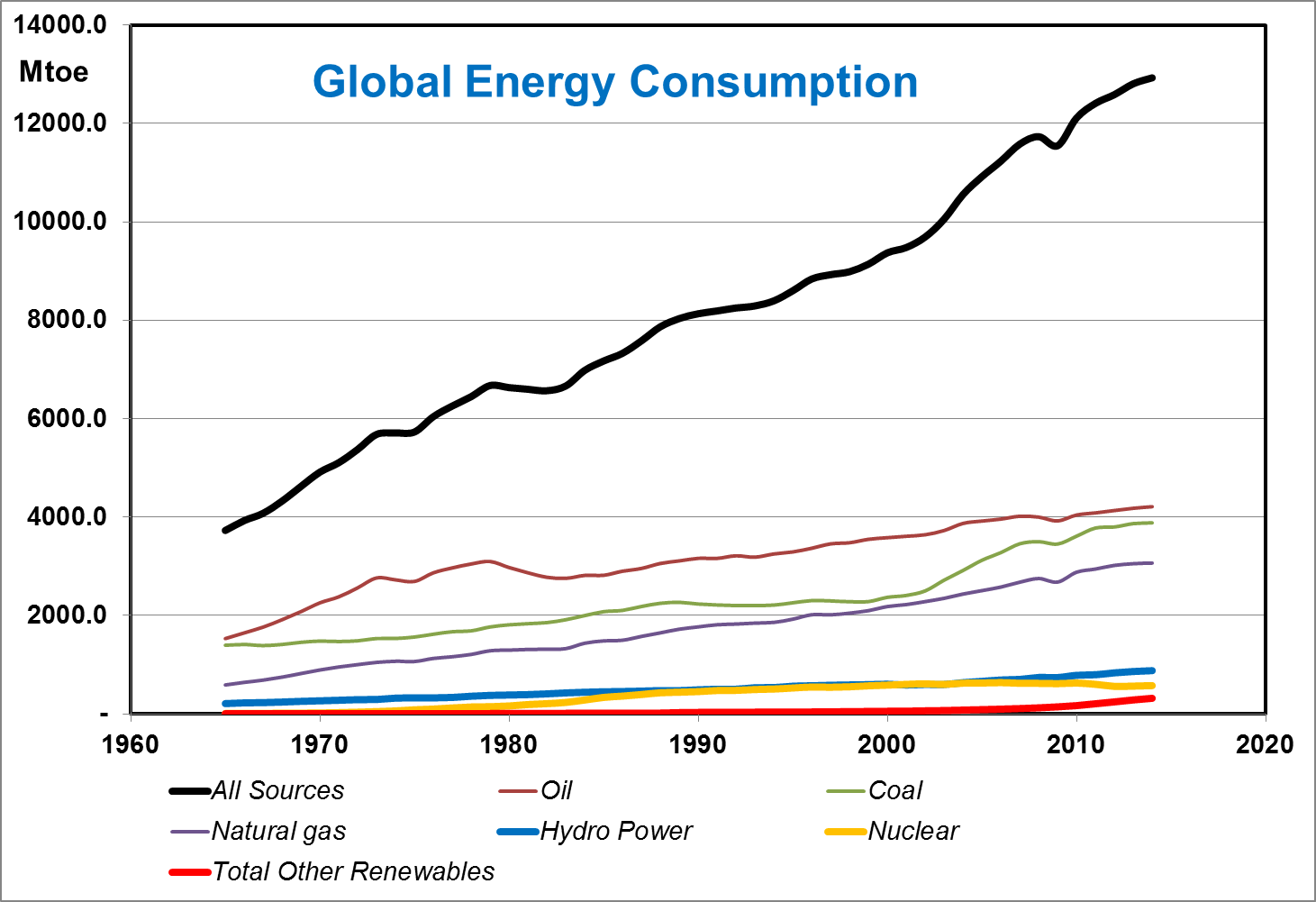
Subsidies for solar and wind and even bio-mass began around 1975. They took off after about 1985. I just note that after 40 years of subsidising wind and solar power, these two sources of energy provide all of 1.3% of the global energy consumption in 2014. I note also that the global energy need that people aspire to is almost double that actually consumed.

Energy consumption 1975 and 2014

Energy consumption 1975 and 2014

Fossil fuels contributed 86.3% of global energy in 2014 and have more than doubled since 1975. While carbon dioxide emissions from the use of fossil fuels had increased by 110%, carbon dioxide in the atmosphere rose from 330 ppm in 1975 to reach 398 ppm in October 2015, an increase of about 20%. The man-made emissions are still less than 5% of all carbon dioxide emissions and there is still no certainty as to how much – if any – of the man-made emissions contribute to the carbon concentration in the atmosphere. And the satellite record shows that there has been no significant increase in global temperature over the last 19 years.

It is not that solar and wind power do not have their niches where they make sense. But without energy storage, the need for back-up capacity always adds a hidden cost. The intermittent nature of the source then means that they can never make more than a marginal contribution. The problem with subsidies is that they can’t make the wind to blow or the sun to shine. And even when the sun is shining, the subsidies can’t control cloud cover. What I dislike even more about subsidies is that they have not been used to develop energy storage. Instead they have distorted the market, put large sums of money into the pockets of “cowboy” developers and have provided no benefits to the consumers. Solar and wind hardly show up when looking at global energy consumption since 1965.

Global energy consumption 1965 - 2014. Data from 2015 BP Statistical Energy Review

Global energy consumption 1965 – 2014. Data from 2015 BP Statistical Energy Review

To see the growth in wind and solar on the same diagram as fossil fuel consumption, it is necessary to use a log scale.

Global Energy Consumption log scale 1965 - 2014. Data source 2015 BP Statistical review of Energy

Global Energy Consumption log scale 1965 – 2014. Data source 2015 BP Statistical review of Energy

Which makes one wonder why the Paris conference is taking place at all. A more pointless exercise, and one which has no real measurable objectives , is hard to imagine.

China has been burning more coal than reported – and any Paris “agreement” will have no significance

November 4, 2015

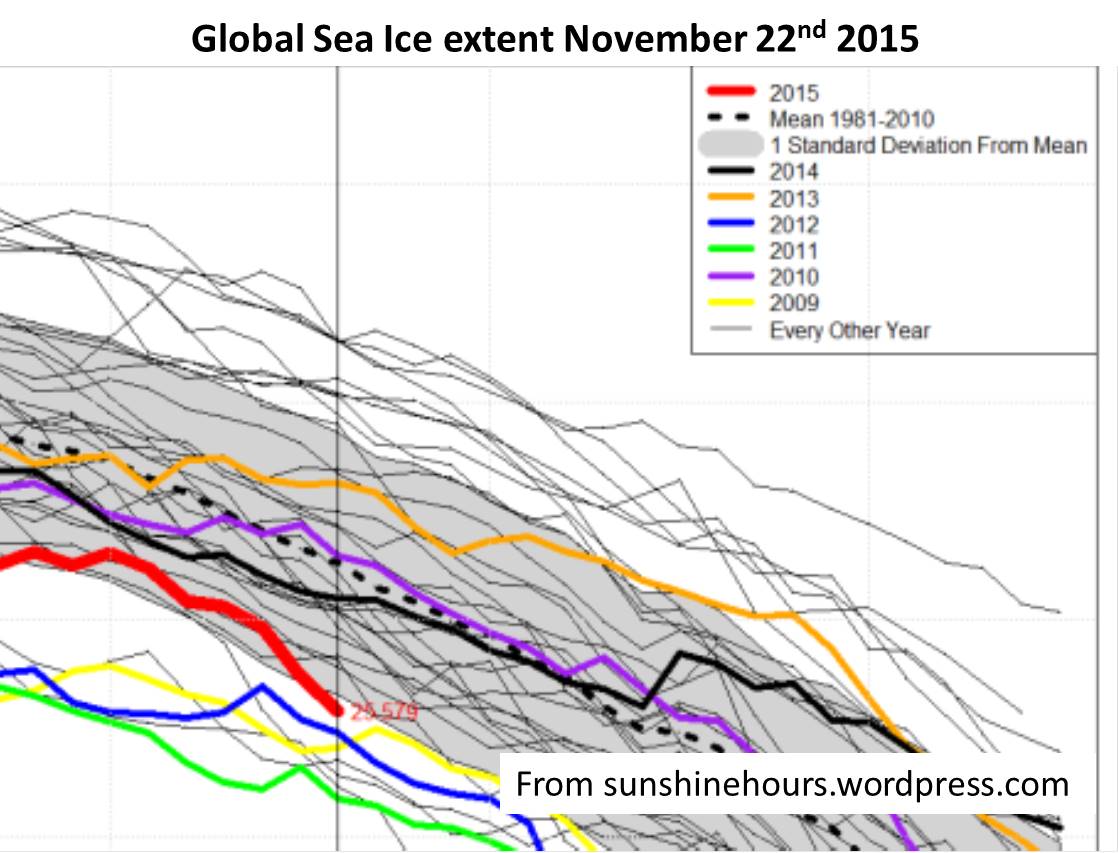
The NYT reports that in the last 10 years China has admitted it has been burning about 17% more coal than has been reported. The extra one billion tons burned every year is equivalent to what is consumed by Germany. But the global temperature (the satellite measurement based calculated temperature, not the calculated land based measurements which are fudged every year to keep cooling the past) has been flat for over 18 years. Antarctica is gaining ice mass. Ice cover in the Arctic is at the highest level for the last 10 years. Sea levels are not rising any faster than they have been for the last 500 years. Apart from shifting money between countries it is difficult to see what Paris is all about.

Irrespective of what Paris may “agree”, it will be non-binding and will allow India to treble its coal consumption and China to double its coal burn. Both will however “reduce” their carbon emission intensity per unit of GDP (how not?). Energy growth exceeds GDP growth at low levels of development (and fuels GDP growth) but then flattens out as the GDP increases. Thus reducing carbon emission intensity per unit of GDP is easy (and virtually impossible to avoid) when GDP is growing and development has reached the point where growth in electricity (or energy) consumption is lower than GDP growth.

energy to gdp growth as function of gdp

energy to gdp growth as function of gdp

The trebling and doubling respectively of India and China’s coal consumption over the next 20 or so years is an inevitability. Carbon emissions will follow no matter how they are packaged to seem to be “a reduction of emissions per unit of gdp”.

What European countries do to cut their fossil fuel use – and increase their electricity costs – is pointless and with no measurable objectives. European actions are no longer of any significance in terms of global emissions. Moreover nothing “agreed to” in Paris will give any measurable impact on any climate parameter over the next 50 years. The only measurable results of any Paris deal are the inputs – money flows between countries and the changes in fuel use. None of the desired “climate changes” are measurable. Truly policies without any measurable objectives.

china - revised coal consumption - graphic NYT

china – revised coal consumption – graphic NYT

NYT: 

China, the world’s leading emitter of greenhouse gases from coal, has been burning up to 17 percent more coal a year than the government previously disclosed, according to newly released data. The finding could complicate the already difficult efforts to limit global warming.

Even for a country of China’s size, the scale of the correction is immense. The sharp upward revision in official figures means that China has released much more carbon dioxide — almost a billion more tons a year according to initial calculations — than previously estimated.

The increase alone is greater than the whole German economy emits annually from fossil fuels.

Confirmed: Antarctic has been gaining ice mass (even while fossil fuel use has been increasing)

November 1, 2015

One again, very clear evidence that the IPCC reports are mere advocacy for lobby groups. They are not scientific reports.

A new study by NASA confirms their finding of 2012 that the Antarctic is gaining in ice mass. The paper is published in the Journal of Glaciology.

Zwally, H. Jay, ; Li, Jun; Robbins, John W.; Saba, Jack L.; Yi, Donghui; Brenner, Anita C. Mass gains of the Antarctic ice sheet exceed losses. Journal of Glaciology, 2015 DOI: 10.3189/2015JoG15J071

Antarctic ice accumulation not only provides no evidence of any global warming, it is also direct evidence that the global warming hypothesis itself is flawed. This ice accumulation has been taking place while carbon dioxide concentration in the atmosphere has been increasing. Leaving aside how much of this increase may be due to human use of fossil fuel, the ice accumulation shows that carbon dioxide concentration is not a significant factor.

As the French mathematicians recently charged:

no sensible, high-quality journal would publish the IPPC‘s work. The IPPC‘s conclusions go against observed facts; the figures used are deliberately chosen to support its conclusions (with no regard for the most basic scientific honesty), and the natural variability of phenomena is passed over without comment. The IPPC‘s report fails to respect the fundamental rules of scientific research and could not be published in any review with a reading panel.

The new NASA paper shows that in recent times the Antarctic gains about 200 billion tons of ice a year while losing about 65 billion tons. Which also means that the Antarctic is responsible for about 135 million tons of water leaving the water cycle and being locked up as ice. This water can only come from the moisture concentration in the atmosphere (including clouds) or from the sea. There is no measurable change in the moisture in the atmosphere and that leaves the seas.

Rather than Antarctic melting causing sea level rise, Antarctic ice accumulation is most likely reducing the rate of sea level rise due to the recovery from the last glacial.

Of course the global warming orthodoxy will now tell us with impressive modelling results, that ice increasing at the Antarctic is perfectly consistent with the warming of the planet.

Go pull the other one.

This and the 2012 paper are in direct contradiction to the IPCC’s 2013 report which claimed that the Antarctic was losing ice. But as the French mathematicians noted the IPCC reports would not meet the normal publishing standards for scientific reports.

I don’t suppose anybody will take any notice of this during the Paris wealth transfer discussions. When will any politician or government have the courage to challenge the religious orthodoxy?

Abstract:

Mass changes of the Antarctic ice sheet impact sea-level rise as climate changes, but recent rates have been uncertain. Ice, Cloud and land Elevation Satellite (ICESat) data (2003–08) show mass gains from snow accumulation exceeded discharge losses by 82 ± 25 Gt a–1, reducing global sea-level rise by 0.23 mm a–1. European Remote-sensing Satellite (ERS) data (1992–2001) give a similar gain of 112 ± 61 Gt a–1. Gains of 136 Gt a–1 in East Antarctica (EA) and 72 Gt a–1 in four drainage systems (WA2) in West Antarctic (WA) exceed losses of 97 Gt a–1 from three coastal drainage systems (WA1) and 29 Gt a–1 from the Antarctic Peninsula (AP). EA dynamic thickening of 147 Gt a–1 is a continuing response to increased accumulation (>50%) since the early Holocene. Recent accumulation loss of 11 Gt a–1 in EA indicates thickening is not from contemporaneous snowfall increases. Similarly, the WA2 gain is mainly (60 Gt a–1) dynamic thickening. In WA1 and the AP, increased losses of 66 ± 16 Gt a–1 from increased dynamic thinning from accelerating glaciers are 50% offset by greater WA snowfall. The decadal increase in dynamic thinning in WA1 and the AP is approximately one-third of the long-term dynamic thickening in EA and WA2, which should buffer additional dynamic thinning for decades.

This map shows the rates of mass changes from ICESat 2003-2008 over Antarctica. Sums are for all of Antarctica: East Antarctica (EA, 2-17); interior West Antarctica (WA2, 1, 18, 19, and 23); coastal West Antarctica (WA1, 20-21); and the Antarctic Peninsula (24-27). Credit: Jay Zwally/ Journal of Glaciology

This map shows the rates of mass changes from ICESat 2003-2008 over Antarctica. Sums are for all of Antarctica: East Antarctica (EA, 2-17); interior West Antarctica (WA2, 1, 18, 19, and 23); coastal West Antarctica (WA1, 20-21); and the Antarctic Peninsula (24-27).
Credit: Jay Zwally/ Journal of Glaciology

Science Daily reports:

A new NASA study says that an increase in Antarctic snow accumulation that began 10,000 years ago is currently adding enough ice to the continent to outweigh the increased losses from its thinning glaciers.

The research challenges the conclusions of other studies, including the Intergovernmental Panel on Climate Change’s (IPCC) 2013 report, which says that Antarctica is overall losing land ice.

According to the new analysis of satellite data, the Antarctic ice sheet showed a net gain of 112 billion tons of ice a year from 1992 to 2001. That net gain slowed to 82 billion tons of ice per year between 2003 and 2008.

“We’re essentially in agreement with other studies that show an increase in ice discharge in the Antarctic Peninsula and the Thwaites and Pine Island region of West Antarctica,” said Jay Zwally, a glaciologist with NASA Goddard Space Flight Center in Greenbelt, Maryland, and lead author of the study, which was published on Oct. 30 in the Journal of Glaciology. “Our main disagreement is for East Antarctica and the interior of West Antarctica — there, we see an ice gain that exceeds the losses in the other areas.” Zwally added that his team “measured small height changes over large areas, as well as the large changes observed over smaller areas.” 

Scientists calculate how much the ice sheet is growing or shrinking from the changes in surface height that are measured by the satellite altimeters. In locations where the amount of new snowfall accumulating on an ice sheet is not equal to the ice flow downward and outward to the ocean, the surface height changes and the ice-sheet mass grows or shrinks.

But still the authors find it necessary to bow down to orthodoxy. That’s probably necessary to get published and to avoid being labelled climate heretics. “It might only take a few decades for Antarctica’s growth to reverse”. Right, and then again it might not.

But it might only take a few decades for Antarctica’s growth to reverse, according to Zwally. “If the losses of the Antarctic Peninsula and parts of West Antarctica continue to increase at the same rate they’ve been increasing for the last two decades, the losses will catch up with the long-term gain in East Antarctica in 20 or 30 years — I don’t think there will be enough snowfall increase to offset these losses.”

In any event, reducing carbon dioxide emissions by cutting the use of fossil  fuels is of no significance to Antarctic ice accumulation – and therefore, of no significance either to any global warming that may be occurring.
French Mathematical Society “Battle against global warming an absurd,costly and pointless crusade”

October 27, 2015

The French Society of Mathematical Calculation (Société de Calcul Mathématique SA) has released a white paper entitled

The battle against global warming: an absurd,costly and pointless crusade

French Mathematical Calculation Society White Paper

The crusade is absurd

There is not a single fact, figure or observation that leads us to conclude that the world‘s climate is in any way disturbed‘. It is variable, as it has always been, but rather less so now than during certain periods or geological eras. Modern methods are far from being able to accurately measure the planet‘s global temperature even today, so measurements made 50 or 100 years ago are even less reliable. Concentrations of CO2 vary, as they always have done; the figures that are being released are biased and dishonest. Rising sea levels are a normal phenomenon linked to upthrust buoyancy; they are nothing to do with so-called global warming. As for extreme weather events – they are no more frequent now than they have been in the past. We ourselves have processed the raw data on hurricanes. We are being told that ‗a temperature increase of more than 2ºC by comparison with the beginning of the industrial age would have dramatic consequences, and absolutely has to be prevented‘. When they hear this, people worry: hasn‘t there already been an increase of 1.9ºC? Actually, no: the figures for the period 1995-2015 show an upward trend of about 1ºC every hundred years! Of course, these figures, which contradict public policies, are never brought to public attention. 

…..

We are not in a position to question the composition of the IPPC, or its legitimacy and policy decisions, and we shall not do so. However, as mathematicians, we have every right to respond to the following question: if the IPPC‘s work were to be submitted for publication in a reputable scientific journal, would it be accepted? This decision is the task of a referee, in a procedure that is common practice in the sciences. The answer is very simple: no sensible, high-quality journal would publish the IPPC‘s work. The IPPC‘s conclusions go against observed facts; the figures used are deliberately chosen to support its conclusions (with no regard for the most basic scientific honesty), and the natural variability of phenomena is passed over without comment. The IPPC‘s report fails to respect the fundamental rules of scientific research and could not be published in any review with a reading panel.

Of course these mathematicians could not possibly be part of the great 97%.

The 97% reminds me of how we used to present “market share” when we were looking to increase the marketing budget. Whenever necessary we could always show that we had 100% market share for the machines we had sold, or that we had virtually zero market share of a market defined sufficiently wide. And any number in-between was a simple matter of defining the market.

Thus, 97% of those who believe in man-made global warming, believe in man-made global warming

India and China have already won and the Paris climate conference has become irrelevant

October 20, 2015
Paris conference

Paris conference

India and China have successfully managed to get the UN to focus on the intensity of emissions per unit of GDP and thus can make promises (not legally binding) about future emissions tied to GDP such that they will not be limited in their use of coal in any significant way.

The hype about the UN’s December climate meeting in Paris is gradually growing. Media, politically correct politicians and the global warming religion’s orthodoxy are winding up their rhetoric. Ostensibly the goal is to demonise carbon and to get nations to commit to reducing fossil fuel use such that the global temperature rise “will not exceed 2ºC”. This target of “allowable” temperature rise is not “2ºC caused by man” but just “2ºC”. Nobody actually knows what the rise by “natural causes” might be and what is caused by man. “Global temperature” itself is an artefact, a calculated quantity and calculated by those with a vested interest in showing that it is increasing. It seems that the calculation method is conveniently variable and is adjusted every year to show that the current year has demonstrated the highest ever temperature. Nevertheless the 5,000 participants and 190+ countries have effectively set themselves up to discuss commitments to stop climate change itself. The arrogance is astounding and worthy of King Cnut.

What effect man has actually had on climate is unknown. For almost 20 years now, man-made carbon dioxide emissions have been growing explosively but “global temperature” has paused. Those countries which have increased their own costs of electricity by reducing fossil fuel use (mainly in Europe) have effectively done it all quite uselessly and unnecessarily. Other countries (China and India in the main) have increased their use of fossil fuels such that global emissions of carbon dioxide have continued to grow. And yet there has been no change in “global temperature” except by arithmetical tricks. The last 3 decades of reducing fossil fuel use in Europe have been unnecessary. Three decades of subsidising renewable energy have still not made them commercial in their own right.

Climate policies are all policies where the objectives are not measurable. Policies are being proposed where the effect of the policies on climate itself cannot be measured. All that can be measured are the actions themselves which is both trivial and meaningless. For example countries can measure amounts of money spent but have no clue as to what the resultant effect on climate may be. Emissions reductions can be measured, but not the actual climate effects such reductions may have caused or not caused. For many delegates the purpose is not climate but the redistribution of wealth among nations where climate policy is the vehicle.

Ask a politician what his countries climate policies will achieve and the answer is that it will “contribute to the world’s efforts to stop climate change”. But by how much and how success can be measured are unknowns. It has become a matter of solidarity among nations not of policies with objectives. Not a single country (nor any politician nor any so-called climate scientist) has any inkling about what its climate policies will achieve for climate or even if it will achieve anything at all.

Some of the more savvy politicians and countries have figured out ways to seem to support political correctness while ensuring that their continued – and increasing – use of fossil fuels is not constrained in practice. For India and China the continued use of fossil fuels is critical and necessary for their growth. For the next 20  – 30 years, their carbon dioxide emissions are going to increase regardless of what the Paris meeting decides. India has proposed policies which seem – at first sight – to be drastic reductions in the “intensity of carbon dioxide emissions per unit of GDP” but defined in terms of growth such that coal consumption will have trebled in the next 25 years from 2005. India has now said it will cut emissions intensity by up to 25% of 2005 levels by 2020. China has also said it will reduce the intensity of carbon dioxide emissions per unit of GDP in 2020 by 40 to 45 percent compared with the level of 2005.

India’s GDP has grown from $0.8 trillion in 2005 to be about $2.1 trillion in 2014. China’s GDP has already grown from $2.3 trillion in 2005 to $10.3 trillion in 2014. These “promises” based on GDP are not even going to be legally binding  and there is certainly no cap to the GDP which can be aimed for or achieved. The GDP targets for India and China inherently require a mix of fuels to be used for electricity generation; coal, gas, nuclear and hydro primarily. Solar and wind power may have a large installed capacity and may contribute something to the growth but are not necessary or critical. The Indian and Chinese plans for using more gas and nuclear in their mix automatically brings down the carbon intensity per GDP from the levels of 2005 when both countries were heavily dependent on coal. Their coal plans can therefore proceed unimpeded while still meeting their “promises”. Both countries are relying on GDP growth to effectively reduce their “intensities of carbon emission” without having to reduce the rate at which they increase planned fossil fuel use or carbon dioxide emissions. Both India and China have reached the stage of development where electricity consumption growth is now lower than GDP growth. Both are at low levels of energy utilisation efficiency such that significant demand side improvements can be made. With around 7% growth in India and even with China reducing to, say, 6% growth, the reductions of intensity of carbon dioxide emissions per unit of GDP are impossible to prevent.

Any agreement in Paris will mean India trebling and China doubling its coal burn by 2030. And with “official” sanction to do so. So what “success” in Paris means is that global, man-made, carbon dioxide emissions are going to double (at least). And it also means that any carbon dioxide emission reductions promised by other countries are of no significance whatsoever. It is a very good thing that man-made, carbon dioxide emissions have no significant impact on global temperature.

And the Paris conference is both meaningless and irrelevant.

Hurricane Joaquin moves away

October 3, 2015

US hurricane strikes are at an all-time low and there has been much alarmist excitement this week about the possibility of hurricane Joaquin striking the US mainland. First, it was going to strike N Carolina. Emergencies were declared. Then it was going to hit New York. Emergencies were extended. The hurricane declined to follow the computer models. Now Boston and New England were the targets claimed the modellers. Hurricane Joaquin moved even slower and moved further East.

The latest is that it is now headed for Bermuda. Some of the UK media are now concerned it may hit the UK. Not to underestimate the power of the hurricane since a cargo ship with 33 on board which was near the eye has gone missing. But, so much for the infallibility of computer models which claim that climate is a settled “science”. “It is weather that is variable and unpredictable”, I hear them cry. “The climate is perfectly predictable and the science is settled”. Ah Yes. But climate is nothing more than weather integrated over space and time.

Modellers who change the data rather than change their mathematical models which don’t fit reality, ought to be beyond the pale. But apparently it is acceptable to fudge data if it preserves political correctness.

Joaquin 1

Joaquin 2

This image from RealScience shows how the predicted track has moved.

In spite of the alarm of extreme weather the reality is that US hurricane strikes are at an all-time low.

Data from:  HURDAT Re-analysis Chronological List of All Hurricanes

Indian monsoon season ends – deficient but no disaster

October 2, 2015

The official 4 month monsoon season (June – September) has ended and the cumulative rainfall falls into the “average” category (from -20% to + 20% of the long-term average), but only just, at -14% for the country as a whole. Rainfall was high in June, quite low in July and August and recovered somewhat in September. Good rainfall continues in October as the monsoon withdraws. Much of this is in deficient regions of Central and South India which will further mitigate the deficiency numbers.

There is some relief that in spite of 2015 being an El Niño year, the overall picture is one of some deficiency but no disaster. Locally there have been wide variations, even between contiguous regions:

  • Jammu & Kashmir recorded 15% excess rains, while next door, Himachal Pradesh was 23% deficient.
  • West Rajasthan recorded 46% excess, while East Rajasthan ended 10% down.
  • Telangana remained rain deficit to the tune of 20% and Andhra Pradesh recorded 10% excess.
  • West Madhya Pradesh recorded normal rains and was at +4% while East Madhya Pradesh was 29% in deficit.
  • West Bengal recorded 8% excess while adjacent Jharkhand was 14% in deficit.
  • Both Marathwada (-40%) and Vidarbha (-11%) were in rain deficit but the variation was large.

From a growth perspective, the 2015 monsoon will be a neutral event (i.e. it will make its “normal” contribution to the economic cycle). The impact will not provide any additional impetus to growth but will not hinder growth either.

As the Reserve Bank has now reduced its reference interest rates by 50 basis points and most of the banks now seem to be passing on about 40 basis point reductions to their lending rates, the cost of lending is likely – for this year – to be have a much greater impact on the economy than the effects of the monsoon. But at least the monsoon will now play its “normal” part in feeding the economic cycle. The monsoon deficiency should not contribute too much to inflation in food prices.

The immediate impact of a good monsoon is increased employment in rural areas (September – October) followed by increased rural consumption of consumer goods (October – December) and even sales of two-wheelers and tractors (November – March). Pesticide sales increase during the monsoon and again in the following pre-monsoon period. Fertiliser sales pick-up strongly in the pre-monsoon period following a good monsoon. The December – June period following a good monsoon is when rural “investments” are mainly made (machinery, equipment, construction, consumer goods). The indirect effects of agriculture on the services and manufacturing sectors are critical. However, even more important is the effect of a good monsoon on food price stability and general economic sentiment.

But I foresee no booms or fireworks in Indian economic activity over the next 6 months. That requires – among other things – the “feel-good” factor that a bumper monsoon brings. Still, 12 months of steady, sustainable growth is probably more valuable than some short-lived volatile balloon of activity.

After the China circus, steady rather than spectacular will be a welcome relief.

Monsoon 2015 - Deficient but no disaster Source IMD

Monsoon 2015 – Deficient but no disaster Source IMD