Archive for the ‘Climate’ Category

Green hijack of the UK Met Office

December 26, 2010

Christopher Booker has an interesting article in The Sunday Telegraph describing how a supposedly science-based institution can be perverted by political dogma; in this case global warming dogma perverting the forecasts of the UK Met Office.

By far the biggest story of recent days, of course, has been the astonishing chaos inflicted, to a greater or lesser extent, on all of our lives by the fact that we are not only enjoying what is predicted to be the coldest December since records began in 1659, but also the harshest of three freezing winters in a row….. But central to all this – as the cry goes up: “Why wasn’t Britain better prepared?” – has been the bizarre role of the Met Office…… in these past three years the Met Office’s forecasting record has become a national joke. Ever since it predicted a summer warmer and drier than average in 2007 – followed by some of the worst floods in living memory – its forecasts have been so unerringly wrong that even the chief adviser to our Transport Secretary might have noticed.

The real question, however, is why has the Met Office become so astonishingly bad at doing the job for which it is paid nearly £200 million a year – in a way which has become so stupendously damaging to our country?

The answer is that in the past 20 years, as can be seen from its website, the Met Office has been hijacked from its proper role to become wholly subservient to its obsession with global warming. (At one time it even changed its name to the Met Office “for Weather and Climate Change”.) This all began when its then-director John Houghton became one of the world’s most influential promoters of the warmist gospel. He, more than anyone else, was responsible for setting up the UN’s Intergovernmental Panel on Climate Change and remained at the top of it for 13 years. It was he who, in 1990, launched the Met Office’s Hadley Centre for Climate Change, closely linked to the Climatic Research Unit in East Anglia (CRU), at the centre of last year’s Climategate row, which showed how the little group of scientists at the heart of the IPCC had been prepared to bend their data and to suppress any dissent from warming orthodoxy.

The full article is here.

Is the Landscheidt minimum a precursor for a grand minimum?

December 23, 2010

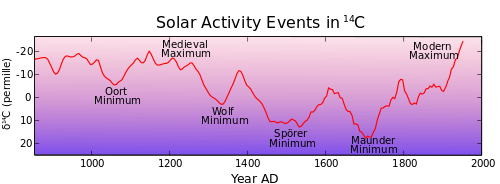
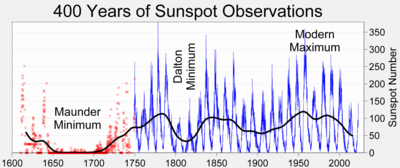
It took 500 years with reducing solar activity to get from the Medieval maximum to the the grand Maunder minimum. The Dalton minimum came a little over a 100 years later as solar activity was increasing to its modern maximum in the years preceding Solar Cycle 22 (c. 1890 – 1990). Now with the Landscheidt minimum seemingly well established, SC 23 and the current SC 24 show a clear trend of declining solar activity. SC’s 22, 23 and 24 are remarkably similar to SC’s 3, 4 and 5. The Dalton minimum coincided with SC’s 5 and 6.

It is reasonable to assume that climatic conditions over the next 20 – 30 years will resemble those prevailing between 1790 and 1820. But SC24 has a way to go yet and it could be that solar activity for SC24 and 25 will be even lower than during the Dalton minimum and perhaps closer to the Spörer minimum but perhaps not as deep as the Maunder minimum.

But in either case the solar activity to come following the Modern maximum may well resemble the 500 years of decline in solar activity which followed the Medieval maximum.

http://en.wikipedia.org/wiki/Dalton_Minimum

Solar activity events recorded in radiocarbon. Present period is on left. Values since 1950 not shown: Wikipedia

http://en.wikipedia.org/wiki/Maunder_Minimum

The Maunder minimum in a 400 year history of sunspot numbers: Wikipedia

http://sc25.com/index.php?id=268&linkbox=true&position=10

Image Attachment

The excellent historical weather chronology covering 1800 years put together by James A Marusek shows that the period between 1790 and 1820 was characterised not only by colder weather but also by violent fluctuations of seasonal weather. An extract of the chronology during the Dalton minimum is here: (weather chronology Dalton).

I give little credence to AGW Alarmism and the doom-saying regarding the effects of carbon dioxide. Environmentalism which was (and still is) highly admirable when concerned with the improvement of local conditions went off the rails when it went “global” and came to be dominated by the overweening arrogance of ignoring the sun and the presumption of super-computers and inadequate computer models.  Rather I am persuaded about the dominance of solar influences on the chaotic system which is our climate.

Whether or not a grand solar minimum is on its way, we are in for a decade of two of reduced activity and a cooling trend during this Landscheidt minimum.

Piers Corbyn forecasts a 3rd solar-influenced wave of snow in UK

December 23, 2010


Reproduced from Climate Realists.com:
Image Attachment

A THIRD period of “Solar Climate Change” on the UK will take place from Christmas Day to the End of December, this comes right after the first & second periods correctly predicted by WeatherAction.com & Piers Corbyn

The forecast made in November says….Snow deluges and blizzards in most of England and Wales, heaviest in East parts. Snow showers in Scotland. Sleet/rain and less cold in far West Ireland.

This “triple hit” of “Solar Climate Change” announced to WeatherAction.com users in November, means that the UK will go on to complete the “worst ever” December for High street retailers and business with the lack of essential public service due to road/rail/airport closures and again bring the country to it’s knees, and with “road salt” running out fast this “third” wave will take it’s toll on the “holiday” work force.

This is likely to add to one of the worst if not THE worst period of disruption in the UK to have been seen in modern times.

I will repeat what was said on the previous statement as this will still apply….

There are potential “life threatening” conditions that will be underestimated by the media (inc. Met Office).

With the aid of this forecast we hope to give some advance warning to those of you who are already suffering hardship and warn you of a very real risk of further and even bigger snow storms and blizzard conditions set for Scotland & England and Eastern Europe.

Please spread news of this forecast to all of those who are vulnerable and try to ensure that food supplies are sufficient to cope with this impending crisis.


Global warming arrogance takes “credit” for the white-out in Europe and the White Christmas in Australia

December 21, 2010

It used to be that the Global Warming zealots warned about the possible disappearance of snow and the mild and wet winters to come in Europe. But their arrogance knows no bounds. They have changed their tune and irrespective of what weather may prevail they mange to put it down to Global Warming. They now put the coldest December in a hundred years and the current white-out across Northern Europe down to Global Warming.

That snow outside is what global warming looks like

James Delingpole at The Telegraph is lauging his socks off.


Not to be outdone, the SMH thinks the possibility of having a White Christmas during the height of Australia’s summer is also due to Global Warming!!!!

The Alarmists cannot live with the thought that man made effects are puny and inconsequential compared to the effects of the sun.

Mild winters, warm winters, early winters, coldest winters in 100 years are all quoted in defence of global warming dogma.  They are all merely grist to the mill of Global Warming arrogance.

Science has been left behind in some far and distant galaxy.


Coldest December in 135 years

December 18, 2010

Kallaste december på 135 år

says the Svenska Dagbladet

http://www.thelocal.se/30914/20101217/

Power outages, traffic accidents as well as train and flight delays have left Swedes reeling from Thursday’s snowstorm, which forecasters say isn’t over yet.

“Slippery conditions will continue across the country. There is already a lot of snow on the roads,” SMHI’s Elin Torstensson told the TT news agency.

She explained that Sweden has experienced more cold days and more snow than is normal for December.

“There were a number of days in a row with below-freezing temperatures, so called ice days. And that we have that before Lucia (December 13th) hasn’t happened in more than 100 years,” she said.

Meteorology agency SMHI has issued a class 1 warning covering all of northern Sweden due to the large amounts of new snow, combined with the strong winds.

The agency also forecasts that the snow will continue throughout much of the country on Friday. Snow showers are expected to continue throughout the weekend over parts of Götaland and southern Svealand in central Sweden, with light flurries forecast for the north of the country.

“We’re expecting about five centimetres of new snow,” said SMHI’s Torstensson. Temperatures on Saturday are expected to range from a few degrees below freezing in Götaland to -25 Celsius in the far north, before cooling somewhat on Sunday when temperatures in the northern Sweden may dip down to 35 degrees below zero.

Weather not climate of course, but the credibility of so-called climate science is disappearing with its alarmist  displays of arrogance.

Winter variations and global warming

December 16, 2010

After a week in Southern India with minimum nighttime temperatures of around 20°C and maximum daytime temperatures of about 28°C, I am now in Delhi where the minimum nighttime temperature is about 5°C and where the daytime maximum touches about 25°C. Without widespread central heating being available, Delhi feels cold and on the streets everybody is bundled up in woollens, jackets, scarves and blankets and the occasional Balaclava.

In the meantime, Scandinavia and the UK and Northern Europe are bracing themselves for another cold wave and much snow. Next week I shall be back in about minus 20°C.

Swedish winter

Humans thrive in daily variations – every day – which range from 10 to 20°C and seasonal variations of temperature – every year – of 40 °C and sometimes upto 50°C.

The global warming doomsday scenarios seem  puny and nonsensical in the face of human adaptability and ingenuity.

A good thing that Cancun didn’t do too much and deferred everything again but of course the jamboree can – and will – continue next year in S. Africa. But “global warming” is going out of fashion and I have the gut feeling that climate alarmism is beginning to be seen in perspective.

Since the 1970s, the long-term rate of global warming has been around 0.16C a decade but that slowed in the last 10 years to between 0.05C – 0.13C depending on which of the three major temperature record series are used.

Global warming has slowed down in the past decade

Cancun won’t because it can’t

December 5, 2010

The  Cancun jamboree enters it’s second week with efforts being made to reduce expectations even further.  It is clear that any extension of Kyoto will be deferred till next year – again- and the pressure is now to get sufficient at Cancun next week to be able pronounce a success.

But the mood of the world has changed. Politicians lag the world by a few months and it is apparent that there are vry few who are leaders.

From the Hindu:

With Japan’s forthright statement on Monday and reluctance on the part of the other countries such as Russia, Canada and Australia to commit to a second phase, the entire negotiation is fraught with uncertainty.

To add to this the ALBA or the Bolivarian Alliance for the Peoples of Our America, which comprise nations of the South America and the Caribbean, has upped the ante by demanding a firm commitment from developed nations to the second phase of the Kyoto protocol, putting pressure on the main polluters. Matters were worsened by rumours of a secret text floated at the conference, which was strenuously denied by Christiana Figueres, Executive Secretary of the United Nations Framework Convention on Climate Change (UNFCCC), on Thursday. The secret text, according to a statement released by NGOs says the presidency of the conference of parties, Mexico, has convened an exclusive small group of countries aimed at agreeing on a text on the most sensitive topic, the mitigation efforts of developed and developing countries.

Ms. Figueres, Executive Secretary of the United Nations Framework Convention on Climate Change (UNFCCC), briefing the press, denied there was any secret Mexican text. Japan was clear about its position for a long time and it comes as no surprise that it had made a statement on its position, she reiterated. “The challenge of Cancun is how to formulate the broad array of proposals from developed countries under the UNFCCC framework,” she said. Even the position of the ALBA countries was known and there was no news there. Their position was 180 degrees opposite to Japan. “I don’t think it will be possible to guarantee a second commitment to the Kyoto Protocol. And it could be addressed later, but not at Cancun,” she said.

Expectations are being walked back.

Some good news from Cancun: Japan refuses to extend Kyoto protocol

December 2, 2010

Jun Arima, an official in the government’s economics trade and industry department, in an open session at Cancun bluntly stated that  “Japan will not inscribe its target under the Kyoto protocol on any conditions or under any circumstances.”

Kyoto stop

The Guardian is concerned which is a good sign in itself:

The brief statement…. was the strongest yet made against the protocol by one of the largest emitters of greenhouse gases.

“For Japan to come out with a statement like that at the beginning of the talks is significant,” said one British official. “The forthrightness of the statement took people by surprise.”

If it proves to be a new, formal position rather than a negotiating tactic, it could provoke a walk-out by some developing countries and threaten a breakdown in the talks. Last night diplomats were urgently trying to clarify the position. The move provoked alarm among the G77, the grouping of developing countries who regard the Kyoto protocol as the world’s only binding agreement on climate change cuts. Japan gave no reasons for making its brief statement on the second day of the talks, but diplomats said last night that it represented a hardening of its line. “Japan has stated before that it wants only one legal instrument and that it would be unfair to continue the protocol,” said one official who did not wish to be named.

Bloomberg writes:

China and Brazil led developing nations in saying Japan’s refusal to help extend the Kyoto Protocol to curb greenhouse gas emissions may halt work on a global accord to combat global warming.

A total of 37 developed countries, including Japan, ratified the Kyoto Protocol in 1997, agreeing to set limits on fossil fuel emissions. The Kyoto accord expires in December 2012 and with no other agreement to replace it, delegates at the United Nation climate talks in Cancun, Mexico, say extending the protocol is crucial.

“The Kyoto Protocol is the very basis of the framework to address climate change through international cooperation,” China’s envoy, Su Wei told reporters in Cancun. “If the pillar is collapsed, you can guess the consequences.”

Nasa/University of Colorado establish Sun-Climate Research Center

November 30, 2010

The “settled science” of climate change seems to be opening up to real science  – at last. Nasa and the University of Colorado are establishing a new research centre dedicated to studying the effect of the sun on climate.

And about time too.

Perhaps they could let the 15,000 gathered in Cancun know about the importance the Sun may have!

Today the University of Colorado Laboratory for Atmospheric and Space Physics (LASP) and NASA’s Goddard Space Flight Center announced the formation of a new collaborative research center dedicated to the study of the Sun’s effect on Earth’s climate. The Press release goes on to say:

Solar Image

The newly announced Sun-Climate Research Center, a collaboration between LASP and Goddard, will focus on research areas such as how solar variations shape Earth’s atmosphere and climate. This image of the sun is from the LASP-built NSF Precision Solar Photometric Telescope (PSPT). (Courtesy NASA/GSFC Scientific Visualization Studio; source data courtesy of HAO and LASP PSPT project team)

The center, called the Sun-Climate Research Center (SCRC), will be directed by Peter Pilewskie, a LASP research scientist and CU professor, Robert Cahalan, Head of Goddard’s Climate and Radiation Branch, and Douglas Rabin, Head of Goddard’s Solar Physics Laboratory.

Pilewskie said, “The exciting thing about this collaboration is that we believe it will promote studies to help answer a key question about the climate system: how does Earth’s atmosphere respond to the sun’s variability, and how does that affect climate? This question is particularly important now, as we seek to quantify the human-induced impact on Earth’s climate.”

The SCRC, which has been made possible by a Federal Space Act Agreement, will foster collaboration between Earth-atmosphere and solar sciences at the two institutions. Opportunities will include a scientist exchange program between the organizations, the ability for post-doctoral scientists and graduate students in science, engineering, and mission operations to move between LASP and Goddard, annual international Sun-Climate research symposia, and the ability for the two institutions to collaborate more fluidly on future research opportunities.

Robert Cahalan, SCRC co-director and Goddard scientist, said, “In recent years Goddard and LASP have worked together on several Earth and Sun missions. Now we look forward to continuing to drive growth in this key interdisciplinary field of Sun-Earth research, bringing new focus to the study of multiyear changes in the Sun and their influence on Earth’s climate.”

With a limited number of such agreements between U.S. universities and any of NASA’s ten field centers, the SCRC represents a rare and innovative step, underscoring LASP’s ability to develop high-caliber research and programmatic opportunities with Goddard.

Daniel Baker, LASP Director, said, “LASP has developed some remarkable areas of expertise that are key to studying the sun and its effect on climate and on human activities. By working with our colleagues at Goddard, we can leverage our skills—and help take an important step toward greater cooperation between NASA centers and leading university research teams.”

Earliest winter in 50 years

November 30, 2010

Östergötland Sweden: image buscainmobiliarias.com

Here in the Östergötland region of Sweden, we have about minus 10 degrees Celsius today and the snow is thick on the ground. Folkbladet reports that winter has not come so early in over 50 years. It was back in 1965 when the winter came almost as early as this year.  Looking out over the current postcard like winter landscape the doomsday scenarios painted at Cancun yesterday seem not only surreal but also lacking common sense.

Free translation:

Winter came early to Norrköping this year. In fact, it has not been this early in 50 years. An unusual weather condition is to blame for the sudden start of
winter 2010.
Until this year 1965 was the earliest winter in common memory. Then the ground was covered with snow on November 14th. In 2010 we recorded the first “snow chaos” on 10th November. And since then the blanket has only become thicker and thicker. “We now have nearly 30 cm of snow”, said Jon Ekwall at SMHI (Swedish Meteorological and Hydrological Institute).

In 1965 we had “only” 7cm of snow on November 29th with a temperature of minus 8 degrees. Today it is minus 10 degrees.

The reason for the winter coming so hard and so early has not yet been analysed deeply. Meteorologists do not see any impending doom or any link to climate change either.
“We do not really know why we get this weather situation. It is only chance, “said Linnea Rehn, meteorologist at SMHI. “We have a weather situation that allows it to be colder than usual. Normally, there is a pressure over Iceland and a low pressure over the Azores, and this pressure difference means that you get a gentle western breeze blowing in”, Linnea explains further. “But at the moment the pressure difference is not as large as usual leading to the cold winds blowing down from the north into Sweden”. And Linnea adds that today’s temperature is much lower than normal. The average temperature is 8-9 degree below zero instead of being around zero.

And so a new record is set in the common memory.