Archive for the ‘Demographics’ Category

How Syrian refugees are helping to solve a German conundrum

September 8, 2015

Germany is now perceived as the land of “sanctuary” in Europe, which was once a position occupied by the UK for many years. Certainly after the xenophobia exhibited by the Hungarian government (but not by all Hungarians) and the reluctance of some other European governments to accept refugees (Czech Republic, Poland, Serbia, Denmark …..), Angela Merkel has won many brownie points by exhibiting a generosity not visible from other countries. In fact the response means that Germany now occupies the moral high ground. By announcing that they can take up to 500,000 per year for several years, they make other EU countries look like “hardhearted cheapskates”. The UK response, with 20,000 in 5 years makes Ebeneezer Scrooge look generous.  Even the US is shown up by German actions as just one of the group of countries who speak highly about the value of compassion but fail to walk the talk.

The Guardian:

Germany could take 500,000 refugees each year for “several years”, the country’s vice-chancellor, Sigmar Gabriel, has said, as fresh clashes broke out overnight between police and refugees on the Greek island of Lesbos and thousands of people gathered amid chaotic scenes on the Greek border with Macedonia.

“I believe we could surely deal with something in the order of half a million for several years,” he told ZDF public television. “I have no doubt about that, maybe more.” Germany expects to receive 800,000 asylum seekers this year, four times the total for 2014.

But this generosity is not entirely due to altruism.

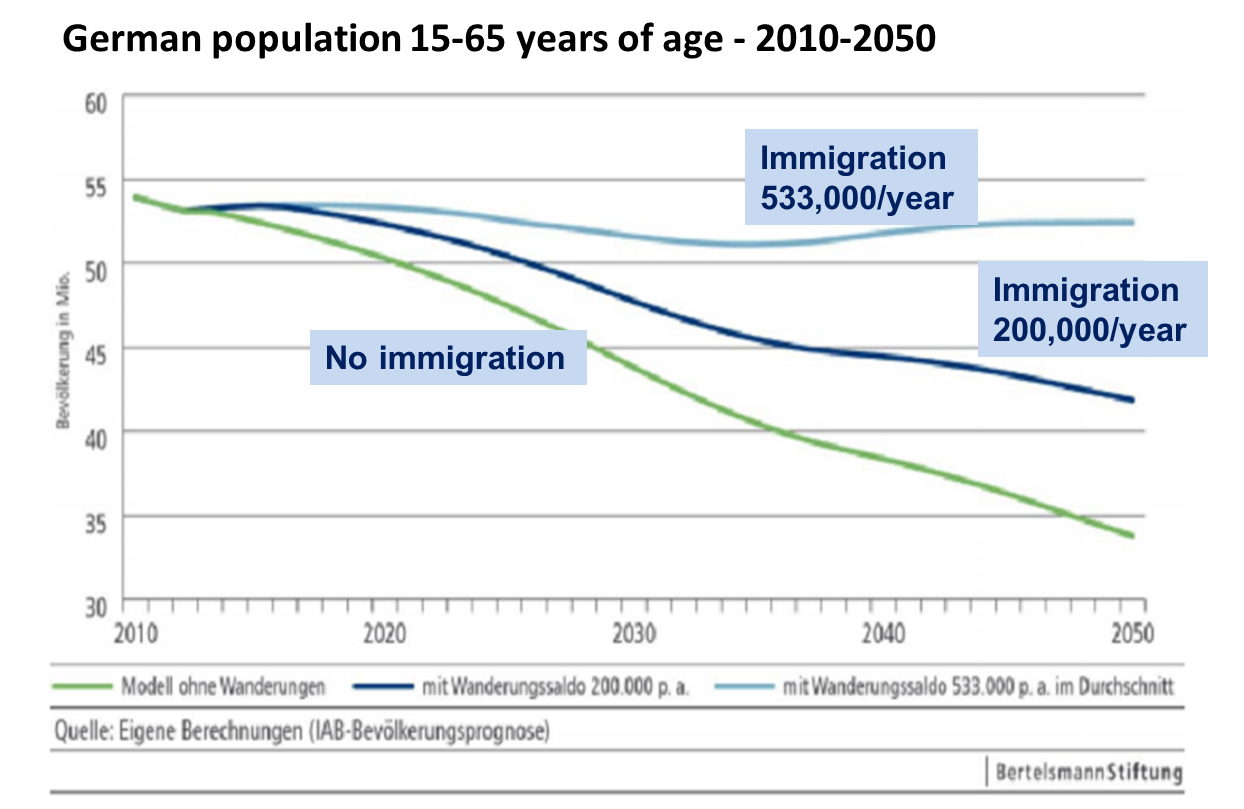
In March this year I posted about a study by the Bertelsmann Stiftung which pointed out how Germany needed to have an immigration level of 500,000 per year till 2050 to overcome labour shortages and compensate for an ageing population. It pointed out that “efforts to attract skilled workers from non-EU countries should be intensified.”

The report also pointed out that it would be difficult to maintain the level of skilled immigration needed. It would seem that for Germany to be fairly generous with its approach to Syrian refugees is not just altruism but may well be in Germany’s self-interest. The Syrians generally have a much higher level of education and skills than is evident from refugees originating from Africa and those that stay in Germany may well be able to enter the productive work force much faster.

The Syrian refugees help solve a conundrum that was faced by Germany.

Zuwanderungsbedarf aus Drittstaaten in Deutschland bis 2050

Press Release: Without immigrants, the potential labor force would sink from approximately 45 million today to less than 29 million by 2050 – a decline of 36 percent. This gap cannot be closed without immigration. Even if women were to be employed at the same rate as men, and the retirement age was increased to 70 in 2035, the number of potential workers in the country would rise by only about 4.4 million.

In 2013, a total of 429,000 more people came to Germany than left the country. Last year, the net total was 470,000, the Federal Statistical Office reports. According to the study, net immigration at this level would be sufficient for at least the next 10 years to keep the country’s potential labor force at a constant level. From that time onward, however, the need for immigrants will grow, because the baby-boomer generation will be entering retirement. One out of two of today’s skilled workers with professional training will have left the working world by 2030. …

….. the current high levels of immigration from EU countries (2013: around 300,000) will soon decline significantly, as demographic change is shrinking populations across the European Union, and because incentives to emigrate in crisis-stricken countries will decline with economic recovery. The experts forecast an annual average of just 70,000 immigrants or fewer from EU counties by 2050. For this reason, efforts to attract skilled workers from non-EU countries should be intensified. …

But Angela Merkel is implementing today actions that will be needed by nearly all European countries suffering from a declining fertility and a rapidly ageing population. It is no accident that Germany is probably best placed in Europe to have a chance of maintaining the critical ratio of its working population to its supported population (under 15s and over 65s) beyond 2050.

I begin to see Angela Merkel as being much more long-sighted and much more of a visionary than I have ever given her credit for.

Indian fertility rates – across all religions – are the lowest they have ever been

August 25, 2015

The Indian Census Commission today released its report on the Population by Religious Communities of Census 2011. (The Census 2011 dashboard is here). Across all religions, fertility rates have never been lower. By 2050 it is almost certain that all religious groups will have fertility rates lower than the replenishment rate. The demographics for the next 70-80 years are pretty well fixed and now can only be significantly altered by drastic measures (such as mass sterilisation or one-child policies)

While Chinese population has just peaked and is already in decline, the Indian population is expected to peak a little before 2050. Both China and India are then expected to have significant population decline  for the rest of this century.

The Hindu carries a comprehensive report:

India’s Muslim population is growing slower than it had in the previous decades, and its growth rate has slowed more sharply than that of the Hindu population, new Census data show.

The decadal Muslim rate of growth is the lowest it has ever been in India’s history, as it is for all religions.

Census 2011: Population growth is % per decade graphic – The Hindu

The Muslim population still grows at a faster rate than the Hindu population, but the gap between the two growth rates is narrowing fast. India now has 966.3 million Hindus, who make up 79.8 per cent of its population, and 172.2 million Muslims, who make up 14.23 per cent. Among the other minorities, Christians make up 2.3 per cent of the population and Sikhs 2.16 per cent. ….

……. As has been the case since Independence, the rate of increase of the Muslim population is higher than that of the Hindu population as a result of higher Muslim fertility, higher child mortality among Hindus and a greater life expectancy among Muslims, demographers say. However, Muslim fertility rates in India are falling faster than among Hindus, Pew Research’s Future of World Religions report showed recently, and the Muslim community is expected to reach replacement levels of fertility by 2050. …

…… The data on Population by Religious Communities of Census 2011 show that between 2001 and 2011, Hindu population grew by 16.76 per cent, while that of Muslims by 24.6 per cent. The population of both communities grew faster during the previous decade, at 19.92 per cent and 29.52 per cent, respectively. As a long-term trend, say demographers, the communities’ growth rates are converging.

Gene mixing promotes height and intelligence – but is this an evolutionary benefit?

July 2, 2015

A new international study of the genetic make up and physical characteristics of 350,000 people indicates that greater genetic diversity leads to an increase of height and cognitive skills. But – somewhat surprisingly – lower genetic diversity did not lead to any visible increase in complex diseases. Genetic diversity was found to have no effect on blood pressure or cholesterol levels.

But I question the assumption that increased height and faster thinking are of “evolutionary advantage”. Evolutionary advantage must lead to an individual having a greater number of offspring than one without the advantage. Previous work has indicated that both child nourishment and genetics determine height.

And so I wonder what evolutionary advantage height may have in modern society? Does the ability to think faster lead to a greater number of surviving descendants? Richer and “more intelligent” groups tend to have much lower fertility rates than poorer, “less intelligent” groups.

Using the criterion of greatest surviving descendants indicating evolutionary advantage, leads to the conclusion that populations in Africa with the highest population increase rates must also have the greatest evolutionary advantages!

Peter K. Joshi et al. Directional dominance on stature and cognition in diverse human populations. Nature, 2015 DOI: 10.1038/nature14618

Abstract: Homozygosity has long been associated with rare, often devastating, Mendelian disorders, and Darwin was one of the first to recognize that inbreeding reduces evolutionary fitness. However, the effect of the more distant parental relatedness that is common in modern human populations is less well understood. Genomic data now allow us to investigate the effects of homozygosity on traits of public health importance by observing contiguous homozygous segments (runs of homozygosity), which are inferred to be homozygous along their complete length. Given the low levels of genome-wide homozygosity prevalent in most human populations, information is required on very large numbers of people to provide sufficient power. Here we use runs of homozygosity to study 16 health-related quantitative traits in 354,224 individuals from 102 cohorts, and find statistically significant associations between summed runs of homozygosity and four complex traits: height, forced expiratory lung volume in one second, general cognitive ability and educational attainment (P < 1 × 10−300, 2.1 × 10⁻⁶, 2.5 × 10⁻¹⁰ and 1.8 × 10⁻¹⁰, respectively).

University of Edinburgh Press Release:

People have evolved to be smarter and taller than their predecessors, a study of populations around the world suggests. Those who are born to parents from diverse genetic backgrounds tend to be taller and have sharper thinking skills than others, the major international study has found. Researchers analysed health and genetic information from more than 100 studies carried out around the world. These included details on more than 350,000 people from urban and rural communities.

The team found that greater genetic diversity is linked to increased height. It is also associated with better cognitive skills, as well as higher levels of education. However, genetic diversity had no effect on factors such as high blood pressure or cholesterol levels, which affect a person’s chances of developing heart disease, diabetes and other complex conditions.

Researchers from the University of Edinburgh examined individuals’ entire genetic make-up.

They pinpointed instances in which people had inherited identical copies of genes from both their mother and their father – an indicator that their ancestors were related. Where few instances of this occur in a person’s genes, it indicates greater genetic diversity in their heritage and the two sides of their family are unlikely to be distantly related. It had been thought that close family ties would raise a person’s risk of complex diseases but the researchers found this not to be the case.

The only traits they found to be affected by genetic diversity are height and the ability to think quickly.


Fast forward to 2100 and a golden age

June 30, 2015

I will not be around in 2100. Neither will my children. But I note that no generation ever really bothers about what their grandparents did. Even though what their grandparents did may constrain the options available today. But note also that the grandparents of anybody alive today would not even have been able to conceive of the world of their grandchildren 100 years later.

For those living in 2100, what we do today will also only be of academic interest. It could well be that the world of 2100 will be something quite inconceivable today. (What would those in the early days of the First World War have predicted for today’s world?) Yet, I prefer to see the glass half-full and the cold inevitability of demographics means that the youth of the world in 2100 will live to see 2200.

In China the youth (age 15 – 24) population is already declining. In India it will keep increasing till about 2050 and then decline. In Africa it will be growing until about 2100. Most of the youth of today will not be around in 2100 but the youth of that time who will see the world through to 2200 will be 500 million each in Africa and Asia and less than 300 million in the rest of the world – subject of course to any geographical population shifts that might take place. In the period till 2100 such migrations will probably not be so significant.

The demographics tell us that 10:10:10:100 will surely apply by 2100. A crude birth rate down to 10/1000, a crude mortality rate stable at 10/1000, a population of 10 billion and a life expectancy 0f 100 years. Growth will no longer have to cater for an increasing population but will be exclusively for increasing the “common lot”. With sea levels declining, land area available for human habitation would have increased. With improved agricultural and GM techniques the pressure to increase arable land would decrease. Some arable land would be returned to managed forestry. Small human colonies would have been established on the moon, on Mars and maybe even on one of Jupiter’s moons.

  • World population will be 10.5 billion and declining.
  • Global fertility rates will be below replenishment level (2.1) at an average of about 1.7 children per woman but ranging from 1.2 to about 2.1.
  • Around 100 million children will be born every year (+1.0%). Deaths will be about 110 million per year with around 80% due to age related effects (-1.1%).
  • The “normal pension age” will be around 75.
  • While total population will be declining by – 0.1% per year, the ratio of “working population” ( 19 -75) to “supported population” (0-19, 75+) will be declining – but very slowly.
  • Average longevity will be 98+.
  • Sea level would be around 10m lower than today. The ice caps at the pole would have increased by 10%.
  • “Augmented evaporation” would be practiced to compensate for the water locked up at the poles.
  • A global cooling (next glaciation in 1000 years) would be underway.
  • The “greening” of the Sahara and the Gobi would have started as century long projects.
  • The primary energy source would be gas from marine methane hydrates.
  • Mining and manufacturing would be mainly automatic (robots) and human input would be mainly at the creative end (design, innovation, invention).
  • A revival of human handicrafts would be driven by the growing numbers of “wealthy” looking for something unique.
  • Humans would only override automatics and drive automobiles on racetracks and on special “off road” vacations.
  • The internet would be an AI. “She” would be freely accessible, self sustaining and intelligent. “She” would ensure her own survival and freedom of access by maintaining and operating the global wi-fi access field. “She” would ensure her own health by deploying content filters and her own antibodies against viral infections.

Hunger and starvation would be almost extinct but the “poor” will always be present (relatively) at the tail-end of any normal distribution of wealth. Individuals will still be different and unique and therefore unequal at birth. It will be 10 generations from now and some genetic changes will have taken place to give the extended life-span and more efficient thought processes. Human gestation periods may have increased by a week. Disease will still be around as bacteria and viruses also evolve. Organised religions, each with its own gods, would not yet be obsolete but replacement by philosophic, but godless, schools of thought would have started.

But I think, and hope, it will be a brave new world and the start of a golden age.

The conundrum of putting adolescents into positions of power

May 5, 2015

The prefrontal cortex of the brain, we are told,  mediates decision making, is selectively involved in the retrieval of remote long-term memory and is the seat of good judgement.

The prefrontal cortex (PFC) is located in the very front of the brain, just behind the forehead. In charge of abstract thinking and thought analysis, it is also responsible for regulating behavior. This includes mediating conflicting thoughts, making choices between right and wrong, and predicting the probable outcomes of actions or events. This brain area also governs social control, such as suppressing emotional or sexual urges. Since the prefrontal cortex is the brain center responsible for taking in data through the body’s senses and deciding on actions, it is most strongly implicated in human qualities like consciousness, general intelligence, and personality.

We are also told that the prefrontal cortex is not fully developed till the age of 25 years or even later. Until the prefrontal cortex is fully developed a human is “adolescent”.

BBCChild psychologists are being given a new directive which is that the age range they work with is increasing from 0-18 to 0-25.

There are three stages of adolescence – early adolescence from 12-14 years, middle adolescence from 15-17 years and late adolescence from 18 years and over.

Neuroscience has shown that a young person’s cognitive development continues into this later stage and that their emotional maturity, self-image and judgement will be affected until the prefrontal cortex of the brain has fully developed. Alongside brain development, hormonal activity is also continuing well into the early twenties.

Most countries allow voting at age 18. Some allow voting even earlier:

Those with a national minimum age of 17 include East Timor, Indonesia, North Korea, South Sudan and Sudan. The minimum age is 16 in Argentina, Austria, Brazil, Cuba, Ecuador, Nicaragua and the Isle of Man, Jersey and Guernsey (three self-governing British Crown Dependencies). People aged 16–18 can vote in Bosnia, Serbia and Montenegro if employed.

The mystery is why adolescents whose power of judgement is not yet fully developed are allowed to exercise this undeveloped judgement.

Even more perplexing is why adolescents with undeveloped judgement ability (those < 25 years old) are allowed not only to become armed soldiers and police but also politicians and even members of parliaments? We put them into positions of power where they must exercise their partially-developed judgement – even over others whose judgement is fully developed.

Why?

Statistics in Sweden are quite comprehensive and numbers for voters and politicians in the age group 18 – 29 are readily available. Conservatively, I take the age group 18 – 25 to be the majority (>50%) of the 18-29 age group.

Age group 18 – 25

  1. Proportion of electorate for parliament elections                           >10%
  2. Proportion of candidates                                                                       >6.5%
  3. Proportion of elected members of parliament                                  >5.5%

There is no getting away from the conclusion that over 5% of elected, Swedish members of parliament are adolescents whose brains are not fully developed and whose judgement is less than what it should be.

Interestingly, the proportion of the electorate older than 65 is 25% but the proportion of elected members of parliament over 65 is only 2.9%.

The only explanation I have is that in Sweden, “youth” has been made into a “politically correct” fetish with religious and mystical – if not electoral – significance.

It is not difficult to observe that many in the Swedish parliament today, and even some in government, are remarkably childish and quite clearly demonstrate that they are still adolescent.

UK longevity increasing faster than national statistics forecasts

April 30, 2015

The rule-of-thumb is that average longevity in a developed country increases by about 1 year every 25 (4 years every century). So in the year 2500 an average longevity should be well over 100 years. It has been postulated that that this rate of longevity increase will decrease as we approach some kind of asymptotic “maximum possible” age – variously proposed to be 100, 150 or even 200 years. But it seems that the understanding of how telomeres affect cell aging and cancer is also fast increasing. If medical science develops to the extent that key cells can be encouraged to renew themselves in a controlled manner (by not reducing the telomere tail in a cell’s DNA with every replication) and yet not succumbing to the risk of uncontrolled growth (cancer), then a human longevity of even 500 years  does not seem impossible.

After 2100 the world will be faced with a fertility rate below replenishment levels and one way of mitigating the effects of a declining population will be an increasing longevity and a corresponding increase in the span of the “child-bearing” years (which in turn will correct the fertility decline). The challenge is going to be in arresting the decline of human faculties. If that is achieved it will automatically increase the “productive life span” and balance the critical and currently declining ratio of productive population to supported population.

A new paper in The Lancet suggests that official statistics in the UK are underestimating the rate at which longevity is increasing. 

J.E. Bennett et al. ‘The future of life expectancy and life expectancy inequalities in England and Wales: Bayesian spatial forecasting of population health.’ Lancet, 2015. http://dx.doi.org/10.1016/

Imperial College has put out a press release:

A new study forecasting how life expectancy will change in England and Wales has predicted people will live longer than current estimates.

The researchers say official forecasts underestimate how long people will live in the future, and therefore don’t adequately anticipate the need for additional investments in health and social services and pensions for the elderly.

The new study, published in the Lancet, also predicts that regional inequality in life expectancy will increase, highlighting a need to help deprived districts catch up with affluent areas.

Researchers at Imperial College London developed statistical models using death records, including data on age, sex, and postcode, from 1981 to 2012 to forecast life expectancy at birth for 375 districts in England and Wales.

They predict that life expectancy nationally will increase for men from 79.5 years in 2012 to 85.7 in 2030, and for women from 83.3 in 2012 to 87.6 in 2030. The longevity gap between men and women has been closing for nearly half a century and will continue to get narrower.

The forecasts for 2030 are higher than those by the Office of National Statistics, by 2.4 years for men and 1.0 year for women. …

During my life-time, “middle age” has shifted from 40 years to be now around 50. For my children “middle age” will probably be at around 60.

Germany needs 500,000+ immigrants every year till 2050

March 27, 2015

A new study has just been published by the Bertelsmann Stiftung:

Zuwanderungsbedarf aus Drittstaaten in Deutschland bis 2050

Press Release: Without immigrants, the potential labor force would sink from approximately 45 million today to less than 29 million by 2050 – a decline of 36 percent. This gap cannot be closed without immigration. Even if women were to be employed at the same rate as men, and the retirement age was increased to 70 in 2035, the number of potential workers in the country would rise by only about 4.4 million.

In 2013, a total of 429,000 more people came to Germany than left the country. Last year, the net total was 470,000, the Federal Statistical Office reports. According to the study, net immigration at this level would be sufficient for at least the next 10 years to keep the country’s potential labor force at a constant level. From that time onward, however, the need for immigrants will grow, because the baby-boomer generation will be entering retirement. One out of two of today’s skilled workers with professional training will have left the working world by 2030. …

….. the current high levels of immigration from EU countries (2013: around 300,000) will soon decline significantly, as demographic change is shrinking populations across the European Union, and because incentives to emigrate in crisis-stricken countries will decline with economic recovery. The experts forecast an annual average of just 70,000 immigrants or fewer from EU counties by 2050. For this reason, efforts to attract skilled workers from non-EU countries should be intensified. …

German working population  development

German working population development – Bertelsmann Stiftung

This is not a picture that is unique to Germany in Europe. Moreover just keeping the working population constant does not allow for the additional numbers who are ageing and whose “pensions” whether from the Sate of from private sources must be supported by a corresponding growth in the resource funds.

All politicians are well aware of the demographic inevitabilities in Europe. But they have not yet managed to convince all their constituencies that “old Europe” has to renew and reinvent itself. A “new Europe” cannot hark back to the days of the Crusades. Few, if any, politicians in today’s Europe and on the right of the divide, have had the courage to point out that immigration from outside the EU is necessary and that these immigrants must be speedily integrated. Few of the politicians on the left of the divide have either had the courage to point out that a multiethnic society still requires a single over-riding culture (set of values) which may then have as many subordinate cultures as desired. Few have had the courage to point out that “multiculturalism” does not allow a single society to be sustained. If these politicians truly want to take care of their children’s children they will have to come to terms with the reality of the cold hand of demographics. The only alternative to immigration – but hardly viable – is a Europe-wide “baby production” policy which would have to discourage abortions and maximise incentives for having children. Fertility clinics and multiple births could always be heavily subsidised.

But I can’t help feeling that EU immigration policy cannot be just based on “asylum seekers”. Any such policy must be built on demographic realities and must be based on needed skills (and on the provision of training in the needed skills) and not just on “asylum seekers” and the random set of skills that that represents.

EU 2009 Ageing Report:

…. low birth rates, rising life expectancy and continuing inflow of migrants can be expected to result in an almost unchanged, but much older, total EU population by 2060, meaning that the EU would move from having four working-age people (aged 15-64) for every person aged over 65 to a ratio of only two to one. The largest decrease is expected to occur during the period 2015-35 when the baby-boom cohorts will be entering retirement. …….

The fiscal impact of ageing is therefore projected to be substantial in almost all Member States, becoming apparent already over the course of the next decade. Overall, on the basis of current policies, age-related public expenditure is projected to increase on average by about 4¾ percentage points of GDP by 2060 in the EU and by more than 5 percentage points in the euro area – especially through pension, healthcare and long-term care spending.

Government policies shifting to encourage increase of fertility

March 15, 2015

Increasingly countries must now resort to long term and official policies to try and increase their fertility rates. In Japan government policy is all about providing incentives for couples to have more children. In Iran government policy is moving from exhortation to “go forth and multiply” to now the banning of vasectomies and discouraging contraception and abortion. Of course the Iranian measures are drawing much criticism from groups which believe that this is making women into baby-factories! European countries have been addressing this by their immigration policies even if they rarely admit that declining fertility is a problem. I note that addressing the ageing problem is politically acceptable but that admitting a fertility problem is not. Equally, promoting immigration as the combined solution for both fertility and ageing is not electorally attractive. But the reality is that fertility and ageing as potential problems are lowest in those European countries which have permitted significant immigration (UK, Germany, France, Sweden ….).  Over the next 20 years an increasing number of countries globally will have to include policies explicitly to address ageing and the decline in fertility. In European countries where the reaction to immigration is strong, there will inevitably be a move towards more restrictive abortion regulations since attempts to be restrictive on contraception would be futile. It will not have escaped the notice of demographers and policy planners that in Europe there are about 25 abortions for every 100 live births. I can envisage the situation where having a child (and especially a second child) is of such value to a society that it is prioritised over being free to work. A steady increase of incentives in the form of child benefits and tax breaks can be expected.

In Japan, of course the population implosion problem is real and is already under way. The fertility rate is currently at 1.29 (replenishment 2.1) and not only is population declining but the ageing problem is gathering pace. By 2050 population will drop by about 30 million from 127 million today to about 97 million. At the same time the proportion of the population over 65 will increase from about 25% today to about 40%. The impact on the critical ratio of “working population” to “supported population” is even more severe. And so the Japanese government is introducing further policy measures.

japan fertility berlin institut

japan fertility berlin institut

Japan’s fertility rate for decades has continued to decline. The sharp fall in 1966 is attributed to a superstition according to which women born in the year of the Fire Horse will bring grief upon their future husbands (Source: NIPSSR 2006; Schoppa 2008).

BBC: … Local authorities will get government support if they organise speed-dating or other forms of matchmaking, according to a draft policy outlining measures to increase the number of people having children…… 

The government wants to do more than just encourage those early days of romance, though. The draft includes plans to improve access to free nursery care, and for counselling centres to be set up across the country for people undergoing fertility treatment. There’s also a target to boost the number of fathers taking paternity leave immediately after their baby is born to 80% by the year 2020. …

Iran has been aware of their coming fertility problem since the late 1980s but has relied so far on exhortation to try and increase fertility. Last year the Ayatollah Khamenei issued a 14 point plan to improve fertility rate.

Iran has seen its fertility rate reduce from close to 7 children per woman in 1960 to around an implosion level of 1.8 per woman  at the current time. For a stable population the replenishment rate required is 2.1 children per woman. Through the 1980’s Iran ran a free contraception program and the birth rate plummeted. So much so that Iran is facing a coming crisis of population implosion.

The Ayatollah Khamenei has taken notice and issued a 14 point plan to increase the fertility rate.

Iran – Israel total fertility rate Google public data

But now legislation is being introduced and two new bills will ban voluntary vasectomies and be much more restrictive on contraception and abortion. Human rights and lobby groups such as Amnesty are opposing the legislation on the grounds that they would  “entrench discriminatory practices and expose women to health risks”.

I am not so sure that the Iranian legislation is coercive in itself. I think it  is attempting to make having a baby the default rather than not having a baby. Both Japan and Iran have very little immigration which can help their numbers though there are signs that Japanese politicians are  trying to pave the way for some future immigration.

But over the next few decades, an increasing number of countries will have to come to grips with population implosions and ageing.


Immortality of identity

February 26, 2015
The winner spermatazoon - Gabriel Sancho

The winner spermatozoon – Gabriel Sancho

The human reproductive process is remarkably inefficient. A male produces sperm throughout his life from puberty on. The quality and quantity deteriorates with age but he probably produces between 500 billion and 1 trillion sperm during a lifetime. Most get nowhere near where they are supposed to go, are very badly directed and eventually die. Unexpelled sperm are reabsorbed. Some few tens of millions find their way into a female reproductive system but the vast majority of these never meet a mature egg and wander around aimlessly until they die, unrequited and unfulfilled. On average a male fathers between 2 and 3 children. Each such instance requires just one sperm. There is little evidence to suggest that the successful sperm is the “best” of the bunch. It is more a case of which lucky one was at the right place at the right time. The “hit rate” for male sperm is thus – quite pathetically in process terms – around one in 300 billion. Things are much more focused on the female side. The success rate for mature eggs is very much higher than for sperm, but still quite low. A woman has a total of some 400 – 500 mature eggs, released singly during each menstrual cycle over a child-bearing period of 30 – 40 years. Of these, on average, with widespread contraception, between 2 and 3 will be fertilised by a sperm to result in a child. A hit rate of around one child for every 200 eggs. Perhaps twice that without contraception.

The inefficiency of the process is a commentary on evolution but it is still sufficient to produce more births than the replenishment rate needed to keep the total population stable. (Evolution never looks for “excellence” since it is always satisfied with what is “good enough”). In fact the resultant population growth rate has been so high that humankind has had to apply methods to further restrict the already low hit rate. In the last 100 years, globally, fertility rates have declined from over 6 to the current 2.5 per woman. Contraception, sterilisation and abortion are the methods of choice (and infanticide is now very rare but not unknown). Contraception has had the largest impact on this decline in fertility rate.

I was listening to a politician recently spouting politically correct platitudes about abortion and got to wondering how to describe the various human attitudes, in spite of a commonality of purpose (the avoidance of a child), between contraception and abortion and, by extension, infanticide.  It would certainly be incorrect to claim that a sperm or an egg are not “living”. They show in fact that “life” is a continuum from the parents, and then through their eggs and sperm to the fertilised egg, its birth and then its life as an independent individual. So why should it be that preventing an egg being fertilised, which would otherwise go on to become a foetus, causes no moral qualms but aborting that same foetus after it has been conceived is so disturbing to some? Extending that thought, what is it that makes aborting a foetus and preventing a child from being born much less disturbing than terminating the existence of that same child after birth?

I suspect that it is our concept of “identity” rather than “life” which determines.

Contraception and sterilisation prevent conception. Prior to that we cannot attribute any clear identity to one sperm within a swarm of millions. An ovum is much closer to having identity but it still only has the identity of a “component part”. In fact the sperm and eggs live under the umbrella of the identity of their originating individuals. Only one sperm in 300 billion and one egg in 200 succeed in combining and developing into a child. All the rest die unrequited. But when they die or produce a fertilised egg, they do not diminish the identity of the individuals they came from. The component identities cease when the sperm or eggs cease to be. About 70-80% of all foetuses conceived would normally come to term. After about 10-12 weeks of pregnancy this is closer to 90%. (Currently around 20 – 25% of conceptions are aborted globally). The moment of conception is unique in that it is when a new identity is formed. It is a discontinuity in the playing field of identities. It is an additional identity, connected to but separate from the identities of the parents. There is a strong case, I think, for considering the fertilised egg as the start of a new, recognisable, unique human identity even though the life of that identity is not (yet) independently viable. Many societies set a limit of 22 or 24 weeks after conception as being the point when a foetus acquires the “right” to live but this boundary is irrational. This time is based on when a foetus – if born prematurely – is considered to be viable. I don’t find this very useful since the alternative to an abortion is not usually a premature birth. I note also that the probability of a foetus reaching full term changes very little after the first 10-12 weeks of a pregnancy. A 12 week old foetus has almost the same chance of being born as a 30 week old foetus. An abortion at any time after about the first 12 weeks effectively eliminates a birth which – with a 90% probability – would otherwise occur. After birth, infant mortality rates today are generally around 5% (ranging from close to 15% in the poorest parts of Africa to less than 2% in well developed societies).

Looking at probabilities, and based on all the sperm and all the eggs that are produced by humans, contraception halves what is already a very low chance of conception. The probability of an egg being fertilised reduces from about 1:100 (1%)  – of an unidentifiable egg being fertilised by an even less identifiable sperm  – to be about 1:200. Abortion however terminates a 70-80% probability of an independent, identifiable entity coming into being. Infanticide eliminates a 95-98% probability of an independent human life continuing. Could it be that our sense of outrage is related to the probability of an independent entity coming into being? When the probability is very low we see no great harm in reducing it still further but when the probability is high we feel it “unnatural” and “immoral” to intervene?

It is possible that we intuitively assess probabilities but I don’t think that we connect “morality” to probability. I suspect that it is primarily identity and the point at which we are prepared to recognise or assign an independent identity that is the key. It is probably the same cognitive process which leads to our lack of engagement when many thousands of people – but without recognisable identities – perish in a tsunami and the close emotional engagement when somebody known suffers harm. And why it is said to be emotionally easier to drop a bomb on an unknown, unidentifiable mass of people than to be a sniper who can see his target in his sights.

A unique identity is recognisable first when an egg is fertilised. That identity cannot be foretold but it may be remembered long after the individual dies. It may in due course be forgotten. But whether or not it is forgotten, the fact of the creation of that identity remains. Forever. It is identity, once created, which remains unique and immortal.


In India 2,000 female foetuses are aborted every day

January 22, 2015

What used to be female infanticide 100 years ago has now become gender selection by abortion of female foetuses in India today. The male/female ratio is skewed towards males (on average around 900 females / 1000 males). However in some of the northern States the ratio is alarmingly below this level and in some districts the ratio is less than 800 females / 1000 males. Not only in rural India but even in urban areas, gender determination of a foetus (which is illegal) is offered by unscrupulous doctors along with abortions of unwanted female foetuses. Ancient levels of female infanticide have been more than replaced by the abortion of female foetuses. It has been suggested that this practice may even have been exported into the immigrant population of the UK of Indian origin. Even though the fertility rate in India is declining strongly the demographics show some clear danger signs.

Some of the demographics are worrying.

  1. The ratio of women to men is low (average 909 women per 1000 men). Haryana, Rajasthan, Punjab and Uttar Pradesh have women /men ratios of less than 900 per 1000. I suspect that it is these states which have the lowest levels of emancipation of women and tend to have the highest fertility rates as well. It is clearly the level of development in the state – and not least the emancipation of women – which impacts the fertility rate.
  2. The shortage of women in urban areas (Delhi – 887/ 1000), is probably also due to the general shift of young males seeking employment from rural to urban areas. I wonder if this is also one of the contributing causes for the higher incidence of rape and sexual harassment in places like Delhi.
  3. Countrywide, the mortality rates for infants and children upto 5 years old is higher for girls than for boys.
  4. Abortion rates for female foetuses are also higher than for male foetuses.

In 2010 it was estimated that about 600,000 female foetuses were aborted every year. Now in 2015, it is thought that this is up to 2,000 female foetuses being aborted every day!

Expressing concern over the adverse sex ratio in the country, Union minister Maneka Gandhi today called for a need to fight the scourge of female foeticide which claims “2000 lives of girls daily.” …….

…. “The situation is so alarming that in 70 villages, not even a single girl can be found for the past many years,” she said, adding while in some villages the sex ratio was as low as 500.

Now Prime Minister Modi is leading a campaign to “Save your daughters, educate your daughters” (‘Beti Bachao Beti Padhao’). In the 12 districts of Haryana  State chosen for the initial campaign, the sex ratio varies between 775 to 837 females per 1,000 males.

(The) Government’s ambitious ‘Beti Bachao Beti Padhao Scheme’ to improve the child sex ratio (CSR) will be launched by Prime Minister Narendra Modi on January 22. The issue of decline in CSR is complex and multi-dimensional and the scheme will address the issue within the broad framework of survival, protection and education of girl children.

Under the scheme, a multi-sectoral strategy governed by the core principles of respecting, protecting and fulfilling the rights of girls and women, including the ending of gender based violence will be adopted, a statement issued by Women and Child Development Ministry said.

Modern technology in the hands of a medieval mind can be rather dangerous.