Archive for the ‘Economy’ Category

Greek negotiating tactics are vacillating between “playing chicken” and bad faith

June 15, 2015

Another negotiating session ended in failure yesterday – after just 45 minutes. The Greek delegation were the visitors in Brussels. In any negotiation, the home side always has the “time” advantage in that that they can go as slow as they like. To neutralise this home advantage, a visiting side in a negotiation always needs to show more patience and always give the impression that they can sit there for ever. For a negotiating session to end in just 45 minutes would need the “visiting” delegation to actually walk away. And if the Greeks did walk away then it would seem that they are either playing a dangerous game of chicken or else that they are negotiating in “bad faith” with no intention of reaching a settlement. If the latter then they are just waiting for an opportune time – for domestic consumption – to bring this to an end and initiate a Grexit. If the former then they are waiting for a Grexit to appear inevitable such that they get some “final” concessions.

My own view is that any settlement now with Greece will only be a temporary fix – and the sins of past Greek profligacy will not have been fundamentally atoned for. The pension system that the Greeks awarded themselves are unsustainable even with the cuts implemented so far. A Greece forced to continue within the Eurozone will remain under debt pressure for a decade. Tourism will be constrained. No Icelandic type of recovery would be possible. Far better to bite the bullet now, allow a Grexit and begin to limit and later shrink the Eurozone. Both Greece and the Eurozone will eventually benefit.

Bloomberg:

Greece enters what could be a defining week after last-ditch negotiations between representatives of the Greek government and its creditors collapsed on Sunday.

The euro dropped as the European Commission said the talks in Brussels had broken up after just 45 minutes with the divide between what creditors asked of Greece and what its government was prepared to do unbridged. The focus now shifts to a June 18 meeting in Luxembourg of euro-area finance ministers, known collectively as the Eurogroup, that may become a make-or-break session deciding Greece’s ability to avert default and its continued membership in the 19-nation euro area. …..

……. “The shadow of a Greek exit from the euro zone is becoming increasingly perceptible,” German Vice Chancellor and Economy Minister Sigmar Gabriel wrote in an op-ed to be published in Bild on Monday. “Greece’s game theorists are gambling the future of their country. And Europe’s too.”

Explaining inflation as resistance to motion

May 14, 2015

“Dad, What’s inflation? Why are Sweden and the UK trying to increase inflation and why are India and China trying to reduce it? Is inflation good or bad?”

Well, it all starts with the economic cycle and the resistances in …….

“What’s an economic cycle?”

OK. Let’s start at the beginning.

Let’s start at the very beginning
a very good place to start
when you read you begin with abc
An economy begins with “N”, “P”, “C”
“N”, “P”, “C”
the three legs needed just happen to be
“N”, “P”, “C”; “N”, “P”, “C”

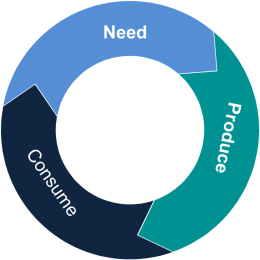
When you get hungry you have a Need, a need for food. That’s where all economies start – with a need, the “N”. So you shout “Mom, What’s for dinner? I’m starving”. It’s fortunate that Mom is there and responds to your shout and starts Producing some dinner. Thats the “P”. And after some time you get your dinner and you Consume it. That makes you a consumer. And then when you’re ready to go out to your party you shout “Dad, can you drop me off at Jimmy’s (and pick me up later)?” you are just another Consumer expressing another Need – a need this time for transport. And when I take you there and bring you back, I am the Producer. And when you come home you’re hungry again. This is the basic cycle – Needs lead to Production which in turn leads to Consumption which leads to new Needs.

A production-consumption loop provides a business process.
economic cycle

The fundamental economic cycle


Every human is a consumer. All producers are consumers. But not all consumers are producers. The economic cycle is the cycle of living. And the more complex the society, the more complex and interconnected are all the various business processes that go to making up the economic cycle. Much of the production may be indirect or the production is of abstract things. Teachers produce “education”. Policemen produce “safety”. Actors and sports stars produce “entertainment”. It can be difficult to discern what politicians and priests produce but they too satisfy human needs. Even you produce something – mainly tension and stress which we consume for the goodness of our souls.

But time is the necessary additional dimension. All these various processes take time. It takes time for a new need to entice a producer and it takes time for the production and then it takes time to get to the point of consumption. The economic cycle is not just a circle. It is a continuous circle wrapped around the time axis. With time involved, the economic cycle reflects “motion” – a movement in time. And wherever there is motion there is resistance to motion. Each part of the cycle and of its subcycles is subject to inertia and friction. Inertia is the resistance not only to the start of motion but also to a change in an existing motion. It comes into play whenever a new need or a changed need requires some new production process or a change to a production process. And once the motion is in progress – and this applies to every business process and to every interaction between processes – there is a frictional resistance to the motion. Inertial resistance is generally higher than rolling friction.

And so we come to inflation. You can think of inflation as a measure of the resistances (inertial and frictional) to motion within an economic cycle. For any business process it can never be zero except if motion stops. When an economic cycle is said to have a negative inflation or a deflation, it only means that some of the component business processes are coming to a halt. For a well functioning economy, the resistances will be as low as possible and that represents the “healthy” level of inflation for that economy.  When inflation is said to be very high it means that business processes are operating sub-optimally – maybe in a stop-go manner, or that they are not meshing together very well or that there is turbulence in the work place.

So when the UK and Sweden try to bring their inflation rate up to about 2%, it is because 2% is judged to be representative of the resistance if all parts of the economy are functioning as smoothly as possible and growing modestly. When India tries to bring its inflation down from double digits to about 4% as a target, it means that many component parts of their economic cycle are functioning – or not – with too high a level of resistance. Processes are starting and stopping or are very inefficient – within themselves or that their inter-connections are broken or damaged.

In a rapidly growing economy where there are inertial resistances to overcome, the “healthy” level will have to be greater than the assumed 2% norm.

So, inflation is neither bad or good – it is a consequence of the business processes making up the economic cycle. It is measure of resistance to the motion of business processes. Even when operating smoothly these processes are subject to frictional resistance. Any growth of the cycle itself requires that production processes start or change and that brings in inertial resistance in addition to the frictional resistance. So inflation can never be zero but for every economic cycle, it needs to be as low as possible for a given complexity, a given size and a given growth. A too low inflation means that some of the component business processes are shrinking or coming to a halt. A too high level of inflation in an economy indicates that resistances are much too high and that the component business processes are not functioning as they should.

In developed countries of Europe the target inflation is at about 2% whereas in faster growing economies (China or India) the target is to be at around 4%.

It’s just a simple matter of “N”, “P”, “C”.

Got it?

“Duh!

With the resistances in this house, my pocket money needs to go up by 20% – at least!”
US is not amused at the rise of AIIB as rival to World Bank

March 20, 2015

The US is not amused.

The list of countries signing up to the Chinese-led initiative which would rival the World Bank is growing as Japan and Australia have now indicated that they too will join. In the last week the UK, Germany, Italy, France and Luxembourg indicated that they too would sign up to the Asian Infrastructure Investment Bank (AIIB) in spite of dire warnings from across the Atlantic. South Korea is also expected to sign up now that the UK and Japan have.

(Reuters)Japan signaled cautious approval of the China-led Asian Infrastructure Investment Bank (AIIB) on Friday and said for the first time that, if conditions were met, it could join the institution that the United States has warned against.

Australian Treasurer Joe Hockey said there was “a lot of merit” in the bank and the Sydney Morning Herald newspaper reported that Canberra could formally decide to sign up when the full cabinet meets on Monday.

Japan, Australia and the South Korea, all major U.S. allies, are the notable regional absentees from the AIIB. The United States, worried about China’s growing diplomatic clout, has questioned whether the AIIB will have sufficient standards of governance and environmental and social safeguards.

The US  (US Treasury department and the US Congress) was not amused in October last year when “India along with 20 other countries today signed an agreement to become founding members of the China-backed Asian Infrastructure Investment Bank (AIIB) to aid the infrastructure development in the Asian region and reduce the dependence on Western-dominated World Bank and IMF.”  The authorised capital of AIIB is to be USD 100 billion and the initial subscribed capital is expected to be around USD 50 billion. The paid-in ratio will be 20 per cent. The AIIB is to be headquartered in Beijing and it is hoped that it will be operational by the end of 2015.

It was the US opposition to allowing any reform of voting rights at the International Monetary Fund which had irritated and annoyed China and other Asian countries which had led to the Chinese initiative. The proposed – relatively mild – reforms for the IMF were agreed at a G20 meeting in 2010 and have been ratified by all European countries. But the US has not yet ratified these changes. It has not been prepared to permit any weakening of its dominance in the World Bank and the IMF.  The founding members of the AIIB members in October 2014 were China, India, Vietnam, Uzbekistan, Thailand, Sri Lanka, Singapore, Qatar, Oman, the Philippines, Pakistan, Nepal, Bangladesh, Brunei, Cambodia, Kazakhstan, Kuwait, Lao PDR, Malaysia, Mongolia and Myanmar.

The US has followed a strategy of criticising the possible environmental and social irresponsibility of the new institution which is intended to focus on transport, energy and telecommunications infrastructure. The US has also raised doubts about the transparency and governance of the proposed new institution and warning other countries not to join. But what was a relatively minor and mainly regional matter has been blown-up by the US opposition. The US strategy of “bad-mouthing” the AIIB seems to have back-fired. Some of the support now coming from countries traditionally seen as US followers can be considered a direct reaction to the bad-willed US opposition. 

From all accounts, the Obama administration has expended serious energy trying to dissuade its allies from joining ……. With the defection of the UK, however, it appears likely that Washington’s carefully constructed coalition will gradually unravel—both Australia and South Korea are apparently reconsidering their earlier reluctance to join the bank and could well use the UK’s decision as political cover for deciding to join the bank.

The European countries (and Japan and South Korea) have realised that their companies must have the chance of bidding for future AIIB infrastructure projects. For at least the next two decades – and maybe longer – there has to be a massive infrastructure investment in Asia. The US will eventually have to join the AIIB or to step aside and to let it proceed. US companies hoping to bid for Asian infrastructure projects would prefer that the US join. But now the US administration has the additional task to do some “face-saving” while it backs away from its ill-considered strategy of opposition.


Critical PR exercise for Greece today

February 23, 2015

Greece needs to present its own reform package today to get the rest of the Eurozone countries to ratify the 4 month extension of its bailout tomorrow. The extension was agreed on Friday provided the package to be presented today was sufficiently credible for the lender countries.

That leaves the new Greek government with the PR problem of presenting what is essentially an “austerity package” but which

  • is its own package and not “imposed” by others,
  • is packaged as something different to “austerity” for domestic consumption.

No doubt the leftist government will include items which are ideologically sound but which have little relevance in monetary terms. Among these cosmetic items will be such things as attacking tax evasion by the rich, and getting rid of some “fat-cat” bureaucrats in the civil service, reemploying some who lost their jobs and increasing some social spending.

But the bottom line is that they will have to present a package which is all about “austerity” in everything but name.

In every financial crisis in the last 40 years I am struck by how using economic jargon and quoting high-sounding economic theory does not alter the fundamental fact that a country’s economy is just like that of any household. Past profligacy leads inevitably to current austerity. That many of the profligates may have fled the nest does not alter the fact that the rest of the household must bear the burden of the austerity. There is little doubt that in Greece, the profligacy of a few (the nexus of corrupt politician/civil servants/ business) is leading now to the austerity of the many. Unfortunately not all of the profligacy is a thing of the past. Not all the profligates have fled.

A bankrupt household must increase its earnings to get out of debt. It has no other option. Of course it must first end profligate spending. All household members must “tighten their belts”. Luxuries must be given up. All external expenditure must be curtailed. Assets may have to be sold off. And Greece must do the same. (Selling some islands to Turkey is beyond the pale). The only quick way that I think Greece can increase its earnings is by tourism – not by industry which will take much longer.

And I am convinced that tourism to Greece will do much better with a Greek drachma which is allowed to find its own level rather than being forced to use a Euro which – for Greece – is at too high a level.

Wealth inequality: The poor are not poor “because” the rich are rich

January 21, 2015

In the run-up to Davos, the headlines have been about 1% of the world’s population owning half the world’s wealth. (The Wealth “bible” is the Credit Suisse Wealth Report). The richest 80 people (0.1% of the 1%) have more wealth than the poorest half of the world’s population. Obama is talking about an additional tax on the wealthy. In his State of the Union address yesterday he declared that the economic crisis was over and about “spreading the wealth”. He prioritised the working families and the “middle class”. In Davos, 2,500 delegates arrived in 1,700 private jets.

Most people on the left of the political divide want more to be taken from the rich to be “given” to the poor. The Robin Hood syndrome. Note that when the intention is to “give to the poor” and not for “making the poor greater creators of wealth”, the driving force is mainly envy. It is when the desire to deprive the rich is more important than any desire to improve the lot of the poor. Concern is over-ridden by envy. Sometimes it seems to me that the real difference between left and right is that the left wants to spread the consumption of existing wealth (and hope that total wealth increases), while the right want to focus on creating wealth (and hope that it trickles down and gets equitably distributed).

But there is a fundamental fallacy in the view that the poor are poor because the rich are rich. There may well be some of the rich who are exploiting some of the poor and where the poor are not getting a just opportunity to be creators of wealth. There may well be members of the rich who create no wealth but remain rich because of inherited wealth. But by far the greatest majority of the rich are rich because they created more wealth than others. The real question is whether each individual gets an equitable opportunity to create wealth and then gets to retain an equitable portion of the wealth he has created. (It is a different matter but I still do not understand why it is the creation and the retention of wealth that attracts more penalties in the form of taxation than the destruction or consumption of wealth).

What constitutes wealth is a different matter, but no matter what definition is used, wealth is not something static. The “wealth of the world” is always changing. It is constantly being created and consumed and destroyed. The key point is not how much the rich have but whether the “poor” are increasing their creation of and their stock of wealth.

And the simple fact is that the “poorer half” of the world has been steadily increasing its wealth creation and its wealth retention. Between 2000 and 2014 the total stock of “wealth” in the world increased by over 250%!

Wealth Report Figure 1 Credit Suisse

Wealth Report Figure 1 Credit Suisse

It is during periods of growth that inequality reduces and this is very striking when comparing the 2000-2007 period with the 2007-2014 period.

Inequality trends for individual countries are explored in more detail in Table 2, with countries listed in order of the increase in inequality since 2000. The most striking feature is the contrast in experience before and after the financial crisis. In the period from 2000 to 2007, 12 countries saw a rise in inequality while 34 recorded a reduction. Between 2007 and 2014, the overall pattern reversed: wealth inequality rose in 35 countries and fell in only 11. The reason for this abrupt change is not well understood, but it is likely to be linked to the downward trend in the share of financial assets in the early years of this century, and the strong recovery in financial assets since 2007.

The “poor” have to leave the ranks of the poor. They are not poor because the rich are rich – but because they do not have the opportunities to create and retain wealth. And that will only come in growing economies and not by increasing public expenditure where the emphasis is on consuming existing wealth rather than creating new wealth.

A “dark gray” Monday for emerging market currencies

December 16, 2014

There is a gloom pervading global markets.  The gloom of the oil producers is not being offset by an optimism among the oil consumers. The Russians are feeling the effects of the sanctions. Chinese and Indian industrial growth – by their standards – are stagnant. Europe is stuck with its high energy price models and is not prepared – yet – to understand that price reductions by cost reductions (in real terms) is a good thing. The political leadership of the G8 or even the G20 are not – individually or jointly – communicating any convincing vision of a global economy and its recovery. The Middle East is in chaos and nobody has any clear notion of how order can be restored.

It was a dark grey – if not a completely black – Monday for emerging market currencies yesterday. The Indian Rupee slumped to a 13 month low. The Indonesian Rupiah hit a 16 year low. The Russian Ruble, Turkish Lira, Brazilian Real and South African Rand all hit new lows. There was no obvious single trigger but largely driven by sentiment and general gloom. The emerging markets are overly concerned about potential rate hikes in the US next year. But the real conflict lies in the mismatch between Japan and Europe planning rate cuts while the US plans rate hikes. A soaring Dollar is all very well and is fine for a while but it reduces the possibility of everybody else buying goods priced in Dollars.

One wonders why the G8 or the G20 counties bother with their summit meetings. Either the meetings are a particularly ineffective forum or the people attending are largely incompetent. I tend to think that without one or more showing real leadership, the G8 and G20 are just talking-shops and “whatever will be, will be”.

To get a turn-around and move upwards during a period of decline, it is necessary first to hit bottom. It seems to me that the bottom is near – unless we are again approaching a chasm where the bottom is not even visible.

Wall Street Journal:

Analysts say there was no specific catalyst for the selloff, but a number of factors converged to put downward pressure on emerging markets. Global oil prices continued to tumble, exacerbating problems for oil-exporting countries like Russia and Colombia. The Federal Reserve is also scheduled to issue a statement on Wednesday, which could signal that the central bank is closer to raising interest rates. That would deliver a blow to emerging markets that have benefited from years of easy money from the Fed. 

As investors scrambled to dump their risky assets, the selloff in emerging markets spread beyond oil exporters into countries like India and Indonesia, which had been relatively resilient in recent weeks.

“There’s just a lot going on in emerging markets, and investors are having some difficulty absorbing that information and figuring out what will happen next,” said Lucas Turton, chief investment officer of Windham Capital Management LLC in Boston, which manages $1.8 billion and cut back on its exposure to emerging-market stocks two months ago.

In afternoon trading in New York, the dollar was up 3.1% against the lira, with the Turkish currency trading at 2.3706 to the greenback. The real was off more than 1% at 2.6884 to the dollar, while the ruble plunged by more than 10% to trade recently at 65.615 to the dollar. ……

….. The Fed is expected to raise interest rates next year as the economy improves, while central banks in Europe and Japan are pursuing strategies to stimulate growth and inflation. This divergence has caused the dollar to soar against currencies around the world in recent months. ….

Many investors are bracing for turmoil in emerging markets as the dollar strengthens, making it more expensive for these countries to pay back international debt, and as U.S. growth beats much of the rest of the world. For instance, Indonesian companies have issued $11.4 billion of foreign-currency debt so far this year, according to Dealogic, putting them at risk for what analysts call a “currency mismatch.” This means these companies could struggle to pay off their dollar debts as their local currency, the rupiah, weakens in value against the greenback.

The WSJ ends on a very pessimistic note.

Stephen Jen, founding partner of hedge fund SLJ Macro Partners, said emerging-market currencies could “melt down” as investors accelerate their selling.

“Nothing the [emerging market] economies can do will stop these potential outflows, as long as the U.S. economy recovers,” Mr. Jen said.

My simplistic view is that market sentiment – gloom or optimism – is the most critical factor. And, I believe, that sentiment is a direct consequence of perceived vision and leadership. Obama has demonstrated that he is something of an analyst but he is no leader. Europe has no leader (apart from a reluctant Merkel) who communicates any clear vision of Europe or the world. In the absence of political leadership I am looking to industry and industry leaders – who I know exist – to provide the resilience to hold the fort and keep going till political leadership appears again.

The political leadership I am looking for is that person or persons who can provide vision and some real leadership for the G8 or the G20 groupings. No doubt it will come, but it could take some time. It has to, I think, come from the US or Europe. It is possible but unlikely to come from China or India or S. America for some time. Jeb Bush or Hilary Clinton or Elizabeth Warren are unlikely to provide such leadership. It could come from an unlikely source in Europe.

“Cometh the hour, cometh the person”, one hopes.

Oil price decline is the antibiotic for India’s inflation infection

December 15, 2014

The effects of the dramatic fall in oil prices since June is now beginning to work its way through into cost and inflation statistics. In India, where oil imports are a major burden on both costs and foreign exchange, the impact seems to be killing the persistent inflation virus. The latest government figures for November 2014 have just been released:

The annual rate of inflation, based on monthly WPI, declined to 0.0% (provisionally) for the month of November, 2014 (over November,2013) as compared to 1.77% (provisional) for the previous month and 7.52% during the corresponding month of the previous year. Build up inflation rate in the financial year so far was 0.67% compared to a build up rate of 6.70% in the corresponding period of the previous year.

The most significant contributor has been the cost of fuel:

The index for this major group declined by 5.4  percent to  199.3 (provisional) from 210.7 (provisional) for the previous month due to lower price of furnace oil (13%), high speed diesel oil (10%), aviation turbine fuel (8%), petrol (5%) and kerosene (3%).

WPI inflation has now dropped for 6 consecutive months. Retail inflation is also declining and reached a record low of 4.38% in November. The target was to get it down to 6% by January 2016 and the oil price decline has allowed this target to be met a year in advance. And this in spite of the government raising some of the taxes on fuel to protect their revenues. With industrial growth also down to 4.2% in October the calls for a cut in Reserve Bank rates are increasing.

India is one of the few countries still fighting inflation. Currently growth is running in the 5.4-5.9% range. The Reserve Bank of India is not cutting rates just yet. It will probably wait until the figures for January and February 2015 are out. But the drop in oil prices has provided welcome relief for Indian consumers – even if the inflation virus has not been eradicated.

Juncker’s Christmas present for Europe: used goods in an imaginary wrapping

November 27, 2014

Jean-Claude Juncker announced – with great fanfare – a Christmas present for Europe yesterday. It was a €315 billion investment plan which would generate 1.3 million new jobs.  Sleight of hand is what he is good at as he has proved during his time as Prime Minister of Luxembourg. Do one thing and call it something else. Provide and attract users for clever schemes for tax evasion but call it tax avoidance.

Yesterday’s announcements don’t surprise. They don’t provide any credit for Juncker, the European Commission or the European Parliament. They do confirm for me that the “old” dream of a new European hegemony – mainly shared by French and German and some Italian politicians – is crippling the EU.  Trying to recreate the past with another Holy Roman Empire or a Fourth Reich will only lead to a spurt for separatism and further internal conflicts.

Right now European companies are awash with money which is not being invested. It is not being invested because the political environment does not provide any confidence that a return can be earned. Angela Merkel is seen as being forced to accept wasteful spending because of her grand coalition with the socialists. German energy policy is in a shambles and Germans pay the highest electricity prices in Europe. Even reductions in oil price don’t get passed on to the consumer because the Energiewende has locked the country into an era of high prices to support the unsupportable shift to renewables. The German economy has been stagnating since the coalition assumed office. Francois Hollande is desperately trying to spend more money that France does not have. Northern Italy is being held down by spending in southern parts. In Sweden a new Red/Green minority coalition depends upon support from the far left (a euphemism for old communists) and is busy stopping infrastructure development projects to keep the Greens happy and planning a splurge of public spending to keep the far left happy.

And then comes Juncker with his claim that Europe would have an early Christmas. The European Fund for Strategic Investment (EFSI) is the brainchild of the EU Commissioners and will keep them happy and the bureaucracy growing in a time of “austerity”. And the idiot EU parliament approved it.

Juncker's EFSI

Juncker’s EFSI

The fund is supposed to stimulate infrastructure projects (road, rail, energy, IT, …) but it needs new legislation in each country and will cause a competition between the countries to get their share of the new EU pig-trough. But his €315 billion turns out not to be €315 billion. It is just €21 billion. Oh, and by the way, even this is not real. It is not any new money but just an arithmetic subterfuge. It is just reallocated from other  areas of the EU budget. And if the massive leveraging to get private investment to produce the rest of the €294 billion does not materialise – as it won’t – then the European taxpayer has to pick up the tab. Those few investors who come in will be protected – by taxpayers money – and will lead to further exploitation of EU money by the few. As wih most such grand EU spending schemes new scams will be developed. A few developers and the EU bureaucrats will enrich themselves. And the EU taxpayers will pay – and continue to pay.

Juncker sees himself as Santa Claus. But as Pope Francis said a couple of days ago, Europe is becoming “haggard”. Not that the Roman Catholic Church has much to crow about but with Juncker at the helm it could become an expensive Christmas for Europe. He faces a no-confidence motion today but I don’t hold out any great hopes that he will be rejected by a compliant and self-serving European Parliament.

The EU has become just another cult.

Two years of $70 oil could be the boost the global economy needs desperately

October 27, 2014

There are two questions here of course:

  1. How will oil price develop over the next 2 years? And the only certain thing is that forecasts will be wrong, and
  2. Can the net difference between the positive effect on oil consuming countries and the negative effects on oil producing countries be sufficient to lift the global ecoonmy out of its doldrums?

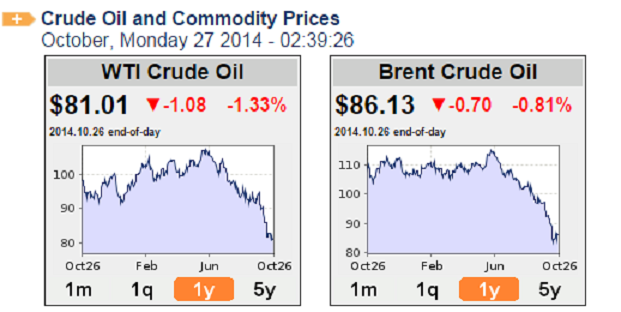
Oil prices have dropped 25% since June and currently WTI crude is at $81 and Brent crude is at $86 – down from around $110 – 115 in June. How far can prices drop and for how long? Of course this depends on supply and demand. But I think there is a new paradigm here and created by the injection of shale oil into the mix. I suspect that shale oil production now establishes a new floor price which means that the prices cannot drop lower than about $60 or possibly even $70. Oil from the traditional, large oil wells can still be produced profitably at much lower prices. But shale oil is more expensive to produce partly due to the costs of fracking but also due to smaller individual wells which last for shorter periods than the large oil wells. This in turn means that there is both a higher investment cost and a higher operating cost for shale oil compared to “traditional” oil. It is thought that as shale oil increases its contribution to the total mix, this production cost will set a floor for all oil at around $60-70 instead of the $30-40 needed for break-even (zero exploration) with traditional oil. The oil companies will maintain profits and dividends by scaling down jobs and their new exploration costs which is the variable they can play with . It is the oil producing countries who will lose tax revenues (offset by increased production – if any).

oil price 2710214 oil-price.net

oil price 27102014 oil-price.net

Goldman Sachs have forecast in a new research report that prices could drop to $70 by the second quarter of 2015.

Reuters 27/10: Brent crude futures fell below $86 a barrel on Monday after Goldman Sachs cut its price forecasts for the contract and for U.S. oil in the first quarter of next year by $15.

The U.S. investment bank said in a research note on Sunday that it had cut its forecast for West Texas Intermediate to $75 a barrel from $90 and that for Brent to $85 from $100, with rising production in non-OPEC countries outside North America expected to outstrip demand.

The bank expects WTI to fall as low as $70 a barrel and Brent to hit $80 in the second quarter of 2015, when it expects oversupply to be most pronounced.

Even Saudi Arabia now seems to have accepted that a regime of low prices will last  1 – 2 years.

Reuters 26/10The recent decline in global oil prices will prove temporary even if it lasts a year or so, since population growth will ultimately bring higher consumption and prices, the chief executive of Saudi Basic Industries Corp said on Sunday.

Mohamed al-Mady was speaking to reporters after the company, one of the world’s largest petrochemicals groups and the Gulf’s largest listed company, reported a 4.5 percent drop in third-quarter net income, missing analysts’ forecasts.

At these price levels for 2 years almost $3 trillion will shift from the “few” producers to the “many” consumers.  But most of this could fuel consumer growth (which it would not do to the same extent when in the hands of the oil producers). The consumer countries will also lose the foreign exchange constraints they must operate under for purchase of oil in US Dollars. It could release monies desperately needed for infrastructure projects. But the consumer countries need the prices to stay low for some time – and I would guess that 2 years is a minimum – for the public funds released to be utilised in “growth” projects.

The EconomistFor governments in consuming countries the price fall offers some budgetary breathing-room. Fuel subsidies hog scandalous amounts of money in many developing countries—20% of public spending in Indonesia and 14% in India (including fertiliser and food). Lower prices give governments the opportunity to spend the money more productively or return it to the taxpayers. This week India led the way by announcing an end to diesel subsidies. Others should follow Narendra Modi’s lead.

Producer countries will be hit. Russia has actually been helped by the fall in the rouble which has cushioned – a little – the rouble values of the dropping oil revenue.

The most vulnerable are Venezuela, Iran and Russia.

The first to crack could be Venezuela, home to the anti-American “Bolivarian revolution”, which the late Hugo Chávez tried to export around his region. Venezuela’s budget is based on oil at $120 a barrel. Even before the price fall it was struggling to pay its debts. Foreign-exchange reserves are dwindling, inflation is rampant and Venezuelans are enduring shortages of everyday goods such as flour and toilet paper.

Iran is also in a tricky position. It needs oil at about $140 a barrel to balance a profligate budget padded with the extravagant spending schemes of its former president, Mahmoud Ahmedinejad. Sanctions designed to curb its nuclear programme make it especially vulnerable. Some claim that Sunni Saudi Arabia is conspiring with America to use the oil price to put pressure on its Shia rival. Whatever the motivation, the falling price is certainly having that effect.

Compared with these two, Russia can bide its time. A falling currency means that the rouble value of oil sales has dropped less than its dollar value, cushioning tax revenues and limiting the budget deficit.

There are a number of other effects of $70 per barrel for oil.

Bio-fuels and bio-diesel, which are fundamentally unsound, have stayed alive on the back of subsidies on the one hand and a high oil price on the other. If the prices stay at $70 for 2 years or longer, land currently being wasted on bio-fuels could revert to food production. With lower fertiliser and transport costs in addition, a great deal of pressure on food prices go away. If the floor price is set by shale oil production costs, it may be too low for oil production from tar sands to take off in any big way. Electricity production costs will be bench-marked against the cost of gas turbine combined cycle plants.

But most importantly, another 2 years or longer with the public spending pressures reduced will allow a number of other countries to get their own shale oil (and gas) production going. And that will make Opec and the oil cartel obsolete. Oil and gas price speculation will no longer be possible.

It could provide the start for a long sustained period – perhaps even a decade or two – with oil prices stable at around $70 per barrel.

Scotland vote is devolving into “yes” for a pink €

August 24, 2014

I am trying from a distance to follow the arguments being aired in Scotland about the joys and sorrows to be expected from a “yes” or a “no” vote in the referendum on independence to be held on 18th September.

Most of the discussions / debates I have heard have just been so much hot air (shades of grey being presented as black or white). The only issue that I have found to be of any real relevance is whether Scotland really wants to become a Euro country or not. If Scotland votes “yes”, it will have to reapply to become a member of the European Union and while that membership will not be delayed too long, an independent Scottish pound will be swamped and Scotland will probably have little chance to avoid entering the European Monetary Union and adopting the €.

Though Alex Salmond seems to be saying that Scotland can continue with the £, that is just wishful thinking and is not within his control. He may still call it the Scots Pound and he could peg it either to the the £ or to the US$. But then it will probably become a target for currency speculation and there will not be enough weight in the Scottish economy to withstand such speculation. As fracking grows in the UK and the North Sea reserves shrink it can only get worse. For a small economy forced to join the €, there are – I think – more disadvantages than there are advantages. And for small countries dependent primarily upon tourism it is worst. Larger economies with large exports have the greatest benefit.

In any event, the Scottish referendum will effectively decide whether it will remain a Sterling country or will join the Euro. And if they decide to join the Euro, they may not have a completely Red Euro but it could well be pink.

Pink Scots Euro

Pink Scots Euro