Archive for the ‘Energy’ Category
September 22, 2012
The fantasy world of subsidies is compounded when the subsidies are for irrational but “politically correct” ends.
Reuters:
U.S. federal policies to promote electric vehicles will cost $7.5 billion through 2019 and have “little to no impact” on overall national gasoline consumption over the next several years, the Congressional Budget Office said in a report issued on Thursday.
Consumer tax credits for buying electric vehicles, which can run as high as $7,500 per vehicle, will account for about 25 percent of the $7.5 billion cost, the CBO said.
The rest of the cost comprises of $2.4 billion in grants to battery makers and projects to promote electric vehicles as well as $3.1 billion in loans to auto companies designed to spur production of fuel-efficient vehicles. …….
Tags:CBO, Congressional Budget Office, Electric car, Electric vehicle
Posted in Alarmism, Automobiles, Energy | Comments Off on Electric cars in the US: $7.5 billion of taxpayers money for “little or no impact” on gas consumption
September 22, 2012
The momentum is now growing fast and it is difficult to keep up with the number of parties coming out in favour of the exploitation of shale gas in Europe. However the self-righteousness behind the “environmental correctness” of the European political establishment will not be overcome without a struggle.
France: Bosses demand shale gas rethink:
BUSINESS leaders have signed up to a call to reopen debate on the extraction of shale gas in France.
The move comes shortly after President Hollande said he will halt exploration during his five-year term and announced refusals of seven oil company applications for drilling permits in the south, because they were thought to be looking for shale gas. …..
UK: IoD: Shale gas could provide 35,000 UK jobs :
The Government is expected to give the green light for more fracking in the UK to access shale reserves within weeks as it publishes a new gas strategy, but energy secretary Ed Davey warned yesterday that it was no “silver bullet”.
The IoD has released a new report on the process this morning which claims there will be an upward revision in the estimate of the size of the UK’s shale gas reserves later this year, up from 5.3 trillion cubic feet. It also suggests there would be “environmental benefits” to using shale gas over coal-fired power plants.
Russia: Gazprom Rethinks Shale as European Gas Prices Sink:
Gazprom has admitted it might yet adjust its attitude towards shale gas, as Russian policy makers assess new dangers to the country’s petro-dollar economy. First, Russia’s Economic Ministry warned that the increasing supply of shale gas on world markets will start hurting Gazprom’s pipeline sales to Europe in 2014. And it seems Gazprom might now be weighing the pros and cons of jumping onto the shale gas bandwagon.
Tags:Europe, Shale gas
Posted in Energy, Europe | Comments Off on Momentum for shale gas builds in Europe
September 22, 2012
The costs of coal fired power generation in Europe have been artificially inflated for some time now by the imposition of various forms of carbon taxes. These taxes and penalties – which are quite arbitrary – serve political and electoral goals and generally pander to the alarmist view of climate change. The electricity consumer has taken the hit.
Bloomberg reports:
Coal Era Beckons for Europe as Carbon Giveaway Finishes
European utilities are poised to add more coal-fired power capacity than natural gas in the next four years, boosting emissions just as the era of free carbon permits ends.
Power producers from EON AG to RWE AG (RWE) will open six times more coal-burning plants than gas-fed units by 2015, UBS AG said in a Sept. 5 research note. Profits at coal-fired power stations may more than double by then, according to a Goldman Sachs Group Inc. report published on Sept. 13.
(more…)
Tags:carbon credits, coal-fired power generation, Electricity generation, European Union
Posted in Alarmism, Energy, European Union | Comments Off on In Europe, coal now offers both lower prices for electricity consumers and higher profits for utilities
September 20, 2012
The solar energy industry is in crisis and I keep reading that it is because subsidies are being reduced or eliminated. As if subsidies come for free. I don’t believe subsidies work and the current crisis only proves that the fundamental issue is not subsidies but that solar energy is not (yet ?) commercially viable. It surely has a place in some very particular situations and the best use of solar energy remains with some isolated users or as a “support” for other energy sources. But for base-load power generation it is just not viable.
Peter Glover writes in the Energy Tribune:
The global solar power industry is in crisis. The industry blames widespread national subsidy cuts and over productivity; China, in particular, being widely vilified on the second count. However, the real cause of the solar industry’s malaise runs deeper, rooted, as it is, in the inescapable fact that, in terms of current technology, commercial scale solar energy remains a non-viable proposition.
(more…)
Tags:Renewable energy, solar energy, subsidies
Posted in Energy, Renewable Energy | Comments Off on Solar Energy is in crisis
August 24, 2012
It is electricity price – rather than energy price – which is I think the more telling parameter for growth and investment. And it is electricity price which matters fundamentally. Winning “brownie points” for being virtuous and politically correct is irrelevant and often counter-productive.
Historically, a low (unsubsidised) electricity price has nearly always given high growth, increased exports to regions with higher electricity prices and an attractive climate to invest in. This simple observation will now lead to my shifting my (small) investments away from Australia for some time – at least as long they continue with their virtuous but meaningless carbon tax. On the other hand, the relatively low electricity prices resulting from the advent of shale gas in the US augur well for the US economy and for US exporters – irrespective of which party the President comes from.
In my own field of power generation I expect a gas turbine combined cycle boom in the US in 2014/15 (which will also be a boom for steam turbine manufacturers). So my message for the next 5 or 6 years is to shift your investments away from Australia (and other virtuous but economically silly countries) and into countries promoting low energy prices (US and other countries where the environmental regulations and tax regimes allow production of electricity at the lowest possible cost).
Sydney Morning Herald:
BHP Billiton head Marius Kloppers has told European investors that Australia’s carbon and mining taxes have helped to render the nation’s coal industry unworthy of further investment at this time. …….
In comments that appeared to be more pointed than those given in his Australian media conference, Mr Kloppers put some of the blame on the federal government’s two controversial new taxes.
”What I am seeing on the eastern seaboard in Australia is that the coal industry has been very heavily impacted by lower prices, higher operating costs, carbon taxes and increased royalties,” he said.
Royalties were increased by the New South Wales government as it sought to exploit a loophole in the federal government’s new mining tax, and a similar tactic is now being considered by the Queensland government. ….
Financial Times:
….. Today, few realise that the US stands on the cusp of significant economic gains stimulated by low energy costs. High quality global journalism requires investment. …..
The consensus view discounts the economic boost from natural gas, arguing that the energy sector cannot generate so many jobs. The doubters wear blinkers; they see nothing but the energy market. They commit the mistake made by forecasters in 1991. They miss the tectonic shifts in trade, ….
(The shale gas) advantage gives manufacturing plants in the US a 60 per cent, 70 per cent or even 80 per cent cost advantage over those operating in China, Japan, South Korea or European countries.
Read more: http://www.ft.com/intl/cms/s/0/09fbb2ac-87b8-11e1-ade2-00144feab49a.html#axzz24QutnD2A
Tags:Australia, Carbon tax, electricity price and growth, investment, Shale gas, US
Posted in Australia, Business, Energy, US | Comments Off on Long term investment: Avoid the carbon taxers (Australia) and follow the shale gas (US)
August 20, 2012
Reality of course is that coal, gas, hydro and nuclear are the cheapest sources of electricity generation and will be with us for some time to come. And there is no need – for the sake of idiotic scenarios of nuclear holocaust and nonsense theories about AGW – to move away from them.
Bloomberg:
Chancellor Angela Merkel’s government says RWE AG (RWE)’s new power plant that can supply 3.4 million homes aids her plan to exit nuclear energy and switch to cleaner forms of generation. It’s fired with coal.
(more…)
Tags:Coal, Coal firing, Electricity generation, EON, Germany, Nuclear power, RWE
Posted in Alarmism, Energy, Germany | 1 Comment »
July 13, 2012
Yet another unwanted consequence of having subsidies in the first place.
First the Spanish Government encouraged a “renewables boom” by providing feed-in tariffs which were obscenely generous (about 4 times higher than the going rate) and irresistible to developers. This was only one of the many acts of profligacy which has led to the current crisis.
And now the Spanish Government is to try and redress the balance by imposing “a levy to spread the expense of closing a gap between costs and revenue in the country’s electricity business, which has racked up debts of 25 billion euros” . Since the largest gap between true cost and revenue is of course with solar and wind plants they will be hardest hit by the levy.
Bloomberg:
(more…)
Tags:energy tax, Renewable energy, subsidies
Posted in Business, Energy, Renewable Energy | Comments Off on Spain to tax renewable energy
July 9, 2012
Recovery of gas and oil from shale is more than just a game changer – it is a mind-changer. The recoverability of oil and gas from shale postpones “peak oil” and “peak gas” indefinitely. For 3 decades we have suffered from the rampant pessimism of the alarmists and the coercive politics of fear. A change of mind-set from pessimistic environmentalism and backward-looking conservationism is called for. A shift of attitude from the joyless “glass half-empty and we are doomed” to the entrepreneurial “glass half-full but can be filled” is over-due.
Resource depletion with usage is a trivial truth – though matter at the elemental level is never destroyed by human use. However utilisation of resources does alter the composition and concentration of materials remaining available. But every alarmist and doom-sayer who has ever lived and has forecast impending catastrophe has been proven spectacularly wrong. Human ingenuity has faced every challenge and trumped the doom-sayers – every time.
The pictures say it all:
The scope of the US oil shale resource
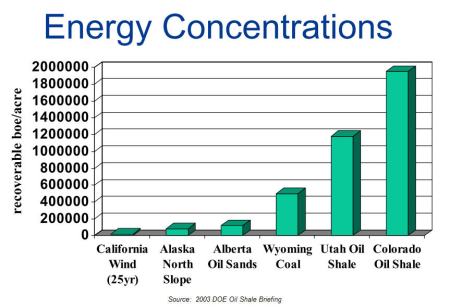
The scope of the US oil shale resource
Related: “Peak Oil” hypothesis is following “Peak Gas” into oblivion

Moving peaks
Tags:"Peak" gas, Business, Energy, oil shale, Peak oil, Resource depletion
Posted in Alarmism, Conservation, Development, Energy, Environment, Gas, Oil, Politics | Comments Off on As with peak gas, peak oil and rampant pessimism need to be postponed
July 6, 2012
I don’t believe in subsidies.
In over 30 years in power generation I have yet to see a convincing case of public subsidies in the market place actually helping to commercialise new technologies. I have seen cases where Government support at the research stage has helped to bring new areas into focus and which has eventually led to commercially driven investments which have deployed the technology. But temporarily distorting the market place by means of public subsidy is unsustainable and does not – in itself – help to make a new technology commercially viable. In fact an artificially distorted market in favour of a new technology only helps to cuccoon and insulate it such that there is no incentive left to make it competitive. Subsidies shift the focus from technology development to subsidy maximisation and when subsidies begin to be removed all creativity is wasted on prolonging subsidies.
The case of subsiding the market place for the deployment of renewable energy is a case in point. Developing technology for wind and solar power is desirable but distorting the market place to deploy wind and solar is just plain stupid and unsustainable.
1. Der Spiegel
Solar subsidies cost German consumers billions of dollars a year and are widely regarded as inefficient. Even environmentalists are concerned that Berlin’s focus on solar comes at the detriment of other renewables. But the solar industry has a powerful lobby, and politicians have proven powerless to resist.
…… A new study by Georg Erdmann, professor of energy systems at Berlin’s Technical University, reveals just how far Germany’s current center-right governing coalition — made up of Chancellor Angela Merkel’s CDU and the business-friendly Free Democrats (FDP) — has strayed from its own self-imposed goals. Erdmann has calculated the effects that the latest changes to the EEG will have between now and 2030. He believes that subsidies for renewable energy, including an expansion of the power grid, will saddle energy consumers with costs well over €300 billion ($377 billion). ….
2. BBC News
Fight on for wind power subsidies
Wind power firms warn they may take the government to court if they get caught in a political row over subsidies. After conducting technical studies, the energy department proposed a subsidy cut of 10% for power from onshore wind. But the chancellor is under pressure from back-benchers to scrap subsidies, and is said to favour a 25% cut.
The industry body, Renewable UK, says it may take legal action if the government makes a decision that overrides its own technical evidence. …
3. GWPF / IVN
California’s Green Suicide
New economic impact study on California’s Global Warming Solutions Act finds that the average California family will end up paying an additional $2,500 annually by 2020. In addition, the state is expected to lose an additional 262,000 jobs, 5.6 percent of the gross state product, and a whopping $7.4 billion through decreased annual state and local tax revenues as a result.
The California Manufacturers and Technology Association released a new report last week that suggests costs associated with AB 32 may be a lot higher than previously estimated. AB 32, otherwise known as the California Global Warming Solutions Act of 2006, was signed into law by Governor Arnold Schwarzenegger- propelling California to the forefront in the fight against global warming. Successful passage of the law effectively turned the state into one of the most stringent regulators of green house gas emissions in the nation and globally. Some would argue that the move all but eliminated California’s competitive edge in today’s market. ……
Tags:Energy, Renewable energy, Solar power, subsidies, technology commercialisation, wind power
Posted in Business, Energy, Politics, Renewable Energy, Technology | 1 Comment »


 The k2p blog