Archive for the ‘Engineering’ Category

Rescue operation in Sea of Okhotsk begins but one icebreaker stuck in the ice…

January 5, 2011
The Russian icebreakers Admiral Makarov and Mo...

Icebreakers Admiral Makarov and Moskva: Image via Wikipedia

The icebreaker Admiral Makarov has reached its destination in the Sea of Okhotsk and the rescue operation to free the ships trapped in the ice has begun. One trawler has been escorted to safety. But there are “hummocks” in the ice which is upto 2 m thick in places. The second icebreaker Magadan is now itself stuck in the ice and the Admiral Makarov is racing to its rescue.

Itar-Tass reports:

VLADIVOSTOK, January 5 (Itar-Tass)The Admiral Makarov icebreaker that took the Mys Yelizavety to the clear waters is now moving at full tilt to help the icebreaker Magadan, which took part in the escorting effort but got stuck in the ice itself. Given that the Magadan, too, has stuck in the thick ice filling the spaces of the Sakhalin Bay, the number of ships drifting amid ice floes towards the shore has again increased to five.

A total of three ships – the Sodruzhetsvo floating factory, the Bereg Nadezhny refrigerating ship, and the Professor Kizivetter, all of them registered in the port of Vladivostok – found themselves stranded in the ice December 30. They are located at a distance of eleven to twelve nautical miles away from Sakhalin’s shore. One more ship, the Anton Gurin trawler registered in St Petersburg, joined the trapped ships January 3.

The Magadan, a port area icebreaker, has the technical characteristics largely inferior to those of the Admiral Makarov. It has a length of 88 meters and a capacity of 13,000 horse-powers. The Admiral Makarov has the length of 135 meters and the capacity for 12,000 horse-powers.

A mass of ice floes has been driven into the Sakhalin Bay by northern winds. The ice is covered with hummocks and its thickness reaches 2 meters in some spots. The total number of seamen trapped by the ice at present stands at around 500. The Sodruzhestvo floating factory has the largest crew of 340 persons.

Qantas A380 flights to LA to restart on 17th January

January 5, 2011

While Qantas had restarted flying its A380 aircraft with Rolls Royce Trent 900 engines on  27th November after the engine failure on 4th November, its flights to Los Angeles remained grounded since the engines had not been cleared for operating at the higher thrust levels necessary for reaching LA.

Reuters reports that flights to LA could now resume on 17th January:

Qantas said on Wednesday it hoped to resume normal A380 operations from January 17 but it would still need the go-ahead from Australia’s aviation regulator before flying the superjumbo aircraft on the lucrative route……. Qantas said on Wednesday it expected to have eight A380 aircraft in the air by early February, up from five currently. The airline is scheduled to take delivery of a new A380 aircraft in mid-January and another new aircraft by early February. A third A380 currently grounded in Sydney was also due to be operating by mid-January……. Analysts estimate damages to Qantas could reach $60 million, although forecasts vary. The LA route is one of Qantas’ most profitable.

For Rolls Royce, getting Qantas back to full operation is critical to bringing this chapter to a close and to limiting at least one part of the inevitable claims that will come. They will also face claims from Airbus who announced a few days ago that they would only deliver 18 A380’s during 2010 and would not reach their already reduced target of 20 planes. This delay is put down to the extra inspections caused by the fault in Rolls Royce engines. No doubt Singapore Airlines and Lufthansa will also have claims on Rolls Royce. I still estimate that the total costs to Rolls Royce will reach $300 million.

Unusually thick ice traps ships in the Sea of Okhotsk

January 3, 2011

Itar-Tass reports that the Magadan icebreaker is struggling through 2-meter-thick ice to reach stuck ships in the Sea of Okhotsk and another ice-breaker is on its way. This reports talks of 3 ships being trapped but other reports speak of 10 ships with over 600 crew being trapped.

Line icebreaker ADMIRAL MAKAROV: image fesco.ru

VLADIVOSTOK, January 2 (Itar-Tass) — The Magadan icebreaker of the Far Eastern Shipping Company is struggling its way through the two-meter-thick ice to rescue three ships stuck in the ice in the Sakhalin Bay of the Sea of Okhotsk, a spokesman for the Yuzhno-Sakhalinsk sea rescue coordination center said on Sunday.

With a speed of 2.6 knots the icebreaker develops in conditions of the 10 point ice, she has to master five miles to reach the stuck ships, the spokesman said.

The Sodruzhestvo mother ship, the Professor Kizevetter research vessel and the Bereg Nadezhdy refrigerated cargo ship are trapped in the ice eleven to twelve miles off the Khabarovsk coastline. Their attempts to break free have been vain ….. According to the Sakhalin regional emergencies administration, there is no threat to the lives and health of crew members of the three ships. Of the three stuck ships, the Sodruzhestvo has the largest crew of 340 people. The ship has food reserves for 75 days.

The Admiral Makarov, the biggest icebreaker in Russia’s Far East, is also heading to join the rescue operations. She is expected to reach the Sakhalin Bay on January 4.

The BBC also carries a report also quoting Itar-Tass but their facts seem to have morphed along the way. Two metres is converted to 12 inches by the BBC calculator!!!!

map

Sea of Okhotsk: image BBC


Rescue efforts are under way to evacuate more than 600 crew on 10 ships trapped in ice in the Sea of Okhotsk. The ice is up to 30cm (12 inches) thick in some places, according to the Russian news agency Itar-Tass.

The temperature in the area is -22C, according to Itar-Tass, and forecasts suggest it will fall even lower.

An Itar-Tass update is here:

http://www.itar-tass.com/eng/level2.html?NewsID=15834220&PageNum=0

488km of high speed railway completed in 2years – must be China

December 30, 2010

Kashi  (Kashgar) and Hotan are major towns on the old Silk Road. To complete 488km of high-speed railway line in just 2 years of construction  – even for China – must be some kind of a record.

From Xinhua News:

kashgar regional map

Kashgar Region: Hotan to Kashi

A railway linking Kashi and Hotan in northwest China’s Xinjiang Uygur Autonomous Region opened Thursday for cargo transportation, and passenger transport is expected to begin in June, according to a local official.

The railway, with a cost about 5.1 billion yuan (773 million U.S. dollars), covers 488.27 kilometers running through the south part of Xinjiang, an important section of the ancient Silk Road. The railroad is expected to have an annual freight volume of 15 million tons, and carry ten passenger trains every day, said Tang Shisheng, director of the Urumqi Railway Bureau. The Kashi-Hotan railway will help promote the development of Xinjiang’ s mining industry, tourism and agriculture, said Tang.

Construction of the railway began in December 2008.

The Ministry of Railways and Xinjiang regional government will invest 310 billion yuan to build more than 8,000 kilometers of railway in Xinjiang during the next 10 years.

EASA eases safety inspections for A380’s Trent 900 engines

December 22, 2010

From the WSJ:

EUAIR1

Agence France-Presse/Getty Images The damaged Rolls-Royce Trent 900 engine and wing section from a Qantas Airways Airbus A380.

European aviation regulators on Tuesday substantially relaxed tight inspection rules covering Rolls-Royce Group PLC engines on Airbus A380 superjumbo jetliners, signaling that safety concerns about the planes are fading. The European Aviation Safety Agency, dropping emergency mandates to inspect Trent 900 engines after every 20 flights, moved to require repetitive inspections of most of the engines after 100 flights. The change is likely to reduce disruption of flight schedules, according to industry officials.

EASA’s move follows intensive inspections of Trent 900s on A380s operated by Qantas, Singapore Airlines Ltd. and Deutsche Lufthansa AG. In its latest directive, the agency said a review of manufacturing and inspection data convinced safety officials that many “lower risk” tubes are less prone to fracture and therefore don’t need such frequent checks.

Lifting the emergency directives so quickly, particularly after such a high-profile and dangerous event, indicates much of the fleet is unaffected by oil-system manufacturing defects.

To further assure the safety of Rolls-Royce-powered A380 jets, European regulators previously also ordered upgrades of Trent 900 electrical systems to prevent engine parts from turning dangerously fast, a condition that can lead to disintegration of spinning disks. Those enhancements already have been incorporated into the A380 fleet.

Problems caused by a manufacturing defect on an oil-supply tube have been blamed for the explosive failure of a relatively new Trent engine on the Qantas jet shortly after takeoff from Singapore. The fault has been found on the current fleet as well as at least one new plane slated for delivery to Qantas, according to industry officials. But on Tuesday, EASA for the first time specifically defined what it considers to be an acceptable minimum thickness for the walls of the tubes.

EASA’s decision also is good news for Qantas and the other carriers that fly A380s with Rolls-Royce engines because those airlines have been concerned about potential schedule disruptions and longer required layovers to accomplish the inspections.

EUAIR2

Australian Transport Safety Bureau report: The Trent 900 engine blew out after the Qantas A380 took off from Singapore on Nov. 4.

It would seem that the initial failings of the Trent 900 have now been found and are being rectified. But it needs a few more months of operation before it can be said that all the “teething” problems of the Trent 900 have been identified and resolved. The costs for the fix – mainly to be borne by Rolls Royce – have still to be added up and will not be finally clear for a few more months.

EASA had also relaxed inspection requirements before the explosion on the Qantas A380 probably in response to representations by the engine manufacturer and /or the airlines. One hopes that their decision to relax inspections this time is not just in response to pressure.

Capitation fees: The stench of corruption in the Indian body academic

December 10, 2010
Varkala in Kerala. India.

Image via Wikipedia

This past week I have been travelling in the southern Indian states of Tamil Nadu and Karnataka.

The growth is palpable and vibrant. But it is chaotic and uncontrolled – and probably uncontrollable, The best that can be hoped for is that movement is in the general direction desired but it is futile to to try and exercise any micro-control. The speed is such that there is no time for consolidation, for reflection, for developing values or standards or for any feedback. Feed forward is the only thing that can keep up.

But in every field of operation – whether construction or government or industry or financial institutions or academia – the stench of corruption is contained under a thin veneer of apparent sophistication. The overpowering fundamental value which gets free reign is greed.

What has become apparent to me is that in spite of many good intentions by government, the shortage of supply in the face of an ever-increasing demand for education has allowed the unfettered growth of  private colleges and universities. But the demand is only used as a vehicle for satisfying greed not for satisfying educational needs.

All degrees and especially post graduate degrees in medicine, engineering and IT related subjects from private colleges in India are granted solely for the payment of a capitation fee.

http://en.wikipedia.org/wiki/Capitation_fee

Capitation fee refers to the unlawful collection of payment by educational bodies in exchange for a seat in the institution. It is also known as donations. This practice is popular in private colleges and universities in India, especially those that grant baccalaureate degrees in Engineering, IT and the sciences. This is an example of institutionalized corruption prevalent in India.The practice goes mostly unnoticed because the board/owners of these institutions hold political/financial powers and also the parents who pay the donations are more than happy to do so.

The Concise Oxford Dictionary defines capitation as follows:

The payment of a fee or a grant to a doctor, school, etc., the amount being determined by the number of patients, pupils etc. Origin (denoting the counting of heads)

The Kerala Self Financing Professional Colleges (Prohibition of Capitation Fees and Procedure for Admission and Fixation of Fees) Act 2004 defines capitation fees as follows.

“capitation fees” means any amount by whatever name called, whether in cash or in kind paid or collected or received directly or indirectly in addition to the fees determined under section 4.

The Supreme Court Judgement in 1993 in the Unni Krishnan Case declared that charging capitation fees was illegal.

But capitation fees are now the only way of  getting a seat in a private college. It guarantees a degree will be awarded. Academic staff  have no say in the selection of students. That selection is reserved for the owners and they usually auction the seats to the highest bidder. Capitation fees are unrecorded, undeclared and paid in cash. Academic standards are irrelevant.

This is not to say that competent engineers and doctors do not exist. But a degree from a private college is an empty thing. It only proves that a capitation fee was paid and is totally silent regarding the capability or competence of the person receiving a degree.

Qantas prepares for legal action against Rolls Royce

December 2, 2010

The Trent 900 fix is not going to be cheap for Rolls Royce. I am still maintaining my estimate that the total cost for the engine manufacturer will be in excess of $300 M.

The Wall Street Journal:

Australia’s Qantas Airways Ltd. Thursday said it has taken measures that would allow litigation against Rolls-Royce Group PLC  if it fails to reach a commercial settlement over the recent failure of a Trent 900 engine powering one of its A380 super jumbos. Qantas confirmed in a statement it is in talks with Rolls Royce over the “financial and operational impacts” of the engine failure.

Also Thursday, the international carrier said it plans fresh inspections on the Trent 900 engines after Australian safety regulators said they have identified a possible manufacturing flaw.

Qantas was forced to ground its fleet of six A380s last month after an engine on board flight QF32 exploded above Batam Island, Indonesia shortly after the airplane took off from Singapore, en route to Australia on November 4. Two of the mega airliners have since returned to service.

The explosion has put U.K., Derby-based Rolls-Royce engines under the microscope as airlines around the world that operate the Airbus A380 run a raft of safety tests. Airbus is a division of European Aeronautic Defence & Space Co.

A statement of claim has been filed by Qantas and an injunction by the Federal Court of Australia granted, ensuring the carrier can pursue legal action if settlement does not emerge, it said in a statement.

Australian safety investigators now believe the cause of the November mid-air drama may have been a manufacturing defect with an oil tube connection on some Trent 900 engines. That problem could cause oil leakage, cracking and possible engine failure from an oil fire, the Australian Transport and Safety Bureau said Thursday.

“The safety recommendation of the ATSB is consistent with what we have said before. We have instituted a regime of inspection, maintenance and removal which has assured safe operation. This programme has been agreed in collaboration with Airbus, our airline customers and the regulators,” a Rolls-Royce spokesman said.

Singapore Airlines, Lufthansa and even Airbus (EADS) can have claims on Rolls Royce and all may well have to resort to legal action to reach settlements. Qantas and Airbus have the greatest potential claims. Whether Rolls Royce knew about defects in advance of the accident on QF32 will be a key issue to determine if the engines delivered by Rolls Royce were actually “fit for service”. If the engines were not “fit for service” it opens the door to an even greater levels of claims on Rolls Royce.

“Critical safety issue” with Trent 900 could lead to “catastrophic failure”: Qantas to make further inspections

December 2, 2010

The Australian Transport Safety Bureau has determined that there is a “critical safety issue” with the Rolls Royce Trent 900 used on the Qantas A380 aircraft which could lead to a “catastrophic failure”. Qantas has been ordered to carry out further inspections.

AFP reports:

The Australian Transport Safety Bureau said a misaligned component had thinned the wall of an oil pipe in the exploded engine, causing “fatigue cracking” that prompted leakage and a fire “central to the engine failure”. “This condition could lead to an elevated risk of fatigue crack initiation and growth, oil leakage and potential catastrophic engine failure from a resulting oil fire,” the ATSB said, noting it was “understood to be related to the manufacturing process.”

The Bureau issued a directive urging Rolls-Royce to “address the safety issue and take actions necessary to ensure the safety of flight operations in transport aircraft equipped with Rolls-Royce Trent 900 series engines.” Qantas said it would immediately conduct further engine investigations as a result of the findings, but stressed it was just a precautionary measure and “there is no immediate risk to flight safety.”

“Qantas currently has two A380 aircraft in operational service, following the grounding of the fleet on 4 November. Both A380 aircraft will be inspected at the Qantas Jet Base in Sydney,” the airline said. “Inspections will commence this afternoon.”

The flagship carrier said it would determine whether further action would need to be taken after inspections were complete and it had consulted both Rolls-Royce and regulators. “Qantas does not anticipate at this stage that the inspections will have an impact on international services. However contingency arrangements will be in place, if needed,” it said.

The findings come just five days after Qantas resumed A380 flights, though the carrier has barred the superjumbo from trans-Pacific trips to Los Angeles due to the extra engine thrust required. It had grounded all six of its Airbus superjumbos after the November 4 blast over the Indonesian island of Batam, which forced an A380 to return to Singapore airport trailing smoke.

Checks revealed problems with 16 of the total 24 Rolls-Royce Trent 900 engines powering Qantas’s A380s — four per plane — meaning the turbines would have to be replaced or modified.

Qantas chief Alan Joyce on Saturday said he was “100 percent comfortable” with the A380s’ operation.

As reported by the WSJ, Qantas has already said that they will be claiming compensation from Rolls Royce.

A380 resumes flying but Qantas has another engine failure on a B747

November 27, 2010

http://www.news.com.au/travel/news/grounded-jet-mars-return-of-airbus-a380/story-e6frfq80-1225962092705#ixzz16VrjhJ7P

As Qantas staged a major PR exercise to mark the return of its A380 fleet to service, another plane from Sydney, a 747, was grounded last night with engine failure.

The flight, QF1 from Sydney to London, was due to leave at 6.05pm – but passengers were pulled off the plane after a loud noise emanated from the engine while they were taxiing towards the runway. The flight was later cancelled.

Earlier, passengers watched as Qantas CEO Alan Joyce staged a media conference to assure the public the company was now “100 per cent confident” A380 planes were safe. But while passengers on the A380 flight to London got away on time, passengers on board flight QF1 to London via Bangkok were pulled off their flight because of an engine fault.

The passengers disembarked about 7pm and were given meal vouchers, while engineers examined the engine. But at 9pm they were told the flight was cancelled. It was expected to leave at 9am today.A passenger on the plane told The Sunday Telegraph he could hear the engine die. “We were on the tarmac and then the captain said there was a mechanical problem; he said there was an electrical fault and that every time they tried to start the engine up it cut out,” he said. “We sat for 45 minutes and then they took us off the plane.”

The captain of yesterday’s flight, David Evans, who was part of the cockpit crew onboard flight QF32, said as “a precaution” Qantas had decided to use “reduced thrust” on the engines for the initial flights.

Airbus vs. Boeing: or a tale of the marketing of delays and engine problems

November 26, 2010

For large, complex, expensive, high-technology products (airplanes, turbines, power plants or ships for example) it is usually not worth indulging in too much negative marketing based on a competitor’s technical difficulties. Early technical difficulties and “teething” problems are common and when a competitor has difficulties it usually leads to some feeling of satisfaction but it is tempered by the knowledge that one could easily suffer similar difficulties. So when GE experiences some problem with its gas turbines or Areva has delays in its nuclear plants there will never be an overt, negative marketing campaign by Siemens against GE or by Westinghouse against Areva.

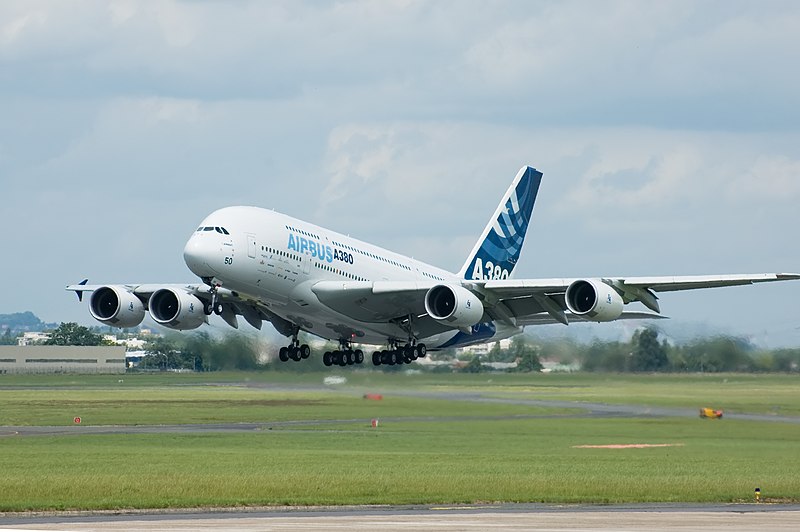
File:Airbus A380.jpg

A380: image wikipedia

And this is the current situation between the Airbus A380 and Boeing’s 787 Dreamliner. The A380 had its share of delays and was over 2 years late in coming into service. Right now the troubles that Rolls Royce are having with their Trent 900 engines is not helping the A380 image. (There are only two engines available for the A380 but it is noteworthy that the General Electric / Pratt & Whitney Alliance which manufacture the GP7200 engine which competes with the Trent 900 are not indulging in any overt negative marketing). The “Rolls Royce effect” for Airbus is currently negative because of the Trent 900 issues but it is indirectly mitigated by the reports of delays in developing the Trent 1000 which is one of the engines for Boeing’s 787.

File:Boeing 787first flight.jpg

B787 First flight: image Wikipedia

As Airbus fights to get airlines to accept the A380 their “best friend” strangely is the delays to the B787 Dreamliner program. The Dreamliner has been further delayed by an electrical system fault which caused a fire on a test flight in early November. For an airline the decision of choosing between Boeing and Airbus has become not one of comparing the advantages each has to offer but instead one of judging the risk exposure that a choice may bring. It becomes a comparison of potential “downsides” and risk mitigation possibilities rather than selecting between potential “upsides”.

For Airbus and Boeing, their sales processes now have to emphasise the risk mitigation available with their products rather than promoting all the advantages their products have to offer. This is unusual for a “sales process” but nothing new in the history of marketing of technologically new products. But it is not so easy for corporations, their salesmen and for sales processes to shift from promoting advantages to the much more difficult task of showing that the risks (whether of delay or of technical difficulties) they pose are less than that of the competitor. Even in terms of financing, the usual offers of financing and leasing packages for the customer must now additionally address the mitigation of financial and consequential exposures in the event that a risk materialises. When a single A380 costs around $320 million, a Boeing 747-400 about $250 million and a Dreamliner has a price tag of $150 -200 million, then downtime and delays have enormous financial consequences for the customer. Marketing strategy for new products in the face of heightened risk perceptions is quite different to the marketing of “tried and tested” products. But this is a fascinating marketing challenge!

The latest reports of delays to the Dreamliner has led to harsh words about Boeing from a potential customer. CityAM reports:

QATAR Airways has threatened to hand extra business to European aircraft giant Airbus after attacking Boeing over problems with its new 787 Dreamliner. Chief executive Akbar Al Baker said the airline was considering increasing its order for five Airbus A380 super-jumbo planes and might order a re-engined version of the A320 single-aisle jetliner. He did not say how many more A380s it might order.

Qatar has expanded its fleet from four to 94 aircraft in 13 years and has orders for 200 more from Airbus and its US rival Boeing worth $40bn, including 30 Dreamliners. Al Baker said Boeing had “failed” in developing its 787 Dreamliner, which is expected to suffer further delays following a fire on a test flight.

Boeing’s development of the carbon-composite 787 is running around three years late and brokers expect a further delay as it addresses the cause of a fire which led to the test flight being grounded two weeks ago.

But I would expect that there is a strong element of price negotiation in Qatar Airways’ statement!