Archive for the ‘Environment’ Category
August 24, 2011
Man-made carbon-dioxide emissions are of little significance in the global concentration of carbon dioxide in the atmosphere and the effect of carbon dioxide concentration on global climate is of even less significance. In fact it is much more likely that CO2 concentrations in the atmosphere follow global temperature rather than the other way around.
Nevertheless there are perceptions of fossil fuel fired power plants being terribly polluting and of being the dominant source of man-made emissions while hydro-power plants are perceived as being totally non-polluting. These perceptions are mainly based on pre-determined political positions and not necessarily on measurements or reality.
A new study from Brazil looking at the impact of hydro power plants and the Balbina dam has been published in the Journal of Geophysical Research. One caveat of course with many such studies is that it is not based on measurements but on some measurement followed by hypotheses built into computer models. Nothing wrong with that of course but the weakness with many model results – as with climate models – is that the results can neither be verified or dis-proved by measurements.
Kemenes, A., B. R. Forsberg, and J. M. Melack (2011), CO2 emissions from a tropical hydroelectric reservoir (Balbina, Brazil), J. Geophys. Res., 116, G03004, doi:10.1029/2010JG001465
Swedish Radio P1:
Electricity from hydropower can lead to several times the emissions of greenhouse gas emissions than produced from fossil fuels. At least from hydro-electric dams in the rain forest areas, according to a new study from Brazil.
The Balbina dam, which was built fifteen years ago, is located north of Amazonas state capital Manaus. When the rain forest area here was flooded large amounts of organic material ended up at the bottom of the pond. Rotting vegetation then caused large emissions of carbon dioxide and methane. According to this study this corresponded to three tonnes of carbon dioxide per megawatt-hour of energy produced, which is almost ten times that of a coal-fired power plants, and just over half of the emissions from burning fossil fuels in the city of São Paulo.
A recently published study of 85 hydroelectric dams in the world shows that emissions vary between different ponds, depending on size, age and what kind of soil is soaked. How big emissions Swedish hydroelectric dams produce has not yet been studied, but estimates indicate that they are significantly lower than from those in tropical areas in Brazil says Professor Philip Fernside of Instituto Nacional de Pesquisas da Amazônia (INPA) in Manaus. “It is true that dams in tropical areas such as the Amazon produces more than ponds in temperate climate, but there are emissions in these areas also” says Philip Fernside.
A pdf version of the paper is here.
Tags:carbon dioxide, emissions from hydro plant, fossil fuel power plant, Hydro power plant, Journal of Geophysical Research
Posted in Brazil, Energy, Environment | 1 Comment »
June 7, 2011
A new paper studying forest area and the density of forests by researchers from the University of Helsinki, the US Forestry Department and Rockefeller University:
A National and International Analysis of Changing Forest Density
by Aapo Rautiainen, Iddo Wernick, Paul E. Waggoner,Jesse H. Ausubel, Pekka E. Kauppi
doi:10.1371/journal.pone.0019577 pdf
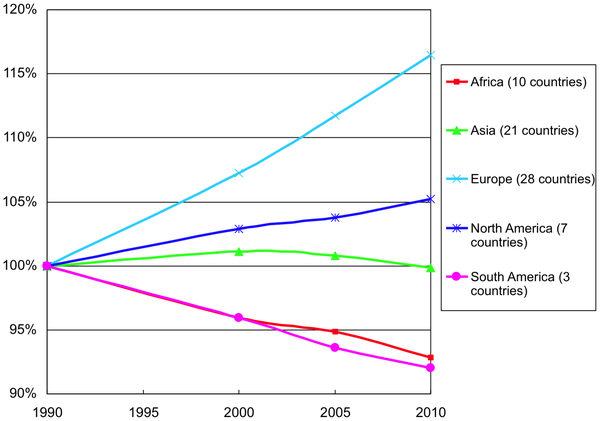
Carbon mass by region 1990–2010.
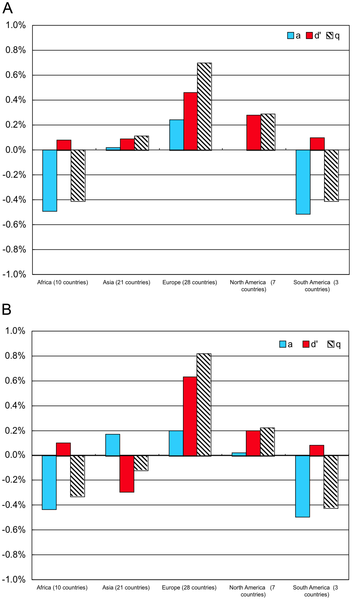
Annual change in forest area a, carbon density d′, and carbon mass q by region (a) 1990–2000 (b) 2000–2010.
The density of forests and woodland across much of the world is actually increasing
In countries from Finland to Malaysia, the thickening has taken place so quickly that it has reversed the carbon losses caused by deforestation between 1990 and 2010. In Britain, forest density has increased by 10.8 per cent from 2000 to 2010 and by 6.6 per cent across the whole of Europe. Even South America and Africa, which have suffered deforestation because of logging and farming, have recorded increases in forest density of 0.8 per cent and 1.1 per cent respectively. The research, carried out by teams from the University of Helsinki and New York’s Rockefeller University, shows that forests are thickening in 45 of 68 countries, which together account for 72 per cent of global forests. Traditionally, environmentalists have focused their concern solely on the dwindling extent of forested areas, but the authors believe evidence of denser forests could be crucial in reducing the world’s carbon footprint. Professor Pekka Kauppi of Helsinki University, a co-author of the study, said: ‘People worry about forest area, and that’s quite correct. But if you want to know the carbon budget, it cannot be monitored observing only the changes in area. It is more important to observe this change in forest density.’ Aapo Rautiainen, lead author of the report, also based at Helsinki University, said: ‘The reversal occurred in Europe much earlier, then a little bit later in North America, and it has now spread to certain parts of Asia. So that is a positive sign.’ In China, an ambitious reforestation programme has added three million hectares to the country’s forests every year over the past decade, but green campaigners believe this is predominantly composed of one species – eucalyptus.
Tags:carbon sequestration, Deforestation, forest cover, Forest density
Posted in Agriculture, Alarmism, Environment, Science | 1 Comment »
May 11, 2011
Reality is based on what people do and not on what do-gooders, alarmists and scaremongers say.
Svenska Dagbladet reports that:
Small companies ignore the environment
Sweden’s small-and medium-sized companies are primarily looking for quality and price when making purchases. The environment is least important according to the Visma Purchase Barometer, and low price is the most important. Environmentally friendly products are usually slightly more expensive and are at a disadvantage when companies chase low prices. Only 1.5 percent of Sweden’s small and medium-sized enterprises consider the environment as the most important criterion when making purchases. Quality and price are the most crucial according to the Visma survey of more than 1600 small and medium-sized businesses.
But 1.5 percent is still a remarkably low figure given that climate change has been so hot the last few years”, says Henrik Salwen, CEO of VismaAdvantage. The companies were asked to specify one of six criteria and Quality was the most important followed by price and punctual delivery. The environment was the least important.
Tags:buying criteria, environment, Price, Quality, Sweden
Posted in Behaviour, Environment, Sweden | Comments Off on Reality: Quality and price are the buying criteria, not the environment
May 11, 2011
It has been obvious for years that many environmental groups such as Greenpeace, Friends of the Earth and even the World Wildlife Fund have been hijacked by “activists” to become political advocacy groups. They have all done some good in the past in the name of protecting the environment, and some of their individual projects are still admirable but for the most part they have lost sight of humans within the environment. They have all generally crossed the line and gone over to trying to impose their world view onto others. Alarmism and prohibition and “authoritarianism” rather than persuasion have become their main tools. Good science has often been replaced by scare-mongering.
But in New Zealand there is a small glimpse of sanity returning and for these political advocacy groups being seen for what they are. The New Zealand Herald reports:
Greenpeace loses charity status case
Greenpeace New Zealand’s political activities mean it cannot register as a charity, the High Court has decided.
Greenpeace appealed against a 2010 ruling by the Charities Commission which found its promotion of “disarmament and peace” was political rather than educational and while it did not directly advocate illegal acts, Greenpeace members had acted illegally.
In his judgment Justice Paul Heath found the commission was correct in its judgment and turned down the Greenpeace appeal.
“Non-violent, but potentially illegal activities (such as trespass), designed to put (in the eyes of Greenpeace) objectionable activities into the public spotlight were an independent object disqualifying it from registration as a charitable entity,” the judge said.
Greenpeace’s pleas for disarmament and peace could be seen as an independent purpose and its political activities were not necessary to educate members of the public on the key issues of Greenpeace, Justice Heath said. Greenpeace’s lawyer Davey Salmon argued all of the organisation’s primary purposes were charitable and the engagement of charities in political advocacy was more acceptable now in 21st century New Zealand.
johnosullivan.livejournal.com comments:
In a story making headlines in the New Zealand Herald (May 10, 2011) climate skeptics around the world will now be consulting lawyers in their respective countries to assess whether similar legal challenges may be made against the disgraced former charity.
In the U.S and Britain environmentalist activists have for decades sought to influence policymakers by a swath of unlawful protests often involving criminal damage and trespass. Several prominent UN climatologists have long aligned themselves with and been apologists for the radical and unlawful acts of these environmentalists.
As a consequence of the shock New Zealand ruling Greenpeace’s political activities mean it will be de-registered as a charity and thus lose the prestige and tax advantages associated with that status.
NASA’s problematic climatologist, James Hansen, flew to London to be an ‘expert witness’ to testify in the defense of climate activists prosecuted for such crimes. Hansen flew to the UK in the case of the “Kingsnorth Six”, who had climbed up E.ON’s coal plant. The six had used Greenpeace’s climate change defence – that their actions were designed to prevent immediate harm to human life and property from climate change – and were acquitted.
Tags:advocacy groups, Charities Commission, charity, Friends of the Earth, Greenpeace, World Wildlife Fund
Posted in Alarmism, Behaviour, Environment, New Zealand, Politics | 2 Comments »
April 26, 2011

Image via Wikipedia
From The Telegraph:
Fears have been reignited about the safety of energy saving light bulbs after a group of scientists warned that they contain cancer causing chemicals.
Their report advises that the bulbs should not be left on for extended periods, particularly near someone’s head, as they emit poisonous materials when switched on. Peter Braun, who carried out the tests at the Berlin’s Alab Laboratory, said: “For such carcinogenic substances it is important they are kept as far away as possible from the human environment.”
The bulbs are already widely used in the UK following EU direction to phase out traditional incandescent lighting by the end of this year. But the German scientists claimed that several carcinogenic chemicals and toxins were released when the environmentally-friendly compact fluorescent lamps (CFLs) were switched on, including phenol, naphthalene and styrene. Andreas Kirchner, of the Federation of German Engineers, said: “Electrical smog develops around these lamps. “I, therefore, use them only very economically. They should not be used in unventilated areas and definitely not in the proximity of the head.” ……
The latest report follows claims by Abraham Haim, a professor of biology at Haifa University in Israel, that the bulbs could result in higher breast cancer rates if used late at night.
He said that the bluer light that CFLs emitted closely mimicked daylight, disrupting the body’s production of the hormone melatonin more than older-style filament bulbs, which cast a yellower light.
The Migraine Action Association has warned that they could trigger migraines and skin care specialists have claimed that their intense light could exacerbate a range of existing skin problems.
Tags:Compact fluorescent lamp, Incandescent light bulb
Posted in Alarmism, Energy, Environment | 2 Comments »
April 20, 2011

Image via Wikipedia
In the style of E Belfort Bax in his book “Courage” from 1890 I take courage to be “the subordination of fear to purpose”. On this line connecting fear and actions then cowardice is when fears dominate the actions and “purpose” is subordinated.
Once upon a time, the environmentalists were a courageous lot and were surely instrumental in the cleaning up of many areas from the effects of real pollution (smoke, dust, wastes, sulphur dioxide, carbon monoxide, nitrous oxides, food additives …..). But the simple virtues of keeping things clean and preventing disease and improving the standard of living for humans has given way to the more pompous and pretentious goals of preventing global warming (an unbridled arrogance), of maintaining bio-diversity (and why is this important?) and of preserving “scarce resources due to the “limits to growth” (with scare scenarios of “peak” oil, “peak” coal, food shortages, water shortages, metal shortages and so on). The environmental movement has become a mish-mash of “do-gooders”, amateur scientists and cult members whose primary weapon has become an imposition of draconian measures for uncertain goals. A sort of eco-fascism.
These goals have even become an acceptable political line and have led to what can only be called the politics of alarmism where fears – and most are imaginary fears – dominate all actions. These fears can never be disproved because they always lie a few generation in the future. But they lead to a world where the emphasis has shifted to telling people what not to do (ostensibly for their own good) because of some fear or the other rather than to having goals for the uplifting of living standards and the actions to be taken in spite of the fears that may exist.
Inevitably the politics of alarmism are accompanied by the opportunists whose greed leads to all the scams surrounding environmental subsidies for renewable power or for carbon trading. But similar scams would appear with any line of politics and I don’t think that the environmental scamsters are any worse than the real estate bubble developers or the sub-prime mortgage supporters or the inside traders or the operators of Ponzi schemes. These scams just reflect the state of ethics that prevail and are not particularly tied to any specific politics.
But I find it a pity that the simple goals of cleaning up the world we live in has given way to the environmentalism of today which generates the politics of alarmism – which is not just a political line without courage – but actually becomes a line of cowardice when it seeks to impose limitations on what others may not do.
Related: “The Red Badge of Courage” in Essence of a Manager
Tags:Courage, Environmentalism, Fear
Posted in Alarmism, Environment | 4 Comments »
February 14, 2011
With easy money like this floating around and waiting to be siphoned off it is not difficult to see why the global warming fraud continues! And of course these $5.5 billion are small change compared to the amounts that have been scammed in Europe.
And to make it worse, carbon dioxide emissions are a little less than insignificant for global temperatures.
The Sydney Morning Herald:
Billions blown on carbon schemes
SUCCESSIVE federal governments have spent more than $5.5 billion over the past decade on climate change programs that are delivering only small reductions in greenhouse gas emissions at unusually high costs for taxpayers and the economy.
An analysis by the Herald of government schemes designed to cut emissions by direct spending or regulatory intervention reveals they have cost an average of $168 for each tonne of carbon dioxide abated. ……
The analysis of 17 programs with a total cost of $5.62 billion shows many of the schemes are at odds with the goal of tackling climate change at the lowest cost to the economy. ………
The weighted average cost of the 17 programs was $168 a tonne. They will deliver about 25 million tonnes of carbon abatement in 2020 – less than 10 per cent of that needed to meet the government’s target of reducing emissions in 2020 by 5 per cent on 2000 levels.
The worst offenders have included Labor’s rebates for rooftop solar panels, which cost $300 or more for every tonne of carbon abated, and the Howard government’s remote renewable power generation scheme, which paid up to $340 for each tonne.
Read the article.
Tags:Australia, carbon trading scams, climate, climate change, Emissions trading, Greenhouse gas
Posted in Alarmism, Australia, Climate, Environment, Scientific Fraud, Weather | Comments Off on Carbon dioxide rip-off has cost Australia $5.5 billion – so far
February 12, 2011
Weather (and climate) which are contained within the thin chaotic layer around the earth’s surface are very far away from being “settled science” in spite of what Al Gore and those of his ilk like to pretend.
Unmanned aircraft are now being used in a new programme to study the “atmospheric rivers” which transport vast quantities of rain around the globe.
They’re called atmospheric rivers – narrow regions in Earth’s atmosphere that transport enormous amounts of water vapor across the Pacific or other regions. Aptly nicknamed “rivers in the sky,” they can transport enough water vapor in one day, on average, to flood an area the size of Maryland 0.3 meters (1 foot) deep, or about seven times the average daily flow of water from the Mississippi River into the Gulf of Mexico. The phenomenon was the subject of a recent major emergency preparedness scenario led by the U.S. Geological Survey, “ARkStorm,” which focused on the possibility of a series of strong atmospheric rivers striking California – a scenario of flooding, wind and mudslides the USGS said could cause damages exceeding those of Hurricane Katrina in 2005.

NASA's Global Hawk soars aloft from Edwards Air Force Base, Calif., on a functional check flight of the WISPAR aircraft payload system and science instruments. Credit: NASA Dryden Flight Research Center
While atmospheric rivers are responsible for great quantities of rain that can produce flooding, they also contribute to beneficial increases in snowpack. A series of atmospheric rivers fueled the strong winter storms that battered the U.S. West Coast from western Washington to Southern California from Dec. 10 to 22, 2010, producing 28 to 64 centimeters (11 to 25 inches) of rain in certain areas. The atmospheric rivers also contributed to the snowpack in the Sierras, which received 75 percent of its annual snow by Dec. 22, the first full day of winter.
To improve our understanding of how atmospheric rivers form and behave and evaluate the operational use of unmanned aircraft for investigating these phenomena, NASA scientists, aircraft and sensors will participate in a National Oceanic and Atmospheric Administration-led airborne field campaign slated to begin Feb. 11.
Called Winter Storms and Pacific Atmospheric Rivers, or WISPAR, the field campaign, which continues through the end of February, is designed to demonstrate new technology, contribute to our understanding of atmospheric rivers and assist NOAA in potentially conducting offshore monitoring of atmospheric rivers to aid in future weather predictions.
Read original article.
Tags:atmospheric rivers, climate, Dryden Flight Research Center, NASA, Rivers in the sky, unmanned aircraft, weather
Posted in Climate, Environment, Science, Weather | Comments Off on Rivers in the sky
February 6, 2011
In India, planned blackouts are used commonly for the management of electricity load. Delhi is used to regular black-outs and there is is no likelihood in the near future that the availability and quality of electric power will be sufficient to eliminate this system of load management. There is no office or shopping mall or large home in Delhi which does not plan for this by installing diesel generators as back-up. Smaller households or those which cannot afford generators use inverters which are sufficient for lighting and perhaps a fridge during an outage but cannot supply enough power for long enough for any air-conditioners or any heating. Even when power is available, the voltage variation is so large that virtually all electrical equipment must be protected by voltage stabilisers.
The black-outs in Delhi occur most often at peak times (around breakfast or dinner) and commonly at night during low load when equipment is shut off for maintenance to be carried out. Unplanned outages are apt to occur at any time. It is on summer nights that the sounds of Delhi are drowned by those of generators cutting in to keep air-conditioners running. There is no possibility of sound regulations being implemented to limit this noise and for those who have difficulty to sleep there is no alternative but to sound-proof their bed-rooms or to use ear-plugs.
The quality and reliability and availability of electric power in the more developed countries (Europe, Japan, US) is often quoted as the target for the Indian power generation and distribution system to aspire to.
But it seems that the US grid is now so weak that parts of Maryland and Washington are beginning to sound like Delhi. The Wasington Post reports:

Blackouts 2010 in Maryland and Washington
In Pepco territory, blackouts mean more home generators, more noise complaints
For Arthur Bennett, blackouts now come with a soundtrack.When last month’s “thundersnow” knocked out power in Bennett’s Montgomery County neighborhood, the preindustrial hush inside his house – when even the refrigerator seemed to hold its breath – soon gave way to the two-stroke roar of engines up and down his block.
Bennett, like many residents of Pepco‘s service area in Maryland and the District, has concluded that blackouts are likely to get even louder as the utility’s fed-up customers turn increasingly to backup power. According to retailers and electricians, home generator sales are booming in the area Pepco serves, especially since the company has been plagued by repeated, prolonged outages
over the past few years. Portable generators sold out at several home stores after the latest storm, and installers report that sales of high-end whole-house units have skyrocketed.
Jim Holt of Gaithersburg’s Holt Electrical said his sales of home generators have been climbing steadily and reached a near “level of panic” after the last blackout – mainly on Pepco’s turf. …….
…………. One thing both generator owners and their juiceless neighbors can agree on is the frustration of having to debate this issue at all. “I really think it’s kind of scandalous that in the capital of the world, we’ve got third-world reliability for electric power,” said Larry Posner of Shepherd Park in Northwest.
Read the entire article.
Tags:Delhi, Diesel generators, Maryland, Noise, Pepco Holdings, Power outage, Washington DC
Posted in Energy, Environment, Urban Living, US | Comments Off on Maryland and Washington begin to sound like Delhi
February 4, 2011
That wind power generating capacity is intermittent capacity and cannot be relied upon is obvious but sometimes escapes notice in the enthusiasm for “renewable energy”. That wind power must be backed up by other more reliable generating capacity for the periods when winds are too low or too high or when the weather is too cold is also often glossed over. That wind power must be used when the wind does blow irrespective of level of demand and thereby displace more stable power (thus rendering it more expensive) is an inevitable consequence.
The following report comes as no surprise.
METEOROLOGICAL MUSINGS reports:
The Electric Reliability Council of Texas said 7,000 megawatts of generating capacity tripped [“tripped” means failed]Tuesday night, leaving the state without enough juice. That’s enough capacity to power about 1.4 million homes. By rotating outages, ERCOT said it prevented total blackouts.
“We have the double whammy of extremely high demand, given the lowest temperatures in 15 years, combined with generation that’s been compromised and is producing less than expected or needed,” said Oncor spokeswoman Catherine Cuellar. Oncor operates power lines in North Texas and facilitated the blackouts for ERCOT.
The article didn’t give a clue as to what generating capability failed, but I can make a pretty good guess: Wind energy…
For a time, Texas was bragging about being the #1 state for “wind power” (it still is) and we were bombarded with TV commercials and newspaper editorial touting the “Pickens Plan” for massive spending on wind energy. Pickens himself was building a huge wind farm in northwest Texas. He has now ceased construction.
Now, because of relying so much on wind power, the state is suffering blackouts.
Tags:Electricity generation, Rolling blackouts, Texas, wind power, Wind power failure
Posted in Energy, Environment, Technology, US, Wind power | 5 Comments »


 The k2p blog