Archive for the ‘Europe’ Category

Preventing extremism: Why stop European jihadists from going to Syria?

June 8, 2014

The Financial Times (paywalled) reports that “Western intelligence agencies have handed Turkish authorities the names of nearly 5,000 people they fear are attempting to travel to Syria to join al-Qaeda linked groups, in a stark illustration of the escalating terror threat posed by homegrown jihadis”.

Turkey has already deported between 1,000 and 2,000 “jihadists” back to their home countries in Europe where they then become a virulent threat.

DailyBeast: It is a scenario that counter-terrorism experts have been warning about for the past two years: a European citizen who travelled to Syria in order to join up with jihadist groups returns to Europe in order to carry out a terrorist attack. It is something we all knew eventually would become a reality and, more worryingly, knew we could not prevent.

“Moderate Islam” in European countries is conspicuous by its complete absence in holding back the extremists and the idiot fanatics. I have no doubt that most Muslims are moderate. But they have been too passive for far too long against their own extremists.  In Europe, in Africa and even in China. They have – for example – allowed the extremists to take over parts of the school system in Birmingham in the UK. But it is not just “moderate Islam” which has abdicated its responsibilities. The political establishment in Europe (mainly) has to take its share of the blame. Political correctness in Europe involves allowing all fanatics and extremists – whether from the neo-Nazis as in Ukraine or Greece or from the religious Islamic fanatics in France and the UK or from the ecofascism of the hard-left green activists – to flourish unchecked.

But I wonder why the intelligence agencies don’t just let these jihadists reach Syria? Why warn Turkey and then have them all deported back to carry out their mayhem? If the US could revoke Snowden’s passport while he was travelling, surely it would be most effective for the US and EU countries to merely revoke those of the 5,000 known to be on their way to Syria? And concentrate on preventing their return? Like it or not, in the current situation Bashar al-Assad could be best equipped to handle these fanatics.

In the long run of course the alienated youth who are then radicalised have to be addressed at home. And the best bet is if “moderate Islam” is encouraged to defuse and neutralise their idiot fanatics. The position of the political centre defines the extremes. A passive centre allows the political spectrum to be skewed towards one extreme or the other or even to reach a bifurcation. The way to prevent unacceptable extremism lies then, I think, not in trying to prevent the extreme views from forming (which is futile) but in having a sufficiently pro-active centre which effectively starves the extremists of recruits.

Swedish Foreign Minister warns of the “Balkanisation of Britain”

June 5, 2014

Carl Bildt was once Sweden’s Prime Minster and was the UN’s envoy to the Balkans and is now the Foreign Minister. Not uncontroversial since he has many business interests ranging from Russia to Africa but generally radiates confidence and competence with a not insignificant measure of arrogance.

For a Foreign Minister he can be quite undiplomatic at times (not that it is always wrong to be undiplomatic). He has now poked his nose into the Scottish referendum and warns of the Balkanisation of the UK if Scotland decides to vote for Independence. He has a point of course. It would only be a matter of time before Wales, Ulster, the Channel Islands –  but perhaps not the Falklands – would all choose to go their own separate  ways into insignificance:

The Scotsman: SWEDEN’S foreign minister has claimed that Scottish independence would lead to the ‘Balkanisation’ of Britain.

 Carl Bildt also warned that a Yes vote would have ‘far-reaching consequences’ for the rest of Europe, in comments that echoed those made by former UK Defence Secretary Lord Robertson, in which he claimed that Scottish independence would have ‘cataclysmic’ geopolitical consequences.

Mr Bildt told the Financial Times that there would be ‘unforeseen chain reactions’ in Europe and the United Kingdom if Scotland voted for independence on September 18th.

The former UN special envoy to the Balkans between 1999 and 2001 said: “I think it’s going to have far more profound implications than people think. The Balkanisation of the British Isles is something we are not looking forward to.

“It opens up a lot, primarily in Scotland but also in the UK. What are the implications for the Irish question? What happens in Ulster?”

Mr Bildt also hinted that a victory for the Yes campaign could lead to the UK having to renegotiate some of its own EU membership terms. 

“The vote is one thing,” he added. “But there will then be a fairly painful period of separation and how is that going to affect the EU relationship? I assume there will have to be renegotiation of votes.” ……….. 

………… He likened the UK to ‘an island adrift in the Atlantic’ if it left the EU.

And the Swedish politician commented that both the EU and independence referendums showed that the debate in Europe was in the process of moving away from the Eurozone crisis to a more political phase.

“The main challenges in the past five years have been economic ones,” he explained. “Looking ahead for the next five years, it is political challenges in the east fairly obviously and also in the west fairly obviously.”

Israel is not immune from the neo-Nazi disease

May 12, 2014

Most countries in Europe have an enormous guilt complex – both singly and collectively – over the persecution of Jews in their countries for many hundreds of years and the indifference to what was happening in Germany which allowed Hitler’s Holocaust to take place. This persecution started at least 2,000 years ago but was organised  and well established by the time of the First Crusade in 1096 as the European nation-states developed and practiced enforced conversions. The Spanish Inquisition in 1478 was primarily directed at Jews (and Muslims) forced to convert to Catholicism. Much of this guilt now devolves to the credit of the nation-state of Israel even though this nation-state exists only as a consequence of  a very successful terrorist campaign carried out by Irgun and Hagganah. In a sense the creation of the nation-state of Israel was an attempt by the European countries to do what Hitler had tried to do with the Holocaust  – export the “Jewish Question” to somewhere else.

With that history of persecution of their fore-fathers, it could be expected that Jews in Israel would be especially sensitive to the persecution of minorities. But the nation-state of Israel is not synonymous with the persecuted Jews of Europe. More than 90% of Israel’s population of 8.1 million was born after the country was formed. Since the formation of Israel in 1948 (14th May), Israel and Israelis have been more of persecutors than persecuted against. And the youth of Israel have never actually experienced any persecution themselves.Their religious fanatics are just as “radicalised” and just as bent on “revenge” or Holy war as the European Muslim youth now keeping the Syrian civil war alive. Past persecution is clearly no defence against idiocy.

Right-wing neo-Nazism is alive and well all over Europe and even in Israel. And just as idiot- Mullahs radicalise Muslim youth. idiot-Rabbis drive the Israeli neo-Nazis.

HaaretzThe writer and Israel Prize laureate Amoz Oz said on Friday that those responsible for hate crimes against Arabs and Christians are “Hebrew neo-Nazis.”

Speaking at a Tel Aviv event marking his 75th birthday, Oz said that terms like “hilltop youth” and “price tag” are “sweet names for a monster that needs to be called what it is: Hebrew neo-Nazis groups.”

Oz added that in his mind, perhaps the only difference between neo-Nazis around the world and perpetrators of hate crimes in Israel is that “our neo-Nazi groups enjoy the support of numerous nationalist or even racist legislators, as well as rabbis who give them what is in my view pseudo-religious justification.”

Of course Amoz Oz is now being castigated for even using the word “Nazi” in relation to Jews. But the reality is that Israeli politicians and religious leaders give tacit support to the persecution of and discrimination against Muslims. The indignation at the use of the word “Nazi” is the same as that against Kerry for calling Israel an apartheid state.

But, I think, their indignation is misplaced and they protest too much.

The EU’s green sickness: Competitiveness and shale gas at Davos

January 28, 2014

It is my contention that the spread of perverse “Green” energy policies in Europe are partly responsible if not for the financial crisis itself, certainly for its prolongation and for slowing down the recovery. It is also my contention that it is the deadening and oppresive inertia that is represented by the “obese” and self-preserving nature of the EU bureaucracy in Brussels which has prevented individual countries in Europe from taking fast corrective actions when needed.

It is now energy costs for industry (and not just labour policies) which is increasing the competitiveness divide between Europe and the US. It seems that this competitiveness – or lack of it – was of some passing interest at Davos:

CNBC

One of the biggest themes at Davos this year — and one that was not there last year — was “competitiveness.” You encountered it whether in the public sessions in the Congress Center, or in the private sessions, and at the various dinners in the hotels strung along the Davos Platz.

This particular rivalry pits the United States head-on against Europe. And, no question — at Davos this year, the United States was judged the clear winner, much to the dispirit of the Europeans trudging back along the icy, snowy streets of this mountain village.

Of course, competitiveness among nations gets measured in many different ways. …… But this year at Davos, it was calibrated along only one axis — energy. And that measure is creating great angst for European industry. …… It all comes down to shale gas and the energy revolution it has triggered in the United States. As a result of the rapid advance of shale technology, the United States now has an abundance of low-cost natural gas — at one-third the price of European gas. European industrial electricity prices are twice as high as those in some countries and are much higher than those in the United States. To a significant degree, this is the result of a pell-mell push toward high-cost renewable electricity (wind and solar), which is imposing heavy costs on consumers and generating large fiscal burdens for governments. In Germany, it was further accentuated by the premature shutdown of its existing nuclear industry after the 2011 Fukushima nuclear accident in Japan. 

All this puts European industrial production at a heavy cost disadvantage against the United States. The result is a migration of industrial investment from Europe to the United States — what one CEO called an “exodus.” It involves, not only energy-intensive industries like chemicals and metals, but also companies in the supply chains that support such industries. …….. a senior European official declared that Europe needs to wake up to the “strategic reality” that shale gas in the United States is a “total game changer.” Without a change in policies at both the European and national levels, he warned, Europe “will lose our energy intensive industries — and we will lose our economy long term.” ……..

And the first signs of a potential change of policy abruptly emerged in both Brussels and Berlin during Davos week. European policy makers, struggling with already high unemployment, have begun to visualize the further job loss that will result from shutting down European plants. They have also started to pay attention to the 2.1 million jobs in in the United States supported by the unconventional oil and gas revolution.

In Brussels, coinciding with the first day of Davos, the European Commission released a new policy paper on energy and climate. It reiterated the commitment to substantial growth in renewable electricity and a “low-carbon economy.” But, for the first time, it put heavy emphasis on the price of such policies and called for a “more cost-efficient approach” to renewables. ….. Despite the fervent opposition to shale gas in some quarters in Europe, it pointedly included shale gas as among the domestic low-carbon energy sources that member countries can pursue.

……… A similar message resounded at exactly the same time from Berlin. Sigmar Gabriel, the social democratic minister of economy and energy in Germany’s coalition government, called for reform in Germany’s Energiewende — or “energy turn” policy — which has heavily subsidized the rapid growth in renewable electricity. He warned that the “anarchy” in renewable energy and its costs in Germany had to be reined in. ……… Up until now, the Energiewende in its present form has been sacrosanct, supported not just by the Greens but all across the political spectrum. Gabriel — and Chancellor Angela Merkel — aim to maintain the commitment, but reduce subsidies, focus more on costs, and, as Gabriel said, “control the expansion of renewable energy.”

His comments reflect the recognition that, if the course remains unchanged, Germany could be facing what Gabriel called “a dramatic deindustrialization.” ………. Exports are responsible for over 50 percent of German GDP, compared to 27 percent for China, which is generally considered to be the workshop of the world.

Gabriel’s comments stirred up criticism from environmentalists; indeed, they may seem strange words coming from the leader of the Social Democrats (the SPD). But the Social Democrats are very close to the trade unions, for which loss of competitiveness translates into loss of jobs.

In 2 decades of green profligacy, I estimate the “jobs lost” by the ” growth prevented” to be around 17 million just within the EU.

EU opposition to shale fracking is crumbling

January 27, 2014

The cost of gas in Europe (from the North Sea or from Russia) is about 3 times higher than in the US (from natural gas onshore and offshore and from the fracking of shale). The high gas price in Germany has led to a return to coal in a big way. Yet Europe has substantial reserves of shale which could give both oil and gas. Gas and energy prices are leading to the EU now increasingly trailing the US in competivity. Jobs are being lost. And it is the instant, knee-jerk reactions of the Greens in Europe, who have set themselves against fracking, which has slowed the deployment of shale gas. This mindless opposition is unsustainable and is beginning to crumble.

The UK has already declared its intentions to now pursue fracking in a big way. Other countries will have no option but to follow suit. The moratoriums against fracking in a number of countries (France, Germany …) will have to be withdrawn. Even Russia – which has a vested interest in keeping the price of natural gas high – is beginning to move on fracking of their vast reserves.

Europe has to frack. But politicians need a “decent”, politically viable interval to make their inevitable U-turns and give up their unsustainable positions. Fracking is becoming politically acceptable if not yet politically correct.

OilPrice

EU Readies for Shale Gas Breakthrough

  • Ukrainian company Nadra Ukrayny, along with co-sponsor International Gas Union, hosts a summit May 20-22 to discuss maximizing the benefits of shale exploration in the European community. Organizers say the event will have a pan-European focus, with strategy sessions focused on the shale potential from Eastern Europe to Great Britain.
  • Polish shale ambitions, meanwhile, were stymied in part by a decision from Italian energy company Eni to pull out of the country, the third company to do so since 2012. Eni said the geology was too complex to exploit now, leaving behind an estimated 187 trillion cubic feet of shale gas reserves. That too should pique future interest once technology evolves. Chevron remains one of the few players still in the Polish shale.
  • Rainer Seele, chairman of German energy company Wintershall, told delegates at a Berlin energy conference it was time for an honest debate about shale exploration. Late last year, German leaders agreed to keep a moratorium in place on hydraulic fracturing. Several European states have expressed reservations about the controversial drilling practice dubbed fracking. For Seele, it’s time for “an informed debate and legal clarity” because now, he said, the conversation is at a standstill. In 2012, a report found there may be as much as 100 trillion cubic feet of technically recoverable gas locked on German shale.
  • Spain too entered the fray last week when the central government filed a challenge against a decision to ban fracking in Cantabria, a region near the coast of the Bay of Biscay.  Regional leaders voted unanimously to ban fracking out of environmental concerns last year, but with Spain importing more than 70 percent of its natural gas needs, the 70 years’ worth of gas in Cantabria is too rich to ignore.
  • France and Bulgaria are among other European states with fracking bans in place. Last week, the European Commission embraced a series of recommendations meant to ensure appropriate safeguards are in place for members that choose to go ahead with shale exploration. The EU said the recommendations were part of a policy framework meant to guide regional energy policy through 2030. EU Environment Commissioner Janez Potocnik said shale gas is “raising hopes” in Europe. With energy companies clamoring to get in line, Europe may be on the cusp of a shale breakthrough.

Heavyweights in Europe backing away from “green” follies

January 27, 2014

The beginning of the end of “green” profligacy? Perhaps – but the EU is still dominated by earnest, self-righteous, politically correct, fanatical, “green” fantasists.

Nevertheless it is a change of political climate in the right direction – from angry, hot alarmism  to a healthy, cold scepticism.

Lobby groups such as Greenpeace and Friends of the Earth are not pleased. And that itself is a good sign. After all – as the great sage John Gummer has pointed out – such groups have been infiltrated and taken over by the Trotskyites.

The inanity of those who would connect weather with global warming is stupefying. I don’t call it “climate change” since if change could include “global cooling” all the warmists would be left without any faith and be out of a job. 

  1. ‘We must not demonise coal’ – German environment minister
  2. UK: Climate scepticism blamed as Owen Paterson slashes spending on global warming
  3. UK: David Cameron pledges to rip up green regulations

Germany:

Germany’s environment minister, Barbara Hendricks, says coal-fired power is important to the country’s economic security and should not be subject to extreme negativity.

In a separate development, Ms Hendricks told Power Engineering International that a court decision, which found the forced shutdown of the Biblis nuclear power plant to be illegal, would not have any impact on Germany’s plans to wind down its nuclear power industry. Speaking to Frankfurter Rundschau, Ms Hendricks said that while the energy transition’s dependence on coal power was ‘undesirable’, it was necessary for the country’s stability, particularly as “we can no longer expect gas to flexibly complement eco-energy.”

“Gas is unprofitable while coal is booming. We must not demonize coal. We still need to transition to a guarantee security of supply.”

She added that ‘rectivating’ the energiewende meant tacking the undesirable development of coal’s eminence. However this, she said, is to be a long term goal governed by market mechanisms/ETS. ETS, which would have to be reactivated. 

In her view backloading of 900 million ETS-certificates is to be a first step even if it is not enough. “The two billion CO2 allowances, which are too much on the European market, must be permanently removed. The 900 million ETS certificates, for which the EU has recently decided on an interim basis, are not enough. We will aggressively fight in the EU for a functioning CO2 trading system.”

UK:

The Department for Environment, Food & Rural Affairs (Defra) will spend just £17.2m on domestic “climate change initiatives” this financial year, a 41 per cent decline on the previous 12 months, according to its response to a freedom of information request. …. 

The dramatic cut in domestic climate change spending comes in Mr Paterson’s first full-year as Environment Secretary – he took up the post in September 2012 . The spending now represents just 0.7 per cent of the department’s total budget for the year, down from 1.2 per cent last year.

Defra is in charge of preparing, or adapting, Britain for global warming, while the Department for Energy and Climate Change is responsible for mitigating the risks. ….  One source who worked with the Environment Secretary said: “Adapting to climate change in itself is not a priority for Owen Paterson. He doesn’t believe that floods have anything to do with climate change, so he calls the biggest aspect of adaptation ‘flood management’. When you talk to him, you don’t use words like ‘adaptation’ – instead you talk about the economic impacts and opportunities and present it as a market solution.”

UK:

David Cameron will on Monday boast of tearing up 80,000 pages of environmental protections and building guidelines as part of a new push to build more houses and cut costs for businesses.

In a speech to small firms, the prime minister will claim that he is leading the first government in decades to have slashed more needless regulation than it introduced.

Rosetta awakes

January 21, 2014

The European Space Agency is – justifiably – feeling pleased with itself:

Rosetta wake-up signal

It was a fairy-tale ending to a tense chapter in the story of the Rosetta space mission this evening as ESA heard from its distant spacecraft for the first time in 31 months.

Rosetta is chasing down Comet 67P/Churyumov-Gerasimenko, where it will become the first space mission to rendezvous with a comet, the first to attempt a landing on a comet’s surface, and the first to follow a comet as it swings around the Sun.

Since its launch in 2004, Rosetta has made three flybys of Earth and one of Mars to help it on course to its rendezvous with 67P/Churyumov-Gerasimenko, encountering asteroids Steins and Lutetia along the way.

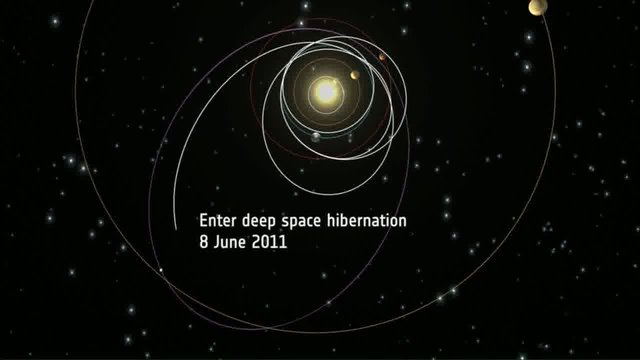
Operating on solar energy alone, Rosetta was placed into a deep space slumber in June 2011 as it cruised out to a distance of nearly 800 million km from the warmth of the Sun, beyond the orbit of Jupiter.

Now, as Rosetta’s orbit has brought it back to within ‘only’ 673 million km from the Sun, there is enough solar energy to power the spacecraft fully again.

Thus today, still about 9 million km from the comet, Rosetta’s pre-programmed internal ‘alarm clock’ woke up the spacecraft. After warming up its key navigation instruments, coming out of a stabilising spin, and aiming its main radio antenna at Earth, Rosetta sent a signal to let mission operators know it had survived the most distant part of its journey.

The signal was received by both NASA’s Goldstone and Canberra ground stations at 18:18 GMT/ 19:18 CET, during the first window of opportunity the spacecraft had to communicate with Earth. It was immediately confirmed in ESA’s space operations centre in Darmstadt and the successful wake-up announced via the @ESA_Rosetta twitter account, which tweeted: “Hello, World!”

Rosetta will be woken up Monday at 1000GMT after a two-and-a-half year sleep

January 19, 2014

The European Space Agency will try and wake-up its sleeping Rosetta spacecraft on Monday at 1000 GMT. The spacecraft entered deep space hibernation in June 2011 when it was too far away from the sun to capture much solar energy. If this works it will be a considerable achievement considering that Rosetta was launched 10 years ago  and the communications technology on board is effectively at least two  “generations” old!

Rosetta trajectory till June 2011

ESA:

At 10:00 GMT on Monday, the most important alarm clock in the Solar System will wake up ESA’s sleeping Rosetta spacecraft.

Rosetta is chasing comet 67P/Churyumov–Gerasimenko and, since its launch in 2004, has made three flybys of Earth and one of Mars to build up enough speed and get on a trajectory towards the comet. It has also encountered asteroids Steins and Lutetia along the way.

Operating on solar energy alone, the spacecraft was placed into a deep space slumber in mid-2011 as it cruised far from the Sun and out towards the orbit of Jupiter. To prepare for its long sleep, Rosetta was oriented so that its solar arrays faced the Sun and put into a once per minute spin for stability.

The only devices left running were its computer and several heaters.

Thirty-one months later, Rosetta’s orbit has brought it back to within ‘only’ 673 million kilometres of the Sun, and there is finally enough solar energy to power the spacecraft fully again. It is time to wake up.

Rosetta’s computer is programmed to carry out a sequence of events to re-establish contact with Earth on 20 January, starting with an ‘alarm clock’ at 10:00 GMT.

Immediately after, the spacecraft’s startrackers will begin to warm up, taking around six hours.

Then its thrusters will fire to stop the slow rotation. A slight adjustment will be made to Rosetta’s orientation to ensure that the solar arrays are still facing directly towards the Sun, before the startrackers are switched on to determine the spacecraft’s attitude.

Once that has been established, Rosetta will turn directly towards Earth, switch on its transmitter and point its high-gain antenna to send its signal to announce that it is awake.

Because of Rosetta’s vast distance – just over 807 million kilometres from Earth – it will take 45 minutes for the signal to reach the ground stations. The first opportunity for receiving a signal on Earth is expected between 17:30 GMT and 18:30 GMT.

Graphic of mission

Rosetta Mission (ESA via BBC)

Shale gas potential delays new natural gas pieline under the Baltic

November 19, 2013

It will be slower than in the US, but shale gas will also be a game changer in Europe. Even though Russia has huge reserves of shale gas and shale oil, they would also prefer that the transition to shale gas should not go too fast. They have so much invested in the Natural Gas infrastructure that they need to keep the sales of natural gas going to ensure a return. Gazprom has the enviable dilemma of protecting an existing revenue stream by preventing the too rapid establishment of another revenue stream. One problem for Gazprom of course is that shale gas is much more widespread across Europe and their virtual monopoly with Siberian natural gas will be threatened.

In any case the energy scene is changing fast and the planned investment in additional gas pipelines under the Baltic Sea from Russia to Germany have been delayed by Nord Stream.

Swedish Radio News: The gas pipeline consortium Nord Stream are delaying their plans for one or two more pipelines under the Baltic Sea. According to Nord Stream’s adviser, Lars Grönstedt, the shareholders want further analyses of the rapidly changing energy market. 

The USA has quickly become almost self-sufficient in energy because of its own shale gas , and it has led to Europe buying more cheap coal than before. “I can not comment directly on the shareholders’ deliberations. But I can guess that since gas has changed to such an extent just the last twelve months , it needs some deeper analysis” says Lars Grönstedt. 

Nord Stream pipeline image http://russia-media.ru/

Nord Stream’s current pipeline has two channels extending from Vyborg in Russia to Greifswald in Germany under the Baltic Sea to deliver Russian natural gas to Europe.  

Nord Stream had planned to add one or two further gas pipes and held public information meetings last spring –  including on Gotland. It is a project that is expected to cost about $9 billion, and in Sweden alone could create some two hundred jobs during construction. 

Nord Stream’s shareholders, five European energy companies , including Russia’s Gazprom , have postponed these plans. The changes in the energy market as Lars Grönstedt mention, are due in part to America’s increased shale gas . 

I suspect that Gazprom’s best way of maximising revenues is by holding up current natural gas prices but not so high that the development of shale gas is accelerated and not so high that gas users shift to coal (as the large utilities are doing in Germany). A delicate calculation and which would require a slow development of their gas distribution pipelines.

But for the private consumers, the lowest cost would be if shale gas development was speeded up.


European Parliament: where they don’t know what they are voting about

October 25, 2013

This only reconfirms my view that the European Parliament is not worthy of any respect and is worthy of much contempt.

(found at Guido Fawkes’ Blog)

A typical day in the European Parliament as MEPs get ready for a vote. But there is a problem. One MEP stands up and explains that the room has no idea what it is voting on, as they haven’t yet been given a chance to read the alterations to the amendments about to be passed.

The response? – “That’s the way we do things here”.