Archive for the ‘Evolution’ Category

The inexorable numbers – 10:10:10:100 is inevitable around 2100

December 4, 2013

10:10:10:100 by 2100

The “success” of a species is generally taken to be indicated by its population though it is of course possible to have quantity without much quality of life. In general however, an increasing population of any species does indicate the sufficiency of food, the ability of the species to withstand competition from other species and the ability to breed successfully in the prevailing conditions. And so it is for humans. Based on population, modern humans have never been as successful as they currently are. And in spite of all the doom-sayers and the alarmists, the fact remains that more humans are being fed and housed and are achieving some large part of their aspirations than ever before. They are living longer than ever before  and their life expectancy is still increasing – currently by about 2 -3 months every year.

However  just looking at the crude birth rate (number of births per 1000 of population) might lead one to a conclusion that there was a catastrophic decline in the human species.

Crude Birth Rate / 1000 of population

Crude Birth Rate / 1000 of population

Birth rates have declined from about 37/1000 in 1950 to less than 15/1000 now and are projected to be around 10/1000 by 2100. For any other species that would be a catastrophic decline. But of course that conclusion would be quite wrong when applied to humans. The mortality rate of humans has also declined drastically as medical and public health advances have been made. And human ingenuity has maintained food and material supplies such that life expectancy has increased in spite of a booming population.

Birth and mortality rates

Birth and mortality rates

The fact that population and life expectancy have increased simultaneously is a clear indicator that the quality of life has not deteriorated. There may be problems of equitable distribution but there is no shortage of food or other resources – and no prospect of any catastrophic shortages occurring. All other indicators tell the same story. Infant mortality, poverty and malnourishment are all at all-time lows and declining even if these can be lower still. The real GDP per capita is increasing. Leisure time (time not spent on the requirements for survival) is increasing and for more people than ever before. The age of space exploration and the potential for access to new sources of raw materials and even real estate has already begun.

There are many who rail against the consumer society and materialism but generally do so from a position of some comfort. There are others who moan the loss of spirituality and yearn for a return to a simpler life but they too are not quite ready to return to the trees. There is no shortage of doom-mongers and alarmists who merely keep pushing their doomsdays into the future where they cannot be disproved.

It is a question of attitude. There are those who would prefer to be governed by fear (the precautionary principle) and there are others who would move forward in spite of their fears.

But the reality is that the human species – with all its warts and threats and self-inflicted problems – is thriving.

Population and life expectancy WPP2012

Population and life expectancy WPP2012

It is not a forecast or an objective but merely the inexorable arithmetic of demographics which leads to the inevitability of 10:10:10:100 around the year 2100.

10 billion population, 10 births per 1000 of population, 10 deaths per 1000 of population and a life expectancy at birth of 100 years.

I prefer to see the glass half-full rather than the glass half-empty.
Numeracy and language

December 2, 2013

I tend towards considering mathematics a language rather than a science. In fact mathematics is more like a family of languages each with a rigorous grammar. I like this quote:

R. L. E. SchwarzenbergerThe Language of Geometry, in A Mathematical Spectrum Miscellany, Applied Probability Trust, 2000, p. 112:

My own attitude, which I share with many of my colleagues, is simply that mathematics is a language. Like English, or Latin, or Chinese, there are certain concepts for which mathematics is particularly well suited: it would be as foolish to attempt to write a love poem in the language of mathematics as to prove the Fundamental Theorem of Algebra using the English language.

Just as conventional languages enable culture and provide a tool for social communication, the various languages of mathematics, I think, enable science and provide a tool for scientific discourse. I take “science” here to be analaogous to a “culture”. To follow that thought then, just as science is embedded within a “larger” culture, so is mathematics embedded within conventional languages. This embedding shows up as the ability of a language to deal with numeracy and numerical concepts.

And that means then the value judgement of what is “primitive” when applied to language can depend upon the extent to which mathematics and therefore numeracy is embedded within that language.

GeoCurrents examines numeracy embedded within languages:

According to a recent article by Mike Vuolo in Slate.com, Pirahã is among “only a few documented cases” of languages that almost completely lack of numbers. Dan Everett, a renowned expert in the Pirahã language, further claims that the lack of numeracy is just one of many linguistic deficiencies of this language, which he relates to gaps in the Pirahã culture. ….. 

The various types of number systems are considered in the WALS.info article on Numeral Bases, written by Bernard Comrie. Of the 196 languages in the sample, 88% can handle an infinite set of numerals. To do so, languages use some arithmetic base to construct numeral expressions. According to Comrie, “we live in a decimal world”: two thirds of the world’s languages use base 10 and such languages are spoken “in nearly every part of the world”. English, Russian, and Mandarin are three examples of such languages. ….. 

Around 20% of the world’s languages use either purely vigesimal (or base 20) or a hybrid vigesimal-decimal system. In a purely vigesimal system, the base is consistently 20, yielding the general formula for constructing numerals as x20 + y. For example, in Diola-Fogny, a Niger-Congo language spoken in Senegal, 51 is expressed as bukan ku-gaba di uɲɛn di b-əkɔn ‘two twenties and eleven’. Other languages with a purely vigesimal system include Arawak spoken in Suriname, Chukchi spoken in the Russian Far East, Yimas in Papua New Guinea, and Tamang in Nepal. In a hybrid vigesimal-decimal system, numbers up to 99 use base 20, but the system then shifts to being decimal for the expression of the hundreds, so that one ends up with expressions of the type x100 + y20 + z. A good example of such a system is Basque, where 256 is expressed as berr-eun eta berr-ogei-ta-hama-sei ‘two hundred and two-twenty-and-ten-six’. Other hybrid vigesimal-decimal systems are found in Abkhaz in the Caucasus, Burushaski in northern Pakistan, Fulfulde in West Africa, Jakaltek in Guatemala, and Greenlandic. In a few mostly decimal languages, moreover, a small proportion of the overall numerical system is vigesimal. In French, for example, numerals in the range 80-99 have a vigesimal structure: 97 is thus expressed as quatre-vingt-dix-sept ‘four-twenty-ten-seven’. Only five languages in the WALS sample use a base that is neither 10 nor 20. For instance, Ekari, a Trans-New Guinean language spoken in Indonesian Papua uses base of 60, as did the ancient Near Eastern language Sumerian, which has bequeathed to us our system of counting seconds and minutes. Besides Ekari, non-10-non-20-base languages include Embera Chami in Colombia, Ngiti in Democratic Republic of Congo, Supyire in Mali, and Tommo So in Mali. …… 

Going back to the various types of counting, some languages use a restricted system that does not effectively go above around 20, and some languages are even more limited, as is the case in Pirahã. The WALS sample contains 20 such languages, all but one of which are spoken in either Australia, highland New Guinea, or Amazonia. The one such language found outside these areas is !Xóõ, a Khoisan language spoken in Botswana. ……. 

Read the whole article. 

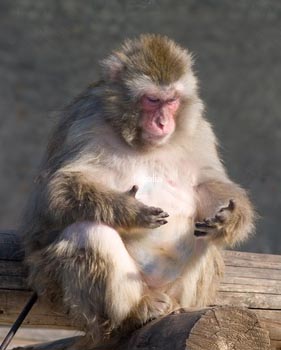
Counting monkey?

In some societies in the ancient past, numeracy did not contribute significantly to survival as probably with isolated tribes like the Pirahã. But in most human societies, numeracy was of significant benefit especially for cooperation between different bands of humans. I suspect that it was the need for social cooperation which fed the need for communication within a tribe and among tribes, which in turn was the spur to the development of language, perhaps over 100,000 years ago. What instigated the need to count is in the realm of speculation. The need for a calendar would only have developed with the development of agriculture. But the need for counting herds probably came earlier in a semi-nomadic phase. Even earlier than that would have come the need to trade with other hunter gatherer groups and that  probably gave rise to counting 50,000 years ago or even earlier. The tribes who learned to trade and developed the ability and concepts of trading were probably the tribes that had the best prospects of surviving while moving from one territory to another. It could be that the ability to trade was an indicator of how far a group could move.

And so I am inclined to think that numeracy in language became a critical factor which 30,000 to 50,000 years ago determined the groups which survived and prospered. It may well be that it is these tribes which developed numbers, and learned to count, and learned to trade that eventually populated most of the globe. It may be a little far-fetched but not impossible that numeracy in language may have been one of the features distinguishing Anatomically Modern Humans from Neanderthals. Even though the Neanderthals had larger brains and that we are all Neanderthals to some extent!

The first string? Man-made, twisted, fibre, cords at least 90,000 years ago

November 22, 2013

The man in question may well have been Neanderthal. Fibre artefacts rot easily and the oldest remains found of a man-made, twisted, fibre “cord” or “string” dates from only about 30,000 years ago. A new paper describes perforations in upto 90,000 year old, stone and tooth artefacts as well as shells from Abri du Maras and other Neanderthal sites in France, indicating they had once been threaded on “strings” and worn as pendants.

This post has beeen shifted to 6,000 Generations

Men, muscles and noses (and why the Dong has a luminous nose)

November 20, 2013

A new study suggests that men have larger noses than women because they have greater muscle mass to supply with oxygen. That is also possibly why archaic humans with greater muscle mass than modern humans also had larger noses.

Nathan E. Holton, Todd R. Yokley, Andrew W. Froehle, Thomas E. Southard, Ontogenetic scaling of the human nose in a longitudinal sample: Implications for genusHomofacial evolutionAmerican Journal of Physical Anthropology, 2013; DOI: 10.1002/ajpa.22402 

The University of Iowa’s news release:

Human noses come in all shapes and sizes. But one feature seems to hold true: Men’s noses are bigger than women’s.

A new study from the University of Iowa concludes that men’s noses are about 10 percent larger than female noses, on average, in populations of European descent. The size difference, the researchers believe, comes from the sexes’ different builds and energy demands: Males in general have more lean muscle mass, which requires more oxygen for muscle tissue growth and maintenance. Larger noses mean more oxygen can be breathed in and transported in the blood to supply the muscle.

The researchers also note that males and females begin to show differences in nose size at around age 11, generally, when puberty starts. Physiologically speaking, males begin to grow more lean muscle mass from that time, while females grow more fat mass. Prior research has shown that, during puberty, approximately 95 percent of body weight gain in males comes from fat-free mass, compared to 85 percent in females. …. 

…. It also explains why our noses are smaller than those of our ancestors, such as the Neanderthals. The reason, the researchers believe, is because our distant lineages had more muscle mass, and so needed larger noses to maintain that muscle. Modern humans have less lean muscle mass, meaning we can get away with smaller noses.

“So, in humans, the nose can become small, because our bodies have smaller oxygen requirements than we see in archaic humans,” Holton says, noting also that the rib cages and lungs are smaller in modern humans, reinforcing the idea that we don’t need as much oxygen to feed our frames as our ancestors. “This all tells us physiologically how modern humans have changed from their ancestors.” ….

And by whatever strange associations that go on in my brain, Edward Lear’s explanation for how his heartbroken and stalwart Dong made himself a prosthetic, luminous nose (which I must have first read some 50 years ago) keeps going around in my head (extract from Edward Lear’s nonsense poem).

……. And those who watch at that midnight hour
From Hall or Terrace, or lofty Tower,
Cry, as the wild light passes along, —
            “The Dong! — the Dong!
      “The wandering Dong through the forest goes!
            “The Dong! the Dong!
      “The Dong with a luminous Nose!”
…….
Playing a pipe with silvery squeaks,
      Since then his Jumbly Girl he seeks,
      And because by night he could not see,
      He gathered the bark of the Twangum Tree
            On the flowery plain that grows.
            And he wove him a wondrous Nose, —
      A Nose as strange as a Nose could be!
Of vast proportions and painted red,
And tied with cords to the back of his head.
      — In a hollow rounded space it ended
      With a luminous Lamp within suspended,
            All fenced about
            With a bandage stout
            To prevent the wind from blowing it out; —
      And with holes all round to send the light,
      In gleaming rays on the dismal night.
…….
And all who watch at the midnight hour,
From Hall or Terrace, or lofty Tower,
Cry, as they trace the Meteor bright,
Moving along through the dreary night, —
      “This is the hour when forth he goes,
      “The Dong with a luminous Nose!
      “Yonder — over the plain he goes;
            “He goes!
            “He goes;
      “The Dong with a luminous Nose!”

The Dong was first published in 1846 and maybe Rudolph, who first appeared in a 1939 booklet written by Robert L. May, got his glowing red nose, in a similar way to the Dong.

New Denisovan genome indicates inter-breeding with another, unknown, archaic human

November 19, 2013

The period some 30,000 – 50,000 years ago is getting positively crowded with different branches of humans. The direct ancestors of modern humans lived and interbred not only with Neanderthals and Denisovans but also apparently with still another, as yet unknown, branch of humans.

NatureNew genome sequences from two extinct human relatives suggest that these ‘archaic’ groups bred with humans and with each other more extensively than was previously known.

The ancient genomes, one from a Neanderthal and one from a different archaic human group, the Denisovans, were presented on 18 November at a meeting at the Royal Society in London. They suggest that interbreeding went on between the members of several ancient human-like groups living in Europe and Asia more than 30,000 years ago, including an as-yet unknown human ancestor from Asia. ..

… All humans whose ancestry originates outside of Africa owe about 2% of their genome to Neanderthals; and certain populations living in Oceania, such as Papua New Guineans and Australian Aboriginals, got about 4% of their DNA from interbreeding between their ancestors and Denisovans, who are named after the cave in Siberia’s Altai Mountains where they were discovered. The cave contains remains deposited there between 30,000 and 50,000 years ago. 

Those conclusions however were based on low-quality genome sequences, riddled with errors and full of gaps, David Reich, an evolutionary geneticist at Harvard Medical School in Boston, Massachusetts said at the meeting. His team, in collaboration with Svante Pääbo at the Max Planck Institute for Evolutionary Anthropology in Leipzig, Germany, have now produced much more complete versions of the Denisovan and Neanderthal genomes — matching the quality of contemporary human genomes. The high-quality Denisovan genome data and new Neanderthal genome both come from bones recovered from Denisova Cave.

The new Denisovan genome indicates that this enigmatic population got around: Reich said at the meeting that they interbred with Neanderthals and with the ancestors of human populations that now live in China and other parts of East Asia, in addition to Oceanic populations, as his team previously reported. Most surprisingly, Reich said, the new genomes indicate that Denisovans interbred with another extinct population of archaic humans that lived in Asia more than 30,000 years ago, which is neither human nor Neanderthal.

It would seem that when the world was still in the grip of an ice age 30,000 – 50,000 years ago, the reality of human history was not so far away from Tolkien’s Middle Earth.  Ancient history but it was only 1,500 – 2,500 generations ago. Middle Earth was where men could breed with elves and hobbits were an off-shoot of men. The Druedain were also off-shoots of men and some – if not all – orcs were deliberately bred from elves while all trolls and dragons were artificially bred.

From the J.R.R. Tolkien Encyclopedia: Scholarship and Critical Assessment

from The biology of Middle eart - Tolkien Encyclopedia

from The biology of Middle Earth – JRR Tolkien Encyclopedia

Another human intervention for the survival of unfit species

November 8, 2013

I believe the entire thrust of “conservationism” in protecting unfit species and sanctioning successful species is fundamentally unsound. It is the survival of the unfit. It is no sustainable way to proceed. If humans are to intervene then it should be in the genetic adaptation of  a weak species to help that species to survive in the long term and not in “protecting” the habitat of the weak species by eradicating successful species so that the weak species continues in a state of being unfit for survival.

And now the very successful brown rats on the Isles of Scilly are to be culled in favour of sea birds that they threaten. Rather than kill the rats and perpetuate the sea birds in their unfit state, surely we ought to be adapting the sea birds to be able to survive in the new environment they live in.

Johnny Birks, chair of the Mammal Society, said: “Brown rats are not native to Britain… it’s our own fault they are so widespread and that makes it right for us to repair the damage we’ve caused.”

He added that the eradication could benefit the Scilly shrew and other species found on the islands, but it was key that the rats did not reinvade.

A convoluted – and rather sick – argument if ever there was one. To just remove the competitive pressures that the weak species is subject to is to try and prevent evolution. It may work in the short term but provides no long term future for the weak species. In fact it prevents them from responding to evolutionary pressures. The rats have taken advantage of the new environment created by humans and have thrived. The sea birds and other species have failed to do that. The paradigm cannot be  “Kill all immigrants” to freeze the unfit native species in their untenable positions. If the answer is to limit the successful species then the present thrust of “conservationism” leads logically – and inevitably – to the culling of humans as the preferred solution.

The weak have a guaranteed place in heaven anyway. Either help them to change or let them die out. But don’t lock them into the unfit state they find themselves in.

BBC

A project aimed at protecting internationally important seabird populations on two of the Isles of Scilly by killing more than 3,000 brown rats, is under way.

The islands, which are located off Cornwall, are home to breeding populations of 14 seabird species and approximately 20,000 birds.

Eradication experts from New Zealand and the UK have been contracted to carry out the work.

“Among many challenges our seabirds face, the greatest threat on land is predation of eggs and chicks by brown rats,” said Jaclyn Pearson from the Isles of Scilly Seabird Recovery Project.

“The brown rats were accidently introduced to islands from shipwrecks in the 18th Century,” she added.

The project is part of a 25-year programme to protect “internationally important” seabird numbers, including those of Manx shearwaters and storm petrels, and is costing more than £755,000.

The rodents will be poisoned on St Agnes and Gugh by Wildlife Management International Limited (WMIL).

The company has helped eradicate rats from Ramsey Island off Wales, Lundy Island off Devon and the Isle of Canna in the Scottish Hebrides.

Elizabeth Bell, from WMIL said: “A period of intensive baiting will start from the 8 November and most of the rats will be dead by the end of November. We’ll then target the surviving rats.”

A long-term monitoring programme will start at the beginning of 2014 to check the rodents have been eradicated from the islands.

Ms Bell said all the bait stations were enclosed, tied down and were designed not to kill any other species, such as rabbits. ……

A platypusian tale of a raunchy rat and a promiscuous duck

November 6, 2013

A science story is doing the rounds today based on a new paper:

No living mammal is more peculiar than the platypus. It has a broad, duck-like bill, thick, otter-like fur, and webbed, beaver-like feet. The platypus lays eggs rather than gives birth to live young, its snout is covered with electroreceptors that detect underwater prey, and male platypuses have a venomous spur on their hind foot. Until recently, the fossil record indicated that the platypus lineage was unique, with only one species inhabiting the Earth at any one time. This picture has changed with the publication of a new study in the latest issue of the Journal of Vertebrate Paleontology that describes a new, giant species of extinct platypus that was a side-branch of the platypus family tree.

The new platypus species, named Obdurodon tharalkooschild, is based on a single tooth from the famous Riversleigh World Heritage Area of northwest Queensland. While many of Riversleigh’s fossil deposits are now being radiometrically dated, the precise age of the particular deposit that produced this giant platypus is in doubt but is likely to be between 15 and 5 million years old.

File:Platypus BrokenRiver QLD Australia2.png

Platypus BrokenRiver QLD Australia Wikimedia

But what I found far more interesting was the story from the Aborigine Dreamtime which is so much more attractive than any evolutionary history of this strange animal. The Dreamtime sounds fascinating – a kind of Brigadoon.

In the Dreamtime, Tharalkoo was a headstrong female duck who disobeyed her parents’ warnings not to swim downriver where Bigoon the water-rat could catch her and have his wicked way with her. Like anyone who disobeys their parents in a fairy story, things turn out exactly as they said they would and Tharalkoo is ravished by Bigoon. When she returns home, the other female ducks are all laying eggs, so she does the same. But instead of a baby duckling, Tharalkoo’s child is a chimera with the bill and webbed hind feet of a duck and the fur and front feet of a rodent – a platypus.

It is not hard to read between the lines that Tharalkoo had promiscuous tendencies and that Bigoon was the swaggering young tough who was the local heartthrob. Unlike Juliet, Tharalkoo got to having her offspring – which has since prospered. Presumably Bigoon fathered others for Tharalkoo’s child to mate with. What else Bigoon got up to and how he came to meet a nasty end (and there can be no doubt that he must have come to a nasty end) is unknown.

Genetic adaptation – not stagnating conservation – is the way to help threatened species

October 26, 2013

If the big cats, or elephants or giraffes or pandas want to survive into the distant future they need to evolve. The changes taking place in their environment and in their loss of habitat are happening too fast for natural selection to throw up the genetic changes needed for long term survival. As long as humans remain the dominant species in their environment they will need to come to terms with that – genetically. Conventional conservation efforts are fundamentally flawed. They are backwards looking. They try to preserve these species – as they are – in artificially protected habitats which are frozen in time, which remain unchanged while the world around them changes. Conservation attempts to freeze these species and thereby lock them into the non-viable position they have found themselves in. This is not going to help them to continue into the future, except as an unsuccessful species. It is paradoxical that unsuccessful species are subject to conservation efforts and successful species get labelled as pests.

Much of the rapid change to the environments for these species is a consequence of the success of humanity as a species. Trying to keep a species unchanged and stagnating in a changing world seems to me to be irresponsible. And creating  little protected bubbles of habitat – whether in a reserve or a zoo can only be a short term measure. Domesticated animals are at little risk of extinction as long as humans thrive. Their success is inextricably linked with the human species and they have been adapted genetically to be what they are today. They are not allowed to breed freely or indiscriminately and that is the genetic price they pay. But their survival is assured – at least as long as humans thrive and maybe even beyond.

‘There are many more “urbanised” species which have through a natural – but environmentally coerced or forced – selection adapted genetically to have the traits which allow them to be successful in  the human-dominated environments they find themselves in. Foxes, bears, wolves, badgers and even the polar bears of Churchill have evolved and adapted to survive in human dominated environments. But they generally live surreptitious lives in the shadow of man. They have not found a sustainable position  as yet. An increasing number of birds have adapted their behaviour (presumably also by genetic changes) to take advantage of human behaviour. They have learned to live in and around our cities, to take advantage of our agricultural and harvesting habits and to use our waste streams as their food source. Even in the water, there are fish species which succeed because of the changes brought about by man. Many insects – be they cockroaches or spiders or mosquitoes, or termites – now know how to take advantage of man-made environments. At the microbial or viral level, species are not much concerned by the changes wrought by humans and continue their merry way.

Now in this new age of DNA analysis and intentional selection of genes I think it is time for Conservation to move away from merely trying to “freeze” species in an artificially protected environment and to move into a pro-active phase where humans actually help threatened species to continue into the future. This does not mean that the neo-species that appear must necessarily be domesticated or in the service of humans but it does mean that they must share the same habitat and be able to co-exist. If they require a specialised habitat which is likely to disappear or change due to man or for any other reason, they are destined to eventually go extinct. Putting such species into zoos or other artificially maintained or otherwise protected habitats only preserves an obsolete species in a temporary environment. Conventional conservation as it is practiced today goes down that route. And while it may provide a short term method for preserving the genes of such species, it is in an unsustainable form. It is a method which does no real service to such species.

Instead of trying to recreate the woolly mammoth for an environment which is totally unsuitable or of making futile attempts to preserve habitats for elephants so that they continue “unchanged”, it would be better if we considered how elephants – or the big cats – could be assisted along the evolutionary path such that they could find a natural and sustainable place in the brave new world that they now inhabit. For example, if neo-elephants were helped to evolve genetically such that their propensity to wander over very large areas reduced, or if they preferred certain kinds of trees and bushes and left others alone, or where their wanderings were more discerning and not as damaging to human crops, then herds of neo-elephants could find a sustainable place by the side of humanity.

Perhaps Siberian neo-tigers could be evolved genetically to help herd reindeer and develop a mutually beneficial partnership with man. An occasional reindeer kill would then be quite acceptable. It would be so much more contructive if neo-wolves were helped not to stagnate genetically, but instead to evolve the behavioural characteristics that allowed them to find a way of co-existing with humans and human flocks of sheep. The idea of neo-dolphins who communicate with man and have a herding behaviour in the oceans which benefit both humans and themselves has long been a subject of science fiction. Our nearest primate cousins have to be helped to move on and not to stagnate into extinction. The pace of environmental change is much too fast for natural selection to throw up the individuals capable of survival. Instead a natural deselection of individuals incapable of surviving is taking place. Neo-gorillas and neo-chimpanzees will not appear without human intervention.

Conservation – as stagnation – is not sustainable.  Trying to prevent change is a futile exercise. It is change which is the fundamental characteristic of life. It is managing change and even designing change which is a particular strength of the human species. It is human ingenuity at work. It is time to give thought to how we can help the species around us evolve into the neo-species which can cope with the changes which are inevitable.

Neanderthal’s weren’t vegetarian – they just ate the stomachs of vegetarians

October 21, 2013

English: First reconstruction of Neanderthal m...

The view that calcified plaque found on Neanderthal teeth came from medicinal plants and vegetables, conjuring up visions of a smart, cultured, sensitive race of homo erectus is being challenged. Laura Buck and Chris Stringer believe these remains have a much more violent source. They came from eating the stomachs of prey which in turn were vegetarian. Neanderthals were only vegetarian by proxy.

Hah! We can now go back to the older vision of Neanderthals being brutal, brutish, insensitive, blood-thirsty carnivores!

(Just as an aside, my grandmother was not only a confirmed vegetarian but a devout Hindu for whom the very thought of eating beef was anathema. She couldn’t quite come to terms with the fact that her grandchildren were carnivorous and that they ate gentle things like chickens and goats. I once tried to convince her that I was more of a vegetarian – by proxy – by eating beef rather than chicken since cows were more vegetarian in their diet than chickens. Chickens after all were known to eat worms and other horrible stuff. She gave up any hopes that I would escape everlasting damnation at that point!).

Past Horizons carries this revisionist view of Neanderthals:

(This article titled “The stomach-turning truth about what the Neanderthals ate?” was written by Robin McKie, for The Observer on Saturday 19th October 2013)

It was the tell-tale tartar on the teeth that told the truth. Or at least, that is what it appeared to do. Researchers – after studying calcified plaque on Neanderthal fossil teeth found in El Sidrón cave in Spain – last year concluded that members of this extinct human species cooked vegetables and consumed bitter-tasting medicinal plants such as chamomile and yarrow.

These were not brainless carnivores, in other words. These were smart and sensitive people capable of providing themselves with balanced diets and of treating themselves with health-restoring herbs, concluded the researchers, led by Karen Hardy at the Catalan Institution for Research and Advanced Studies in Barcelona. Our vision of these long-extinct people needs adjusting, they argued.

But now this tale of ancient tartar has taken a new twist with two researchers at London’s Natural History Museum challenging the Barcelona group’s conclusions. Dental research does not prove that Neanderthals were self-medicating, vegetable-eating sophisticates, one told the Observer. There are other, equally valid but decidedly more grizzly explanations to account for those microscopic fragments of herbs and plants found in Neanderthal teeth.

In a paper by Laura Buck and Chris Stringer and published in the latest edition of Quaternary Science Reviews, Stringer argues that the tiny pieces of plant found in Neanderthal teeth could have come from a very different source. They may well have become embedded in the stomach contents of deer, bison and other herbivores that had then been hunted and eaten by Neanderthals.

“Many hunter-gatherers, including the Inuit, Cree and Blackfeet, eat the stomach contents of animals such as deer because they are good source of vitamin C and trace elements,” said Stringer. “For example, among the Inuit, the stomach contents of an animal are considered a special delicacy with a consistency and a flavour that is not unlike cream cheese. At least that is what I am told.” ……

…… Stringer and Buck stress that they are not arguing that Neanderthals definitely did not eat vegetables or could not have used certain herbs as medicines. “What we are saying is that the evidence of plant fragments in Neanderthal teeth is simply not strong enough to prove that they did so. There are other explanations, including the proposal that they ate these organs of the animals they killed. They had the stomach for it, if you want to put it that way.”

The ancient melting pots of Europe

October 11, 2013

Stone Age settlers migrated across Europe in multiple waves that replaced older hunter-gatherer cultures with the genes from each wave blending into the population of the day. Ancient mtDNA studies are revealing that cultures spread to a great extent by the physical migrations of peoples and possibly faster and more effectively than by cultural diffusion alone. And the many different gene-melts continue today. Whereas in the Stone Age much of the action was in Central Europe, in the jet-age the melting-pots have shifted westwards and are mainly now in Western and Northern Europe. The peopling of Europe is an ongoing thing.

Guido Brandt, Wolfgang Haak, Christina J. Adler, Christina Roth, Anna Szécsényi-Nagy, Sarah Karimnia, Sabine Möller-Rieker, Harald Meller, Robert Ganslmeier, Susanne Friederich, Nicole Nicklisch, Joseph K. Pickrell, Frank Sirocko, David Reich, Alan Cooper, Kurt W. Alt and The Genographic Consortium, “DNA reveals key stages in the formation of Central European mitochondrial genetic diversity,” Science doi: 10.1126/science.1241844

National Geographic:

… the people who lived in Central Europe 7,000 years ago had different DNA lineages than those that lived there 5,000 years ago, and again different to those that lived 3,500 years ago. Central Europe was dynamic place during the Bronze age, and the genetic composition of the people that lived there demonstrates that there was nothing static about European prehistory.

Genographic Project Director and National Geographic Explorer-in-Residence, Spencer Wells expounds: “spanning a period from the dawn of farming during the Neolithic period through to the Bronze Age, the [genetic] data from the archaeological remains reveals successive waves of migration and population replacement- genetic ‘revolutions’ that combined to create the genetic patterns we see today.”

What we see in Europeans today is a kind of mixture of what was present there at different times in our past. So, just like parts of Europe today are melting pots from different living cultures across the world, Europe is also a melting pot of genetic lineages from different prehistoric cultures that lived there at different periods of time.

timeline peopling of europe Brandt et al, DOI: 10.1126/science.1241844 fig.3


Dienekes: “Central Europe, once populated exclusively by hunter-gatherers, experienced a virtual disappearance of their matrilineages for almost two thousand years after the advent of farming.  Then, between the Middle to Late Neolithic, around five thousand year ago, the hunter-gatherers make their re-appearance before their lineages converge to their modern (minority) frequency”