Archive for the ‘Evolution’ Category

Another headline chasing psychologist is censured

August 7, 2013

What is it about social psychology and psychologists that causes them particularly to chase notoriety and public attention even to the extent of faking data? Diedrik Stapel and Marc Hauser being recent high profile cases. Could it just be that they are all suffer from a narcissism which can only be satisfied by generating headlines and generally being in the limelight?

Now a certain Geoffrey Miller – supposedly an “evolutionary psychologist” – has been publicly censured by New York University  for essentially behaving like an idiot and then lying about it. After tweeting a stupid and offensive remark he then tried to pass it off as part of a research project! He has now apologised – a bit late – and deleted the tweet. But his self-promotional intentions were recognised. Apparently he researches into how the human mind evolved. (Or as is pretty obvious –  didn’t evolve for some).

“The Tweeting activities of associate professor Geoffrey Miller did not rise to the level of research,” said a statement from the IRB on the university’s website.

“The board concluded that Miller’s Tweets were self-promotional in nature and did not follow research criteria which require specific research questions or hypotheses, systematic methods for collection quantitative and/or qualitative data and criteria for selecting respondents.”

He is an Associate Professor at the University of New Mexico and visiting NYU

The Times Higher Education covers the developments:

A US professor who Tweeted that if overweight PhD applicants “didn’t have the willpower to stop eating carbs” then they “won’t have the willpower to do a dissertation” has been formally censured by his university.

Geoffrey Miller Twitter page

Geoffrey Miller Twitter page

Geoffrey Miller, associate professor of psychology at the University of New Mexico, apologised after sending the Tweet, which he subsequently deleted. He later told UNM it had been part of a research project – a claim dismissed by the university

The institution has now formally censured Professor Miller for “misrepresenting to his department chair and colleagues the motivation for a Tweet”. 

“Miller at first claimed his Tweet was part of a research project, but investigations by the Institutional Review Board at New York University where he was a visiting professor, and the IRB at UNM where he is a tenured professor, concluded that was not correct,” a statement from his university read. 

As part of the censure, Professor Miller will be required to develop “a plan for sensitivity training as it pertains to obesity” in cooperation with the UNM psychology department, and apologise to colleagues for his behavior. 

Professor Miller, who can appeal the censure, will also have his work monitored by the chair of the psychology department, and will be assigned a faculty mentor for three years, with whom he will meet on a regular basis to discuss potential problems.

Y-chromosome study dates most recent common male ancestor to only 120 -156 thousand years ago

August 2, 2013

I am not quite sure why a difference in the time when our most recent common male ancestor (Y-chromosomal Adam) lived to that when our most recent common female ancestor (Mitochondrial Eve) lived should actually be a discrepancy which needs resolving.

Except of course if the authors wish to believe that all 7 billion humans alive today actually derive from a single couple!!

G. David Poznik et al, Sequencing Y Chromosomes Resolves Discrepancy in Time to Common Ancestor of Males Versus Females, Science 2 August 2013: 562-565. DOI:10.1126/science.1237619

This new study claims

… that this initial paper on Y chromosome sequence diversity provides important first evidence that the male most recent common ancestor did not live more recently than the female most recent common ancestor. 

The study involved Y chromosomes obtained through the Human Genome Diversity Project, and from other sources. It included chromosomes from 69 men in several populations in sub-Saharan Africa, and from Siberia, Cambodia, Pakistan, Algeria and Mexico.

Abstract: The Y chromosome and the mitochondrial genome have been used to estimate when the common patrilineal and matrilineal ancestors of humans lived. We sequenced the genomes of 69 males from nine populations, including two in which we find basal branches of the Y-chromosome tree. We identify ancient phylogenetic structure within African haplogroups and resolve a long-standing ambiguity deep within the tree. Applying equivalent methodologies to the Y chromosome and the mitochondrial genome, we estimate the time to the most recent common ancestor (TMRCA) of the Y chromosome to be 120 to 156 thousand years and the mitochondrial genome TMRCA to be 99 to 148 thousand years. Our findings suggest that, contrary to previous claims, male lineages do not coalesce significantly more recently than female lineages.

The study seems not to have looked at recent evidence of the age of the male lineage. This other evidence is more convincing and suggests that Y-chromosomal Adam is very much older and may lie some 237-581 thousand years ago and that Mitochondrial Eve goes back to about 200 thousand years ago.

Silly science? Evolution does not favour the selfish

August 1, 2013

Silly season is upon us.

Two Michigan University researchers claim that evolution will not sustain a “selfish gene” but will eventually select for cooperation.

Why am I not in the least bit convinced?

If either selfishness or cooperation was genetically determined, and if survival was dependent upon such a choice, then one or the other should have become extinct a long time ago.  The silliness of this work lies first in the assumption that a behavioural characteristic – even if crucial for survival – is merely determined by genetics.  Second, evolution never selects for excellence – whether in superlative selfishness or for unstinting cooperation. It represents the minimum of behavioural traits needed to survive till reproduction.

Evolution couldn’t care less if individuals are selfish or cooperative. It only results from those individuals sufficiently selfish or sufficiently cooperative for survival until reproduction. 

Of course the Daily Mail manages to put it in a remarkably silly headline:

Selfish people ‘will eventually die out’ because evolution favours cooperation

The paper is published in Nature Communications.

Christoph Adami, Arend Hintze. Evolutionary instability of zero-determinant strategies demonstrates that winning is not everythingNature Communications, 2013; 4 DOI:10.1038/ncomms3193

The accompanying press release trumpets

Evolution will punish you if you’re selfish and mean 

Two Michigan State University evolutionary biologists offer new evidence that evolution doesn’t favor the selfish, disproving a theory popularized in 2012.

“We found evolution will punish you if you’re selfish and mean,” said lead author Christoph Adami, MSU professor of microbiology and molecular genetics. “For a short time and against a specific set of opponents, some selfish organisms may come out ahead. But selfishness isn’t evolutionarily sustainable.”

The paper appears in the current issue of Nature Communications and focuses on game theory, which is used in biology, economics, political science and other disciplines. Much of the last 30 years of research has focused on how cooperation came to be, since it’s found in many forms of life, from single-cell organisms to people.

In 2012, a scientific paper unveiled a newly discovered strategy – called zero-determinant – that gave selfish players a guaranteed way to beat cooperative players.

“The paper caused quite a stir,” said Adami, who co-authored the paper with Arend Hintze, molecular and microbiology research associate. “The main result appeared to be completely new, despite 30 years of intense research in this area.”

Adami and Hintze had their doubts about whether following a zero determinant strategy (ZD) would essentially eliminate cooperation and create a world full of selfish beings. So they used high-powered computing to run hundreds of thousands of games and found ZD strategies can never be the product of evolution. While ZD strategies offer advantages when they’re used against non-ZD opponents, they don’t work well against other ZD opponents.

“In an evolutionary setting, with populations of strategies, you need extra information to distinguish each other,” Adami said.

So ZD strategies only worked if players knew who their opponents were and adapted their strategies accordingly. A ZD player would play one way against another ZD player and a different way against a cooperative player.

“The only way ZD strategists could survive would be if they could recognize their opponents,” Hintze said. “And even if ZD strategists kept winning so that only ZD strategists were left, in the long run they would have to evolve away from being ZD and become more cooperative. So they wouldn’t be ZD strategists anymore.” 

Game theory for an individual game or even for a succession of games is one thing but evolution does not care how selfish or how cooperative an individual is.

Successful owl species to be killed off to assist an unsuccessful owl species!

July 24, 2013

“Conservation” is fundamentally anti-evolution if human intervention is to protect unviable species while killing off the successful ones. And here it would seem that the intervention by the US Fish and Wildlife Service is more to atone for their past sins than for any sound principles. All in the name of “Conservation”.

Barred owl

A barred owl is seen near Index, Wash. The federal government is considering killing some of the owls in the Pacific Northwest to aid the smaller northern spotted owl in the area. (Barton Glasser / Associated Press)LATimes: 

LA Times: Federal wildlife officials have moved one step closer to their plan to play referee in a habitat supremacy contest that has pitted two species of owl against one another in the forests of the Pacific Northwest.

On Tuesday, the U.S. Fish and Wildlife Service released a final environmental review of an experiment planned in three states to see if killing barred owls will assist the northern spotted owls, which are threatened with extinction after a major loss of territory since the 1970s.

The agency’s preferred course of action calls for killing 3,603 barred owls in four study areas in Oregon, Washington and Northern California over the next four years. At a cost of $3 million, the plan requires a special permit under the Migratory Bird Treaty Act, which prohibits killing non-game birds.

“It’s a fair assessment to say that going after the barred owls is the plan we’d prefer to pursue,” Robin Bown, a federal wildlife biologist, told the Los Angeles Times.

The agency began evaluating alternatives in 2009, gathering public comment and consulting ethicists, focus groups and conduction scientific studies.

It will issue a final decision on the plan in 30 days.

…..

Life on land four times older than previously thought

July 23, 2013

“Settled science” has had it that life on land dates from about 500 million years ago. But fossils of something rather simpler than plants or animals found in South Africa provide evidence that life on land could be 2.2 billion years old.

Gregory J. Retallack, Evelyn S. Krull, Glenn D. Thackray, Dula Parkinson. Problematic urn-shaped fossils from a Paleoproterozoic (2.2Ga) paleosol in South AfricaPrecambrian Research, 2013; 235: 71

DOI:10.1016/j.precamres.2013.05.015

Science Daily

Conventional scientific wisdom has it that plants and other creatures have only lived on land for about 500 million years, and that landscapes of the early Earth were as barren as Mars.

A new study, led by geologist Gregory J. Retallack of the University of Oregon, now has presented evidence for life on land that is four times as old — at 2.2 billion years ago and almost half way back to the inception of the planet.

That evidence, which is detailed in the September issue of the journal Precambrian Research, involves fossils the size of match heads and connected into bunches by threads in the surface of an ancient soil from South Africa. They have been named Diskagma buttonii, meaning “disc-shaped fragments of Andy Button,” but it is unsure what the fossils were, the authors say.

“They certainly were not plants or animals, but something rather more simple,” said Retallack, professor of geological sciences and co-director of paleontological collections at the UO’s Museum of Natural and Cultural History. The fossils, he added, most resemble modern soil organisms called Geosiphon, a fungus with a central cavity filled with symbiotic cyanobacteria.

“There is independent evidence for cyanobacteria, but not fungi, of the same geological age, and these new fossils set a new and earlier benchmark for the greening of the land,” he said. “This gains added significance because fossil soils hosting the fossils have long been taken as evidence for a marked rise in the amount of oxygen in the atmosphere at about 2.4 billion to 2.2 billion years ago, widely called the Great Oxidation Event.”

By modern standards, in which Earth’s air is now 21 percent oxygen, this early rise was modest, to about 5 percent oxygen, but it represented a rise from vanishingly low oxygen levels earlier in geological time. …

Read the whole article

On birth rates, abortions and “eugenics by default”

July 20, 2013

Selective breeding works.

Humans have applied it – and very successfully – for plants and animals since antiquity.

There is nothing “wrong” conceptually with eugenics for the selective breeding of humans. But the Nazis – and not only the Nazis – brought all of eugenics into disrepute by the manner in which they tried to apply the concept.  Because of the Nazis and the coercive treatment of some minorities in Europe and of the Aborigines in Australia where forced sterilisation, forced abortions, genocide, euthanasia and mass murder were used to try and control the traits of future generations, eugenics has come to be inextricably associated with the methods used. Even in more recent times genocide, mass rapes and mass murder have been evident even if not openly for the purpose of controlling the genetic characteristics of the survivors.

I note that evolution by “natural selection” does not intentionally select for any particular traits. Surviving traits are due to the deselection of individuals who have not the wherewithal to survive until reproduction. Natural Selection in that sense is not pro-active and evolution is merely the result of changing environments which causes individuals of a species who cannot cope with the change to perish. Evolution has no direction of its own and is just the result of who survives an environmental change. It is not not some great force which “selects” or  leads a species into a desired future. Species fail when the available spread of traits and characteristics among the existing individuals of that species is not sufficient to generate some individuals who can survive the environmental change. Natural Selection is therefore not an intentional selection process but represents the survivors of change. Of course, not all traits have a direct influence on survival. All “collateral” traits are carried along – coincidentally and unintentionally –  with those traits which do actually help survival in any particular environment. But as conditions change what was once a collateral trait may become one which assists in survival.

As breeding techniques go, “Natural Selection” relies on a wide variation of traits throwing up viable individuals able to cope no matter how the environment changes, while “Artificial Selection” chooses particular traits to promote but runs the risk of unwanted collateral traits showing up (as with some bulldogs unable to breathe or with the development of killer bees). Natural selection is the shot-gun to the rifle of artificial selection. The shot gun usually succeeds to hit the target but may not provide a “kill”. But the rifle usually kills but it could easily miss or even kill the wrong target!

Of all the babies conceived today about 1% are conceived by “artificial” means (IVF or surrogacy) and include a measure of genetic selection. Even the other 99% include a measure of partner selection and – though very indirectly – a small measure of genetic selection. A significant portion (perhaps around 20%?) are through “arranged” marriages where some due diligence accompanies the “arrangement”. Such due diligence tends to focus on economic and social checks but does inherently contain some “genetic selection” (for example by excluding partners with histories of mental or other illnesses in their families). If eugenics was only about deliberate breeding programs seeking particular traits then we would not be very far down the eugenics road. But more importantly around 20-25% of babies conceived are aborted and represent a genetic deselection. As a result, a form of “eugenics by default” is already being applied today.

(The rights and wrongs of abortion is another discussion which – in my opinion – is both needless and tainted. Abortion, I think, is entirely a matter for the pregnant female and her medical advisors. I cannot see how anybody else – male or female – can presume to impose the having or not having of an abortion on any pregnant person. Even the male sperm donor does not, I think,  warrant any decisive role in what another person should or should not do. No society requires that a female should get its approval for conceiving or having a child (with the exception of China’s one-child policy). Why then should not having a child require such approval? While society may justifiably seek to impose rules about infanticide, abortion – by any definition – is not the same as infanticide. Until the umbilical is severed, a foetus is essentially parasitic, totally dependent upon its host- mother and not – in my way of thinking – an independent entity. I cannot and do not have much respect for the Pope or other religious mullahs who would determine if I should shave or not or if a woman may or may not have an abortion).

Consider our species as we breed today.

In general the parents of children being conceived today share a geographical habitat. Apart from the necessity – so far – of the parents having to meet physically, it is geographical proximity which I think has dominated throughout history. Victors of war, conquerors, immigrants, emigres and wanderers have all succumbed to the lures of the local population within a few generations. In consequence, partners often share similar social and religious and ethnic backgrounds. But the geographical proximity takes precedence. Apart from isolated instances (Ancient Greece, the Egypt of the Pharaohs, the persecution of the Roma, European Royalty, Nazi Germany and the caste-system on the Indian sub-continent), selective breeding solely for promoting or destroying specific genetic traits has never been the primary goal of child-bearing. Even restrictive tribes where marrying outside the “community” (some Jews and Parsis for example) is discouraged have been and still are more concerned about not diluting inherited wealth than any desire to promote specific genetic traits.

But it is my contention that we are in fact – directly and indirectly –  exercising an increasing amount of genetic control in the selection and deselection of our offspring . So much so that we already have “eugenics by default” being applied to a significant degree in the children being born today.

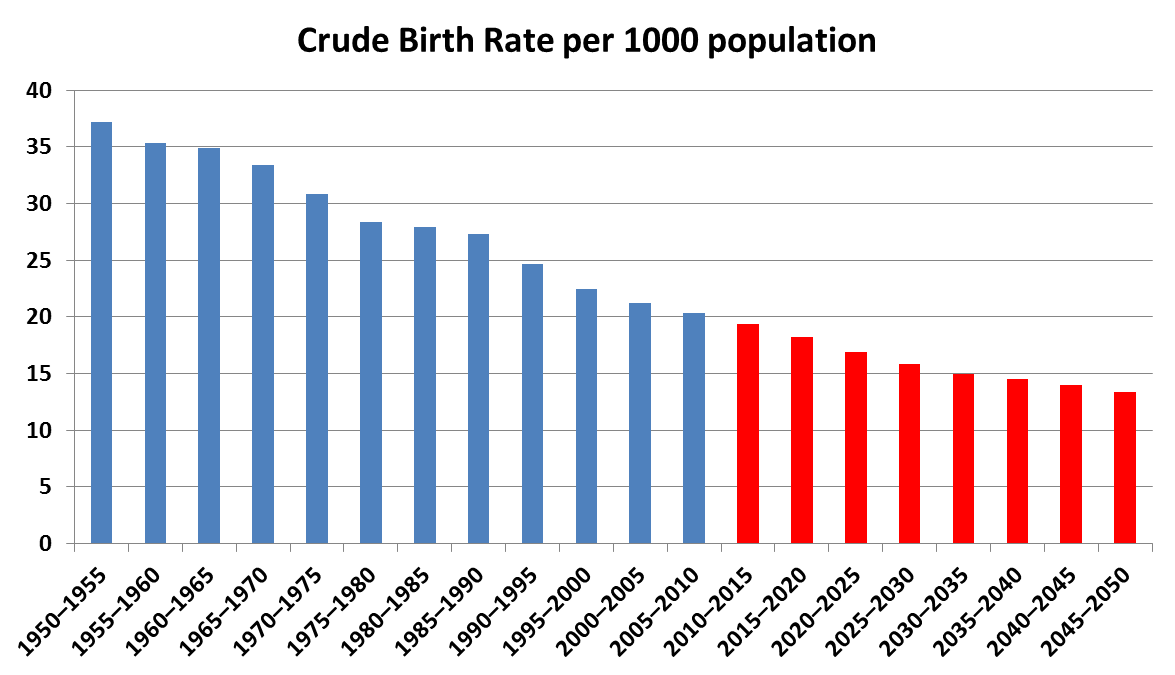
Currently the global birth rate is around 20 per 1000 of population (2%), having been around 37 in 1950 and projected to reduce to around 14 (1.4%) by 2050.
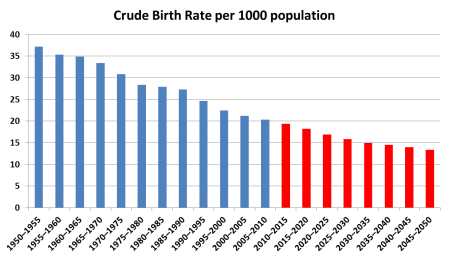
Crude birth rate actual and forecast UN data

Crude birth rate actual and forecast: UN data

Of these the number conceived by artificial means (IVF and surrogacy) is probably around 1% (around 0.2 births per 1000 of population). For example for around 2% of live births in the UK in 2010 , conception was by IVF. In Europe this is probably around 1.5% and worldwide it is still less than 1%. But this number is increasing and could more than double by 2050 as IVF spreads into Asia and Africa. By 2050 it could well be that for around 3% of all live births, conception has been by “artificial” means and that there will be a much greater degree of genetic screening applied.

Abortion rates increased sharply after the 1950’s as the medical procedures developed to make this a routine procedure. Done properly it is a relatively risk-free procedure though there are still many “unsafe” abortions in the developing and religiously repressive countries. Since 1995 abortion rates worldwide have actually decreased from about 35 per 1000 women of child-bearing age to about 28 today.  These numbers would indicate that the number of abortions taking place today is around 20-25% of the number of live births.

http://www.economist.com/blogs/graphicdetail/2012/01/daily-chart-7
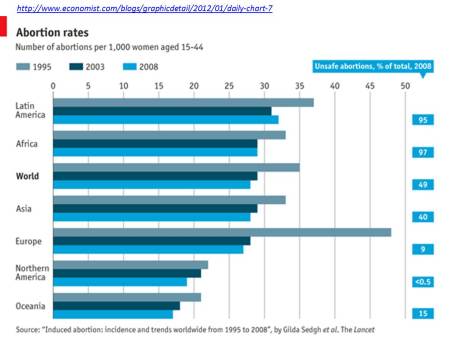
Global abortion rates: graphic Economist

Global abortion rates: graphic Economist

So of every 100 babies conceived around 25% are deselected by abortion and 75 proceed to birth. Only 1 of these 75 would have been conceived by “artificial” means. The genetic deselection by abortion is both direct and indirect. The detection of genetic defects in the foetus often leads to abortion and this proportion can be expected to increase as techniques for the early identification of defects or the propensity for developing a debilitating disease are perfected. In many cases abortion is to safeguard the health of the mother and does not – at least directly – involve any deselection for genetic reasons. In many countries – especially India – abortions are often carried out to avoid a girl child and this is a direct genetic deselection. It seems to apply particularly for a first child. The majority of abortions today are probably for convenience. But if the “maternal instinct” is in any way a genetic charateristic, then even such abortions would tend to be deselection in favour of those who do have the instinct.

The trends I think are fairly clear. The proportion of “artificial births” is increasing and the element of genetic selection by screening for desired charateristics in such cases is on the increase. The number of abortions after conception would seem to be on its way to some “stable” level of perhaps 25% of all conceptions. The genetic content of the decision to abort however is also increasing and it is likely that the frequency of births where genetic disorders exist or where the propensity for debilitating disease is high will decrease sharply as genetic screening techniques develop further.

It is still a long way off to humans breeding for specific charateristics but even what is being practised now is the start of eugenics in all but name. And it is not difficult to imagine that eugenics – without any hint of coercion – but where parents or the mothers-to-be select for certain characteristics or deselect (by abortion) to avoid others in their children-to-be will be de rigueur.

 

When is a strawberry dead?

June 25, 2013

An interesting discussion yesterday on BBC Radio

What Is Death?

Series 8 Episode 1 of 6 Monday 24 June 2013

“What Is Death?”

In the first of a new series of the award winning science/comedy series, Brian Cox and Robin Ince are joined on stage by comedian Katy Brand, biochemist Nick Lane and forensic anthropologist Sue Black to discuss why death is such an inevitable feature of a living planet. As well as revisiting such weighty scientific issues, such as when can a strawberry, be truly declared to be dead, they’ll also explore the scientific process of death, its evolutionary purpose and whether it is scientifically possibly to avoid it all together.

The death of a strawberry had apparently been discussed on an earlier program last year:

Brian Cox Strawberry

A fascinating discussion regarding when a cell can be truly considered “dead” though I couldn’t quite agree that death was necessary to evolution. Only birth is of course. It would be pretty crowded without death but life – or death – after procreation no longer has any part to play in the passing on of genes to the next generation or on evolution. With immortality there would, of course, be no need for procreation or for any future generations. But if immortal beings did beget other immortal beings then an Infinite Universe would come in very handy. However, the fertility rate needed for replenishment of the mortal members of a species is unconnected to the longevity of the individuals and I cannot see that death, per se, has any impact on evolution.

As far as the life and death of a strawberry are concerned it seemed to me that the question was essentially meaningless. You could as well ask if your finger could be alive when it no longer was connected to your body. A finger -like a strawberry is never truly alive unless connected to the body that it is a part of and the question of life or death when it is separated from its host body is moot.

Self-replicating fingers – or strawberries – would make John Wyndham’s Triffids seem benign.

The future for human evolution

June 25, 2013

The future of human evolution is secure as we develop into more robust species.

From The Onion:

Image of Mollusca

ANN ARBOR, MI—In a breakthrough study that researchers say adds important insight into the evolution of Homo sapiens, scientists at the University of Michigan confirmed Thursday that human beings are slowly evolving into mollusks. “Evidence shows that modern humans emerged on the evolutionary timeline about 200,000 years ago, developed into the highly evolved hominids of today, and are now transforming into soft-bodied invertebrates,” said the study’s lead author Dr. Mitch Keneally, adding humans have already started turning into snails, slugs, and octopi, evidenced by their increasingly amorphous figures. “Over the next 1,000 years, we’re going to see people developing gills, a hard protective shell around their torsos, and a large, muscular foot in their dorsal region that will help with locomotion and mucus secretion. The world is changing rapidly, and those who can’t filter seawater aren’t going to be able to survive.” Scientists added that the evolutionary trajectory isn’t all that surprising considering that mollusks themselves descended from monkeys just 5,000 years ago.

Reproduction after death: Guppies do it, humans can – but should they?

June 13, 2013

Guppies use stored sperm while humans can use stored sperm. Using the sperm of someone long dead is certainly possible to “create” a new human. The ethical question – if there is one – is the responsibility (whose?) to the child so produced. And this could be even more important if it is also true that the age of the sperm producer at the time of sperm production has an impact on the health of the child. And is there a responsibility to the deceased sperm donor? By agreeing to the storage of sperm does not the donor implicitly consent to the use of that sperm even after his demise unless he explicitly forbids it?

Photo shows guppies.

Guppies are small freshwater fish PHOTO CREDIT: PIERSON HILL.

UCRtoday:

Performing experiments in a river in Trinidad, a team of evolutionary biologists has found that male guppies continue to reproduce for at least ten months after they die, living on as stored sperm in females, who have much longer lifespans (two years) than males (three-four months).

“Populations that are too small can go extinct because close relatives end up breeding with each other and offspring suffer from inbreeding,” said David Reznick, a professor of biology at the University of California, Riverside and the principal investigator of the research project.  “If there are stored sperm, then the real population size is bigger than the number of animals you see.  Also, stored sperm can increase genetic variation in other ways.”

Scientific American:

Is it ethical to use a dead man’s sperm to father a child? Experts are calling for a consensus on policies surrounding this question, which currently vary widely across the country.

It has been possible for a few decades to obtain a man’s sperm after his death and use it to fertilize an egg. Today, requests for postmortem sperm retrieval (PMSR) are growing, yet the United States has no guidelines governing the retrieval of sperm from deceased men, said Dr. Larry Lipshultz, a urologist at Baylor College of Medicine in Texas.

In the absence of government regulations, medical institutions should come up with their own rules so they can handle the time-sensitive and ethically questionable procedures, Lipshultz argued in an editorial published June 5 in the journal Fertility and Sterility. 

Requests for PMSR can come from the wife or parents of a young man who suddenly died in an accident before having a chance to leave a child, and requests can also come from living, terminally ill men who wish to preserve sperm to be used after death.

But the institutions trying to draft a protocol for these situations face a number of ethical concerns. For example, has the deceased consented to have his sperm used for reproduction after he’s gone? Could just anybody request to obtain his sperm? Is it in the best interest of the child to be brought into the world without having a father? …… 

…. PMSR is currently illegal in France, Germany, Sweden and other countries, even with written consent from the deceased. In the United Kingdom, it can be done if there is written consent, and in Israel, the sperm can be retrieved, but then a judge has to decide whether it can be used.

Future human evolution will be selection by deselection

June 6, 2013

io9 carries  a look at how science fiction treats evolution :The most ludicrous depictions of evolution in science fiction history.

Of course this begs the question as to how humans are likely to evolve over the coming generations?

Humans and chimpanzees ancestors split some 7-8 million years ago and it took some 350,000 generations after that divergence for evolution by natural selection to produce anatomically modern humans (AMH). (This of course raises the question as to how chimpanzee evolution proceeded to reach modern chimpanzees while humans were developing into homo sapiens?).

It has been only about 10,000 generations since AMH appeared and only some 6,000 generations or so since modern humans left Africa. A very short time in evolutionary terms yet in this period humans have evolved to exhibit the various races of man that exist today. This differentiation is primarily superficial and all humans existing are capable of mating and producing viable offspring with each other. In theory humans existing today would also be compatible and – in the main – capable of mating with the humans of 6,000 generations ago. In practice a meeting of modern humans with those from 120,000 years ago would be an exaggerated replica of modern man meeting with isolated tribes in the 20th century. These isolated branches of humanity generally had lower levels of immunity to the bacteria carried by their distant cousins and were ravaged by disease after such encounters. The bacteria we carry are probably greatly different to those that humans carried at the dawn of anatomically modern humans. Probably no such meeting or mating would be very successful and one or both would probably succumb to disease brought on by the other’s bacteria. Nevertheless the genomes of the two – even after 6,000 generations – would  not be so very different and probably still be compatible. In any primate species a generational distance of over 20,000 between individuals will probably disqualify any theoretical possibility of successful mating.

(more…)