Archive for the ‘Fraud’ Category
March 1, 2011
The power of the internet and we should not forget that of the shoes!!
zu Googleberg has bowed to the inevitable and has resigned.

German Defense Minister Karl-Theodor zu Guttenberg has announced his resignation after weeks of criticism over plagiarizing parts of his Ph.D. thesis. ….The University of Bayreuth had already stripped Guttenberg of his law doctorate last week. Guttenberg apologized to the German parliament, and said he had made “grave errors” in his thesis, but insisted he did not intentionally copy it.
Pressure mounted on him to resign, after at least 17,000 academics signed an open letter to the German chancellor on Monday (over 20,000 according to the Updated ticker of Germans signing the open letter here), in which they said the plagiarism scandal made a “mockery” of the academic profession.
In recent days Education Minister Annette Schavan had called Guttenberg’s actions shameful, and parliamentary speaker Norbert Lammert said they were “a nail in the coffin for confidence in democracy.”
Tags:Angela Merkel, Bayreuth University, burnt toast, Germany, Guttenberg plagiarism, Karl-Theodor zu Guttenberg, zu Googleberg
Posted in Corruption, Ethics, Fraud, Germany, Politics | 2 Comments »
February 24, 2011
After the success of the on-line analysis of Guttenberg’s PhD thesis from Bayreuth University which proved that more than two-thirds of the pages had plagiarised content, the suspect thesis of Gadaffi Jr. from the LSE is also being examined on line here.
It would probably be a good idea for LSE to apply some plagiarism software and get ahead of the curve.
From Wikipedia:
Saif Al-Islam Gaddafi received his Ph.D. from the London School of Economics in 2008. Through the Gaddafi International Charity and Development Foundation, Saif subsequently pledged a donation of £1.5 million to support the work of the LSE’s Centre for the Study of Global Governance on civil society organizations in North Africa. Following the political uprising in Libya in February 2011, the LSE has issued a statement indicating that it will cut all financial ties with the country and will accept no further money from the Foundation, having already received and spent the first £300,000 installment of the donation.
Saif’s Ph.D. thesis has been made available online and commentators have already identified several passages which appear to have been copied from other sources without attribution. There is speculation that the thesis was plagiarized and/or ghostwritten by another individual.

Saif Al-Islam Gaddafi
Analysis of Saif Al-Islam Gaddafi’s LSE Thesis:
“THE ROLE OF CIVIL SOCIETY IN THE DEMOCRATISATION OF GLOBAL GOVERNANCE INSTITUTIONS”
(PDF)
In the Guttenberg case, Bayreuth University has now rescinded his PhD in an investigation which lasted less than a week. As Professor Debora Weber-Wulff points out this must be the fastest ever decision by a German University in over 400 years!!
Well, this has to be a record. I believe this is the shortest university decision process in the last 400 years or so. Last Tuesday evening the story broke, just over a week later the university commission for good scientific work at the University of Bayreuth reached a decision. They are rescinding his doctorate.
They didn’t go into details, and most important, didn’t decide if he plagiarized on purpose. He says he didn’t, the documentation found on the GuttenPlagWiki screams a different story. Since he has announced that he wanted to withdraw his doctorate anyway, he won’t contest it, so they don’t have to do the normal detailed analysis.
Tags:Bayreuth University, Libya, LSE, Plagiarism, Saif Al-Islam Gaddafi, Scientific misconduct, zu Googleberg, zu Guttenberg
Posted in Corruption, Education, Fraud, Germany, Libya, scientific misconduct | 1 Comment »
February 23, 2011
Between 500 and 700 PhD degrees awarded in Germany every year are illegitimate. The days when Ph.D. degrees were mainly awarded to scientists and scholars in Germany are long gone. The title is in high demand among managers, lawyers and politicians – many with little time for the required research writes Deutsche Welle.
The zu Googleberg affaire has focused the spotlight on Germany’s new PhD consultantcy industry. New cases of corrupt practices are being found regularly.
One former law professor from Hanover, for example, is currently serving three years in prison after he was found guilty of issuing doctoral titles in exchange for bribes and sexual favors in 2009. It seems the prestige and the higher salary an academic title confers is a temptation some career-minded Germans find difficult to pass up.
Guttenberg is hardly alone when it comes to ambitious people with high goals battling time restraints. In German corporate circles, where a Ph.D. means more status and a higher salary, busy managers have little time to study. While the defense minister stands accused of failing to provide the proper attribution for certain passages of his thesis, others have been known to turn to a relatively small industry of so-called “doctorate consultants.”
The consultants demand anywhere from 10,000 to 30,000 euros to help aspiring doctorate holders with all the formalities and contacts needed to be accepted into a Ph.D. program – and more. It’s the “more” that can cause problems, however. Doctorate consultants specialize in providing assistance in labor-intensive areas such as research and writing – tasks Ph.D. aspirants are normally expected to master on their own.
“We’re aware of the criticism of our line of business but we aren’t doing anything criminal,” said Thomas Nemet from ACAD Write, a company that employs around 250 staff and serves a customer base of 1,500.
“Our clients are mostly managers, lawyers and others in the medical profession, who have little time. We help them optimize their time to earn a Ph.D. But let me make one point very clear, we don’t sell doctorate degrees.” Some of his rivals in the doctorate consulting branch, like the “Institut für Wissenschaftsberatung” in Bergisch Gladbach, have been accused of doing exactly that, however, by paying large bribes to corrupt professors. …..
Manuel Rene Theisen, an economics professor at the Ludwig-Maximillian University in Munich, estimates that between two and three percent of the Ph.D. degrees awarded in Germany are illegitimate. So that’s between 500 and 700 degrees annually.
Time Magazine reported in 2009:
…. German prosecutors revealed that they are investigating around 100 academics at some of the country’s top universities on the suspicion that they granted doctorates to dozens of unqualified students after taking bribes from a consultancy firm. The investigation follows a raid on an academic consultancy called the Institute for Scientific Counselling in the western town of Bergisch Gladbach in March 2008. .. Prosecutors in the city of Cologne say the institute helped doctoral candidates find a supervisor and paid lecturers to take on Ph.D. students. “Some Ph.D. students paid up to $30,000 to get their doctor titles,” Günther Feld, a senior prosecutor in Cologne tells TIME. “Many people had received mediocre results in exams and they weren’t eligible to do a Ph.D. in the first place.”

Leibnitz Universität Hannover
…. One former director of the Bergisch Gladbach consultancy was convicted on bribery charges in July 2008 and sentenced to three and a half years in prison. He was found guilty of illegally helping more than 60 students get their doctor titles. A law professor at the University of Hanover who received money from the consultancy for accepting doctoral candidates was given a three-year jail sentence. ….. “We recently stripped nine Ph.D. holders of their titles,” Henning Radtke, Dean of the Law Faculty at the University of Hanover. Those students are now appealing the decision.
“The investigation in Cologne is just the tip of the iceberg,” says Manuel René Theisen, professor of business administration at the Ludwig-Maximilians University in Munich. “Around a dozen academic consultancies have been on the market for years offering Ph.D.s for money.” Theisen says he estimates that of the 25,000 doctorates awarded each year in Germany, up to 1,000 are obtained through illicit means. “The consultancies advertise in trade magazines and they pretend to offer coaching for would-be Ph.D. students, but it’s a fairy tale,” he says. “People know when they read the adverts they can get their Ph.D. for money and not for their [academic] work.”
The Googleberg affaire might accelerate the decline of the reputation of German PhD’s. On the other hand if it leads to more rigorous award processes it could help in restoring some of the shine that a German PhD once conferred — but that is by no means certain.
Tags:Corrupt PHD, Education, German PhD fraud, Guttenberg fraud, Purchase PhD, zu Googleberg
Posted in Corruption, Education, Fraud, Germany, scientific misconduct | Comments Off on Price of a PhD in Germany: €10,000 – €30,000
February 22, 2011
zu Googleberg on 18th February 2011: “I will temporarily – I repeat temporarily – give up my doctoral title.”
22nd February 2011:
The University of Bayreuth says he has now asked them to retract his doctorate in law, according to German TV. Mr Guttenberg admitted that he had made “serious mistakes”. At an election rally near Frankfurt on Monday, the charismatic defence minister said the mistakes were not intentional but he conceded that they “do not meet the ethical code of science”. ….
Chancellor Angela Merkel insisted on Monday that she is standing by her defence minister, who is seen as something of a rising star in her conservative coalition.
“I appointed Guttenberg as minister of defence,” she told reporters. “I did not appoint him as an academic assistant or doctor. What is important to me is his work as minister of defence and he carries out these duties perfectly.”
He has a nice smile and he is apparently popular but the Defence Minister of the Republic of Germany, Mr. zu Googleberg is nothing but a liar and a cheat and a fraud. And Angela Merkel will at some point realise that keeping him on brings her own ethics and integrity into question.
But maybe it is just a continuation of the long line of German politicians with deficient ethics and little integrity.
“We hang the petty thieves and appoint the great ones to public office”.
Aesop (~550 BC)
Tags:Angela Merkel, Bayreuth University, Defence minister, Germany, Guttenberg fraud, Karl-Theodor zu Guttenberg, zu Googleberg
Posted in Corruption, Ethics, Fraud, Germany, scientific misconduct | 1 Comment »
February 20, 2011
Update!
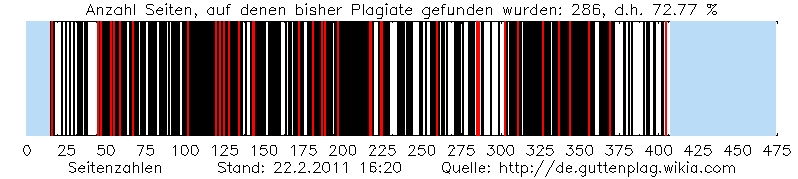
The GuttenPlag Wiki is expanding . Over 68% of the pages in his thesis contain plagiarised material.
http://de.guttenplag.wikia.com/wiki/GuttenPlag_Wiki

Pages where plagiarism were found (black). The Table of Contents (pages 1-14) and Annexes, page 408 (blue) were not included in calculating the percentages. Pages with imitations of various sources are shown in red. Plagiat graphic.jpg
Professor DEBORA WEBER-WULFF writes
I’m wondering if KTzG thought that this crazy quilt is how we do science. Or if he is perhaps suffering from an advanced version of cryptomnesia. Wikipedia quotes Macrae, C.N., Bodenhasen, G. V. & Calvini, G. (1999). Contexts of cryptomnesia: May the source be with you. Social Cognition, 17, 273–297:
Cryptomnesia is more likely to occur when the ability to properly monitor sources is impaired. For example, people are more likely to falsely claim ideas as their own when they were under high cognitive load at the time they first considered the idea.
Sounds fitting. The saga continues.
Perhaps the rumour that zu Guttenberg (aka “zu Googleberg”) actually used ghost writers for his thesis is more than just rumour.

Baron zu Googleberg image: emperorswithoutclothes.com
Der Spiegel reveals:
In May 2004, when Guttenberg was a member of parliament for the conservative Christian Social Union party, Ulrich Tammler, a civil servant in the department with two PhDs of his own, wrote an analysis for Guttenberg headlined “The Question of the Link to Faith in the US Constitution and Supreme Court Rulings on the Separation of the Church and State.”
Tammler completed the 10-page document on May 13, 2004 and passed it on to Guttenberg’s parliamentary office under the reference number WF III – 100/04, according to an article due to be published in SPIEGEL on Monday.Even though members of Bundestag, or lower house of parliament, are only supposed to use of the department for work relating to their parliamentary mandate, Guttenberg included almost the entire article in his dissertation, with only minor word changes.
Tammler himself isn’t cited in any of Guttenberg’s footnotes. Only the parliamentary research department itself is mentioned, a footnote 83. The 60 staff of the department are meant to help lawmakers fulfil their duties as members of parliament. The department’s guidelines state: “The German Bundestag reserves all rights to the work of the Research Department. Publication and distribution require the approval of the departmental management.”
A man of no shame!

Gockel-guttenberg.jpg
And the question becomes whether his thesis contains anything original at all.
On Friday Angela Merkel was still giving her Defence Minister her public support but it is going to be difficult for her to continue with this line. Associating with him is now a burden that few will be able to bear. The Süddeutsche Zeitung reported that the defense minister had plagiarised at least 19 authors. According to the Berliner Zeitung he also copied the work of first-year students at the Free University of Berlin.
Tags:Copycat Minister, Defence minister, Guttenberg plagiarism, Karl-Theodor zu Guttenberg, PhD fraud, Plagiarism, zu Googleberg
Posted in Corruption, Ethics, Fraud, Germany, scientific misconduct | 1 Comment »
February 18, 2011
Misconduct in the scientific world takes months if not years to be investigated and sanctions – if any – are light. But for those riding high in the poltical world the consequences can be swift. It seems unlikely that Googleberg can continue as the German Defence Minister for very long.
Just 4 days ago he was
Baron Dr. Karl-Theodor Maria Nikolaus Johann Jacob Philipp Franz Joseph Sylvester Freiherr von und zu Guttenberg, Defence Minister of the Federal Republic of Germany.

Baron Dr. Karl-Theodor Maria Nikolaus Johann Jakob Philipp Franz Joseph Sylvester Freiherr von und zu Guttenberg (focus.de)
Then his plagiarism was revealed by the Süddeutsche Zeitung earlier this week, and his copying of some 24 passages for his PhD thesis has grown to be the copying of at least 78 passages. Even the first two paragraphs of his introduction appear to have been copied from a 1997 article in the center-right dailyFrankfurter Allgemeine Zeitung.
Der Spiegel dubbed him Merkel’s Minister of Scandals.
Deutsche Welle decided that Googleberg was more appropriate than Guttenberg. Two criminal complaints have now been filed against him, claiming infringement of copyrights and lying in the sworn statement that accompanied the thesis. Others are claiming that he can’t be guilty of plagiarism – it must have been the fault of his ghost writer!
In a desperate damage control exercise after being read the riot act by Angela Merkel, Googleberg said on Friday that he would temporarily renounce his doctorate and relinquish his “doctor” title amid allegations that he plagiarized significant sections of his dissertation.
And now Der Spiegel has baptised him Merkel’s Copycat minister.
In the space of just 3 days,
Herr. Dr. Karl Theodor Maria Nikolaus Johann Jacob Philipp Franz Joseph Sylvester Freiherr von und zu Guttenberg, Defence Minister of the Federal Republic of Germany
has morphed to
Herr Theodor Googleberg, Merkel’s copycat minister.
But at least Googleberg has upheld the reputation of German politicians in the misconduct stakes and managed to reduce the lead that was being being taken by Bunga Bunga Berlusconi in Italy and by the “free loading” ministers of the French Republic.
Tags:fraud, Guttenberg plagiarism, Karl-Theodor zu Guttenberg, Plagiarism, Scientific misconduct, zu Googleberg
Posted in Corruption, Education, Ethics, Fraud, Germany, Uncategorized | 3 Comments »
February 18, 2011
Update 2!
Breaking –
That’s easily done but guilt cannot be as easily renounced!!
Karl-Theodor zu Guttenberg (aka “zu Googleberg”) is in hot water. Without the ability to “cut and paste” he is apparently at a loss for words! Clearly Google is the corrupting influence.
The German MSM are having a field day.
Deutsche Welle: Guttenberg is back from Afghanistan and
Chancellor Merkel called Defense Minister Karl-Theodor zu Guttenberg to her office in Berlin to explain severe allegations of plagiarism in his doctoral thesis. Opposition politicians, meanwhile, want Guttenberg to go.
After returning from Afghanistan on a short visit with German troops, Defense Minister Karl-Theodor zu Guttenberg had to let down excited guests at a campaign fundraiser in Saxony-Anhalt on Thursday because he was “unavailable and engaged in Berlin.”
Public broadcaster ZDF reported that the popular politician had been called in by Chancellor Angela Merkel for a question-and-answer session regarding allegations that he plagiarized complete – and numerous – passages of his doctoral dissertation.
“Karl-Theodor zu Guttenberg did not credit me as the author of excerpts that came from an article I once wrote,” Barbara Zehnpfennig, a professor at Passau University, told news channel N24. “This breaks all academic rules.”
Zehnpfennig is not the only source not “properly cited” in Guttenberg’s text; several German law professors have accused him of blatant plagiarism, citing up to 70 dubious passages.
Newsmagazine Spiegel said Guttenberg even passed off US Embassy material as his own text – translated directly into German – in a string of allegations that has prompted German media to turn the posh Franconian surname “zu Guttenberg” into a far less noble “zu Googleberg.” …….
…… The university has given the minister 14 days to issue a written explanation of the allegations.
Der Spiegel’s headline calls him the Minister of Scandals
Tags:Germany, Karl-Theodor zu Guttenberg, Minister of Scandals, Plagiarism, zu Googleberg
Posted in Behaviour, Corruption, Fraud, Germany, Media, scientific misconduct | 2 Comments »
February 18, 2011

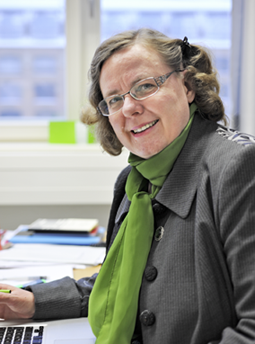
Prof. Dr. Debora Weber-Wulff
The Guttenberg plagiarism saga continues while he has gone off to Afghanistan for a surprise visit – probably because it is less dangerous there right now.
Prof. Dr. Debora Weber-Wulff is Professor for Media and Computing at the HTW Berlin. She was involved in the BMBF flagship project “Virtuelle Fachhochschule” developing eLearning materials and carries out Internet- and eLearning-related projects. She also works on detecting plagiarism and has a plagiarism blog.
Following the apparently blatant plagiarism carried out by Germany’s Defence Minister for his PhD thesis, she was interviewed by TheLocal.de which includes the folllowing:
What is your assessment of the Guttenberg situation?
What the rest of the thesis is like, and which chapter the alleged plagiarism is in – that’s another question. There are communities here who say it’s OK to plagiarize a little in your methodology section, but not in others. I think this is completely bizarre. Germans have a way of talking the problem down.The excerpts that the Süddeutsche Zeitung has online are scary, because they are one-to-one copies. And that’s not OK.
What is the real issue then?
This has to do with the German tendency to love titles, they are title-fixated, and people in politics love to have a doctor title so they seem wiser. But it should be about science, for scientists to prove that they can work by themselves – it’s the first proof that they can do research on their own.
Would you say there is a culture of plagiarising and cheating among German students?
I wouldn’t go that far. There’s a download culture. Young people download their music, videos, and why not download their thesis, because they just see it as busy work – something that stands between them and the degree they think they want or need so they can make lots of money and don’t have to work any longer.
She also writes on her blog:
Guttenberg, the conservative German defense minister from Bavaria, has left the country and gone to Afghanistan. They say this was planned, but right now, he’s probably safer there than in the streets of Berlin. The opposition is gleefully taking potshots at him (metaphorically, you understand).
His supporters accuse the scientist who discovered the plagiarism of being part of a commie plot to undermine the country, if I understand their tone of voice correctly.
No one believes that a professor might sit down one evening at the computer, in the midst of writing a review of a doctoral thesis that had been around for a while, but had a very prominent author, currently under fire for other things. The professor, Andreas Fischer-Lescano of the University of Bremen, poured himself a glass of Argentine red wine, looked over the thesis and put three words into Google: “säkularer laizistischer multireligiöser” (secular lay multireligious – the thesis includes a chapter on putting references to a god in a constitution).
And he got a hit. From an article in the Neue Züricher Zeitung by Klara Obermüller, written a few years before his thesis was published. Oops. He poured another glass and tried some other terms, and some more. Fischer-Lescano wrote a scathing review, and includes as an appendix 24 word-for-word passages that are not quoted and not referenced. The review will be published the end of the month in Kritische Justiz, 44(1), pp. 112-119.
A number of journalists have spoken with me today to question this way of working. How do I look for plagiarists? “Well,” I said, “pretty much the same. Except that I prefer Austrian wine.”
As a sociological phenomenon, the rise of the “cut-and-paste” culture together with the German love of academic titles is a worthy subject for study. But what does not seem to be in doubt is that Guttenberg is just another politician who is just another fraud. And a misuse of position – whether to get an academic degree or to amass huge sums of money – is still corruption.
Why voters continue to vote for frauds is an even more interesting subject for study.
Tags:Bayreuth University, Debora Weber-Wulff, Germany, Guttenberg fraud, Guttenberg plagiarism, Karl-Theodor zu Guttenberg, Süddeutsche Zeitung
Posted in Behaviour, Corruption, Fraud, Germany, scientific misconduct, Social Science | 3 Comments »
February 14, 2011
From Xinhua News:

Li Liansheng: photo China Daily
BEIJING, Feb. 10 (Xinhua) — The recent revocation of a national scientific award due to academic fraud was the first of its kind in China, National Office for Science and Technology Awards told Xinhua Thursday.
China’s Ministry of Science and Technology, on Feb. 1, issued a statement revoking the State Scientific and Technological Progress Award (SSTPA) given to Li Liansheng, former professor of Xi’an Jiaotong University.
According to the statement, the investigation found Li had plagiarized others’ works and fabricated data in his winning project, and his prize will be canceled and money awarded retrieved.
Zhao Baojing, senior officer with the National Office for S&T Award, told Xinhua that it was the first time China had withdrawn a national scientific honor.
Li Liansheng, former professor and doctoral tutor of Xi’an Jiaotong University, received the second-place prize of the SSTPA in 2005 for his research on key technologies for designing and manufacturing scroll compressors.
In 2008, he was accused of plagiarism and providing false data in the winning project by six professors of Xi’an Jiaotong University. An investigation was later carried out.
Xi’an Jiaotong University suspended Li from working at the university and rescinded his employment contract in March, 2010.
AsiaOne.com writes:
News that the ministry is stripping him of his award for scientific and technological progress comes three years after six colleagues first claimed that the energy and power studies expert had plagiarized the work of others.
Wan Gang, the minister of science and technology, had earlier vowed that there would be a “zero tolerance” policy toward research frauds and academic plagiarism amid growing criticism about the country’s academic integrity.
“We will dig up the past of those researchers who fake their works and punish them,” he told China Daily in November 2010.
The country has more than 2.3 million workers in the science and technology field and the number of research papers published on the subject has topped the world.
The intense competition to get work published has led some researchers to exaggerate their achievements, said critics.
“In China, we care whether a paper is published in a magazine more than we care about the paper’s quality and academic influence,” Rao Yi, dean of the School of Life Sciences at Peking University, was quoted as saying in a report in China Youth Daily.
Universities and colleges are ranked according to the number of academic papers their staff can get published and the number of references they get in influential journals
Related:
https://ktwop.wordpress.com/2010/10/13/chinese-science-ministry-vindicates-academic-fraud-journalists/
Tags:Academic Dishonesty, China, Li Liansheng, Plagiarism, Scientific misconduct, Xi'an Jiaotong University
Posted in China, Ethics, Fraud | Comments Off on China retracts a national scientific award for plagiarism






 The k2p blog